

ASTM D6372-23
(Practice)Standard Practice for Design, Testing, and Construction of Microsurfacing
General Information
- Abstract
SIGNIFICANCE AND USE
5.1 This microsurfacing practice is written as a guide and should not be construed as a specification. End use specifications should be adapted to conform to job and user requirements.
Note 2: The quality of the results produced by this standard are dependent on the competence of the personnel performing the procedure and the capability, calibration, and maintenance of the equipment used. Agencies that meet the criteria of Specification D3666 are generally considered capable of competent and objective testing, sampling, inspection, etc. Users of this standard are cautioned that compliance with Specification D3666 alone does not completely ensure reliable results. Reliable results depend on many factors; following the suggestions of Specification D3666 or some similar acceptable guideline provides a means of evaluating and controlling some of those factors.
SCOPE
1.1 This practice covers the design, testing, and construction of mixtures of polymer-modified asphalt emulsion, mineral aggregate, mineral filler, water, and other additives, properly proportioned, mixed and spread on a paved surface. It is written as a guide and should be used as such. End use specifications should be adapted to conform to job and user requirements.
Note 1: This practice references test methods outside the jurisdiction of ASTM that may or may not have a precision statement.
1.2 The values stated in SI units are to be regarded as the standard.
1.3 The text of this standard references notes and footnotes which provide explanatory material. These notes and footnotes (excluding those in tables and figures) shall not be considered as requirements of the standard.
1.4 This standard does not purport to address all of the safety concerns, if any, associated with its use. It is the responsibility of the user of this standard to establish appropriate safety, health, and environmental practices and determine the applicability of regulatory limitations prior to use.
1.5 This international standard was developed in accordance with internationally recognized principles on standardization established in the Decision on Principles for the Development of International Standards, Guides and Recommendations issued by the World Trade Organization Technical Barriers to Trade (TBT) Committee.
- Status
- Published
- Publication Date
- 30-Apr-2023
- Technical Committee
- D04 - Road and Paving Materials
- Drafting Committee
- D04.24 - Asphalt Surface Treatments
Overview
ASTM D6372-23: Standard Practice for Design, Testing, and Construction of Microsurfacing provides comprehensive guidelines for the use of microsurfacing mixtures in road maintenance and surface treatment. Developed by ASTM International, this standard outlines best practices for mix design, laboratory testing, and construction methods specific to microsurfacing, a technique widely used to improve paved surfaces using polymer-modified asphalt emulsion, aggregates, mineral filler, water, and additives.
This document is intended as a guide, not a specification, and encourages users to adapt end-use specifications to their particular job and user requirements. It emphasizes the importance of competent personnel, well-maintained equipment, and adherence to quality assurance standards for delivering reliable microsurfacing results.
Key Topics
- Mix Design and Proportioning: Guidance on selecting and proportioning polymer-modified asphalt emulsion, quality aggregates, mineral fillers, and other additives.
- Testing Procedures: Definitions and explanations of essential laboratory tests, such as cohesion, wet track abrasion, loaded wheel, and compatibility tests, to ensure durability and performance.
- Application Techniques: Recommendations for the practical application of microsurfacing mixtures, including equipment requirements, spreading methods, and finishing techniques.
- Construction Process: Detailed steps for site preparation, surface cleaning, weather limitations, and application consistency to achieve durable, high-performance pavement surfaces.
- Quality Assurance: Emphasis on the calibration of mixing equipment, performance of trained personnel, and adherence to referenced quality standards such as ASTM D3666.
Applications
Microsurfacing, as defined in ASTM D6372-23, is a cost-effective pavement preservation solution suitable for a variety of paved surfaces. Key applications include:
- Urban and Residential Streets: Type II microsurfacing is ideal for streets with moderate traffic, as well as airport runways, providing a smoother ride and improved surface friction.
- Primary and Interstate Highways: Type III microsurfacing is used for high-traffic roads and rut-filling applications, restoring ride quality and extending pavement life.
- Rutted Wheelpaths: The standard provides guidance for reprofiling ruts, allowing engineers to estimate material requirements for effective rut leveling.
- Preventive Maintenance: Microsurfacing improves surface texture, seals minor cracks, and postpones more costly rehabilitation, reducing long-term maintenance costs.
- Airports, Parking Lots, and Industrial Sites: Microsurfacing is adaptable to a wide range of paved facilities requiring rapid return to service and enhanced surface performance.
Related Standards
Proper implementation of ASTM D6372-23 often involves coordination with related standards and guidelines, including:
- ASTM D3666: Specification for minimum requirements for agencies testing and inspecting road and paving materials.
- ASTM D3910: Practices for the design, testing, and construction of slurry seal, related to microsurfacing techniques.
- ASTM D8: Terminology relating to materials for roads and pavements.
- ASTM D2397: Specification for cationic emulsified asphalt.
- ASTM C88, C131, D2419: Standards for testing aggregate soundness, abrasion resistance, and sand equivalent value.
- ISSA Technical Bulletins: Specific methods and guidelines from the International Slurry Surfacing Association, referenced for additional laboratory procedures and application recommendations.
Practical Value
Using ASTM D6372-23 helps ensure the quality, durability, and cost-effectiveness of microsurfacing applications. This standard supports asset management objectives by offering:
- Extended pavement lifespan through preventative surface treatment.
- Improved ride quality and traffic safety by restoring surface texture and friction.
- Consistency in performance using verified laboratory test methods and quality-controlled application processes.
- Sustainability by minimizing resource use and extending maintenance intervals for paved surfaces.
For pavement engineers, contractors, and asset managers, compliance with ASTM D6372-23 provides a structured, internationally recognized approach to superior microsurfacing project outcomes.
Relations
- Effective Date
- 01-Jan-2024
- Effective Date
- 15-Feb-2020
- Effective Date
- 01-Nov-2019
- Effective Date
- 01-Aug-2019
- Effective Date
- 01-May-2019
- Effective Date
- 01-Mar-2019
- Effective Date
- 15-Dec-2018
- Effective Date
- 15-Aug-2018
- Effective Date
- 01-Aug-2018
- Effective Date
- 01-Jul-2018
- Effective Date
- 01-Feb-2018
- Effective Date
- 15-Jul-2017
- Effective Date
- 15-Jun-2017
- Effective Date
- 01-Jun-2017
- Effective Date
- 01-May-2017
Get Certified
Connect with accredited certification bodies for this standard

Zavod za gradbeništvo Slovenije (ZAG) - Inšpekcija
ZAG inspection body for construction products, structures, and materials.
Sponsored listings
Frequently Asked Questions
ASTM D6372-23 is a standard published by ASTM International. Its full title is "Standard Practice for Design, Testing, and Construction of Microsurfacing". This standard covers: SIGNIFICANCE AND USE 5.1 This microsurfacing practice is written as a guide and should not be construed as a specification. End use specifications should be adapted to conform to job and user requirements. Note 2: The quality of the results produced by this standard are dependent on the competence of the personnel performing the procedure and the capability, calibration, and maintenance of the equipment used. Agencies that meet the criteria of Specification D3666 are generally considered capable of competent and objective testing, sampling, inspection, etc. Users of this standard are cautioned that compliance with Specification D3666 alone does not completely ensure reliable results. Reliable results depend on many factors; following the suggestions of Specification D3666 or some similar acceptable guideline provides a means of evaluating and controlling some of those factors. SCOPE 1.1 This practice covers the design, testing, and construction of mixtures of polymer-modified asphalt emulsion, mineral aggregate, mineral filler, water, and other additives, properly proportioned, mixed and spread on a paved surface. It is written as a guide and should be used as such. End use specifications should be adapted to conform to job and user requirements. Note 1: This practice references test methods outside the jurisdiction of ASTM that may or may not have a precision statement. 1.2 The values stated in SI units are to be regarded as the standard. 1.3 The text of this standard references notes and footnotes which provide explanatory material. These notes and footnotes (excluding those in tables and figures) shall not be considered as requirements of the standard. 1.4 This standard does not purport to address all of the safety concerns, if any, associated with its use. It is the responsibility of the user of this standard to establish appropriate safety, health, and environmental practices and determine the applicability of regulatory limitations prior to use. 1.5 This international standard was developed in accordance with internationally recognized principles on standardization established in the Decision on Principles for the Development of International Standards, Guides and Recommendations issued by the World Trade Organization Technical Barriers to Trade (TBT) Committee.
SIGNIFICANCE AND USE 5.1 This microsurfacing practice is written as a guide and should not be construed as a specification. End use specifications should be adapted to conform to job and user requirements. Note 2: The quality of the results produced by this standard are dependent on the competence of the personnel performing the procedure and the capability, calibration, and maintenance of the equipment used. Agencies that meet the criteria of Specification D3666 are generally considered capable of competent and objective testing, sampling, inspection, etc. Users of this standard are cautioned that compliance with Specification D3666 alone does not completely ensure reliable results. Reliable results depend on many factors; following the suggestions of Specification D3666 or some similar acceptable guideline provides a means of evaluating and controlling some of those factors. SCOPE 1.1 This practice covers the design, testing, and construction of mixtures of polymer-modified asphalt emulsion, mineral aggregate, mineral filler, water, and other additives, properly proportioned, mixed and spread on a paved surface. It is written as a guide and should be used as such. End use specifications should be adapted to conform to job and user requirements. Note 1: This practice references test methods outside the jurisdiction of ASTM that may or may not have a precision statement. 1.2 The values stated in SI units are to be regarded as the standard. 1.3 The text of this standard references notes and footnotes which provide explanatory material. These notes and footnotes (excluding those in tables and figures) shall not be considered as requirements of the standard. 1.4 This standard does not purport to address all of the safety concerns, if any, associated with its use. It is the responsibility of the user of this standard to establish appropriate safety, health, and environmental practices and determine the applicability of regulatory limitations prior to use. 1.5 This international standard was developed in accordance with internationally recognized principles on standardization established in the Decision on Principles for the Development of International Standards, Guides and Recommendations issued by the World Trade Organization Technical Barriers to Trade (TBT) Committee.
ASTM D6372-23 is classified under the following ICS (International Classification for Standards) categories: 93.080.20 - Road construction materials. The ICS classification helps identify the subject area and facilitates finding related standards.
ASTM D6372-23 has the following relationships with other standards: It is inter standard links to ASTM C88/C88M-24, ASTM C131/C131M-20, ASTM D2397/D2397M-19a, ASTM D8-19, ASTM D2397/D2397M-19, ASTM E145-19, ASTM D8-18c, ASTM D8-18b, ASTM C88/C88M-18, ASTM D8-18a, ASTM D8-18, ASTM D8-17c, ASTM D8-17b, ASTM D2397/D2397M-17, ASTM D8-17a. Understanding these relationships helps ensure you are using the most current and applicable version of the standard.
ASTM D6372-23 is available in PDF format for immediate download after purchase. The document can be added to your cart and obtained through the secure checkout process. Digital delivery ensures instant access to the complete standard document.
Standards Content (Sample)
This international standard was developed in accordance with internationally recognized principles on standardization established in the Decision on Principles for the
Development of International Standards, Guides and Recommendations issued by the World Trade Organization Technical Barriers to Trade (TBT) Committee.
Designation: D6372 − 23
Standard Practice for
Design, Testing, and Construction of Microsurfacing
This standard is issued under the fixed designation D6372; the number immediately following the designation indicates the year of
original adoption or, in the case of revision, the year of last revision. A number in parentheses indicates the year of last reapproval. A
superscript epsilon (´) indicates an editorial change since the last revision or reapproval.
1. Scope Small-Size Coarse Aggregate by Abrasion and Impact in
the Los Angeles Machine
1.1 This practice covers the design, testing, and construction
D8 Terminology Relating to Materials for Roads and Pave-
of mixtures of polymer-modified asphalt emulsion, mineral
ments
aggregate, mineral filler, water, and other additives, properly
D2397/D2397M Specification for Cationic Emulsified As-
proportioned, mixed and spread on a paved surface. It is
phalt
written as a guide and should be used as such. End use
D2419 Test Method for Sand Equivalent Value of Soils and
specifications should be adapted to conform to job and user
Fine Aggregate
requirements.
D3666 Specification for Minimum Requirements for Agen-
NOTE 1—This practice references test methods outside the jurisdiction
cies Testing and Inspecting Road and Paving Materials
of ASTM that may or may not have a precision statement.
D3910 Practices for Design, Testing, and Construction of
1.2 The values stated in SI units are to be regarded as the
Slurry Seal
standard.
E145 Specification for Gravity-Convection and Forced-
1.3 The text of this standard references notes and footnotes
Ventilation Ovens
which provide explanatory material. These notes and footnotes
2.2 ISSA Documents:
(excluding those in tables and figures) shall not be considered
ISSA Technical Bulletin No. 100 Test Method for Wet Track
as requirements of the standard.
Abrasion of Slurry Surfaces
1.4 This standard does not purport to address all of the ISSA Technical Bulletin No. 109 Test Method for Measure-
safety concerns, if any, associated with its use. It is the
ment of Excess Asphalt in Bituminous Mixtures by Use of
responsibility of the user of this standard to establish appro- a Loaded Wheel Tester and Sand Adhesion
priate safety, health, and environmental practices and deter-
ISSA Technical Bulletin No. 139 Test Method to Classify
mine the applicability of regulatory limitations prior to use. Emulsified Asphalt/Aggregate Mixture Systems by Modi-
1.5 This international standard was developed in accor- fied Cohesion Tester, Measurement of Set and Cure
dance with internationally recognized principles on standard-
Characteristics
ization established in the Decision on Principles for the ISSA A143 Recommended Performance Guidelines For
Development of International Standards, Guides and Recom-
Micro-Surfacing, revised May 2003
mendations issued by the World Trade Organization Technical ISSA Technical Bulletin No. 144 Test Method for Classifi-
Barriers to Trade (TBT) Committee.
cation of Aggregate Filler—Bitumen Compatability by
Schultze-Breuer and Ruck Procedures
2. Referenced Documents
ISSA Technical Bulletin No. 147 Test Methods for Measure-
ments of Stability and Resistance to Compaction, Vertical
2.1 ASTM Standards:
and Lateral Displacement of Multilayered Fine Aggregate
C88/C88M Test Method for Soundness of Aggregates by
Cold Mixes
Use of Sodium Sulfate or Magnesium Sulfate
C131/C131M Test Method for Resistance to Degradation of
3. Terminology
3.1 Definitions—For definitions of terms used in this
standard, refer to Terminology D8.
This practice is under the jurisdiction of ASTM Committee D04 on Road and
Paving Materials and is the direct responsibility of Subcommittee D04.24 on
3.2 Definitions of Terms Specific to This Standard:
Asphalt Surface Treatments.
3.2.1 flashing, n—as related to the compaction of microsur-
Current edition approved May 1, 2023. Published May 2023. Originally
facing test specimens, the excess material overhanging the two
approved in 1999. Last previous edition approved in 2015 as D6372 – 15. DOI:
10.1520/D6372-23.
parallel bases of the cylindrical specimen.
For referenced ASTM standards, visit the ASTM website, www.astm.org, or
contact ASTM Customer Service at service@astm.org. For Annual Book of ASTM
Standards volume information, refer to the standard’s Document Summary page on Available from International Slurry Surfacing Association, 3 Church Circle,
the ASTM website. PMB 250, Annapolis, MD 21401.
Copyright © ASTM International, 100 Barr Harbor Drive, PO Box C700, West Conshohocken, PA 19428-2959. United States
D6372 − 23
3.2.2 polymer-modified emulsified asphalt microsurfacing 25 % using magnesium sulfate. Testing by Test Method C131/
mixtures, n—as related to this practice, mixtures of fine C131M shall show an abrasion resistance of 30 % maximum.
aggregate with mineral filler, mixing water, and field control
6.2 Mineral Filler—Mineral filler shall be any recognized
additive, uniformly mixed with polymer-modified emulsified
brand of nonairentrained portland cement or hydrated lime.
asphalt.
The mineral filler shall be free of lumps and accepted upon
visual inspection. The type and amount of mineral filler needed
4. Summary of Practice
shall be determined by a laboratory mix design and will be
4.1 This practice outlines the basic properties for materials,
considered as part of the aggregate gradation.
mix design procedures, and application techniques for the
design and application of microsurfacing. The mix developed
6.3 Emulsified Asphalt—The emulsified asphalt shall be a
through this practice should be capable of being spread in quick-set polymer-modified asphalt emulsion conforming to
variable thick cross sections, which after curing and initial
the requirements of Specification D2397/D2397M for CQS-1h.
traffic consolidation, resist compaction through the entire
The polymer material shall be milled or blended into the
design tolerance range of bitumen content and variable thick-
asphalt or emulsifier solution prior to the emulsification pro-
ness to be encountered. The end product should maintain a high
cess. The cement mixing test shall be waived for this emulsion.
friction surface and variable thick sections throughout its
The five day settlement test may be waived. Refer to ISSA
surface life. The mix should be a quick traffic system and
Document A143.
should be able to accept rolling traffic on a 12.7 mm thick
surface within 1 h after placement in 24 °C temperature and
7. Composition of Microsurfacing Mixtures
50 % or less humidity.
7.1 A job mixture shall be selected that conforms to the
5. Significance and Use
specifications for a quick traffic system, meaning that it will be
able to accept traffic after a short period of time and is capable
5.1 This microsurfacing practice is written as a guide and
of being spread in variable cross sections, wedges, ruts, scratch
should not be construed as a specification. End use specifica-
courses, and surfaces and that after curing and initial traffic
tions should be adapted to conform to job and user require-
consolidation resists compaction throughout the entire design
ments.
tolerance range of bitumen content and variable thickness to be
NOTE 2—The quality of the results produced by this standard are
encountered. The mixture should maintain a high friction
dependent on the competence of the personnel performing the procedure
surface, and variable thick sections throughout the service life
and the capability, calibration, and maintenance of the equipment used.
of the mixture. The mixture shall be able to accept rolling
Agencies that meet the criteria of Specification D3666 are generally
considered capable of competent and objective testing, sampling, traffic on a 12.7 mm thick surface within 1 h after placement at
inspection, etc. Users of this standard are cautioned that compliance with
24 °C temperature and 50 % or less humidity. The mixture
Specification D3666 alone does not completely ensure reliable results.
shall conform to one of the gradation types listed in Table 1.
Reliable results depend on many factors; following the suggestions of
Type II is suitable for urban and residential streets and airport
Specification D3666 or some similar acceptable guideline provides a
runways. It shall be applied at the minimum rate of 5.4 to
means of evaluating and controlling some of those factors.
8.1 kg ⁄m . Type III is suitable for primary and interstate routes
6. Design
and to fill wheel ruts. It shall be applied at the rate of 8.1 to
6.1 Aggregates—The aggregate shall be a manufactured 16.2 kg ⁄m for primary and interstate routes. The application
crushed stone such as granite, slag, limestone, chat, or other for wheel ruts shall be as prescribed in Appendix X1.
high quality aggregate or combination thereof. The aggregate
shall be totally crushed with 100 % of the parent aggregate
8. Test Procedures For Mix Design of Polymer-Modified
being larger than the largest stone in the gradation to be used. Emulsified Asphalt Microsurfacing Systems
Recommended grading requirements are shown in Table 1.
8.1 Cohesion Test:
When tested by Test Method D2419, the combined aggregate
8.1.1 This test procedure is used to determine various set
prior to the addition of any chemically active mineral filler
times of the microsurfacing mixture. It measures torque of a
shall have a sand equivalent of not less than 65. When tested by
microsurfacing mixture as it coalesces and develops cohesive
Test Method C88/C88M the aggregate shall have a weighed
strength. The amount of torque developed plotted over time
average loss not greater than 15 % using sodium sulfate or
shows how the mixture is developing resistance to movement.
Specific torque and time values are defined as “set time” and
TABLE 1 Grading Requirements
“early rolling traffic time” (see Fig. 1).
Type II Percent Type III Percent
Sieve Size Stockpile Tolerance
Passing Passing 8.1.2 Set time is defined as the lapsed time after casting a
9.5 mm 100 100 specimen of the microsurfacing mixture after which it cannot
4.75 mm 90 to 100 70 to 90 ± 5 %
be remixed homogeneously (there is no free emulsion to
2.36 mm 65 to 90 45 to 70 ± 5 %
lubricate the system) and no lateral displacement is possible
1.18 mm 45 to 70 28 to 50 ± 5 %
600 μm 30 to 50 19 to 34 ± 5 % when it is compacted. It is further defined as the time when
330 μm 18 to 30 12 to 25 ± 4 %
there are no signs of free emulsion when pressed with an
150 μm 10 to 21 7 to 18 ± 3 %
absorptive paper towel and there is no free emulsion diluted
75 μm 5 to 15 5 to 15 ± 2 %
and washed away when rinsed with water.
D6372 − 23
wheel track machine and subjected to 1000, 56.7 kg cycles of
compaction. The specimen is then removed and immediately
remeasured laterally in the wheelpath and the results recorded.
The lateral displacement is expressed as the percent increase of
the original width. The specific gravity should be expressed as
the increase by percent after compaction of the specimen.
NOTE 5—The weight of 56.7 kg is total weight applied to the test
specimen. The weight includes the mass of the wheel and any additional
mass applied to the carriage holder.
8.3.2 Apparatus:
8.3.2.1 Balance, capable of weighing 2000 g or more to
within 61.0 g.
8.3.2.2 Loaded Wheel Tester, (as described in ISSA TB109)
consisting of a 7.62 cm diameter soft rubber wheel loaded with
56.7 kg which reciprocates through a 30.48 cm horizontal path
at the rate of 44 cycles per minute.
8.3.2.3 Suitable Heavy Gage Round Bottom Bowl, suitable
FIG. 1 Classification of Mix Systems by Modified Cohesion Test to prepare 500 g mixes.
Curves
8.3.2.4 Long-Handled Steel Spoon, or suitable spatula for
mixing of aggregate emulsion mixtures.
8.1.3 Early rolling traffic time is defined as the time at which
8.3.2.5 Specimen Mounting Plate, (0.60 mm galvanized
the microsurfacing mixture will accept rolling traffic without
steel 7.62 by 40.6 cm, deburred).
picking or deformation.
8.3.2.6 Specimen Mold, 12.7 mm thick by 76.2 mm by 40.6
8.1.4 Set times for the microsurfacing mixture shall be
cm outside and 50.8 mm by 38.1 cm inside dimensions.
determined as outlined in 6.2 of Practice D3910.
8.3.2.7 Calipers, capable of measuring specimen width to
within 0.01 mm.
NOTE 3—Reference ISSA Technical Bulletin No. 139.
8.3.2.8 Oven, forced draft constant temperature thermostati-
8.2 Wet Track Abrasion Test:
cally controlled at 60 6 3 °C. See specification E145 Type IIB.
8.2.1 This test procedure is used to determine the minimum
8.3.3 Preparation of Test Specimen:
asphalt content and resistance to abrasion.
8.3.3.1 A 500 g dry weight aggregate mixture is prepared
8.2.2 It establishes the minimum permissible emulsion con-
using the 4.75 mm and smaller fractions, the desired quantities
tent of a given microsurfacing system and the long-term
of fillers, water additives, and asphalt emulsion.
moisture susceptibility of the system.
8.3.3.2 After 30 s of vigorous mixing, cast the mixture into
8.2.3 The test shall be run in accordance with Practice
the mold, centered over the 0.60 mm mounting plate and
D3910, Section 6.4.
immediately struck-off uniformly with a wooden dowel or
NOTE 4—Reference ISSA Technical Bulletin No. 100.
U-shaped wooden screed using a sawing action. The casting
8.3 Loaded Wheel Test—This test procedure measures the operation should be completed within 15 s so that no more than
amount of compaction and displacement characteristics of 45 s has elapsed from starting the mix to finishing the speci-
multi-layered microsurfacing mixtures under simulated rolling men.
traffic compaction (see Fig. 2). 8.3.3.3 As soon as the mixture is sufficiently set to prevent
8.3.1 Summary of Test Procedure:
free flow, carefully remove the mold without disturbing the
8.3.1.1 A 500 g dry aggregate weight mixture is prepared specimen. Then air-cure the specimen for 24 h and then dry to
using 0/#4 or other gradation aggregate and the desired
a constant weight in a forced draft oven at 60 °C for 18 to 20 h.
quantities of fillers, water, additives, and asphalt emulsion.
8.3.3.4 After cooling for 2 h to room temperature, measure
After 30 s of vigorous mixing, the mixture is cast into a 12.7
the specimen with the calipers for net lateral thickness.
by 50.8 mm by 38.1 cm mold centered over a 0.60 mm
8.3.3.5 Then mount the specimen in the loaded wheel tester
mounting plate and immediately struck-off uniformly with a
machine and subject it to 1000 cycles of compaction at a
wooden dowel or U-shaped wooden screed using a sawing
temperature of 22 6 2 °C.
action. The inside surfaces of the mold may be coated with a
8.3.3.6 Then remove the specimen from the loaded wheel
thin coating of petroleum jelly or a mixture of glycerin and talc
tester machine and immediately remeasure laterally.
as a mold release to prevent sticking.
NOTE 6—Reference ISSA Technical Bulletin No. 147.
8.3.1.2 As soon as the mixture is sufficiently set to prevent
8.4 Classification Test—This test procedure covers the de-
free flow, the mold is carefully removed without disturbing the
specimen. The specimen is air cured for 24 h, then dried to a termination of the relative compatibility between
...
This document is not an ASTM standard and is intended only to provide the user of an ASTM standard an indication of what changes have been made to the previous version. Because
it may not be technically possible to adequately depict all changes accurately, ASTM recommends that users consult prior editions as appropriate. In all cases only the current version
of the standard as published by ASTM is to be considered the official document.
Designation: D6372 − 15 D6372 − 23
Standard Practice for
Design, Testing, and Construction of Microsurfacing
This standard is issued under the fixed designation D6372; the number immediately following the designation indicates the year of
original adoption or, in the case of revision, the year of last revision. A number in parentheses indicates the year of last reapproval. A
superscript epsilon (´) indicates an editorial change since the last revision or reapproval.
1. Scope
1.1 This practice covers the design, testing, and construction of mixtures of polymer modified polymer-modified asphalt emulsion,
mineral aggregate, mineral filler, water, and other additives, properly proportioned, mixed and spread on a paved surface. It is
written as a guide and should be used as such. End use specifications should be adapted to conform to job and user requirements.
NOTE 1—This practice references test methods outside the jurisdiction of ASTM that may or may not have a precision statement.
1.2 The values stated in SI units are to be regarded as the standard.
1.3 The text of this standard references notes and footnotes which provide explanatory material. These notes and footnotes
(excluding those in tables and figures) shall not be considered as requirements of the standard.
1.4 This standard does not purport to address all of the safety concerns, if any, associated with its use. It is the responsibility
of the user of this standard to establish appropriate safety and healthsafety, health, and environmental practices and determine
the applicability of regulatory limitations prior to use.
1.5 This international standard was developed in accordance with internationally recognized principles on standardization
established in the Decision on Principles for the Development of International Standards, Guides and Recommendations issued
by the World Trade Organization Technical Barriers to Trade (TBT) Committee.
2. Referenced Documents
2.1 ASTM Standards:
C88C88/C88M Test Method for Soundness of Aggregates by Use of Sodium Sulfate or Magnesium Sulfate
C131C131/C131M Test Method for Resistance to Degradation of Small-Size Coarse Aggregate by Abrasion and Impact in the
Los Angeles Machine
D8 Terminology Relating to Materials for Roads and Pavements
D2397D2397/D2397M Specification for Cationic Emulsified Asphalt
D2419 Test Method for Sand Equivalent Value of Soils and Fine Aggregate
D3666 Specification for Minimum Requirements for Agencies Testing and Inspecting Road and Paving Materials
D3910 Practices for Design, Testing, and Construction of Slurry Seal
E145 Specification for Gravity-Convection and Forced-Ventilation Ovens
This practice is under the jurisdiction of ASTM Committee D04 on Road and Paving Materials and is the direct responsibility of Subcommittee D04.24 on Asphalt
Surface Treatments.
Current edition approved June 15, 2015May 1, 2023. Published August 2015May 2023. Originally approved in 1999. Last previous edition approved in 20102015 as
D6372 – 05 (2010).D6372 – 15. DOI: 10.1520/D6372-15.10.1520/D6372-23.
For referenced ASTM standards, visit the ASTM website, www.astm.org, or contact ASTM Customer Service at service@astm.org. For Annual Book of ASTM Standards
volume information, refer to the standard’s Document Summary page on the ASTM website.
Copyright © ASTM International, 100 Barr Harbor Drive, PO Box C700, West Conshohocken, PA 19428-2959. United States
D6372 − 23
2.2 ISSA Documents:
ISSA Technical Bulletin No. 100 Technical Bulletin No. 100, Test Method for Wet Track Abrasion of Slurry Surfaces
ISSA Technical Bulletin No. 109 Technical Bulletin No. 109, Test Method for Measurement of Excess Asphalt in Bituminous
Mixtures by Use of a Loaded Wheel Tester and Sand Adhesion
ISSA Technical Bulletin No. 139 Technical Bulletin No. 139, Test Method to Classify Emulsified Asphalt/Aggregate Mixture
Systems by Modified Cohesion Tester, Measurement of Set and Cure Characteristics
ISSA A143 A143 Revised May 2003 Recommended Performance Guidelines For Micro-SurfacingMicro-Surfacing, revised
May 2003
ISSA Technical Bulletin No. 144 Technical Bulletin No. 144, Test Method for Classification of Aggregate Filler—Bitumen
Compatability by Schultze-Breuer and Ruck Procedures
ISSA Technical Bulletin No. 147 Technical Bulletin No. 147, Test Methods for Measurements of Stability and Resistance to
Compaction, Vertical and Lateral Displacement of Multilayered Fine Aggregate Cold Mixes
3. Terminology
3.1 Definitions—For definitions of terms used in this standard, refer to Terminology D8.
3.2 Definitions of Terms Specific to This Standard:
3.2.1 flashing, n—as related to the compaction of microsurfacing test specimens, the excess material overhanging the two parallel
bases of the cylindrical specimen.
3.2.2 polymer modified polymer-modified emulsified asphalt micro surfacingmicrosurfacing mixtures, mixtures—n—as related to
this practice, mixtures of fine aggregate with mineral filler, mixing water, and field control additive, uniformly mixed with polymer
modified polymer-modified emulsified asphalt.
4. Summary of Practice
4.1 This practice outlines the basic properties for materials, mix design procedures, and application techniques for the design and
application of microsurfacing. The mix developed through this practice should be capable of being spread in variable thick cross
sections, which after curing and initial traffic consolidation, resist compaction through the entire design tolerance range of bitumen
content and variable thickness to be encountered. The end product should maintain a high friction surface and variable thick
sections throughout its surface life. The mix should be a quick traffic system and should be able to accept rolling traffic on a 12.7
mm thick surface within 1 h after placement in 24°C24 °C temperature and 50 % or less humidity.
5. Significance and Use
5.1 This microsurfacing practice is written as a guide and should not be construed as a specification. End use specifications should
be adapted to conform to job and user requirements.
NOTE 2—The quality of the results produced by this standard are dependent on the competence of the personnel performing the procedure and the
capability, calibration, and maintenance of the equipment used. Agencies that meet the criteria of Specification D3666 are generally considered capable
of competent and objective testing, sampling, inspection, etc. Users of this standard are cautioned that compliance with Specification D3666 alone does
not completely ensure reliable results. Reliable results depend on many factors; following the suggestions of Specification D3666 or some similar
acceptable guideline provides a means of evaluating and controlling some of those factors.
6. Design
6.1 Aggregates—The aggregate shall be a manufactured crushed stone such as granite, slag, limestone, chat, or other high quality
aggregate or combination thereof. The aggregate shall be totally crushed with 100 % of the parent aggregate being larger than the
largest stone in the gradation to be used. Recommended grading requirements are shown in Table 1. When tested by Test Method
D2419, the combined aggregate prior to the addition of any chemically active mineral filler shall have a sand equivalent of not
less than 65. When tested by Test Method C88C88/C88M the aggregate shall have a weighed average loss not greater than 15 %
using sodium sulfate or 25 % using magnesium sulfate. Testing by Test Method C131C131/C131M shall show an abrasion
resistance of 30 % maximum.
Available from International Slurry Surfacing Association, 3 Church Circle, PMB 250, Annapolis, MD 21401.
D6372 − 23
TABLE 1 Grading Requirements
Type II Percent Type III Percent
Sieve Size Stockpile Tolerance
Passing Passing
9.5 mm 100 100
4.75 mm 90 to 100 70 to 90 ± 5 %
2.36 mm 65 to 90 45 to 70 ± 5 %
1.18 mm 45 to 70 28 to 50 ± 5 %
600 μm 30 to 50 19 to 34 ± 5 %
330 μm 18 to 30 12 to 25 ± 4 %
150 μm 10 to 21 7 to 18 ± 3 %
75 μm 5 to 15 5 to 15 ± 2 %
6.2 Mineral Filler—Mineral filler shall be any recognized brand of nonairentrained portland cement or hydrated lime. The mineral
filler shall be free of lumps and accepted upon visual inspection. The type and amount of mineral filler needed shall be determined
by a laboratory mix design and will be considered as part of the aggregate gradation.
6.3 Emulsified Asphalt—The emulsified asphalt shall be a quick set polymer modified quick-set polymer-modified asphalt
emulsion conforming to the requirements of Specification D2397D2397/D2397M for CSS-1h.CQS-1h. The polymer material shall
be milled or blended into the asphalt or emulsifier solution prior to the emulsification process. The cement mixing test shall be
waived for this emulsion. The five day settlement test may be waived. Refer to ISSA Document A143.
7. Composition of Microsurfacing Mixtures
7.1 A job mixture shall be selected that conforms to the specifications for a quick traffic system, meaning that it will be able to
accept traffic after a short period of time and is capable of being spread in variable cross sections, wedges, ruts, scratch courses,
and surfaces and that after curing and initial traffic consolidation resists compaction throughout the entire design tolerance range
of bitumen content and variable thickness to be encountered. The mixture should maintain a high friction surface, and variable
thick sections throughout the service life of the mixture. The mixture shall be able to accept rolling traffic on a 12.7 mm thick
surface within 1 h after placement at 24°C24 °C temperature and 50 % or less humidity. The mixture shall conform to one of the
gradation types listed in Table 1. Type II is suitable for urban and residential streets and airport runways. It shall be applied at the
minimum rate of 5.4 to 8.1 8.1 kg kg/m⁄m . Type III is suitable for primary and interstate routes and to fill wheel ruts. It shall be
applied at the rate of 8.1 to 16.2 16.2 kg kg/m⁄m . for primary and interstate routes. The application for wheel ruts shall be as
prescribed in Appendix X1.
8. Test Procedures For Mix Design of Polymer Modified Polymer-Modified Emulsified Asphalt Microsurfacing Systems
8.1 Cohesion Test:
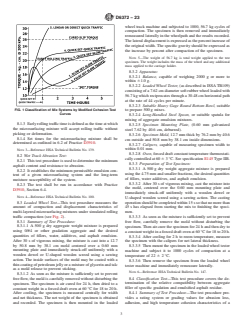
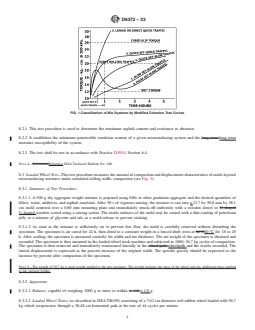
8.1.1 This test procedure is used to determine various set times of the microsurfacing mixture. It measures torque of a
microsurfacing mixture as it coalesces and develops cohesive strength. The amount of torque developed plotted over time shows
how the mixture is developing resistance to movement. Specific torque and time values are defined as “set time” and “early rolling
traffic time” (see Fig. 1).
8.1.2 Set time is defined as the lapsed time after casting a specimen of the microsurfacing mixture after which it cannot be remixed
homogeneously (there is no free emulsion to lubricate the system) and no lateral displacement is possible when it is compacted.
It is further defined as the time when there are no signs of free emulsion when pressed with an absorptive paper towel and there
is no free emulsion diluted and washed away when rinsed with water.
8.1.3 Early rolling traffic time is defined as the time at which the microsurfacing mixture will accept rolling traffic without picking
or deformation.
8.1.4 Set times for the microsurfacing mixture shall be determined as outlined in 6.36.2 of Practice D3910.
NOTE 3—ReferencedReference ISSA Technical Bulletin No. 139.
8.2 Wet Track Abrasion Test:
D6372 − 23
FIG. 1 Classification of Mix Systems by Modified Cohesion Test Curves
8.2.1 This test procedure is used to determine the minimum asphalt content and resistance to abrasion.
8.2.2 It establishes the minimum permissible emulsion content of a given microsurfacing system and the long term long-term
moisture susceptibility of the system.
8.2.3 The test shall be run in accordance with Practice D3910, Section 6.4.
NOTE 4—ReferencedReference ISSA Technical Bulletin No. 100.
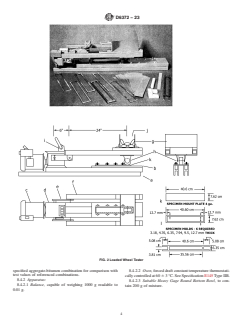
8.3 Loaded Wheel Test—This test procedure measures the amount of compaction and displacement characteristics of multi-layered
microsurfacing mixtures under simulated rolling traffic compaction (see Fig. 2).
8.3.1 Summary of Test Procedure:
8.3.1.1 A 500 g dry aggregate weight mixture is prepared using 0/#4 or other gradation aggregate and the desired quantities of
fillers, water, additives, and asphalt emulsion. After 30 s of vigorous mixing, the mixture is cast into a 12.7 by 50.8 mm by 38.1
cm mold centered over a 0.60 mm mounting plate and immediately struck-off uniformly with a wooden dowel or U shaped
U-shaped wooden screed using a sawing action. The inside surfaces of the mold may be coated with a thin coating of petroleum
jelly or a mixture of glycerin and talc as a mold release to prevent sticking.
8.3.1.2 As soon as the mixture is sufficiently set to prevent free flow, the mold is carefully removed without disturbing the
specimen. The specimen is air cured for 24 h, then dried to a constant weight in a forced draft oven at 60°C60 °C for 18 to 20
h. After cooling, the specimen is measured centrally for width and net thickness. The net weight of the specimen is obtained and
recorded. The specimen is then mounted in the loaded wheel track machine and subjected to 1000, 56.7 kg cycles of compaction.
The specimen is then removed and immediately remeasured laterally in the wheel path wheelpath and the results recorded. The
lateral displacement is expressed as the percent increase of the original width. The specific gravity should be expressed as the
increase by percent after compaction of the specimen.
NOTE 5—The weight of 56.7 kg is total weight applied to the test specimen. The weight includes the mass of the wheel and any additional mass applied
to the carriage holder.
8.3.2 Apparatus:
8.3.2.1 Balance, capable of weighing 2000 g or more to within 6 1.0 61.0 g.
8.3.2.2 Loaded Wheel Tester, (as described in ISSA TB109) consisting of a 7.62 cm diameter soft rubber wheel loaded with 56.7
kg which reciprocates through a 30.48 cm horizontal path at the rate of 44 cycles per minute.
D6372 − 23
FIG. 2 Loaded Wheel Tester
8.3.2.3 Suitable Heavy Gage Round Bottom Bowl, suitable to prepare 500 gram 500 g mixes.
8.3.2.4 Long Handled Long-Handled Steel Spoon, or suitable spatula for mixing of aggregate emulsion mixtures.
8.3.2.5 Specimen Mounting Plate, (0.60 mm galvanized steel 7.62 by 40.6 cm, deburred).
D6372 − 23
8.3.2.6 Specimen Mold, 12.7 mm thick by 76.2 mm ×by 40.6 cm outside and 50.8 mm by 38.1 cm inside dimensions.
8.3.2.7 Calipers, capable of measuring specimen width to within 0.01 mm.
8.3.2.8 Oven, forced draft constant temperature thermostatically controlled at 60 6 3°C.3 °C. See specification E145 Type IIB.
8.3.3 Preparation of Test Specimen:
8.3.3.1 A 500 gram 500 g dry weight aggregate mixture is prepared using the 4.75 mm and smaller fractions, the desired quantities
of fillers, water additives, and asphalt emulsion.
8.3.3.2 After 30 s of vigorous mixing, cast the mixture into the mold, centered over the 0.60 mm mounting plate and immediately
struck-off uniformly with a wooden dowel or U shaped U-shaped wooden screed using a sawing action. The casting operation
should be completed within 15 s so that no more than 45 s 45 s has elapsed from starting the mix to finishing the specimen.
8.3.3.3 As soon as the mixture is sufficiently set to prevent free flow, carefully remove the mold without disturbing the specimen.
Then air-cure the specimen for 24 h and then dry to a constant weight in a forced draft oven at 60°C60 °C for 18 to 20 h.20 h.
8.3.3.4 After cooling for 2 h to room temperature, measure the specimen with the calipe
...