

ASTM D8255-19
(Guide)Standard Guide for Work of Fracture Measurements on Small Nuclear Graphite Specimens
General Information
- Abstract
SIGNIFICANCE AND USE
5.1 Structural integrity assessments typically use values of strength and elastic modulus to predict crack initiation in graphite components and there is a suite of ASTM standards (Section 2, Test Methods C651, C695, C747, C749, C769, and D7775) to cover the measurement of these properties.
5.2 The graphite component behavior after crack initiation depends on fracture mechanics parameters, such as fracture toughness and the work of fracture. Test Method D7779 provides the specification and requirements for measuring the fracture toughness of graphite based on linear-elastic stress analysis. Moreover, Test Method D7779 applies to cases where there are no restrictions on specimen size and on applicable machining and specimen preparation techniques.
5.3 Most polycrystalline graphites are non-linear elastic, non-uniform, quasi-brittle materials. For such materials, an effective approach for the determination of fracture properties is the analysis of the global energy balance associated with crack extension, similar to Griffith's theory of brittle fracture. This approach does not have the mathematical complexity of the non-linear elastic fracture and is easier to implement in practice.
5.4 Work of Fracture, γf (J/m2), is defined as the energy required to form a crack divided by the cross sectional area of the crack. It is assumed that the energy per unit area is constant during crack propagation. In general, components that have an excess of strain energy to the point of fracture, compared to the work needed to extend the crack to full dimension, fail by fast fracture. Any excess energy is converted into kinetic energy through a process that generates stress waves. If the amount of excess energy is sufficiently large, the stress waves will have peak magnitudes greater than the material strength, leading to the initiation and propagation of secondary cracks that could result in the fragmentation of the component.
5.5 However, some components that have less str...
SCOPE
1.1 This guide provides general tutorial information and best practice for measuring the work of fracture on manufactured graphite and carbon specimens. Although applicable to all carbon and graphite materials, this guide is aimed specifically at measurements required on nuclear graphites, where there may be constraints on the geometry and/or volume of the test specimen.
1.2 The values stated in SI units are to be regarded as standard. The values given in parentheses after SI units are provided for information only and are not considered standard.
1.3 This standard does not purport to address all of the safety concerns, if any, associated with its use. It is the responsibility of the user of this standard to establish appropriate safety, health, and environmental practices and determine the applicability of regulatory limitations prior to use.
1.4 This international standard was developed in accordance with internationally recognized principles on standardization established in the Decision on Principles for the Development of International Standards, Guides and Recommendations issued by the World Trade Organization Technical Barriers to Trade (TBT) Committee.
- Status
- Published
- Publication Date
- 30-Apr-2019
- Technical Committee
- D02 - Petroleum Products, Liquid Fuels, and Lubricants
- Drafting Committee
- D02.F0 - Manufactured Carbon and Graphite Products
Overview
ASTM D8255-19, Standard Guide for Work of Fracture Measurements on Small Nuclear Graphite Specimens, is a critical resource for laboratories and organizations involved in the structural integrity assessment of graphite and carbon specimens. Developed by ASTM International, this guide provides tutorial information and best practices tailored specifically for measuring the work of fracture (WoF) on manufactured graphite, particularly nuclear graphites where specimen size and geometry may be constrained due to irradiated material handling.
This standard supports the safe and efficient evaluation of brittle and quasi-brittle behavior in graphite materials, enabling the ongoing assurance of performance for components used in nuclear reactors and other high-reliability settings.
Key Topics
Work of Fracture (WoF) Definition
WoF is defined as the energy required to create a unit area of new fracture surface in a material, stated in joules per square meter (J/m²). This property is essential in understanding post-crack propagation behavior in polycrystalline, non-linear elastic graphites.Test Methods and Specimen Preparation
The guide emphasizes:- Preparing small graphite or carbon specimens, accommodating limited size, especially for irradiated nuclear graphite.
- Using chevron-notched beams in standardized dimensions, ensuring compatibility with available testing equipment and remote handling requirements.
- Accurate dimension measurement and image analysis to determine fracture area.
Experimental Setup
Recommendations include:- Displacement-controlled testing using suitable machines capable of precise force and displacement logging.
- Appropriate test speeds and data logging rates, with preliminary optimization advised for each laboratory setup.
- High-stiffness fixtures and articulated rollers to ensure data integrity and repeatability.
Data Analysis
The standard details methods for analyzing load-displacement data to calculate energy absorption, separating elastic and plastic energy contributions to derive the work of fracture.Dealing with Uncertainties
Guidance is provided on addressing potential sources of error such as test machine compliance, misalignment, specimen handling, and permanent strain or indentation effects in as-manufactured or irradiated samples.
Applications
The practical applications of ASTM D8255-19 include:
- Nuclear Graphite Assessment:
Ensuring structural integrity of graphite used in nuclear reactors by measuring fracture properties on small, often irradiated, specimens. This supports safety assessments and lifetime predictions for critical core components. - Material Research and Development:
Enabling researchers to compare different graphite grades or formulations for improved performance in demanding applications by providing reliable fracture measurements. - Quality Assurance:
Supporting quality control programs in graphite manufacturing, especially where product is destined for safety-critical or highly regulated uses. - Testing Automation:
Facilitating remote or automated testing in shielded facilities, crucial when handling radioactive or contaminated specimens. - Education and Standards Compliance:
Providing a technical framework for laboratories and students alike to understand and apply best practices in fracture mechanics for carbon and graphite materials.
Related Standards
ASTM D8255-19 references and complements several related ASTM standards that cover the mechanical properties of graphite and carbon materials:
- ASTM C651: Flexural strength measurement using four-point loading
- ASTM C695: Compressive strength of carbon and graphite
- ASTM C747: Modulus of elasticity and fundamental frequencies by sonic resonance
- ASTM C749: Tensile stress-strain testing
- ASTM C769: Sonic velocity for estimating Young’s modulus
- ASTM D7775: Measurements on small graphite specimens
- ASTM D7779: Determination of fracture toughness of graphite
- ASTM D7972: Flexural strength using three-point loading
- ASTM E4: Force verification of testing machines
- ASTM E399: Linear-elastic plane-strain fracture toughness of metallic materials
Conclusion
ASTM D8255-19 is an essential guide for any laboratory or industry professional involved in the mechanical testing and evaluation of small nuclear graphite specimens. By following its best practices, users can achieve reliable, repeatable measurements of the work of fracture-enabling better safety assessments, material development, and compliance with international standards. This standard enhances both the practical value and scientific rigor of fracture measurements in nuclear graphite testing.
Relations
- Effective Date
- 01-Oct-2023
- Effective Date
- 01-May-2020
- Effective Date
- 01-May-2020
- Effective Date
- 01-May-2020
- Effective Date
- 01-May-2020
- Effective Date
- 01-Oct-2016
- Effective Date
- 01-Jan-2016
- Effective Date
- 01-Oct-2015
- Effective Date
- 01-Oct-2015
- Effective Date
- 01-Jun-2015
- Effective Date
- 01-Jun-2015
- Effective Date
- 01-Dec-2014
- Effective Date
- 01-Jun-2014
- Effective Date
- 01-Oct-2013
- Effective Date
- 01-Oct-2013
Get Certified
Connect with accredited certification bodies for this standard

ECOCERT
Organic and sustainability certification.

Eurofins Food Testing Global
Global leader in food, environment, and pharmaceutical product testing.

Intertek Bangladesh
Intertek certification and testing services in Bangladesh.
Sponsored listings
Frequently Asked Questions
ASTM D8255-19 is a guide published by ASTM International. Its full title is "Standard Guide for Work of Fracture Measurements on Small Nuclear Graphite Specimens". This standard covers: SIGNIFICANCE AND USE 5.1 Structural integrity assessments typically use values of strength and elastic modulus to predict crack initiation in graphite components and there is a suite of ASTM standards (Section 2, Test Methods C651, C695, C747, C749, C769, and D7775) to cover the measurement of these properties. 5.2 The graphite component behavior after crack initiation depends on fracture mechanics parameters, such as fracture toughness and the work of fracture. Test Method D7779 provides the specification and requirements for measuring the fracture toughness of graphite based on linear-elastic stress analysis. Moreover, Test Method D7779 applies to cases where there are no restrictions on specimen size and on applicable machining and specimen preparation techniques. 5.3 Most polycrystalline graphites are non-linear elastic, non-uniform, quasi-brittle materials. For such materials, an effective approach for the determination of fracture properties is the analysis of the global energy balance associated with crack extension, similar to Griffith's theory of brittle fracture. This approach does not have the mathematical complexity of the non-linear elastic fracture and is easier to implement in practice. 5.4 Work of Fracture, γf (J/m2), is defined as the energy required to form a crack divided by the cross sectional area of the crack. It is assumed that the energy per unit area is constant during crack propagation. In general, components that have an excess of strain energy to the point of fracture, compared to the work needed to extend the crack to full dimension, fail by fast fracture. Any excess energy is converted into kinetic energy through a process that generates stress waves. If the amount of excess energy is sufficiently large, the stress waves will have peak magnitudes greater than the material strength, leading to the initiation and propagation of secondary cracks that could result in the fragmentation of the component. 5.5 However, some components that have less str... SCOPE 1.1 This guide provides general tutorial information and best practice for measuring the work of fracture on manufactured graphite and carbon specimens. Although applicable to all carbon and graphite materials, this guide is aimed specifically at measurements required on nuclear graphites, where there may be constraints on the geometry and/or volume of the test specimen. 1.2 The values stated in SI units are to be regarded as standard. The values given in parentheses after SI units are provided for information only and are not considered standard. 1.3 This standard does not purport to address all of the safety concerns, if any, associated with its use. It is the responsibility of the user of this standard to establish appropriate safety, health, and environmental practices and determine the applicability of regulatory limitations prior to use. 1.4 This international standard was developed in accordance with internationally recognized principles on standardization established in the Decision on Principles for the Development of International Standards, Guides and Recommendations issued by the World Trade Organization Technical Barriers to Trade (TBT) Committee.
SIGNIFICANCE AND USE 5.1 Structural integrity assessments typically use values of strength and elastic modulus to predict crack initiation in graphite components and there is a suite of ASTM standards (Section 2, Test Methods C651, C695, C747, C749, C769, and D7775) to cover the measurement of these properties. 5.2 The graphite component behavior after crack initiation depends on fracture mechanics parameters, such as fracture toughness and the work of fracture. Test Method D7779 provides the specification and requirements for measuring the fracture toughness of graphite based on linear-elastic stress analysis. Moreover, Test Method D7779 applies to cases where there are no restrictions on specimen size and on applicable machining and specimen preparation techniques. 5.3 Most polycrystalline graphites are non-linear elastic, non-uniform, quasi-brittle materials. For such materials, an effective approach for the determination of fracture properties is the analysis of the global energy balance associated with crack extension, similar to Griffith's theory of brittle fracture. This approach does not have the mathematical complexity of the non-linear elastic fracture and is easier to implement in practice. 5.4 Work of Fracture, γf (J/m2), is defined as the energy required to form a crack divided by the cross sectional area of the crack. It is assumed that the energy per unit area is constant during crack propagation. In general, components that have an excess of strain energy to the point of fracture, compared to the work needed to extend the crack to full dimension, fail by fast fracture. Any excess energy is converted into kinetic energy through a process that generates stress waves. If the amount of excess energy is sufficiently large, the stress waves will have peak magnitudes greater than the material strength, leading to the initiation and propagation of secondary cracks that could result in the fragmentation of the component. 5.5 However, some components that have less str... SCOPE 1.1 This guide provides general tutorial information and best practice for measuring the work of fracture on manufactured graphite and carbon specimens. Although applicable to all carbon and graphite materials, this guide is aimed specifically at measurements required on nuclear graphites, where there may be constraints on the geometry and/or volume of the test specimen. 1.2 The values stated in SI units are to be regarded as standard. The values given in parentheses after SI units are provided for information only and are not considered standard. 1.3 This standard does not purport to address all of the safety concerns, if any, associated with its use. It is the responsibility of the user of this standard to establish appropriate safety, health, and environmental practices and determine the applicability of regulatory limitations prior to use. 1.4 This international standard was developed in accordance with internationally recognized principles on standardization established in the Decision on Principles for the Development of International Standards, Guides and Recommendations issued by the World Trade Organization Technical Barriers to Trade (TBT) Committee.
ASTM D8255-19 is classified under the following ICS (International Classification for Standards) categories: 71.060.10 - Chemical elements. The ICS classification helps identify the subject area and facilitates finding related standards.
ASTM D8255-19 has the following relationships with other standards: It is inter standard links to ASTM C747-23, ASTM C651-20, ASTM C559-16(2020), ASTM C749-15(2020), ASTM D7972-14(2020), ASTM C747-16, ASTM C559-16, ASTM C749-15, ASTM C651-15, ASTM C695-15, ASTM D7775-11(2015), ASTM D7972-14, ASTM E4-14, ASTM C749-13, ASTM C651-13. Understanding these relationships helps ensure you are using the most current and applicable version of the standard.
ASTM D8255-19 is available in PDF format for immediate download after purchase. The document can be added to your cart and obtained through the secure checkout process. Digital delivery ensures instant access to the complete standard document.
Standards Content (Sample)
This international standard was developed in accordance with internationally recognized principles on standardization established in the Decision on Principles for the
Development of International Standards, Guides and Recommendations issued by the World Trade Organization Technical Barriers to Trade (TBT) Committee.
Designation: D8255 − 19
Standard Guide for
Work of Fracture Measurements on Small Nuclear Graphite
Specimens
This standard is issued under the fixed designation D8255; the number immediately following the designation indicates the year of
original adoption or, in the case of revision, the year of last revision.Anumber in parentheses indicates the year of last reapproval.A
superscript epsilon (´) indicates an editorial change since the last revision or reapproval.
1. Scope C747TestMethodforModuliofElasticityandFundamental
Frequencies of Carbon and Graphite Materials by Sonic
1.1 This guide provides general tutorial information and
Resonance
best practice for measuring the work of fracture on manufac-
C749Test Method for Tensile Stress-Strain of Carbon and
tured graphite and carbon specimens. Although applicable to
Graphite
all carbon and graphite materials, this guide is aimed specifi-
C769Test Method for Sonic Velocity in Manufactured
cally at measurements required on nuclear graphites, where
Carbon and Graphite Materials for Use in Obtaining an
there may be constraints on the geometry and/or volume of the
Approximate Value of Young’s Modulus
test specimen.
D7775Guide for Measurements on Small Graphite Speci-
1.2 The values stated in SI units are to be regarded as
mens
standard. The values given in parentheses after SI units are
D7779Test Method for Determination of Fracture Tough-
provided for informationonlyandarenotconsideredstandard.
ness of Graphite at Ambient Temperature
1.3 This standard does not purport to address all of the
D7972Test Method for Flexural Strength of Manufactured
safety concerns, if any, associated with its use. It is the Carbon and GraphiteArticles Using Three-Point Loading
responsibility of the user of this standard to establish appro-
at Room Temperature
priate safety, health, and environmental practices and deter- E4Practices for Force Verification of Testing Machines
mine the applicability of regulatory limitations prior to use.
E399Test Method for Linear-Elastic Plane-Strain Fracture
1.4 This international standard was developed in accor- Toughness of Metallic Materials
dance with internationally recognized principles on standard-
3. Terminology
ization established in the Decision on Principles for the
Development of International Standards, Guides and Recom-
3.1 Definitions:
mendations issued by the World Trade Organization Technical 2
3.1.1 work of fracture, γ (J/m ),n—the total energy re-
f
Barriers to Trade (TBT) Committee.
quired to produce a unit area of fracture surface.
3.2 Definitions of Terms Specific to This Standard:
2. Referenced Documents
3.2.1 absorbed energy, n—the plastic energy absorbed by
2.1 ASTM Standards:
the system.
C559Test Method for Bulk Density by Physical Measure-
3.2.1.1 Discussion—This is primarily the work done to
ments of Manufactured Carbon and Graphite Articles
extend the crack but can also include other plastic strains
C651Test Method for Flexural Strength of Manufactured
related to the specimen, such as microcracking, or the entire
CarbonandGraphiteArticlesUsingFour-PointLoadingat
system, usually related to the stiffness of the loading frame.
Room Temperature
These cases are discussed in detail in Section 10.
C695Test Method for Compressive Strength of Carbon and
3.2.2 total (consumed) energy, n—the total energy calcu-
Graphite
lated by the load-displacement trace in this type of test.
3.2.2.1 Discussion—This is the sum of the elastic energy
This guide is under the jurisdiction of ASTM Committee D02 on Petroleum thatleadstoelasticdeformationofthespecimenandtheplastic
Products, Liquid Fuels, and Lubricants and is the direct responsibility of Subcom-
energy, which is primarily the work done to extend the crack.
mittee D02.F0 on Manufactured Carbon and Graphite Products.
Current edition approved May 1, 2019. Published June 2019. DOI: 10.1520/
4. Summary of Guide
D8255-19.
For referenced ASTM standards, visit the ASTM website, www.astm.org, or
4.1 An introduction is provided on the characteristics of
contact ASTM Customer Service at service@astm.org. For Annual Book of ASTM
nuclear graphite that restrict the number of test methods that
Standards volume information, refer to the standard’s Document Summary page on
the ASTM website. are applicable for measuring the Work of Fracture (WoF),
Copyright © ASTM International, 100 Barr Harbor Drive, PO Box C700, West Conshohocken, PA 19428-2959. United States
D8255 − 19
3,4
especially with regard to testing of small irradiated specimens in the cross-section. Because the crack is initiated at the tip
in a shielded facility. This guide takes into account these of the chevron at very low applied loads, it is not necessary to
restrictions and proposes a method for measuring WoF. make assumptions about the crack initiation process.
Furthermore, provided the chevron shape is such that the
4.2 This guide provides the basic principles and experimen-
compliance of the specimen increases continuously as the
tal setup for the proposed method.
crack propagates, fast fracture cannot occur under
displacement-controlled loading and release any excess energy
5. Significance and Use
that cannot be measured during the test.
5.1 Structural integrity assessments typically use values of
6.2 Duringsuchatest,measurementsoftheloadapplication
strength and elastic modulus to predict crack initiation in
point displacement and the load applied can be used to
graphite components and there is a suite of ASTM standards
determine the energy being dissipated. Assuming that all the
(Section 2,Test Methods C651, C695, C747, C749, C769, and
energy is used in the formation of the crack and the area of the
Guide D7775) to cover the measurement of these properties.
crack’ssurfaceisknown,WoF, γ,canbedetermined.Withthe
f
5.2 The graphite component behavior after crack initiation
above caveats in mind, measurement of the load and the
depends on fracture mechanics parameters, such as fracture
deformation at the load points enables the WoF to be directly
toughness and the work of fracture. Test Method D7779
evaluated from the energy changes that occur as the crack
provides the specification and requirements for measuring the
propagates and so it is not necessary to make assumptions
fracture toughness of graphite based on linear-elastic stress
about the values of elastic modulus and strength.
analysis.Moreover,TestMethodD7779appliestocaseswhere
6.3 An example case that follows these basic principles is
there are no restrictions on specimen size and on applicable
described in Sections7–9.
machining and specimen preparation techniques.
5.3 Most polycrystalline graphites are non-linear elastic,
7. Test Specimen for Example Case
non-uniform, quasi-brittle materials. For such materials, an
7.1 Test Specimen Configuration—The specimens were me-
effective approach for the determination of fracture properties
dium grain graphite rectangular beams with a 90º chevron cut
is the analysis of the global energy balance associated with
at the mid-point, Fig. 1. In this particular case, the specimen
crack extension, similar to Griffith’s theory of brittle fracture.
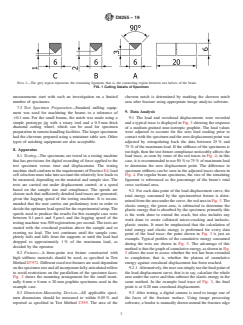
size of interest was a nominal 6 mm × 6 mm × 20 mm beam.
This approach does not have the mathematical complexity of
However,beamswithnominalsizes10mm×10mm×50mm
the non-linear elastic fracture and is easier to implement in
and 20 mm × 20 mm × 100 mm were also tested.
practice.
7.2 Notch Size—Stable crack growth requires a sufficiently
5.4 Work of Fracture, γ (J/m ), is defined as the energy
f
largeinitialcracklength,withtheliteraturesuggestingthat,for
required to form a crack divided by the cross sectional area of
a straight crack front, it should extend to at least half of the
thecrack.Itisassumedthattheenergyperunitareaisconstant
beam depth. However, for a very small test specimen as used
during crack propagation. In general, components that have an
here, too large a notch would result in the specimen being too
excessofstrainenergytothepointoffracture,comparedtothe
delicate to handle, particularly for oxidized specimens. Thus,
work needed to extend the crack to full dimension, fail by fast
an important variable is initial crack depth.To investigate this,
fracture. Any excess energy is converted into kinetic energy
three separate notch typesA, B, and C were tested as shown in
through a process that generates stress waves. If the amount of
Fig. 1. In each case, the notch shape was identical but shifted
excess energy is sufficiently large, the stress waves will have
verticallytoprovidevaryingremainingligamentareasof25%,
peak magnitudes greater than the material strength, leading to
40%, and 60%, nominally, of the original beam cross section,
the initiation and propagation of secondary cracks that could
(notch typesA, B, and C respectively).All notched 6 mm × 6
result in the fragmentation of the component.
mm × 20 mm specimens resulted in stable crack growth, but
5.5 However, some components that have less strain energy the 25 % remaining ligament area left a very small remaining
at the point of fracture than the work needed to extend the graphite ligament and may not be appropriate for highly
degraded graphite. As it was not certain that the 60 %
cracktofulldimension,failinaquasi-brittlemannerandresult
instablecracks,crackbridginganddistributedmicro-cracking. remainingligamentareawouldresultinstablecrackgrowthfor
the larger graphite specimens and the literature recommends a
Graphite components are generally tested in their as-
manufacturedstateandfailsomewherebetweentheseextremes deep chevron notch, a remaining ligament area of 40 % was
used for the remaining tests. It is recommended that all WoF
showingfastfracturewithrelativelyminoramountsofsecond-
arycracking and littletendencytofragment.Thechangeinthe
WoF and strain rate of graphite components in a reactor
environment is important in assessing the component’s ten- 3
Sakai, M., Urashima, K., Inagaki, M., Energy Principle of Elastic-Plastic
FractureanditsApplicationtotheFractureMechanicsofaPolycrystallineGraphite,
dency for secondary cracking and fragmentation.
Journal of the American Ceramic Society, Vol 66, No. 12, 1983, pp. 848–874.
Barinov, S. M., Sakai, M., The Work-of-Fractrure of Brittle Materials:
6. Basic Principles
Principle, Determination and Applications, Journal of Materials Research, Vol 9,
No. 6, 1994, pp. 1412–1425.
6.1 A widely used approach to measuring fracture param-
Tzelepi, A., Ramsay, P., Steer, A. G., Dinsdale-Potter, J., Measuring the
eters for brittle materials is by means of a compact tension or
Fracture Properties of Irradiated Reactor Core Graphite, Journal of Nuclear
3-point bend specimen with a chevron-shaped notch machined Materials, Vol 509, 2018.
D8255 − 19
NOTE 1—The grey region represents the remaining ligament, that is, the connecting region between two halves of the beam.
FIG. 1 Cutting Details of Specimen
measurements start with such an investigation on a limited chevron notch is determined by marking the chevron notch
number of specimens. area after fracture using appropriate image analysis software.
7.3 Test Specimen Preparation—Standard milling equip-
9. Data Analysis
ment was used for machining the beams to a tolerance of
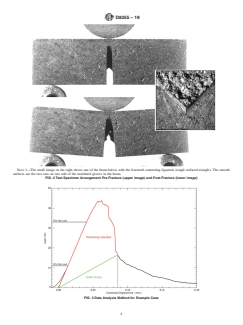
60.1mm. For the small beams, the notch was made using a 9.1 The load and crosshead displacements were recorded
simple prototype jig with a rotary tool and a 0.5mm thick
and a typical trace is displayed in Fig. 3 showing the response
diamond cutting wheel, which can be used for specimen of a medium-grained near-isotropic graphite. The load values
preparationinremote-handlingfacilities.Thelargerspecimens were adjusted to account for the zero load reading prior to
had the chevrons prepared using a miniature table saw. Other
contactwiththespecimenandthezerodisplacementpointwas
types of notching equipment are also acceptable. adjusted by extrapolating back the data between 25% and
75% of the maximum load. If the stiffness of the specimens is
8. Apparatus
too high, then the test fixture compliance noticeably affects the
8.1 Testing—The specimens are tested in a testing machine load trace, as seen by some of the red traces in Fig. 4; in this
that has provisions for digital recording of force applied to the case,itisrecommendedtouse50%to75%ofmaximumload
test
...