

ASTM C749-15(2020)
(Test Method)Standard Test Method for Tensile Stress-Strain of Carbon and Graphite
General Information
- Abstract
SIGNIFICANCE AND USE
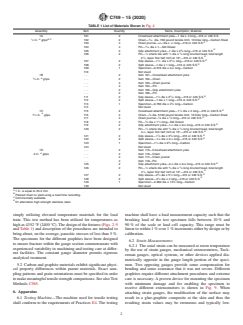
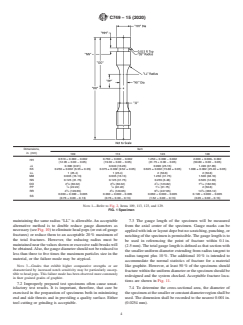
5.1 The round robin testing on which the precision and bias for this test method have been determined employed a range of graphites (see Table 2) whose grain sizes were of the order of 1 mil to 1/4 in. (0.0254 mm to 6.4 mm) and larger. This wide range of carbons and graphites can be tested with uniform gauge diameters with minimum parasitic stresses to provide quality data for use in engineering applications rather than simply for quality control. This test method can be easily adapted to elevated temperature testing of carbons and graphites without changing the specimen size or configuration by simply utilizing elevated temperature materials for the load train. This test method has been utilized for temperatures as high as 4352 °F (2400 °C). The design of the fixtures (Figs. 2-9 and Table 1) and description of the procedures are intended to bring about, on the average, parasitic stresses of less than 5 %. The specimens for the different graphites have been designed to ensure fracture within the gauge section commensurate with experienced variability in machining and testing care at different facilities. The constant gauge diameter permits rigorous analytical treatment.
Note 1: Refer to Fig. 2, Items 101 and 115.
Note 1: Refer to Fig. 2, Items 103 and 117. (A) Screw size.
Note 1: Refer to Fig. 2, Items 107, 109, 111, 113, 121, 123, and 129.
Note 1: Refer to Fig. 2, Items 105, 109, 113, 119, 123, 125, and 129.
Note 1: Refer to Fig. 2, Items 108, 112, 122, and 128.
FIG. 9 Attachment for Strain Flags or Extensometers to Provide Minimum Damage to Surface of Specimen
Note 1: Jig align to ensure precision gauge length; mount post or groove to match type of extensometer.
5.2 Carbon and graphite materials exhibit significant physical property differences within parent materials. Exact sampling patterns and grain orientations must be specified in order to make meaningful tensile strength comparisons. See also Test Methods C565.
SCOPE
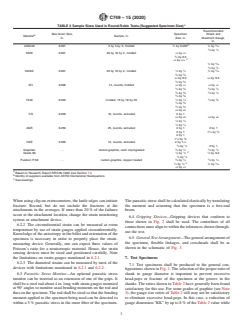
1.1 This test method covers the testing of carbon and graphite in tension to obtain the tensile stress-strain behavior, to failure, from which the ultimate strength, the strain to failure, and the elastic moduli may be calculated as may be required for engineering applications. Table 2 lists suggested sizes of specimens that can be used in the tests.
Note 1: The results of about 400 tests, on file at ASTM as a research report, show the ranges of materials that have been tested, the ranges of specimen configurations, and the agreement between the testers. See Section 11.
Note 2: For safety considerations, it is recommended that the chains be surrounded by suitable members so that at failure all parts of the load train behave predictably and do not constitute a hazard for the operator.
1.2 The values stated in inch-pound units are to be regarded as standard. The values given in parentheses are mathematical conversions to SI units that are provided for information only and are not considered standard. Conversions are not provided in the tables and figures.
1.3 This standard does not purport to address all of the safety concerns, if any, associated with its use. It is the responsibility of the user of this standard to establish appropriate safety, health, and environmental practices and determine the applicability of regulatory limitations prior to use.
1.4 This international standard was developed in accordance with internationally recognized principles on standardization established in the Decision on Principles for the Development of International Standards, Guides and Recommendations issued by the World Trade Organization Technical Barriers to Trade (TBT) Committee.
- Status
- Published
- Publication Date
- 30-Apr-2020
- Technical Committee
- D02 - Petroleum Products, Liquid Fuels, and Lubricants
- Drafting Committee
- D02.F0 - Manufactured Carbon and Graphite Products
Overview
ASTM C749-15(2020): Standard Test Method for Tensile Stress-Strain of Carbon and Graphite provides a comprehensive procedure to determine the tensile stress-strain behavior, including the ultimate tensile strength, strain to failure, and elastic modulus of carbon and graphite materials. Developed by ASTM International, this standard guides testing across a wide range of carbon and graphite types, grain sizes, and specimen configurations. It is extensively used for engineering applications and can be adapted for either quality control or research and development.
This test method is recognized globally and aligns with established international standardization principles, supporting reliability and reproducibility across laboratories.
Key Topics
Tensile Testing Procedure
The standard outlines the process for subjecting carbon and graphite specimens to uniaxial tensile loads using precisely engineered loading assemblies. It includes instructions for specimen mounting, load and strain measurement, and fracture documentation.Specimen Design and Preparation
ASTM C749 provides guidance on recommended specimen sizes and shapes, preparation methods to minimize surface and end damage, and alignment procedures to ensure accurate tensile stress results. Accepted sample grain sizes range from 0.0254 mm to 6.4 mm and larger.Measurement and Data Reporting
The methodology requires accurate calibration of measurement devices and careful recording of stress-strain data from initial loading to failure. The ultimate tensile strength, elastic modulus, and strain to failure must be calculated and reported, including statistical measures such as average values and standard deviations.Significance and Use
By minimizing parasitic stresses and ensuring consistent specimen geometry, the test provides high-quality tensile data suitable for engineering design and material comparison. The procedure is adaptable for elevated temperature testing up to 2400 °C (4352 °F), enhancing its relevance for demanding applications.Material Variability
The standard emphasizes the significant physical property variations within carbon and graphite types. It stresses the need for precise sampling and orientation to allow meaningful comparative analysis.
Applications
Engineering Design
Tensile stress-strain data generated per ASTM C749 is critical for the structural analysis and component design involving carbon and graphite, such as reactor components, furnaces, and bearings.Quality Control in Manufacturing
Manufacturers of carbon and graphite components use this standard to monitor batch consistency, validate supplier materials, and maintain product standards.Research and Development
Material scientists and engineers utilize this method for developing new carbon and graphite grades, understanding failure modes, and improving performance under mechanical loads.Elevated Temperature Testing
The method's adaptability to high temperatures makes it valuable for industries where carbon and graphite are exposed to extreme environments, including aerospace, metallurgy, and energy sectors.Material Comparison
Organizations can use rigorously obtained data to compare different grades or sources of carbon and graphite, aiding procurement and process optimization decisions.
Related Standards
ASTM C565: Test Methods for Tension Testing of Carbon and Graphite
Further elaborates on tensile testing procedures for these materials, complementing C749.ASTM E4: Practices for Force Verification of Testing Machines
Specifies requirements for the calibration and verification of mechanical testing equipment.ASTM E6: Terminology Relating to Methods of Mechanical Testing
Provides definitions relevant to mechanical testing procedures and reporting.ASTM E177: Practice for Use of the Terms Precision and Bias in ASTM Test Methods
Guides statistical analysis and reporting of test results.ASTM E691: Practice for Conducting an Interlaboratory Study to Determine the Precision of a Test Method
Informs round-robin testing to establish method reproducibility.
Implementing ASTM C749-15(2020) ensures that tensile testing of carbon and graphite is carried out with precision, aligns with international best practices, and produces data that are essential for engineering, quality control, and materials research. By adhering to established testing protocols, organizations can confidently characterize and utilize carbon and graphite in advanced industrial applications.
Relations
- Effective Date
- 01-May-2020
- Effective Date
- 01-Jun-2014
- Effective Date
- 01-May-2014
- Effective Date
- 01-May-2013
- Effective Date
- 01-May-2013
- Effective Date
- 01-Nov-2011
- Effective Date
- 01-Oct-2010
- Effective Date
- 01-Jun-2010
- Effective Date
- 01-May-2010
- Effective Date
- 01-Nov-2009
- Effective Date
- 15-May-2009
- Effective Date
- 15-May-2009
- Effective Date
- 01-Apr-2009
- Effective Date
- 01-Apr-2009
- Effective Date
- 01-Jan-2009
Get Certified
Connect with accredited certification bodies for this standard

ECOCERT
Organic and sustainability certification.

Eurofins Food Testing Global
Global leader in food, environment, and pharmaceutical product testing.

Intertek Bangladesh
Intertek certification and testing services in Bangladesh.
Sponsored listings
Frequently Asked Questions
ASTM C749-15(2020) is a standard published by ASTM International. Its full title is "Standard Test Method for Tensile Stress-Strain of Carbon and Graphite". This standard covers: SIGNIFICANCE AND USE 5.1 The round robin testing on which the precision and bias for this test method have been determined employed a range of graphites (see Table 2) whose grain sizes were of the order of 1 mil to 1/4 in. (0.0254 mm to 6.4 mm) and larger. This wide range of carbons and graphites can be tested with uniform gauge diameters with minimum parasitic stresses to provide quality data for use in engineering applications rather than simply for quality control. This test method can be easily adapted to elevated temperature testing of carbons and graphites without changing the specimen size or configuration by simply utilizing elevated temperature materials for the load train. This test method has been utilized for temperatures as high as 4352 °F (2400 °C). The design of the fixtures (Figs. 2-9 and Table 1) and description of the procedures are intended to bring about, on the average, parasitic stresses of less than 5 %. The specimens for the different graphites have been designed to ensure fracture within the gauge section commensurate with experienced variability in machining and testing care at different facilities. The constant gauge diameter permits rigorous analytical treatment. Note 1: Refer to Fig. 2, Items 101 and 115. Note 1: Refer to Fig. 2, Items 103 and 117. (A) Screw size. Note 1: Refer to Fig. 2, Items 107, 109, 111, 113, 121, 123, and 129. Note 1: Refer to Fig. 2, Items 105, 109, 113, 119, 123, 125, and 129. Note 1: Refer to Fig. 2, Items 108, 112, 122, and 128. FIG. 9 Attachment for Strain Flags or Extensometers to Provide Minimum Damage to Surface of Specimen Note 1: Jig align to ensure precision gauge length; mount post or groove to match type of extensometer. 5.2 Carbon and graphite materials exhibit significant physical property differences within parent materials. Exact sampling patterns and grain orientations must be specified in order to make meaningful tensile strength comparisons. See also Test Methods C565. SCOPE 1.1 This test method covers the testing of carbon and graphite in tension to obtain the tensile stress-strain behavior, to failure, from which the ultimate strength, the strain to failure, and the elastic moduli may be calculated as may be required for engineering applications. Table 2 lists suggested sizes of specimens that can be used in the tests. Note 1: The results of about 400 tests, on file at ASTM as a research report, show the ranges of materials that have been tested, the ranges of specimen configurations, and the agreement between the testers. See Section 11. Note 2: For safety considerations, it is recommended that the chains be surrounded by suitable members so that at failure all parts of the load train behave predictably and do not constitute a hazard for the operator. 1.2 The values stated in inch-pound units are to be regarded as standard. The values given in parentheses are mathematical conversions to SI units that are provided for information only and are not considered standard. Conversions are not provided in the tables and figures. 1.3 This standard does not purport to address all of the safety concerns, if any, associated with its use. It is the responsibility of the user of this standard to establish appropriate safety, health, and environmental practices and determine the applicability of regulatory limitations prior to use. 1.4 This international standard was developed in accordance with internationally recognized principles on standardization established in the Decision on Principles for the Development of International Standards, Guides and Recommendations issued by the World Trade Organization Technical Barriers to Trade (TBT) Committee.
SIGNIFICANCE AND USE 5.1 The round robin testing on which the precision and bias for this test method have been determined employed a range of graphites (see Table 2) whose grain sizes were of the order of 1 mil to 1/4 in. (0.0254 mm to 6.4 mm) and larger. This wide range of carbons and graphites can be tested with uniform gauge diameters with minimum parasitic stresses to provide quality data for use in engineering applications rather than simply for quality control. This test method can be easily adapted to elevated temperature testing of carbons and graphites without changing the specimen size or configuration by simply utilizing elevated temperature materials for the load train. This test method has been utilized for temperatures as high as 4352 °F (2400 °C). The design of the fixtures (Figs. 2-9 and Table 1) and description of the procedures are intended to bring about, on the average, parasitic stresses of less than 5 %. The specimens for the different graphites have been designed to ensure fracture within the gauge section commensurate with experienced variability in machining and testing care at different facilities. The constant gauge diameter permits rigorous analytical treatment. Note 1: Refer to Fig. 2, Items 101 and 115. Note 1: Refer to Fig. 2, Items 103 and 117. (A) Screw size. Note 1: Refer to Fig. 2, Items 107, 109, 111, 113, 121, 123, and 129. Note 1: Refer to Fig. 2, Items 105, 109, 113, 119, 123, 125, and 129. Note 1: Refer to Fig. 2, Items 108, 112, 122, and 128. FIG. 9 Attachment for Strain Flags or Extensometers to Provide Minimum Damage to Surface of Specimen Note 1: Jig align to ensure precision gauge length; mount post or groove to match type of extensometer. 5.2 Carbon and graphite materials exhibit significant physical property differences within parent materials. Exact sampling patterns and grain orientations must be specified in order to make meaningful tensile strength comparisons. See also Test Methods C565. SCOPE 1.1 This test method covers the testing of carbon and graphite in tension to obtain the tensile stress-strain behavior, to failure, from which the ultimate strength, the strain to failure, and the elastic moduli may be calculated as may be required for engineering applications. Table 2 lists suggested sizes of specimens that can be used in the tests. Note 1: The results of about 400 tests, on file at ASTM as a research report, show the ranges of materials that have been tested, the ranges of specimen configurations, and the agreement between the testers. See Section 11. Note 2: For safety considerations, it is recommended that the chains be surrounded by suitable members so that at failure all parts of the load train behave predictably and do not constitute a hazard for the operator. 1.2 The values stated in inch-pound units are to be regarded as standard. The values given in parentheses are mathematical conversions to SI units that are provided for information only and are not considered standard. Conversions are not provided in the tables and figures. 1.3 This standard does not purport to address all of the safety concerns, if any, associated with its use. It is the responsibility of the user of this standard to establish appropriate safety, health, and environmental practices and determine the applicability of regulatory limitations prior to use. 1.4 This international standard was developed in accordance with internationally recognized principles on standardization established in the Decision on Principles for the Development of International Standards, Guides and Recommendations issued by the World Trade Organization Technical Barriers to Trade (TBT) Committee.
ASTM C749-15(2020) is classified under the following ICS (International Classification for Standards) categories: 71.060.10 - Chemical elements. The ICS classification helps identify the subject area and facilitates finding related standards.
ASTM C749-15(2020) has the following relationships with other standards: It is inter standard links to ASTM C749-15, ASTM E4-14, ASTM E177-14, ASTM E691-13, ASTM E177-13, ASTM E691-11, ASTM E177-10, ASTM E4-10, ASTM C565-93(2010)e1, ASTM E4-09a, ASTM E6-09b, ASTM E6-09be1, ASTM E6-09a, ASTM E4-09, ASTM E6-09. Understanding these relationships helps ensure you are using the most current and applicable version of the standard.
ASTM C749-15(2020) is available in PDF format for immediate download after purchase. The document can be added to your cart and obtained through the secure checkout process. Digital delivery ensures instant access to the complete standard document.
Standards Content (Sample)
This international standard was developed in accordance with internationally recognized principles on standardization established in the Decision on Principles for the
Development of International Standards, Guides and Recommendations issued by the World Trade Organization Technical Barriers to Trade (TBT) Committee.
Designation: C749 − 15 (Reapproved 2020)
Standard Test Method for
Tensile Stress-Strain of Carbon and Graphite
This standard is issued under the fixed designation C749; the number immediately following the designation indicates the year of
original adoption or, in the case of revision, the year of last revision. A number in parentheses indicates the year of last reapproval. A
superscript epsilon (´) indicates an editorial change since the last revision or reapproval.
1. Scope Graphite Mechanical Materials
E4 Practices for Force Verification of Testing Machines
1.1 This test method covers the testing of carbon and
E6 Terminology Relating to Methods of Mechanical Testing
graphite in tension to obtain the tensile stress-strain behavior,
E177 Practice for Use of the Terms Precision and Bias in
to failure, from which the ultimate strength, the strain to
ASTM Test Methods
failure, and the elastic moduli may be calculated as may be
E691 Practice for Conducting an Interlaboratory Study to
required for engineering applications. Table 2 lists suggested
Determine the Precision of a Test Method
sizes of specimens that can be used in the tests.
NOTE 1—The results of about 400 tests, on file at ASTM as a research
3. Terminology
report, show the ranges of materials that have been tested, the ranges of
3.1 Definitions:
specimen configurations, and the agreement between the testers. See
Section 11. 3.1.1 The terms as related to tension testing as given in
NOTE 2—For safety considerations, it is recommended that the chains
Terminology E6 shall be considered as applying to the terms
be surrounded by suitable members so that at failure all parts of the load
used in this test method.
train behave predictably and do not constitute a hazard for the operator.
3.1.2 modulus of elasticity, n—the ratio of a force applied to
1.2 The values stated in inch-pound units are to be regarded
a material to the increment of dimensional change along the
as standard. The values given in parentheses are mathematical
force axis, commonly defined as the ratio of tensile stress to
conversions to SI units that are provided for information only
tensile strain.
and are not considered standard. Conversions are not provided
3.1.3 tensile strength, n—property of solid material that
in the tables and figures.
indicates its ability to withstand a uniaxial tensile load,
1.3 This standard does not purport to address all of the
converted to unit stress based on the original cross-section area
safety concerns, if any, associated with its use. It is the
of the tensile test specimen.
responsibility of the user of this standard to establish appro-
3.1.4 ultimate tensile strength, n—the maximum tensile
priate safety, health, and environmental practices and deter-
stress applied in stretching a specimen to rupture.
mine the applicability of regulatory limitations prior to use.
1.4 This international standard was developed in accor-
4. Summary of Test Method
dance with internationally recognized principles on standard-
4.1 Atensile specimen (Fig. 1) is placed within a load train
ization established in the Decision on Principles for the
assembly made up of precision chains and other machined
Development of International Standards, Guides and Recom-
parts (Fig. 2).Aload is applied to the specimen provided with
mendations issued by the World Trade Organization Technical
means of measuring strain until it is caused to fracture. This
Barriers to Trade (TBT) Committee.
test yields the tensile strength, elastic constants, and strain to
failure of carbons and graphites.
2. Referenced Documents
2.1 ASTM Standards:
5. Significance and Use
C565 Test Methods for Tension Testing of Carbon and
5.1 The round robin testing on which the precision and bias
for this test method have been determined employed a range of
This test method is under the jurisdiction of ASTM Committee D02 on
graphites (see Table 2) whose grain sizes were of the order of
Petroleum Products, Liquid Fuels, and Lubricants and is the direct responsibility of
1 mil to ⁄4 in. (0.0254 mm to 6.4 mm) and larger. This wide
Subcommittee D02.F0 on Manufactured Carbon and Graphite Products.
range of carbons and graphites can be tested with uniform
Current edition approved May 1, 2020. Published June 2020. Originally
gauge diameters with minimum parasitic stresses to provide
approved in 1973. Last previous edition approved in 2015 as C749 – 15. DOI:
10.1520/C0749-15R20.
quality data for use in engineering applications rather than
For referenced ASTM standards, visit the ASTM website, www.astm.org, or
simply for quality control. This test method can be easily
contact ASTM Customer Service at service@astm.org. For Annual Book of ASTM
adapted to elevated temperature testing of carbons and graphi-
Standards volume information, refer to the standard’s Document Summary page on
the ASTM website. tes without changing the specimen size or configuration by
Copyright © ASTM International, 100 Barr Harbor Drive, PO Box C700, West Conshohocken, PA 19428-2959. United States
C749 − 15 (2020)
TABLE 1 List of Materials Shown in Fig. 2
Assembly Item Quantity Name, Description, Material
1A 101 2 Crosshead attachment yoke—1 diax4long—416 or 440 S.S.
A B,C
1 3
⁄2 in. grips 102 2 Chain— ⁄16 dia, 700 pound tensile limit, 10 links long—Carbon Steel
D
9 1
103 4 Chain journal— ⁄16 dia x ⁄2 long—416 or 440 S.S.
104 4 Pin— ⁄16 dia x 1—Std Dowel
D
105 2 Grip attachment yoke—1 dia x 2 ⁄8 long—416 or 440 S.S.
1 1 3
106 2 Pin— ⁄4 shank dia with ⁄2 dia x ⁄4 long knurled head, total length
D
2 ⁄2, taper first half inch at 10°—416 or 440 S.S.
D
1 5
107 2 Grip sleeve—1 ⁄2 diax2 ⁄16 long—416 or 440 S.S.
D
108 2 Split sleeve—1 diax1long—416 or 440 S.S.
109 1 Specimen—0.510 dia x 4 ⁄4 long—Carbon
110 Not Used
1B . . . 2 Item 101—Crosshead attachment yoke
A
⁄4 in. grips . . . 2 Item 102—Chain
. . . 4 Item 103—Chain journal
. . . 4 Item 104—Pin
. . . 2 Item 105—Grip attachment yoke
. . . 2 Item 106—Pin
D
1 5
111 2 Grip sleeve—1 ⁄2diax2 ⁄16 long—416 or 440 S.S.
D
112 2 Split sleeve—1 diax1long—416 or 440 S.S.
113 1 Specimen—0.760 dia x 4 ⁄4 long—Carbon
114 Not Used
D
1C 115 2 Crosshead attachment yoke—1 ⁄2 diax4long—416 or 440 S.S.
A
1 3
1 ⁄4 in. grips 116 2 Chain— ⁄8 dia, 5100 pound tensile limit, 10 links long—Carbon Steel
D
5 5
117 4 Chain journal— ⁄8 dia x ⁄8 long—416 or 440 S.S.
3 1
118 4 Pin— ⁄8 diax1 ⁄2 long—Std Dowel
1 5 D
119 2 Grip attachment yoke—1 ⁄2 diax2 ⁄8 long—416 or 440 S.S.
1 3 3
120 2 Pin— ⁄2 shank dia with ⁄4 dia x ⁄4 long knurled head, total length
1 D
4 ⁄4, taper first half inch at 10°—416 or 440 S.S.
D
7 5
121 2 Grip sleeve—1 ⁄8diax3 ⁄8 long—416 or 440 S.S.
D
1 1
122 2 Split sleeve—1 ⁄2diax2 ⁄4 long—416 or 440 S.S.
1 3
123 1 Specimen—1 ⁄4 diax9 ⁄4 long—Carbon
124 Not Used
1D . . . 2 Item 115—Crosshead attachment yoke
A
2in. grips . . . 2 Item 116—Chain
. . . 4 Item 117—Chain journal
. . . 4 Item 118—Pin
D
1 5
125 2 Grip attachment yoke—2 ⁄4 diax2 ⁄8 long—416 or 440 S.S.
1 3 3
126 2 Pin— ⁄2 shank dia with ⁄4 dia x ⁄4 long knurled head, total length
D
4 ⁄4, taper first half inch at 10°—416 or 440 S.S.
D
3 1
127 2 Grip sleeve—2 ⁄4diax5 ⁄2 long—416 or 440 S.S.
D
128 2 Split sleeve—2 ⁄4diax4long—416 or 440 S.S.
129 1 Specimen—2.000 dia x 14 ⁄8 long—Carbon
130 Not Used
A
1 in. is equal to 25.4 mm.
B
Preload chain to yield using a load time recording.
C
Commercially available.
D
Or alternative high strength stainless steel.
simply utilizing elevated temperature materials for the load machine shall have a load measurement capacity such that the
train. This test method has been utilized for temperatures as breaking load of the test specimen falls between 10 % and
highas4352 °F(2400 °C).Thedesignofthefixtures(Figs.2-9 90 % of the scale or load cell capacity. This range must be
and Table 1) and description of the procedures are intended to lineartowithin1 %over1 %incrementseitherbydesignorby
bring about, on the average, parasitic stresses of less than 5 %. calibration.
The specimens for the different graphites have been designed
6.2 Strain Measurements:
to ensure fracture within the gauge section commensurate with
6.2.1 The axial strain can be measured at room temperature
experienced variability in machining and testing care at differ-
by the use of strain gauges, mechanical extensometers, Tuck-
ent facilities. The constant gauge diameter permits rigorous
erman gauges, optical systems, or other devices applied dia-
analytical treatment.
metrically opposite in the gauge length portion of the speci-
5.2 Carbon and graphite materials exhibit significant physi- men. Two opposing gauges provide some compensation for
cal property differences within parent materials. Exact sam- bending and some assurance that it was not severe. Different
pling patterns and grain orientations must be specified in order graphites require different attachment procedures and extreme
tomakemeaningfultensilestrengthcomparisons.SeealsoTest
care is necessary. A proven device for mounting the specimen
Methods C565. with minimum damage and for enabling the specimen to
receive different extensometers is shown in Fig. 9. When
6. Apparatus
attaching strain gauges, the modification of the surface may
6.1 Testing Machine—The machine used for tensile testing result in a glue-graphite composite at the skin and thus the
shall conform to the requirements of Practices E4. The testing resulting strain values may be erroneous and typically low.
C749 − 15 (2020)
A
TABLE 2 Sample Sizes Used in Round-Robin Tests (Suggested Specimen Size)
Recommended
Max Grain Size, Specimen Shank and
B
Material Sample, in.
in. Size, in. Maximum Gauge,
in.
1 C 1 3
AXM-50 0.001 5 by 5 by 5, molded ⁄2 by 0.200 ⁄2 by ⁄16
3 1
⁄4 by ⁄4
1 1
9326 0.001 20 by 10 by 2, molded ⁄2 by ⁄4
⁄4 by 0.3
C
1 3
⁄2 by ⁄16
1 3
⁄2 by ⁄16
3 1
⁄4 by ⁄4
1 1 1 3
9326A 0.001 20 by 10 by 2, molded ⁄2 by ⁄4 ⁄2 by ⁄16
3 3
⁄4 by ⁄8
3 3
⁄4 by 0.3 ⁄4 by 0.3
3 3
⁄4 by ⁄8
1 1 1 1
ATJ 0.006 13, rounds, molded ⁄2 by ⁄4 ⁄2 by ⁄4
3 3 3 1
⁄4 by ⁄8 ⁄4 by ⁄4
3 3 3 1
⁄4 by ⁄8 ⁄4 by ⁄4
3 3
⁄4 by ⁄8
1 1 3 3
HLM 0.033 molded, 10 by 18 by 25 ⁄2 by ⁄4 ⁄4 by ⁄8
3 3
⁄4 by ⁄8
3 3
⁄4 by ⁄8
3 3
⁄4 by ⁄8
CS 0.030 10, rounds, extruded 2 by 1
3 3 3 3
⁄4 by ⁄8 ⁄4 by ⁄8
1 1
⁄2 by ⁄4
1 1
⁄2 by ⁄4
AGR 0.250 25, rounds, extruded 2 by 1 2 by 1
1 5
2by1 1 ⁄4 by ⁄8
2by1
1 5
1 ⁄4 by ⁄8
CGE 0.265 14, rounds, extruded 2 by 1 ⁄4
3 1
⁄4 by ⁄2 2by1
3 1 3 1
Graphitar . . . carbon-graphite, resin impregnated ⁄4 by ⁄4 ⁄4 by ⁄4
C
1 1 1
Grade 86 ⁄2 by ⁄4 ⁄2 by 0.2
1 1
⁄2 by ⁄4
3 1 3 1
Purebon P-59 . . . carbon-graphite, copper treated ⁄4 by ⁄4 ⁄4 by ⁄4
C
1 1 1 3
⁄2 by ⁄4 ⁄2 by ⁄16
1 1
⁄2 by ⁄4
A
Based on Research Report RR:C05-1000 (see Section 11).
B
Identity of suppliers available from ASTM International Headquarters.
C
Gas-bearings.
When using clip-on extensometers, the knife edges can initiate Theparasiticstressshallbecalculatedelasticallybytranslating
fracture. Record, but do not include the fractures at the the moment and assuming that the specimen is a free-end
attachments in the averages. If more than 20 % of the failures beam.
occur at the attachment location, change the strain monitoring
6.4 Gripping Devices—Gripping devices that conform to
system or attachment device.
those shown in Fig. 2 shall be used. The centerlines of all
6.2.2 The circumferential strain can be measured at room
connectionsmustaligntowithinthetolerancesshownthrough-
temperature by use of strain gauges applied circumferentially.
out the test.
Knowledge of the anisotropy in the billet and orientation of the
6.5 General TestArrangement—Thegeneralarrangementof
specimen is necessary in order to properly place the strain-
the specimen, flexible linkages, and crossheads shall be as
measuring device. Generally, one can expect three values of
shown in the schematic of Fig. 3.
Poisson’s ratio for a nonisotropic material. Hence, the strain
sensing devices must be sized and positioned carefully. Note
7. Test Specimens
the limitations on strain gauges mentioned in 6.2.1.
6.2.3 The diametral strains can be measured by most of the
7.1 Test specimens shall be produced to the general con-
devices with limitations mentioned in 6.2.1 and 6.2.2.
figurations shown in Fig. 1.The selection of the proper ratio of
6.3 Parasitic Stress Monitor—An optional parasitic stress shank to gauge diameter is important to prevent excessive
monitor can be inserted as an extension of one of the grips. It head-pops or fracture of the specimen at the groove in the
shall be a steel rod about 4 in. long with strain gauges mounted shanks.The ratios shown in Table 2 have generally been found
at 90° angles to monitor axial bending moments on the rod and satisfactory for this use. For some grades of graphite (see Note
thusonthespecimen.Therodshallbesizedsothatthebending 3), the gauge size ratios of Table 2 still may not be satisfactory
moment applied to the specimen being used can be detected to to eliminate excessive head-pops. In this case, a reduction of
within a 5 % parasitic stress in the outer fiber of the specimen. gaugedimension“KK”byupto8 %oftheTable2valuewhile
C749 − 15 (2020)
Dimensions, Item
in. (mm)
109 113 123 129
0.510 + 0.000 − 0.002 0.760 + 0.000 − 0.002 1.250 + 0.000 − 0.002 2.000 + 0.000− 0.002
HH
(12.95 + 0.00 − 0.05) (19.30 + 0.00 − 0.05) (31.75 + 0.00 − 0.05) (50.80 + 0.00 − 0.05)
JJ 0.390 (9.91) 0.640 (16.26) 0.990 (25.15) 1.490 (37.85)
KK 0.250 ± 0.002 (6.35 ± 0.05) 0.375 ± 0.002 (9.52 ± 0.05) 0.625 ± 0.002 (15.88 ± 0.05) 1.000 ± 0.002 (25.40 ± 0.05)
LL 1 (25.4) 1 (25.4) 2 (50.8) 2 (50.8)
MM 0.635 (16.13) 0.635 (16.13) 1.250 (31.75) 1.500 (38.10)
NN 0.125 (31.75) 0.125 (31.75) 0.255 (6.48) 0.505 (12.83)
3 3 7 3
OO 2 ⁄8 (60.32) 2 ⁄8 (60.32) 4 ⁄8 (123.82) 7 ⁄16 (182.56)
7 7 1
PP ⁄8 (22.22) ⁄8 (22.22) 1 ⁄4 (31.75) 2 (50.8)
3 3 3 3
RR 4 ⁄4 (120.65
...