

ASTM F2082/F2082M-23
(Test Method)Standard Test Method for Determination of Transformation Temperature of Nickel-Titanium Shape Memory Alloys by Bend and Free Recovery
General Information
- Abstract
SIGNIFICANCE AND USE
5.1 This test method provides a rapid, economical method for determination of transformation temperatures.
5.2 Measurement of the specimen motion closely parallels many shape memory applications and provides a result that is applicable to the function of the material.
5.3 This test method uses a wire, tube, strip specimen, or a wire, tube, or strip specimen extracted from a component; thus, it provides an assessment of a nickel titanium product in its semifinished or finished form.
5.4 This test method may be used on annealed samples to determine the transformation temperatures and ensure the alloy formulation, since chemical analysis is not precise enough to adequately determine the nickel-to-titanium ratio of shape memory alloys.
5.5 In general, the transformation temperatures measured by this method will not be the same as those measured by the DSC method defined in Test Method F2004. Therefore, the results of DSC and BFR cannot be compared directly.
5.5.1 The BFR method measures the transformation temperatures by tracking shape recovery of stress-induced martensite deformed below the R′s temperature or the As temperature. In contrast, the DSC method measures the start, peak, and finish temperatures of the thermal transformation of martensite to R-phase or to austenite. See Refs (1-4).
5.6 The test method is applicable to shape memory alloys with Af temperatures in the range of approximately –25 to 90 °C.
SCOPE
1.1 This test method describes a procedure for quantitatively determining the martensite-to-austenite or the martensite to R-phase transformation temperature of annealed, aged, shape-set, or tempered nickel-titanium alloy specimens by deforming the specimen in bending and measuring the deformation recovered during heating through the thermal transformation (BFR method). See 3.1.1.
Note 1: For aged, shape-set, or tempered specimens the transformation may be from martensite to austenite or from martensite to R-phase. See Reference (1)2 for details.
1.2 The test specimen may be wire, tube, or strip or a specimen extracted from a semifinished or finished component.
1.2.1 For specimens not in the form of a wire, tube, or strip that are extracted from semifinished or finished components, a wire, tube, or strip shaped test specimen shall be made from the component such that the deformation mode in the test specimen is pure bending.
1.2.2 Other specimen geometries or displacements resulting in a more complex strain state, such as bending with torsion or buckling, are beyond the scope of this standard.
1.3 Ruggedness tests have demonstrated that sample Af must be limited to obtain good test results. See 5.6 for details. Ruggedness tests have demonstrated that deformation strain, deformation temperature, and equilibration time at the deformation temperature must be controlled to obtain good test results. See 9.1, 9.2, and 9.4 for details.
1.4 The values stated in either SI units or inch-pound units are to be regarded separately as standard. The values stated in each system may not be exact equivalents; therefore, each system shall be used independently of the other. Combining values from the two systems may result in nonconformance with this standard.
1.5 This standard does not purport to address all of the safety concerns, if any, associated with its use. It is the responsibility of the user of this standard to establish appropriate safety, health, and environmental practices and determine the applicability of regulatory limitations prior to use.
1.6 This international standard was developed in accordance with internationally recognized principles on standardization established in the Decision on Principles for the Development of International Standards, Guides and Recommendations issued by the World Trade Organization Technical Barriers to Trade (TBT) Committee.
- Status
- Published
- Publication Date
- 14-Oct-2023
- Technical Committee
- F04 - Medical and Surgical Materials and Devices
- Drafting Committee
- F04.15 - Material Test Methods
Buy Documents
ASTM F2082/F2082M-23 - Standard Test Method for Determination of Transformation Temperature of Nickel-Titanium Shape Memory Alloys by Bend and Free Recovery
REDLINE ASTM F2082/F2082M-23 - Standard Test Method for Determination of Transformation Temperature of Nickel-Titanium Shape Memory Alloys by Bend and Free Recovery
Overview
ASTM F2082/F2082M-23 is the Standard Test Method for Determination of Transformation Temperature of Nickel-Titanium Shape Memory Alloys by Bend and Free Recovery. Published by ASTM International, this standard provides a reliable and efficient approach for measuring the transformation temperatures of nickel-titanium (Nitinol) shape memory alloys using bend and free recovery (BFR) techniques. These transformation temperatures are critical for evaluating the shape memory effect and superelastic properties relevant to the alloy’s intended application, especially in the medical device sector.
This method enables product performance verification throughout manufacturing, from raw materials to semifinished and finished components. It is particularly valuable because chemical analysis alone cannot precisely define the nickel-to-titanium ratio essential for shape memory performance, making transformation temperature determination a key quality control parameter.
Key Topics
- Transformation Temperature Measurement
The standard describes how to quantitatively determine the martensite-to-austenite, or martensite-to-R-phase, transformation temperatures of annealed, aged, shape-set, or tempered Nitinol specimens using deformation in bending and monitoring recovery during heating. - Specimen Types and Applicability
The test applies to specimens in the form of wire, tube, or strip, as well as samples directly extracted from semifinished or finished components, ensuring broad applicability in real-world manufacturing scenarios. - Test Method Principles
- Specimens are deformed in their low-temperature martensitic state and then heated while the shape recovery is measured.
- The method closely parallels how shape memory alloys perform in functional applications, providing results directly relevant to end-use.
- The measured transformation temperatures cover alloys with austenite finish (Af) temperatures ranging from approximately –25 °C to 90 °C.
- Comparison to Other Methods
It is important to note that BFR results are not directly comparable to results from Differential Scanning Calorimetry (DSC) methods (such as those described in ASTM F2004), due to different measurement principles involving strain and load.
Applications
- Medical Devices
Nickel-titanium alloys are widely used in medical and surgical devices, such as stents, guidewires, and orthodontic archwires, where precise transformation temperature control is critical. - Material Quality Assurance
The BFR test can be used throughout material processing, from raw material assessment to final product validation, ensuring the correct shape memory behavior is present. - Product Development and Research
The standard provides a rapid and cost-effective means to screen transformation characteristics, supporting new product development and optimization. - Regulatory and Compliance Testing
Ensures conformance with international requirements for shape memory alloy transformation temperature reporting in critical applications.
Related Standards
To ensure consistency and compatibility across different testing and reporting protocols for nickel-titanium alloy transformation temperatures, the following related ASTM standards are referenced:
- ASTM E177 – Practice for Use of the Terms Precision and Bias in ASTM Test Methods
- ASTM E220 – Test Method for Calibration of Thermocouples By Comparison Techniques
- ASTM E691 – Practice for Conducting an Interlaboratory Study to Determine the Precision of a Test Method
- ASTM F2004 – Test Method for Transformation Temperature of Nickel-Titanium Alloys by Thermal Analysis (DSC method)
- ASTM F2005 – Terminology for Nickel-Titanium Shape Memory Alloys
Summary
ASTM F2082/F2082M-23 provides essential guidelines for determining transformation temperatures in nickel-titanium shape memory alloys using the bend and free recovery method. This ensures the functional performance and reliability of Nitinol products in demanding applications, especially in the medical device industry. Integrating this standard into quality systems supports consistent product outcomes and regulatory compliance.
Keywords: ASTM F2082, nickel-titanium, shape memory alloys, transformation temperature, Nitinol, bend and free recovery, medical device materials, quality control, material testing standards.
Relations
- Effective Date
- 15-Oct-2023
- Referred By
ASTM F2516-22 - Standard Test Method for Tension Testing of Nickel-Titanium Superelastic Materials - Effective Date
- 15-Oct-2023
Buy Documents
ASTM F2082/F2082M-23 - Standard Test Method for Determination of Transformation Temperature of Nickel-Titanium Shape Memory Alloys by Bend and Free Recovery
REDLINE ASTM F2082/F2082M-23 - Standard Test Method for Determination of Transformation Temperature of Nickel-Titanium Shape Memory Alloys by Bend and Free Recovery
Get Certified
Connect with accredited certification bodies for this standard

Element Materials Technology
Materials testing and product certification.

Inštitut za kovinske materiale in tehnologije
Institute of Metals and Technology. Materials testing, metallurgical analysis, NDT.
Sponsored listings
Frequently Asked Questions
ASTM F2082/F2082M-23 is a standard published by ASTM International. Its full title is "Standard Test Method for Determination of Transformation Temperature of Nickel-Titanium Shape Memory Alloys by Bend and Free Recovery". This standard covers: SIGNIFICANCE AND USE 5.1 This test method provides a rapid, economical method for determination of transformation temperatures. 5.2 Measurement of the specimen motion closely parallels many shape memory applications and provides a result that is applicable to the function of the material. 5.3 This test method uses a wire, tube, strip specimen, or a wire, tube, or strip specimen extracted from a component; thus, it provides an assessment of a nickel titanium product in its semifinished or finished form. 5.4 This test method may be used on annealed samples to determine the transformation temperatures and ensure the alloy formulation, since chemical analysis is not precise enough to adequately determine the nickel-to-titanium ratio of shape memory alloys. 5.5 In general, the transformation temperatures measured by this method will not be the same as those measured by the DSC method defined in Test Method F2004. Therefore, the results of DSC and BFR cannot be compared directly. 5.5.1 The BFR method measures the transformation temperatures by tracking shape recovery of stress-induced martensite deformed below the R′s temperature or the As temperature. In contrast, the DSC method measures the start, peak, and finish temperatures of the thermal transformation of martensite to R-phase or to austenite. See Refs (1-4). 5.6 The test method is applicable to shape memory alloys with Af temperatures in the range of approximately –25 to 90 °C. SCOPE 1.1 This test method describes a procedure for quantitatively determining the martensite-to-austenite or the martensite to R-phase transformation temperature of annealed, aged, shape-set, or tempered nickel-titanium alloy specimens by deforming the specimen in bending and measuring the deformation recovered during heating through the thermal transformation (BFR method). See 3.1.1. Note 1: For aged, shape-set, or tempered specimens the transformation may be from martensite to austenite or from martensite to R-phase. See Reference (1)2 for details. 1.2 The test specimen may be wire, tube, or strip or a specimen extracted from a semifinished or finished component. 1.2.1 For specimens not in the form of a wire, tube, or strip that are extracted from semifinished or finished components, a wire, tube, or strip shaped test specimen shall be made from the component such that the deformation mode in the test specimen is pure bending. 1.2.2 Other specimen geometries or displacements resulting in a more complex strain state, such as bending with torsion or buckling, are beyond the scope of this standard. 1.3 Ruggedness tests have demonstrated that sample Af must be limited to obtain good test results. See 5.6 for details. Ruggedness tests have demonstrated that deformation strain, deformation temperature, and equilibration time at the deformation temperature must be controlled to obtain good test results. See 9.1, 9.2, and 9.4 for details. 1.4 The values stated in either SI units or inch-pound units are to be regarded separately as standard. The values stated in each system may not be exact equivalents; therefore, each system shall be used independently of the other. Combining values from the two systems may result in nonconformance with this standard. 1.5 This standard does not purport to address all of the safety concerns, if any, associated with its use. It is the responsibility of the user of this standard to establish appropriate safety, health, and environmental practices and determine the applicability of regulatory limitations prior to use. 1.6 This international standard was developed in accordance with internationally recognized principles on standardization established in the Decision on Principles for the Development of International Standards, Guides and Recommendations issued by the World Trade Organization Technical Barriers to Trade (TBT) Committee.
SIGNIFICANCE AND USE 5.1 This test method provides a rapid, economical method for determination of transformation temperatures. 5.2 Measurement of the specimen motion closely parallels many shape memory applications and provides a result that is applicable to the function of the material. 5.3 This test method uses a wire, tube, strip specimen, or a wire, tube, or strip specimen extracted from a component; thus, it provides an assessment of a nickel titanium product in its semifinished or finished form. 5.4 This test method may be used on annealed samples to determine the transformation temperatures and ensure the alloy formulation, since chemical analysis is not precise enough to adequately determine the nickel-to-titanium ratio of shape memory alloys. 5.5 In general, the transformation temperatures measured by this method will not be the same as those measured by the DSC method defined in Test Method F2004. Therefore, the results of DSC and BFR cannot be compared directly. 5.5.1 The BFR method measures the transformation temperatures by tracking shape recovery of stress-induced martensite deformed below the R′s temperature or the As temperature. In contrast, the DSC method measures the start, peak, and finish temperatures of the thermal transformation of martensite to R-phase or to austenite. See Refs (1-4). 5.6 The test method is applicable to shape memory alloys with Af temperatures in the range of approximately –25 to 90 °C. SCOPE 1.1 This test method describes a procedure for quantitatively determining the martensite-to-austenite or the martensite to R-phase transformation temperature of annealed, aged, shape-set, or tempered nickel-titanium alloy specimens by deforming the specimen in bending and measuring the deformation recovered during heating through the thermal transformation (BFR method). See 3.1.1. Note 1: For aged, shape-set, or tempered specimens the transformation may be from martensite to austenite or from martensite to R-phase. See Reference (1)2 for details. 1.2 The test specimen may be wire, tube, or strip or a specimen extracted from a semifinished or finished component. 1.2.1 For specimens not in the form of a wire, tube, or strip that are extracted from semifinished or finished components, a wire, tube, or strip shaped test specimen shall be made from the component such that the deformation mode in the test specimen is pure bending. 1.2.2 Other specimen geometries or displacements resulting in a more complex strain state, such as bending with torsion or buckling, are beyond the scope of this standard. 1.3 Ruggedness tests have demonstrated that sample Af must be limited to obtain good test results. See 5.6 for details. Ruggedness tests have demonstrated that deformation strain, deformation temperature, and equilibration time at the deformation temperature must be controlled to obtain good test results. See 9.1, 9.2, and 9.4 for details. 1.4 The values stated in either SI units or inch-pound units are to be regarded separately as standard. The values stated in each system may not be exact equivalents; therefore, each system shall be used independently of the other. Combining values from the two systems may result in nonconformance with this standard. 1.5 This standard does not purport to address all of the safety concerns, if any, associated with its use. It is the responsibility of the user of this standard to establish appropriate safety, health, and environmental practices and determine the applicability of regulatory limitations prior to use. 1.6 This international standard was developed in accordance with internationally recognized principles on standardization established in the Decision on Principles for the Development of International Standards, Guides and Recommendations issued by the World Trade Organization Technical Barriers to Trade (TBT) Committee.
ASTM F2082/F2082M-23 is classified under the following ICS (International Classification for Standards) categories: 77.120.50 - Titanium and titanium alloys. The ICS classification helps identify the subject area and facilitates finding related standards.
ASTM F2082/F2082M-23 has the following relationships with other standards: It is inter standard links to ASTM F2082/F2082M-16, ASTM F2516-22. Understanding these relationships helps ensure you are using the most current and applicable version of the standard.
ASTM F2082/F2082M-23 is available in PDF format for immediate download after purchase. The document can be added to your cart and obtained through the secure checkout process. Digital delivery ensures instant access to the complete standard document.
Standards Content (Sample)
This international standard was developed in accordance with internationally recognized principles on standardization established in the Decision on Principles for the
Development of International Standards, Guides and Recommendations issued by the World Trade Organization Technical Barriers to Trade (TBT) Committee.
Designation: F2082/F2082M − 23
Standard Test Method for
Determination of Transformation Temperature of Nickel-
Titanium Shape Memory Alloys by Bend and Free Recovery
This standard is issued under the fixed designation F2082/F2082M; the number immediately following the designation indicates the year
of original adoption or, in the case of revision, the year of last revision. A number in parentheses indicates the year of last reapproval.
A superscript epsilon (´) indicates an editorial change since the last revision or reapproval.
1. Scope 1.5 This standard does not purport to address all of the
safety concerns, if any, associated with its use. It is the
1.1 This test method describes a procedure for quantita-
responsibility of the user of this standard to establish appro-
tively determining the martensite-to-austenite or the martensite
priate safety, health, and environmental practices and deter-
to R-phase transformation temperature of annealed, aged,
mine the applicability of regulatory limitations prior to use.
shape-set, or tempered nickel-titanium alloy specimens by
1.6 This international standard was developed in accor-
deforming the specimen in bending and measuring the defor-
dance with internationally recognized principles on standard-
mation recovered during heating through the thermal transfor-
ization established in the Decision on Principles for the
mation (BFR method). See 3.1.1.
Development of International Standards, Guides and Recom-
NOTE 1—For aged, shape-set, or tempered specimens the transforma-
mendations issued by the World Trade Organization Technical
tion may be from martensite to austenite or from martensite to R-phase.
Barriers to Trade (TBT) Committee.
See Reference (1) for details.
1.2 The test specimen may be wire, tube, or strip or a
2. Referenced Documents
specimen extracted from a semifinished or finished component.
2.1 ASTM Standards:
1.2.1 For specimens not in the form of a wire, tube, or strip
E177 Practice for Use of the Terms Precision and Bias in
that are extracted from semifinished or finished components, a
ASTM Test Methods
wire, tube, or strip shaped test specimen shall be made from the
E220 Test Method for Calibration of Thermocouples By
component such that the deformation mode in the test speci-
Comparison Techniques
men is pure bending.
E691 Practice for Conducting an Interlaboratory Study to
1.2.2 Other specimen geometries or displacements resulting
Determine the Precision of a Test Method
in a more complex strain state, such as bending with torsion or
F2004 Test Method for Transformation Temperature of
buckling, are beyond the scope of this standard.
Nickel-Titanium Alloys by Thermal Analysis
1.3 Ruggedness tests have demonstrated that sample A
f
F2005 Terminology for Nickel-Titanium Shape Memory
must be limited to obtain good test results. See 5.6 for details.
Alloys
Ruggedness tests have demonstrated that deformation strain,
deformation temperature, and equilibration time at the defor-
3. Terminology
mation temperature must be controlled to obtain good test
3.1 Definitions of Terms Specific to This Standard:
results. See 9.1, 9.2, and 9.4 for details.
3.1.1 Definitions—Specific technical terms used in this test
1.4 The values stated in either SI units or inch-pound units
method are found in Terminology F2005.
are to be regarded separately as standard. The values stated in
3.1.2 free recovery, n—unconstrained motion of a shape
each system may not be exact equivalents; therefore, each
memory alloy specimen upon heating and transformation to
system shall be used independently of the other. Combining
austenite or R-phase after deformation at a temperature below
values from the two systems may result in nonconformance
the temperature for the start of the formation of martensite, M .
s
with this standard.
3.1.3 A —austenite finish temperature of a finished wire,
f-95
tube, or component measured by bend and free recovery using
the 95 percent recoverable deformation methodology.
This test method is under the jurisdiction of ASTM Committee F04 on Medical
and Surgical Materials and Devices and is the direct responsibility of Subcommittee
F04.15 on Material Test Methods.
Current edition approved Oct. 15, 2023. Published October 2023. Originally
approved in 2001. Last previous edition approved in 2016 as F2082/F2082M – 16. For referenced ASTM standards, visit the ASTM website, www.astm.org, or
DOI: 10.1520/F2082_F2082M-23. contact ASTM Customer Service at service@astm.org. For Annual Book of ASTM
The boldface numbers in parentheses refer to a list of references at the end of Standards volume information, refer to the standard’s Document Summary page on
this standard. the ASTM website.
Copyright © ASTM International, 100 Barr Harbor Drive, PO Box C700, West Conshohocken, PA 19428-2959. United States
F2082/F2082M − 23
3.1.4 A —austenite finish temperature of a finished wire, 5.3 This test method uses a wire, tube, strip specimen, or a
f-tan
tube, or component measured by bend and free recovery using wire, tube, or strip specimen extracted from a component; thus,
the tangent methodology. it provides an assessment of a nickel titanium product in its
semifinished or finished form.
3.2 Abbreviations:
3.2.1 LVDT—linear variable differential transducer.
5.4 This test method may be used on annealed samples to
determine the transformation temperatures and ensure the alloy
3.2.2 RVDT—rotary variable differential transducer.
formulation, since chemical analysis is not precise enough to
adequately determine the nickel-to-titanium ratio of shape
4. Summary of Test Method
memory alloys.
4.1 This test method involves cooling a test specimen to a
5.5 In general, the transformation temperatures measured by
temperature below the start temperature for the reversion to
this method will not be the same as those measured by the DSC
austenite, A , or to below the start temperature for the reversion
s
method defined in Test Method F2004. Therefore, the results of
to R-phase, R' , if there is an intermediate R-phase, deforming
s
DSC and BFR cannot be compared directly.
the specimen, and heating the specimen to its fully austenitic
5.5.1 The BFR method measures the transformation tem-
phase. During heating, the motion of the specimen is measured
peratures by tracking shape recovery of stress-induced marten-
and plotted versus the specimen temperature. For a two-stage
site deformed below the R' temperature or the A temperature.
transformation, the R' , R' , A , and A , as defined in Terminol-
s s
s f s f
In contrast, the DSC method measures the start, peak, and
ogy F2005, are determined using the tangent methodology. For
finish temperatures of the thermal transformation of martensite
a single-stage transformation, the A and A are determined
s f
to R-phase or to austenite. See Refs (1-4).
using the tangent methodology. Alternatively, for either single
or two-stage transformation material, the A may be measured
f
5.6 The test method is applicable to shape memory alloys
using the 95 percent recoverable deformation methodology.
with A temperatures in the range of approximately –25 to
f
90 °C.
5. Significance and Use
6. Apparatus
5.1 This test method provides a rapid, economical method
for determination of transformation temperatures.
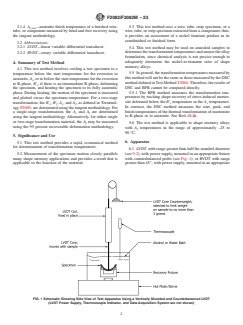
6.1 LVDT, with range greater than half the mandrel diameter
5.2 Measurement of the specimen motion closely parallels (see 9.2), with power supply, mounted in an appropriate fixture
many shape memory applications and provides a result that is with counterbalanced probe (see Fig. 1); or RVDT with range
applicable to the function of the material. greater than 45°, with power supply, mounted in an appropriate
FIG. 1 Schematic Showing Side View of Test Apparatus Using a Vertically Mounted and Counterbalanced LVDT
(LVDT Power Supply, Thermocouple Indicator, and Data Acquisition System are not shown)
F2082/F2082M − 23
fixture (see Fig. 2); or a vision system; or equivalent means of 8. Calibration
measuring sample displacement.
8.1 The thermocouple and indicator shall be kept in a
6.2 Thermocouple and Indicator, with resolution of 0.1 °C calibrated condition, traceable to the National Institute for
Standards and Technology or appropriate National Metrology
[0.2 °F] or better.
Institute that successfully participates in relevant international
6.3 XY Chart Recorder, or equivalent manual or automated
interlaboratory comparisons.
data acquisition system.
8.2 The thermocouple shall be calibrated using Test Method
6.4 Hot Plate and Stirrer.
E220.
6.5 Bath of Heat Transfer Fluid, for example, denatured
9. Procedure
alcohol, ethylene glycol, or water, or a fluid agreed upon
between the customer and supplier. 9.1 For alloys that are austenitic at room temperature, cool
a bath of appropriate heat transfer fluid to –55 °C [–67 °F] or
6.6 Mandrel, for deforming the sample in the martensitic
lower using liquid nitrogen, dry ice, or other suitable method.
state.
For alloys that are martensitic or R-phase at room temperature,
6.7 Fixture, for holding the sample during recovery.
cool the bath to 10 °C [50 °F] or lower.
6.8 Liquid Nitrogen, or dry ice.
9.2 Select a mandrel according to the sample diameter or
thickness to give an outer fiber strain of 2 to 2.5 %. For these
7. Sampling
strains, mandrel diameter shall be between 39 and 49 times
specimen diameter or thickness.
7.1 The test specimen shall be a wire, tube, or strip, or a
wire, tube, or strip specimen extracted from a component with
NOTE 2—Outer fiber strain, e%, is calculated as follows: e% (decimal
the specimen diameter or thickness in the range of 0.3 to
equivalent) = r / (r + R), where r = radius or half thickness of the test
specimen and R = radius of the mandrel. See Ref (5).
3.0 mm [0.012 to 0.12 in.].
7.1.1 For test systems that do not contact the specimen (for
9.3 Cut a test specimen long enough to wrap 90 to 180°
example, vision system), the diameter or thickness of the
around the mandrel.
specimen may be less than 0.3 mm.
9.4 Place the recovery fixture and the mandrel, along with
7.2 Specimens shall be tested in the annealed, aged, shape-
the test specimen, in the bath and wait a minimum of 3 min for
set, or tempered condition as defined in Terminology F2005 the fixture, mandrel, and specimen to equilibrate to the bath
and required by the product specification. temperature.
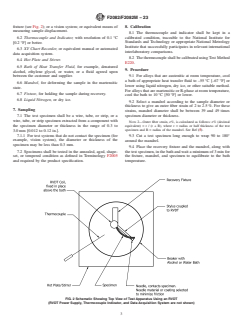
FIG. 2 Schematic Showing Top View of Test Apparatus Using an RVDT
(RVDT Power Supply, Thermocouple Indicator, and Data Acquisition System are not shown)
F2082/F2082M − 23
9.5 Deform the specimen in the bath by wrapping it 90 to and the displacement-versus-temperature cur
...
This document is not an ASTM standard and is intended only to provide the user of an ASTM standard an indication of what changes have been made to the previous version. Because
it may not be technically possible to adequately depict all changes accurately, ASTM recommends that users consult prior editions as appropriate. In all cases only the current version
of the standard as published by ASTM is to be considered the official document.
Designation: F2082/F2082M − 16 F2082/F2082M − 23
Standard Test Method for
Determination of Transformation Temperature of Nickel-
Titanium Shape Memory Alloys by Bend and Free Recovery
This standard is issued under the fixed designation F2082/F2082M; the number immediately following the designation indicates the year
of original adoption or, in the case of revision, the year of last revision. A number in parentheses indicates the year of last reapproval.
A superscript epsilon (´) indicates an editorial change since the last revision or reapproval.
1. Scope
1.1 This test method describes a procedure for quantitatively determining the martensite-to-austenite transformation temperatures
of either fully annealed or heat-treated nickel titanium alloys by or the martensite to R-phase transformation temperature of
annealed, aged, shape-set, or tempered nickel-titanium alloy specimens by deforming the specimen in bending and measuring the
deformation recovered during heating through the thermal transformation. transformation (BFR method). See 3.1.1.
NOTE 1—For aged, shape-set, or tempered specimens the transformation may be from martensite to austenite or from martensite to R-phase. See Reference
(1) for details.
1.2 The test specimen may be wire, tube, or strip or a specimen extracted from a semifinished or finished component.
1.2.1 For specimens not in the form of a wire, tube, or strip that are extracted from semifinished or finished components, a wire,
tube, or strip shaped test specimen shall be made from the component such that the deformation mode in the test specimen is pure
bending.
1.2.2 Other specimen geometries or displacements resulting in a more complex strain state, such as bending with torsion or
buckling, are beyond the scope of this standard.
1.3 Ruggedness tests have demonstrated that sample A must be limited to obtain good test results. See 5.6 for details. Ruggedness
f
tests have demonstrated that deformation strain, deformation temperature, and equilibration time at the deformation temperature
must be controlled to obtain good test results. See 9.1, 9.2, and 9.4 for details.
1.4 The values stated in either SI units or inch-pound units are to be regarded separately as standard. The values stated in each
system may not be exact equivalents; therefore, each system shall be used independently of the other. Combining values from the
two systems may result in non-conformancenonconformance with this standard.
1.5 This standard does not purport to address all of the safety concerns, if any, associated with its use. It is the responsibility
of the user of this standard to establish appropriate safety, health, and environmental practices and determine the applicability of
regulatory limitations prior to use.
1.6 This international standard was developed in accordance with internationally recognized principles on standardization
established in the Decision on Principles for the Development of International Standards, Guides and Recommendations issued
by the World Trade Organization Technical Barriers to Trade (TBT) Committee.
This test method is under the jurisdiction of ASTM Committee F04 on Medical and Surgical Materials and Devices and is the direct responsibility of Subcommittee
F04.15 on Material Test Methods.
Current edition approved April 1, 2016Oct. 15, 2023. Published May 2016October 2023. Originally approved in 2001. Last previous edition approved in 20152016 as
F2082 – 15.F2082/F2082M – 16. DOI: 10.1520/F2082_F2082M-16.10.1520/F2082_F2082M-23.
The boldface numbers in parentheses refer to a list of references at the end of this standard.
Copyright © ASTM International, 100 Barr Harbor Drive, PO Box C700, West Conshohocken, PA 19428-2959. United States
F2082/F2082M − 23
2. Referenced Documents
2.1 ASTM Standards:
E177 Practice for Use of the Terms Precision and Bias in ASTM Test Methods
E220 Test Method for Calibration of Thermocouples By Comparison Techniques
E691 Practice for Conducting an Interlaboratory Study to Determine the Precision of a Test Method
F2004 Test Method for Transformation Temperature of Nickel-Titanium Alloys by Thermal Analysis
F2005 Terminology for Nickel-Titanium Shape Memory Alloys
3. Terminology
3.1 Definitions of Terms Specific to This Standard:
3.1.1 Definitions—Specific technical terms used in this test method are found in Terminology F2005.
3.1.2 free recovery—recovery, n—unconstrained motion of a shape memory alloy specimen upon heating and transformation to
austenite or R-phase after deformation in a lower temperature phase.at a temperature below the temperature for the start of the
formation of martensite, M .
s
3.1.3 A —austenite finish temperature of a finished wire, tube, or component measured by bend and free recovery using the 95
f-95
percent recoverable deformation methodology.
3.1.4 A —austenite finish temperature of a finished wire, tube, or component measured by bend and free recovery using the
f-tan
tangent methodology.
3.2 Abbreviations:
3.2.1 LVDT—linear variable differential transducer.
3.2.2 RVDT—rotary variable differential transducer.
4. Summary of Test Method
4.1 This test method involves cooling a test specimen to its nominally fully martensitic phase, a temperature below the start
temperature for the reversion to austenite, A , or to below the start temperature for the reversion to R-phase, R' , if there is an
s s
intermediate R-phase, deforming the specimen, and heating the specimen to its fully austenitic phase. During heating, the motion
of the specimen is measured and plotted versus the specimen temperature. For a two-stage transformation, the R’R' ,R’R' ,A , and
s f s
A , as defined in Terminology F2005, are determined using the tangent methodology. For a single-stage transformation, the A and
f s
A are determined using the tangent methodology. Alternatively, for either single or two-stage transformation material, the A may
f f
be measured using the 95 percent recoverable deformation methodology.
5. Significance and Use
5.1 This test method provides a rapid, economical method for determination of transformation temperatures.
5.2 Measurement of the specimen motion closely parallels many shape memory applications and provides a result that is
applicable to the function of the material.
5.3 This test method uses a wire, tube, or strip samples; thus, it is able to provide strip specimen, or a wire, tube, or strip specimen
extracted from a component; thus, it provides an assessment of the a nickel titanium product in its semifinished or finished form.
5.4 This test method may be used on annealed samples to determine the transformation temperatures and assureensure the alloy
formulation, since chemical analysis is not precise enough to determine adequately determine the nickel-to-titanium ratio of shape
memory alloys.
For referenced ASTM standards, visit the ASTM website, www.astm.org, or contact ASTM Customer Service at service@astm.org. For Annual Book of ASTM Standards
volume information, refer to the standard’s Document Summary page on the ASTM website.
F2082/F2082M − 23
5.5 Transformation temperatures derived from this test method may differ from those derived from other methods as a result of
In general, the transformation temperatures measured by this method will not be the same as those measured by the DSC method
defined in Test Method F2004the effects of strain and load on the transformation temperature. Therefore, the results of DSC and
BFR cannot be compared directly.
5.5.1 The BFR method measures the transformation temperatures by tracking shape recovery of stress-induced martensite
deformed below the R' temperature or the A temperature. In contrast, the DSC method measures the start, peak, and finish
s s
temperatures of the thermal transformation of martensite to R-phase or to austenite. See Refs (1-4).
5.6 The test method is applicable to shape memory alloys with A temperatures in the range of approximately –25 to
f
6 90°C.90 °C.
6. Apparatus
6.1 LVDT, with range greater than half the mandrel diameter (see 9.2), with power supply, mounted in an appropriate fixture with
counterbalanced probe (see Fig. 1); or RVDT with range greater than 45°, with power supply, mounted in an appropriate fixture
(see Fig. 2); or a vision system; or equivalent means of measuring sample displacement.
6.2 Thermocouple and Indicator, with resolution of 0.1°C (0.2°F)0.1 °C [0.2 °F] or better.
6.3 XY Chart Recorder, or equivalent manual or automated data acquisition system.
6.4 Hot Plate and Stirrer.
6.5 Bath of Heat Transfer Fluid, for example, denatured alcohol, ethylene glycol, water, and so forth.or water, or a fluid agreed
upon between the customer and supplier.
FIG. 1 Schematic Showing Side View of Test Apparatus Using a Vertically Mounted and Counterbalanced LVDT
(LVDT Power Supply, Thermocouple Indicator, and Data Acquisition System are not shown)
F2082/F2082M − 23
FIG. 2 Schematic Showing Top View of Test Apparatus usingUsing an RVDT
(RVDT Power Supply, Thermocouple Indicator, and Data Acquisition System are not shown)
6.6 Mandrel, for deforming the sample in the martensitic state.
6.7 Fixture, for holding the sample during recovery.
6.8 Liquid Nitrogen, or dry ice.
7. Sampling
7.1 Test specimen canThe test specimen shall be a wire, tube, or strip with diameter or thickness in the range of 0.3 to 3.0 mm
(0.012 to 0.12 in.). For test systems that do not contact the specimen (for example, vision system), the strip, or a wire, tube, or
strip specimen extracted from a component with the specimen diameter or thickness may be less than 0.3 mm.in the range of 0.3
to 3.0 mm [0.012 to 0.12 in.].
7.1.1 For test systems that do not contact the specimen (for example, vision system), the diameter or thickness of the specimen
may be less than 0.3 mm.
7.2 Specimens mayshall be tested in the semifinished (heat-treated) or annealed condition. Anneal is annealed, aged, shape-set,
or tempered condition as defined in Terminology F2005. and required by the product specification.
8. Calibration
8.1 The thermocouple and indicator shall be kept in a calibrated condition, traceable to the National Institute for Standards and
Technology or appropriate National Metrology Institute that successfully participates in relevant international interlaboratory
comparisons.
8.2 The thermocouple shall be calibrated using Test Method E220.
F2082/F2082M − 23
9. Procedure
9.1 For alloys that are superelasticaustenitic at room temperature, cool a bath of appropriate heat transfer fluid to –55°C
(–67°F)–55 °C [–67 °F] or lower using liquid nitrogen, dry ice, or other suitable method. For alloys that are martensitic or R-phase
at room temperature, cool the bath to 10°C (50°F)10 °C [50 °F] or lower.
9.2 Select a mandrel according to the sample diameter or thickness to give an outer fiber strain of 2 to 2.5 %. For these strains,
mandrel diameter shall be between 39 and 49 times specimen diameter or thickness.
NOTE 2—Outer fiber strain, e%, is calculated as follows: e% (decimal equivalent) = r / (r + R), where r = radius or half thickness of the test specimen
and R = radius of the mandrel. See Ref (5).
9.3 Cut a test specimen long enough to wrap 90 to 180° around the mandrel.
9.4 Place the recovery fixture and the mandrel, along with the test specimen, in the bath and wait a minim
...