

ASTM F2516-22
(Test Method)Standard Test Method for Tension Testing of Nickel-Titanium Superelastic Materials
General Information
- Abstract
SIGNIFICANCE AND USE
5.1 Tension tests provide information on the strength and the elastic and plastic properties of materials under uniaxial tensile stresses.
5.2 Tension tests, as described in this test method, also provide information on the superelasticity, as defined in Terminology F2005, of the material at the test temperature.
SCOPE
1.1 This test method covers the tension testing of superelastic nickel-titanium (nitinol) materials, specifically the methods for determination of upper plateau strength, lower plateau strength, residual elongation, tensile strength, and elongation.
1.2 The values stated in SI units are to be regarded as standard. No other units of measurement are included in this standard.
1.3 This standard does not purport to address all of the safety concerns, if any, associated with its use. It is the responsibility of the user of this standard to establish appropriate safety, health, and environmental practices and determine the applicability of regulatory limitations prior to use.
1.4 This international standard was developed in accordance with internationally recognized principles on standardization established in the Decision on Principles for the Development of International Standards, Guides and Recommendations issued by the World Trade Organization Technical Barriers to Trade (TBT) Committee.
- Status
- Published
- Publication Date
- 31-May-2022
- Technical Committee
- F04 - Medical and Surgical Materials and Devices
- Drafting Committee
- F04.15 - Material Test Methods
Buy Documents
ASTM F2516-22 - Standard Test Method for Tension Testing of Nickel-Titanium Superelastic Materials
REDLINE ASTM F2516-22 - Standard Test Method for Tension Testing of Nickel-Titanium Superelastic Materials
Overview
ASTM F2516-22: Standard Test Method for Tension Testing of Nickel-Titanium Superelastic Materials provides a comprehensive approach for assessing the mechanical properties of Nickel-Titanium (NiTi, or nitinol) superelastic materials under uniaxial tensile stress. This standard is developed by ASTM International and is widely referenced for quality control, research, and development of shape memory alloys-key materials in industries such as medical devices and engineering.
The test evaluates crucial parameters including upper and lower plateau strengths, tensile strength, residual elongation, and overall elongation, offering valuable insights into material behavior, especially the superelastic and shape memory effects unique to these alloys.
Key Topics
Purpose of Tension Testing:
- Determines material strength and both elastic and plastic deformation characteristics.
- Specifically measures superelastic behavior, including reversible deformations under load.
Superelastic Nitinol Properties Assessed:
- Upper Plateau Strength: Maximum stress at a defined strain during loading.
- Lower Plateau Strength: Stress at a specified strain during unloading.
- Residual Elongation: Permanent strain left after unloading.
- Tensile Strength: Maximum stress endured prior to fracture.
- Uniform and Elongation at Fracture: Measures of ductility and failure points.
Test Method Requirements:
- Testing at specified temperatures above the austenitic finish transformation temperature ensures accurate superelastic assessment.
- Utilizes calibrated extensometers or precise crosshead displacement methods for strain measurement.
- Adheres to SI units as the standard measurement system.
Precision and Reproducibility:
- Results are validated via interlaboratory studies, highlighting repeatability and reproducibility across different diameters and testing environments.
Applications
Medical Devices:
- Quality control and design validation of stents, guidewires, orthodontic devices, and other products leveraging the unique superelastic and shape-memory properties of nitinol.
- Ensures biocompatibility and performance consistency under physiological conditions.
Industrial Engineering:
- Used in the manufacture and assessment of actuators, connectors, and couplings that require materials to withstand cyclical loading and recover original shapes.
Research and Development:
- Fundamental to the investigation of new NiTi alloys and superelastic materials.
- Supports innovation by providing standardized measurements for material comparisons.
Regulatory and Quality Assurance:
- Documentation for compliance with international requirements, including those related to product safety and reliability.
Related Standards
- ASTM E8/E8M: Standard Test Methods for Tension Testing of Metallic Materials
- ASTM E83: Practice for Verification and Classification of Extensometer Systems
- ASTM E111: Test Method for Young’s Modulus, Tangent Modulus, and Chord Modulus
- ASTM F2004: Test Method for Transformation Temperature of Nickel-Titanium Alloys by Thermal Analysis
- ASTM F2005: Terminology for Nickel-Titanium Shape Memory Alloys
- ASTM F2082/F2082M: Test Method for Determination of Transformation Temperature of Nickel-Titanium Shape Memory Alloys by Bend and Free Recovery
- ASTM E3098: Test Method for Mechanical Uniaxial Pre-strain and Thermal Free Recovery of Shape Memory Alloys
These related ASTM standards provide foundation and supplementary methods for the complete characterization of superelastic nickel-titanium materials, ensuring consistent, reliable, and internationally recognized test results.
Keywords: ASTM F2516, tension testing, superelastic nickel-titanium, nitinol, shape memory alloys, upper plateau strength, lower plateau strength, residual elongation, tensile strength, medical devices, mechanical properties testing.
Relations
- Effective Date
- 01-Jan-2024
- Effective Date
- 15-Oct-2023
- Effective Date
- 01-Nov-2017
- Effective Date
- 01-Oct-2017
- Effective Date
- 01-Dec-2016
- Effective Date
- 15-Jul-2016
- Effective Date
- 01-Feb-2015
- Effective Date
- 01-May-2014
- Effective Date
- 01-Jun-2013
- Effective Date
- 01-May-2013
- Effective Date
- 01-May-2013
- Effective Date
- 01-Dec-2011
- Effective Date
- 01-Nov-2011
- Effective Date
- 01-Dec-2010
- Effective Date
- 01-Oct-2010
Buy Documents
ASTM F2516-22 - Standard Test Method for Tension Testing of Nickel-Titanium Superelastic Materials
REDLINE ASTM F2516-22 - Standard Test Method for Tension Testing of Nickel-Titanium Superelastic Materials
Get Certified
Connect with accredited certification bodies for this standard

Element Materials Technology
Materials testing and product certification.

Inštitut za kovinske materiale in tehnologije
Institute of Metals and Technology. Materials testing, metallurgical analysis, NDT.
Sponsored listings
Frequently Asked Questions
ASTM F2516-22 is a standard published by ASTM International. Its full title is "Standard Test Method for Tension Testing of Nickel-Titanium Superelastic Materials". This standard covers: SIGNIFICANCE AND USE 5.1 Tension tests provide information on the strength and the elastic and plastic properties of materials under uniaxial tensile stresses. 5.2 Tension tests, as described in this test method, also provide information on the superelasticity, as defined in Terminology F2005, of the material at the test temperature. SCOPE 1.1 This test method covers the tension testing of superelastic nickel-titanium (nitinol) materials, specifically the methods for determination of upper plateau strength, lower plateau strength, residual elongation, tensile strength, and elongation. 1.2 The values stated in SI units are to be regarded as standard. No other units of measurement are included in this standard. 1.3 This standard does not purport to address all of the safety concerns, if any, associated with its use. It is the responsibility of the user of this standard to establish appropriate safety, health, and environmental practices and determine the applicability of regulatory limitations prior to use. 1.4 This international standard was developed in accordance with internationally recognized principles on standardization established in the Decision on Principles for the Development of International Standards, Guides and Recommendations issued by the World Trade Organization Technical Barriers to Trade (TBT) Committee.
SIGNIFICANCE AND USE 5.1 Tension tests provide information on the strength and the elastic and plastic properties of materials under uniaxial tensile stresses. 5.2 Tension tests, as described in this test method, also provide information on the superelasticity, as defined in Terminology F2005, of the material at the test temperature. SCOPE 1.1 This test method covers the tension testing of superelastic nickel-titanium (nitinol) materials, specifically the methods for determination of upper plateau strength, lower plateau strength, residual elongation, tensile strength, and elongation. 1.2 The values stated in SI units are to be regarded as standard. No other units of measurement are included in this standard. 1.3 This standard does not purport to address all of the safety concerns, if any, associated with its use. It is the responsibility of the user of this standard to establish appropriate safety, health, and environmental practices and determine the applicability of regulatory limitations prior to use. 1.4 This international standard was developed in accordance with internationally recognized principles on standardization established in the Decision on Principles for the Development of International Standards, Guides and Recommendations issued by the World Trade Organization Technical Barriers to Trade (TBT) Committee.
ASTM F2516-22 is classified under the following ICS (International Classification for Standards) categories: 77.120.40 - Nickel, chromium and their alloys. The ICS classification helps identify the subject area and facilitates finding related standards.
ASTM F2516-22 has the following relationships with other standards: It is inter standard links to ASTM E8/E8M-24, ASTM F2082/F2082M-23, ASTM E3098-17, ASTM F2004-17, ASTM F2004-16, ASTM E8/E8M-16, ASTM E8/E8M-15, ASTM E177-14, ASTM E8/E8M-13, ASTM E691-13, ASTM E177-13, ASTM E8/E8M-11, ASTM E691-11, ASTM F2005-05(2010), ASTM E177-10. Understanding these relationships helps ensure you are using the most current and applicable version of the standard.
ASTM F2516-22 is available in PDF format for immediate download after purchase. The document can be added to your cart and obtained through the secure checkout process. Digital delivery ensures instant access to the complete standard document.
Standards Content (Sample)
This international standard was developed in accordance with internationally recognized principles on standardization established in the Decision on Principles for the
Development of International Standards, Guides and Recommendations issued by the World Trade Organization Technical Barriers to Trade (TBT) Committee.
Designation: F2516 − 22
Standard Test Method for
Tension Testing of Nickel-Titanium Superelastic Materials
This standard is issued under the fixed designation F2516; the number immediately following the designation indicates the year of
original adoption or, in the case of revision, the year of last revision. A number in parentheses indicates the year of last reapproval. A
superscript epsilon (´) indicates an editorial change since the last revision or reapproval.
1. Scope E1876 Test Method for Dynamic Young’s Modulus, Shear
Modulus, and Poisson’s Ratio by Impulse Excitation of
1.1 This test method covers the tension testing of superelas-
Vibration
tic nickel-titanium (nitinol) materials, specifically the methods
E3098 Test Method for Mechanical Uniaxial Pre-strain and
for determination of upper plateau strength, lower plateau
Thermal Free Recovery of Shape Memory Alloys
strength, residual elongation, tensile strength, and elongation.
F2004 Test Method for Transformation Temperature of
1.2 The values stated in SI units are to be regarded as
Nickel-Titanium Alloys by Thermal Analysis
standard. No other units of measurement are included in this
F2005 Terminology for Nickel-Titanium Shape Memory
standard.
Alloys
1.3 This standard does not purport to address all of the F2082/F2082M Test Method for Determination of Transfor-
safety concerns, if any, associated with its use. It is the
mation Temperature of Nickel-Titanium Shape Memory
responsibility of the user of this standard to establish appro- Alloys by Bend and Free Recovery
priate safety, health, and environmental practices and deter-
mine the applicability of regulatory limitations prior to use. 3. Terminology
1.4 This international standard was developed in accor-
3.1 The definitions of terms relating to tension testing
dance with internationally recognized principles on standard-
appearing in Terminology E6 and the terms relating to nickel-
ization established in the Decision on Principles for the
titanium shape memory alloys appearing in Terminology
Development of International Standards, Guides and Recom-
F2005 shall be considered as applying to the terms used in this
mendations issued by the World Trade Organization Technical
test method. Engineering stress and strain are assumed unless
Barriers to Trade (TBT) Committee.
otherwise noted.Additional terms being defined are as follows
(see Fig. 1):
2. Referenced Documents
3.2 Definitions:
2.1 ASTM Standards:
3.2.1 alignment stress, n—stress (not to exceed 7 MPa)
E6 Terminology Relating to Methods of Mechanical Testing
appliedtothespecimenafteritisinstalledinthegripstoensure
E8/E8M Test Methods for Tension Testing of Metallic Ma-
that the specimen is straight and aligned to the grips.
terials
3.2.2 elongation at fracture (El ), n—elongation measured
fr
E83 Practice for Verification and Classification of Exten-
just prior to the sudden decrease in force associated with
someter Systems
fracture. See Fig. 1 and X1.2. E6
E111 Test Method for Young’s Modulus, Tangent Modulus,
and Chord Modulus
3.2.2.1 Discussion—Elongation at fracture results may be
E177 Practice for Use of the Terms Precision and Bias in
very sensitive to test variables such as test speed, specimen
ASTM Test Methods
geometry, heat dissipation, surface finish, and alignment. See
E691 Practice for Conducting an Interlaboratory Study to
Test Methods E8/E8M.
Determine the Precision of a Test Method
3.2.2.2 Discussion—Corrections for nonuniform strains be-
tween the extensometer attachments, including in the necked
region,arebeyondthescopeofthisstandard.SeeTestMethods
This test method is under the jurisdiction ofASTM Committee F04 on Medical
E8/E8M.
and Surgical Materials and Devices and is the direct responsibility of Subcommittee
3.2.3 fracture ductility (ɛ ), n—trueplasticstrainatfracture.
fr
F04.15 on Material Test Methods.
See X1.2. E6
Current edition approved June 1, 2022. Published June 2022. Originally
approved in 2005. Last previous edition approved in 2018 as F2516 – 18. DOI:
3.2.3.1 Discussion—For prismatic specimens, the fracture
10.1520/F2516-22.
For referenced ASTM standards, visit the ASTM website, www.astm.org, or ductility is calculated as follows:
contact ASTM Customer Service at service@astm.org. For Annual Book of ASTM
A 1
Standards volume information, refer to the standard’s Document Summary page on O
ε 5 ln 5 ln (1)
S D S D
fr
the ASTM website. A 1 2RA%⁄100
fr
Copyright © ASTM International, 100 Barr Harbor Drive, PO Box C700, West Conshohocken, PA 19428-2959. United States
F2516 − 22
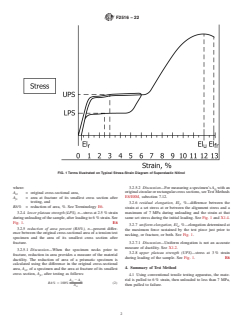
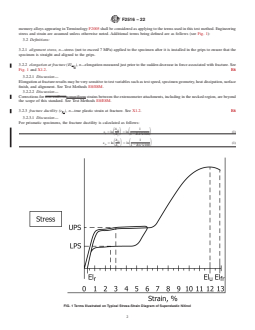
FIG. 1 Terms Illustrated on Typical Stress-Strain Diagram of Superelastic Nitinol
where: 3.2.5.2 Discussion—For measuring a specimen’s A with an
fr
originalcircularorrectangularcrosssections,seeTestMethods
A = original cross-sectional area,
O
A = area at fracture of its smallest cross section after E8/E8M, subection 7.12.
fr
testing, and
3.2.6 residual elongation, El,%—difference between the
f
RA% = reduction of area, %. See Terminology E6.
strain at a set stress at or between the alignment stress and a
3.2.4 lower plateau strength (LPS), n—stress at 2.5 % strain maximum of 7 MPa during unloading and the strain at that
duringunloadingofthesample,afterloadingto6 %strain.See same set stress during the initial loading. See Fig. 1 and X1.4.
Fig. 1. E6
3.2.7 uniform elongation, El ,%—elongation determined at
u
3.2.5 reduction of area percent (RA%), n—percent differ-
the maximum force sustained by the test piece just prior to
ence between the original cross-sectional area of a tension test
necking, or fracture, or both. See Fig. 1.
specimen and the area of its smallest cross section after
fracture. 3.2.7.1 Discussion—Uniform elongation is not an accurate
measure of ductility. See X1.2.
3.2.5.1 Discussion—When the specimen necks prior to
3.2.8 upper plateau strength (UPS)—stress at 3 % strain
fracture, reduction in area provides a measure of the material
during loading of the sample. See Fig. 1. E6
ductility. The reduction of area of a prismatic specimen is
calculated using the difference in the original cross-sectional
4. Summary of Test Method
area, A , of a specimen and the area at fracture of its smallest
O
cross section, A , after testing as follows:
fr
4.1 Using conventional tensile testing apparatus, the mate-
A 2 A rial is pulled to 6 % strain, then unloaded to less than 7 MPa,
O fr
RA% 5 100% (2)
A then pulled to failure.
O
F2516 − 22
NOTE 1—Strain should be measured using extensometer versus cross-
5. Significance and Use
head displacement, as this will result in a more accurate measurement of
5.1 Tension tests provide information on the strength and
strain.
the elastic and plastic properties of materials under uniaxial
8.1.4.1 When using a clip-on extensometer with small-
tensile stresses.
diameter wire, care shall be taken not to bend or distort the
5.2 Tension tests, as described in this test method, also
wire when attaching the extensometer.
provide information on the superelasticity, as defined in Ter-
8.1.5 Upper plateau strength shall be determined as the
minology F2005, of the material at the test temperature.
value of the stress at a strain of 3.0 % during the initial loading
of the specimen.
6. Apparatus
8.1.6 Lower plateau strength shall be determined as the
6.1 Apparatus is as described in Test Methods E8/E8M.
value of the stress at a strain of 2.5 % during the unloading of
the specimen.
7. Test Specimen
8.1.7 Residual elongation shall be determined by the differ-
7.1 Test specimens are as described in Test Methods E8/
ence between the strain at a set stress at or between the
E8M.
alignment stress and a maximum of 7 MPa during unloading
and the strain at that same set stress during the initial loading.
8. Procedure
NOTE 2—Slippage of the blades of a mechanical contact extensometer
8.1 Procedure shall be per Test Methods E8/E8M with the
can cause variations in the measurement of residual elongation. These
following additions:
errorsmaybepreventedbyusingO-ringbladesorothermodificationsthat
increase the contact friction between the mechanical contact extensometer
8.1.1 The material should be tested at a temperature that is
and the test specimen.
a minimum of 5 °C above the austenitic finish transformation
NOTE 3—If using a mechanical contact extensometer on a tensile test
temperature (A) in order to prevent testing of a partially
f
machine, systematic deviations in the measurement of residual elongation
transformed material. The temperature of the test should be
may not become apparent in a test method validation. Comparisons of
22.0 6 2.0 °C or 37 6 2.0 °C, unless otherwise specified. See
different extensometer types or test results from different labs using the
same extensometer may be required to confirm significant measurement
Terminology F2005 for the definition of A. See Test Methods
f
deviations due to extensometer blade slippage during tensile testing of
F2004, F2082/F2082M, and E3098 to determine A.
f
smooth-surfaced NiTi specimens.
8.1.2 The free-running crosshead speed shall be limited per
NOTE 4—Commercially available mechanical extensometers usually
Table 1. See X1.3.
cannot be calibrated to measure displacements below 0.02 mm. Depend-
8.1.3 The test shall consist of zeroing the test machine per ingongaugelengthandacceptancecriteria,thismaygiveanunacceptable
test precision for residual elongation.
Test Methods E8/E8M, gripping the specimen, loading the
specimen to the alignment stress, pulling the specimen to 6 %
8.1.8 The uniform elongation shall be determined by elon-
strain, revers
...
This document is not an ASTM standard and is intended only to provide the user of an ASTM standard an indication of what changes have been made to the previous version. Because
it may not be technically possible to adequately depict all changes accurately, ASTM recommends that users consult prior editions as appropriate. In all cases only the current version
of the standard as published by ASTM is to be considered the official document.
Designation: F2516 − 18 F2516 − 22
Standard Test Method for
Tension Testing of Nickel-Titanium Superelastic Materials
This standard is issued under the fixed designation F2516; the number immediately following the designation indicates the year of
original adoption or, in the case of revision, the year of last revision. A number in parentheses indicates the year of last reapproval. A
superscript epsilon (´) indicates an editorial change since the last revision or reapproval.
1. Scope
1.1 This test method covers the tension testing of superelastic nickel-titanium (nitinol) materials, specifically the methods for
determination of upper plateau strength, lower plateau strength, residual elongation, tensile strength, and elongation.
1.2 The values stated in SI units are to be regarded as standard. No other units of measurement are included in this standard.
1.3 This standard does not purport to address all of the safety concerns, if any, associated with its use. It is the responsibility
of the user of this standard to establish appropriate safety, health, and environmental practices and determine the applicability of
regulatory limitations prior to use.
1.4 This international standard was developed in accordance with internationally recognized principles on standardization
established in the Decision on Principles for the Development of International Standards, Guides and Recommendations issued
by the World Trade Organization Technical Barriers to Trade (TBT) Committee.
2. Referenced Documents
2.1 ASTM Standards:
E6 Terminology Relating to Methods of Mechanical Testing
E8/E8M Test Methods for Tension Testing of Metallic Materials
E83 Practice for Verification and Classification of Extensometer Systems
E111 Test Method for Young’s Modulus, Tangent Modulus, and Chord Modulus
E177 Practice for Use of the Terms Precision and Bias in ASTM Test Methods
E691 Practice for Conducting an Interlaboratory Study to Determine the Precision of a Test Method
E1876 Test Method for Dynamic Young’s Modulus, Shear Modulus, and Poisson’s Ratio by Impulse Excitation of Vibration
E3098 Test Method for Mechanical Uniaxial Pre-strain and Thermal Free Recovery of Shape Memory Alloys
F2004 Test Method for Transformation Temperature of Nickel-Titanium Alloys by Thermal Analysis
F2005 Terminology for Nickel-Titanium Shape Memory Alloys
F2082/F2082M Test Method for Determination of Transformation Temperature of Nickel-Titanium Shape Memory Alloys by
Bend and Free Recovery
3. Terminology
3.1 The definitions of terms relating to tension testing appearing in Terminology E6 and the terms relating to nickel-titanium shape
This test method is under the jurisdiction of ASTM Committee F04 on Medical and Surgical Materials and Devices and is the direct responsibility of Subcommittee
F04.15 on Material Test Methods.
Current edition approved Oct. 1, 2018June 1, 2022. Published October 2018June 2022. Originally approved in 2005. Last previous edition approved in 20142018 as
F2516 – 14.F2516 – 18. DOI: 10.1520/F2516-18.10.1520/F2516-22.
For referenced ASTM standards, visit the ASTM website, www.astm.org, or contact ASTM Customer Service at service@astm.org. For Annual Book of ASTM Standards
volume information, refer to the standard’s Document Summary page on the ASTM website.
Copyright © ASTM International, 100 Barr Harbor Drive, PO Box C700, West Conshohocken, PA 19428-2959. United States
F2516 − 22
memory alloys appearing in Terminology F2005 shall be considered as applying to the terms used in this test method. Engineering
stress and strain are assumed unless otherwise noted. Additional terms being defined are as follows (see Fig. 1):
3.2 Definitions:
3.2.1 alignment stress, n—stress (not to exceed 7 MPa) applied to the specimen after it is installed in the grips to ensure that the
specimen is straight and aligned to the grips.
3.2.2 elongation at fracture (El ), n—elongation measured just prior to the sudden decrease in force associated with fracture. See
Ffr
Fig. 1 and X1.2. E6
3.2.2.1 Discussion—
Elongation at fracture results may be very sensitive to test variables such as test speed, specimen geometry, heat dissipation, surface
finish, and alignment. See Test Methods E8/E8M.
3.2.2.2 Discussion—
Corrections for non-uniformnonuniform strains between the extensometer attachments, including in the necked region, are beyond
the scope of this standard. See Test Methods E8/E8M.
3.2.3 fracture ductility (ɛ ), n—true plastic strain at fracture. See X1.2. E6
ffr
3.2.3.1 Discussion—
For prismatic specimens, the fracture ductility is calculated as follows:
A 1
O
ε 5 ln 5 ln (1)
S D S D
f
A 12 RA%⁄100
f
A 1
O
ε 5 ln 5 ln (1)
S D S D
fr
A 12 RA%⁄100
fr
FIG. 1 Terms Illustrated on Typical Stress-Strain Diagram of Superelastic Nitinol
F2516 − 22
where:
A = original cross-sectional area,
O
A = area at fracture of its smallest cross section after testing, and
f
A = area at fracture of its smallest cross section after testing, and
fr
RA% = reduction of area, %. See Terminology E6.
3.2.4 lower plateau strength (LPS), n—stress at 2.5 % strain during unloading of the sample, after loading to 6 % strain. See Fig.
1. E6
3.2.5 reduction of area percent (RA%), n—percent difference between the original cross-sectional area of a tension test specimen
and the area of its smallest cross section after fracture.
3.2.5.1 Discussion—
When the specimen necks prior to fracture, reduction in area provides a measure of the material ductility. The reduction of area
of a prismatic specimen is calculated using the difference in the original cross-sectional area, A , of a specimen and the area at
O
fracture of its smallest cross section, A , after testing as follows:
ffr
A 2 A
O f
RA%5 100% (2)
A
O
A 2 A
O fr
RA%5 100% (2)
A
O
3.2.5.2 Discussion—
For measuring a specimen’s A with an original circular or rectangular cross sections, see Test Methods E8/E8M, Sectionsubection
ffr
7.12.
3.2.6 residual elongation, El , %—difference between the strain at a set stress at or between the alignment stress and a maximum
f
of 7 MPa during unloading and the strain at that same set stress during the initial loading. See Fig. 1 and X1.4.
3.2.7 uniform elongation, El , %—elongation determined at the maximum force sustained by the test piece just prior to necking,
u
or fracture, or both. See Fig. 1.
3.2.7.1 Discussion—
Uniform elongation is not an accurate measure of ductility. See X1.2.
3.2.8 upper plateau strength (UPS)—stress at 3 % strain during loading of the sample. See Fig. 1. E6
4. Summary of Test Method
4.1 Using conventional tensile testing apparatus, the material is pulled to 6 % strain, then unloaded to less than 7 MPa, then pulled
to failure.
5. Significance and Use
5.1 Tension tests provide information on the strength and the elastic and plastic properties of materials under uniaxial tensile
stresses.
5.2 Tension tests, as described in this test method, also provide information on the superelasticity, as defined in Terminology
F2005, of the material at the test temperature.
6. Apparatus
6.1 Apparatus is as described in Test Methods E8/E8M.
7. Test Specimen
7.1 Test specimens are as described in Test Methods E8/E8M.
F2516 − 22
8. Procedure
8.1 Procedure shall be per Test Methods E8/E8M with the following additions:
8.1.1 The material should be tested at a temperature that is a minimum of 5°C5 °C above the austenitic finish transformation
temperature (A ) in order to prevent testing of a partially transformed material. The temperature of the test should be 22.0 6
f
2.0°C2.0 °C or 37 6 2.0°C,2.0 °C, unless otherwise specified. See Terminology F2005 for the definition of A . See Test Methods
f
F2004, F2082/F2082M, and E3098 to determine A .
f
8.1.2 The free-running crosshead speed shall be limited per Table 1. See X1.3.
8.1.3 The test shall consist of zeroing the test machine per Test MethodMethods E8/E8M, gripping the specimen, loading the
specimen to the alignment stress, pulling the specimen to 6 % strain, reversing the motion to unload the specimen to the alignment
stress, and then pulling the specimen to failure. See X1.4.
8.1.4 For materials with diameter greater than 0.2 mm, strain shall be determined by use of a calibrated extensometer of classClass
C or better (see Practice E83). For materials with diameter less than or equal to 0.2 mm, strain may be determined by use of an
extensometer or by crosshead motion. When using crosshead motion to calculate strain, the length between the grips shall be a
minimum of 150 mm. See X1.5.
NOTE 1—Strain should be measured using extensometer versus crosshead displacement, as this will result in a more accurate measurement of strain.
8.1.4.1 When using a clip-on extensometer with small-diameter wire, care shall be taken not to bend or distort the wire when
attaching the extensometer.
8.1.5 Upper plateau strength shall be determined as the value of the stress at a strain of 3.0 % during the initial loading of the
specimen.
8.1.6 Lower plateau strength shall be determined as the value of the stress at a strain of 2.5 % during the unloading of the
specimen.
8.1.7 Residual elongation shall be determined by the difference between the strain at a set stress at or between the alignment stress
and a maximum of 7 MPa during unloading and the strain at that same set stress during the initial loading.
NOTE 2—Slippage of the blades of a mechanical contact extensometer can cause variations in the measurement of residual elongation. These errors may
be prevented by using O-ring blades or other modifications that increase the contact friction between the mechanical contact extensometer and the test
specimen.
NOTE 3—If using a mechanical contact extensometer on a tensile test machine, systematic deviations in the measurement of residual el
...