

ASTM F3228-21
(Specification)Standard Specification for Flight Data and Voice Recording in Small Aircraft
General Information
- Abstract
SCOPE
1.1 This specification covers international standards for the flight recording aspects of airworthiness and design for “small” aircraft.
1.2 The applicant for a design approval must seek the individual guidance of their respective civil aviation authority (CAA) body concerning the use of this specification as part of a certification plan. For information on which CAA regulatory bodies have accepted this specification (in whole or in part) as a means of compliance to their Small Aircraft Airworthiness regulations (hereinafter referred to as “the Rules”), refer to ASTM F44 webpage (www.ASTM.org/COMMITTEE/F44.htm), which includes CAA website links. Annex A1 maps the Means of Compliance described in this specification to EASA CS-23, amendment 5, or later, and FAA 14 CFR Part 23, amendment 64, or later.
1.3 This standard does not purport to address all of the safety concerns, if any, associated with its use. It is the responsibility of the user of this standard to establish appropriate safety, health, and environmental practices and determine the applicability of regulatory limitations prior to use.
1.4 This international standard was developed in accordance with internationally recognized principles on standardization established in the Decision on Principles for the Development of International Standards, Guides and Recommendations issued by the World Trade Organization Technical Barriers to Trade (TBT) Committee.
- Status
- Published
- Publication Date
- 31-Aug-2021
- Technical Committee
- F44 - General Aviation Aircraft
- Drafting Committee
- F44.50 - Systems and Equipment
Buy Documents
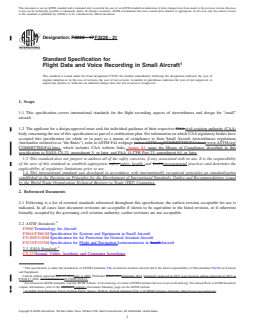
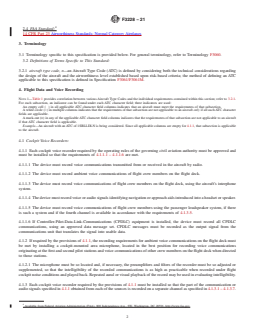
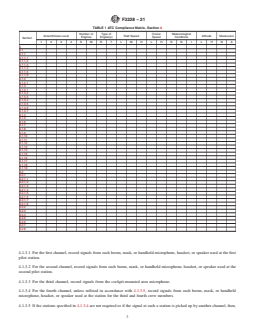
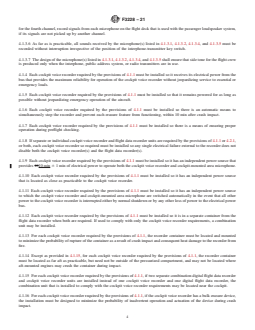
ASTM F3228-21 - Standard Specification for Flight Data and Voice Recording in Small Aircraft
REDLINE ASTM F3228-21 - Standard Specification for Flight Data and Voice Recording in Small Aircraft
Overview
ASTM F3228-21 sets forth international standards for flight data and voice recording in small aircraft, optimizing airworthiness and design compliance. Developed by ASTM International and maintained under Committee F44, this standard focuses on specifications for the installation, operation, and safety features of flight data recorders (FDR) and cockpit voice recorders (CVR) tailored to small aircraft operations. The specification is recognized as a key means of compliance by certain regulatory bodies, such as the FAA and EASA, under applicable sections of 14 CFR Part 23 and CS-23.
The primary objective is to ensure reliable recording of cockpit communications and essential flight data, enhancing aircraft safety, facilitating accident investigations, and supporting regulatory certification for small aircraft.
Key Topics
Scope and Regulatory Context
- Covers requirements for CVR and FDR systems in “small” aircraft
- Applies to new certifications or retrofits, subject to national civil aviation authority (CAA) adoption
- Provides mapping to FAA (14 CFR Part 23) and EASA (CS-23) rules
Installation and Performance Criteria
- Voice recorders must capture all pertinent cockpit communications, including radio transmissions, interphone, ambient sounds, and certain public address communications
- Flight data recorders must document key operational parameters such as airspeed, altitude, and heading using accurate data sources
- Recorders must have durable, crash-survivable containers in bright orange or yellow with reflective tape and, where required, an underwater locating device
Power and Survivability
- Recorders must receive power from reliable aircraft buses without compromising vital systems
- Provisions for independent power sources to maintain operation after primary power is lost
- Installation requirements to minimize risk of damage from crash impact, fire, and water immersion
System Redundancy and Separation
- Separate containers for voice and data recorders when both are installed (unless using approved combination units)
- Protection against the simultaneous loss of both recorders due to electrical failure
Pre-Flight and Maintenance Checks
- Requirements for preflight checking and verification of recording
Means of Compliance
- Annexes provide detailed correlation tables that map each requirement to the specific regulatory paragraphs in FAA and EASA standards, supporting streamlined certification
Applications
Type Certification and Airworthiness Approval
- Provides a recognized standard for manufacturers, modifiers, and operators to demonstrate compliance during type certification or supplemental type certification with FAA and EASA regulations for small aircraft
- Assists applicants and authorities in establishing conformity with requirements for CVR and FDR equipment
Safety and Accident Investigation
- Enhances post-event investigation capability through standardized, reliable data and voice capture
- Supports accident prevention initiatives by enabling detailed safety analysis
Regulatory Acceptance
- Recommended for use in certification plans, with applicants advised to consult their CAA for specific acceptance and guidance
- Supports global harmonization of small aircraft flight data and cockpit voice recording requirements
Related Standards
- ASTM F3060: Terminology for Aircraft
- ASTM F3061/F3061M: Specification for Systems and Equipment in Small Aircraft
- ASTM F3120/F3120M: Specification for Ice Protection in General Aviation Aircraft
- ASTM F3233/F3233M: Specification for Flight and Navigation Instrumentation in Small Aircraft
- EASA CS-23: Certification Specification for Normal, Utility, Aerobatic, and Commuter Aeroplanes
- FAA 14 CFR Part 23: Airworthiness Standards - Normal Category Airplanes
These related standards further clarify technical definitions, systems integration, instrumentation, and compliance pathways, supporting comprehensive safety and regulatory frameworks in small aircraft operations.
Keywords: ASTM F3228-21, flight data recorder, cockpit voice recorder, small aircraft, airworthiness, FAA, EASA, flight recording, aircraft safety, aviation standards
Relations
- Refers
ASTM F3233/F3233M-23a - Standard Specification for Flight and Navigation Instrumentation in Aircraft - Effective Date
- 01-Nov-2023
- Effective Date
- 01-Oct-2023
- Effective Date
- 01-Jan-2020
- Effective Date
- 01-Nov-2019
- Effective Date
- 01-Jun-2019
- Effective Date
- 15-Feb-2017
- Effective Date
- 01-Dec-2016
- Effective Date
- 01-Nov-2016
- Effective Date
- 01-Aug-2016
- Effective Date
- 01-Apr-2016
- Effective Date
- 01-Feb-2016
- Refers
ASTM F3120/F3120M-15 - Standard Specification for Ice Protection for General Aviation Aircraft - Effective Date
- 01-Dec-2015
- Effective Date
- 15-Sep-2015
- Effective Date
- 01-May-2015
- Effective Date
- 01-Mar-2015
Buy Documents
ASTM F3228-21 - Standard Specification for Flight Data and Voice Recording in Small Aircraft
REDLINE ASTM F3228-21 - Standard Specification for Flight Data and Voice Recording in Small Aircraft
Get Certified
Connect with accredited certification bodies for this standard

BSI Group
BSI (British Standards Institution) is the business standards company that helps organizations make excellence a habit.

Bureau Veritas
Bureau Veritas is a world leader in laboratory testing, inspection and certification services.

DNV
DNV is an independent assurance and risk management provider.
Sponsored listings
Frequently Asked Questions
ASTM F3228-21 is a technical specification published by ASTM International. Its full title is "Standard Specification for Flight Data and Voice Recording in Small Aircraft". This standard covers: SCOPE 1.1 This specification covers international standards for the flight recording aspects of airworthiness and design for “small” aircraft. 1.2 The applicant for a design approval must seek the individual guidance of their respective civil aviation authority (CAA) body concerning the use of this specification as part of a certification plan. For information on which CAA regulatory bodies have accepted this specification (in whole or in part) as a means of compliance to their Small Aircraft Airworthiness regulations (hereinafter referred to as “the Rules”), refer to ASTM F44 webpage (www.ASTM.org/COMMITTEE/F44.htm), which includes CAA website links. Annex A1 maps the Means of Compliance described in this specification to EASA CS-23, amendment 5, or later, and FAA 14 CFR Part 23, amendment 64, or later. 1.3 This standard does not purport to address all of the safety concerns, if any, associated with its use. It is the responsibility of the user of this standard to establish appropriate safety, health, and environmental practices and determine the applicability of regulatory limitations prior to use. 1.4 This international standard was developed in accordance with internationally recognized principles on standardization established in the Decision on Principles for the Development of International Standards, Guides and Recommendations issued by the World Trade Organization Technical Barriers to Trade (TBT) Committee.
SCOPE 1.1 This specification covers international standards for the flight recording aspects of airworthiness and design for “small” aircraft. 1.2 The applicant for a design approval must seek the individual guidance of their respective civil aviation authority (CAA) body concerning the use of this specification as part of a certification plan. For information on which CAA regulatory bodies have accepted this specification (in whole or in part) as a means of compliance to their Small Aircraft Airworthiness regulations (hereinafter referred to as “the Rules”), refer to ASTM F44 webpage (www.ASTM.org/COMMITTEE/F44.htm), which includes CAA website links. Annex A1 maps the Means of Compliance described in this specification to EASA CS-23, amendment 5, or later, and FAA 14 CFR Part 23, amendment 64, or later. 1.3 This standard does not purport to address all of the safety concerns, if any, associated with its use. It is the responsibility of the user of this standard to establish appropriate safety, health, and environmental practices and determine the applicability of regulatory limitations prior to use. 1.4 This international standard was developed in accordance with internationally recognized principles on standardization established in the Decision on Principles for the Development of International Standards, Guides and Recommendations issued by the World Trade Organization Technical Barriers to Trade (TBT) Committee.
ASTM F3228-21 is classified under the following ICS (International Classification for Standards) categories: 49.020 - Aircraft and space vehicles in general. The ICS classification helps identify the subject area and facilitates finding related standards.
ASTM F3228-21 has the following relationships with other standards: It is inter standard links to ASTM F3233/F3233M-23a, ASTM F3061/F3061M-23b, ASTM F3060-20, ASTM F3061/F3061M-19a, ASTM F3061/F3061M-19, ASTM F3061/F3061M-17, ASTM F3061/F3061M-16b, ASTM F3060-16a, ASTM F3061/F3061M-16a, ASTM F3060-16, ASTM F3061/F3061M-16, ASTM F3120/F3120M-15, ASTM F3060-15b, ASTM F3060-15a, ASTM F3060-15. Understanding these relationships helps ensure you are using the most current and applicable version of the standard.
ASTM F3228-21 is available in PDF format for immediate download after purchase. The document can be added to your cart and obtained through the secure checkout process. Digital delivery ensures instant access to the complete standard document.
Standards Content (Sample)
This international standard was developed in accordance with internationally recognized principles on standardization established in the Decision on Principles for the
Development of International Standards, Guides and Recommendations issued by the World Trade Organization Technical Barriers to Trade (TBT) Committee.
Designation:F3228 −21
Standard Specification for
Flight Data and Voice Recording in Small Aircraft
This standard is issued under the fixed designation F3228; the number immediately following the designation indicates the year of
original adoption or, in the case of revision, the year of last revision.Anumber in parentheses indicates the year of last reapproval.A
superscript epsilon (´) indicates an editorial change since the last revision or reapproval.
1. Scope 2.2 ASTM Standards:
F3060Terminology for Aircraft
1.1 This specification covers international standards for the
F3061/F3061MSpecification for Systems and Equipment in
flightrecordingaspectsofairworthinessanddesignfor“small”
Small Aircraft
aircraft.
F3120/F3120MSpecification for Ice Protection for General
1.2 The applicant for a design approval must seek the Aviation Aircraft
individual guidance of their respective civil aviation authority
F3233/F3233MSpecification for Flight and Navigation In-
(CAA) body concerning the use of this specification as part of strumentation in Aircraft
a certification plan. For information on which CAAregulatory
2.3 EASA Standard:
bodies have accepted this specification (in whole or in part) as
CS-23Normal,Utility,AerobaticandCommuterAeroplanes
a means of compliance to their Small Aircraft Airworthiness
2.4 FAA Standard:
regulations (hereinafter referred to as “the Rules”), refer to
14 CFR Part 23Airworthiness Standards: Normal Category
ASTM F44 webpage (www.ASTM.org/COMMITTEE/
Airplanes
F44.htm), which includes CAAwebsite links. AnnexA1 maps
3. Terminology
the Means of Compliance described in this specification to
EASACS-23,amendment5,orlater,andFAA14CFRPart23,
3.1 Terminology specific to this specification is provided
amendment 64, or later.
below. For general terminology, refer to Terminology F3060.
1.3 This standard does not purport to address all of the
3.2 Definitions of Terms Specific to This Standard:
safety concerns, if any, associated with its use. It is the
3.2.1 aircraft type code, n—anAircraftType Code (ATC) is
responsibility of the user of this standard to establish appro-
defined by considering both the technical considerations re-
priate safety, health, and environmental practices and deter-
garding the design of the aircraft and the airworthiness level
mine the applicability of regulatory limitations prior to use.
established based upon risk-based criteria; the method of
1.4 This international standard was developed in accor-
defining an ATC applicable to this specification is defined in
dance with internationally recognized principles on standard- Specification F3061/F3061M.
ization established in the Decision on Principles for the
4. Flight Data and Voice Recording
Development of International Standards, Guides and Recom-
NOTE 1—Table 1 provides correlation between various Aircraft Type
mendations issued by the World Trade Organization Technical
Codesandtheindividualrequirementscontainedwithinthissection;refer
Barriers to Trade (TBT) Committee.
to 3.2.1. For each subsection, an indicator can be found under each ATC
character field; three indicators are used:
2. Referenced Documents An empty cell ( ) in all applicable ATC character field columns
indicates that an aircraft must meet the requirements of that subsection.
2.1 Following is a list of external standards referenced
A white circle (○) in multiple columns indicates that the requirements
throughout this specification; the earliest revision acceptable of that subsection are not applicable to an aircraft only if all such ATC
character fields are applicable.
for use is indicated. In all cases later document revisions are
A mark-out (×) in any of the applicable ATC character field columns
acceptableifshowntobeequivalenttothelistedrevision,orif
indicates that the requirements of that subsection are not applicable to an
otherwise formally accepted by the governing civil aviation
aircraft if that ATC character field is applicable.
authority; earlier revisions are not acceptable.
For referenced ASTM standards, visit the ASTM website, www.astm.org, or
contact ASTM Customer Service at service@astm.org. For Annual Book of ASTM
ThisspecificationisunderthejurisdictionofASTMCommitteeF44onGeneral Standards volume information, refer to the standard’s Document Summary page on
Aviation Aircraft and is the direct responsibility of Subcommittee F44.50 on the ASTM website.
Systems and Equipment. Available from European Union Aviation Safety Agency (EASA), Konrad-
Current edition approved Sept. 1, 2021. Published September 2021. Originally Adenauer-Ufer 3, D-50668 Cologne, Germany, https://www.easa.europa.eu.
approved in 2017. Last previous edition approved in 2017 as F3228-17. DOI: Available from Federal Aviation Administration (FAA), 800 Independence
10.1520/F3228-21. Ave., SW, Washington, DC 20591, http://www.faa.gov.
Copyright © ASTM International, 100 Barr Harbor Drive, PO Box C700, West Conshohocken, PA 19428-2959. United States
F3228−21
TABLE 1 ATC Compliance Matrix, Section 4
Number of Type of Cruise Meteorological
Airworthiness Level Stall Speed Altitude Maneuvers
Engines Engine(s) Speed Conditions
Section
12 34 S M R T L M H L H D N I L H N A
4.1
4.1.1
4.1.1.1
4.1.1.2
4.1.1.3
4.1.1.4
4.1.1.5
4.1.1.6
4.1.2
4.1.2.1
4.1.3
4.1.3.1
4.1.3.2
4.1.3.3
4.1.3.4
4.1.3.5
4.1.3.6
4.1.3.7
4.1.4
4.1.5
4.1.6
4.1.7
4.1.8
4.1.9
4.1.10
4.1.11
4.1.12
4.1.13
4.1.14
4.1.15
4.1.16
4.1.17
4.1.18
4.1.19
4.2
4.2.1
4.2.1.1
4.2.1.2
4.2.1.3
4.2.1.4
4.2.1.5
4.2.1.6
4.2.1.7
4.2.1.8
4.2.2
4.2.3
4.2.4
4.2.5
4.2.6
4.2.7
4.2.8
Example—AnaircraftwithanATCof1SRLLDLNisbeingconsidered.
4.1.1.3 The device must record voice communications of
Since all applicable columns are empty for 4.1.1, that subsection is
flight crew members on the flight deck, using the aircraft’s
applicable to the aircraft.
interphone system.
4.1 Cockpit Voice Recorders:
4.1.1.4 The device must record voice or audio signals
4.1.1 Each cockpit voice recorder required by the operating
identifying navigation or approach aids introduced into a
rules of the governing civil aviation authority must be ap-
headset or speaker.
provedandmustbeinstalledsothattherequirementsof4.1.1.1
4.1.1.5 The device must record voice communications of
– 4.1.1.6 are met.
flight crew members using the passenger loudspeaker system,
4.1.1.1 The device must record voice communications if there is such a system and if the fourth channel is available
transmitted from or received in the aircraft by radio.
in accordance with the requirements of 4.1.3.5.
4.1.1.2 The device must record ambient voice communica- 4.1.1.6 If Controller-Pilot-Data-Link-Communications (CP-
tions of flight crew members on the flight deck. DLC) equipment is installed, the device must record all
F3228−21
CPDLC communications, using an approved data message set. 4.1.6 Eachcockpitvoicerecorderrequiredbytheprovisions
CPDLC messages must be recorded as the output signal from of 4.1.1 must be installed so there is an automatic means to
the communications unit that translates the signal into usable simultaneously stop the recorder and prevent each erasure
data. feature from functioning, within 10min after crash impact.
4.1.2 If required by the provisions of 4.1.1, the recording
4.1.7 Eachcockpitvoicerecorderrequiredbytheprovisions
requirements for ambient voice communications on the flight
of4.1.1mustbeinstalledsothereisameansofensuringproper
deck must be met by installing a cockpit-mounted area
operation during preflight checking.
microphone, located in the best position for recording voice
4.1.8 If separate or individual cockpit voice recorder and
communications originating at the first and second pilot
flightdatarecorderunitsarerequiredbytheprovisionsof4.1.1
stations and voice communications of other crew members on
or 4.2.1, or both, each cockpit voice recorder so required must
the flight deck when directed to those stations.
be installed so any single electrical failure external to the
4.1.2.1 The microphone must be so located and, if
recorderdoesnotdisableboththecockpitvoicerecorder(s)and
necessary, the preamplifiers and filters of the recorder must be
the flight data recorder(s).
so adjusted or supplemented, so that the intelligibility of the
4.1.9 Eachcockpitvoicerecorderrequiredbytheprovisions
recorded communications is as high as practicable when
of 4.1.1 must be installed so it has an independent power
recordedunderflightcockpitnoiseconditionsandplayedback.
source that provides 10min 6 1min of electrical power to
Repeatedauralorvisualplaybackoftherecordmaybeusedin
operate both the cockpit voice recorder and cockpit-mounted
evaluating intelligibility.
area microphone.
4.1.3 Eachcockpitvoicerecorderrequiredbytheprovisions
4.1.10 Each cockpit voice recorder required by the provi-
of4.1.1mustbeinstalledsothatthepartofthecommunication
sions of 4.1.1 must be installed so it has an independent power
or audio signals specified in 4.1.1 obtained from each of the
source that is located as close as practicable to the cockpit
sourcesisrecordedonaseparatechannelasspecifiedin4.1.3.1
voice recorder.
– 4.1.3.7.
4.1.11 Each cockpit voice recorder required by the provi-
4.1.3.1 Forthefirstchannel,recordsignalsfromeachboom,
sions of 4.1.1 must be installed so it has an independent power
mask, or handheld microphone, headset, or speaker used at the
source to which the cockpit voice recorder and cockpit-
first pilot station.
mounted area microphone are switched automatically in the
4.1.3.2 For the second channel, record signals from each
event that all other power to the cockpit voice recorder is
boom,mask,orhandheldmicrophone,headset,orspeakerused
interrupted either by normal shutdown or by any other loss of
at the second pilot station.
power to the electrical power bus.
4.1.3.3 For the third channel, record signals from the
4.1.12 Each cockpit voice recorder required by the provi-
cockpit-mounted area microphone.
sions of 4.1.1 must be installed so it is in a separate container
4.1.3.4 Forthefourthchannel,unlessutilizedinaccordance
from the flight data recorder when both are required. If used to
with 4.1.3.5, record signals from each boom, mask, or hand-
comply with only the cockpit voice recorder requirements, a
heldmicrophone,headset,orspeakerusedatthestationforthe
combination unit may be installed.
third and fourth crew members.
4.1.13 For each cockpit voice recorder required by the
4.1.3.5 Ifthestationsspecifiedin4.1.3.4arenotrequiredor
provisions of 4.1.1, the recorder container must be located and
if the signal at such a station is picked up by another channel,
mountedtominimizetheprobabilityofruptureofthecontainer
then, for the fourth channel, record signals from each micro-
as a result of crash impact and consequent heat damage to the
phone on the flight deck that is used with the passenger
recorder from fire.
loudspeaker system, if its signals are not picked up by another
4.1.14 Except as provided in 4.1.15, for each cockpit voice
channel.
recorder required by the provisions of 4.1.1, the recorder
4.1.3.6 As far as is practicable, all sounds received by the
containermustbelocatedasfaraftaspracticable,butneednot
microphone(s) listed in 4.1.3.1, 4.1.3.2, 4.1.3.4, and 4.1.3.5
be outside of the pressurized compartment, and may not be
must be recorded without interruption irrespective of the
located where aft-mounted engines may crush the container
position of the interphone-transmitter key switch.
during impact.
4.1.3.7 The design of the microphone(s) listed in 4.1.3.1,
4.1.3.2, 4.1.3.4, and 4.1.3.5 shall ensure that side tone for the 4.1.15 For each cockpit voice recorder required by the
provisions of 4.1.1, if two separate combination digital flight
flight crew is produced only when the interphone, public
address system, or radio transmitters are in use. data recorder and cockpit voice recorder units are installed
insteadofonecockpitvoicerecorderandonedigitalflightdata
4.1.4 Eachcockpitvoicerecorderrequiredbytheprovisions
recorder, the combination unit that is installed to comply with
of 4.1.1 must be installed so it receives its electrical power
the cockpit voice recorder requirements may be located near
from the bus that provides the maximum reliability for opera-
the cockpit.
tion of the cockpit voice recorder without jeopardizing service
to essential or emergency loads.
4.1.16 For each cockpit voice recorder required by the
4.1.5 Eachcockpitvoicerecorderrequiredbyt
...
This document is not an ASTM standard and is intended only to provide the user of an ASTM standard an indication of what changes have been made to the previous version. Because
it may not be technically possible to adequately depict all changes accurately, ASTM recommends that users consult prior editions as appropriate. In all cases only the current version
of the standard as published by ASTM is to be considered the official document.
Designation: F3228 − 17 F3228 − 21
Standard Specification for
Flight Data and Voice Recording in Small Aircraft
This standard is issued under the fixed designation F3228; the number immediately following the designation indicates the year of
original adoption or, in the case of revision, the year of last revision. A number in parentheses indicates the year of last reapproval. A
superscript epsilon (´) indicates an editorial change since the last revision or reapproval.
1. Scope
1.1 This specification covers international standards for the flight recording aspects of airworthiness and design for “small”
aircraft.
1.2 The applicant for a design approval must seek the individual guidance of their respective CAA civil aviation authority (CAA)
body concerning the use of this specification as part of a certification plan. For information on which CAA regulatory bodies have
accepted this specification (in whole or in part) as a means of compliance to their Small Aircraft Airworthiness regulations
(hereinafter referred to as “the Rules”), refer to ASTM F44 webpage (www.ASTM.org/COMMITTEE/F44.htm)(www.ASTM.org/
COMMITTEE/F44.htm), which includes CAA website links. Annex A1 maps the Means of Compliance described in this
specification to EASA CS-23, amendment 5, or later, and FAA 14 CFR Part 23, amendment 64, or later.
1.3 This standard does not purport to address all of the safety concerns, if any, associated with its use. It is the responsibility
of the user of this standard to establish appropriate safety safety, health, and healthenvironmental practices and determine the
applicability of regulatory limitations prior to use.
1.4 This international standard was developed in accordance with internationally recognized principles on standardization
established in the Decision on Principles for the Development of International Standards, Guides and Recommendations issued
by the World Trade Organization Technical Barriers to Trade (TBT) Committee.
2. Referenced Documents
2.1 Following is a list of external standards referenced throughout this specification; the earliest revision acceptable for use is
indicated. In all cases later document revisions are acceptable if shown to be equivalent to the listed revision, or if otherwise
formally accepted by the governing civil aviation authority; earlier revisions are not acceptable.
2.2 ASTM Standards:
F3060 Terminology for Aircraft
F3061/F3061M Specification for Systems and Equipment in Small Aircraft
F3120/F3120M Specification for Ice Protection for General Aviation Aircraft
F3233/F3233M Specification for Flight and Navigation Instrumentation in Small Aircraft
2.3 EASA Standard:
CS-23 Normal, Utility, Aerobatic and Commuter Aeroplanes
This specification is under the jurisdiction of ASTM Committee F44 on General Aviation Aircraft and is the direct responsibility of Subcommittee F44.50 on Systems
and Equipment.
Current edition approved Feb. 15, 2017Sept. 1, 2021. Published March 2017September 2021. Originally approved in 2017. Last previous edition approved in 2017 as
F3228-17. DOI: 10.1520/F3228-17.10.1520/F3228-21.
For referenced ASTM standards, visit the ASTM website, www.astm.org, or contact ASTM Customer Service at service@astm.org. For Annual Book of ASTM Standards
volume information, refer to the standard’sstandard’s Document Summary page on the ASTM website.
Available from European Union Aviation Safety Agency (EASA), Konrad-Adenauer-Ufer 3, D-50668 Cologne, Germany, https://www.easa.europa.eu.
Copyright © ASTM International, 100 Barr Harbor Drive, PO Box C700, West Conshohocken, PA 19428-2959. United States
F3228 − 21
2.4 FAA Standard:
14 CFR Part 23 Airworthiness Standards: Normal Category Airplanes
3. Terminology
3.1 Terminology specific to this specification is provided below. For general terminology, refer to Terminology F3060.
3.2 Definitions of Terms Specific to This Standard:
3.2.1 aircraft type code, n—an Aircraft Type Code (ATC) is defined by considering both the technical considerations regarding
the design of the aircraft and the airworthiness level established based upon risk-based criteria; the method of defining an ATC
applicable to this specification is defined in Specification F3061/F3061M.
4. Flight Data and Voice Recording
NOTE 1—Table 1 provides correlation between various Aircraft Type Codes and the individual requirements contained within this section; refer to 3.2.1.
For each subsection, an indicator can be found under each ATC character field; three indicators are used:
An empty cell ( ) in all applicable ATC character field columns indicates that an aircraft must meet the requirements of that subsection.
A white circle (○) in multiple columns indicates that the requirements of that subsection are not applicable to an aircraft only if all such ATC character
fields are applicable.
A mark-out (×) in any of the applicable ATC character field columns indicates that the requirements of that subsection are not applicable to an aircraft
if that ATC character field is applicable.
Example—An aircraft with an ATC of 1SRLLDLN is being considered. Since all applicable columns are empty for 4.1.1, that subsection is applicable
to the aircraft.
4.1 Cockpit Voice Recorders:
4.1.1 Each cockpit voice recorder required by the operating rules of the governing civil aviation authority must be approved and
must be installed so that the requirements of 4.1.1.1 – 4.1.1.6 are met.
4.1.1.1 The device must record voice communications transmitted from or received in the aircraft by radio.
4.1.1.2 The device must record ambient voice communications of flight crew members on the flight deck.
4.1.1.3 The device must record voice communications of flight crew members on the flight deck, using the aircraft’s interphone
system.
4.1.1.4 The device must record voice or audio signals identifying navigation or approach aids introduced into a headset or speaker.
4.1.1.5 The device must record voice communications of flight crew members using the passenger loudspeaker system, if there
is such a system and if the fourth channel is available in accordance with the requirements of 4.1.3.5.
4.1.1.6 If Controller-Pilot-Data-Link-Communications (CPDLC) equipment is installed, the device must record all CPDLC
communications, using an approved data message set. CPDLC messages must be recorded as the output signal from the
communications unit that translates the signal into usable data.
4.1.2 If required by the provisions of 4.1.1, the recording requirements for ambient voice communications on the flight deck must
be met by installing a cockpit-mounted area microphone, located in the best position for recording voice communications
originating at the first and second pilot stations and voice communications of other crew members on the flight deck when directed
to those stations.
4.1.2.1 The microphone must be so located and, if necessary, the preamplifiers and filters of the recorder must be so adjusted or
supplemented, so that the intelligibility of the recorded communications is as high as practicable when recorded under flight
cockpit noise conditions and played back. Repeated aural or visual playback of the record may be used in evaluating intelligibility.
4.1.3 Each cockpit voice recorder required by the provisions of 4.1.1 must be installed so that the part of the communication or
audio signals specified in 4.1.1 obtained from each of the sources is recorded on a separate channel as specified in 4.1.3.1 – 4.1.3.7.
Available from Federal Aviation Administration (FAA), 800 Independence Ave., SW, Washington, DC 20591, http://www.faa.gov.
F3228 − 21
TABLE 1 ATC Compliance Matrix, Section 4
Number of Type of Cruise Meteorological
Airworthiness Level Stall Speed Altitude Maneuvers
Engines Engine(s) Speed Conditions
Section
1 2 3 4 S M R T L M H L H D N I L H N A
4.1
4.1.1
4.1.1.1
4.1.1.2
4.1.1.3
4.1.1.4
4.1.1.5
4.1.1.6
4.1.2
4.1.2.1
4.1.3
4.1.3.1
4.1.3.2
4.1.3.3
4.1.3.4
4.1.3.5
4.1.3.6
4.1.3.7
4.1.4
4.1.5
4.1.6
4.1.7
4.1.8
4.1.9
4.1.10
4.1.11
4.1.12
4.1.13
4.1.14
4.1.15
4.1.16
4.1.17
4.1.18
4.1.19
4.2
4.2.1
4.2.1.1
4.2.1.2
4.2.1.3
4.2.1.4
4.2.1.5
4.2.1.6
4.2.1.7
4.2.1.8
4.2.2
4.2.3
4.2.4
4.2.5
4.2.6
4.2.7
4.2.8
4.1.3.1 For the first channel, record signals from each boom, mask, or handheld microphone, headset, or speaker used at the first
pilot station.
4.1.3.2 For the second channel, record signals from each boom, mask, or handheld microphone, headset, or speaker used at the
second pilot station.
4.1.3.3 For the third channel, record signals from the cockpit-mounted area microphone.
4.1.3.4 For the fourth channel, unless utilized in accordance with 4.1.3.5, record signals from each boom, mask, or handheld
microphone, headset, or speaker used at the station for the third and fourth crew members.
4.1.3.5 If the stations specified in 4.1.3.4 are not required or if the signal at such a station is picked up by another channel, then,
F3228 − 21
for the fourth channel, record signals from each microphone on the flight deck that is used with the passenger loudspeaker system,
if its signals are not picked up by another channel.
4.1.3.6 As far as is practicable, all sounds received by the microphone(s) listed in 4.1.3.1, 4.1.3.2, 4.1.3.4, and 4.1.3.5 must be
recorded without interruption irrespective of the position of the interphone-transmitter key switch.
4.1.3.7 The design of the microphone(s) listed in 4.1.3.1, 4.1.3.2, 4.1.3.4, and 4.1.3.5 shall ensure that side tone for the flight crew
is produced only when the interphone, public address system, or radio transmitters are in use.
4.1.4 Each cockpit voice recorder required by the provisions of 4.1.1 must be installed so it receives its electrical power from the
bus that provides the maximum reliability for operation of the cockpit voice recorder without jeopardizing service to essential or
emergency loads.
4.1.5 Each cockpit voice recorder required by the provisions of 4.1.1 must be installed so that it remains powered for as long as
possible without jeopardizing emergency operation of the aircraft.
4.1.6 Each cockpit voice recorder required by the provisions of 4.1.1 must be installed so there is an automatic means to
simultaneously stop the recorder and prevent each erasure feature from functioning, within 10 min after crash impact.
4.1.7 Each cockpit voice recorder required by the provisions of 4.1.1 must be installed so there is a means of ensuring proper
operation during preflight checking.
4.1.8 If separate or individual cockpit voice recorder and flight data recorder units are required by the provisions of 4.1.1 or 4.2.1,
or both, each cockpit voice recorder so required must be installed so any single electrical failure external to the recorder does not
disable both the cockpit voice recorder(s) and the flight data recorder(s).
4.1.9 Each cockpit voice recorder required by the provisions of 4.1.1 must be installed so it has an independent power source that
provides 1010 min 6 1 min of electrical power to operate both the cockpit voice recorder and cockpit-mounted area microphone.
4.1.10 Each cockpit voice recorder required by the provisions of 4.1.1 must be installed so it has an independent power source
that is located as close as practicable to the cockpit voice recorder.
4.1.11 Each cockpit voice recorder required by the provisions of 4.1.1 must be installed so it has an independent power source
to which the cockpit voice recorder and cockpit-mounted area microphone are switched automatically in the event that all other
power to the cockpit voice recorder is interrupted either by normal shutdown or by any other loss of power to the electrical power
bus.
4.1.12 Each cockpit voice recorder required by the provisions of 4.1.1 must be installed so it is in a separate container from the
flight data recorder when both are required. If used to comply with only the cockpit voice recorder requirements, a combination
unit may be installed.
4.1.13 For each cockpit voice recorder required by the provisions of 4.1.1, the recorder container must be located and mounted
to minimize the probability of rupture of the container as a result of crash impact and consequent heat damage to the recorder from
fire.
4.1.14 Except as provided in 4.1.15, for each cockpit voice recorder required by the provisions of 4.1.1, the recorder container
must be located as far aft as practicable, but need not be outside of the pressurized compartment, and may not be located where
aft-mounted engines may crush the container during impact.
4.1.15 For each cockpit voice recorder required by the provisions of 4.1.1, if two separate combination digital flig
...