

ASTM D3822/D3822M-14(2020)
(Test Method)Standard Test Method for Tensile Properties of Single Textile Fibers
General Information
- Abstract
SIGNIFICANCE AND USE
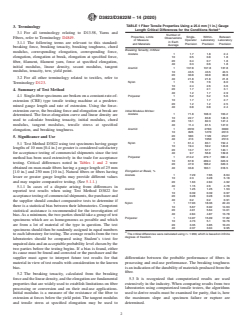
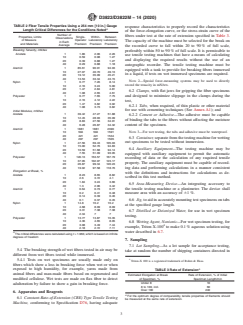
5.1 Test Method D3822 using test specimens having gauge lengths of 10 mm [0.4 in.] or greater is considered satisfactory for acceptance testing of commercial shipments since the test method has been used extensively in the trade for acceptance testing. Critical differences noted in Tables 1 and 2 were obtained on man-made fibers having a gauge length of 25 mm [1.0 in.] and 250 mm [10 in.]. Natural fibers or fibers having lesser or greater gauge lengths may provide different values and may require comparative testing. (See 5.1.1.) (A) The critical differences were calculated using t = 1.960, which is based on infinite degrees of freedom. (A) The critical differences were calculated using t = 1.960, which is based on infinite degrees of freedom
5.1.1 In cases of a dispute arising from differences in reported test results when using Test Method D3822 for acceptance testing of commercial shipments, the purchaser and the supplier should conduct comparative tests to determine if there is a statistical bias between their laboratories. Competent statistical assistance is recommended for the investigation of bias. As a minimum, the two parties should take a group of test specimens which are as homogeneous as possible and which are from a lot of material of the type in question. The test specimens should then be randomly assigned in equal numbers to each laboratory for testing. The average results from the two laboratories should be compared using Student's t-test for unpaired data and an acceptable probability level chosen by the two parties before the testing begins. If a bias is found, either its cause must be found and corrected or the purchaser and the supplier must agree to interpret future test results for that material in view of test results with consideration to the known bias.
5.2 The breaking tenacity, calculated from the breaking force and the linear density, and the elongation are fundamental properties that are widely used to establish limitations on f...
SCOPE
1.1 This test method covers the measurement of tensile properties of natural and man-made single textile fibers of sufficient length to permit mounting test specimens in a tensile testing machine.
1.2 This test method is also applicable to continuous (filament) and discontinuous (staple) fibers or filaments taken from yarns or tow. When the fibers to be tested contain crimp, or if the tow or yarns have been subjected to bulking, crimping, or texturing process, the tensile properties are determined after removal of the crimp.
Note 1: Testing of filaments taken from yarns or tow, included in this test method was originally covered in Test Method D2101, that is discontinued.
1.3 The words “fiber” and “filament” are used interchangeably throughout this test method.
1.4 This test method is also applicable to fibers removed from yarns, or from yarns processed further into fabrics. It should be recognized that yarn and manufacturing processes can influence or modify the tensile properties of fibers. Consequently, tensile properties determined on fibers taken from yarns, or from yarns that have been processed into fabrics, may be different than for the same fibers prior to being subjected to yarn or fabric manufacturing processes.
1.5 This test method provides directions for measuring the breaking force and elongation at break of single textile fibers and for calculating breaking tenacity, initial modulus, chord modulus, tangent modulus, tensile stress at specified elongation, and breaking toughness.
1.6 Procedures for measuring the tensile properties of both conditioned and wet single fibers are included. The test method is applicable to testing under a wide range of conditions.
1.7 As the length of the test specimen decreases, the tensile strength is likely to increase, but the accuracy of the tensile properties determined may decrease, which may require the need to increase the number of test specimens. T...
- Status
- Published
- Publication Date
- 31-Jan-2020
- Technical Committee
- D13 - Textiles
- Drafting Committee
- D13.58 - Yarns and Fibers
Overview
ASTM D3822/D3822M-14(2020): Standard Test Method for Tensile Properties of Single Textile Fibers establishes procedures for the determination of the tensile properties-such as breaking force, breaking tenacity, and elongation at break-of individual natural and man-made textile fibers. Developed by ASTM International, this standard is widely recognized and utilized for quality control, research, and acceptance testing in the textile industry. The method applies to both single fibers extracted from yarns or fabrics as well as from bulk fiber forms, including both continuous (filament) and discontinuous (staple) fibers.
Key Topics
- Measurement Scope: Covers testing of tensile properties for single natural and synthetic fibers with sufficient length to be mounted in testing machines.
- Types of Fibers: Applies to continuous (filament) and staple (discontinuous) fibers, including those taken from yarns, tow, or processed fabrics, with special attention to fibers containing crimp or subjected to bulking or texturing.
- Properties Measured:
- Breaking force
- Elongation at break
- Breaking tenacity (calculated from force and linear density)
- Initial, chord, and tangent modulus
- Tensile stress at specified elongation
- Breaking toughness
- Conditioning: Procedures for testing both conditioned and wet fibers, recognizing that properties may differ under various environmental or processing conditions.
- Precision and Bias: Detailed guidance for inter-laboratory comparison, including the use of statistical tools like Student’s t-test and instructions to identify and address potential sources of bias in reported test results.
Applications
This ASTM standard test method provides critical guidance for manufacturers, suppliers, and laboratories in the following scenarios:
- Acceptance Testing: Used extensively for the acceptance testing of commercial shipments, ensuring consistent quality of textile raw materials.
- Quality Control: Fundamental in routine quality assurance processes, enabling comparison of fiber properties before and after various stages of manufacture.
- Research and Product Development: Supports the development of new fiber types or finishes by yielding quantitative tensile data under standardized conditions.
- Comparative Analysis: Essential for testing fibers that have been removed from yarns or fabrics, recognizing that manufacturing and processing can influence tensile outcomes.
- Performance Specification: Offers parameters like breaking tenacity and elongation at break, which are commonly included in product specifications for diverse end-use applications, such as apparel, technical textiles, and industrial fibers.
Related Standards
Users of ASTM D3822/D3822M-14(2020) will find alignment and cross-references with several related ASTM standards and best practices, including:
- ASTM D76 - Specification for Tensile Testing Machines for Textiles
- ASTM D123 - Terminology Relating to Textiles
- ASTM D1577 - Test Methods for Linear Density of Textile Fibers
- ASTM D1776 - Practice for Conditioning and Testing Textiles
- ASTM D629 - Test Methods for Quantitative Analysis of Textiles
- ASTM D2258 - Practice for Sampling Yarn for Testing
- ASTM D3333 - Practice for Sampling Manufactured Staple Fibers, Sliver, or Tow for Testing
These referenced documents support accurate sampling, specimen preparation, and machine setup to ensure reliable tensile testing according to industry best practices.
Summary
ASTM D3822/D3822M-14(2020) provides a comprehensive and standardized approach for determining the tensile properties of single textile fibers. Its procedures are fundamental for quality control, acceptance testing, and research within the global textile industry and provide a uniform basis for comparing fiber performance in both raw material and finished product forms. By adhering to this standard test method, stakeholders ensure compliance, reliable data, and greater confidence in fiber quality and performance.
Keywords: textile fiber testing, tensile properties, breaking force, elongation at break, ASTM D3822, single fiber analysis, quality control, fiber tenacity, textile standards, mechanical properties of fibers
Relations
- Effective Date
- 01-Feb-2020
- Effective Date
- 01-Jul-2018
- Effective Date
- 01-Jul-2018
- Effective Date
- 01-Mar-2017
- Effective Date
- 01-Jun-2016
- Effective Date
- 15-Sep-2015
- Effective Date
- 01-Sep-2015
- Effective Date
- 01-Apr-2015
- Effective Date
- 01-Feb-2015
- Effective Date
- 01-Oct-2013
- Effective Date
- 01-Oct-2013
- Effective Date
- 01-Oct-2013
- Effective Date
- 01-Oct-2013
- Effective Date
- 15-Jun-2013
- Effective Date
- 15-Jun-2013
Get Certified
Connect with accredited certification bodies for this standard

Control Union Certifications
Global certification for agriculture and sustainability.

Hohenstein Institut
Textile testing and certification.

Bureau Veritas Bangladesh
Bureau Veritas certification services in Bangladesh.
Sponsored listings
Frequently Asked Questions
ASTM D3822/D3822M-14(2020) is a standard published by ASTM International. Its full title is "Standard Test Method for Tensile Properties of Single Textile Fibers". This standard covers: SIGNIFICANCE AND USE 5.1 Test Method D3822 using test specimens having gauge lengths of 10 mm [0.4 in.] or greater is considered satisfactory for acceptance testing of commercial shipments since the test method has been used extensively in the trade for acceptance testing. Critical differences noted in Tables 1 and 2 were obtained on man-made fibers having a gauge length of 25 mm [1.0 in.] and 250 mm [10 in.]. Natural fibers or fibers having lesser or greater gauge lengths may provide different values and may require comparative testing. (See 5.1.1.) (A) The critical differences were calculated using t = 1.960, which is based on infinite degrees of freedom. (A) The critical differences were calculated using t = 1.960, which is based on infinite degrees of freedom 5.1.1 In cases of a dispute arising from differences in reported test results when using Test Method D3822 for acceptance testing of commercial shipments, the purchaser and the supplier should conduct comparative tests to determine if there is a statistical bias between their laboratories. Competent statistical assistance is recommended for the investigation of bias. As a minimum, the two parties should take a group of test specimens which are as homogeneous as possible and which are from a lot of material of the type in question. The test specimens should then be randomly assigned in equal numbers to each laboratory for testing. The average results from the two laboratories should be compared using Student's t-test for unpaired data and an acceptable probability level chosen by the two parties before the testing begins. If a bias is found, either its cause must be found and corrected or the purchaser and the supplier must agree to interpret future test results for that material in view of test results with consideration to the known bias. 5.2 The breaking tenacity, calculated from the breaking force and the linear density, and the elongation are fundamental properties that are widely used to establish limitations on f... SCOPE 1.1 This test method covers the measurement of tensile properties of natural and man-made single textile fibers of sufficient length to permit mounting test specimens in a tensile testing machine. 1.2 This test method is also applicable to continuous (filament) and discontinuous (staple) fibers or filaments taken from yarns or tow. When the fibers to be tested contain crimp, or if the tow or yarns have been subjected to bulking, crimping, or texturing process, the tensile properties are determined after removal of the crimp. Note 1: Testing of filaments taken from yarns or tow, included in this test method was originally covered in Test Method D2101, that is discontinued. 1.3 The words “fiber” and “filament” are used interchangeably throughout this test method. 1.4 This test method is also applicable to fibers removed from yarns, or from yarns processed further into fabrics. It should be recognized that yarn and manufacturing processes can influence or modify the tensile properties of fibers. Consequently, tensile properties determined on fibers taken from yarns, or from yarns that have been processed into fabrics, may be different than for the same fibers prior to being subjected to yarn or fabric manufacturing processes. 1.5 This test method provides directions for measuring the breaking force and elongation at break of single textile fibers and for calculating breaking tenacity, initial modulus, chord modulus, tangent modulus, tensile stress at specified elongation, and breaking toughness. 1.6 Procedures for measuring the tensile properties of both conditioned and wet single fibers are included. The test method is applicable to testing under a wide range of conditions. 1.7 As the length of the test specimen decreases, the tensile strength is likely to increase, but the accuracy of the tensile properties determined may decrease, which may require the need to increase the number of test specimens. T...
SIGNIFICANCE AND USE 5.1 Test Method D3822 using test specimens having gauge lengths of 10 mm [0.4 in.] or greater is considered satisfactory for acceptance testing of commercial shipments since the test method has been used extensively in the trade for acceptance testing. Critical differences noted in Tables 1 and 2 were obtained on man-made fibers having a gauge length of 25 mm [1.0 in.] and 250 mm [10 in.]. Natural fibers or fibers having lesser or greater gauge lengths may provide different values and may require comparative testing. (See 5.1.1.) (A) The critical differences were calculated using t = 1.960, which is based on infinite degrees of freedom. (A) The critical differences were calculated using t = 1.960, which is based on infinite degrees of freedom 5.1.1 In cases of a dispute arising from differences in reported test results when using Test Method D3822 for acceptance testing of commercial shipments, the purchaser and the supplier should conduct comparative tests to determine if there is a statistical bias between their laboratories. Competent statistical assistance is recommended for the investigation of bias. As a minimum, the two parties should take a group of test specimens which are as homogeneous as possible and which are from a lot of material of the type in question. The test specimens should then be randomly assigned in equal numbers to each laboratory for testing. The average results from the two laboratories should be compared using Student's t-test for unpaired data and an acceptable probability level chosen by the two parties before the testing begins. If a bias is found, either its cause must be found and corrected or the purchaser and the supplier must agree to interpret future test results for that material in view of test results with consideration to the known bias. 5.2 The breaking tenacity, calculated from the breaking force and the linear density, and the elongation are fundamental properties that are widely used to establish limitations on f... SCOPE 1.1 This test method covers the measurement of tensile properties of natural and man-made single textile fibers of sufficient length to permit mounting test specimens in a tensile testing machine. 1.2 This test method is also applicable to continuous (filament) and discontinuous (staple) fibers or filaments taken from yarns or tow. When the fibers to be tested contain crimp, or if the tow or yarns have been subjected to bulking, crimping, or texturing process, the tensile properties are determined after removal of the crimp. Note 1: Testing of filaments taken from yarns or tow, included in this test method was originally covered in Test Method D2101, that is discontinued. 1.3 The words “fiber” and “filament” are used interchangeably throughout this test method. 1.4 This test method is also applicable to fibers removed from yarns, or from yarns processed further into fabrics. It should be recognized that yarn and manufacturing processes can influence or modify the tensile properties of fibers. Consequently, tensile properties determined on fibers taken from yarns, or from yarns that have been processed into fabrics, may be different than for the same fibers prior to being subjected to yarn or fabric manufacturing processes. 1.5 This test method provides directions for measuring the breaking force and elongation at break of single textile fibers and for calculating breaking tenacity, initial modulus, chord modulus, tangent modulus, tensile stress at specified elongation, and breaking toughness. 1.6 Procedures for measuring the tensile properties of both conditioned and wet single fibers are included. The test method is applicable to testing under a wide range of conditions. 1.7 As the length of the test specimen decreases, the tensile strength is likely to increase, but the accuracy of the tensile properties determined may decrease, which may require the need to increase the number of test specimens. T...
ASTM D3822/D3822M-14(2020) is classified under the following ICS (International Classification for Standards) categories: 59.060.01 - Textile fibres in general. The ICS classification helps identify the subject area and facilitates finding related standards.
ASTM D3822/D3822M-14(2020) has the following relationships with other standards: It is inter standard links to ASTM D3822/D3822M-14, ASTM D3333-07(2018), ASTM D4849-13(2018), ASTM D123-17, ASTM E178-16, ASTM D123-15b, ASTM D123-15a, ASTM D123-15, ASTM D629-15, ASTM D4849-13, ASTM D4849-13e3, ASTM D4849-13e1, ASTM D4849-13e2, ASTM D123-13ae1, ASTM D123-13a. Understanding these relationships helps ensure you are using the most current and applicable version of the standard.
ASTM D3822/D3822M-14(2020) is available in PDF format for immediate download after purchase. The document can be added to your cart and obtained through the secure checkout process. Digital delivery ensures instant access to the complete standard document.
Standards Content (Sample)
This international standard was developed in accordance with internationally recognized principles on standardization established in the Decision on Principles for the
Development of International Standards, Guides and Recommendations issued by the World Trade Organization Technical Barriers to Trade (TBT) Committee.
Designation: D3822/D3822M − 14 (Reapproved 2020)
Standard Test Method for
Tensile Properties of Single Textile Fibers
This standard is issued under the fixed designation D3822/D3822M; the number immediately following the designation indicates the
year of original adoption or, in the case of revision, the year of last revision. A number in parentheses indicates the year of last
reapproval. A superscript epsilon (´) indicates an editorial change since the last revision or reapproval.
1. Scope particularly true for those properties dependent on the mea-
surement of elongation, since the shorter lengths increase the
1.1 This test method covers the measurement of tensile
relative effect of slippage and stretching of the test specimens
properties of natural and man-made single textile fibers of
within the jaws of either clamp.
sufficient length to permit mounting test specimens in a tensile
testing machine. 1.8 The values stated in either SI units or inch-pound units
are to be regarded separately as standard. The values stated in
1.2 This test method is also applicable to continuous (fila-
eachsystemarenotnecessarilyexactequivalents;therefore,to
ment)anddiscontinuous(staple)fibersorfilamentstakenfrom
ensure conformance with the standard, each system shall be
yarns or tow. When the fibers to be tested contain crimp, or if
used independently of the other, and values from the two
the tow or yarns have been subjected to bulking, crimping, or
systems shall not be combined.
texturing process, the tensile properties are determined after
1.9 This standard does not purport to address all of the
removal of the crimp.
safety concerns, if any, associated with its use. It is the
NOTE 1—Testing of filaments taken from yarns or tow, included in this
responsibility of the user of this standard to establish appro-
test method was originally covered in Test Method D2101, that is
priate safety, health, and environmental practices and deter-
discontinued.
mine the applicability of regulatory limitations prior to use.
1.3 The words “fiber” and “filament” are used interchange-
1.10 This international standard was developed in accor-
ably throughout this test method.
dance with internationally recognized principles on standard-
1.4 This test method is also applicable to fibers removed
ization established in the Decision on Principles for the
from yarns, or from yarns processed further into fabrics. It
Development of International Standards, Guides and Recom-
should be recognized that yarn and manufacturing processes
mendations issued by the World Trade Organization Technical
can influence or modify the tensile properties of fibers.
Barriers to Trade (TBT) Committee.
Consequently, tensile properties determined on fibers taken
from yarns, or from yarns that have been processed into 2. Referenced Documents
fabrics, may be different than for the same fibers prior to being 2
2.1 ASTM Standards:
subjected to yarn or fabric manufacturing processes.
D76Specification for Tensile Testing Machines for Textiles
1.5 This test method provides directions for measuring the D123Terminology Relating to Textiles
breaking force and elongation at break of single textile fibers D629Test Methods for Quantitative Analysis of Textiles
and for calculating breaking tenacity, initial modulus, chord D1577Test Methods for Linear Density of Textile Fibers
modulus, tangent modulus, tensile stress at specified D1776Practice for Conditioning and Testing Textiles
elongation, and breaking toughness. D2101Test Method for Tensile Properties of Single Man-
Made Textile Fibers Taken From Yarns and Tows (With-
1.6 Procedures for measuring the tensile properties of both
drawn 1995)
conditionedandwetsinglefibersareincluded.Thetestmethod
D2258Practice for Sampling Yarn for Testing
is applicable to testing under a wide range of conditions.
D3333Practice for Sampling Manufactured Staple Fibers,
1.7 As the length of the test specimen decreases, the tensile
Sliver, or Tow for Testing
strength is likely to increase, but the accuracy of the tensile
D4849Terminology Related to Yarns and Fibers
properties determined may decrease, which may require the
E178Practice for Dealing With Outlying Observations
need to increase the number of test specimens. This is
For referenced ASTM standards, visit the ASTM website, www.astm.org, or
ThistestmethodisunderthejurisdictionofASTMCommitteeD13onTextiles contact ASTM Customer Service at service@astm.org. For Annual Book of ASTM
and is the direct responsibility of Subcommittee D13.58 on Yarns and Fibers. Standards volume information, refer to the standard’s Document Summary page on
Current edition approved Feb. 1, 2020. Published February 2020. Originally the ASTM website.
approved in 1979. Last previous edition approved in 2014 as D3822–14. DOI: The last approved version of this historical standard is referenced on
10.1520/D3822_D3822M-14R20. www.astm.org.
Copyright © ASTM International, 100 Barr Harbor Drive, PO Box C700, West Conshohocken, PA 19428-2959. United States
D3822/D3822M − 14 (2020)
TABLE 1 Fiber Tensile Properties Using a 25.4 mm [1 in.] Gauge
3. Terminology
A
Length Critical Differences for the Conditions Noted
3.1 For all terminology relating to D13.58, Yarns and
Number of
Properties, Limits Single- Within- Between
Fibers, refer to Terminology D4849.
Observations
of Measure Operator Laboratory Laboratory
in Each
3.1.1 The following terms are relevant to this standard:
and Materials Precision Precision Precision
Average
breaking force, breaking tenacity, breaking toughness, chord
Breaking Tenacity, mN/tex:
modulus, corresponding elongation, corresponding force,
Acetate 1 1.7 1.8 2.4
elongation, elongation at break, elongation at specified force,
10 0.5 0.8 1.8
20 0.4 0.7 1.8
fiber, filament, filament yarn, force at specified elongation,
40 0.3 0.6 1.8
initial modulus, linear density, secant modulus, tangent
Aramid 1 137.8 137.8 137.8
modulus, tenacity, tow, yield point. 10 43.5 43.5 43.5
20 30.8 30.8 30.8
3.2 For all other terminology related to textiles, refer to
40 21.8 21.8 21.8
Nylon 1 7.6 7.6 8.0
Terminology D123.
10 2.4 2.6 3.6
20 1.7 2.1 3.1
4. Summary of Test Method
40 1.2 1.7 2.9
4.1 Single-fiberspecimensarebrokenonaconstant-rate-of- Polyester 1 5.2 5.2 5.6
10 1.7 1.7 2.7
extension (CRE) type tensile testing machine at a predeter-
20 1.2 1.2 2.5
mined gauge length and rate of extension. Using the force-
40 0.8 0.8 2.4
extensioncurve,thebreakingforceandelongationatbreakare Initial Modulus Mn/tex:
Acetate 1 71.8 108.0 163.2
determined. The force-elongation curve and linear density are
10 22.7 83.8 148.3
used to calculate breaking tenacity, initial modulus, chord
20 16.1 82.3 147.4
modulus, tangent modulus, tensile stress at specified 40 11.4 81.5 147.0
Aramid 1 2610 2783 3600
elongation, and breaking toughness.
10 826 1270 2613
20 583 1129 2547
5. Significance and Use
40 413 1050 2513
Nylon 1 61.4 83.1 152.4
5.1 Test Method D3822 using test specimens having gauge
10 19.4 59.2 140.8
lengths of 10 mm [0.4 in.] or greater is considered satisfactory
20 13.7 57.7 140.1
for acceptance testing of commercial shipments since the test
40 9.7 56.8 139.8
Polyester 1 214.2 279.7 382.4
method has been used extensively in the trade for acceptance
10 67.8 209.4 323.9
testing. Critical differences noted in Tables 1 and 2 were
20 47.9 186.2 320.3
obtained on man-made fibers having a gauge length of 25 mm 40 33.8 183.1 318.5
Elongation at Break, %
[1.0 in.] and 250 mm [10 in.]. Natural fibers or fibers having
Acetate 1 7.29 7.65 8.64
lesser or greater gauge lengths may provide different values
10 2.3 3.28 5.18
and may require comparative testing. (See 5.1.1.)
20 1.63 2.84 4.92
40 1.15 2.6 4.78
5.1.1 In cases of a dispute arising from differences in
Aramid 1 1.25 1.25 1.53
reported test results when using Test Method D3822 for
10 0.39 0.39 0.97
acceptancetestingofcommercialshipments,thepurchaserand 20 0.28 0.28 0.93
40 0.2 0.2 0.91
the supplier should conduct comparative tests to determine if
Nylon 1 17.93 18.36 22.43
there is a statistical bias between their laboratories. Competent
10 5.67 6.92 14.63
statistical assistance is recommended for the investigation of 20 4.01 5.64 14.01
40 2.84 4.87 13.78
bias.Asaminimum,thetwopartiesshouldtakeagroupoftest
Polyester 1 14.97 15.09 17.82
specimens which are as homogeneous as possible and which
10 4.73 5.1 10.76
20 3.35 3.85 10.23
are from a lot of material of the type in question. The test
40 2.37 3.04 9.95
specimensshouldthenberandomlyassignedinequalnumbers
A
Thecriticaldifferenceswerecalculatedusingt=1.960,whichisbasedoninfinite
toeachlaboratoryfortesting.Theaverageresultsfromthetwo
degrees of freedom.
laboratories should be compared using Student’s t-test for
unpaireddataandanacceptableprobabilitylevelchosenbythe
two parties before the testing begins. If a bias is found, either
its cause must be found and corrected or the purchaser and the
supplier must agree to interpret future test results for that differentiate between the probable performance of fibers in
materialinviewoftestresultswithconsiderationtotheknown processing and end-use performance. The breaking toughness
bias. isanindicationofthedurabilityofmaterialsproducedfromthe
fiber.
5.2 The breaking tenacity, calculated from the breaking
forceandthelineardensity,andtheelongationarefundamental 5.3 It is recognized that computerized results are used
properties that are widely used to establish limitations on fiber extensively in the industry. When comparing results from two
processing or conversion and on their end-use applications. laboratories using computerized tensile testers, the algorithms
Initial modulus is a measure of the resistance of the fiber to used to derive results must be examined for parity, that is, how
extensionatforcesbelowtheyieldpoint.Thetangentmodulus the maximum slope and specimen failure or rupture are
and tensile stress at specified elongation may be used to determined.
D3822/D3822M − 14 (2020)
TABLE 2 Fiber Tensile Properties Using a 254 mm [10 in.] Gauge
response characteristics to properly record the characteristics
A
Length Critical Differences for the Conditions Noted
of the force-elongation curve, or the stress-strain curve of the
Number of
fibers under test at the rate of extension specified in Table 3.
Properties, Limits Single- Within- Between
Observations
of Measure Operator Laboratory Laboratory
The capacity of the machine must be selected for the break on
in Each
and Materials Precision Precision Precision
Average
the recorded curve to fall within 20 to 90% of full scale,
Breaking Tenacity, mN/tex
preferably within 50 to 90% of full scale. It is permissible to
Acetate 1 1.86 2.06 2.26
use tensile testing machines that have a means of calculating
10 0.59 0.98 1.27
and displaying the required results without the use of an
20 0.39 0.88 1.27
40 0.29 0.88 1.18
autographic recorder. The tensile testing machine must be
Aramid 1 85.61 90.91 94.93
equipped with a tank to provide for breaking fibers immersed
10 27.07 40.70 49.13
in a liquid, if tests on wet immersed specimens are required.
20 19.12 35.99 45.21
40 13.53 33.34 43.15
NOTE 2—Special force-measuring systems may be used to directly
Nylon 1 6.77 7.26 8.14
record the tenacity in mN/tex.
10 2.16 3.24 5.00
20 1.47 2.84 4.81
6.2 Clamps, with flat jaws for gripping the fiber specimens
40 1.08 2.65 4.61
and designed to minimize slippage in the clamps during the
Polyester 1 6.77 7.65 7.75
10 2.16 4.12 4.22
test,
20 1.47 3.82 3.92
6.2.1 Tabs, when required, of thin plastic or other material
40 1.08 3.73 3.82
for use with cementing techniques (See Annex A1); and
Initial Modulus, mN/tex
Acetate 1 39.42 47.27 51.88
6.2.2 Cement or Adhesive—The adhesive must be capable
10 12.45 28.93 35.99
of binding the tabs to the fibers without affecting the moisture
20 8.83 27.56 34.91
content of the specimen.
40 6.28 26.87 34.32
Aramid 1 1881 1881 2390
NOTE 3—For wet testing, the tabs and adhesive must be waterproof.
10 594 594 1591
20 421 421 1534
6.3 Container,separatefromthetestingmachineforwetting
40 297 297 1505
out specimens to be tested without immersion.
Nylon 1 47.56 69.43 105.03
10 15.00 52.76 94.83
6.4 Auxiliary Equipment—The testing machine may be
20 10.59 51.68 94.14
40 7.55 51.09 93.95 equipped with auxiliary equipment to permit the automatic
Polyester 1 120.13 153.57 167.79
recording of data or the calculation of any required tensile
10 37.95 102.97 123.17
property. The auxiliary equipment must be capable of record-
20 26.87 99.34 120.23
40 19.02 97.58 118.76
ing data and performing calculations in a manner consistent
Elongation at Break, %
with the definitions and instructions for calculations as de-
Acetate 1 8.23 8.65 8.82
scribed in this test method.
10 2.6 3.72 4.1
20 1.84 3.24 3.66
6.5 Area-Measuring Device—An integrating accessory to
40 1.3 2.96 3.42
the tensile testing machine or a planimeter. The device shall
Aramid 1 0.64 0.73 0.77
10 0.2 0.41 0.48
measure area with an accuracy of 61%.
20 0.14 0.39 0.46
40 0.1 0.37 0.45 6.6 Jig,toaidinaccuratelymountingtestspecimensontabs
Nylon 1 14.8 16.2 16.2
at the specified gauge length.
10 4.68 8.09 8.09
20 3.31 7.38 7.38
6.7 Distilled or Deionized Water, for use in wet specimen
40 2.34 7 7
testing.
Polyester 1 13.77 13.87 16.35
10 4.36 4.65 8.05
6.8 Wetting Agent, Nonionic—For wet specimen testing, for
20 3.08 3.49 7.44
example, Triton X-100 to make 0.1% aqueous solution using
40 2.18 2.72 7.11
water described in 6.7.
A
Thecriticaldifferenceswerecalculatedusingt=1.960,whichisbasedoninfinite
degrees of freedom
7. Sampling
7.1 Lot Sampling—As a lot sample for acceptance testing,
5.4 The breaking strength of wet fibers tested in air may be
take at random the number of shipping containers directed in
different from wet fibers tested while immersed.
5.4.1 Tests on wet specimens are usually made only on
Triton-X 100 is a registered trademark of Rohm & Haas.
fibers which show a loss in breaking force when wet or when
A
exposed to high humidity, for example, yarns made from
TABLE 3 Rate of Extension
animal fibers and man-made fibers based on regenerated and
Estimated Elongation at Break Rate of Extension, % of Initial
of Specimen, % Specimen Length/min
modified cellulose. Wet tests are made on flax fiber to detect
Under 8 10
adulteration by failure to show a gain in breaking force.
8 to 100, incl. 60
Over 100 240
6. Apparatus and Reagents
A
For the optimum degree of comparability, tensile properties of filaments should
6.1 Constant-Rate-of-Extension (CRE) Type Tensile Testing
be measured at the same rate of extension.
Machine, conforming to Specification D76, having adequate
D3822/D3822M − 14 (2020)
the applicable material specification or other agreement be- changes in breaking force, or elongation at break when
tween the purchaser and supplier, such as an agreement to use followed by longer periods of immersion.
Practice D3333 or Practice D2258. Consider shipping contain- 8.3.2 When desizing treatments are specified prior to wet
ers to be the primary sampling units. testing, use desizing treatments that will not effect the normal
physical property of the material as directed in Test Methods
NOTE 4—An adequate specification or other agreement between the
D629.
purchaser or supplier requires taking into account the variability between
shipping units, between packages, ends or other laboratory sampling unit
8.4 For wet specimens tested while immersed, proceed as
within a shipping unit if applicable, and with specimens from a single
directed in 11.2.2.
package,endorotherlaboratorysamplingunittoprovideasamplingplan
with a meaningful producer’s risk, consumer’s risk, acceptable quality
9. Preparation of Test Apparatus
level, and limiting quantity level.
7.2 Laboratory Sample—As a laboratory sample for accep- 9.1 Select the appropriate force range for the fiber to be
tance testing, take at random from each shipping container in tested.
the lot sample the number of laboratory sampling units as
9.2 Verify that the tensile tester is within calibration as
directed in an applicable material specification or other agree-
specified in the manufacturer’s instructions.
ment between purchaser and supplier such as an agreement to
9.3 Adjust the distance between the clamps to obtain the
use Practice D3333 or Practice D2258. Preferably, the same
selected nominal gauge length of at least 10 mm [0.4 in.] and,
number of laboratory sampling units are taken from each
when applicable, 250 mm [10 in.] or more. The most common
shipping container in the lot sample. If differing numbers of
gauge lengths are 10, 20, 25, 100 and 250 mm [0.4, 0.8, 1.0, 4
laboratory sampling units are to be taken from shipping
and 10 in.].
containers in the lot sample, determine at random which
shippingcontainersaretohaveeachnumberoflaboratoryunits
NOTE 5—The results obtained are normally subject to less error if the
gauge length is selected to be as large as possible, consistent with the
drawn.
length of fibers to be tested. When comparisons are to be made between
7.2.1 For Staple Fiber—Take 50 g samples from laboratory
different fibers or where it is necessary to obtain comparable results in
sampling units.
different laboratories, it is advisable to use the same gauge length for all
7.2.2 For Sliver (or Top) or Tow—Take 1 m [3 yd] from the
tests, selecting it to accommodate the shortest fibers of interest.
leading end which has a clean, uniform appearance from each
9.3.1 If the fiber specimen is mounted on tabs before being
laboratory sampling unit.
placedinthetestingmachine,thedistancebetweentabsdefines
7.2.3 ForYarns—Takeatleasta1m[3yd]lengthfromeach
the nominal gauge length (See Annex A1).
laboratory sampling unit.
9.4 Settheextensionspeedtoprovidetherateofelongation
7.3 Test Specimens—From each laboratory sampling unit,
specified in Table 1 for the gauge length selected.
take 20 fiber specimens at random. If the standard deviation
9.5 When using microprocessor automatic data gathering
determined for the 20 specimens is more than a value agreed
systems, set the appropriate parameters as defined in the
upon between the purchaser and supplier prior to testing,
manufacturer’s instruction.
continue testing in groups of 20 specimens from the same
laboratory sampling unit until the standard deviation for all
10. Conditioning
specimens tested is not more than the agreed-to value or, by
agreement, stop testing after a specified number.
10.1 Precondition and condition the specimens, as directed
7.3.1 Carefully remove twist before taking specimens from
in Practice D1776.
yarn. Using tweezers and grasping each specimen at one end,
gently remove the required number of specimens from the
11. Procedure
laboratory sampling units for testing. In some cases, if speci-
11.1 Test the conditioned specimens as directed in Practice
mens are not to be tested immediately, place them on a
D1776.
short-pile or plush surface for storage until ready to test.
11.2 Mount a test specimen in the jaws of the clamps,
8. Preparation of Test Specimens
removingslackwithoutstretchingthespecimen.Thespecimen
must be straight within the jaws and extreme care must be
8.1 Measure the linear density of each specimen as directed
takentoensurethatthefiberspecimenliesonthelineofaction
in Test Methods D1577.
between the force-measuring device and the point where the
8.2 Iffibersaretobetabbed,selectatechniquefromAnnex
fiber leaves the moving jaw face.Any misalignment that tends
A1 or some other technique agreed upon by the purchaser and
to produce transverse motion of the clamps and jaws will
supplier.
introduce errors in measurements of elongation and may
8.3 For testing wet specimens without immersion, place the contribute to premature fiber failure.
specimens in a container and submerge in a 0.1% aqueous 11.2.1 For testing wet specimens without immersion, re-
solution of a nonionic wetting agent in distilled or deionized move a specimen from the water and immediately mount it in
water at ambient temperature until thoroughly soaked. (See theclampsasdirectedin11.1and11.2.Performthetestwithin
8.3.1 and 8.3.2.) two minutes after removal of the specimen from the water.
8.3.1 The time of immersion must be sufficient to com- 11.2.2 For testing wet specimens while immersed, secure
pletely wet out the specimens, as indicated by no significant the specimens into the clamps of the tensile tester and
D3822/D3822M − 14 (2020)
submerge in the tank containing a 0.1% aqueous solution of a 11.7 Obtain the elongation data by means of a suitable
nonionic wetting agent in distilled or deionized water at recordingdevice,orcomputer,atthesametimeasthebreaking
ambient temperature until thoroughly soaked. (See 8.3.1 and force is determined unless otherwise agreed upon, as provided
8.3.2.). Test while the specimens are immersed in the water for in an applicable material specification.
bath.
12. Calculation
NOTE 6—In general, it will be found that no one type of fiber mounting
12.1 Breaking Force—Record the breaking force of indi-
will be suitable for all types and sizes of fibers and experience may show
vidual specimens to three significant digits as read directly
that some mounting techniques are much more efficient than others.
from the tension testing machine expressed in mN [gf].
Experience and operator preferences have been found to be of importance
in selecting the most satisfactory mounting methods for a given labora-
12.2 Breaking Tenacity—Calculate the breaking tenacity of
tory.
individual specimens to three significant digits, using Eq 1:
11.3 For specimens having crimp, use a pretension of 3 to
F
ϒ 5 (1)
10 mN/tex [0.03 to 0.11 gf/d] to remove the crimp while the
D
L
fiberisplacedintheclamps.Ifcertainfiberswithahighdegree
where:
of crimp require greater pretensioning than the amount
specified, determine the minimum pretension as directed in ϒ = breaking tenacity in mN/tex [gf/den],
F = breaking force in mN [gf], and
AppendixXIofTestMethodD1577.If,byvisualexamination,
D = linear density in tex [denier].
thecrimpisnotcompletelyremovedevenatthesegreaterforce
L
applications, record this fact.
12.3 Effective Specimen Length—Calculate the effective
specimen length of individual specimens to three significant
11.4 Start the tensile testing machine and any associated
digits, using Eq 3: (See Annex A2 and Figs. X1.1 and X1.2.)
auxiliary equipment, extending the fiber specimen to break at
theselectedextensionspeedandrecordthedataofinterest.For
L 5 L 1∆L (2)
e i c
fibers of low stiffness, it may be advisable to first back off the
where:
movingjawofthetestingmachinetoallowthefibertobeslack
L = effective specimen length, mm [in.],
e
at the time the testing machine is started.
L = initial distance between clamps (gauge length), mm
i
11.5 After breaking the specimen, return the testing ma-
[in.], and
chine to its starting condition and remove all remains o
...