

ASTM F1757-96(2022)
(Guide)Standard Guide for Digital Communication Protocols for Computerized Systems
General Information
- Abstract
SIGNIFICANCE AND USE
4.1 This guide is intended to provide an understanding of the wide range of communication protocols standards, allowing the user to understand better their applicability to shipboard networks and marine platform computerized systems. For computerized networks and systems, communication protocols are necessary for integrating various system devices, providing functionality between dissimilar subnetworks, or for enabling remote connections, either pier side or through geophysical communication technologies.
4.2 The wide variety and scope of digital communication protocol standards adds greatly to the complex decision process for specifying compatible protocols for system applications and related devices for the myriad of potential shipboard systems. However, the user must identify the initial networking requirements, so once the network protocols under evaluation are well understood, the decision process should determine the appropriate network protocols. Therefore, this guide is intended to reduce the complexity involved with protocol selection and implementation.
4.3 Network protocols define an agreed, quantifiable entity, or set of rules, by which user computers, system networks, and internetworking devices communicate and exchange information. Communication protocols specify essential networking guidelines, such as physical interface connections, or data format and control operations between two communicating computers. Ship and marine digital communication protocol requirements are no different than their land-based networked counterparts. Both require standardized protocol selection, in various protocol categories, including LAN standards, WAN protocols, LAN/WAN protocols, network management, wiring hub configurations/operations, hardware platforms, operating systems, and network applications.
SCOPE
1.1 The principal content of this guide provides a road map to implement a communication network applicable to ship and marine computer systems by:
1.1.1 Examining the relationship of digital communication protocols as a network technological infrastructure,
1.1.2 Outlining the basic building blocks of network topologies and transmission techniques associated with the implementation of transmission media in a network environment; and,
1.1.3 Identifying operating system and environments.
1.2 Using the Open System Interconnection (OSI) model, which provides a layered approach to network functionality and evaluation, common network communications protocols are identified and characterized in this guide according to lower and upper layer protocols corresponding to their degree and type of functionality.
1.3 Although it is desirable that network users, designers, and administrators recognize and understand every possible networking protocol, it is not possible to know the intimate details of every protocol specification. Accordingly, this guide is not intended to address fully every hardware and software protocol ever developed for commercial use, which spans a period of about 25 years. Instead, the user of this guide will be introduced to a brief overview of the majority of past and present protocols which may comprise a ship or marine internetwork, to include Local Area Networks (LANs), Wide Area Networks (WANs), and related hardware and software that provide such network interoperability and data transfer.
1.4 While this guide provides an understanding of the wide range of communication protocols, the user is recommended to consult the reference material for acquiring a more comprehensive understanding of individual communication protocols. However, by examining the basic functions of protocols and reviewing the protocol characterization criteria identified in this guide, the user will be more apt to understanding other protocols not mentioned or addressed herein.
1.5 This international standard was developed in accordance with internationally recognized principles on...
- Status
- Published
- Publication Date
- 31-Jan-2022
- Technical Committee
- F25 - Ships and Marine Technology
- Drafting Committee
- F25.05 - Computer Applications
Overview
ASTM F1757-96(2022): Standard Guide for Digital Communication Protocols for Computerized Systems provides essential guidance for understanding and selecting digital communication protocols for computerized networks, with a strong emphasis on shipboard and marine platform systems. Developed by ASTM International, this standard serves as a comprehensive road map to help users navigate the complexities of network protocol standards, efficiently integrating system devices, enabling interoperability among diverse subnetworks, and supporting remote and local connections in marine and industrial environments.
The guide uses the Open System Interconnection (OSI) model as a basis for describing and categorizing protocols, aiding users in evaluating protocol functionality from physical connections to network application layers. By outlining widely-used protocols and their characteristics, the standard helps network designers, administrators, and systems integrators make informed protocol selection decisions, thereby streamlining implementation and boosting system compatibility.
Key Topics
- Protocol Standards and Selection: Explains the distinction between LAN and WAN protocols, network management schemes, and integration techniques.
- OSI Model Framework: Outlines the layered approach, from physical interfaces up to network applications and management tools.
- Network Topologies: Describes bus, ring, star, mesh, and hierarchical configurations suitable for shipboard and marine networks.
- Transmission Media: Details the use and characteristics of coaxial cable, twisted pair (UTP/STP), and fiber optic solutions.
- Network Devices: Provides fundamental concepts relating to switches, hubs, routers, bridges, gateways, servers, and nodes.
- Protocol Types: Discusses defacto, dejure, and proprietary protocol standards, acknowledging the trend toward open standards for interoperability.
- Interconnection and Internetworking: Covers methods for linking multiple local networks, with emphasis on devices that enable different protocols to coexist.
- Operating Systems and Environments: Identifies common network operating systems (NOS) and supporting platform environments relevant to marine and industrial settings.
Applications
This ASTM standard is particularly valuable for a range of practical applications, including:
- Shipboard Networks: Provides guidance for integrating digital communication protocols in vessel control, monitoring, automation, and navigation systems.
- Marine Platforms: Assists in specifying compatible protocols for offshore rigs, research vessels, and coastal facilities.
- Remote System Access: Supports secure data exchange between marine systems and land-based facilities, leveraging remote connectivity protocols.
- Industrial and Defense Systems: Applicable wherever high-reliability, standards-based communication is crucial, such as in manufacturing or military environments.
- Multi-Vendor System Integration: Aids in selecting interoperable protocol standards, ensuring seamless communication between devices and platforms from different suppliers.
- Upgrades and Expansions: Facilitates protocol evaluation when expanding existing networks or adopting new hardware or software platforms.
Related Standards
This guide references and complements several other notable industry and international standards, including:
- IEEE 802 Series: Standards defining physical and data link layer protocols for Ethernet, Token Bus, Token Ring, and fiber, such as IEEE 802.3, 802.4, 802.5, and 802.8.
- ANSI X3 Series: Covers advanced networking technologies like High Speed Local Network and Fiber Distributed Data Interface (FDDI).
- ISO 7498: The foundational OSI Reference Model for open systems interconnection.
- Internet RFCs: Including RFC 768 (UDP), RFC 791 (IP), RFC 793 (TCP), and RFC 959 (FTP), covering essential internet transport and application protocols.
- ITU-T Recommendations: Such as X.25, specifying packet-switched network protocols.
- EIA/TIA 568: Commercial building telecommunications cabling standards.
For detailed selection and implementation, users are encouraged to consult referenced documents and related ASTM, IEEE, ANSI, ISO, and ITU standards, ensuring a comprehensive and up-to-date approach to protocol deployment in marine and industrial computerized systems.
Keywords: ASTM F1757, digital communication protocols, shipboard networks, marine platforms, OSI model, network standards, LAN, WAN, network interoperability, protocol selection.
Get Certified
Connect with accredited certification bodies for this standard

BSI Group
BSI (British Standards Institution) is the business standards company that helps organizations make excellence a habit.

NYCE
Mexican standards and certification body.
Sponsored listings
Frequently Asked Questions
ASTM F1757-96(2022) is a guide published by ASTM International. Its full title is "Standard Guide for Digital Communication Protocols for Computerized Systems". This standard covers: SIGNIFICANCE AND USE 4.1 This guide is intended to provide an understanding of the wide range of communication protocols standards, allowing the user to understand better their applicability to shipboard networks and marine platform computerized systems. For computerized networks and systems, communication protocols are necessary for integrating various system devices, providing functionality between dissimilar subnetworks, or for enabling remote connections, either pier side or through geophysical communication technologies. 4.2 The wide variety and scope of digital communication protocol standards adds greatly to the complex decision process for specifying compatible protocols for system applications and related devices for the myriad of potential shipboard systems. However, the user must identify the initial networking requirements, so once the network protocols under evaluation are well understood, the decision process should determine the appropriate network protocols. Therefore, this guide is intended to reduce the complexity involved with protocol selection and implementation. 4.3 Network protocols define an agreed, quantifiable entity, or set of rules, by which user computers, system networks, and internetworking devices communicate and exchange information. Communication protocols specify essential networking guidelines, such as physical interface connections, or data format and control operations between two communicating computers. Ship and marine digital communication protocol requirements are no different than their land-based networked counterparts. Both require standardized protocol selection, in various protocol categories, including LAN standards, WAN protocols, LAN/WAN protocols, network management, wiring hub configurations/operations, hardware platforms, operating systems, and network applications. SCOPE 1.1 The principal content of this guide provides a road map to implement a communication network applicable to ship and marine computer systems by: 1.1.1 Examining the relationship of digital communication protocols as a network technological infrastructure, 1.1.2 Outlining the basic building blocks of network topologies and transmission techniques associated with the implementation of transmission media in a network environment; and, 1.1.3 Identifying operating system and environments. 1.2 Using the Open System Interconnection (OSI) model, which provides a layered approach to network functionality and evaluation, common network communications protocols are identified and characterized in this guide according to lower and upper layer protocols corresponding to their degree and type of functionality. 1.3 Although it is desirable that network users, designers, and administrators recognize and understand every possible networking protocol, it is not possible to know the intimate details of every protocol specification. Accordingly, this guide is not intended to address fully every hardware and software protocol ever developed for commercial use, which spans a period of about 25 years. Instead, the user of this guide will be introduced to a brief overview of the majority of past and present protocols which may comprise a ship or marine internetwork, to include Local Area Networks (LANs), Wide Area Networks (WANs), and related hardware and software that provide such network interoperability and data transfer. 1.4 While this guide provides an understanding of the wide range of communication protocols, the user is recommended to consult the reference material for acquiring a more comprehensive understanding of individual communication protocols. However, by examining the basic functions of protocols and reviewing the protocol characterization criteria identified in this guide, the user will be more apt to understanding other protocols not mentioned or addressed herein. 1.5 This international standard was developed in accordance with internationally recognized principles on...
SIGNIFICANCE AND USE 4.1 This guide is intended to provide an understanding of the wide range of communication protocols standards, allowing the user to understand better their applicability to shipboard networks and marine platform computerized systems. For computerized networks and systems, communication protocols are necessary for integrating various system devices, providing functionality between dissimilar subnetworks, or for enabling remote connections, either pier side or through geophysical communication technologies. 4.2 The wide variety and scope of digital communication protocol standards adds greatly to the complex decision process for specifying compatible protocols for system applications and related devices for the myriad of potential shipboard systems. However, the user must identify the initial networking requirements, so once the network protocols under evaluation are well understood, the decision process should determine the appropriate network protocols. Therefore, this guide is intended to reduce the complexity involved with protocol selection and implementation. 4.3 Network protocols define an agreed, quantifiable entity, or set of rules, by which user computers, system networks, and internetworking devices communicate and exchange information. Communication protocols specify essential networking guidelines, such as physical interface connections, or data format and control operations between two communicating computers. Ship and marine digital communication protocol requirements are no different than their land-based networked counterparts. Both require standardized protocol selection, in various protocol categories, including LAN standards, WAN protocols, LAN/WAN protocols, network management, wiring hub configurations/operations, hardware platforms, operating systems, and network applications. SCOPE 1.1 The principal content of this guide provides a road map to implement a communication network applicable to ship and marine computer systems by: 1.1.1 Examining the relationship of digital communication protocols as a network technological infrastructure, 1.1.2 Outlining the basic building blocks of network topologies and transmission techniques associated with the implementation of transmission media in a network environment; and, 1.1.3 Identifying operating system and environments. 1.2 Using the Open System Interconnection (OSI) model, which provides a layered approach to network functionality and evaluation, common network communications protocols are identified and characterized in this guide according to lower and upper layer protocols corresponding to their degree and type of functionality. 1.3 Although it is desirable that network users, designers, and administrators recognize and understand every possible networking protocol, it is not possible to know the intimate details of every protocol specification. Accordingly, this guide is not intended to address fully every hardware and software protocol ever developed for commercial use, which spans a period of about 25 years. Instead, the user of this guide will be introduced to a brief overview of the majority of past and present protocols which may comprise a ship or marine internetwork, to include Local Area Networks (LANs), Wide Area Networks (WANs), and related hardware and software that provide such network interoperability and data transfer. 1.4 While this guide provides an understanding of the wide range of communication protocols, the user is recommended to consult the reference material for acquiring a more comprehensive understanding of individual communication protocols. However, by examining the basic functions of protocols and reviewing the protocol characterization criteria identified in this guide, the user will be more apt to understanding other protocols not mentioned or addressed herein. 1.5 This international standard was developed in accordance with internationally recognized principles on...
ASTM F1757-96(2022) is classified under the following ICS (International Classification for Standards) categories: 35.100.30 - Network layer. The ICS classification helps identify the subject area and facilitates finding related standards.
ASTM F1757-96(2022) is available in PDF format for immediate download after purchase. The document can be added to your cart and obtained through the secure checkout process. Digital delivery ensures instant access to the complete standard document.
Standards Content (Sample)
This international standard was developed in accordance with internationally recognized principles on standardization established in the Decision on Principles for the
Development of International Standards, Guides and Recommendations issued by the World Trade Organization Technical Barriers to Trade (TBT) Committee.
Designation: F1757 − 96 (Reapproved 2022) An American National Standard
Standard Guide for
Digital Communication Protocols for Computerized
Systems
This standard is issued under the fixed designation F1757; the number immediately following the designation indicates the year of
original adoption or, in the case of revision, the year of last revision. A number in parentheses indicates the year of last reapproval. A
superscript epsilon (´) indicates an editorial change since the last revision or reapproval.
1. Scope this guide, the user will be more apt to understanding other
protocols not mentioned or addressed herein.
1.1 The principal content of this guide provides a road map
1.5 This international standard was developed in accor-
to implement a communication network applicable to ship and
dance with internationally recognized principles on standard-
marine computer systems by:
ization established in the Decision on Principles for the
1.1.1 Examining the relationship of digital communication
Development of International Standards, Guides and Recom-
protocols as a network technological infrastructure,
mendations issued by the World Trade Organization Technical
1.1.2 Outlining the basic building blocks of network topolo-
Barriers to Trade (TBT) Committee.
gies and transmission techniques associated with the imple-
mentation of transmission media in a network environment;
2. Referenced Documents
and,
1.1.3 Identifying operating system and environments. 2.1 ASTM Standards:
E1013 Terminology Relating to Computerized Systems
1.2 Using the Open System Interconnection (OSI) model,
(Withdrawn 2000)
which provides a layered approach to network functionality
2.2 ANSI Standards:
and evaluation, common network communications protocols
X3T9.5 High Speed Local Network
areidentifiedandcharacterizedinthisguideaccordingtolower
X3.139 Fiber Distributed Data Interface (FDDI) – Token
and upper layer protocols corresponding to their degree and
Ring Media Access Control (MAC)
type of functionality.
X3.148 Fiber Distributed Data Interface (FDDI) – Token
1.3 Although it is desirable that network users, designers,
Ring Physical Layer Protocol (PHY)
and administrators recognize and understand every possible
X3.166 Fiber Distributed Data Interface (FDDI) – Token
networking protocol, it is not possible to know the intimate
Ring Physical Layer Medium Dependent (PMD)
details of every protocol specification. Accordingly, this guide
X3.172 American National Standard Dictionary for Infor-
is not intended to address fully every hardware and software
mation Systems
protocol ever developed for commercial use, which spans a
2.3 IEEE Standards:
period of about 25 years. Instead, the user of this guide will be
100 Standard Dictionary for Electrical and Electronic Terms
introduced to a brief overview of the majority of past and
610 Standard Glossary for Software Engineering Terminol-
present protocols which may comprise a ship or marine
ogy
internetwork, to include Local Area Networks (LANs), Wide
610.7 Standard Glossary of Computer Networking Termi-
Area Networks (WANs), and related hardware and software
nology
that provide such network interoperability and data transfer.
802.1 High Level Interface (Internetworking)
1.4 While this guide provides an understanding of the wide
802.2 Logical Link Control
range of communication protocols, the user is recommended to
802.3 CSMA/CD Medium Access Control
consult the reference material for acquiring a more compre- 802.4 Token Bus Medium Access Control
hensive understanding of individual communication protocols.
However, by examining the basic functions of protocols and
For referenced ASTM standards, visit the ASTM website, www.astm.org, or
reviewing the protocol characterization criteria identified in
contact ASTM Customer Service at service@astm.org. For Annual Book of ASTM
Standards volume information, refer to the standard’s Document Summary page on
the ASTM website.
1 3
This guide is under the jurisdiction of ASTM Committee F25 on Ships and The last approved version of this historical standard is referenced on
Marine Technology and is the direct responsibility of Subcommittee F25.05 on www.astm.org.
Computer Applications. Available fromAmerican National Standards Institute (ANSI), 25 W. 43rd St.,
Current edition approved Feb. 1, 2022. Published April 2022. Originally 4th Floor, New York, NY 10036, http://www.ansi.org.
approved in 1996. Last previous edition approved in 2015 as F1757 – 96 (2015). Available from Institute of Electrical and Electronics Engineers, Inc. (IEEE),
DOI: 10.1520/F1757-96R22. 445 Hoes Ln., P.O. Box 1331, Piscataway, NJ 08854-1331, http://www.ieee.org.
Copyright © ASTM International, 100 Barr Harbor Drive, PO Box C700, West Conshohocken, PA 19428-2959. United States
F1757 − 96 (2022)
802.5 Token Ring Medium Access Control RFC 821 Simple Mail Transfer Protocol (SMTP)
802.6 Metropolitan Area Networking RFC 826
802.8 Fiber Optic Technical Advisory Group RFC 854 TELNET Protocol
802.9 Local and Metropolitan Area Networks: Integrated RFC 894
Services (IS) LAN Interface at the Medium Access RFC 903
Control (MAC) and Physical (PHY) Layers RFC 959 File Transfer Protocol (FTP)
803.5 RFC 1042
RFC 1157 Simple Network Management Protocol
2.4 ISO Standards:
RFC 1201
7498 Information Processing Systems–Open Systems Inter-
connection–Basic Reference Model
3. Terminology
9040/9041 Virtual Terminal (VT)
3.1 Definitions:
8831/8832 Job Transfer and Manipulation (JTM)
3.1.1 The terminology used in this guide is defined in
8571/8572 File Transfer Access Management (FTAM)
Terminology E1013, IEEE 610, and ANSI X3.172, with the
9595/9596 Common Management Information Service/
following additions defined in 3.2.
Protocol (CMIP)
3.2 Definitions of Terms Specific to This Standard:
8823 Connection Oriented Presentation Protocol
3.2.1 bridge, n—a device that interconnects local or remote
8327 Connection Oriented Session Protocol
networks no matter what network protocol that is, TCP/IP or
8073 Connection Oriented Transport Protocol
IPX, are involved. Bridges form a single logical network.
8473 Connectionless Network Service
8208 Packet Level Protocol
3.2.2 hub, n—a central location for the attachment of cables
8802-2 Logical Link Control
from nodes and other network components.
9314-2 FDDI
3.2.3 internetwork, n—a collection of LANs using different
8802-3 CSMA/CD (Bus)
network operating systems that are connected to form a larger
8802-4 Token Bus
network.
8802-5 Token Ring
3.2.4 LAN (local area network), n—a data communication
7776 Link Access Protocol/Link Access Protocol-Balanced
system consisting of a collection of interconnected computers,
(LAP/LAPB)
sharing applications, data and peripherals.
7809 High-Level Data Link Control (HDLC)
3.2.5 network operating system (NOS), n—the software for
2.5 ITU Standards:
a network that runs in a file server and control access to files
X.25 Packet Level Protocol
and other resources from multiple users.
X.226 Connection Oriented Presentation Protocol
X.225 Connection Oriented Session Protocol
3.2.6 node(s), n—any intelligent device connected to the
X.224 Connection Oriented Transport Protocol
network. This includes terminal servers, host computers, and
2.6 CCITT Standards: any other devices, such as printers and terminals, that are
V.35 directly connected to the network.
X.21 (BIS) Interface Between Data Terminal Equipment
3.2.7 protocol, n—a standard method of communicating
(DTE) and Data Circuit-Terminating Equipment (DCE)
over a network.
for Synchronous Operation on Public Data Networks
3.2.8 repeater, n—a network device that repeats signals
X.25 Interface Between Data Terminal Equipment (DTE)
from one cable onto one or more other cables, while restoring
and Data Circuit Terminating Equipment (DCE) for Ter-
signal timing and waveforms.
minals Operating in the Packet Mode and Connected
3.2.9 router, n—a device capable of filtering/forwarding
Public Data Networks by Dedicated Circuit
packets based upon data link layer information.
2.7 EIA/TIA Standard:
232C 3.2.10 server, n—a device that stores data for network users
and provides network access to that data.
568 Commercial Building Telecommunications Wiring
Standard (ANSI/EIA/TIA-568-91)
3.2.11 topology, n—the arrangement of the nodes and con-
2.8 Internet Request for Comments (RFCs) Standards:
necting hardware that comprises the network.
RFC 768 User Datagram Protocol (UDP)
3.2.12 WAN (wide area network), n—a network using com-
RFC 791 Internet Protocol (IP)
mon carrier transmission services for transmission of data over
RFC 792 Internet Control Message Protocol (CMP)
a large geographical area.
RFC 793 Transmission Control Protocol (TCP)
4. Significance and Use
6 4.1 This guide is intended to provide an understanding of
Available from Electronic Industries Alliance (EIA), 2500 Wilson Blvd.,
the wide range of communication protocols standards, allow-
Arlington, VA 22201, http://www.eia.org.
Available from the U.S. Department of Commerce, National Technical Infor-
ingtheusertounderstandbettertheirapplicabilitytoshipboard
mation Service (NTIS), 5285 Port Royal Rd., Springfield, VA 22161, http://
networks and marine platform computerized systems. For
www.ntis.gov.
computerized networks and systems, communication protocols
Documents may be obtained by means of anonymous ftp from the
hosts:ds.internic.net, directory rfc. are necessary for integrating various system devices, providing
F1757 − 96 (2022)
functionality between dissimilar subnetworks, or for enabling 6.2 Topology—The common topologies used for local net-
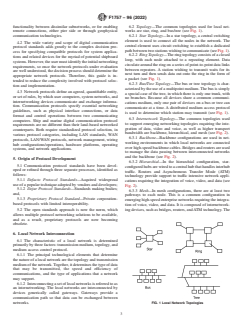
remote connections, either pier side or through geophysical works are star, ring, and bus/tree (see Fig. 1).
communication technologies. 6.2.1 Star Topology—In a star topology, a central switching
element is used to connect all the nodes in the network. The
4.2 The wide variety and scope of digital communication
central element uses circuit switching to establish a dedicated
protocol standards adds greatly to the complex decision pro-
pathbetweentwostationswishingtocommunicate(seeFig.1).
cess for specifying compatible protocols for system applica-
6.2.2 RingTopology—Theringtopologyconsistsofaclosed
tions and related devices for the myriad of potential shipboard
loop, with each node attached to a repeating element. Data
systems.However,theusermustidentifytheinitialnetworking
circulate around the ring on a series of point-to-point data links
requirements, so once the network protocols under evaluation
between repeaters. A station wishing to transmit waits for its
are well understood, the decision process should determine the
next turn and then sends data out onto the ring in the form of
appropriate network protocols. Therefore, this guide is in-
a packet (see Fig. 1).
tended to reduce the complexity involved with protocol selec-
6.2.3 Bus/Tree Topology—The bus or tree topology is char-
tion and implementation.
acterized by the use of a multipoint medium.The bus is simply
4.3 Network protocols define an agreed, quantifiable entity,
a special case of the tree, in which there is only one trunk, with
or set of rules, by which user computers, system networks, and
no branches. Because all devices share a common communi-
internetworking devices communicate and exchange informa-
cations medium, only one pair of devices on a bus or tree can
tion. Communication protocols specify essential networking
communicate at a time. A distributed medium access protocol
guidelines, such as physical interface connections, or data
is used to determine which station may transmit (see Fig. 1).
format and control operations between two communicating
6.3 Internetwork Topology—The common topologies used
computers. Ship and marine digital communication protocol
to support emerging networking topologies requiring the inte-
requirements are no different than their land-based networked
gration of data, video and voice, as well as higher transport
counterparts. Both require standardized protocol selection, in
bandwidth are backbone, hierarchical, and mesh (see Fig. 2).
various protocol categories, including LAN standards, WAN
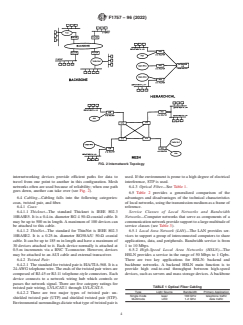
6.3.1 Backbone—Backbone configurations are used in net-
protocols, LAN/WAN protocols, network management, wiring
working environments in which local networks are connected
hub configurations/operations, hardware platforms, operating
over high-speed backbone cables. Bridges and routers are used
systems, and network applications.
to manage the data passing between interconnected networks
and the backbone (see Fig. 2).
5. Origin of Protocol Development
6.3.2 Hierarchial—In the hierarchial configuration, star-
5.1 Communication protocol standards have been devel-
configuredhubsarewiredtoacentralhubthathandlesinterhub
oped or refined through three separate processes, identified as
traffic. Routers and Asynchronous Transfer Mode (ATM)
follows:
technology provide support to traffic intensive network appli-
5.1.1 Defacto Protocol Standards—Acquired widespread
cations requiring the integration of voice, video, and data (see
use of a popular technique adopted by vendors and developers;
Fig. 2).
5.1.2 Dejur Protocol Standards—Standards making bodies;
6.3.3 Mesh—In mesh configurations, there are at least two
and,
pathways to each node. This is a common configuration in
5.1.3 Proprietary Protocol Standard—Private corporation-
emerging high-speed enterprise networks requiring the integra-
based protocols with limited interoperability.
tion of voice, video, and data. It is composed of internetwork-
ingdevices,suchasbridges,routers,andATMtechnology.The
5.2 The open standards approach is now the norm, which
allows multiple protocol networking solutions to be available,
and as a result, proprietary protocols are now becoming
obsolete.
6. Local Network Interconnection
6.1 The characteristic of a local network is determined
primarily by three factors: transmission medium, topology, and
medium access control protocol.
6.1.1 The principal technological elements that determine
the nature of a local network are the topology and transmission
mediumofthenetwork.Together,itdeterminesthetypeofdata
that may be transmitted, the speed and efficiency of
communications, and the type of applications that a network
may support.
6.1.2 Interconnectingasetoflocalnetworksisreferredtoas
an internetworking. The local networks are interconnected by
devices generically called gateways. Gateways provide a
communication path so that data can be exchanged between
networks. FIG. 1 Local Network Topologies
F1757 − 96 (2022)
FIG. 2 Internetwork Topology
internetworking devices provide efficient paths for data to used. If the environment is prone to a high degree of electrical
travel from one point to another in this configuration. Mesh interference, STP is used.
networks often are used because of reliability; when one path 6.4.3 Optical Fiber—See Table 1.
goes down, another can take over (see Fig. 2).
6.5 Table 2 provides a generalized comparison of the
6.4 Cabling—Cabling falls into the following categories: advantages and disadvantages of the technical characteristics
coax, twisted pair, and fiber. oflocalnetworks,usingthetransmissionmediumasaframeof
6.4.1 Coax: reference.
6.4.1.1 Thicknet—The standard Thicknet is IEEE 802.3 Service Classes of Local Networks and Bandwidth
10BASE5. It is a 0.4-in. diameter RG 4 50-Ω coaxial cable. It Networks—Computer networks that serve as components of a
may be up to 500 m in length.Amaximum of 100 devices can communicationnetworkprovidesupporttoalargemultitudeof
be attached to this cable. service classes (see Table 3).
6.4.1.2 ThinNet—The standard for ThinNet is IEEE 802.3 6.5.1 Local Area Network (LAN)—The LAN provides ser-
10BASE2. It is a 0.25-in. diameter RG58A/U 50-Ω coaxial vices to support a group of interconnected computers to share
cable. It can be up to 185 m in length and have a maximum of applications, data, and peripherals. Bandwidth service is from
30 devices attached to it. Each device normally is attached at 1 to 10 Mbps.
0.5-m increments via a BNC T-connector. However, devices 6.5.2 High-Speed Local Area Networks (HSLN)—The
may be attached to an AUI cable and external transceiver. HSLN provides a service in the range of 50 Mbps to 1 Gpbs.
6.4.2 Twisted Pair: There are two key applications for HSLN: backend and
6.4.2.1 The standard for twisted pair is EIA/TIA-568. It is a backbone networks. A backend HSLN main function is to
24-AWGtelephonewire.Theendsofthetwistedpairwiresare provide high end-to-end throughput between high-speed
composed of RJ-45 or RJ-11 telephone-style connectors. Each devices, such as servers and mass storage devices.Abackbone
device connects to a network wiring hub which controls or
passes the network signal. There are five category ratings for
TABLE 1 Optical Fiber Cabling
twisted pair wiring, LVL/CAT-1 through LVL/CAT-5.
Type Light Source Bandwidth Primary Application
6.4.2.2 There are two major types of twisted pair: un-
Single mode laser 100 GHz telephone traffic
shielded twisted pair (UTP) and shielded twisted pair (STP).
Multimode LED 1-2 GHz data traffic
Environmentalsurroundingsdictatewhattypeoftwistedpairis
F1757 − 96 (2022)
TABLE 2 Technical Characteristics of LANS
Transmission Medium
Characteristic twisted pair (UTP, STP) baseband coaxial cable broadband coaxial cable fiber optic cable
Topology bus, star, or ring bus or ring bus or ring bus, star, or ring
Channels single channel single channel multichannel single, multichannel
normally up to 4 Mbps or 16
normally 2 to 10 Mbps; up
Data rate Mbps; up to 100 Mbps up to 400 Mbps up to 1 Gbps
to 100 Mbps obtainable
obtainable
Maximum nodes on net usually <255 usually <1024 several thousands several thousands
supports voice, data, and
low cost; may be able to use supports voice, data, and
Major advantages low cost; simple to install video applications
existing wire video applications simultaneously
simultaneously
limited bandwidth, requires
high cost; difficult to install;
Major disadvantages conduits; low immunity to low immunity to noise cable cost; difficult to splice
requires RF modems
noise
TABLE 3 Classes of Local Networks
6.7.2 Gateways are applications specific that connect differ-
Local Area High-Speed Local ent architectures. It also provides translation services between
WAN
Network Network
different protocols.
Transmission twisted pair, coax, twisted pair, CATV public/private data
medium fiber coax, fiber network providers
6.8 Types of LANs—LANs are descriptive in their configu-
backbone,
ration at two levels: administrative relationship between nodes
Topology bus, tree, ring hierarchical, point-to-point
mesh (stations) and physical and logical relationship among nodes.
Transmission 56 Kbps - 45.5
1-20 Mbps 50 Mbps - 1 Gbps
6.8.1 Administrative Relationship Between Nodes
speed Mbps
(Station)—LANs are divided into server-based and peer-to-
Switching
packet, circuit packet, circuit packet, circuit
technique
peer LANs. Server-based LAN (client server) controls access
to some resource, such as a hard disk or printer, and serves as
a hosts for the workstations connected to the server. A
workstation request services, such as access to fields or
programs on the hard disk or use of a printer, from a server.
HSLN provides a LAN or WAN that interconnects intermedi-
6.8.1.1 Servers run the network operating system (NOS)
ate systems. Fiber optic cables are used as a transmission
software; workstations run client software that manages the
medium to internetwork topologies.
communication between the workstation and the network.
6.5.3 Wide Area Network (WAN)—A network that covers a
6.8.1.2 Peer-to-peer LANs involve direct communications
large geographic area. The differences between WAN and
between computing devices without a dedicated server.
LANs are as follows:
6.8.2 Physical and Logical Relationship Among Nodes—
6.5.3.1 Economic—WAN services are purchased; LANs are
This has to do with the manner in how data is transmitted over
owned.
a network.The physical is concerned with the topology, that is,
6.5.3.2 Technical—WANs are made up of point-to-point
bus, ring, or star, and logical refers to the method of data
links; LANs are shared-media.
transport that is Ethernet, Token Ring, FDDI, ATM, and so
6.6 MediumAccessControlProtocol—Tofacilitatetheshar-
forth.
ing of the transmission among network stations, a proper
6.9 Network Operating System (NOS)—The NOS runs on a
medium access control scheme must be implemented to
server and is responsible for processing requests from
control, coordinate, and supervise the access of user informa-
workstations, for maintaining the network, and for controlling
tion to and from the shared transmission medium:
the services and devices available to users. An NOS may
6.6.1 LAN—IEEE 802.3, IEEE 802.4, and IEEE 802.5
replace the native operating system or run as a program on top
(CSMA/CD, token bus, and token ring) LAN protocols.
of the native operating system. Current NOS available are:
6.6.2 HSLN—IEEE 802.2 (FDDI fiber token ring protocol)
NOVELL Netware, WINDOWS NT, LANtastic, BANYAN,
or IEEE 802.6 DQDB, ATM.
IBM LAN Server, LAN Manager, AppleShare/AppleTalk.
6.6.3 WAN—X.25 Frame Relay, ATM.
6.10 Operating System (OS)—Operating systems bring to-
6.7 Internetworking (Gateways and Routers)—
gether disparate computing resources and present the user with
Internetworking is the interconnection and interoperability of
more convenient abstractions. These resources include devices
small-size local networks into existing networks. A local
for processing, storing, and transmitting information:
network should have the capability to support multiple proto-
6.10.1 DOS (Disk Operating System)—Single-user operat-
cols and allow difference environments to operate in parallel.
ing system for the personal computer (PC).
Internetworking devices available for these services are Rout-
ers and Gateways. 6.10.2 Windows 95/NT—Microsoft windows product re-
6.7.1 Routers are devices that implement the network ser- placing Windows 3.1 and Windows for Workgroup 3.11. It
vice. Routers are required to support multiple protocol stacks, provides system monitor utilities, remote access, network
each with its own routing protocols, and to allow these e-mail, fax capabilities, and file-and printer-sharing for both
different environments to operate in parallel. Windows-based and Netware-based clients.
F1757 − 96 (2022)
6.10.3 OS/2—A multicasting operating system originally
developed by IBM and Microsoft for use with Intel’s micro-
processor and IBM’s Personal System/2 (PS/2) computers.
6.10.4 MAC OS—Apple’s Mac operating system.
6.10.5 UNIX—A multitasking, multiuser operating system
developed by AT&T. This means that more than one user can
use the same computer (programs, file system, memory, CPU)
by logging in off of different ports (serial, Ethernet, Internet,
FIG. 3 Protocol Layers in the OSI Model
and so forth).
6.11 Operating Environments—Operating environments
providecomputingflexibilityandpowertohavemorethanone
application active at the same time. They allow users to
network (3), and transport (4), correspond roughly to protocols
activate and switch several applications simultaneously.
used in all networks. Physical distinguishes individual (0,1)
6.11.1 Windows 3.1—This program provides an environ-
bits, data link allows reliable transmission of groups of bits
mentforrunning16-bitWindowsandDOSapplications.Italso
between adjacent computers, network provides safe routing
supports multimedia, true-type fonts, compound documents
data packets between distant source and distinction computers,
(OLE), as well as drag-and-stop capabilities.
and transport lets programs running on different computers
6.11.2 Windows for Workgroups—This program is a LAN-
exchange sequences of possibly long messages.
capable version of MS Windows 3.1 environment providing
7.3 The bottom three layers are implemented by communi-
integrated file sharing, electronic mail (Microsoft Mail), and
cations carrier hardware or by LAN interfaces. Transport
workgroup scheduling (Schedule +) capabilities. Windows for
software runs on user computers. The highest three layers,
Workgroups 3.11 also supports 32–bit disk and file access.
session (5), presentation (6), and application (7), are intended
6.11.3 Windows 95/NT—This program provides utilities,
to serve the needs of the application or application-specific
protocols, and services for a LAN environment running client
elements.
softwarewithsupportforWindows,WindowsNTWorkstation,
7.4 For WANs, the intermediate-node routing function,
Windows for Workgroups, MS-DOS, Macintosh, OS/2, and
network layer, is important, but media access is simple, usually
UNIX.
a maker of making a leased, dial-up connection or satellite.
6.11.4 X Window System—A network-based widowing sys-
Conversely,forLANsandMANs,noroutingdecisionsneedbe
tem. It provides an application interface for graphic window
made, and the network layer is essentially absent, although the
displays.
multiaccess protocol can become quite sophisticated.
7. OSI Layers of Functionality
8. Layers of Interconnection
7.1 The OSI is a reference model put forth by the Interna-
tional Standards Or
...