

ASTM C1619-23
(Specification)Standard Specification for Elastomeric Seals for Joining Concrete Structures
General Information
- Abstract
ABSTRACT
This specification covers the physical property requirements of elastomeric seals (gaskets) used to seal the joints of precast concrete structures used in gravity and low head pressure applications. The seals shall be classified as: Class A; Class B; Class C; Class D; and Class E. All gaskets shall be extruded or molded in such a manner that any cross-section will be dense, homogeneous, and free of porosity, blisters, pitting, or other imperfections. The gaskets shall be fabricated from an elastomeric material meeting the appropriate classification physical property requirements. The following test methods shall be performed to conform to the specified requirements: tensile strength and elongation; hardness; compression set; accelerated aging; water absorption; ozone resistance; oil immersion testing; and splice strength classification.
SCOPE
1.1 This specification covers the physical property requirements of elastomeric seals (gaskets) used to seal the joints of precast concrete structures conforming to Specifications C14, C14M, C118, C118M, C361, C361M, C443, C443M, C505, C505M, or C1628 used in gravity and low head pressure applications.
1.2 Requirements are given for natural or synthetic rubber gaskets, or a combination of both.
1.3 The values stated in inch-pound units are to be regarded as standard. The values given in parentheses are mathematical conversions to SI units that are provided for information only and are not considered standard.
1.4 The following precautionary caveat pertains only to the test method portion, Section 8, of this specification. This standard does not purport to address all of the safety concerns, if any, associated with its use. It is the responsibility of the user of this standard to establish appropriate safety, health, and environmental practices and determine the applicability of regulatory limitations prior to use.
1.5 This international standard was developed in accordance with internationally recognized principles on standardization established in the Decision on Principles for the Development of International Standards, Guides and Recommendations issued by the World Trade Organization Technical Barriers to Trade (TBT) Committee.
- Status
- Published
- Publication Date
- 30-Sep-2023
- Technical Committee
- C13 - Concrete Pipe
- Drafting Committee
- C13.08 - Joints for Precast Concrete Structures
Buy Documents
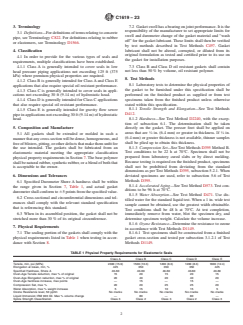


ASTM C1619-23 - Standard Specification for Elastomeric Seals for Joining Concrete Structures
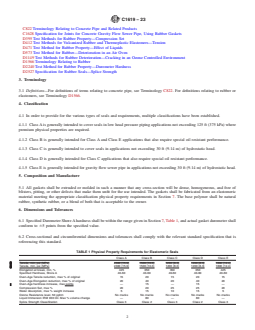

REDLINE ASTM C1619-23 - Standard Specification for Elastomeric Seals for Joining Concrete Structures
Overview
ASTM C1619-23 is the authoritative standard specification for elastomeric seals-commonly referred to as gaskets-used to seal the joints of precast concrete structures in gravity and low head pressure applications. Developed by ASTM International, this standard provides comprehensive physical property requirements and classification guidance to ensure the reliable performance and longevity of seals used in concrete infrastructure projects, including sewer, storm drain, and irrigation systems. This specification covers both natural and synthetic rubber gaskets and is referenced by several other key ASTM concrete pipe standards.
Key Topics
- Physical Property Requirements: ASTM C1619-23 details strict physical property criteria for elastomeric seals, including tensile strength, elongation at break, hardness (durometer), compression set, accelerated aging, water absorption, ozone resistance, oil immersion, and splice strength. These requirements ensure seals perform reliably under field conditions.
- Seal Classifications: The standard defines multiple classes (A, B, C, D, E) to accommodate various pressure levels and application demands:
- Class A: Premium properties for low head pressures up to 125 ft.
- Class B: Enhanced oil resistance for Class A or E applications.
- Class C: Standard seals for pressures up to 30 ft head.
- Class D: Oil-resistant option for Class C settings.
- Class E: Suited for gravity-flow applications up to 30 ft head.
- Manufacturing and Material Quality: Seals must be extruded or molded to achieve a dense, homogeneous construction free of defects like blisters, pitting, or porosity. Acceptable base materials include natural rubber, synthetic rubber, or blends, contingent on meeting the respective class requirements.
- Testing Protocols: The standard mandates laboratory testing of finished gaskets for physical properties, using recognized ASTM methods (e.g., D412 for tensile strength, D2240 for hardness, D395 for compression set, and D1149 for ozone resistance).
- Marking and Traceability: Seals are required to be clearly marked with manufacturer details, size, class, ASTM designation, run number, and production date for quality assurance and traceability.
Applications
ASTM C1619-23 is widely used by manufacturers, engineers, and contractors involved in the design and construction of precast concrete structures such as:
- Concrete Sewer Pipes: Ensures water-tight, durable joints in both nonreinforced and reinforced systems used in sanitary and stormwater infrastructure.
- Storm Drains and Culvert Pipes: Reliable seal integrity for effective water handling and flood management.
- Irrigation Systems: Maintains leak-free connections in critical water conveyance lines.
- Manholes and Box Sections: Provides robust joint sealing to prevent infiltration and exfiltration.
- Low Head Pressure Installations: Critical for applications where consistent watertightness at lower pressures is required.
Related Standards
Professionals using ASTM C1619-23 should also be familiar with the following related ASTM standards referenced within the document:
- ASTM C14 / C14M: Nonreinforced concrete sewer, storm drain, and culvert pipe specifications
- ASTM C118 / C118M: Concrete pipe for irrigation or drainage
- ASTM C361 / C361M: Reinforced concrete low-head pressure pipe
- ASTM C443 / C443M: Joints for concrete pipes and manholes, using rubber gaskets
- ASTM C505 / C505M: Nonreinforced concrete irrigation pipe with rubber gasket joints
- ASTM C1628: Joints for concrete gravity flow sewer pipe, using rubber gaskets
- ASTM D395, D412, D471, D573, D1149, D2240, D2527: Various rubber testing and specification methods relevant to physical property assessment
By specifying ASTM C1619-23 for elastomeric seals in concrete structure joints, stakeholders support higher performance, safety, and environmental protection in concrete infrastructure and ensure compatibility with a comprehensive suite of ASTM guidelines.
Relations
- Replaces
ASTM C1619-20 - Standard Specification for Elastomeric Seals for Joining Concrete Structures - Effective Date
- 01-Oct-2023
- Effective Date
- 01-Jan-2024
- Effective Date
- 15-Jul-2019
- Effective Date
- 15-Jul-2019
- Effective Date
- 01-Oct-2023
- Effective Date
- 01-Oct-2023
- Effective Date
- 01-Oct-2023
- Effective Date
- 01-Oct-2023
- Effective Date
- 01-Oct-2023
- Effective Date
- 01-Oct-2023
- Referred By
ASTM C361M-22 - Standard Specification for Reinforced Concrete Low-Head Pressure Pipe (Metric) - Effective Date
- 01-Oct-2023
- Effective Date
- 01-Oct-2023
- Effective Date
- 01-Oct-2023
- Effective Date
- 01-Oct-2023
- Referred By
ASTM C1677-11a(2017) - Standard Specification for Joints for Concrete Box, Using Rubber Gaskets - Effective Date
- 01-Oct-2023
Buy Documents
ASTM C1619-23 - Standard Specification for Elastomeric Seals for Joining Concrete Structures
REDLINE ASTM C1619-23 - Standard Specification for Elastomeric Seals for Joining Concrete Structures
Frequently Asked Questions
ASTM C1619-23 is a technical specification published by ASTM International. Its full title is "Standard Specification for Elastomeric Seals for Joining Concrete Structures". This standard covers: ABSTRACT This specification covers the physical property requirements of elastomeric seals (gaskets) used to seal the joints of precast concrete structures used in gravity and low head pressure applications. The seals shall be classified as: Class A; Class B; Class C; Class D; and Class E. All gaskets shall be extruded or molded in such a manner that any cross-section will be dense, homogeneous, and free of porosity, blisters, pitting, or other imperfections. The gaskets shall be fabricated from an elastomeric material meeting the appropriate classification physical property requirements. The following test methods shall be performed to conform to the specified requirements: tensile strength and elongation; hardness; compression set; accelerated aging; water absorption; ozone resistance; oil immersion testing; and splice strength classification. SCOPE 1.1 This specification covers the physical property requirements of elastomeric seals (gaskets) used to seal the joints of precast concrete structures conforming to Specifications C14, C14M, C118, C118M, C361, C361M, C443, C443M, C505, C505M, or C1628 used in gravity and low head pressure applications. 1.2 Requirements are given for natural or synthetic rubber gaskets, or a combination of both. 1.3 The values stated in inch-pound units are to be regarded as standard. The values given in parentheses are mathematical conversions to SI units that are provided for information only and are not considered standard. 1.4 The following precautionary caveat pertains only to the test method portion, Section 8, of this specification. This standard does not purport to address all of the safety concerns, if any, associated with its use. It is the responsibility of the user of this standard to establish appropriate safety, health, and environmental practices and determine the applicability of regulatory limitations prior to use. 1.5 This international standard was developed in accordance with internationally recognized principles on standardization established in the Decision on Principles for the Development of International Standards, Guides and Recommendations issued by the World Trade Organization Technical Barriers to Trade (TBT) Committee.
ABSTRACT This specification covers the physical property requirements of elastomeric seals (gaskets) used to seal the joints of precast concrete structures used in gravity and low head pressure applications. The seals shall be classified as: Class A; Class B; Class C; Class D; and Class E. All gaskets shall be extruded or molded in such a manner that any cross-section will be dense, homogeneous, and free of porosity, blisters, pitting, or other imperfections. The gaskets shall be fabricated from an elastomeric material meeting the appropriate classification physical property requirements. The following test methods shall be performed to conform to the specified requirements: tensile strength and elongation; hardness; compression set; accelerated aging; water absorption; ozone resistance; oil immersion testing; and splice strength classification. SCOPE 1.1 This specification covers the physical property requirements of elastomeric seals (gaskets) used to seal the joints of precast concrete structures conforming to Specifications C14, C14M, C118, C118M, C361, C361M, C443, C443M, C505, C505M, or C1628 used in gravity and low head pressure applications. 1.2 Requirements are given for natural or synthetic rubber gaskets, or a combination of both. 1.3 The values stated in inch-pound units are to be regarded as standard. The values given in parentheses are mathematical conversions to SI units that are provided for information only and are not considered standard. 1.4 The following precautionary caveat pertains only to the test method portion, Section 8, of this specification. This standard does not purport to address all of the safety concerns, if any, associated with its use. It is the responsibility of the user of this standard to establish appropriate safety, health, and environmental practices and determine the applicability of regulatory limitations prior to use. 1.5 This international standard was developed in accordance with internationally recognized principles on standardization established in the Decision on Principles for the Development of International Standards, Guides and Recommendations issued by the World Trade Organization Technical Barriers to Trade (TBT) Committee.
ASTM C1619-23 is classified under the following ICS (International Classification for Standards) categories: 21.140 - Seals, glands. The ICS classification helps identify the subject area and facilitates finding related standards.
ASTM C1619-23 has the following relationships with other standards: It is inter standard links to ASTM C1619-20, ASTM C1628-19(2024), ASTM C118-19, ASTM C118M-19, ASTM C1433M-22, ASTM C1903-21, ASTM C443-21, ASTM C443M-21, ASTM C361-22, ASTM C1896-20, ASTM C361M-22, ASTM C1628-19, ASTM C1433-20e1, ASTM C1577-20e1, ASTM C1677-11a(2017). Understanding these relationships helps ensure you are using the most current and applicable version of the standard.
ASTM C1619-23 is available in PDF format for immediate download after purchase. The document can be added to your cart and obtained through the secure checkout process. Digital delivery ensures instant access to the complete standard document.
Standards Content (Sample)
This international standard was developed in accordance with internationally recognized principles on standardization established in the Decision on Principles for the
Development of International Standards, Guides and Recommendations issued by the World Trade Organization Technical Barriers to Trade (TBT) Committee.
Designation: C1619 − 23
Standard Specification for
Elastomeric Seals for Joining Concrete Structures
This standard is issued under the fixed designation C1619; the number immediately following the designation indicates the year of
original adoption or, in the case of revision, the year of last revision. A number in parentheses indicates the year of last reapproval. A
superscript epsilon (´) indicates an editorial change since the last revision or reapproval.
1. Scope C14 Specification for Nonreinforced Concrete Sewer, Storm
Drain, and Culvert Pipe
1.1 This specification covers the physical property require-
C14M Specification for Nonreinforced Concrete Sewer,
ments of elastomeric seals (gaskets) used to seal the joints of
Storm Drain, and Culvert Pipe (Metric)
precast concrete structures conforming to Specifications C14,
C118 Specification for Concrete Pipe for Irrigation or Drain-
C14M, C118, C118M, C361, C361M, C443, C443M, C505,
age
C505M, or C1628 used in gravity and low head pressure
C118M Specification for Concrete Pipe for Irrigation or
applications.
Drainage (Metric)
1.2 Requirements are given for natural or synthetic rubber
C361 Specification for Reinforced Concrete Low-Head
gaskets, or a combination of both.
Pressure Pipe
1.3 The values stated in inch-pound units are to be regarded
C361M Specification for Reinforced Concrete Low-Head
as standard. The values given in parentheses are mathematical
Pressure Pipe (Metric)
conversions to SI units that are provided for information only
C443 Specification for Joints for Concrete Pipe and
and are not considered standard.
Manholes, Using Rubber Gaskets
1.4 The following precautionary caveat pertains only to the C443M Specification for Joints for Concrete Pipe and
test method portion, Section 8, of this specification. This Manholes, Using Rubber Gaskets (Metric)
standard does not purport to address all of the safety concerns, C497 Test Methods for Concrete Pipe, Concrete Box
if any, associated with its use. It is the responsibility of the user Sections, Manhole Sections, or Tile
of this standard to establish appropriate safety, health, and
C497M Test Methods for Concrete Pipe, Concrete Box
environmental practices and determine the applicability of Sections, Manhole Sections, or Tile (Metric)
regulatory limitations prior to use.
C505 Specification for Nonreinforced Concrete Irrigation
1.5 This international standard was developed in accor-
Pipe with Rubber Gasket Joints
dance with internationally recognized principles on standard-
C505M Specification for Nonreinforced Concrete Irrigation
ization established in the Decision on Principles for the
Pipe With Rubber Gasket Joints (Metric)
Development of International Standards, Guides and Recom-
C822 Terminology Relating to Concrete Pipe and Related
mendations issued by the World Trade Organization Technical
Products
Barriers to Trade (TBT) Committee.
C1628 Specification for Joints for Concrete Gravity Flow
Sewer Pipe, Using Rubber Gaskets
2. Referenced Documents
D395 Test Methods for Rubber Property—Compression Set
D412 Test Methods for Vulcanized Rubber and Thermoplas-
2.1 ASTM Standards:
tic Elastomers—Tension
D471 Test Method for Rubber Property—Effect of Liquids
D573 Test Method for Rubber—Deterioration in an Air
This specification is under the jurisdiction of ASTM Committee C13 on
Concrete Pipe and is the direct responsibility of Subcommittee C13.08 on Joints for
Oven
Precast Concrete Structures.
D1149 Test Methods for Rubber Deterioration—Cracking in
Current edition approved Oct. 1, 2023. Published October 2023. Originally
an Ozone Controlled Environment
approved in 2005. Last previous edition approved in 2020 as C1619–20. DOI:
10.1520/C1619-23.
D1566 Terminology Relating to Rubber
For referenced ASTM standards, visit the ASTM website, www.astm.org, or
D2240 Test Method for Rubber Property—Durometer Hard-
contact ASTM Customer Service at service@astm.org. For Annual Book of ASTM
ness
Standards volume information, refer to the standard’s Document Summary page on
the ASTM website. D2527 Specification for Rubber Seals—Splice Strength
Copyright © ASTM International, 100 Barr Harbor Drive, PO Box C700, West Conshohocken, PA 19428-2959. United States
C1619 − 23
3. Terminology 7.2 Gasket swell has a bearing on joint performance. It is the
responsibility of the manufacturer to set appropriate limits for
3.1 Definitions—For definitions of terms relating to concrete
swell and durometer change of the gasket material and “wash
pipe, see Terminology C822. For definitions relating to rubber
off” for the gasket lubricant. These limits shall then be verified
or elastomers, see Terminology D1566.
by test methods described in Test Methods C497. Gasket
4. Classification lubricant shall not be altered, corrupted, or diluted from its
original formulation as tested and certified prior to its use on
4.1 In order to provide for the various types of seals and
the gasket for installation purposes.
requirements, multiple classifications have been established.
7.3 Class B and Class D oil resistant gaskets shall contain
4.1.1 Class A is generally intended to cover seals in low
head pressure piping applications not exceeding 125 ft (375 not less than 50 % by volume, oil resistant polymer.
kPa) where premium physical properties are required.
8. Test Methods
4.1.2 Class B is generally intended for Class A and Class E
8.1 Laboratory tests to determine the physical properties of
applications that also require special oil resistant performance.
the gasket to be furnished under this specification shall be
4.1.3 Class C is generally intended to cover seals in appli-
performed on the finished product as supplied or from test
cations not exceeding 30 ft (9.14 m) of hydrostatic head.
specimens taken from the finished product unless otherwise
4.1.4 Class D is generally intended for Class C applications
stated within this specification.
that also require special oil resistant performance.
8.1.1 Tensile Strength and Elongation—See Test Methods
4.1.5 Class E is generally intended for gravity flow sewer
D412.
pipe in applications not exceeding 30 ft (9.14 m) of hydrostatic
8.1.2 Hardness—See Test Method D2240, with the excep-
head.
tion of subsection 6.1. The determination shall be taken
5. Composition and Manufacture
directly on the gasket. The presser foot shall be applied on
1 1
areas that are ⁄4 in. (6.4 mm) or greater in thickness. If ⁄4 in.
5.1 All gaskets sha
...
This document is not an ASTM standard and is intended only to provide the user of an ASTM standard an indication of what changes have been made to the previous version. Because
it may not be technically possible to adequately depict all changes accurately, ASTM recommends that users consult prior editions as appropriate. In all cases only the current version
of the standard as published by ASTM is to be considered the official document.
Designation: C1619 − 20 C1619 − 23
Standard Specification for
Elastomeric Seals for Joining Concrete Structures
This standard is issued under the fixed designation C1619; the number immediately following the designation indicates the year of
original adoption or, in the case of revision, the year of last revision. A number in parentheses indicates the year of last reapproval. A
superscript epsilon (´) indicates an editorial change since the last revision or reapproval.
1. Scope
1.1 This specification covers the physical property requirements of elastomeric seals (gaskets) used to seal the joints of precast
concrete structures conforming to Specifications C14, C14M, C118, C118M, C361, C361M, C443, C443M, C505, C505M, or
C1628 used in gravity and low head pressure applications.
1.2 Requirements are given for natural or synthetic rubber gaskets, or a combination of both.
1.3 The values stated in inch-pound units are to be regarded as standard. The values given in parentheses are mathematical
conversions to SI units that are provided for information only and are not considered standard.
1.4 The following precautionary caveat pertains only to the test method portion, Section 8, of this specification. This standard
does not purport to address all of the safety concerns, if any, associated with its use. It is the responsibility of the user of this
standard to establish appropriate safety, health, and environmental practices and determine the applicability of regulatory
limitations prior to use.
1.5 This international standard was developed in accordance with internationally recognized principles on standardization
established in the Decision on Principles for the Development of International Standards, Guides and Recommendations issued
by the World Trade Organization Technical Barriers to Trade (TBT) Committee.
2. Referenced Documents
2.1 ASTM Standards:
C14 Specification for Nonreinforced Concrete Sewer, Storm Drain, and Culvert Pipe
C14M Specification for Nonreinforced Concrete Sewer, Storm Drain, and Culvert Pipe (Metric)
C118 Specification for Concrete Pipe for Irrigation or Drainage
C118M Specification for Concrete Pipe for Irrigation or Drainage (Metric)
C361 Specification for Reinforced Concrete Low-Head Pressure Pipe
C361M Specification for Reinforced Concrete Low-Head Pressure Pipe (Metric)
C443 Specification for Joints for Concrete Pipe and Manholes, Using Rubber Gaskets
C443M Specification for Joints for Concrete Pipe and Manholes, Using Rubber Gaskets (Metric)
C497 Test Methods for Concrete Pipe, Concrete Box Sections, Manhole Sections, or Tile
C497M Test Methods for Concrete Pipe, Concrete Box Sections, Manhole Sections, or Tile (Metric)
C505 Specification for Nonreinforced Concrete Irrigation Pipe with Rubber Gasket Joints
C505M Specification for Nonreinforced Concrete Irrigation Pipe With Rubber Gasket Joints (Metric)
This specification is under the jurisdiction of ASTM Committee C13 on Concrete Pipe and is the direct responsibility of Subcommittee C13.08 on Joints for Precast
Concrete Structures.
Current edition approved Sept. 1, 2020Oct. 1, 2023. Published September 2020October 2023. Originally approved in 2005. Last previous edition approved in 20192020
as C1619–19. DOI: 10.1520/C1619-20.–20. DOI: 10.1520/C1619-23.
For referenced ASTM standards, visit the ASTM website, www.astm.org, or contact ASTM Customer Service at service@astm.org. For Annual Book of ASTM Standards
volume information, refer to the standard’s Document Summary page on the ASTM website.
Copyright © ASTM International, 100 Barr Harbor Drive, PO Box C700, West Conshohocken, PA 19428-2959. United States
C1619 − 23
C822 Terminology Relating to Concrete Pipe and Related Products
C1628 Specification for Joints for Concrete Gravity Flow Sewer Pipe, Using Rubber Gaskets
D395 Test Methods for Rubber Property—Compression Set
D412 Test Methods for Vulcanized Rubber and Thermoplastic Elastomers—Tension
D471 Test Method for Rubber Property—Effect of Liquids
D573 Test Method for Rubber—Deterioration in an Air Oven
D1149 Test Methods for Rubber Deterioration—Cracking in an Ozone Controlled Environment
D1566 Terminology Relating to Rubber
D2240 Test Method for Rubber Property—Durometer Hardness
D2527 Specification for Rubber Seals—Splice Strength
3. Terminology
3.1 Definitions—For definitions of terms relating to concrete pipe, see Terminology C822. For definitions relating to rubber or
elastomers, see Terminology D1566.
4. Classification
4.1 In order to provide for the various types of seals and requirements, multiple classifications have been established.
4.1.1 Class A is generally intended to cover seals in low head pressure piping applications not exceeding 125 ft (375 kPa) where
premium physical properties are required.
4.1.2 Class B is generally intended for Class A and Class E applications that also require special oil resistant performance.
4.1.3 Class C is generally intended to cover seals in applications not exceeding 30 ft (9.14 m) of hydrostatic head.
4.1.4 Class D is generally intended for Class C applications that also require special oil resistant performance.
4.1.5 Class E is generally intended for gravity flow sewer pipe in applications not exceeding 30 ft (9.14 m) of hydrostatic head.
5. Composition and Manufacture
5.1 All gaskets shall be extruded or molded in such a manner that any cross-section will be dense, homogeneous, and free of
blisters, pitting, or other defects that make them unfit for the use intended. The gaskets shall be fabricated from an elastomeric
material meeting the appropriate classification physical property requirements in Section 7. The base polymer shall be natural
rubber, synthetic rubber, or a blend of both that is acceptable to the owner.
6. Dimensions and Tolerances
6.1 Specified Durometer Shore A hardness shall be within the range given in Section 7, Table 1, and actual gasket durometer shall
conform to 65 points from the specified value.
6.2 Cross-sectional and circumferential dimensions and tolerances shall comply with the relevant standard specification that is
referencing this standard.
TABLE 1 Physical Property Requirements for Elastomeric Seals
Class A Class B Class C Class D Class E
Tensile, min, psi (MPa) 2300 (15.9) 1500 (10.3) 1200 (8-3) 1200 (8.3) 1800 (12.4)
Tensile, min, psi (MPa) 2300 (15.9) 1500 (10.3) 1200 (8.3) 1200 (8.3) 1800 (12.4)
Elongation at break, min, % 425 350 350 350 425
Specified Hardness, Shore A 40-60 40-60 40-60 40-60 40-60
Oven-Age Tensi
...