

ASTM D4304-22
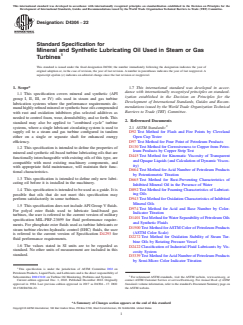
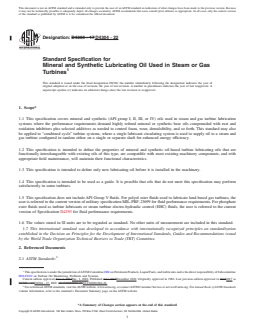
(Specification)Standard Specification for Mineral and Synthetic Lubricating Oil Used in Steam or Gas Turbines
General Information
- Abstract
ABSTRACT
This specification covers mineral lubricating oils used in steam and gas turbine lubricating systems where the performance requirements demand a highly refined mineral base oil compounded with rust and oxidation inhibitors plus selected additives as needed to control foam, wear, demulsibility, and so forth. This specification is intended to define the properties of new mineral oil-based turbine lubricating oils that are functionally interchangeable with existing oils of this type, are compatible with most existing machinery components, and with appropriate field maintenance, will maintain their functional characteristics. The lubricating oils shall meet the functional property limits specified for each type, as follows: ISO-viscosity grade; ASTM color; specific gravity, flash point, and pour point; water content and viscosity; visual examination; total acid number; emulsion characteristics; foaming characteristics; air release; rust preventing characteristics; copper corrosion; oxidation stability; 1000-h TOST sludge and total acid number; and cleanliness at the delivery stage.
SCOPE
1.1 This specification covers mineral and synthetic (API group I, II, III, or IV) oils used in steam and gas turbine lubrication systems where the performance requirements demand highly refined mineral or synthetic base oils compounded with rust and oxidation inhibitors plus selected additives as needed to control foam, wear, demulsibility, and so forth. This standard may also be applied to “combined cycle” turbine systems, where a single lubricant circulating system is used to supply oil to a steam and gas turbine configured in tandem either on a single or separate shaft for enhanced energy efficiency.
1.2 This specification is intended to define the properties of mineral and synthetic oil-based turbine lubricating oils that are functionally interchangeable with existing oils of this type, are compatible with most existing machinery components, and with appropriate field maintenance, will maintain their functional characteristics.
1.3 This specification is intended to define only new lubricating oil before it is installed in the machinery.
1.4 This specification is intended to be used as a guide. It is possible that oils that do not meet this specification may perform satisfactorily in some turbines.
1.5 This specification does not include API Group V fluids. For polyol ester fluids used to lubricate land-based gas turbines, the user is referred to the current version of military specification MIL-PRF-23699 for fluid performance requirements. For phosphate ester fluids used as turbine lubricants or steam turbine electro-hydraulic control (EHC) fluids, the user is referred to the current version of Specification D4293 for fluid performance requirements.
1.6 The values stated in SI units are to be regarded as standard. No other units of measurement are included in this standard.
1.7 This international standard was developed in accordance with internationally recognized principles on standardization established in the Decision on Principles for the Development of International Standards, Guides and Recommendations issued by the World Trade Organization Technical Barriers to Trade (TBT) Committee.
- Status
- Published
- Publication Date
- 30-Nov-2022
- Technical Committee
- D02 - Petroleum Products, Liquid Fuels, and Lubricants
- Drafting Committee
- D02.C0.01 - Turbine Oil Monitoring, Problems and Systems
Buy Documents
ASTM D4304-22 - Standard Specification for Mineral and Synthetic Lubricating Oil Used in Steam or Gas Turbines
REDLINE ASTM D4304-22 - Standard Specification for Mineral and Synthetic Lubricating Oil Used in Steam or Gas Turbines
Overview
ASTM D4304-22 is the international standard specification for mineral and synthetic lubricating oils used in steam and gas turbines. Developed by ASTM International, this standard defines requirements for new lubricating oils formulated to meet the performance needs of modern turbine lubrication systems. It specifies physical, chemical, and performance properties for both mineral and synthetic turbine oils, including those used in combined cycle turbines.
This specification is designed to ensure that turbine oils are highly refined and include rust, oxidation inhibitors, and additives to control critical aspects such as foaming, demulsibility, wear, and cleanliness. Lubricating oils under this standard are engineered to be functionally interchangeable with existing products and to be compatible with most turbine machinery components.
Key Topics
ASTM D4304-22 covers a range of important technical aspects relevant to users, manufacturers, and maintainers of turbine lubricating oils:
Types of Lubricating Oils
- Type I: For systems not requiring high load capacity (e.g., standard steam/gas turbines).
- Type II: For systems needing enhanced load carrying, especially those with gearboxes.
- Type III: For heavy-duty turbines requiring higher thermal stability and performance in high-temperature operations.
Oil Base Types
- Mineral oil (API group I, II, III)
- Synthetic oil (API group IV)
- Excludes API Group V fluids (refer to other ASTM or military standards)
Performance and Functional Properties
- ISO viscosity grades (per ISO VG system)
- Flash point, pour point, specific gravity, and water content
- Acid number, oxidation stability, sludge tendency
- Foaming tendencies, demulsibility (water separation), air release
- Rust and corrosion protection (for iron and copper alloys)
- Oil cleanliness (particle count standards)
- Elastomer compatibility (rubber seal performance)
Testing and Quality Assurance
- Reference to key ASTM and ISO test methods for property verification (such as ASTM D445 for viscosity, D892 for foaming, D665 for rust testing)
- Guidance on sampling, testing, and system preparation
Applications
The oils specified under ASTM D4304-22 play a crucial role in the performance and reliability of steam and gas turbines, as well as in combined cycle turbine systems where both steam and gas turbines may operate together on a single or dual shaft. Key application areas include:
Power Generation Plants
- Steam turbines in thermal, nuclear, or combined cycle power plants
- Gas turbines used for electricity generation or mechanical drives
Industrial and Utility Operations
- Process steam turbines in refineries, petrochemical plants, and manufacturing operations
Marine and Offshore Turbine Systems
- Turbine-driven marine propulsion or auxiliary systems
Applying this standard helps ensure turbine equipment longevity, reliability, and safety by safeguarding lubricated components against wear, corrosion, foaming, water ingress, and operational contamination. Oils conforming to ASTM D4304-22 can help simplify oil procurement, minimize compatibility risks, and streamline turbine maintenance workflows.
Related Standards
For comprehensive oil performance and compatibility, ASTM D4304-22 references and complements several related standards:
- ASTM D4293 - Phosphate Ester Based Fluids for Turbine Lubrication and Electro-Hydraulic Control (EHC) Systems
- MIL-PRF-23699 - Military specification for polyol ester fluids in land-based gas turbines
- ISO 8068 - International specification for lubricant oils for turbines
- ASTM D445 - Test Method for Kinematic Viscosity
- ASTM D892 - Test Method for Foaming Characteristics
- ASTM D665 - Test Method for Rust Prevention
- ASTM D943/D2272/D4310 - Oxidation stability and sludge testing
- ASTM D1500 - Determination of Oil Color
- ASTM D3427 - Air Release Properties of Oils
For best results, users should also review manufacturer recommendations and other applicable international and military standards, especially for unique or high-demand turbine applications.
Relations
- Effective Date
- 01-Apr-2024
- Effective Date
- 01-Mar-2024
- Effective Date
- 01-Feb-2024
- Effective Date
- 01-Feb-2024
- Refers
ASTM D4175-23a - Standard Terminology Relating to Petroleum Products, Liquid Fuels, and Lubricants - Effective Date
- 15-Dec-2023
- Effective Date
- 01-Dec-2023
- Effective Date
- 01-Nov-2023
- Effective Date
- 01-Oct-2023
- Refers
ASTM D4175-23e1 - Standard Terminology Relating to Petroleum Products, Liquid Fuels, and Lubricants - Effective Date
- 01-Jul-2023
- Effective Date
- 01-May-2020
- Effective Date
- 01-Jan-2020
- Effective Date
- 01-Dec-2019
- Effective Date
- 01-Dec-2019
- Effective Date
- 01-Jun-2018
- Effective Date
- 01-May-2018
Buy Documents
ASTM D4304-22 - Standard Specification for Mineral and Synthetic Lubricating Oil Used in Steam or Gas Turbines
REDLINE ASTM D4304-22 - Standard Specification for Mineral and Synthetic Lubricating Oil Used in Steam or Gas Turbines
Get Certified
Connect with accredited certification bodies for this standard

Element Materials Technology
Materials testing and product certification.

ABS Group Brazil
ABS Group certification services in Brazil.

ABS Quality Evaluations Inc.
American Bureau of Shipping quality certification.
Sponsored listings
Frequently Asked Questions
ASTM D4304-22 is a technical specification published by ASTM International. Its full title is "Standard Specification for Mineral and Synthetic Lubricating Oil Used in Steam or Gas Turbines". This standard covers: ABSTRACT This specification covers mineral lubricating oils used in steam and gas turbine lubricating systems where the performance requirements demand a highly refined mineral base oil compounded with rust and oxidation inhibitors plus selected additives as needed to control foam, wear, demulsibility, and so forth. This specification is intended to define the properties of new mineral oil-based turbine lubricating oils that are functionally interchangeable with existing oils of this type, are compatible with most existing machinery components, and with appropriate field maintenance, will maintain their functional characteristics. The lubricating oils shall meet the functional property limits specified for each type, as follows: ISO-viscosity grade; ASTM color; specific gravity, flash point, and pour point; water content and viscosity; visual examination; total acid number; emulsion characteristics; foaming characteristics; air release; rust preventing characteristics; copper corrosion; oxidation stability; 1000-h TOST sludge and total acid number; and cleanliness at the delivery stage. SCOPE 1.1 This specification covers mineral and synthetic (API group I, II, III, or IV) oils used in steam and gas turbine lubrication systems where the performance requirements demand highly refined mineral or synthetic base oils compounded with rust and oxidation inhibitors plus selected additives as needed to control foam, wear, demulsibility, and so forth. This standard may also be applied to “combined cycle” turbine systems, where a single lubricant circulating system is used to supply oil to a steam and gas turbine configured in tandem either on a single or separate shaft for enhanced energy efficiency. 1.2 This specification is intended to define the properties of mineral and synthetic oil-based turbine lubricating oils that are functionally interchangeable with existing oils of this type, are compatible with most existing machinery components, and with appropriate field maintenance, will maintain their functional characteristics. 1.3 This specification is intended to define only new lubricating oil before it is installed in the machinery. 1.4 This specification is intended to be used as a guide. It is possible that oils that do not meet this specification may perform satisfactorily in some turbines. 1.5 This specification does not include API Group V fluids. For polyol ester fluids used to lubricate land-based gas turbines, the user is referred to the current version of military specification MIL-PRF-23699 for fluid performance requirements. For phosphate ester fluids used as turbine lubricants or steam turbine electro-hydraulic control (EHC) fluids, the user is referred to the current version of Specification D4293 for fluid performance requirements. 1.6 The values stated in SI units are to be regarded as standard. No other units of measurement are included in this standard. 1.7 This international standard was developed in accordance with internationally recognized principles on standardization established in the Decision on Principles for the Development of International Standards, Guides and Recommendations issued by the World Trade Organization Technical Barriers to Trade (TBT) Committee.
ABSTRACT This specification covers mineral lubricating oils used in steam and gas turbine lubricating systems where the performance requirements demand a highly refined mineral base oil compounded with rust and oxidation inhibitors plus selected additives as needed to control foam, wear, demulsibility, and so forth. This specification is intended to define the properties of new mineral oil-based turbine lubricating oils that are functionally interchangeable with existing oils of this type, are compatible with most existing machinery components, and with appropriate field maintenance, will maintain their functional characteristics. The lubricating oils shall meet the functional property limits specified for each type, as follows: ISO-viscosity grade; ASTM color; specific gravity, flash point, and pour point; water content and viscosity; visual examination; total acid number; emulsion characteristics; foaming characteristics; air release; rust preventing characteristics; copper corrosion; oxidation stability; 1000-h TOST sludge and total acid number; and cleanliness at the delivery stage. SCOPE 1.1 This specification covers mineral and synthetic (API group I, II, III, or IV) oils used in steam and gas turbine lubrication systems where the performance requirements demand highly refined mineral or synthetic base oils compounded with rust and oxidation inhibitors plus selected additives as needed to control foam, wear, demulsibility, and so forth. This standard may also be applied to “combined cycle” turbine systems, where a single lubricant circulating system is used to supply oil to a steam and gas turbine configured in tandem either on a single or separate shaft for enhanced energy efficiency. 1.2 This specification is intended to define the properties of mineral and synthetic oil-based turbine lubricating oils that are functionally interchangeable with existing oils of this type, are compatible with most existing machinery components, and with appropriate field maintenance, will maintain their functional characteristics. 1.3 This specification is intended to define only new lubricating oil before it is installed in the machinery. 1.4 This specification is intended to be used as a guide. It is possible that oils that do not meet this specification may perform satisfactorily in some turbines. 1.5 This specification does not include API Group V fluids. For polyol ester fluids used to lubricate land-based gas turbines, the user is referred to the current version of military specification MIL-PRF-23699 for fluid performance requirements. For phosphate ester fluids used as turbine lubricants or steam turbine electro-hydraulic control (EHC) fluids, the user is referred to the current version of Specification D4293 for fluid performance requirements. 1.6 The values stated in SI units are to be regarded as standard. No other units of measurement are included in this standard. 1.7 This international standard was developed in accordance with internationally recognized principles on standardization established in the Decision on Principles for the Development of International Standards, Guides and Recommendations issued by the World Trade Organization Technical Barriers to Trade (TBT) Committee.
ASTM D4304-22 is classified under the following ICS (International Classification for Standards) categories: 75.100 - Lubricants, industrial oils and related products. The ICS classification helps identify the subject area and facilitates finding related standards.
ASTM D4304-22 has the following relationships with other standards: It is inter standard links to ASTM D445-24, ASTM D1500-24, ASTM D7546-24, ASTM D7647-24, ASTM D4175-23a, ASTM D665-23, ASTM D445-23, ASTM D892-23, ASTM D4175-23e1, ASTM D7155-20, ASTM D4310-20, ASTM D665-19, ASTM D5182-19, ASTM D7155-18, ASTM D7547-18. Understanding these relationships helps ensure you are using the most current and applicable version of the standard.
ASTM D4304-22 is available in PDF format for immediate download after purchase. The document can be added to your cart and obtained through the secure checkout process. Digital delivery ensures instant access to the complete standard document.
Standards Content (Sample)
This international standard was developed in accordance with internationally recognized principles on standardization established in the Decision on Principles for the
Development of International Standards, Guides and Recommendations issued by the World Trade Organization Technical Barriers to Trade (TBT) Committee.
Designation:D4304 −22
Standard Specification for
Mineral and Synthetic Lubricating Oil Used in Steam or Gas
Turbines
This standard is issued under the fixed designation D4304; the number immediately following the designation indicates the year of
original adoption or, in the case of revision, the year of last revision. A number in parentheses indicates the year of last reapproval. A
superscript epsilon (´) indicates an editorial change since the last revision or reapproval.
1. Scope* 1.7 This international standard was developed in accor-
dance with internationally recognized principles on standard-
1.1 This specification covers mineral and synthetic (API
ization established in the Decision on Principles for the
group I, II, III, or IV) oils used in steam and gas turbine
Development of International Standards, Guides and Recom-
lubrication systems where the performance requirements de-
mendations issued by the World Trade Organization Technical
mandhighlyrefinedmineralorsyntheticbaseoilscompounded
Barriers to Trade (TBT) Committee.
with rust and oxidation inhibitors plus selected additives as
needed to control foam, wear, demulsibility, and so forth. This
2. Referenced Documents
standard may also be applied to “combined cycle” turbine
systems, where a single lubricant circulating system is used to 2.1 ASTM Standards:
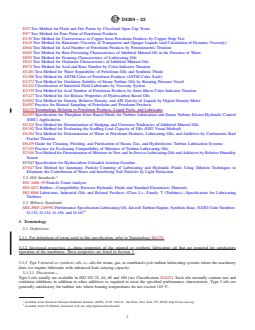
supply oil to a steam and gas turbine configured in tandem D92 Test Method for Flash and Fire Points by Cleveland
either on a single or separate shaft for enhanced energy Open Cup Tester
efficiency. D97 Test Method for Pour Point of Petroleum Products
D130 Test Method for Corrosiveness to Copper from Petro-
1.2 This specification is intended to define the properties of
leum Products by Copper Strip Test
mineral and synthetic oil-based turbine lubricating oils that are
D445 Test Method for Kinematic Viscosity of Transparent
functionally interchangeable with existing oils of this type, are
and Opaque Liquids (and Calculation of Dynamic Viscos-
compatible with most existing machinery components, and
ity)
with appropriate field maintenance, will maintain their func-
D664 Test Method for Acid Number of Petroleum Products
tional characteristics.
by Potentiometric Titration
1.3 This specification is intended to define only new lubri-
D665 Test Method for Rust-Preventing Characteristics of
cating oil before it is installed in the machinery.
Inhibited Mineral Oil in the Presence of Water
1.4 This specification is intended to be used as a guide. It is D892 Test Method for Foaming Characteristics of Lubricat-
ing Oils
possible that oils that do not meet this specification may
perform satisfactorily in some turbines. D943 Test Method for Oxidation Characteristics of Inhibited
Mineral Oils
1.5 This specification does not includeAPI Group V fluids.
D974 Test Method for Acid and Base Number by Color-
For polyol ester fluids used to lubricate land-based gas
Indicator Titration
turbines, the user is referred to the current version of military
D1401 TestMethodforWaterSeparabilityofPetroleumOils
specification MIL-PRF-23699 for fluid performance require-
and Synthetic Fluids
ments. For phosphate ester fluids used as turbine lubricants or
D1500 Test Method forASTM Color of Petroleum Products
steam turbine electro-hydraulic control (EHC) fluids, the user
(ASTM Color Scale)
is referred to the current version of Specification D4293 for
D2272 Test Method for Oxidation Stability of Steam Tur-
fluid performance requirements.
bine Oils by Rotating Pressure Vessel
1.6 The values stated in SI units are to be regarded as
D2422 Classification of Industrial Fluid Lubricants by Vis-
standard. No other units of measurement are included in this
cosity System
standard.
D3339 Test Method forAcid Number of Petroleum Products
by Semi-Micro Color Indicator Titration
This specification is under the jurisdiction of ASTM Committee D02 on
Petroleum Products, Liquid Fuels, and Lubricants and is the direct responsibility of
Subcommittee D02.C0.01 on Turbine Oil Monitoring, Problems and Systems. For referenced ASTM standards, visit the ASTM website, www.astm.org, or
Current edition approved Dec. 1, 2022. Published December 2022. Originally contact ASTM Customer Service at service@astm.org. For Annual Book of ASTM
approved in 1984. Last previous edition approved in 2017 as D4304 – 17. DOI: Standards volume information, refer to the standard’s Document Summary page on
10.1520/D4304-22. the ASTM website.
*A Summary of Changes section appears at the end of this standard
Copyright © ASTM International, 100 Barr Harbor Drive, PO Box C700, West Conshohocken, PA 19428-2959. United States
D4304−22
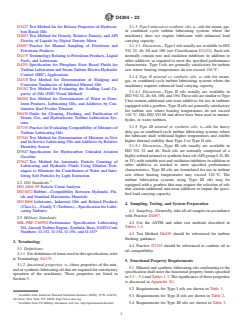
D3427 Test Method forAir Release Properties of Hydrocar- 3.1.3 Type I mineral or synthetic oils, n—oilsforsteam,gas,
bon Based Oils or combined cycle turbine lubricating systems where the
machinery does not require lubricants with enhanced load
D4052 Test Method for Density, Relative Density, and API
Gravity of Liquids by Digital Density Meter carrying capacity.
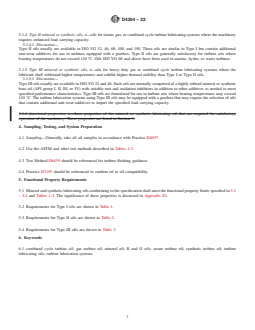
D4057 Practice for Manual Sampling of Petroleum and 3.1.3.1 Discussion—Type I oils usually are available in ISO
Petroleum Products VG 32, 46, 68 and 100 (see Classification D2422). Such oils
D4175 Terminology Relating to Petroleum Products, Liquid normally contain rust and oxidation inhibitors in addition to
Fuels, and Lubricants other additives as required to meet the specified performance
D4293 Specification for Phosphate Ester Based Fluids for characteristic. Type I oils are generally satisfactory for turbine
Turbine Lubrication and SteamTurbine Electro-Hydraulic sets where bearing temperatures do not exceed 110 °C.
Control (EHC) Applications
3.1.4 Type II mineral or synthetic oils, n—oils for steam,
D4310 Test Method for Determination of Sludging and
gas, or combined cycle turbine lubricating systems where the
Corrosion Tendencies of Inhibited Mineral Oils
machinery requires enhanced load carrying capacity.
D5182 Test Method for Evaluating the Scuffing Load Ca-
3.1.4.1 Discussion—Type II oils usually are available in
pacity of Oils (FZG Visual Method)
ISOVG32,46,68,100,and150.TheseoilsaresimilartoType
D6304 Test Method for Determination of Water in Petro-
I but contain additional anti-wear additives for use in turbines
leum Products, Lubricating Oils, and Additives by Cou-
equipped with a gearbox.Type II oils are generally satisfactory
lometric Karl Fischer Titration
for turbine sets where bearing temperatures do not exceed
D6439 Guide for Cleaning, Flushing, and Purification of
110 °C. Oils ISO VG 68 and above have been used in marine,
Steam, Gas, and Hydroelectric Turbine Lubrication Sys-
hydro, or water turbines.
tems
3.1.5 Type III mineral or synthetic oils, n—oils for heavy
D7155 Practice for Evaluating Compatibility of Mixtures of
duty gas or combined cycle turbine lubricating systems where
Turbine Lubricating Oils
the lubricant shall withstand higher temperatures and exhibit
D7546 Test Method for Determination of Moisture in New
higher thermal stability than Type I or Type II oils.
and In-Service Lubricating Oils andAdditives by Relative
3.1.5.1 Discussion—Type III oils usually are available in
Humidity Sensor
ISO VG 32 and 46. Such oils are normally comprised of a
D7547 Specification for Hydrocarbon Unleaded Aviation
highlyrefinedmineralorsyntheticbaseoil(APIgroupI,II,III,
Gasoline
or IV) with suitable rust and oxidation inhibitors in addition to
D7647 Test Method for Automatic Particle Counting of
other additives as needed to meet specified performance
Lubricating and Hydraulic Fluids Using Dilution Tech-
characteristics. Type III oils are formulated for use in turbine
niques to Eliminate the Contribution of Water and Inter-
sets where bearing temperatures may exceed 110 °C. The
fering Soft Particles by Light Extinction
turbine lubrication systems using Type III oils may be
2.2 ISO Standards:
equipped with a gearbox that may require the selection of oils
ISO 4406–99 Particle Count Analysis
that contain additional anti-wear additives to impart the speci-
ISO 6072 Rubber—Compatibility Between Hydraulic Flu-
fied load carrying capacity.
ids and Standard Elastomeric Materials
ISO 8068 Lubricatns, Industrial Oils and Related Products
4. Sampling, Testing, and System Preparation
(Class L)—Family T (Turbines)—Specification for Lubri-
4.1 Sampling—Generally, take all oil samples in accordance
cating Turbines
with Practice D4057.
2.3 Military Standards:
4.2 Use the ASTM and other test methods described in
MIL-PRF-23699G Performance Specification Lubricating
Oil,AircraftTurbine Engine, Synthetic Base, NATO Code Tables 1-3.
Numbers: O-152, O-154, O-156, and O-167
4.3 Test Method D6439 should be referenced for turbine
flushing guidance.
3. Terminology
4.4 Practice D7155 should be referenced to confirm oil to
3.1 Definitions:
oil compatibility.
3.1.1 Fordefinitionsoftermsusedinthisspecification,refer
to Terminology D4175.
5. Functional Property Requirements
3.1.2 functional properties, n—those properties of the min-
5.1 Mineral and synthetic lubricating oils conforming to the
eralorsyntheticlubricatingoilthatarerequiredforsatisfactory
specification shall meet the functional property limits specified
operation of the machinery. These properties are listed in
in5.2–5.4andTables1-3.Thesignificanceoftheseproperties
Section 5.
is discussed in Appendix X1.
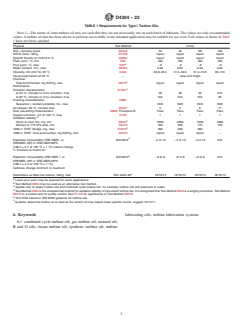
5.2 Requirements for Type I oils are shown in Table 1.
Available fromAmerican National Standards Institute (ANSI), 25 W. 43rd St.,
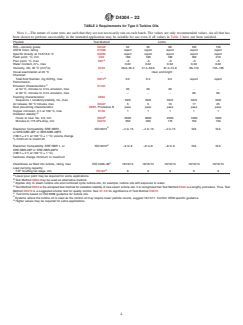
5.3 Requirements for Type II oils are shown in Table 2.
4th Floor, New York, NY 10036, http://www.ansi.org.
Available from US Military document web site, http://quicksearch.dla.mil/ 5.4 Requirements for Type III oils are shown in Table 3.
D4304−22
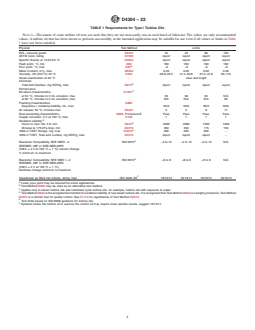
TABLE 1 Requirements for Type I Turbine Oils
NOTE 1—The nature of some turbine oil tests are such that they are not necessarily run on each batch of lubricant. The values are only recommended
values.Aturbine oil that has been shown to perform successfully in the intended application may be suitable for use even if all values or limits in Table
1 have not been satisfied.
Physical Test Method Limits
ISO—viscosity grade D2422 32 46 68 100
ASTM Color, rating D1500 report report report report
Specific Gravity at 15.6/15.6 °C D4052 report report report report
Flash point, °C, min D92 180 180 180 180
A
Pour point, °C, max D97 −6 −6 −6 −6
Water Content, m%, max D6304 0.02 0.02 0.02 0.02
Viscosity, cSt (mm /s) 40 °C D445 28.8–35.2 41.4–50.6 61.2–74.8 90–110
Visual examination at 20 °C . clear and bright
Chemical:
B
Total Acid Number, mg KOH/g, max D974 report report report report
Performance
C
Emulsion characteristics: D1401
at 54 °C, minutes to 3 mL emulsion, max 30 30 30 N/A
at 82 °C, minutes to 3 mL emulsion, max N/A N/A N/A 60
Foaming characteristics: D892
Sequence I, tendency/stability, mL, max 50/0 50/0 50/0 50/0
Air release, 50 °C, minutes max D3427 558 17
Rust preventing characteristics D665, Procedure B Pass Pass Pass Pass
Copper corrosion, 3 h at 100 °C, max D130 1111
D
Oxidation stability:
D
Hours to neut. No. 2.0, min D943 2000 2000 1500 1000
Minutes to 175 kPa drop, min D2272 350 350 175 150
C
1000–h TOST Sludge, mg, max D4310 200 200 200 .
1000–h TOST, Total acid number, mg KOH/g, max D4310 report report report .
E
Elastomer Compatibility SRE NBR1, or ISO 6072 –4 to 15 –4 to 15 –4 to 15 N/A
SRENBR- 28P or SRE-NBR-28PX
(168 h ± 2 h at 100 °C ± 1 °C) volume change
% minimum to maximum
E
Elastomer Compatibility SRE NBR 1, or ISO 6072 –8 to 8 –8 to 8 –8 to 8 N/A
SRENBR- 28P or SRE-NBR-28PX
(168h±2hat100°C±1°C),
hardness change minimum to maximum
F
Cleanliness as filled into turbine, rating, max ISO 4406–99 18/16/13 18/16/13 18/16/13 18/16/13
A
Lower pour point may be required for some applications.
B
Test Method D664 may be used as an alternative test method.
C
Applies only to steam turbine oils and combined cycle turbine oils, for example, turbine oils with exposure to water.
D
Test Method D943 is the accepted test method for oxidation stability of new steam turbine oils. It is recognized that Test Method D943 is a lengthy procedure. Test Method
D2272 is a shorter test for quality control. See X1.3.6 for significance of Test Method D2272.
E
Test limits based on ISO 8068 guidance for turbine oils.
F
Systems where the turbine oil is used as the control oil may require lower particle counts, suggest 16/14/11.
6. Keywords lubricating oils; turbine lubrication systems
6.1 combined cycle turbine oil; gas turbine oil; mineral oil;
R and O oils; steam turbine oil; synthetic turbine oil; turbine
D4304−22
TABLE 2 Requirements for Type II Turbine Oils
NOTE 1—The nature of some tests are such that they are not necessarily run on each batch. The values are only recommended values.An oil that has
been shown to perform successfully in the intended application may be suitable for use even if all values in Table 2 have not been satisfied.
Physical Test Method Limits
ISO—viscosity grade D2422 32 46 68 100 150
ASTM Color, rating D1500 report report report report report
Specific Gravity at 15.6/15.6 °C D4052 report report report report report
Flash point, °C, min D92 180 180 180 180 210
A
Pour point, °C, max D97 –5 –5 −5 −5 −5
Water Content, m%, max 0.02 0.02 0.02 0.02 0.02
Viscosity, cSt, 40 °C (mm /s) D445 28.8–35.2 41.4–50.6 61.2–74.8 90–110 135–165
Visual examination at 20 °C . clear and bright
Chemical:
B
Total Acid Number, mg KOH/g, max D974 0.2 0.2 0.2 report report
Performance:
C
Emulsion Characteristics: D1401
at 54 °C, minutes to 3 mL emulsion, max 30 30 30 . .
at 82 °C, minutes to 3 mL emulsion, max . . . 60 60
Foaming characteristics: D892
Sequence I, tendency/stability, mL, max 50/0 50/0 50/0 50/0 50/0
Air release, 50 °C minutes max D3427 5 5 10 17 25
Rust preventing characteristics D665, Procedure B pass pass pass pass pass
Copper corrosion, 3 h at 100 °C, max D130 11 1 1 1
D
Oxidation stability:
D
Hours to neut. No. 2.0, min D943 3500 3000 2500 1000 1000
Minutes to 175 kPa drop, min D2272 350 350 175 150 150
E
Elastomer Compatibility SRE NBR1, ISO 6072 –4 to 15 –4 to 15 –4 to 15 N/A N/A
or SRE-NBR-28P or SRE-NBR-28PX
(168h±2hat100°C±1°C) volume change
% minimum to maximum
E
Elastomer Compatibility SRE NBR 1, or ISO 6072 –8 to 8 –8 to 8 –8 to 8 N/A N/A
SRE-NBR-28P or SRE-NBR-28PX
(168h±2hat100°C±1°C),
hardness change minimum to maximum
F
Cleanliness as filled into turbine, rating, max ISO 4406–99 18/16/13 18/16/13 18/16/13 18/16/13 18/16/13
Load carrying capacity:
G
FZF Scuffing fail stage, min D5182 88 8 9 9
A
Lower pour point may be required for some applications.
B
Test Method D664 may be used as alternative method.
C
Applies only to steam turbine oils and combined cycle turbine oils, for example, turbine oils with exposure to water.
D
Test Method D943 is the accepted test method for oxidation stability of new steam turbine oils. It is recognized that Test Method D943 is a lengthy procedure. Thus, Test
Method D2272 is a suggested shorter test for quality control. See X1.3.6 for significance of Test Method D2272.
E
Test limits based on ISO 8068 guidance for turbine oils.
F
Systems where the turbine oil is used as the control oil may require lower particle counts, suggest 16/14/11. Confirm OEM specific guidance.
G
Higher values may be required for some applications.
D4304−22
TABLE 3 Requirements for Type III Turbine Oils
NOTE 1—The nature of some turbine oil tests is such that they are not necessarily run on each batch of lubricant. The values are only recommended
values.Aturbine oil that has been shown to perform successfully in
...
This document is not an ASTM standard and is intended only to provide the user of an ASTM standard an indication of what changes have been made to the previous version. Because
it may not be technically possible to adequately depict all changes accurately, ASTM recommends that users consult prior editions as appropriate. In all cases only the current version
of the standard as published by ASTM is to be considered the official document.
Designation: D4304 − 17 D4304 − 22
Standard Specification for
Mineral and Synthetic Lubricating Oil Used in Steam or Gas
Turbines
This standard is issued under the fixed designation D4304; the number immediately following the designation indicates the year of
original adoption or, in the case of revision, the year of last revision. A number in parentheses indicates the year of last reapproval. A
superscript epsilon (´) indicates an editorial change since the last revision or reapproval.
1. Scope*
1.1 This specification covers mineral and synthetic (API group I, II, III, or IV) oils used in steam and gas turbine lubrication
systems where the performance requirements demand highly refined mineral or synthetic base oils compounded with rust and
oxidation inhibitors plus selected additives as needed to control foam, wear, demulsibility, and so forth. This standard may also
be applied to “combined cycle” turbine systems, where a single lubricant circulating system is used to supply oil to a steam and
gas turbine configured in tandem either on a single or separate shaft for enhanced energy efficiency.
1.2 This specification is intended to define the properties of mineral and synthetic oil-based turbine lubricating oils that are
functionally interchangeable with existing oils of this type, are compatible with most existing machinery components, and with
appropriate field maintenance, will maintain their functional characteristics.
1.3 This specification is intended to define only new lubricating oil before it is installed in the machinery.
1.4 This specification is intended to be used as a guide. It is possible that oils that do not meet this specification may perform
satisfactorily in some turbines.
1.5 This specification does not include API Group V fluids. For polyol ester fluids used to lubricate land-based gas turbines, the
user is referred to the current version of military specification MIL-PRF-23699 for fluid performance requirements. For phosphate
ester fluids used as turbine lubricants or steam turbine electro-hydraulic control (EHC) fluids, the user is referred to the current
version of Specification D4293 for fluid performance requirements.
1.6 The values stated in SI units are to be regarded as standard. No other units of measurement are included in this standard.
1.7 This international standard was developed in accordance with internationally recognized principles on standardization
established in the Decision on Principles for the Development of International Standards, Guides and Recommendations issued
by the World Trade Organization Technical Barriers to Trade (TBT) Committee.
2. Referenced Documents
2.1 ASTM Standards:
This specification is under the jurisdiction of ASTM Committee D02 on Petroleum Products, Liquid Fuels, and Lubricants and is the direct responsibility of Subcommittee
D02.C0.01 on Turbine Oil Monitoring, Problems and Systems.
Current edition approved June 1, 2017Dec. 1, 2022. Published June 2017December 2022. Originally approved in 1984. Last previous edition approved in 20132017 as
D4304 – 13.D4304 – 17. DOI: 10.1520/D4304-17.10.1520/D4304-22.
For referenced ASTM standards, visit the ASTM website, www.astm.org, or contact ASTM Customer Service at service@astm.org. For Annual Book of ASTM Standards
volume information, refer to the standard’s Document Summary page on the ASTM website.
*A Summary of Changes section appears at the end of this standard
Copyright © ASTM International, 100 Barr Harbor Drive, PO Box C700, West Conshohocken, PA 19428-2959. United States
D4304 − 22
D92 Test Method for Flash and Fire Points by Cleveland Open Cup Tester
D97 Test Method for Pour Point of Petroleum Products
D130 Test Method for Corrosiveness to Copper from Petroleum Products by Copper Strip Test
D445 Test Method for Kinematic Viscosity of Transparent and Opaque Liquids (and Calculation of Dynamic Viscosity)
D664 Test Method for Acid Number of Petroleum Products by Potentiometric Titration
D665 Test Method for Rust-Preventing Characteristics of Inhibited Mineral Oil in the Presence of Water
D892 Test Method for Foaming Characteristics of Lubricating Oils
D943 Test Method for Oxidation Characteristics of Inhibited Mineral Oils
D974 Test Method for Acid and Base Number by Color-Indicator Titration
D1401 Test Method for Water Separability of Petroleum Oils and Synthetic Fluids
D1500 Test Method for ASTM Color of Petroleum Products (ASTM Color Scale)
D2272 Test Method for Oxidation Stability of Steam Turbine Oils by Rotating Pressure Vessel
D2422 Classification of Industrial Fluid Lubricants by Viscosity System
D3339 Test Method for Acid Number of Petroleum Products by Semi-Micro Color Indicator Titration
D3427 Test Method for Air Release Properties of Hydrocarbon Based Oils
D4052 Test Method for Density, Relative Density, and API Gravity of Liquids by Digital Density Meter
D4057 Practice for Manual Sampling of Petroleum and Petroleum Products
D4175 Terminology Relating to Petroleum Products, Liquid Fuels, and Lubricants
D4293 Specification for Phosphate Ester Based Fluids for Turbine Lubrication and Steam Turbine Electro-Hydraulic Control
(EHC) Applications
D4310 Test Method for Determination of Sludging and Corrosion Tendencies of Inhibited Mineral Oils
D5182 Test Method for Evaluating the Scuffing Load Capacity of Oils (FZG Visual Method)
D6304 Test Method for Determination of Water in Petroleum Products, Lubricating Oils, and Additives by Coulometric Karl
Fischer Titration
D6439 Guide for Cleaning, Flushing, and Purification of Steam, Gas, and Hydroelectric Turbine Lubrication Systems
D7155 Practice for Evaluating Compatibility of Mixtures of Turbine Lubricating Oils
D7546 Test Method for Determination of Moisture in New and In-Service Lubricating Oils and Additives by Relative Humidity
Sensor
D7547 Specification for Hydrocarbon Unleaded Aviation Gasoline
D7647 Test Method for Automatic Particle Counting of Lubricating and Hydraulic Fluids Using Dilution Techniques to
Eliminate the Contribution of Water and Interfering Soft Particles by Light Extinction
2.2 ISO Standards:
ISO 4406–99 Particle Count Analysis
ISO 6072 Rubber—Compatibility Between Hydraulic Fluids and Standard Elastomeric Materials
ISO 8068 Lubricatns, Industrial Oils and Related Products (Class L)—Family T (Turbines)—Specification for Lubricating
Turbines
2.3 Military Standards:
MIL-PRF-23699G Performance Specification Lubricating Oil, Aircraft Turbine Engine, Synthetic Base, NATO Code Numbers:
O-152, O-154, O-156, and O-167
3. Terminology
3.1 Definitions:
3.1.1 For definitions of terms used in this specification, refer to Terminology D4175.
3.1.2 functional properties, n—those properties of the mineral or synthetic lubricating oil that are required for satisfactory
operation of the machinery. These properties are listed in Section 5.
3.1.3 Type I mineral or synthetic oils, n—oils for steam, gas, or combined cycle turbine lubricating systems where the machinery
does not require lubricants with enhanced load carrying capacity.
3.1.3.1 Discussion—
Type I oils usually are available in ISO VG 32, 46, 68 and 100 (see Classification D2422). Such oils normally contain rust and
oxidation inhibitors in addition to other additives as required to meet the specified performance characteristic. Type I oils are
generally satisfactory for turbine sets where bearing temperatures do not exceed 110 °C.
Available from American National Standards Institute (ANSI), 25 W. 43rd St., 4th Floor, New York, NY 10036, http://www.ansi.org.
Available from US Military document web site, http://quicksearch.dla.mil/
D4304 − 22
3.1.4 Type II mineral or synthetic oils, n—oils for steam, gas, or combined cycle turbine lubricating systems where the machinery
requires enhanced load carrying capacity.
3.1.4.1 Discussion—
Type II oils usually are available in ISO VG 32, 46, 68, 100, and 150. These oils are similar to Type I but contain additional
anti-wear additives for use in turbines equipped with a gearbox. Type II oils are generally satisfactory for turbine sets where
bearing temperatures do not exceed 110 °C. Oils ISO VG 68 and above have been used in marine, hydro, or water turbines.
3.1.5 Type III mineral or synthetic oils, n—oils for heavy duty gas or combined cycle turbine lubricating systems where the
lubricant shall withstand higher temperatures and exhibit higher thermal stability than Type I or Type II oils.
3.1.5.1 Discussion—
Type III oils usually are available in ISO VG 32 and 46. Such oils are normally comprised of a highly refined mineral or synthetic
base oil (API group I, II, III, or IV) with suitable rust and oxidation inhibitors in addition to other additives as needed to meet
specified performance characteristics. Type III oils are formulated for use in turbine sets where bearing temperatures may exceed
110 °C. The turbine lubrication systems using Type III oils may be equipped with a gearbox that may require the selection of oils
that contain additional anti-wear additives to impart the specified load carrying capacity.
3.1.4 functional properties, n—those properties of the mineral or synthetic lubricating oil that are required for satisfactory
operation of the machinery. These properties are listed in Section 5.
4. Sampling, Testing, and System Preparation
4.1 Sampling—Generally, take all oil samples in accordance with Practice D4057.
4.2 Use the ASTM and other test methods described in Tables 1-3.
4.3 Test Method D6439 should be referenced for turbine flushing guidance.
4.4 Practice D7155 should be referenced to confirm oil to oil compatibility.
5. Functional Property Requirements
5.1 Mineral and synthetic lubricating oils conforming to the specification shall meet the functional property limits specified in 5.2
– 5.4 and Tables 1-3. The significance of these properties is discussed in Appendix X1.
5.2 Requirements for Type I oils are shown in Table 1.
5.3 Requirements for Type II oils are shown in Table 2.
5.4 Requirements for Type III oils are shown in Table 3.
6. Keywords
6.1 combined cycle turbine oil; gas turbine oil; mineral oil; R and O oils; steam turbine oil; synthetic turbine oil; turbine
lubricating oils; turbine lubrication systems
D4304 − 22
TABLE 1 Requirements for Type I Turbine Oils
NOTE 1—The nature of some turbine oil tests are such that they are not necessarily run on each batch of lubricant. The values are only recommended
values. A turbine oil that has been shown to perform successfully in the intended application may be suitable for use even if all values or limits in Table
1 have not been satisfied.
Physical Test Method Limits
ISO—viscosity grade D2422 32 46 68 100
ASTM Color, rating D1500 report report report report
Specific Gravity at 15.6/15.6 °C D4052 report report report report
Flash point, °C, min D92 180 180 180 180
A
Pour point, °C, max D97 −6 −6 −6 −6
Water Content, m%, max D6304 0.02 0.02 0.02 0.02
Viscosity, cSt (mm /s) 40 °C D445 28.8–35.2 41.4–50.6 61.2–74.8 90–110
Visual examination at 20 °C . clear and bright
Chemical:
B
Total Acid Number, mg KOH/g, max D974 report report report report
Performance
C
Emulsion characteristics: D1401
at 54 °C, minutes to 3 mL emulsion, max 30 30 30 N/A
at 82 °C, minutes to 3 mL emulsion, max N/A N/A N/A 60
Foaming characteristics: D892
Sequence I, tendency/stability, mL, max 50/0 50/0 50/0 50/0
Air release, 50 °C, minutes max D3427 5 5 8 17
Rust preventing characteristics D665, Procedure B Pass Pass Pass Pass
Copper corrosion, 3 h at 100 °C, max D130 1 1 1 1
D
Oxidation stability:
D
Hours to neut. No. 2.0, min D943 2000 2000 1500 1000
Minutes to 175 kPa drop, min D2272 350 350 175 150
C
1000–h TOST Sludge, mg, max D4310 200 200 200 .
1000–h TOST, Total acid number, mg KOH/g, max D4310 report report report .
E
Elastomer Compatibility SRE NBR1, or ISO 6072 –4 to 15 –4 to 15 –4 to 15 N/A
SRENBR- 28P or SRE-NBR-28PX
(168 h ± 2 h at 100 °C ± 1 °C) volume change
% minimum to maximum
E
Elastomer Compatibility SRE NBR 1, or ISO 6072 –8 to 8 –8 to 8 –8 to 8 N/A
SRENBR- 28P or SRE-NBR-28PX
(168 h ± 2 h at 100 °C ± 1 °C),
hardness change minimum to maximum
F
Cleanliness as filled into turbine, rating, max ISO 4406–99 18/16/13 18/16/13 18/16/13 18/16/13
A
Lower pour point may be required for some applications.
B
Test Method D664 may be used as an alternative test method.
C
Applies only to steam turbine oils and combined cycle turbine oils, for example, turbine oils with exposure to water.
D
Test Method D943 is the accepted test method for oxidation stability of new steam turbine oils. It is recognized that Test Method D943 is a lengthy procedure. Test Method
D2272 is a shorter test for quality control. See X1.3.6 for significance of Test Method D2272.
E
Test limits based on ISO 8068 guidance for turbine oils.
F
Systems where the turbine oil is used as the control oil may require lower particle counts, suggest 16/14/11.
D4304 − 22
TABLE 2 Requirements for Type II Turbine Oils
NOTE 1—The nature of some tests are such that they are not necessarily run on each batch. The values are only recommended values. An oil that has
been shown to perform successfully in the intended application may be suitable for use even if all values in Table 2 have not been satisfied.
Physical Test Method Limits
ISO—viscosity grade D2422 32 46 68 100 150
ASTM Color, rating D1500 report report report report report
Specific Gravity at 15.6/15.6 °C D4052 report report report report report
Flash point, °C, min D92 180 180 180 180 210
A
Pour point, °C, max D97 –5 –5 −5 −5 −5
Water Content, m%, max 0.02 0.02 0.02 0.02 0.02
Viscosity, cSt, 40 °C (mm /s) D445 28.8–35.2 41.4–50.6 61.2–74.8 90–110 135–165
Visual examination at 20 °C . clear and bright
Chemical:
B
Total Acid Number, mg KOH/g, max D974 0.2 0.2 0.2 report report
Performance:
C
Emulsion Characteristics: D1401
at 54 °C, minutes to 3 mL emulsion, max 30 30 30 . .
at 82 °C, minutes to 3 mL emulsion, max . . . 60 60
Foaming characteristics: D892
Sequence I, tendency/stability, mL, max 50/0 50/0 50/0 50/0 50/0
Air release, 50 °C minutes max D3427 5 5 10 17 25
Rust preventing characteristics D665, Procedure B pass pass pass pass pass
Copper corrosion, 3 h at 100 °C, max D130 1 1 1 1 1
D
Oxidation stability:
D
Hours to neut. No. 2.0, min D943 3500 3000 2500 1000 1000
Minutes to 175 kPa drop, min D2272 350 350 175 150 150
E
Elastomer Compatibility SRE NBR1, ISO 6072 –4 to 15 –4 to 15 –4 to 15 N/A N/A
or SRE-NBR-28P or SRE-NBR-28PX
(168 h ± 2 h at 100 °C ± 1 °C) volume change
% minimum to maximum
E
Elastomer Compatibility SRE NBR 1, or ISO 6072 –8 to 8 –8 to 8 –8 to 8 N/A N/A
SRE-NBR-28P or SRE-NBR-28PX
(168 h ± 2 h at 100 °C ± 1 °C),
hardness change minimum to maximum
F
Cleanliness as filled into turbine, rating, max ISO 4406–99 18/16/13 18/16/13 18/16/13 18/16/13 18/16/13
Load carrying capacity:
G
FZF Scuffing fail stage, min D5182 8 8 8 9 9
A
Lower pour point may be required for some applications.
B
Test Method D664 may be used as alternative method.
C
Applies only to steam turbine oils and combined cycle turbine oils, for example, turbine oils with exposure to water.
D
Test Method D943 is the accepted test method for oxidation stability of new steam turbine oils. It is recognized that Test Method D943 is a lengthy procedure. Thus, Test
Method D2272 is a suggested shorter test for quality control. See X1.3.6 for significance of Test Method D2272.
E
Test limits based on ISO 8068 guidance for turbine oils.
F
Systems where the turbine oil is used as the control oil may require lower particle counts, suggest 16/14/11. Confirm OEM specific guidance.
G
Higher values may be required for some applications.
D4304 − 22
TABLE 3 Requirements for Type III Turbine Oils
NOTE 1—The nature of some turbine oil tests is such that they are not necessarily run on each batch of lubricant. The values
...