

ASTM E1915-20
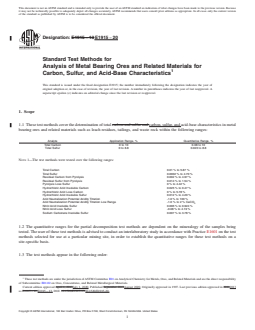
(Test Method)Standard Test Methods for Analysis of Metal Bearing Ores and Related Materials for Carbon, Sulfur, and Acid-Base Characteristics
General Information
- Abstract
SIGNIFICANCE AND USE
4.1 These test methods are primarily intended to test materials for compliance with compositional specifications and for monitoring.
4.1.1 The determination of carbon and sulfur and acid neutralization potential in ores and related materials is necessary to classify ores for metallurgical processing and to classify waste materials from the mining and processing of ores such as leach residues, waste rock, and tailings according to their potential to generate acid in the environment. This information is useful during mine development to assist in mining and mineral processing operations and for proper disposal of waste materials.
4.1.1.1 The use of the acid neutralization potential titration low range method is most useful where acidity is present in the samples and when acid potential by titration is desired in the uncertain range below 2 % CaCO3.
4.1.2 These test methods are also used to isolate minerals based on carbon and sulfur contents of metal-bearing ores and related materials so that acid-base accounting can be performed (that is, carbonate mineral acid neutralization potential (ANP) minus sulfide-sulfur mineral acid generation potential (AGP) = net calcium carbonate (NCC)).
4.1.3 Additionally, the carbon hydrochloric acid insoluble test method has utility to identify the amount of organic carbon contained in gold ores so that potential for preg-robbing can be identified and rectified through established pretreatment methods prior to cyanidation. Warning—Pyrolysis pretreatment at 550 °C has a potential to thermally decompose some carbonate minerals: (1) transition metal carbonates (for example, siderite, FeCO3, and rhodochrosite, MnCO3) decompose, yielding carbon dioxide (CO2) in the range of 220 °C to 520 °C; (2) calcite decomposes slightly between 300 °C and 500 °C, although most decomposition occurs above 550 °C; (3) dolomite decomposes at 800 °C to 900 °C (Hammack, 1994, p. 440).3
4.2 These test methods also may be used for the classificatio...
SCOPE
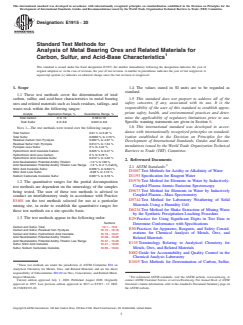
1.1 These test methods cover the determination of total carbon, sulfur, and acid-base characteristics in metal bearing ores and related materials such as leach residues, tailings, and waste rock within the following ranges:
Analyte
Application Range, %
Quantitative Range, %
Total Carbon
0 to 10
0.08 to 10
Total Sulfur
0 to 8.8
0.023 to 8.8
Note 1: The test methods were tested over the following ranges:
Total Carbon
0.01 % to 5.87 %
Total Sulfur
0.0002 % to 4.70 %
Residual Carbon from Pyrolysis
0.002 % to 4.97 %
Residual Sulfur from Pyrolysis
0.014 % to 1.54 %
Pyrolysis Loss Sulfur
0 % to 4.42 %
Hydrochloric Acid Insoluble Carbon
0.025 % to 0.47 %
Hydrochloric Acid Loss Carbon
0 % to 5.78 %
Hydrochloric Acid Insoluble Sulfur
0.012 % to 4.20 %
Acid Neutralization Potential Acidity Titration
-1.0 % to 100 %
Acid Neutralization Potential Acidity Titration Low Range
-1.0 % to 2 % CaCO3
Nitric Acid Insoluble Sulfur
0.006 % to 0.924 %
Nitric Acid Loss Sulfur
-0.08 % to 4.19 %
Sodium Carbonate Insoluble Sulfur
0.007 % to 3.78 %
1.2 The quantitative ranges for the partial decomposition test methods are dependent on the mineralogy of the samples being tested. The user of these test methods is advised to conduct an interlaboratory study in accordance with Practice E1601 on the test methods selected for use at a particular mining site, in order to establish the quantitative ranges for these test methods on a site-specific basis.
1.3 The test methods appear in the following order:
Sections
Carbon and Sulfur, Total
10.1 – 10.9
Carbon and Sulfur, Residual from Pyrolysis
10.10 – 10.18
Carbon and Sulfur, Hydrochloric Acid Insoluble
10.19 – 10.27
Acid Neutralization Potential Acidity Titration
10.28 – 10.36
Acid Neutralization Potential Acidity Titration Low Rang...
- Status
- Published
- Publication Date
- 30-Jun-2020
- Technical Committee
- E01 - Analytical Chemistry for Metals, Ores, and Related Materials
- Drafting Committee
- E01.02 - Ores, Concentrates, and Related Metallurgical Materials
Buy Documents
ASTM E1915-20 - Standard Test Methods for Analysis of Metal Bearing Ores and Related Materials for Carbon, Sulfur, and Acid-Base Characteristics
REDLINE ASTM E1915-20 - Standard Test Methods for Analysis of Metal Bearing Ores and Related Materials for Carbon, Sulfur, and Acid-Base Characteristics
Overview
ASTM E1915-20, issued by ASTM International, provides standard test methods for the analysis of metal-bearing ores and related materials for the determination of total carbon, sulfur, and acid-base characteristics. This standard is essential for laboratories, mining companies, and environmental consultants that require accurate assessment of ore composition and the acid-generating potential of mining and metallurgical waste materials. Applying these methods enables compliance with industry regulations, process optimization, and effective environmental management in mining operations.
Key Topics
Total Carbon and Sulfur Determination:
ASTM E1915-20 outlines methods for measuring the total carbon and sulfur content in ores, leach residues, tailings, and waste rocks, using standardized combustion-infrared analysis.Acid-Base Accounting:
By determining acid neutralization potential (ANP) and acid generation potential (AGP), the standard supports acid-base accounting (ABA) to classify materials for their tendency to generate acid in the environment.Residual Carbon and Sulfur by Pyrolysis:
Methods for analyzing organic and inorganic carbon and sulfur-including those remaining after pyrolysis-help identify mineral composition and potential reactivity.Hydrochloric Acid Insoluble Carbon:
A specialty method enables laboratories to quantify organic carbon, particularly in gold ores, which is vital to prevent preg-robbing during cyanide extraction.Quality Control and Calibration:
E1915-20 emphasizes rigorous calibration, use of certified reference materials, and performance verification-ensuring reproducibility, accuracy, and traceability of results.Sample Preparation:
The standard details best practices for sample drying, grinding, and dilution, minimizing contamination and ensuring representativeness of test specimens.
Applications
Ore Classification for Metallurgical Processing:
Determining carbon and sulfur content helps classify metal ores to inform process decisions in extraction and refining, maximizing yield and reducing processing issues.Environmental Impact Assessment:
Quantifying acid generation and neutralization capacities enables accurate classification of mining wastes, predicting their potential environmental impact and dictating steps for safe disposal.Mine Development and Closure Planning:
Acid-base characteristics determined by these methods guide the management of tailings, waste rock, and leach residues-crucial for regulatory compliance and long-term site stewardship.Preg-Robbing Prediction in Gold Ores:
Identifying organic carbon in gold ores allows for targeted pretreatment, preventing loss of gold due to adsorption during cyanidation.Rock Classification for Construction:
Evaluation of acid-generation potential is also relevant when selecting mine-derived rocks for construction projects to prevent environmental degradation.
Related Standards
- ASTM E1019 - Test Methods for Determination of Carbon, Sulfur, Nitrogen, and Oxygen in Metals by Combustion and Inert Gas Fusion
- ASTM E1601 - Practice for Conducting an Interlaboratory Study to Evaluate the Performance of an Analytical Method
- ASTM E50 - Practices for Apparatus, Reagents, and Safety Considerations
- ASTM E1950 - Practice for Reporting Results from Methods of Chemical Analysis
- ASTM D1067, D1193, D1976, D5673, D5744, D6234, E29, E135, E882, E2242 - Additional references for analytical procedures, terminology, apparatus, and environmental leaching assessments
Practical Value
Implementing ASTM E1915-20 ensures that laboratories and mining operators use recognized, effective protocols for analyzing key components in metal-bearing ores and waste. This supports technical decision-making, regulatory reporting, and sustainable environmental practices by providing clear guidance on carbon and sulfur analysis, acid-base characterization, and quality assurance in sample testing. The standard’s methods are widely applicable across mining, environmental monitoring, process design, and post-closure remediation projects.
By adhering to ASTM E1915-20, organizations can reliably determine ore quality, manage environmental risks, and uphold industry standards for mining waste classification and mineral analysis.
Relations
- Effective Date
- 01-Jul-2020
- Effective Date
- 01-May-2020
- Effective Date
- 01-Jan-2020
- Effective Date
- 01-Nov-2019
- Effective Date
- 15-May-2019
- Effective Date
- 01-Sep-2018
- Effective Date
- 01-Jul-2018
- Effective Date
- 15-Nov-2017
- Effective Date
- 01-Sep-2017
- Effective Date
- 01-Dec-2016
- Effective Date
- 01-Dec-2016
- Effective Date
- 01-Aug-2016
- Effective Date
- 15-May-2016
- Effective Date
- 01-Jul-2015
- Effective Date
- 01-Jul-2015
Buy Documents
ASTM E1915-20 - Standard Test Methods for Analysis of Metal Bearing Ores and Related Materials for Carbon, Sulfur, and Acid-Base Characteristics
REDLINE ASTM E1915-20 - Standard Test Methods for Analysis of Metal Bearing Ores and Related Materials for Carbon, Sulfur, and Acid-Base Characteristics
Get Certified
Connect with accredited certification bodies for this standard

ECOCERT
Organic and sustainability certification.

Eurofins Food Testing Global
Global leader in food, environment, and pharmaceutical product testing.

Intertek Bangladesh
Intertek certification and testing services in Bangladesh.
Sponsored listings
Frequently Asked Questions
ASTM E1915-20 is a standard published by ASTM International. Its full title is "Standard Test Methods for Analysis of Metal Bearing Ores and Related Materials for Carbon, Sulfur, and Acid-Base Characteristics". This standard covers: SIGNIFICANCE AND USE 4.1 These test methods are primarily intended to test materials for compliance with compositional specifications and for monitoring. 4.1.1 The determination of carbon and sulfur and acid neutralization potential in ores and related materials is necessary to classify ores for metallurgical processing and to classify waste materials from the mining and processing of ores such as leach residues, waste rock, and tailings according to their potential to generate acid in the environment. This information is useful during mine development to assist in mining and mineral processing operations and for proper disposal of waste materials. 4.1.1.1 The use of the acid neutralization potential titration low range method is most useful where acidity is present in the samples and when acid potential by titration is desired in the uncertain range below 2 % CaCO3. 4.1.2 These test methods are also used to isolate minerals based on carbon and sulfur contents of metal-bearing ores and related materials so that acid-base accounting can be performed (that is, carbonate mineral acid neutralization potential (ANP) minus sulfide-sulfur mineral acid generation potential (AGP) = net calcium carbonate (NCC)). 4.1.3 Additionally, the carbon hydrochloric acid insoluble test method has utility to identify the amount of organic carbon contained in gold ores so that potential for preg-robbing can be identified and rectified through established pretreatment methods prior to cyanidation. Warning—Pyrolysis pretreatment at 550 °C has a potential to thermally decompose some carbonate minerals: (1) transition metal carbonates (for example, siderite, FeCO3, and rhodochrosite, MnCO3) decompose, yielding carbon dioxide (CO2) in the range of 220 °C to 520 °C; (2) calcite decomposes slightly between 300 °C and 500 °C, although most decomposition occurs above 550 °C; (3) dolomite decomposes at 800 °C to 900 °C (Hammack, 1994, p. 440).3 4.2 These test methods also may be used for the classificatio... SCOPE 1.1 These test methods cover the determination of total carbon, sulfur, and acid-base characteristics in metal bearing ores and related materials such as leach residues, tailings, and waste rock within the following ranges: Analyte Application Range, % Quantitative Range, % Total Carbon 0 to 10 0.08 to 10 Total Sulfur 0 to 8.8 0.023 to 8.8 Note 1: The test methods were tested over the following ranges: Total Carbon 0.01 % to 5.87 % Total Sulfur 0.0002 % to 4.70 % Residual Carbon from Pyrolysis 0.002 % to 4.97 % Residual Sulfur from Pyrolysis 0.014 % to 1.54 % Pyrolysis Loss Sulfur 0 % to 4.42 % Hydrochloric Acid Insoluble Carbon 0.025 % to 0.47 % Hydrochloric Acid Loss Carbon 0 % to 5.78 % Hydrochloric Acid Insoluble Sulfur 0.012 % to 4.20 % Acid Neutralization Potential Acidity Titration -1.0 % to 100 % Acid Neutralization Potential Acidity Titration Low Range -1.0 % to 2 % CaCO3 Nitric Acid Insoluble Sulfur 0.006 % to 0.924 % Nitric Acid Loss Sulfur -0.08 % to 4.19 % Sodium Carbonate Insoluble Sulfur 0.007 % to 3.78 % 1.2 The quantitative ranges for the partial decomposition test methods are dependent on the mineralogy of the samples being tested. The user of these test methods is advised to conduct an interlaboratory study in accordance with Practice E1601 on the test methods selected for use at a particular mining site, in order to establish the quantitative ranges for these test methods on a site-specific basis. 1.3 The test methods appear in the following order: Sections Carbon and Sulfur, Total 10.1 – 10.9 Carbon and Sulfur, Residual from Pyrolysis 10.10 – 10.18 Carbon and Sulfur, Hydrochloric Acid Insoluble 10.19 – 10.27 Acid Neutralization Potential Acidity Titration 10.28 – 10.36 Acid Neutralization Potential Acidity Titration Low Rang...
SIGNIFICANCE AND USE 4.1 These test methods are primarily intended to test materials for compliance with compositional specifications and for monitoring. 4.1.1 The determination of carbon and sulfur and acid neutralization potential in ores and related materials is necessary to classify ores for metallurgical processing and to classify waste materials from the mining and processing of ores such as leach residues, waste rock, and tailings according to their potential to generate acid in the environment. This information is useful during mine development to assist in mining and mineral processing operations and for proper disposal of waste materials. 4.1.1.1 The use of the acid neutralization potential titration low range method is most useful where acidity is present in the samples and when acid potential by titration is desired in the uncertain range below 2 % CaCO3. 4.1.2 These test methods are also used to isolate minerals based on carbon and sulfur contents of metal-bearing ores and related materials so that acid-base accounting can be performed (that is, carbonate mineral acid neutralization potential (ANP) minus sulfide-sulfur mineral acid generation potential (AGP) = net calcium carbonate (NCC)). 4.1.3 Additionally, the carbon hydrochloric acid insoluble test method has utility to identify the amount of organic carbon contained in gold ores so that potential for preg-robbing can be identified and rectified through established pretreatment methods prior to cyanidation. Warning—Pyrolysis pretreatment at 550 °C has a potential to thermally decompose some carbonate minerals: (1) transition metal carbonates (for example, siderite, FeCO3, and rhodochrosite, MnCO3) decompose, yielding carbon dioxide (CO2) in the range of 220 °C to 520 °C; (2) calcite decomposes slightly between 300 °C and 500 °C, although most decomposition occurs above 550 °C; (3) dolomite decomposes at 800 °C to 900 °C (Hammack, 1994, p. 440).3 4.2 These test methods also may be used for the classificatio... SCOPE 1.1 These test methods cover the determination of total carbon, sulfur, and acid-base characteristics in metal bearing ores and related materials such as leach residues, tailings, and waste rock within the following ranges: Analyte Application Range, % Quantitative Range, % Total Carbon 0 to 10 0.08 to 10 Total Sulfur 0 to 8.8 0.023 to 8.8 Note 1: The test methods were tested over the following ranges: Total Carbon 0.01 % to 5.87 % Total Sulfur 0.0002 % to 4.70 % Residual Carbon from Pyrolysis 0.002 % to 4.97 % Residual Sulfur from Pyrolysis 0.014 % to 1.54 % Pyrolysis Loss Sulfur 0 % to 4.42 % Hydrochloric Acid Insoluble Carbon 0.025 % to 0.47 % Hydrochloric Acid Loss Carbon 0 % to 5.78 % Hydrochloric Acid Insoluble Sulfur 0.012 % to 4.20 % Acid Neutralization Potential Acidity Titration -1.0 % to 100 % Acid Neutralization Potential Acidity Titration Low Range -1.0 % to 2 % CaCO3 Nitric Acid Insoluble Sulfur 0.006 % to 0.924 % Nitric Acid Loss Sulfur -0.08 % to 4.19 % Sodium Carbonate Insoluble Sulfur 0.007 % to 3.78 % 1.2 The quantitative ranges for the partial decomposition test methods are dependent on the mineralogy of the samples being tested. The user of these test methods is advised to conduct an interlaboratory study in accordance with Practice E1601 on the test methods selected for use at a particular mining site, in order to establish the quantitative ranges for these test methods on a site-specific basis. 1.3 The test methods appear in the following order: Sections Carbon and Sulfur, Total 10.1 – 10.9 Carbon and Sulfur, Residual from Pyrolysis 10.10 – 10.18 Carbon and Sulfur, Hydrochloric Acid Insoluble 10.19 – 10.27 Acid Neutralization Potential Acidity Titration 10.28 – 10.36 Acid Neutralization Potential Acidity Titration Low Rang...
ASTM E1915-20 is classified under the following ICS (International Classification for Standards) categories: 71.040.50 - Physicochemical methods of analysis. The ICS classification helps identify the subject area and facilitates finding related standards.
ASTM E1915-20 has the following relationships with other standards: It is inter standard links to ASTM E1915-13, ASTM D1976-20, ASTM E135-20, ASTM E1601-19, ASTM E135-19, ASTM D5744-18, ASTM D1976-18, ASTM E1950-17, ASTM E50-17, ASTM E882-10(2016), ASTM E882-10(2016)e1, ASTM E50-11(2016), ASTM E135-16, ASTM D5673-15, ASTM E135-15a. Understanding these relationships helps ensure you are using the most current and applicable version of the standard.
ASTM E1915-20 is available in PDF format for immediate download after purchase. The document can be added to your cart and obtained through the secure checkout process. Digital delivery ensures instant access to the complete standard document.
Standards Content (Sample)
This international standard was developed in accordance with internationally recognized principles on standardization established in the Decision on Principles for the
Development of International Standards, Guides and Recommendations issued by the World Trade Organization Technical Barriers to Trade (TBT) Committee.
Designation: E1915 − 20
Standard Test Methods for
Analysis of Metal Bearing Ores and Related Materials for
Carbon, Sulfur, and Acid-Base Characteristics
This standard is issued under the fixed designation E1915; the number immediately following the designation indicates the year of
original adoption or, in the case of revision, the year of last revision. A number in parentheses indicates the year of last reapproval. A
superscript epsilon (´) indicates an editorial change since the last revision or reapproval.
1. Scope 1.4 The values stated in SI units are to be regarded as
standard.
1.1 These test methods cover the determination of total
1.5 This standard does not purport to address all of the
carbon, sulfur, and acid-base characteristics in metal bearing
safety concerns, if any, associated with its use. It is the
ores and related materials such as leach residues, tailings, and
responsibility of the user of this standard to establish appro-
waste rock within the following ranges:
priate safety, health, and environmental practices and deter-
Analyte Application Range, % Quantitative Range, %
mine the applicability of regulatory limitations prior to use.
TotalCarbon 0to10 0.08to10
Total Sulfur 0 to 8.8 0.023 to 8.8
Specific warning statements are given in Section 6.
1.6 This international standard was developed in accor-
NOTE 1—The test methods were tested over the following ranges:
dance with internationally recognized principles on standard-
Total Carbon 0.01 % to 5.87 %
Total Sulfur 0.0002 % to 4.70 % ization established in the Decision on Principles for the
Residual Carbon from Pyrolysis 0.002 % to 4.97 %
Development of International Standards, Guides and Recom-
Residual Sulfur from Pyrolysis 0.014 % to 1.54 %
mendations issued by the World Trade Organization Technical
Pyrolysis Loss Sulfur 0 % to 4.42 %
Hydrochloric Acid Insoluble Carbon 0.025 % to 0.47 % Barriers to Trade (TBT) Committee.
Hydrochloric Acid Loss Carbon 0 % to 5.78 %
Hydrochloric Acid Insoluble Sulfur 0.012 % to 4.20 %
2. Referenced Documents
Acid Neutralization Potential Acidity Titration -1.0 % to 100 %
Acid Neutralization Potential Acidity Titration Low Range -1.0 % to 2 % CaCO
2.1 ASTM Standards:
Nitric Acid Insoluble Sulfur 0.006 % to 0.924 %
D1067 Test Methods for Acidity or Alkalinity of Water
Nitric Acid Loss Sulfur -0.08 % to 4.19 %
Sodium Carbonate Insoluble Sulfur 0.007 % to 3.78 %
D1193 Specification for Reagent Water
D1976 Test Method for Elements in Water by Inductively-
1.2 The quantitative ranges for the partial decomposition
Coupled Plasma Atomic Emission Spectroscopy
test methods are dependent on the mineralogy of the samples
D5673 Test Method for Elements in Water by Inductively
being tested. The user of these test methods is advised to
Coupled Plasma—Mass Spectrometry
conduct an interlaboratory study in accordance with Practice
D5744 Test Method for Laboratory Weathering of Solid
E1601 on the test methods selected for use at a particular
Materials Using a Humidity Cell
mining site, in order to establish the quantitative ranges for
D6234 Test Method for Shake Extraction of Mining Waste
these test methods on a site-specific basis.
by the Synthetic Precipitation Leaching Procedure
1.3 The test methods appear in the following order:
E29 Practice for Using Significant Digits in Test Data to
Sections
Determine Conformance with Specifications
Carbon and Sulfur, Total 10.1 – 10.9
E50 Practices for Apparatus, Reagents, and Safety Consid-
Carbon and Sulfur, Residual from Pyrolysis 10.10 – 10.18
erations for Chemical Analysis of Metals, Ores, and
Carbon and Sulfur, Hydrochloric Acid Insoluble 10.19 – 10.27
Acid Neutralization Potential Acidity Titration 10.28 – 10.36
Related Materials
Acid Neutralization Potential Acidity Titration Low Range 10.37 – 10.46
E135 Terminology Relating to Analytical Chemistry for
Sulfur, Nitric Acid Insoluble 10.47 – 10.55
Sulfur, Sodium Carbonate Insoluble 10.56 – 10.64 Metals, Ores, and Related Materials
E882 Guide for Accountability and Quality Control in the
Chemical Analysis Laboratory
E1019 Test Methods for Determination of Carbon, Sulfur,
These test methods are under the jurisdiction of ASTM Committee E01 on
Analytical Chemistry for Metals, Ores, and Related Materials and are the direct
responsibility of Subcommittee E01.02 on Ores, Concentrates, and Related Metal-
lurgical Materials. For referenced ASTM standards, visit the ASTM website, www.astm.org, or
Current edition approved July 1, 2020. Published August 2020. Originally contact ASTM Customer Service at service@astm.org. For Annual Book of ASTM
approved in 1997. Last previous edition approved in 2013 as E1915 – 13. DOI: Standards volume information, refer to the standard’s Document Summary page on
10.1520/E1915-20. the ASTM website.
Copyright © ASTM International, 100 Barr Harbor Drive, PO Box C700, West Conshohocken, PA 19428-2959. United States
E1915 − 20
Nitrogen, and Oxygen in Steel, Iron, Nickel, and Cobalt most decomposition occurs above 550 °C; (3) dolomite decom-
Alloys by Various Combustion and Inert Gas Fusion poses at 800 °C to 900 °C (Hammack, 1994, p. 440).
Techniques
4.2 These test methods also may be used for the classifica-
E1601 Practice for Conducting an Interlaboratory Study to
tion of rock to be used in construction, where the potential to
Evaluate the Performance of an Analytical Method
generate acid under environmental conditions exists.
E1950 Practice for Reporting Results from Methods of
4.3 It is assumed that the users of these test methods will be
Chemical Analysis
trained analysts capable of performing common laboratory
E2242 Test Method for Column Percolation Extraction of
procedures skillfully and safely. It is expected that work will be
Mine Rock by the Meteoric Water Mobility Procedure
performed in a properly equipped laboratory and that proper
waste disposal procedures will be followed. Appropriate qual-
3. Terminology
ity control practices such as those described in Guide E882
3.1 Definitions—For definitions of terms used in these test
must be followed.
methods, refer to Terminology E135.
5. Reagents and Materials
3.2 Definitions of Terms Specific to This Standard:
3.2.1 accuracy, n—qualitative term that involves precision
5.1 Purity of Reagents—Reagent grade chemicals shall be
and bias. The closeness of agreement between a measured
used in all tests. Unless otherwise indicated, it is intended that
quantity value and a true quantity value of a measurand.
all reagents conform to the specifications of the Committee on
3.2.2 standardization, v—analysis of samples with known Analytical Reagents of the American Chemical Society where
values or known additions, prior to and within groups of test such specifications are available. Other grades may be used,
samples to assure accuracy. provided it is first ascertained that the reagent is of sufficiently
high purity to permit its use without lessening the accuracy of
3.2.3 standardization sample, n—calibration mixtures or
the determination.
samples with known values or known additions that are
analyzed with test samples to assure accuracy of analysis.
5.2 Purity of Water—Unless otherwise indicated, references
to water shall be understood to mean reagent water as defined
4. Significance and Use in Type I of Specification D1193.
4.1 These test methods are primarily intended to test mate-
6. Hazards
rials for compliance with compositional specifications and for
monitoring. 6.1 For hazards to be observed in the use of reagents and
apparatus in these test methods, refer to Practices E50. Use
4.1.1 The determination of carbon and sulfur and acid
neutralization potential in ores and related materials is neces- care when handling hot crucibles or boats and when operating
furnaces to avoid personal injury by either burn or electrical
sary to classify ores for metallurgical processing and to classify
waste materials from the mining and processing of ores such as shock.
leach residues, waste rock, and tailings according to their
7. Rounding Calculated Values
potential to generate acid in the environment. This information
is useful during mine development to assist in mining and
7.1 Rounding of test results obtained using this Test Method
mineral processing operations and for proper disposal of waste
shall be performed as directed in Practice E29 Rounding
materials.
Method, unless an alternative rounding method is specified by
4.1.1.1 The use of the acid neutralization potential titration
the customer or applicable material specification.
low range method is most useful where acidity is present in the
samples and when acid potential by titration is desired in the
8. Interlaboratory Studies
uncertain range below 2 % CaCO .
8.1 These test methods have been evaluated in accordance
4.1.2 These test methods are also used to isolate minerals
with Practice E1601 unless otherwise noted in the precision
based on carbon and sulfur contents of metal-bearing ores and
and bias section. The lower limit in the scope of these test
related materials so that acid-base accounting can be performed
methods specifies the lowest analyte content that may be
(that is, carbonate mineral acid neutralization potential (ANP)
analyzed with an acceptable error. A warning statement is
minus sulfide-sulfur mineral acid generation potential (AGP) =
included in the scope for test methods not observing this
net calcium carbonate (NCC)).
convention.
4.1.3 Additionally, the carbon hydrochloric acid insoluble
test method has utility to identify the amount of organic carbon
contained in gold ores so that potential for preg-robbing can be
Hammack, R. W., “Evolved-Gas Analysis: A Method for Determining Pyrite,
identified and rectified through established pretreatment meth-
Marcasite, and Alkaline-Earth Carbonates,” Environmental Geochemistry of Sulfide
ods prior to cyanidation. Warning—Pyrolysis pretreatment at
Oxidation, Alpers, C., and Blowes, D., eds., Chapter 28, ACS Symposium Series
550 °C has a potential to thermally decompose some carbonate
550, American Chemical Society, Washington, D.C., 1994, pp. 431–444.
Reagent Chemicals, American Chemical Society Specifications, American
minerals: (1) transition metal carbonates (for example, siderite,
Chemical Society, Washington, DC, www.chemistry.org. For suggestions on the
FeCO , and rhodochrosite, MnCO ) decompose, yielding car-
3 3
testing of reagents not listed by the American Chemical Society, see the United
bon dioxide (CO ) in the range of 220 °C to 520 °C; (2) calcite
2 States Pharmacopeia and National Formulary, U.S. Pharmacopeial Convention,
decomposes slightly between 300 °C and 500 °C, although Inc. (USPC), Rockville, MD, http://www.usp.org.
E1915 − 20
8.2 Site-Specific Quantitative Ranges—An interlaboratory 10.4.1.1 Barium Sulfate (BaSO ), Anhydrous, contains
study may be conducted in accordance with Practice E1601 to 13.74 % sulfur (purity 99.9 % minimum). Dry 100 g at 120 °C
establish quantitative ranges for the partial decomposition test for 2 h and store in a 250-mL glass bottle.
methods selected for a particular site. Test samples shall be 10.4.1.2 Blank Reference Sample—Prepare a blank refer-
selected for each alteration or lithologic unit, or both, contain-
ence sample by pulverizing or grinding 100 g of SiO (see
ing high and low contents of carbon and sulfur minerals. Each 10.4.1.6), to pass through a 150-µm (No. 100) sieve, mix, and
test sample must be analyzed in rapid succession for total
store in a 250-mL glass bottle. This blank contains 0.00 %
carbon and sulfur followed by the different partial decompo- carbon and 0.00 % sulfur.
sition treatments selected in order to minimize the between-
10.4.1.3 Calcium Carbonate (CaCO ), Anhydrous, contains
method variation. 12.00 % carbon (purity 99.9 % minimum). Dry 100 g for 2 h at
120 °C and store in a 250-mL glass bottle.
9. Sampling and Sample Preparation
10.4.1.4 Calibration Mixture A—(1 g = 20 mg C and
9.1 Materials Safety—Samples must be prepared, stored, 20 mg S)—Combine 16.67 g CaCO , 14.56 g BaSO , and
3 4
and disposed of in accordance with the materials and safety 68.77 g SiO in a ring and puck grinding mill or equivalent
guidelines in Practices E50. device. Grind until 100 % passes through a 150-µm (No. 100)
sieve, pass the mixture through the screen to break up any
9.2 Prepared Sample—Dry a representative portion of the
lumps, mix, and store in a glass bottle. This mixture contains
gross sample at 80 °C to constant mass in order to minimize
2.00 % carbon and 2.00 % sulfur. Alternatively, grind the
sulfide mineral oxidation. Pulverize or grind the laboratory
reagents separately, mix, and pass through the screen prior to
sample until 100 % passes a 150-µm (No. 100) sieve.
final mixing.
NOTE 2—Results from the interlaboratory study suggest that it may be
10.4.1.5 Calibration Mixtures—Transfer 4.00 g, 10.00 g,
necessary to grind samples to pass a 75-µm (No. 200) sieve in order to
20.00 g, and 30.00 g of Calibration Mixture A to ring and puck
improve precision for samples containing low contents of carbon or sulfur.
grinding mills or equivalent devices. Add the amount of dried
9.3 Diluted Sample—If the content of sulfur in the test
SiO needed to bring the total mass to 40.0 g in each mill, grind
material exceeds 1.75 % for the minimum range instrument,
to 100 % passing a 150-µm (No. 100) sieve, pass the mixture
prepare a diluted sample as in 9.3.1.
through the screen, mix, and store in 250-mL glass bottles.
9.3.1 Weigh 10.0 g 6 0.1 g prepared sample and combine
These mixtures contain: 0.2 %, 0.5 %, 1.0 %, and 1.5 % for
with 40.0 g 6 0.1 g dry silica (SiO ). Grind the mixture in a
both carbon and sulfur. Alternatively, grind the reagents
ring and puck mill, or equivalent, until 100 % will pass through
separately, mix, and pass through the screen prior to final
a 150-µm (No. 100) sieve; mix, and store in a 250-mL glass
mixing. Commercially-produced calibration mixtures, which
bottle.
meet these specifications, may also be used.
10.4.1.6 Silica (SiO ) (purity 99.9 % minimum), Ottawa
NOTE 3—Dry alumina (Al O ) can be used provided proper verification
2 3
of analysis is used.
sand, washed and ignited, containing less than 0.01 % carbon
and 0.01 % sulfur. Dry at 120 °C for 2 h and store in a 250-mL
10. Procedures
glass bottle.
10.4.1.7 Tungstic Acid (H WO ) (purity 99 % minimum).
TOTAL CARBON AND SULFUR 2 4
10.4.1.8 Vanadium Pentoxide (V O ) (purity 99 % mini-
2 5
10.1 Scope—This test method covers the determination of
mum).
total carbon in the content range between 0.1 % and 10 % and
10.4.2 Materials:
total sulfur contents in the range between 0.1 % and 8.8 %.
10.4.2.1 Crucibles or boats, suitable for combustion analy-
10.2 Summary of Test Method:
ses.
10.2.1 The carbon in the test sample is converted to carbon
10.5 Calibration and Standardization:
dioxide (CO ) and the sulfur to sulfur dioxide (SO)by
2 2
10.5.1 Apparatus—Operate and calibrate the instrument in
combustion in a stream of oxygen.
accordance with the manufacturer’s instructions. Resistance
10.2.2 The amount of carbon dioxide (CO ) and sulfur
furnace instruments require the use of V O or H WO for the
2 5 2 4
dioxide (SO ) are measured by infrared absorption.
determination of sulfur in this test method. Use a 0.200 g 6
10.3 Apparatus:
0.01 g mass for all calibration mixtures, reference materials,
10.3.1 Combustion-InfraredAnalyzer, equipped with a com-
blank reference materials, test samples, and diluted test
bustion chamber, oxygen carrier stream, and infrared absorp-
samples in this test method.
tion detector, suitable for analysis of sulfur in a minimum range
10.5.1.1 Certain instruments may require different sample
instrument from 0.1 % to 1.75 % or in a maximum range
masses for certain content ranges, which is permissible as long
instrument from 0.1 % to 8.8 % and carbon in the range of
as the precision and bias requirements of these test methods are
0.1 % to 10 %, using 0.2-g test portions of ores and related
fulfilled.
materials. Instruments, such as those presented in Test Methods
10.5.2 Heat/bake the crucibles or boats for test samples and
E1019 that can be shown to give equivalent results may also be
standard samples in a muffle furnace for 1 h at 550 °C 6 10 °C.
used for these test methods.
10.5.3 Laboratory Test Method Performance
10.4 Reagents and Materials: Demonstration—A demonstration of laboratory test method
10.4.1 Reagents: performance must be performed before this test method may be
E1915 − 20
TABLE 1 Calibration Mixture 95 % Confidence Limits from
analysis of test samples and discard the results since the last
Interlaboratory Testing
acceptable quality control sample result had been obtained.
Mixture Min, % Max., % Min, % Sulfur Max., %
10.5.4.3 Reference Sample—Analyze a reference sample,
Carbon Carbon Sulfur
certified for total carbon and total sulfur before analysis of test
0.0 -0.02 0.04 -0.01 0.01
samples for total carbon and sulfur and within each group of
0.2 0.16 0.25 0.12 0.26
0.5 0.44 0.55 0.42 0.55
fifty test samples. If the difference of the reference sample and
1.0 0.92 1.08 0.85 1.14
the reference value for the reference sample exceeds the limits
1.5 1.42 1.59 1.34 1.62
2.0 1.87 2.13 1.78 2.16 shown in Table 1 for materials of comparable content, correct
BaSO . . 12.4 14.5
any instrumental problems and repeat the analysis of the
CaCO 10.9 12.8 . . . . . .
reference material and discard the results since the last accept-
able quality control sample result had been obtained.
10.5.4.4 Control Sample—Analyze the 0.2 % calibration
mixture prior to and within each group of fifty test samples. If
the result for the control sample exceeds the limits shown in
used in a laboratory for the first time. This demonstration is
Table 1 for the 0.2 % calibration mixture, correct any instru-
particularly important if the laboratory needs to modify the test
mental problems and repeat the analysis of the control sample
method in any way. The demonstration must be repeated
before proceeding with analysis of test samples and discard the
whenever the test method is significantly modified.
results since the last acceptable quality control sample result
10.5.3.1 Linearity Verification—Measure total carbon and
had been obtained.
sulfur for the blank reference sample, calibration mixtures,
10.5.4.5 Spike Addition Sample—Analyze a spike addition
BaSO , and CaCO in increasing order using the same mass of
4 3
sample prior to analysis of each group of fifty test samples by
calibration mixtures selected for test samples, in accordance
preparing a duplicate of the first test sample in the group and
with the manufacturer’s instructions. Record the calibration
adding an equal mass of the 0.5 % calibration mixture just prior
mixture masses used and the carbon and sulfur results from the
to determination of carbon and sulfur. Calculate the reference
instrument. Check for linearity by linear regression or by a
values for the spike addition sample by adding 0.5 % to the
graphical method to meet a deviation less than 10 % relative
carbon and sulfur results for the test sample performed without
for each of the calibration material results at or above a content
the spike addition and divide the sum by two. If the difference
of 0.2 % carbon and 0.2 % sulfur and a correlation coefficient
of any result for the spike addition sample and the reference
of at least 0.99. Correct any problems with the instrument
value exceeds the limits shown in Table 1 for materials of
before proceeding with the analysis of test samples.
comparable content, correct any instrumental problems and
NOTE 4—Linearity may also be verified by the use of BaSO and
repeat the spike addition sample analysis before proceeding
CaCO masses equivalent to the content of the calibration mixtures.
with analysis of test samples, and discard the results since the
10.5.3.2 Blank Sample Precision Verification—Analyze ten
last acceptable quality control sample result had been obtained.
replicates of the blank reference sample. If the standard
10.6 Interferences—The elements normally present in ores
deviation of the replicate analyses exceeds 0.02 % for carbon
and related materials do not interfere with this test method.
or 0.01 % for sulfur, correct any instrumental problems and
10.7 Procedure:
repeat the blank sample precision verification before proceed-
10.7.1 Ignite the crucibles or boats for test samples and
ing with test method implementation.
standardization samples in a muffle furnace for 1 h at 550 °C 6
10.5.3.3 Low Calibration Mixture Precision Verification—
10 °C. See 10.5.2.
Analyze four replicates of the 0.2 % calibration mixture. If any
10.7.2 Test Samples—Transfer test samples, diluted test
result for the 0.2 % calibration mixture exceeds the limits
samples and standardization samples using 0.200 g 6 0.01 g
shown in Table 1, correct any instrumental problems and repeat
the low calibration mixture precision verification before pro- into the crucible or boat used for instrumental analysis and
record the mass. Use of a different sample mass may be
ceeding with test method implementation.
10.5.4 Method Quality Control: required on some instruments for some samples (see 10.5.1.1).
10.7.3 Duplicate Test Sample—Analyze a duplicate test
10.5.4.1 Calibration Verification—Analyze a calibration
mixture with a content greater than or equal to 0.5 % carbon sample within each group of fifty test samples. If the difference
of the duplicate results exceeds the limits shown in Table 1 for
and 0.5 % sulfur prior to and within each group of fifty test
samples. If the calibration mixture result exceeds the limits in a material of comparable content, discard the results since the
last acceptable quality control sample result had been obtained,
Table 1, correct any instrumental problems and repeat the
linearity verification before proceeding with analysis of test correct any sample preparation or instrumental problems, and
repeat the analyses from 10.7.2.
samples and discard the results since the last acceptable quality
control sample result had been obtained. 10.7.4 Analysis:
10.5.4.2 Blank Reference Sample—Analyze a blank refer- 10.7.4.1 Analyze quality control samples before each batch
ence sample before analysis of test samples and within each of test samples and within each group of ten test samples as
group of fifty test samples. If the result for the blank reference directed in 10.5.4. Measure the carbon and sulfur contents for
sample exceeds the limits in Table 1 for the 0.0 % calibration quality control samples, test samples, and diluted test samples
mixture, correct any instrumental problems and repeat the in percent in accordance with the instrument manufacturer’s
analysis of the blank reference sample before proceeding with instructions, and record the measurements.
E1915 − 20
TABLE 2 Statistical Information—Total Carbon TABLE 3 Statistical Information—Total Sulfur
Min, SD Reproducibility Min, SD Reproducibility
Number of Carbon
Test Material (S , Practice Index (R, Prac- R ,% Number of Sulfur (S , Index (R,
M rel M
Laboratories Found, % Test Material R ,%
rel
E1601) tice E1601) Laboratories Found, % Practice Practice
E1601) E1601)
Blank 7 0.012 0.004 0.034 300
Ottawa Sand 10 0.021 0.011 0.0477 230 Blank 7 0.0002 0.002 0.010 5000
(D) Ottawa Sand 11 0.004 0.003 0.0133 312
Inert Diorite (K) 7 0.050 0.005 0.037 74 (D)
Inert Andesite 7 0.090 0.004 0.054 59 Diorite Gneiss 11 0.014 0.007 0.039 283
(J) (F)
Calibration 7 0.095 0.004 0.024 25
Autoclave 10 0.086 0.016 0.115 133
Feed Ore Mixture 0.1
(A) Inert Andesite 7 0.176 0.005 0.095 54
Calibration 7 0.117 0.007 0.049 42 (J)
Mixture 0.1 Inert Diorite (K) 7 0.190 0.004 0.081 43
Duluth Waste 10 0.142 0.017 0.112 79 Pit Rock (G) 11 0.285 0.014 0.068 24
Rock (B) Spiked Andes- 6 0.336 0.005 0.055 16
Spiked Andes- 6 0.292 0.008 0.051 17 ite
ite Vinini Waste 11 0.761 0.019 0.269 35
Reclamation 10 0.462 0.025 0.223 48 Rock (E)
Tailings (C) Refractory 11 1.50 0.052 0.326 22
Vinini Waste 10 0.771 0.024 0.180 23 Gold Ore (I)
Rock (E) Duluth Waste 11 1.57 0.024 0.186 12
Pit Rock (G) 10 0.800 0.025 0.117 15 Rock (B)
Diorite Gneiss 10 1.04 0.032 0.170 16 Zinc Plant Tail- 11 3.79 0.072 0.423 11
(F) ings (H)
Zinc Plant Tail- 10 5.87 0.055 0.494 8 Reclamation 11 4.04 0.053 0.462 11
ings (H) Tailings (C)
Refractory 10 5.70 0.038 0.478 8 Autoclave 11 4.70 0.067 0.648 14
Gold Ore (I) Feed Ore
(A)
TABLE 4 Bias Information—Total Carbon
10.7.4.2 Continue analysis until the batch of test samples is
Reference Difference
Test Material Source Description
completed, or until a quality control sample or duplicate test
Carbon, % Carbon, %
sample result deviates more than the limits shown in Table 1,
Diorite Gneiss 1.0±0.1 0.040 CANMET SY-4 Diorite gneiss
(F) Provisional
for a material of comparable content. If the difference of the
results exceeds the limits shown in Table 1 for a material of
comparable content, discard the results since the last accept-
TABLE 5 Bias Information—Total Sulfur
able quality control sample result had been obtained, correct
Reference Sulfur, Difference
any sample preparation or instrumental problems and repeat Test Material Source Description
% Sulfur, %
the analyses from 10.7.4.2.
Diorite Gneiss 0.015 ± 0.004 –0.001 CANMET SY-4 Diorite
(F) Provisional gneiss
10.8 Calculation:
Pit Rock (G) 0.298 ± 0.015 –0.013 CANMET NBM-1 pit rock
10.8.1 Calculate the total carbon and sulfur contents for the
Recommended
Refractory Gold 1.466 ± 0.044 0.034 NIST NIST-886
test samples in accordance with the manufacturer’s instruc-
Ore (I) Certified refractory gold
tions.
ore
10.8.2 Round the results above 0.1 % to the nearest 0.01 %
and record as total carbon or sulfur. Enclose results from
0.03 % to 0.1 % in parentheses and below 0.03 % in parenthe-
reference materials to verify that this test method is performing
ses followed by an asterisk in accordance with Practice E1950.
10.8.3 Over-Range Results—If the sulfur result exceeds accurately in their laboratory.
CAUTION—The user of this test method is cautioned that
1.75 % for the minimum range instrument, discard the result
and repeat the procedure with the diluted sample. Multiply the the method may not be quantitative for reporting above a
reproducibility index (R) of 50 % relative, in accordance with
diluted test sample result by five and round to the nearest
0.1 %. Practice E1601. The user is advised to take this into account, in
addition to the mineralogy of the sample, when interpreting the
10.8.3.1 Alternatively, use a lower sample mass for the
analysis as specified in 10.5.1.1. results for this test method.
10.9 Precision and Bias:
RESIDUAL CARBON AND SULFUR FROM
10.9.1 Precision—Eleven laboratories cooperated in testing
PYROLYSIS
this test method, providing ten sets of data for carbon and
10.10 Scope—This test method covers the determination of
eleven sets of data for sulfur, and obtained the precision data
residual carbon from pyrolysis in the content range between
summarized in Tables 2 and 3.
0.1 % and 10 % and residual sulfur from pyrolysis contents in
10.9.2 Bias—The accuracy of this test method for carbon
the range between 0.1 % and 8.8 %.
and sulfur is deemed satisfactory based on the values in Tables
4 and 5. Users are encouraged to employ these or similar 10.11 Summary of Test Method:
E1915 − 20
10.11.1 The test sample is ignited in a muffle furnace prior linearity verification before proceeding with analysis of test
to instrumental analysis where the carbon in the test sample is samples and discard the results since the last acceptable quality
converted to carbon dioxide (CO ) and the sulfur to sulfur control sample result had been obtained.
dioxide (SO ) by combustion in a stream of oxygen.
10.14.4.2 Blank Reference Sample—Analyze a blank refer-
10.11.2 The amount of carbon dioxide (CO ) and sulfur ence sample before analysis of test samples and within each
dioxide (SO ) are measured by infrared absorption.
group of fifty test samples. If the result for the blank reference
sample exceeds the limits in Table 1 for the 0.0 % calibration
10.12 Apparatus:
mixture, correct any instrumental problems and repeat the
10.12.1 Combustion-Infrared Analyzer, equipped with a
analysis of the blank reference sample before proceeding with
combustion chamber, oxygen carrier stream and infrared ab-
analysis of test samples and discard the results since the last
sorption detector, suitable for analysis of sulfur in a minimum
acceptable quality control sample result had been obtained.
range instrument from 0.1 % to 1.75 % or in a maximum range
10.14.4.3 Reference Sample—Analyze a reference sample,
instrument from 0.1 % to 8.8 % and carbon in the range of
certified for total carbon and total sulfur before analysis of test
0.1 % to 10 %, using 0.2-g test portions of ores and related
samples for and within each group of fifty test samples and a
materials. Instruments, such as those shown in Test Methods
reference sample certified for pyrolysis residual carbon or
E1019 that can be shown to give equivalent results may also be
sulfur from pyrolysis, if available. If the difference of the
used for these test methods.
reference sample and the reference value for the reference
10.13 Reagents and Materials:
sample exceeds the limits shown in Table 1 for materials of
10.13.1 Reagents:
comparable content, correct any instrumental problems and
10.13.1.1 Barium Sulfate (see 10.4.1.1).
repeat the analysis of the reference material and discard the
10.13.1.2 Blank Reference Sample (see 10.4.1.2).
results since the last acceptable quality control sample result
10.13.1.3 Calcium Carbonate (see 10.4.1.3).
had been obtained.
10.13.1.4 Calibration Mixture A (see 10.4.1.4).
10.14.4.4 Control Sample—Analyze the 0.2 % calibration
10.13.1.5 Calibration Mixtures (see 10.4.1.5).
mixture prior to and within each group of fifty test samples. If
10.13.1.6 Silica (see 10.4.1.6).
the result for the control sample exceeds the limits shown in
10.13.1.7 Tungstic Acid (see 10.4.1.7).
Table 1 for the 0.2 % calibration mixture, correct any instru-
10.13.1.8 Vanadium Pentoxide (see 10.4.1.8).
mental problems and repeat the analysis of the control sample
10.13.2 Materials:
before proceeding with analysis of test samples and discard the
10.13.2.1 Cruciblesorboats, suitable for combustion analy- results since the last acceptable quality control sample result
ses. had been obtained.
10.14.4.5 Spike Addition Sample—Analyze a spike addition
10.14 Calibration and Standardization:
sample prior to analysis of each group of fifty test samples by
10.14.1 Apparatus: Operate and calibrate the instrument in
preparing a duplicate of the first test sample in the group and
accordance with the manufacturer’s instructions. Resistance
adding an equal mass of the 0.5 % calibration mixture just prior
furnace instruments require the use of vanadium pentoxide or
to determination of carbon and sulfur. Calculate the reference
H WO for the determination of sulfur in this test method. Use
2 4
values for the spike addition sample by adding 0.5 % to the
a 0.200 g 6 0.01 g mass for all calibration mixtures, reference
carbon and sulfur results for the test sample performed without
materials, blank reference materials, test samples, and diluted
the spike addition and divide the sum by two. If the difference
test samples in this test method.
of any result for the spike addition sample and the reference
10.14.1.1 Certain instruments may require different sample
value exceeds the limits shown in Table 1 for materials of
masses for certain content ranges, which is permissible as long
comparable content, correct any instrumental problems and
as the precision and bias requirements of these test methods are
repeat the spike addition sample analysis before proceeding
fulfilled.
with analysis of test samples, and discard the results since the
10.14.2 Ignite the crucibles or boats for test samples and
last acceptable quality control sample result had been obtained.
standard samples as described in 10.5.2.
Add the 0.5 % calibration mixture after the pyrolysis procedure
10.14.3 Laboratory Test Method Performance
but before the analysis step.
Demonstration—A demonstration of laboratory test method
performance must be performed before this test method may be 10.15 Interferences—The elements normally present in ores
used in a laboratory for the first time. This demonstration is and related materials do not interfere with this test method. Use
particularly important if the laboratory needs to modify the test of adequate draft in the muffle furnace is necessary to avoid
method in any way. The demonstration must be repeated excessive adsorption of sulfur gasses on the solid phase of the
whenever the test method is significantly modified. Conduct test samples, leading to low sulfur loss by pyrolysis.
the performance demonstration as described in 10.5.3.
CAUTION—SO (g) can be adsorbed by carbonate minerals
10.14.4 Method Quality Control:
within a sample and from other samples in a batch, resulting in
10.14.4.1 Calibration Verification—Analyze a calibration low pyrolysis loss estimates for sulfide. Pyrolysis pretreatment
mixture with a content greater than or equal to 0.5 % carbon at 550 °C has a potential to thermally decompose some
and 0.5 % sulfur prior to and within each group of fifty test carbonate minerals:
samples. If the calibration mixture result exceeds the limits in (1) Transition metal carbonates (for example, FeCO and
Table 1, correct any instrumental problems and repeat the MnCO ) decompose, yielding CO , in the range of 220 °C to
3 2
E1915 − 20
TABLE 6 Residual Carbon From Pyrolysis
520 °C;
(2) calcite decomposes slightly between 300 °C and 500 °C, Min, SD Reproducibility
Number of Carbon
Test Material (S , Practice Index (R, Prac- R ,%
M rel
although most decomposition occurs above 550 °C;
Laboratories Found, %
E1601) tice E1601)
(3) dolomite decomposes at 800 °C to 900 °C.
Ottawa Sand 7 0.002 0.014 0.053 2449
(D)
10.16 Procedure:
Inert Diorite (K) 7 0.011 0.006 0.061 530
10.16.1 Heat/bake the crucibles or boats for test samples
Autoclave 7 0.024 0.009 0.051 210
Feed Ore
and standardization samples in a muffle furnace for 1 h at
(A)
550 °C 6 10 °C (see 10.5.2).
Inert Andesite 7 0.030 0.009 0.061 204
10.16.2 Test Samples—Transfer test samples, diluted test
(J)
Duluth Waste 7 0.107 0.009 0.071 66
samples, and standardization samples using 0.200 g 6 0.01 g
Rock (B)
into the crucible or boat used for instrumental analysis and
Vinini Waste 7 0.131 0.009 0.087 67
record the mass. Use of a different sample mass may be
Rock (E)
Reclamation 7 0.216 0.011 0.101 47
required on some instruments for some samples (see
Tailings (C)
10.14.1.1).
Pit Rock (G) 7 0.359 0.010 0.261 73
10.16.3 Pre-bake—Heat the crucibles or boats containing Diorite Gneiss 7 0.931 0.015 0.125 13
(F)
the test samples, blank, reference samples for pyrolysis re-
Refractory 7 4.84 0.076 0.752 16
sidual carbon and sulfur from pyrolysis and spike addition
Gold Ore (I)
Zinc Plant Tail- 7 4.97 0.047 1.82 37
samples in a muffle furnace for 1 h at 550 °C 6 10 °C. Add the
ings (H)
calibration mixture portion for the spike addition sample after
pyrolysis and cooling, then mix.
10.16.4 Duplicate Test Sample—Analyze a duplicate test
sample within each group of fifty test samples. If the difference
below the lower scope limits enclosed in parentheses and
of the duplicate results exceeds the limits shown in Table 1 for
below the null limit followed by an asterisk in accordance with
a material of comparable content, discard the results since the
Practice E1950.
last acceptable quality control sample result had been obtained,
10.17.4 Over-Range Results—If the sulfur result exceeds
correct any sample preparation or instrumental problems and
1.75 % for the minimum range instrument, discard the result
repeat the analyses from 10.16.2.
and repeat the procedure from with the diluted sample.
10.16.5 Analysis:
Multiply the diluted test sample result by five and round to the
10.16.5.1 Analyze quality control samples before each
nearest 0.1 %.
batch of test samples and within each group of ten test samples
10.17.4.1 Alternatively, use a lower sample mass for the
as directed in 10.14.4. Measure the carbon and sulfur contents
analysis as specified in 10.14.1.1.
for quality control samples, test samples and diluted test
10.18 Precision and Bias:
samples in percent in accordance with the instrument manu-
10.18.1 Precision—Nine laboratories cooperated in testing
facturer’s instructions and record the measurements.
this test method, providing seven sets of data for carbon and
10.16.5.2 Continue analysis until the batch of test samples is
nine sets of data for sulfur, and obtained the precision data
completed, or until a quality control sample or duplicate test
summarized in Tables 6-8.
sample result deviates more than the limits shown in Table 1
10.18.2 Bias—No information on the bias of this test
for a material of comparable content. If the difference of the
method is known because at the time of the interlaboratory
results exceeds the limits shown in Table 1 for a material of
study, suitable reference materials were not available. The user
comparable content, discard the results since the last accept-
of this test method is encouraged to employ accepted reference
able quality control sample result had been obtained, correct
materials, if available, to determine the presence or absence of
any sample preparation or instrumental problems, and repeat
bias.
the analyses from 10.16.2.
CAUTION—The user of this test method is cautioned that
10.17 Calculation:
the method may not be quantitative for reporting above a
10.17.1 Calculate the residual carbon and sulfur from py-
reproducibility index (R) of 50 % relative, in accordance with
rolysis contents for the test samples in accordance with the Practice E1601. The user is advised to take this into account, in
manufacturer’s instructions.
addition to the mineralogy of the sample, when interpreting the
results for this test method.
10.17.2 Calculate the pyrolysis loss sulfur, % A, as follows:
A 5 B 2 C (1)
HYDROCHLORIC ACID INSOLUBLE CARBON AND
SULFUR
where:
B = total sulfur result, %, and
10.19 Scope—This test method covers the determination of
C = residual sulfur from pyrolysis result, %.
HCl insoluble carbon in the content range of 0.1 % to 10 % and
HCl insoluble sulfur contents in the range of 0.1 % to 8.8 %.
10.17.3 Round the results to the nearest 0.01 % and record
as residual carbon from pyrolysis, residual sulfur from 10.20 Summary of Test Method:
pyrolysis, or pyrolysis loss sulfur, at or above the lower scope 10.20.1 The test sample is partially decomposed with HCl
limit established during interlaboratory testing. Report results prior to instrumental analysis, where the carbon in the test
E1915 − 20
TABLE 7 Residual Sulfur From Pyrolysis
10.22.1 Reagents:
Min, SD Reproducibility
10.22.1.1 Barium Sulfate (see 10.4.1.1).
Number of Sulfur
Test Material (S , Practice Index (R, Prac- R ,%
M rel
Laboratories Found, % 10.22.1.2 Blank Reference Sample (see 10.4.1.2).
E1601) tice E1601)
10.22.1.3 Calcium Carbonate (see 10.4.1.3).
Ottawa Sand 9 0.014 0.009 0.029 204
(D) 10.22.1.4 Calibration Mixture A (see 10.4.1.4).
Diorite Gneiss 9 0.107 0.038 0.164 153
10.22.1.5 Calibration Mixtures (see 10.4.1.5).
(F)
Inert Andesite 8 0.196 0.019 0.176 90 10.22.1.6 Silica (see 10.4.1.6).
(J)
10.22.1.7 Tungstic Acid (see 10.4.1.7).
Pit Rock (G) 9 0.229 0.037 0.187 82
10.22.1.8 Vanadium Pentoxide (see 10.4.1.8).
Inert Diorite (K) 9 0.244 0.016 0.187 77
Autoclave 9 0.288 0.022 0.323 112
10.22.2 Materials:
Feed Ore
10.22.2.1 Cruciblesorboats, suitable for combustion analy-
(A)
Vinini Waste 9 0.425 0.015 0.162 38
ses.
Rock (E)
10.22.2.2 Glass Filters—Fine-porosity glass micro filters,
Refractory 9 0.710 0.032 0.244 34
carbon content must be less than 0.15 %, sulfur content must
Gold Ore (I)
Duluth Waste 9 0.714 0.056 0.275 38
be less than 0.05 % and the filter mass must be less than 0.2 g.
Rock (B)
Zinc Plant Tail- 9 1.24 0.042 1.45 117
10.23 Calibration and Standardization:
ings (H)
10.23.1 Apparatus—Operate and calibrate the instrument in
Reclamation 9 1.54 0.025 0.435 28
accordance with the manufacturer’s instructions. Resistance
Tailings (C)
furnace instruments require the use of V O or H WO for the
2 5 2 4
determination of sulfur in this test method. Use a 0.200 g 6
TABLE 8 Pyrolysis Loss Sulfur
0.01 g mass for all calibration mixtures, reference materials,
Min, SD Reproducibility blank reference materials, test samples and diluted test samples
Number of Sulfur
Test Material (S , Practice Index (R, Prac- R ,%
M rel
Laboratories Loss, % in this test method.
E1601) tice E1601)
10.23.1.1 Certain instruments may require different sample
Diorite Gneiss 9 - 0.106 0.038 0.197 -186
masses for certain content ranges, which is permissible as long
(F)
Inert Diorite (K) 9 - 0.063 0.015 0.143 -224
as the precision and bias requirements of these test methods are
Inert Andesite 8 - 0.041 0.018 0.165 -406
fulfilled.
(J)
Ottawa Sand 9 - 0.017 0.009 0.070 -420 10.23.2 Ignite the crucibles or boats for test samples and
(D)
standardization samples as described in 10.5.2.
Pit Rock (G) 9 0.042 0.035 0.225 536
10.23.3 Laboratory Test Method Performance
Vinini Waste 9 0.322 0.024 0.248 77
Rock (E)
Demonstration—A demonstration of laboratory test method
Refractory 9 0.763 0.059 0.373 49
performance must be performed before this test method may be
Gold Ore (I)
used in a laboratory for the first time. This demonstration is
Duluth Waste 9 0.863 0.058 0.384 44
Rock (B)
particularly important if the laboratory needs to modify the test
Reclamation 9 2.50 0.062 0.599 24
method in any way. The demonstration must be repeated
Tailings (C)
whenever the test method is significantly modified. Conduct
Zinc Plant Tail- 9 2.53 0.082 1.21 48
ings (H)
the performance demonstration as described in 10.5.3.
Autoclave 9 4.42 0.076 0.696 16
10.23.4 Method Quality Control:
Feed Ore
(A)
10.23.4.1 Calibration Verification—Analyze a calibration
mixture with a content greater than or equal to 0.5 % carbon
and 0.5 % sulfur prior to and within each group of fifty test
samples. If the calibration mixture result exceeds the limits in
sample is converted to carbon dioxide (CO ) and the sulfur to
Table 1, correct any instrumental problems and repeat the
sulfur dioxide (SO ) by combustion in a stream of oxygen.
linearity verification before proceeding with analysis of test
10.20.2 The amount of carbon dioxide (CO ) and sulfur
samples and discard the results since the last acceptable quality
dioxide (SO ) are measured by infrared absorption.
control sample result had been obtained.
10.21 Apparatus:
10.23.4.2 Blank Reference Sample—Analyze a blank refer-
10.21.1 Combustion-Infrared Analyzer, equipped with a
ence sample before analysis of test samples and within each
combustion chamber, oxygen carrier stream, and infrared
group of fifty test samples. If the result for the blank reference
absorption detector, suitable for analysis of sulfur in a mini-
sample exceeds the limits in Table 1 for the 0.0 % calibration
mum range instrument from 0.1 % to 1.75 % or in a maximum
mixture, correct any instrumental problems and repeat the
range instrument from 0.1 % to 8.8 % and carbon in the range
analysis of the blank reference sample before proceeding with
of 0.1 % to 10 %, using 0.2-g test portions of ores and related
analysis of test samples and discard the results since the last
materials. Instruments, such as those shown in Test Methods
acceptable quality control sample result had been obtained.
E1019 that can be shown to give equivalent results may also be
10.23.4.3 Reference Sample—Analyze a reference sample,
used for these test methods.
certified for total carbon and total sulfur before analysis of test
10.22 Reagents and Materials: samples for total carbon and sulfur and within each group of
E1915 − 20
fifty test samples and a reference sample certified for hydro- of the duplicate results exceeds the limits shown in Table 1, for
chloric acid insoluble carbon or sulfur, if available. If the a material of comparable content, discard the results sin
...
This document is not an ASTM standard and is intended only to provide the user of an ASTM standard an indication of what changes have been made to the previous version. Because
it may not be technically possible to adequately depict all changes accurately, ASTM recommends that users consult prior editions as appropriate. In all cases only the current version
of the standard as published by ASTM is to be considered the official document.
Designation: E1915 − 13 E1915 − 20
Standard Test Methods for
Analysis of Metal Bearing Ores and Related Materials for
Carbon, Sulfur, and Acid-Base Characteristics
This standard is issued under the fixed designation E1915; the number immediately following the designation indicates the year of
original adoption or, in the case of revision, the year of last revision. A number in parentheses indicates the year of last reapproval. A
superscript epsilon (´) indicates an editorial change since the last revision or reapproval.
1. Scope
1.1 These test methods cover the determination of total carbon and sulfur and carbon, sulfur, and acid-base characteristics in metal
bearing ores and related materials such as leach residues, tailings, and waste rock within the following ranges:
Analyte Application Range, % Quantitative Range, %
Total Carbon 0 to 10 0.08 to 10
Total Sulfur 0 to 8.8 0.023 to 8.8
NOTE 1—The test methods were tested over the following ranges:
Total Carbon 0.01 % to 5.87 %
Total Sulfur 0.0002 % to 4.70 %
Residual Carbon from Pyrolysis 0.002 % to 4.97 %
Residual Sulfur from Pyrolysis 0.014 % to 1.54 %
Pyrolysis Loss Sulfur 0 % to 4.42 %
Hydrochloric Acid Insoluble Carbon 0.025 % to 0.47 %
Hydrochloric Acid Loss Carbon 0 % to 5.78 %
Hydrochloric Acid Insoluble Sulfur 0.012 % to 4.20 %
Acid Neutralization Potential Acidity Titration -1.0 % to 100 %
Acid Neutralization Potential Acidity Titration Low Range -1.0 % to 2 % CaCO
Nitric Acid Insoluble Sulfur 0.006 % to 0.924 %
Nitric Acid Loss Sulfur -0.08 % to 4.19 %
Sodium Carbonate Insoluble Sulfur 0.007 % to 3.78 %
1.2 The quantitative ranges for the partial decomposition test methods are dependent on the mineralogy of the samples being
tested. The user of these test methods is advised to conduct an interlaboratory study in accordance with Practice E1601 on the test
methods selected for use at a particular mining site, in order to establish the quantitative ranges for these test methods on a
site-specific basis.
1.3 The test methods appear in the following order:
These test methods are under the jurisdiction of ASTM Committee E01 on Analytical Chemistry for Metals, Ores, and Related Materials and are the direct responsibility
of Subcommittee E01.02 on Ores, Concentrates, and Related Metallurgical Materials.
Current edition approved April 1, 2013July 1, 2020. Published September 2013August 2020. Originally approved in 1997. Last previous edition approved in 20112013
as E1915 – 11.E1915 – 13. DOI: 10.1520/E1915-13.10.1520/E1915-20.
Copyright © ASTM International, 100 Barr Harbor Drive, PO Box C700, West Conshohocken, PA 19428-2959. United States
E1915 − 20
Sections
Carbon and Sulfur, Total 10.1 – 10.9
Carbon and Sulfur, Residual from Pyrolysis 10.10 – 10.18
Carbon and Sulfur, Hydrochloric Acid Insoluble 10.19 – 10.27
Acid Neutralization Potential Acidity Titration 10.28 – 10.36
Acid Neutralization Potential Acidity Titration Low Range 10.37 – 10.46
Sulfur, Nitric Acid Insoluble 10.47 – 10.55
Sulfur, Sodium Carbonate Insoluble 10.56 – 10.64
1.4 The values stated in SI units are to be regarded as standard.
1.5 This standard does not purport to address all of the safety concerns, if any, associated with its use. It is the responsibility
of the user of this standard to establish appropriate safety safety, health, and healthenvironmental practices and determine the
applicability of regulatory limitations prior to use. Specific warning statements are given in Section 6.
1.6 This international standard was developed in accordance with internationally recognized principles on standardization
established in the Decision on Principles for the Development of International Standards, Guides and Recommendations issued
by the World Trade Organization Technical Barriers to Trade (TBT) Committee.
2. Referenced Documents
2.1 ASTM Standards:
D1067 Test Methods for Acidity or Alkalinity of Water
D1193 Specification for Reagent Water
D1976 Test Method for Elements in Water by Inductively-Coupled Plasma Atomic Emission Spectroscopy
D5673 Test Method for Elements in Water by Inductively Coupled Plasma—Mass Spectrometry
D5744 Test Method for Laboratory Weathering of Solid Materials Using a Humidity Cell
D6234 Test Method for Shake Extraction of Mining Waste by the Synthetic Precipitation Leaching Procedure
E29 Practice for Using Significant Digits in Test Data to Determine Conformance with Specifications
E50 Practices for Apparatus, Reagents, and Safety Considerations for Chemical Analysis of Metals, Ores, and Related Materials
E135 Terminology Relating to Analytical Chemistry for Metals, Ores, and Related Materials
E882 Guide for Accountability and Quality Control in the Chemical Analysis Laboratory
E1019 Test Methods for Determination of Carbon, Sulfur, Nitrogen, and Oxygen in Steel, Iron, Nickel, and Cobalt Alloys by
Various Combustion and Inert Gas Fusion Techniques
E1601 Practice for Conducting an Interlaboratory Study to Evaluate the Performance of an Analytical Method
E1950 Practice for Reporting Results from Methods of Chemical Analysis
E2242 Test Method for Column Percolation Extraction of Mine Rock by the Meteoric Water Mobility Procedure
3. Terminology
3.1 Definitions—For definitions of terms used in these test methods, refer to Terminology E135.
3.2 Definitions of Terms Specific to This Standard:
3.2.1 accuracy, n—qualitative term that involves precision and bias. The closeness of agreement between a measured quantity
value and a true quantity value of a measurand.
3.2.2 standardization, v—analysis of samples with known values or known additions, prior to and within groups of test samples
to assure accuracy.
3.2.3 standardization sample, n—calibration mixtures or samples with known values or known additions that are analyzed with
test samples to assure accuracy of analysis.
4. Significance and Use
4.1 These test methods are primarily intended to test materials for compliance with compositional specifications and for
monitoring.
For referenced ASTM standards, visit the ASTM website, www.astm.org, or contact ASTM Customer Service at service@astm.org. For Annual Book of ASTM Standards
volume information, refer to the standard’s Document Summary page on the ASTM website.
E1915 − 20
4.1.1 The determination of carbon and sulfur and acid neutralization potential in ores and related materials is necessary to classify
ores for metallurgical processing and to classify waste materials from the mining and processing of ores such as leach residues,
waste rock, and tailings according to their potential to generate acid in the environment. This information is useful during mine
development to assist in mining and mineral processing operations and for proper disposal of waste materials.
4.1.1.1 The use of the acid neutralization potential titration low range method is most useful where acidity is present in the samples
and when acid potential by titration is desired in the uncertain content range below 2 % CaCO .
4.1.2 These test methods are also used to isolate minerals based on carbon and sulfur contents of metal-bearing ores and related
materials so that acid-base accounting can be performed (that is, carbonate mineral acid neutralization potential (ANP) minus
sulfide-sulfur mineral acid generation potential (AGP) = net calcium carbonate (NCC)).
4.1.3 Additionally, the carbon hydrochloric acid insoluble test method has utility to identify the amount of organic carbon
contained in gold ores so that potential for preg robbing preg-robbing can be identified and rectified through established
pretreatment methods prior to cyanidation. Warning—Pyrolysis pretreatment at 550 °C has a potential to thermally decompose
some carbonate minerals: (1) transition metal carbonates (for example, siderite, FeCO , and rhodochrosite, MnCO ) decompose,
3 3
yielding carbon dioxide, COdioxide (CO ,) in the range of 220 °C to 520 °C; (2) calcite decomposes slightly between 300 °C and
500 °C, although most decomposition occurs above 550 °C; (3) dolomite decomposes at 800 °C to 900 °C (Hammack, 1994, p.
440).
4.2 These test methods also may be used for the classification of rock to be used in construction, where the potential to generate
acid under environmental conditions exists.
4.3 It is assumed that the users of these test methods will be trained analysts capable of performing common laboratory procedures
skillfully and safely. It is expected that work will be performed in a properly equipped laboratory and that proper waste disposal
procedures will be followed. Appropriate quality control practices such as those described in Guide E882 must be followed.
5. Reagents and Materials
5.1 Purity of Reagents—Reagent grade chemicals shall be used in all tests. Unless otherwise indicated, it is intended that all
reagents conform to the specifications of the Committee on Analytical Reagents of the American Chemical Society where such
specifications are available. Other grades may be used, provided it is first ascertained that the reagent is of sufficiently high purity
to permit its use without lessening the accuracy of the determination.
5.2 Purity of Water—Unless otherwise indicated, references to water shall be understood to mean reagent water as defined in Type
I of Specification D1193.
6. Hazards
6.1 For hazards to be observed in the use of reagents and apparatus in these test methods, refer to Practices E50. Use care when
handling hot crucibles or boats and when operating furnaces to avoid personal injury by either burn or electrical shock.
7. Rounding Calculated Values
7.1 Calculated values shall be rounded to the desired number of places Rounding of test results obtained using this Test Method
shall be performed as directed in the RoundingPractice E29 Method of PracticeRounding Method, unless E29.an alternative
rounding method is specified by the customer or applicable material specification.
8. Interlaboratory Studies
8.1 These test methods have been evaluated in accordance with Practice E1601 unless otherwise noted in the precision and bias
Hammack, R. W., “Evolved-Gas Analysis: A Method for Determining Pyrite, Marcasite, and Alkaline-Earth Carbonates,” Environmental Geochemistry of Sulfide
Oxidation, Alpers, C., and Blowes, D., eds., Chapter 28, ACS Symposium Series 550, American Chemical Society, Washington, D.C., 1994, pp. 431–444.
Reagent Chemicals, American Chemical Society Specifications, American Chemical Society, Washington, DC, www.chemistry.org. For suggestions on the testing of
reagents not listed by the American Chemical Society, see the United States Pharmacopeia and National Formulary, U.S. Pharmacopeial Convention, Inc. (USPC), Rockville,
MD, http://www.usp.org.
E1915 − 20
section. The lower limit in the scope of these test methods specifies the lowest analyte content that may be analyzed with an
acceptable error. A warning statement is included in the scope for test methods not observing this convention.
8.2 Site-Specific Quantitative Ranges—An interlaboratory study may be conducted in accordance with Practice E1601 to establish
quantitative ranges for the partial decomposition test methods selected for a particular site. Test samples shall be selected for each
alteration or lithologic unit, or both, containing high and low contents of carbon and sulfur minerals. Each test sample must be
analyzed in rapid succession for total carbon and sulfur followed by the different partial decomposition treatments selected in order
to minimize the between-method variation.
9. Sampling and Sample Preparation
9.1 Materials Safety—Samples must be prepared, stored, and disposed of in accordance with the materials and safety guidelines
in Practices E50.
9.2 Prepared Sample—Dry a representative portion of the gross sample at 80 °C to constant mass in order to minimize sulfide
mineral oxidation. Pulverize or grind the laboratory sample until 100 % passes a No. 100 (150-μm)150-μm (No. 100) sieve.
NOTE 2—Results from the interlaboratory study suggest that it may be necessary to grind samples to pass a No. 200 (75-μm)75-μm (No. 200) sieve in
order to improve precision for samples containing low contents of carbon or sulfur.
9.3 Diluted Sample—If the content of sulfur in the test material exceeds 1.75 % for the minimum range instrument, prepare a
diluted sample as in 9.3.1.
9.3.1 Weigh 10.0 g 6 0.1 g prepared sample and combine with 40.0 g 6 0.1 g dry silica (SiO ). Grind the mixture in a ring and
puck mill, or equivalent, until 100 % will pass through a No. 100 (150-μm)150-μm (No. 100) sieve; mix, and store in a 250-mL
glass bottle.
NOTE 3—Dry alumina (Al O ) can be used provided proper verification of analysis is used.
2 3
10. Procedures
TOTAL CARBON AND SULFUR
10.1 Scope—This test method covers the determination of total carbon in the content range between 0.1 % and 10 % and total
sulfur contents in the range between 0.1 % and 8.8 %.
10.2 Summary of Test Method:
10.2.1 The carbon in the test sample is converted to carbon dioxide (CO ) and the sulfur to sulfur dioxide (SO ) by combustion
2 2
in a stream of oxygen.
10.2.2 The amount of carbon dioxide (CO ) and sulfur dioxide (SO ) are measured by infrared absorption.
2 2
10.3 Apparatus:
10.3.1 Combustion-Infrared Spectrophotometer,Analyzer, equipped with a combustion chamber, oxygen carrier stream, and
infrared absorption detector, suitable for analysis of sulfur in a minimum range instrument from 0.1 % to 1.75 % or in a maximum
range instrument from 0.1 % to 8.8 % and carbon in the range of 0.1 % to 10 %, using 0.2-g test portions of ores and related
materials. Instruments, such as those shownpresented in Test Methods E1019 that can be shown to give equivalent results may also
be used for these test methods.
10.4 Reagents and Materials:
10.4.1 Reagents:
E1915 − 20
10.4.1.1 Barium Sulfate (BaSO ), Anhydrous, contains 13.74 % sulfur (purity 99.9 % minimum). Dry 100 g at 120 °C for 2 h and
store in a 250-mL glass bottle.
10.4.1.2 Blank Reference Sample—Prepare a blank reference sample by pulverizing or grinding 100 g of SiO (see 10.4.1.6), to
pass through a No. 100 (150-μm)150-μm (No. 100) sieve, mix, and store in a 250-mL glass bottle. This blank contains 0.00 %
carbon and 0.00 % sulfur.
10.4.1.3 Calcium Carbonate (CaCO ), Anhydrous, contains 12.00 % carbon (purity 99.9 % minimum). Dry 100 g for 2 h at
120 °C and store in a 250-mL glass bottle.
10.4.1.4 Calibration Mixture A—(1 g = 20 mg C and 20 mg S)—Combine 16.67 g CaCO , 14.56 g BaSO , and 68.77 g SiO in
3 4 2
a ring and puck grinding mill or equivalent device. Grind until 100 % passes through a No. 100 (150-μm)150-μm (No. 100) sieve,
pass the mixture through the screen to break up any lumps, mix, and store in a glass bottle. This mixture contains 2.00 % carbon
and 2.00 % sulfur. Alternatively, grind the reagents separately, mix, and pass through the screen prior to final mixing.
(1) Alternatively, grind the reagents separately, mix, and pass through the screen prior to final mixing.
10.4.1.5 Calibration Mixtures—Transfer 4.00 g, 10.00 g, 20.00 g, and 30.00 g of Calibration Mixture A to ring and puck grinding
mills or equivalent devices. Add the amount of dried SiO needed to bring the total mass to 40.0 g in each mill, grind to 100 %
passing a No. 100 (150-μm)150-μm (No. 100) sieve, pass the mixture through the screen, mix, and store in 250-mL glass bottles.
These mixtures contain: 0.2 %, 0.5 %, 1.0 %, and 1.5 % for both carbon and sulfur. Alternatively, grind the reagents separately,
mix, and pass through the screen prior to final mixing. Commercially-produced calibration mixtures, which meet these
specifications, may also be used.
(1) Alternatively, grind the reagents separately, mix, and pass through the screen prior to final mixing.
(2) Commercially-produced calibration mixtures, which meet these specifications, may also be used.
10.4.1.6 Silica (SiO ) (purity 99.9 % minimum), Ottawa sand, washed and ignited, containing less than 0.01 % carbon and 0.01 %
sulfur. Dry at 120 °C for 2 h and store in a 250-mL glass bottle.
10.4.1.7 Tungstic Acid (H WO ) (purity 99 % minimum).
2 4
10.4.1.8 Vanadium Pentoxide (V O ) (purity 99 % minimum).
2 5
10.4.2 Materials:
10.4.2.1 Crucibles or boats, suitable for combustion analyses.
10.5 Calibration and Standardization:
10.5.1 Apparatus—Operate and calibrate the instrument in accordance with the manufacturer’s instructions. Resistance furnace
instruments require the use of V O or H WO for the determination of sulfur in this test method. Use a 0.200 g 6 0.01 g mass
2 5 2 4
for all calibration mixtures, reference materials, blank reference materials, test samples, and diluted test samples in this test method.
10.5.1.1 Certain instruments may require different sample masses for certain content ranges, which is permissible as long as the
precision and bias requirements of these test methods are fulfilled.
10.5.2 IgniteHeat/bake the crucibles or boats for test samples and standard samples in a muffle furnace for 1 h at 550 °C 6 10 °C.
10.5.3 Laboratory Test Method Performance Demonstration—A demonstration of laboratory test method performance must be
performed before this test method may be used in a laboratory for the first time. This demonstration is particularly important if
the laboratory needs to modify the test method in any way. The demonstration must be repeated whenever the test method is
significantly modified.
10.5.3.1 Linearity Verification—Measure total carbon and sulfur for the blank reference sample, calibration mixtures, BaSO , and
CaCO in increasing order using the same mass of calibration mixtures selected for test samples, in accordance with the
manufacturer’s instructions. Record the calibration mixture masses used and the carbon and sulfur results from the instrument.
Check for linearity by linear regression or by a graphical method to meet a deviation less than 10 % relative for each of the
E1915 − 20
TABLE 1 Calibration Mixture 95 % Confidence Limits from
Interlaboratory Testing
Mixture Min, % Max., % Min, % Sulfur Max., %
Carbon Carbon Sulfur
0.0 -0.02 0.04 -0.01 0.01
0.2 0.16 0.25 0.12 0.26
0.5 0.44 0.55 0.42 0.55
1.0 0.92 1.08 0.85 1.14
1.5 1.42 1.59 1.34 1.62
2.0 1.87 2.13 1.78 2.16
BaSO . . . . . . 12.4 14.5
CaCO 10.9 12.8 . . . . . .
calibration material results at or above a content of 0.2 % carbon and 0.2 % sulfur and a correlation coefficient of at least 0.99.
Correct any problems with the instrument before proceeding with the analysis of test samples.
(1) Linearity may also be verified by the use of BaSO and CaCO masses equivalent to the content of the calibration mixtures.
4 3
NOTE 4—Linearity may also be verified by the use of BaSO and CaCO masses equivalent to the content of the calibration mixtures.
4 3
10.5.3.2 Blank Sample Precision Verification—Analyze ten replicates of the blank reference sample. If the standard deviation of
the replicate analyses exceeds 0.02 % for carbon or 0.01 % for sulfur, correct any instrumental problems and repeat the blank
sample precision verification before proceeding with test method implementation.
10.5.3.3 Low Calibration Mixture Precision Verification—Analyze four replicates of the 0.2 % calibration mixture. If any result
for the 0.2 % calibration mixture exceeds the limits shown in Table 1, correct any instrumental problems and repeat the low
calibration mixture precision verification before proceeding with test method implementation.
10.5.4 Method Quality Control:
10.5.4.1 Calibration Verification—Analyze a calibration mixture with a content greater than or equal to 0.5 % carbon and 0.5 %
sulfur prior to and within each group of fifty test samples. If the calibration mixture result exceeds the limits in Table 1, correct
any instrumental problems and repeat the linearity verification before proceeding with analysis of test samples and discard the
results since the last acceptable quality control sample result had been obtained.
10.5.4.2 Blank Reference Sample—Analyze a blank reference sample before analysis of test samples and within each group of fifty
test samples. If the result for the blank reference sample exceeds the limits in Table 1 for the 0.0 % calibration mixture, correct
any instrumental problems and repeat the analysis of the blank reference sample before proceeding with analysis of test samples
and discard the results since the last acceptable quality control sample result had been obtained.
10.5.4.3 Reference Sample—Analyze a reference sample, certified for total carbon and total sulfur before analysis of test samples
for total carbon and sulfur and within each group of fifty test samples. If the difference of the reference sample and the reference
value for the reference sample exceeds the limits shown in Table 1 for materials of comparable content, correct any instrumental
problems and repeat the analysis of the reference material and discard the results since the last acceptable quality control sample
result had been obtained.
10.5.4.4 Control Sample—Analyze the 0.2 % calibration mixture prior to and within each group of fifty test samples. If the result
for the control sample exceeds the limits shown in Table 1 for the 0.2 % calibration mixture, correct any instrumental problems
and repeat the analysis of the control sample before proceeding with analysis of test samples and discard the results since the last
acceptable quality control sample result had been obtained.
10.5.4.5 StandardSpike Addition Sample—Analyze a standardspike addition sample prior to analysis of each group of fifty test
samples by preparing a duplicate of the first test sample in the group and adding an equal mass of the 0.5 % calibration mixture
just prior to determination of carbon and sulfur. Calculate the reference values for the standardspike addition sample by adding
0.5 % to the carbon and sulfur results for the test sample performed without the standardspike addition and divide the sum by two.
If the difference of any result for the standardspike addition sample and the reference value exceeds the limits shown in Table 1
for materials of comparable content, correct any instrumental problems and repeat the standardspike addition sample analysis
before proceeding with analysis of test samples, and discard the results since the last acceptable quality control sample result had
been obtained.
E1915 − 20
10.6 Interferences—The elements normally present in ores and related materials do not interfere with this test method.
10.7 Procedure:
10.7.1 Ignite the crucibles or boats for test samples and standardization samples in a muffle furnace for 1 h at 550 °C 6 10 °C,
unless10 °C. See 10.5.2it is demonstrated that omission of this step does not degrade the precision and bias of the analysis.
10.7.2 Test Samples—Transfer test samples, diluted test samples and standardization samples using 0.200 g 6 0.01 g into the
crucible or boat used for instrumental analysis and record the mass. Use of a different sample mass may be required on some
instruments for some samples (see 10.5.1.1).
10.7.3 Duplicate Test Sample—Analyze a duplicate test sample within each group of fifty test samples. If the difference of the
duplicate results exceeds the limits shown in Table 1 for a material of comparable content, discard the results since the last
acceptable quality control sample result had been obtained, correct any sample preparation or instrumental problems, and repeat
the analyses from 10.7.2.
10.7.4 Analysis:
10.7.4.1 Analyze quality control samples before each batch of test samples and within each group of ten test samples as directed
in 10.5.4. Measure the carbon and sulfur contents for quality control samples, test samples, and diluted test samples in percent in
accordance with the instrument manufacturer’s instructions, and record the measurements.
10.7.4.2 Continue analysis until the batch of test samples is completed, or until a quality control sample or duplicate test sample
result deviates more than the limits shown in Table 1, for a material of comparable content. If the difference of the results exceeds
the limits shown in Table 1 for a material of comparable content, discard the results since the last acceptable quality control sample
result had been obtained, correct any sample preparation or instrumental problems and repeat the analyses from 10.7.4.2.
10.8 Calculation:
10.8.1 Calculate the total carbon and sulfur contents for the test samples in accordance with the manufacturer’s instructions.
10.8.2 Round the results above 0.1 % to the nearest 0.01 % and record as total carbon or sulfur. Enclose results from 0.03 % to
0.1 % in parentheses and below 0.03 % in parentheses followed by an asterisk in accordance with Practice E1950.
10.8.3 Over-Range Results—If the sulfur result exceeds 1.75 % for the minimum range instrument, discard the result and repeat
the procedure from with the diluted sample. Multiply the diluted test sample result by five and round to the nearest 0.1 %.
10.8.3.1 Alternatively, use a lower sample mass for the analysis as specified in 10.5.1.1.
5,6
10.9 Precision and Bias:
10.9.1 Precision—Eleven laboratories cooperated in testing this test method, providing ten sets of data for carbon and eleven sets
of data for sulfur, and obtained the precision data summarized in Tables 2 and 3.
10.9.2 Bias—The accuracy of this test method for carbon and sulfur is deemed satisfactory based on the values in Tables 4 and
5. Users are encouraged to employ these or similar reference materials to verify that this test method is performing accurately in
their laboratory.
NOTE 3—The user of this test method is cautioned that the method may not be quantitative for reporting above a reproducibility index (R) of 50 % relative,
in accordance with Practice E1601. The user is advised to take this into account, in addition to the mineralogy of the sample, when interpreting the results
for this test method.
CAUTION—The user of this test method is cautioned that the method may not be quantitative for reporting above a
reproducibility index (R) of 50 % relative, in accordance with Practice E1601. The user is advised to take this into account, in
addition to the mineralogy of the sample, when interpreting the results for this test method.
E1915 − 20
TABLE 2 Statistical Information—Total Carbon
Min, SD Reproducibility
Number of Carbon
Test Material (S , Practice Index (R, Prac- R , %
M rel
Laboratories Found, %
E1601) tice E1601)
Blank 7 0.012 0.004 0.034 300
Ottawa Sand 10 0.021 0.011 0.0477 230
(D)
Inert Diorite (K) 7 0.050 0.005 0.037 74
Inert Andesite 7 0.090 0.004 0.054 59
(J)
Autoclave 10 0.086 0.016 0.115 133
Feed Ore
(A)
Calibration 7 0.117 0.007 0.049 42
Mixture 0.1
Duluth Waste 10 0.142 0.017 0.112 79
Rock (B)
Spiked Andes- 6 0.292 0.008 0.051 17
ite
Reclamation 10 0.462 0.025 0.223 48
Tailings (C)
Vinini Waste 10 0.771 0.024 0.180 23
Rock (E)
Pit Rock (G) 10 0.800 0.025 0.117 15
Diorite Gneiss 10 1.04 0.032 0.170 16
(F)
Zinc Plant Tail- 10 5.87 0.055 0.494 8
ings (H)
Refractory 10 5.70 0.038 0.478 8
Gold Ore (I)
TABLE 3 Statistical Information—Total Sulfur
Min, SD Reproducibility
Number of Sulfur (S , Index (R,
M
Test Material R , %
rel
Laboratories Found, % Practice Practice
E1601) E1601)
Blank 7 0.0002 0.002 0.010 5000
Ottawa Sand 11 0.004 0.003 0.0133 312
(D)
Diorite Gneiss 11 0.014 0.007 0.039 283
(F)
Calibration 7 0.095 0.004 0.024 25
Mixture 0.1
Inert Andesite 7 0.176 0.005 0.095 54
(J)
Inert Diorite (K) 7 0.190 0.004 0.081 43
Pit Rock (G) 11 0.285 0.014 0.068 24
Spiked Andes- 6 0.336 0.005 0.055 16
ite
Vinini Waste 11 0.761 0.019 0.269 35
Rock (E)
Refractory 11 1.50 0.052 0.326 22
Gold Ore (I)
Duluth Waste 11 1.57 0.024 0.186 12
Rock (B)
Zinc Plant Tail- 11 3.79 0.072 0.423 11
ings (H)
Reclamation 11 4.04 0.053 0.462 11
Tailings (C)
Autoclave 11 4.70 0.067 0.648 14
Feed Ore
(A)
TABLE 4 Bias Information—Total Carbon
Reference Difference
Test Material Source Description
Carbon, % Carbon, %
Diorite Gneiss 1.0 ± 0.1 0.040 CANMET SY-4 Diorite gneiss
(F) Provisional
E1915 − 20
TABLE 5 Bias Information—Total Sulfur
Reference Sulfur, Difference
Test Material Source Description
% Sulfur, %
Diorite Gneiss 0.015 ± 0.004 –0.001 CANMET SY-4 Diorite
(F) Provisional gneiss
Pit Rock (G) 0.298 ± 0.015 –0.013 CANMET NBM-1 pit rock
Recommended
Refractory Gold 1.466 ± 0.044 0.034 NIST SRM-886
Ore (I) Certified refractory gold
ore
Refractory Gold 1.466 ± 0.044 0.034 NIST NIST-886
Ore (I) Certified refractory gold
ore
RESIDUAL CARBON AND SULFUR FROM PYROLYSIS
10.10 Scope—This test method covers the determination of residual carbon from pyrolysis in the content range between 0.1 % and
10 % and residual sulfur from pyrolysis contents in the range between 0.1 % and 8.8 %.
10.11 Summary of Test Method:
10.11.1 The test sample is ignited in a muffle furnace prior to instrumental analysis where the carbon in the test sample is
converted to carbon dioxide (CO ) and the sulfur to sulfur dioxide (SO ) by combustion in a stream of oxygen.
2 2
10.11.2 The amount of carbon dioxide (CO ) and sulfur dioxide (SO ) are measured by infrared absorption.
2 2
10.12 Apparatus:
10.12.1 Combustion-Infrared Spectrophotometer,Analyzer, equipped with a combustion chamber, oxygen carrier stream and
infrared absorption detector, suitable for analysis of sulfur in a minimum range instrument from 0.1 % to 1.75 % or in a maximum
range instrument from 0.1 % to 8.8 % and carbon in the range of 0.1 % to 10 %, using 0.2-g test portions of ores and related
materials. Instruments, such as those shown in Test Methods E1019 that can be shown to give equivalent results may also be used
for these test methods.
10.13 Reagents and Materials:
10.13.1 Reagents:
10.13.1.1 Barium Sulfate (see 10.4.1.1).
10.13.1.2 Blank Reference Sample (see 10.4.1.2).
10.13.1.3 Calcium Carbonate (see 10.4.1.3).
10.13.1.4 Calibration Mixture A (see 10.4.1.4).
10.13.1.5 Calibration Mixtures (see 10.4.1.5).
10.13.1.6 Silica (see 10.4.1.6).
10.13.1.7 Tungstic Acid (see 10.4.1.7).
10.13.1.8 Vanadium Pentoxide (see 10.4.1.8).
10.13.2 Materials:
10.13.2.1 Crucibles or boats, suitable for combustion analyses.
E1915 − 20
10.14 Calibration and Standardization:
10.14.1 Apparatus: Operate and calibrate the instrument in accordance with the manufacturer’s instructions. Resistance furnace
instruments require the use of vanadium pentoxide or H WO for the determination of sulfur in this test method. Use a 0.200 g
2 4
6 0.01 g mass for all calibration mixtures, reference materials, blank reference materials, test samples, and diluted test samples
in this test method.
10.14.1.1 Certain instruments may require different sample masses for certain content ranges, which is permissible as long as the
precision and bias requirements of these test methods are fulfilled.
10.14.2 Ignite the crucibles or boats for test samples and standard samples as described in 10.5.2a muffle furnace for 1 h at 550 °C
6 10 °C. .
10.14.3 Laboratory Test Method Performance Demonstration—A demonstration of laboratory test method performance must be
performed before this test method may be used in a laboratory for the first time. This demonstration is particularly important if
the laboratory needs to modify the test method in any way. The demonstration must be repeated whenever the test method is
significantly modified. Carry out Conduct the performance demonstration as described in 10.5.3.
10.14.4 Method Quality Control:
10.14.4.1 Calibration Verification—Analyze a calibration mixture with a content greater than or equal to 0.5 % carbon and 0.5 %
sulfur prior to and within each group of fifty test samples. If the calibration mixture result exceeds the limits in Table 1, correct
any instrumental problems and repeat the linearity verification before proceeding with analysis of test samples and discard the
results since the last acceptable quality control sample result had been obtained.
10.14.4.2 Blank Reference Sample—Analyze a blank reference sample before analysis of test samples and within each group of
fifty test samples. If the result for the blank reference sample exceeds the limits in Table 1 for the 0.0 % calibration mixture, correct
any instrumental problems and repeat the analysis of the blank reference sample before proceeding with analysis of test samples
and discard the results since the last acceptable quality control sample result had been obtained.
10.14.4.3 Reference Sample—Analyze a reference sample, certified for total carbon and total sulfur before analysis of test samples
for and within each group of fifty test samples and a reference sample certified for pyrolysis residual carbon or sulfur from
pyrolysis, if available. If the difference of the reference sample and the reference value for the reference sample exceeds the limits
shown in Table 1 for materials of comparable content, correct any instrumental problems and repeat the analysis of the reference
material and discard the results since the last acceptable quality control sample result had been obtained.
10.14.4.4 Control Sample—Analyze the 0.2 % calibration mixture prior to and within each group of fifty test samples. If the result
for the control sample exceeds the limits shown in Table 1 for the 0.2 % calibration mixture, correct any instrumental problems
and repeat the analysis of the control sample before proceeding with analysis of test samples and discard the results since the last
acceptable quality control sample result had been obtained.
10.14.4.5 StandardSpike Addition Sample—Analyze a standardspike addition sample prior to analysis of each group of fifty test
samples by preparing a duplicate of the first test sample in the group and adding an equal mass of the 0.5 % calibration mixture
just prior to determination of carbon and sulfur. Calculate the reference values for the standardspike addition sample by adding
0.5 % to the carbon and sulfur results for the test sample performed without the standardspike addition and divide the sum by two.
If the difference of any result for the standardspike addition sample and the reference value exceeds the limits shown in Table 1
for materials of comparable content, correct any instrumental problems and repeat the standardspike addition sample analysis
before proceeding with analysis of test samples, and discard the results since the last acceptable quality control sample result had
been obtained. Add the 0.5 % calibration mixture after the pyrolysis procedure but before the analysis step.
NOTE 4—Add the 0.5 % calibration mixture after the pyrolysis procedure but before the analysis step.
10.15 Interferences—The elements normally present in ores and related materials do not interfere with this test method. Use of
adequate draft in the muffle furnace is necessary to avoid excessive adsorption of sulfur gasses on the solid phase of the test
samples, leading to low sulfur loss by pyrolysis.
E1915 − 20
NOTE 5—SO (g) can be adsorbed by carbonate minerals within a sample and from other samples in a batch, resulting in low pyrolysis loss estimates for
sulfide. Pyrolysis pretreatment at 550 °C has a potential to thermally decompose some carbonate minerals:
(1) Transition metal carbonates (for example, FeCO and MnCO ) decompose, yielding CO , in the range of 220 °C to 520 °C;
3 3 2
(2) calcite decomposes slightly between 300 °C and 500 °C, although most decomposition occurs above 550 °C;
(3) dolomite decomposes at 800 °C to 900 °C.
CAUTION—SO (g) can be adsorbed by carbonate minerals within a sample and from other samples in a batch, resulting in low
pyrolysis loss estimates for sulfide. Pyrolysis pretreatment at 550 °C has a potential to thermally decompose some carbonate
minerals:
(1) Transition metal carbonates (for example, FeCO and MnCO ) decompose, yielding CO , in the range of 220 °C to 520 °C;
3 3 2
(2) calcite decomposes slightly between 300 °C and 500 °C, although most decomposition occurs above 550 °C;
(3) dolomite decomposes at 800 °C to 900 °C.
10.16 Procedure:
10.16.1 IgniteHeat/bake the crucibles or boats for test samples and standardization samples in a muffle furnace for 1 h at 550 °C
6 10 °C (see 10.7.110.5.2).
10.16.2 Test Samples—Transfer test samples, diluted test samples, and standardization samples using 0.200 g 6 0.01 g into the
crucible or boat used for instrumental analysis and record the mass. Use of a different sample mass may be required on some
instruments for some samples (see 10.14.1.1).
10.16.3 Ignition—Pre-bake—IgniteHeat the crucibles or boats containing the test samples, blank, reference samples for pyrolysis
residual carbon and sulfur from pyrolysis and standardspike addition samples in a muffle furnace for 1 h at 550 °C 6 10 °C. Add
the calibration mixture portion for the standardspike addition sample after pyrolysis and cooling, then mix.
10.16.4 Duplicate Test Sample—Analyze a duplicate test sample within each group of fifty test samples. If the difference of the
duplicate results exceeds the limits shown in Table 1 for a material of comparable content, discard the results since the last
acceptable quality control sample result had been obtained, correct any sample preparation or instrumental problems and repeat
the analyses from 10.16.2.
10.16.5 Analysis:
10.16.5.1 Analyze quality control samples before each batch of test samples and within each group of ten test samples as directed
in 10.14.4. Measure the carbon and sulfur contents for quality control samples, test samples and diluted test samples in percent
in accordance with the instrument manufacturer’s instructions and record the measurements.
10.16.5.2 Continue analysis until the batch of test samples is completed, or until a quality control sample or duplicate test sample
result deviates more than the limits shown in Table 1 for a material of comparable content. If the difference of the results exceeds
the limits shown in Table 1 for a material of comparable content, discard the results since the last acceptable quality control sample
result had been obtained, correct any sample preparation or instrumental problems, and repeat the analyses from 10.16.2.
10.17 Calculation:
10.17.1 Calculate the residual carbon and sulfur from pyrolysis contents for the test samples in accordance with the manufacturer’s
instructions.
10.17.2 Calculate the pyrolysis loss sulfur, % A, as follows:
A 5 B 2 C (1)
where:
B = total sulfur result, %, and
C = residual sulfur from pyrolysis result, %.
10.17.3 Round the results to the nearest 0.01 % and record as residual carbon from pyrolysis, residual sulfur from pyrolysis, or
pyrolysis loss sulfur, at or above the lower scope limit established during interlaboratory testing. Report results below the lower
scope limits enclosed in parentheses and below the null limit followed by an asterisk in accordance with Practice E1950.
E1915 − 20
TABLE 6 Residual Carbon From Pyrolysis
Min, SD Reproducibility
Number of Carbon
Test Material (S , Practice Index (R, Prac- R , %
M rel
Laboratories Found, %
E1601) tice E1601)
Ottawa Sand 7 0.002 0.014 0.053 2449
(D)
Inert Diorite (K) 7 0.011 0.006 0.061 530
Autoclave 7 0.024 0.009 0.051 210
Feed Ore
(A)
Inert Andesite 7 0.030 0.009 0.061 204
(J)
Duluth Waste 7 0.107 0.009 0.071 66
Rock (B)
Vinini Waste 7 0.131 0.009 0.087 67
Rock (E)
Reclamation 7 0.216 0.011 0.101 47
Tailings (C)
Pit Rock (G) 7 0.359 0.010 0.261 73
Diorite Gneiss 7 0.931 0.015 0.125 13
(F)
Refractory 7 4.84 0.076 0.752 16
Gold Ore (I)
Zinc Plant Tail- 7 4.97 0.047 1.82 37
ings (H)
10.17.4 Over-Range Results—If the sulfur result exceeds 1.75 % for the minimum range instrument, discard the result and repeat
the procedure from with the diluted sample. Multiply the diluted test sample result by five and round to the nearest 0.1 %.
10.17.4.1 Alternatively, use a lower sample mass for the analysis as specified in 10.14.1.1.
10.18 Precision and Bias:
10.18.1 Precision—Nine laboratories cooperated in testing this test method, providing seven sets of data for carbon and nine sets
of data for sulfur, and obtained the precision data summarized in Tables 6-8.
10.18.2 Bias—No information on the bias of this test method is known because at the time of the interlaboratory study, suitable
reference materials were not available. The user of this test method is encouraged to employ accepted reference materials, if
available, to determine the presence or absence of bias.
NOTE 6—The user of this test method is cautioned that the method may not be quantitative for reporting above a reproducibility index (R) of 50 % relative,
in accordance with Practice E1601. The user is advised to take this into account, in addition to the mineralogy of the sample, when interpreting the results
for this test method.
CAUTION—The user of this test method is cautioned that the method may not be quantitative for reporting above a
reproducibility index (R) of 50 % relative, in accordance with Practice E1601. The user is advised to take this into account, in
addition to the mineralogy of the sample, when interpreting the results for this test method.
HYDROCHLORIC ACID INSOLUBLE CARBON AND SULFUR
10.19 Scope—This test method covers the determination of HCl insoluble carbon in the content range of 0.1 % to 10 % and
hydrochloric acid HCl insoluble sulfur contents in the range of 0.1 % to 8.8 %.
10.20 Summary of Test Method:
10.20.1 The test sample is partially decomposed with HCl prior to instrumental analysis, where the carbon in the test sample is
converted to carbon dioxide (CO ) and the sulfur to sulfur dioxide (SO ) by combustion in a stream of oxygen.
2 2
10.20.2 The amount of carbon dioxide (CO ) and sulfur dioxide (SO ) are measured by infrared absorption.
2 2
10.21 Apparatus:
E1915 − 20
TABLE 7 Residual Sulfur From Pyrolysis
Min, SD Reproducibility
Number of Sulfur
Test Material (S , Practice Index (R, Prac- R , %
M rel
Laboratories Found, %
E1601) tice E1601)
Ottawa Sand 9 0.014 0.009 0.029 204
(D)
Diorite Gneiss 9 0.107 0.038 0.164 153
(F)
Inert Andesite 8 0.196 0.019 0.176 90
(J)
Pit Rock (G) 9 0.229 0.037 0.187 82
Inert Diorite (K) 9 0.244 0.016 0.187 77
Autoclave 9 0.288 0.022 0.323 112
Feed Ore
(A)
Vinini Waste 9 0.425 0.015 0.162 38
Rock (E)
Refractory 9 0.710 0.032 0.244 34
Gold Ore (I)
Duluth Waste 9 0.714 0.056 0.275 38
Rock (B)
Zinc Plant Tail- 9 1.24 0.042 1.45 117
ings (H)
Reclamation 9 1.54 0.025 0.435 28
Tailings (C)
TABLE 8 Pyrolysis Loss Sulfur
Min, SD Reproducibility
Number of Sulfur
Test Material (S , Practice Index (R, Prac- R , %
M rel
Laboratories Loss, %
E1601) tice E1601)
Diorite Gneiss 9 - 0.106 0.038 0.197 -186
(F)
Inert Diorite (K) 9 - 0.063 0.015 0.143 -224
Inert Andesite 8 - 0.041 0.018 0.165 -406
(J)
Ottawa Sand 9 - 0.017 0.009 0.070 -420
(D)
Pit Rock (G) 9 0.042 0.035 0.225 536
Vinini Waste 9 0.322 0.024 0.248 77
Rock (E)
Refractory 9 0.763 0.059 0.373 49
Gold Ore (I)
Duluth Waste 9 0.863 0.058 0.384 44
Rock (B)
Reclamation 9 2.50 0.062 0.599 24
Tailings (C)
Zinc Plant Tail- 9 2.53 0.082 1.21 48
ings (H)
Autoclave 9 4.42 0.076 0.696 16
Feed Ore
(A)
10.21.1 Combustion-Infrared Spectrophotometer,Analyzer, equipped with a combustion chamber, oxygen carrier stream, and
infrared absorption detector, suitable for analysis of sulfur in a minimum range instrument from 0.1 % to 1.75 % or in a maximum
range instrument from 0.1 % to 8.8 % and carbon in the range of 0.1 % to 10 %, using 0.2-g test portions of ores and related
materials. Instruments, such as those shown in Test Methods E1019 that can be shown to give equivalent results may also be used
for these test methods.
10.22 Reagents and Materials:
10.22.1 Reagents:
10.22.1.1 Barium Sulfate (see 10.4.1.1).
10.22.1.2 Blank Reference Sample (see 10.4.1.2).
10.22.1.3 Calcium Carbonate (see 10.4.1.3).
E1915 − 20
10.22.1.4 Calibration Mixture A (see 10.4.1.4).
10.22.1.5 Calibration Mixtures (see 10.4.1.5).
10.22.1.6
...