

ASTM E1999-23
(Test Method)Standard Test Method for Analysis of Cast Iron by Spark Atomic Emission Spectrometry
General Information
- Abstract
SIGNIFICANCE AND USE
5.1 The chemical composition of cast iron alloys shall be determined accurately in order to ensure the desired metallurgical properties. This procedure is suitable for manufacturing control and inspection testing.
SCOPE
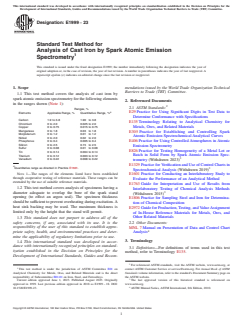
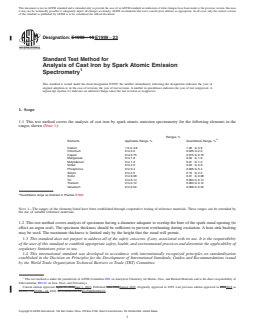
1.1 This test method covers the analysis of cast iron by spark atomic emission spectrometry for the following elements in the ranges shown (Note 1):
Ranges, %
Elements
Applicable Range, %
Quantitative Range, %A
Carbon
1.9 to 3.8
1.90 to 3.8
Chromium
0 to 2.0
0.025 to 2.0
Copper
0 to 0.75
0.015 to 0.75
Manganese
0 to 1.8
0.03 to 1.8
Molybdenum
0 to 1.2
0.01 to 1.2
Nickel
0 to 2.0
0.02 to 2.0
Phosphorus
0 to 0.4
0.005 to 0.4
Silicon
0 to 2.5
0.15 to 2.5
Sulfur
0 to 0.08
0.01 to 0.08
Tin
0 to 0.14
0.004 to 0.14
Titanium
0 to 0.12
0.003 to 0.12
Vanadium
0 to 0.22
0.008 to 0.22
Note 1: The ranges of the elements listed have been established through cooperative testing of reference materials. These ranges can be extended by the use of suitable reference materials.
1.2 This test method covers analysis of specimens having a diameter adequate to overlap the bore of the spark stand opening (to effect an argon seal). The specimen thickness should be sufficient to prevent overheating during excitation. A heat sink backing may be used. The maximum thickness is limited only by the height that the stand will permit.
1.3 This standard does not purport to address all of the safety concerns, if any, associated with its use. It is the responsibility of the user of this standard to establish appropriate safety, health, and environmental practices and determine the applicability of regulatory limitations prior to use.
1.4 This international standard was developed in accordance with internationally recognized principles on standardization established in the Decision on Principles for the Development of International Standards, Guides and Recommendations issued by the World Trade Organization Technical Barriers to Trade (TBT) Committee.
- Status
- Published
- Publication Date
- 31-May-2023
- Technical Committee
- E01 - Analytical Chemistry for Metals, Ores, and Related Materials
- Drafting Committee
- E01.01 - Iron, Steel, and Ferroalloys
Buy Documents
ASTM E1999-23 - Standard Test Method for Analysis of Cast Iron by Spark Atomic Emission Spectrometry
REDLINE ASTM E1999-23 - Standard Test Method for Analysis of Cast Iron by Spark Atomic Emission Spectrometry
Overview
ASTM E1999-23 is the internationally recognized standard test method for the analysis of cast iron by spark atomic emission spectrometry (spark OES). Developed by ASTM International, this standard outlines procedures for the accurate determination of key chemical elements in cast iron alloys, ensuring that metallurgical properties meet critical manufacturing requirements. Spark atomic emission spectrometry is widely used for rapid, precise, and multi-element analysis, making this test method essential for quality control and inspection in iron foundries and related industries.
Key Topics
- Scope of Analysis: Specifies the determination of elements such as carbon, chromium, copper, manganese, molybdenum, nickel, phosphorus, silicon, sulfur, tin, titanium, and vanadium in specific concentration ranges suitable for cast iron.
- Applicability: Suitable for cast iron specimens with adequate dimensions to ensure a reliable argon seal during excitation; proper specimen preparation is emphasized to avoid overheating and ensure homogeneity.
- Significance: Accurate composition analysis ensures that cast iron components exhibit the required mechanical and metallurgical characteristics for their intended applications.
- Quality Assurance: Addresses the need for calibration, standardization, drift correction, and verification procedures to maintain analytical credibility.
- Precision and Bias: Includes guidance on estimation of precision and bias based on interlaboratory studies, with caution regarding differences arising from calibration materials.
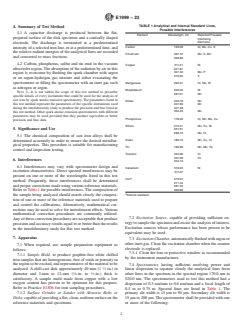
- Interferences: Discusses potential spectral interferences and the importance of using suitable reference materials and mathematical correction procedures.
Applications
The ASTM E1999-23 method is widely used in:
- Manufacturing Quality Control: Rapid, on-site analysis of cast iron during production to ensure chemical composition remains within specified limits.
- Inspection Testing: Verification of material conformity for incoming materials, in-process controls, and finished products in foundries, steelworks, and metalworking industries.
- Process Optimization: Monitoring elemental composition to optimize casting processes, reduce defects, and maintain product performance for automotive, construction, piping, and machinery components.
- Research and Development: Supporting metallurgical research, development of new iron alloys, and validation of production techniques by enabling detailed elemental analysis.
Related Standards
Users of ASTM E1999-23 may also reference the following ASTM standards for complementary procedures and terminology:
- ASTM E29: Practice for Using Significant Digits in Test Data to Determine Conformance with Specifications
- ASTM E135: Terminology Relating to Analytical Chemistry for Metals, Ores, and Related Materials
- ASTM E305: Practice for Establishing and Controlling Spark Atomic Emission Spectrochemical Analytical Curves
- ASTM E406: Practice for Using Controlled Atmospheres in Atomic Emission Spectrometry
- ASTM E1806: Practice for Sampling Steel and Iron for Determination of Chemical Composition
- ASTM E1601: Practice for Conducting an Interlaboratory Study to Evaluate the Performance of an Analytical Method
- ASTM E2972: Guide for Production, Testing, and Value Assignment of In-House Reference Materials for Metals, Ores, and Other Related Materials
Summary
ASTM E1999-23 provides a robust framework for the chemical analysis of cast iron by spark atomic emission spectrometry. By following this standard, industries can ensure reliable, reproducible results for a range of critical elements, supporting compliance, product performance, and quality assurance. This test method is indispensable for manufacturers, laboratories, and inspectors who require accurate cast iron analysis in line with international best practices.
Keywords: ASTM E1999-23, spark atomic emission spectrometry, cast iron analysis, spark OES, chemical composition, metallurgical quality, iron alloy testing, manufacturing control, inspection testing, ASTM standards.
Relations
- Effective Date
- 01-Jan-2020
- Effective Date
- 01-Nov-2019
- Effective Date
- 01-Oct-2019
- Refers
ASTM E406-19 - Standard Practice for Using Controlled Atmospheres in Atomic Emission Spectrometry - Effective Date
- 01-Oct-2019
- Effective Date
- 15-May-2019
- Effective Date
- 15-May-2016
- Effective Date
- 01-Jul-2015
- Effective Date
- 15-May-2015
- Effective Date
- 15-Feb-2015
- Effective Date
- 15-Aug-2014
- Effective Date
- 01-Apr-2014
- Effective Date
- 15-Feb-2014
- Effective Date
- 01-Dec-2013
- Effective Date
- 01-Apr-2013
- Effective Date
- 15-Dec-2012
Buy Documents
ASTM E1999-23 - Standard Test Method for Analysis of Cast Iron by Spark Atomic Emission Spectrometry
REDLINE ASTM E1999-23 - Standard Test Method for Analysis of Cast Iron by Spark Atomic Emission Spectrometry
Get Certified
Connect with accredited certification bodies for this standard

ECOCERT
Organic and sustainability certification.

Eurofins Food Testing Global
Global leader in food, environment, and pharmaceutical product testing.

Intertek Bangladesh
Intertek certification and testing services in Bangladesh.
Sponsored listings
Frequently Asked Questions
ASTM E1999-23 is a standard published by ASTM International. Its full title is "Standard Test Method for Analysis of Cast Iron by Spark Atomic Emission Spectrometry". This standard covers: SIGNIFICANCE AND USE 5.1 The chemical composition of cast iron alloys shall be determined accurately in order to ensure the desired metallurgical properties. This procedure is suitable for manufacturing control and inspection testing. SCOPE 1.1 This test method covers the analysis of cast iron by spark atomic emission spectrometry for the following elements in the ranges shown (Note 1): Ranges, % Elements Applicable Range, % Quantitative Range, %A Carbon 1.9 to 3.8 1.90 to 3.8 Chromium 0 to 2.0 0.025 to 2.0 Copper 0 to 0.75 0.015 to 0.75 Manganese 0 to 1.8 0.03 to 1.8 Molybdenum 0 to 1.2 0.01 to 1.2 Nickel 0 to 2.0 0.02 to 2.0 Phosphorus 0 to 0.4 0.005 to 0.4 Silicon 0 to 2.5 0.15 to 2.5 Sulfur 0 to 0.08 0.01 to 0.08 Tin 0 to 0.14 0.004 to 0.14 Titanium 0 to 0.12 0.003 to 0.12 Vanadium 0 to 0.22 0.008 to 0.22 Note 1: The ranges of the elements listed have been established through cooperative testing of reference materials. These ranges can be extended by the use of suitable reference materials. 1.2 This test method covers analysis of specimens having a diameter adequate to overlap the bore of the spark stand opening (to effect an argon seal). The specimen thickness should be sufficient to prevent overheating during excitation. A heat sink backing may be used. The maximum thickness is limited only by the height that the stand will permit. 1.3 This standard does not purport to address all of the safety concerns, if any, associated with its use. It is the responsibility of the user of this standard to establish appropriate safety, health, and environmental practices and determine the applicability of regulatory limitations prior to use. 1.4 This international standard was developed in accordance with internationally recognized principles on standardization established in the Decision on Principles for the Development of International Standards, Guides and Recommendations issued by the World Trade Organization Technical Barriers to Trade (TBT) Committee.
SIGNIFICANCE AND USE 5.1 The chemical composition of cast iron alloys shall be determined accurately in order to ensure the desired metallurgical properties. This procedure is suitable for manufacturing control and inspection testing. SCOPE 1.1 This test method covers the analysis of cast iron by spark atomic emission spectrometry for the following elements in the ranges shown (Note 1): Ranges, % Elements Applicable Range, % Quantitative Range, %A Carbon 1.9 to 3.8 1.90 to 3.8 Chromium 0 to 2.0 0.025 to 2.0 Copper 0 to 0.75 0.015 to 0.75 Manganese 0 to 1.8 0.03 to 1.8 Molybdenum 0 to 1.2 0.01 to 1.2 Nickel 0 to 2.0 0.02 to 2.0 Phosphorus 0 to 0.4 0.005 to 0.4 Silicon 0 to 2.5 0.15 to 2.5 Sulfur 0 to 0.08 0.01 to 0.08 Tin 0 to 0.14 0.004 to 0.14 Titanium 0 to 0.12 0.003 to 0.12 Vanadium 0 to 0.22 0.008 to 0.22 Note 1: The ranges of the elements listed have been established through cooperative testing of reference materials. These ranges can be extended by the use of suitable reference materials. 1.2 This test method covers analysis of specimens having a diameter adequate to overlap the bore of the spark stand opening (to effect an argon seal). The specimen thickness should be sufficient to prevent overheating during excitation. A heat sink backing may be used. The maximum thickness is limited only by the height that the stand will permit. 1.3 This standard does not purport to address all of the safety concerns, if any, associated with its use. It is the responsibility of the user of this standard to establish appropriate safety, health, and environmental practices and determine the applicability of regulatory limitations prior to use. 1.4 This international standard was developed in accordance with internationally recognized principles on standardization established in the Decision on Principles for the Development of International Standards, Guides and Recommendations issued by the World Trade Organization Technical Barriers to Trade (TBT) Committee.
ASTM E1999-23 is classified under the following ICS (International Classification for Standards) categories: 71.040.50 - Physicochemical methods of analysis. The ICS classification helps identify the subject area and facilitates finding related standards.
ASTM E1999-23 has the following relationships with other standards: It is inter standard links to ASTM E135-20, ASTM E1601-19, ASTM E2972-15(2019), ASTM E406-19, ASTM E135-19, ASTM E135-16, ASTM E135-15a, ASTM E135-15, ASTM E2972-15, ASTM E135-14b, ASTM E135-14a, ASTM E135-14, ASTM E135-13a, ASTM E826-08(2013), ASTM E1601-12. Understanding these relationships helps ensure you are using the most current and applicable version of the standard.
ASTM E1999-23 is available in PDF format for immediate download after purchase. The document can be added to your cart and obtained through the secure checkout process. Digital delivery ensures instant access to the complete standard document.
Standards Content (Sample)
This international standard was developed in accordance with internationally recognized principles on standardization established in the Decision on Principles for the
Development of International Standards, Guides and Recommendations issued by the World Trade Organization Technical Barriers to Trade (TBT) Committee.
Designation: E1999 − 23
Standard Test Method for
Analysis of Cast Iron by Spark Atomic Emission
Spectrometry
This standard is issued under the fixed designation E1999; the number immediately following the designation indicates the year of
original adoption or, in the case of revision, the year of last revision. A number in parentheses indicates the year of last reapproval. A
superscript epsilon (´) indicates an editorial change since the last revision or reapproval.
1. Scope mendations issued by the World Trade Organization Technical
Barriers to Trade (TBT) Committee.
1.1 This test method covers the analysis of cast iron by
spark atomic emission spectrometry for the following elements
2. Referenced Documents
in the ranges shown (Note 1):
2.1 ASTM Standards:
Ranges, %
A
E29 Practice for Using Significant Digits in Test Data to
Elements Applicable Range, % Quantitative Range, %
Determine Conformance with Specifications
Carbon 1.9 to 3.8 1.90 to 3.8
E135 Terminology Relating to Analytical Chemistry for
Chromium 0 to 2.0 0.025 to 2.0
Metals, Ores, and Related Materials
Copper 0 to 0.75 0.015 to 0.75
Manganese 0 to 1.8 0.03 to 1.8
E305 Practice for Establishing and Controlling Spark
Molybdenum 0 to 1.2 0.01 to 1.2
Atomic Emission Spectrochemical Analytical Curves
Nickel 0 to 2.0 0.02 to 2.0
E406 Practice for Using Controlled Atmospheres in Atomic
Phosphorus 0 to 0.4 0.005 to 0.4
Silicon 0 to 2.5 0.15 to 2.5
Emission Spectrometry
Sulfur 0 to 0.08 0.01 to 0.08
E826 Practice for Testing Homogeneity of a Metal Lot or
Tin 0 to 0.14 0.004 to 0.14
Titanium 0 to 0.12 0.003 to 0.12 Batch in Solid Form by Spark Atomic Emission Spec-
Vanadium 0 to 0.22 0.008 to 0.22
trometry (Withdrawn 2023)
E1329 Practice for Verification and Use of Control Charts in
A
Quantitative range as directed in Practice E1601.
Spectrochemical Analysis (Withdrawn 2019)
NOTE 1—The ranges of the elements listed have been established
E1601 Practice for Conducting an Interlaboratory Study to
through cooperative testing of reference materials. These ranges can be
Evaluate the Performance of an Analytical Method
extended by the use of suitable reference materials.
E1763 Guide for Interpretation and Use of Results from
1.2 This test method covers analysis of specimens having a
Interlaboratory Testing of Chemical Analysis Methods
diameter adequate to overlap the bore of the spark stand
(Withdrawn 2015)
opening (to effect an argon seal). The specimen thickness
E1806 Practice for Sampling Steel and Iron for Determina-
should be sufficient to prevent overheating during excitation. A
tion of Chemical Composition
heat sink backing may be used. The maximum thickness is
E2972 Guide for Production, Testing, and Value Assignment
limited only by the height that the stand will permit.
of In-House Reference Materials for Metals, Ores, and
Other Related Materials
1.3 This standard does not purport to address all of the
safety concerns, if any, associated with its use. It is the
2.2 Other Documents:
responsibility of the user of this standard to establish appro- MNL 7 Manual on Presentation of Data and Control Chart
priate safety, health, and environmental practices and deter-
Analysis
mine the applicability of regulatory limitations prior to use.
3. Terminology
1.4 This international standard was developed in accor-
dance with internationally recognized principles on standard-
3.1 Definitions—For definitions of terms used in this test
ization established in the Decision on Principles for the
method, refer to Terminology E135.
Development of International Standards, Guides and Recom-
For referenced ASTM standards, visit the ASTM website, www.astm.org, or
This test method is under the jurisdiction of ASTM Committee E01 on contact ASTM Customer Service at service@astm.org. For Annual Book of ASTM
Analytical Chemistry for Metals, Ores, and Related Materials and is the direct Standards volume information, refer to the standard’s Document Summary page on
responsibility of Subcommittee E01.01 on Iron, Steel, and Ferroalloys. the ASTM website.
Current edition approved June 1, 2023. Published August 2023. Originally The last approved version of this historical standard is referenced on
approved in 1999. Last previous edition approved in 2018 as E1999 – 18. DOI: www.astm.org.
10.1520/E1999-23. ASTM Manual Series, ASTM International, 8th Edition, 2010.
Copyright © ASTM International, 100 Barr Harbor Drive, PO Box C700, West Conshohocken, PA 19428-2959. United States
E1999 − 23
TABLE 1 Analytical and Internal Standard Lines,
4. Summary of Test Method
Possible Interferences
4.1 A capacitor discharge is produced between the flat,
Element Wavelength, nm Reported Possible
prepared surface of the disk specimen and a conically shaped
Interfering
Elements
electrode. The discharge is terminated at a predetermined
Carbon 193.09 Al, Mo, Cu, S
intensity of a selected iron line, or at a predetermined time, and
the relative radiant energies of the analytical lines are recorded
Chromium 267.72 Mo, S, Mn
and converted to mass fractions.
265.86
4.2 Carbon, phosphorus, sulfur and tin emit in the vacuum
Copper 211.21 Ni
ultraviolet region. The absorption of the radiation by air in this 221.81
327.40 Mo, P
region is overcome by flushing the spark chamber with argon
510.55 V
or an argon-hydrogen gas mixture and either evacuating the
Manganese 293.31 Cr, Mo, W
spectrometer or filling the spectrometer with an inert gas such
as nitrogen or argon.
Molybdenum 202.03 Ni
NOTE 2—It is not within the scope of this test method to prescribe
281.61 Mn
specific details of every instrument that could be used for the analysis of
cast iron by spark atomic emission spectrometry. The parameters listed in
Nickel 243.79 Mn
this test method represent the parameters of the specific instruments used
231.60 Mn
341.48
during the interlaboratory study to produce the precision and bias listed in
352.45 Mo
this test method. Other spark atomic emission spectrometers with different
parameters may be used provided that they produce equivalent or better
Phosphorus 178.29 Cr, Mn, Mo, Cu
precision and bias data.
Silicon 212.41 Mo, Cu, Ni
5. Significance and Use 251.61
288.16 Mo, Cr
5.1 The chemical composition of cast iron alloys shall be
Sulfur 180.73 Mn, Cu, Cr
determined accurately in order to ensure the desired metallur-
gical properties. This procedure is suitable for manufacturing
Tin 189.99 Mn, Mo, Fe
control and inspection testing.
Titanium 334.90 Cr
337.28 Fe
6. Interferences
334.19
6.1 Interferences may vary with spectrometer design and
Vanadium 310.23 Ni
excitation characteristics. Direct spectral interferences may be
311.07
present on one or more of the wavelengths listed in this test
A
Iron 273.07
method. Frequently, these interferences shall be determined
271.44
and proper corrections made using various reference materials.
281.33
360.89
Refer to Table 1 for possible interferences. The composition of
A
the sample being analyzed should match closely the composi- Internal standard.
tion of one or more of the reference materials used to prepare
and control the calibrations. Alternatively, mathematical cor-
rections may be used to solve for interelement effects. Various
mathematical correction procedures are commonly utilized.
7.2 Excitation Source, capable of providing sufficient en-
Any of these correction procedures are acceptable that produce
ergy to sample the specimen and excite the analytes of interest.
precision and accuracy results equal to or better than the results
Excitation sources whose performance has been proven to be
in the interlaboratory study for this test method.
equivalent may be used.
7. Apparatus
7.3 Excitation Chamber, automatically flushed with argon or
other inert gas. Clean the excitation chamber when the counter
7.1 When required, use sample preparation equipment as
electrode is replaced.
follows:
7.3.1 Clean the lens or protective window as recommended
7.1.1 Sample Mold, to produce graphite-free white chilled
by the instrument manufacturer.
iron samples that are homogeneous, free of voids or porosity in
the region to be excited, and representative of the material to be 7.4 Spectrometer, having sufficient resolving power and
analyzed. A chill-cast disk approximately 40 mm (1 ⁄2 in.) in
linear dispersion to separate clearly the analytical lines from
1 1
diameter and 3-mm to 12-mm ( ⁄8-in. to ⁄2-in.) thick is other lines in the spectrum in the spectral region 170.0 nm to
satisfactory. A sample mold made from copper with a low
520.0 nm. The spectrometers used to test this method had a
oxygen content has proven to be optimum for this purpose. dispersion of 0.3 nm/mm to 0.6 nm/mm and a focal length of
Refer to Practice E1806 for iron sampling procedures.
0.5 m to 0.75 m. Spectral lines are listed in Table 1. The
7.1.2 Surface Grinder or Sander with Abrasive Belts or primary slit width is 15 μm to 50 μm. Secondary slit width is
Disks, capable of providing a flat, clean, uniform surface on the 15 μm to 200 μm. The spectrometer shall be provided with one
reference materials and specimens. or more of the following:
E1999 − 23
7.4.1 An air/gas inlet and a vacuum outlet. The spectrometer the calibration RMs should be similar to that of the specimens
shall be operated at a vacuum of 25 μm of mercury or below. being analyzed as directed in Practice E305.
7.4.2 A gas inlet and a gas outlet.
9.2 Certified Reference Materials (CRMs), used as calibra-
7.4.3 Sealed with nitrogen or other inert gas.
tion RMs for chill-cast iron alloys and are available commer-
7.5 Measuring System, consisting of photomultipliers hav-
cially.
ing individual voltage adjustment, capacitors on which the
9.3 Reference Materials (RM’s), used as calibration RMs for
output of each photomultiplier is stored and an electronic
chill-cast iron alloys and are available commercially.
system to measure voltages on the capacitors either directly or
NOTE 4—The distinction is made between CRMs and production
indirectly, and the necessary switching arrangements to pro-
materials because there are commercially available RMs produced by
vide the desired sequence of operation. reputable producers that do not claim to be CRMs but in all other respects
fit the definition of CRMs. Refer to Guide E2972 for additional informa-
7.6 Readout Console or Computer, capable of indicating the
tion regarding reference materials.
ratio of the analytical lines to the internal standard with
9.4 Analyzed Production Samples shall be chemically ana-
sufficient precision to produce the accuracy of analysis desired.
lyzed test specimens taken from production material as di-
7.7 Gas System, consisting of an argon or argon-hydrogen
rected in Practice E1806. They shall cover the mass fraction
supply with pressure and flow regulation. Automatic sequenc-
ranges of the elements to be determined and shall include all of
ing shall be provided to actuate the flow at a given rate for a
the specific types of alloys being analyzed. These calibration
specific time interval. The flow rate may be manually or
RMs shall be homogeneous and free of voids and porosity.
automatically controlled. The gas system shall meet the re-
Refer to Practice E826 for information on homogeneity testing
quirements of Practice E406.
of reference materials using spark atomic emission spectrom-
etry.
7.8 Vacuum Pump, if required, capable of maintaining a
vacuum of 25 μm Hg or less.
10. Preparation of Calibration RMs and Specimens
NOTE 3—A pump with a displacement of at least 0.23 m /min (8
ft /min) is usually adequate.
10.1 Specimens, cast graphite-free specimens from molten
metal into a suitable mold and cool. Refer to Practice E1806
8. Reagents and Materials
for information on the preparation of specimens for analysis.
8.1 Inert Gas (Argon, Nitrogen), or Hydrogen, as required,
10.2 Preparation, prepare the surface to be analyzed on a
shall be of sufficient purity to permit proper excitation of the
suitable belt or disk grinder. Prepare the surface of the
analytical lines of interest in the excitation chamber and to
specimens and calibration RMs in a similar manner. All
permit light transmittance in the spectrometer chamber. Use as
specimens shall be free of moisture, oil, and residue for proper
directed in Practice E406.
excitation.
8.2 Counter Electrodes—A silver or tungsten rod of 2-mm
10.3 Specimen porosity is undesirable because it leads to
to 6-mm diameter ground to a 30° to 90° conical tip. Other
the “diffuse-type” rather than the desired “concentrated-type”
material may be used provided it can be shown experimentally
discharge. The specimen surface should be kept clean because
that equivalent precision and accuracy are obtained.
the specimen is the electron emitter, and electron emission is
8.2.1 A black deposit may build up on the tip of the
inhibited by oily, dirty surfaces.
electrode, thus reducing the overall intensity of the spectral
10.4 Calibration RMs and specimens shall be refinished dry
radiation. The number of acceptable excitations on an electrode
on a belt or disc grinder before being re-excited on the same
varies from one instrument to another and should be deter-
area.
mined in each laboratory. Cleaning of the electrodes after each
sample analysis significantly reduces this buildup and gives
11. Specimen Excitation Parameters
more consistent results.
11.1 Operate the spectrometer as directed by the manufac-
9. Calibration Reference Materials (RMs)
turer’s instructions. When the parameters in 11.1.1 are
established, maintain them carefully. The variation of the
9.1 These are available in three forms: certified reference
power supply voltage shall not exceed 6 5 % and preferably
materials, reference materials, and analyzed production
should be held within 6 2 %.
samples. In selecting calibration RMs, use caution with com-
11.1.1 An example of excitation parameters for a high-
positions that are unusual. One element may adversely influ-
energy unidirectional spark source is listed below:
ence the radiant energy of another element or its uniformity of
distribution within the material. Tests should be made to Preburn Integration
Capacitance, μF 10 10
determine if interrelations exist between elements in the
Inductance, μH 20 20
calibration RMs. To compensate for inter-element effects, it is
Resistance, Ω 0 4.4
Potential, V 550 350
suggested that the calibration RMs approximate the composi-
Number of discharges/s 120 60
tion of the material to be tested. The metallurgical history of
E1999 − 23
11.2 Spark Conditions—An example of spark parameters two times. Using the average intensity of the data for each
follows: point, determine the calibrations as described in Practice E305
(Note 5).
Flush period, s 2 to 10
Preburn period, s 5 to 20
13.2 Drift Correction (Standardization)—Following the
Integration period, s 5 to 20
manufacturer’s recommendations, drift correct (standardize)
Gas Flow ft /h L/min
on an initial setup or anytime that it is known or suspected that
Flush 5 to 45 2.5 to 25
readings have shifted. Make the necessary corrections by
Preburn 5 to 45 2.5 to 25
applying arithmetic corrections. Drift correction (standardiza-
Integration 5 to 30 2.5 to 15
tion) shall be don
...
This document is not an ASTM standard and is intended only to provide the user of an ASTM standard an indication of what changes have been made to the previous version. Because
it may not be technically possible to adequately depict all changes accurately, ASTM recommends that users consult prior editions as appropriate. In all cases only the current version
of the standard as published by ASTM is to be considered the official document.
Designation: E1999 − 18 E1999 − 23
Standard Test Method for
Analysis of Cast Iron by Spark Atomic Emission
Spectrometry
This standard is issued under the fixed designation E1999; the number immediately following the designation indicates the year of
original adoption or, in the case of revision, the year of last revision. A number in parentheses indicates the year of last reapproval. A
superscript epsilon (´) indicates an editorial change since the last revision or reapproval.
1. Scope
1.1 This test method covers the analysis of cast iron by spark atomic emission spectrometry for the following elements in the
ranges shown (Note 1):
Ranges, %
A
Elements Applicable Range, % Quantitative Range, %
Carbon 1.9 to 3.8 1.90 to 3.8
Chromium 0 to 2.0 0.025 to 2.0
Copper 0 to 0.75 0.015 to 0.75
Manganese 0 to 1.8 0.03 to 1.8
Molybdenum 0 to 1.2 0.01 to 1.2
Nickel 0 to 2.0 0.02 to 2.0
Phosphorus 0 to 0.4 0.005 to 0.4
Silicon 0 to 2.5 0.15 to 2.5
Sulfur 0 to 0.08 0.01 to 0.08
Tin 0 to 0.14 0.004 to 0.14
Titanium 0 to 0.12 0.003 to 0.12
Vanadium 0 to 0.22 0.008 to 0.22
A
Quantitative range as directed in Practice E1601.
NOTE 1—The ranges of the elements listed have been established through cooperative testing of reference materials. These ranges can be extended by
the use of suitable reference materials.
1.2 This test method covers analysis of specimens having a diameter adequate to overlap the bore of the spark stand opening (to
effect an argon seal). The specimen thickness should be sufficient to prevent overheating during excitation. A heat sink backing
may be used. The maximum thickness is limited only by the height that the stand will permit.
1.3 This standard does not purport to address all of the safety concerns, if any, associated with its use. It is the responsibility
of the user of this standard to establish appropriate safety, health, and environmental practices and determine the applicability of
regulatory limitations prior to use.
1.4 This international standard was developed in accordance with internationally recognized principles on standardization
established in the Decision on Principles for the Development of International Standards, Guides and Recommendations issued
by the World Trade Organization Technical Barriers to Trade (TBT) Committee.
This test method is under the jurisdiction of ASTM Committee E01 on Analytical Chemistry for Metals, Ores, and Related Materials and is the direct responsibility of
Subcommittee E01.01 on Iron, Steel, and Ferroalloys.
Current edition approved April 15, 2018June 1, 2023. Published June 2018August 2023. Originally approved in 1999. Last previous edition approved in 20112018 as
E1999 – 11.E1999 – 18. DOI: 10.1520/E1999-18.10.1520/E1999-23.
Copyright © ASTM International, 100 Barr Harbor Drive, PO Box C700, West Conshohocken, PA 19428-2959. United States
E1999 − 23
2. Referenced Documents
2.1 ASTM Standards:
E29 Practice for Using Significant Digits in Test Data to Determine Conformance with Specifications
E135 Terminology Relating to Analytical Chemistry for Metals, Ores, and Related Materials
E305 Practice for Establishing and Controlling Spark Atomic Emission Spectrochemical Analytical Curves
E406 Practice for Using Controlled Atmospheres in Atomic Emission Spectrometry
E826 Practice for Testing Homogeneity of a Metal Lot or Batch in Solid Form by Spark Atomic Emission Spectrometry
(Withdrawn 2023)
E1329 Practice for Verification and Use of Control Charts in Spectrochemical Analysis (Withdrawn 2019)
E1601 Practice for Conducting an Interlaboratory Study to Evaluate the Performance of an Analytical Method
E1763 Guide for Interpretation and Use of Results from Interlaboratory Testing of Chemical Analysis Methods (Withdrawn
2015)
E1806 Practice for Sampling Steel and Iron for Determination of Chemical Composition
E2972 Guide for Production, Testing, and Value Assignment of In-House Reference Materials for Metals, Ores, and Other
Related Materials
2.2 Other Documents:
MNL 7 Manual on Presentation of Data and Control Chart Analysis
3. Terminology
3.1 Definitions—For definitions of terms used in this test method, refer to Terminology E135.
4. Summary of Test Method
4.1 A capacitor discharge is produced between the flat, groundprepared surface of the disk specimen and a conically shaped
electrode. The discharge is terminated at a predetermined intensity of a selected iron line, or at a predetermined time, and the
relative radiant energies of the analytical lines are recorded and converted to mass fractions.
4.2 Carbon, phosphorus, sulfur and tin emit in the vacuum ultraviolet region. The absorption of the radiation by air in this region
is overcome by flushing the spark chamber with argon or an argon-hydrogen gas mixture and either evacuating the spectrometer
or filling the spectrometer with an inert gas such as nitrogen or argon.
NOTE 2—It is not within the scope of this test method to prescribe specific details of every instrument that could be used for the analysis of cast iron by
spark atomic emission spectrometry. The parameters listed in this test method represent the parameters of the specific instruments used during the
interlaboratory study to produce the precision and bias listed in this test method. Other spark atomic emission spectrometers with different parameters
may be used provided that they produce equivalent or better precision and bias data.
5. Significance and Use
5.1 The chemical composition of cast iron alloys shall be determined accurately in order to insureensure the desired metallurgical
properties. This procedure is suitable for manufacturing control and inspection testing.
6. Interferences
6.1 Interferences may vary with spectrometer design and excitation characteristics. Direct spectral interferences may be present
on one or more of the wavelengths listed in this test method. Frequently, these interferences shall be determined and proper
corrections made by the use of using various reference materials. Refer to Table 1 for possible interferences. The composition of
the sample being analyzed should match closely the composition of one or more of the reference materials used to prepare and
control the calibration curve. calibrations. Alternatively, mathematical corrections may be used to solve for interelement effects.
Various mathematical correction procedures are commonly utilized. Any of these correction procedures are acceptable that produce
precision and accuracy results equal to or better than the results in the interlaboratory study for this test method are
acceptable.method.
For referenced ASTM standards, visit the ASTM website, www.astm.org, or contact ASTM Customer Service at service@astm.org. For Annual Book of ASTM Standards
volume information, refer to the standard’s Document Summary page on the ASTM website.
The last approved version of this historical standard is referenced on www.astm.org.
ASTM Manual Series, ASTM International, 8th Edition, 2010.
E1999 − 23
TABLE 1 Analytical and Internal Standard Lines,
Possible Interferences
Element Wavelength, nm Reported Possible
Interfering
Elements
Carbon 193.09 Al, Mo, Cu, S
Chromium 267.72 Mo, S, Mn
265.86
Copper 211.21 Ni
221.81
327.40 Mo, P
510.55 V
Manganese 293.31 Cr, Mo, W
Molybdenum 202.03 Ni
281.61 Mn
Nickel 243.79 Mn
231.60 Mn
341.48
352.45 Mo
Phosphorus 178.29 Cr, Mn, Mo, Cu
Silicon 212.41 Mo, Cu, Ni
251.61
288.16 Mo, Cr
Sulfur 180.73 Mn, Cu, Cr
Tin 189.99 Mn, Mo, Fe
Titanium 334.90 Cr
337.28 Fe
334.19
Vanadium 310.23 Ni
311.07
A
Iron 273.07
271.44
281.33
360.89
A
Internal standard.
7. Apparatus
7.1 When required, use sample preparation equipment as follows:
7.1.1 Sample Mold, to produce graphite-free white chilled iron samples that are homogeneous, free of voids or porosity in the
region to be excited, and representative of the material to be analyzed. A chill-cast disk approximately 40 mm (1 ⁄2 in.) in diameter
1 1
and 3-mm to 12-mm ( ⁄8-in. to ⁄2-in.) thick is satisfactory. A sample mold made from copper with a low oxygen content has proven
to be optimum for this purpose. Refer to Practice E1806 for iron sampling procedures.
7.1.2 Surface Grinder or Sander with Abrasive Belts or Disks, capable of providing a flat, clean, uniform surface on the reference
materials and specimens.
7.2 Excitation Source, capable of providing sufficient energy to sample the specimen and excite the analytes of interest. Any other
excitation source Excitation sources whose performance has been proven to be equivalent may be used.
7.3 Excitation Chamber, automatically flushed with argon or other inert gas. Clean the excitation chamber when the counter
electrode is replaced.
7.3.1 Clean the lens or protective window as recommended by the instrument manufacturer.
E1999 − 23
7.4 Spectrometer, having sufficient resolving power and linear dispersion to separate clearly the analytical lines from other lines
in the spectrum in the spectral region 170.0 nm to 520.0 nm. The spectrometers used to test this method had a dispersion of 0.3
nm/mm to 0.6 nm/mm and a focal length of 0.5 m to 0.75 m. Spectral lines are listed in Table 1. The primary slit width is 15 μm
to 50 μm. Secondary slit width is 15 μm to 200 μm. The spectrometer shall be provided with one or more of the following:
7.4.1 An air/gas inlet and a vacuum outlet. The spectrometer shall be operated at a vacuum of 25 μm of mercury or below.
7.4.2 A gas inlet and a gas outlet.
7.4.3 Sealed with nitrogen or other inert gas.
7.5 Measuring System, consisting of photomultipliers having individual voltage adjustment, capacitors on which the output of each
photomultiplier is stored and an electronic system to measure voltages on the capacitors either directly or indirectly, and the
necessary switching arrangements to provide the desired sequence of operation.
7.6 Readout Console or Computer, capable of indicating the ratio of the analytical lines to the internal standard with sufficient
precision to produce the accuracy of analysis desired.
7.7 Gas System, consisting of an argon or argon-hydrogen supply with pressure and flow regulation. Automatic sequencing shall
be provided to actuate the flow at a given rate for a specific time interval. The flow rate may be manually or automatically
controlled. The gas system shall meet the requirements of Practice E406.
7.8 Vacuum Pump, if required, capable of maintaining a vacuum of 25 μm Hg or less.
3 3
NOTE 3—A pump with a displacement of at least 0.23 m /min (8 ft /min) is usually adequate.
8. Reagents and Materials
8.1 Inert Gas (Argon, Nitrogen), or Hydrogen, as required, shall be of sufficient purity to permit proper excitation of the analytical
lines of interest in the excitation chamber and to permit light transmittance in the spectrometer chamber. Use as directed in Practice
E406.
8.2 Counter Electrodes—A silver or tungsten rod of 2-mm to 6-mm diameter ground to a 30° to 90° conical tip. Other material
may be used provided it can be shown experimentally that equivalent precision and accuracy are obtained.
8.2.1 A black deposit may build up on the tip of the electrode, thus reducing the overall intensity of the spectral radiation. The
number of acceptable excitations on an electrode varies from one instrument to another and should be determined in each
laboratory. Cleaning of the electrodes after each burn sample analysis significantly reduces this buildup and gives more consistent
results.
9. Calibration Reference Materials (RMs)
9.1 These can comeare available in three forms: certified reference materials, reference materials, and analyzed production
samples. In selecting calibration RMs, use caution with compositions that are unusual. One element may adversely influence the
radiant energy of another element or its uniformity of distribution within the material. Tests should be made to determine if
interrelations exist between elements in the calibration RMs. To compensate for inter-element effects, it is suggested that the
calibration RMs approximate the composition of the material to be tested. The metallurgical history of the calibration RMs should
be similar to that of the specimens being analyzed as directed in Practice E305.
9.2 Certified Reference Materials (CRMs), used as calibration RMs for chill-cast iron alloys and are available commercially.
9.3 Reference Materials (RM’s), used as calibration RMs for chill-cast iron alloys and are available commercially.
NOTE 4—The distinction is made between CRMs and production materials because there are commercially available RMs produced by reputable
E1999 − 23
producers that do not claim to be CRMs but in all other respects fit the definition of CRMs. Refer to Guide E2972 for additional information regarding
reference materials.
9.4 Analyzed Production Samples shall be chemically analyzed test specimens taken from production heats produced material as
directed in Practice E1806. They shall cover the mass fraction ranges of the elements to be determined and shall include all of the
specific types of alloys being analyzed. These calibration RMs shall be homogeneous and free of voids and porosity. Refer to
Practice E826 for information on homogeneity testing of reference materials using spark atomic emission spectrometry.
10. Preparation of Calibration RMs and Specimens
10.1 Specimens, cast graphite-free specimens from molten metal into a suitable mold and cool. Refer to Practice E1806 for
information on the preparation of specimens for analysis.
10.2 Preparation, prepare the surface to be analyzed on a suitable belt or disk grinder. Prepare the surface of the specimens and
calibration RMs in a similar manner. All specimens shall be free of moisture, oil, and residue for proper excitation.
10.3 Specimen porosity is undesirable because it leads to the “diffuse-type” rather than the desired “concentrated-type” discharge.
The specimen surface should be kept clean because the specimen is the electron emitter, and electron emission is inhibited by oily,
dirty surfaces.
10.4 Calibration RMs and specimens shall be refinished dry on a belt or disc sandergrinder before being re-excited on the same
area.
11. Specimen Excitation Parameters
11.1 Operate the spectrometer as directed by the manufacturer’s instructions. When the parameters in 11.1.1 are established,
maintain them carefully. The variation of the power supply voltage shall not exceed 6 5 % and preferably should be held within
6 2 %.
11.1.1 An example of excitation parameters for a high-energy unidirectional spark source is listed below:
Preburn Integration
Capacitance, μF 10 10
Inductance, μH 20 20
Resistance, 0 4.4
Potential, V 550 350
Number of discharges/s 120 60
11.2 Spark Conditions (Conditions—11.2.1)—An example of spark parameters is listed below:follows:
Flush period, s 2 to 10
Preburn period, s 5 to 20
Integration period, s 5 to 20
Gas Flow ft /h L/min
Flush 5 to 45 2.5 to 25
Preburn 5 to 45 2.5 to 25
Integration 5 to 30 2.5 to 15
11.2.1 Select preburn and integration periods after a study of volatization rates during specimen excitation. Once established,
maintain the parameters consistently. The instrument manufacturer can normally provide this information.
11.3 Electrode System—For conventional capacitor discharge excitation systems, the specimen, electrically negative, serves as one
electrode. The opposite electrode or counter electrode is a tungsten or silver rod. Use a 3-mm to 6-mm (0.125-in. to 0.25-in.)
analytica
...