

ASTM F3602-23
(Guide)Standard Guide for Assessing the Compatibility of a Cleaning Brush Part with Different Substrates Used in the Construction of Medical Devices
General Information
- Abstract
SIGNIFICANCE AND USE
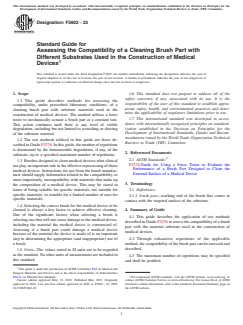
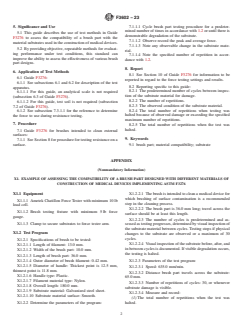
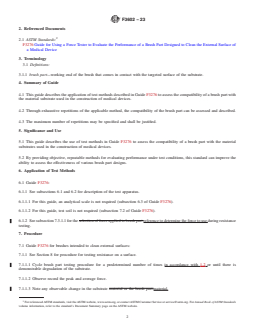
5.1 This guide describes the use of test methods in Guide F3276 to assess the compatibility of a brush part with the material substrates used in the construction of medical devices.
5.2 By providing objective, repeatable methods for evaluating performance under test conditions, this standard can improve the ability to assess the effectiveness of various brush part designs.
SCOPE
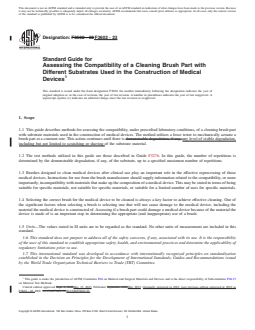
1.1 This guide describes methods for assessing the compatibility, under prescribed laboratory conditions, of a cleaning brush part with substrate materials used in the construction of medical devices. The method utilizes a force tester to mechanically actuate a brush part at a constant rate. This action continues until there is any level of visible degradation, including but not limited to scratching or shaving of the substrate material.
1.2 The test methods utilized in this guide are those described in Guide F3276. In this guide, the number of repetitions is determined by the demonstrable degradation, if any, of the substrate, up to a specified maximum number of repetitions.
1.3 Brushes designed to clean medical devices after clinical use play an important role in the effective reprocessing of those medical devices. Instructions for use from the brush manufacturer should supply information related to the compatibility, or more importantly, incompatibility with materials that make up the composition of a medical device. This may be stated in terms of being suitable for specific materials, not suitable for specific materials, or suitable for a limited number of uses for specific materials.
1.4 Selecting the correct brush for the medical device to be cleaned is always a key factor to achieve effective cleaning. One of the significant factors when selecting a brush is selecting one that will not cause damage to the medical device, including the material the medical device is constructed of. Assessing if a brush part could damage a medical device because of the material the device is made of is an important step in determining the appropriate (and inappropriate) use of a brush.
1.5 Units—The values stated in SI units are to be regarded as the standard. No other units of measurement are included in this standard.
1.6 This standard does not purport to address all of the safety concerns, if any, associated with its use. It is the responsibility of the user of this standard to establish appropriate safety, health, and environmental practices and determine the applicability of regulatory limitations prior to use.
1.7 This international standard was developed in accordance with internationally recognized principles on standardization established in the Decision on Principles for the Development of International Standards, Guides and Recommendations issued by the World Trade Organization Technical Barriers to Trade (TBT) Committee.
- Status
- Published
- Publication Date
- 14-May-2023
- Technical Committee
- F04 - Medical and Surgical Materials and Devices
- Drafting Committee
- F04.15 - Material Test Methods
Buy Documents


ASTM F3602-23 - Standard Guide for Assessing the Compatibility of a Cleaning Brush Part with Different Substrates Used in the Construction of Medical Devices
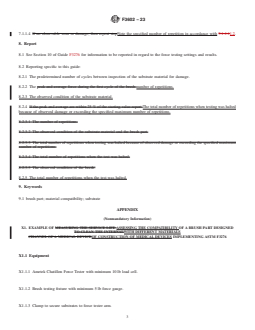
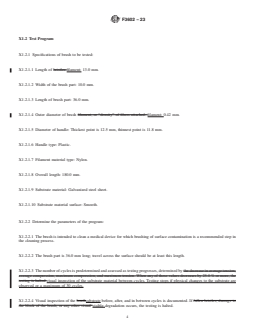
REDLINE ASTM F3602-23 - Standard Guide for Assessing the Compatibility of a Cleaning Brush Part with Different Substrates Used in the Construction of Medical Devices
Overview
ASTM F3602-23: Standard Guide for Assessing the Compatibility of a Cleaning Brush Part with Different Substrates Used in the Construction of Medical Devices is an international standard developed by ASTM International. It provides comprehensive guidance for evaluating the interaction between cleaning brushes and the various materials-referred to as substrates-that are commonly employed in medical device manufacturing. The primary goal is to ensure that cleaning brush parts do not damage or degrade these substrates during use, thereby supporting both the effectiveness of device cleaning and the longevity of medical equipment.
This guide is intended for use by device manufacturers, brush designers, and testing laboratories. It builds upon established ASTM test methods (notably Guide ASTM F3276) to enable objective, repeatable, and standardized assessment of cleaning brush compatibility with relevant materials.
Key Topics
Compatibility Assessment:
- Describes mechanical test methods to determine if repeated use of a cleaning brush part causes visible degradation (such as scratching or shaving) to the substrate material.
- Utilizes a force tester to actuate the brush part at a constant rate across the substrate, observing for any material change.
Test Parameters and Procedure:
- The number of test cycles is determined by either the onset of substrate damage or a maximum specified cycle count.
- Inspections between cycles are performed to detect any visible degradation of either the substrate or the brush part.
Reporting and Documentation:
- Comprehensive reporting includes the number of cycles to failure (or completion), observed substrate and brush conditions, as well as the force values recorded throughout the testing process.
Material Suitability:
- Provides manufacturers with actionable information on which cleaning brushes are safe for use with specific medical device materials.
- Aids in the development of instructions for use related to brush-material compatibility.
Role in Reprocessing:
- Emphasizes the importance of selecting the correct cleaning brush to support effective medical device reprocessing while avoiding unintentional damage.
Applications
Medical Device Manufacturing:
- Supports device designers and quality assurance teams in selecting and verifying cleaning methods that preserve device integrity.
- Helps validate cleaning tool selection during product development and routine manufacturing processes.
Brush Part Development:
- Assists brush manufacturers in demonstrating the safety and compatibility of their products for use with various medical substrates.
- Enables clear labeling and instructions defining suitable and unsuitable substrate materials.
Testing Laboratories:
- Provides laboratories with standardized methods for conducting compatibility assessments, ensuring results are reliable and repeatable for regulatory and compliance submissions.
Healthcare Facilities:
- Guides purchasing and reprocessing staff in choosing compatible brushes for cleaning reusable medical devices, reducing the risk of surface degradation and device failure.
Related Standards
ASTM F3276:
- Guide for Using a Force Tester to Evaluate the Performance of a Brush Part Designed to Clean the External Surface of a Medical Device. This is the referenced method upon which ASTM F3602-23 relies for force testing protocols and procedures.
ISO 13485:
- International standard covering quality management systems for medical device manufacturing, frequently referenced in relation to validation and risk management.
ASTM F04 Committee Standards:
- A broader range of standards relevant to medical and surgical materials, including testing, labeling, and biocompatibility evaluation.
Regulatory Guidance:
- Global regulations, such as those from the FDA or EU MDR, which require manufacturers to validate cleaning and reprocessing methods for reusable devices.
Applying ASTM F3602-23 ensures that cleaning processes are both effective and safe, directly supporting device durability and regulatory compliance while minimizing the risk of material incompatibility in medical device cleaning workflows.
Buy Documents
ASTM F3602-23 - Standard Guide for Assessing the Compatibility of a Cleaning Brush Part with Different Substrates Used in the Construction of Medical Devices
REDLINE ASTM F3602-23 - Standard Guide for Assessing the Compatibility of a Cleaning Brush Part with Different Substrates Used in the Construction of Medical Devices
Get Certified
Connect with accredited certification bodies for this standard

BSI Group
BSI (British Standards Institution) is the business standards company that helps organizations make excellence a habit.

TÜV Rheinland
TÜV Rheinland is a leading international provider of technical services.

TÜV SÜD
TÜV SÜD is a trusted partner of choice for safety, security and sustainability solutions.
Sponsored listings
Frequently Asked Questions
ASTM F3602-23 is a guide published by ASTM International. Its full title is "Standard Guide for Assessing the Compatibility of a Cleaning Brush Part with Different Substrates Used in the Construction of Medical Devices". This standard covers: SIGNIFICANCE AND USE 5.1 This guide describes the use of test methods in Guide F3276 to assess the compatibility of a brush part with the material substrates used in the construction of medical devices. 5.2 By providing objective, repeatable methods for evaluating performance under test conditions, this standard can improve the ability to assess the effectiveness of various brush part designs. SCOPE 1.1 This guide describes methods for assessing the compatibility, under prescribed laboratory conditions, of a cleaning brush part with substrate materials used in the construction of medical devices. The method utilizes a force tester to mechanically actuate a brush part at a constant rate. This action continues until there is any level of visible degradation, including but not limited to scratching or shaving of the substrate material. 1.2 The test methods utilized in this guide are those described in Guide F3276. In this guide, the number of repetitions is determined by the demonstrable degradation, if any, of the substrate, up to a specified maximum number of repetitions. 1.3 Brushes designed to clean medical devices after clinical use play an important role in the effective reprocessing of those medical devices. Instructions for use from the brush manufacturer should supply information related to the compatibility, or more importantly, incompatibility with materials that make up the composition of a medical device. This may be stated in terms of being suitable for specific materials, not suitable for specific materials, or suitable for a limited number of uses for specific materials. 1.4 Selecting the correct brush for the medical device to be cleaned is always a key factor to achieve effective cleaning. One of the significant factors when selecting a brush is selecting one that will not cause damage to the medical device, including the material the medical device is constructed of. Assessing if a brush part could damage a medical device because of the material the device is made of is an important step in determining the appropriate (and inappropriate) use of a brush. 1.5 Units—The values stated in SI units are to be regarded as the standard. No other units of measurement are included in this standard. 1.6 This standard does not purport to address all of the safety concerns, if any, associated with its use. It is the responsibility of the user of this standard to establish appropriate safety, health, and environmental practices and determine the applicability of regulatory limitations prior to use. 1.7 This international standard was developed in accordance with internationally recognized principles on standardization established in the Decision on Principles for the Development of International Standards, Guides and Recommendations issued by the World Trade Organization Technical Barriers to Trade (TBT) Committee.
SIGNIFICANCE AND USE 5.1 This guide describes the use of test methods in Guide F3276 to assess the compatibility of a brush part with the material substrates used in the construction of medical devices. 5.2 By providing objective, repeatable methods for evaluating performance under test conditions, this standard can improve the ability to assess the effectiveness of various brush part designs. SCOPE 1.1 This guide describes methods for assessing the compatibility, under prescribed laboratory conditions, of a cleaning brush part with substrate materials used in the construction of medical devices. The method utilizes a force tester to mechanically actuate a brush part at a constant rate. This action continues until there is any level of visible degradation, including but not limited to scratching or shaving of the substrate material. 1.2 The test methods utilized in this guide are those described in Guide F3276. In this guide, the number of repetitions is determined by the demonstrable degradation, if any, of the substrate, up to a specified maximum number of repetitions. 1.3 Brushes designed to clean medical devices after clinical use play an important role in the effective reprocessing of those medical devices. Instructions for use from the brush manufacturer should supply information related to the compatibility, or more importantly, incompatibility with materials that make up the composition of a medical device. This may be stated in terms of being suitable for specific materials, not suitable for specific materials, or suitable for a limited number of uses for specific materials. 1.4 Selecting the correct brush for the medical device to be cleaned is always a key factor to achieve effective cleaning. One of the significant factors when selecting a brush is selecting one that will not cause damage to the medical device, including the material the medical device is constructed of. Assessing if a brush part could damage a medical device because of the material the device is made of is an important step in determining the appropriate (and inappropriate) use of a brush. 1.5 Units—The values stated in SI units are to be regarded as the standard. No other units of measurement are included in this standard. 1.6 This standard does not purport to address all of the safety concerns, if any, associated with its use. It is the responsibility of the user of this standard to establish appropriate safety, health, and environmental practices and determine the applicability of regulatory limitations prior to use. 1.7 This international standard was developed in accordance with internationally recognized principles on standardization established in the Decision on Principles for the Development of International Standards, Guides and Recommendations issued by the World Trade Organization Technical Barriers to Trade (TBT) Committee.
ASTM F3602-23 is classified under the following ICS (International Classification for Standards) categories: 11.040.99 - Other medical equipment. The ICS classification helps identify the subject area and facilitates finding related standards.
ASTM F3602-23 is available in PDF format for immediate download after purchase. The document can be added to your cart and obtained through the secure checkout process. Digital delivery ensures instant access to the complete standard document.
Standards Content (Sample)
This international standard was developed in accordance with internationally recognized principles on standardization established in the Decision on Principles for the
Development of International Standards, Guides and Recommendations issued by the World Trade Organization Technical Barriers to Trade (TBT) Committee.
Designation: F3602 − 23
Standard Guide for
Assessing the Compatibility of a Cleaning Brush Part with
Different Substrates Used in the Construction of Medical
Devices
This standard is issued under the fixed designation F3602; the number immediately following the designation indicates the year of
original adoption or, in the case of revision, the year of last revision. A number in parentheses indicates the year of last reapproval. A
superscript epsilon (´) indicates an editorial change since the last revision or reapproval.
1. Scope 1.6 This standard does not purport to address all of the
safety concerns, if any, associated with its use. It is the
1.1 This guide describes methods for assessing the
responsibility of the user of this standard to establish appro-
compatibility, under prescribed laboratory conditions, of a
priate safety, health, and environmental practices and deter-
cleaning brush part with substrate materials used in the
mine the applicability of regulatory limitations prior to use.
construction of medical devices. The method utilizes a force
1.7 This international standard was developed in accor-
tester to mechanically actuate a brush part at a constant rate.
dance with internationally recognized principles on standard-
This action continues until there is any level of visible
ization established in the Decision on Principles for the
degradation, including but not limited to scratching or shaving
Development of International Standards, Guides and Recom-
of the substrate material.
mendations issued by the World Trade Organization Technical
1.2 The test methods utilized in this guide are those de-
Barriers to Trade (TBT) Committee.
scribed in Guide F3276. In this guide, the number of repetitions
is determined by the demonstrable degradation, if any, of the
2. Referenced Documents
substrate, up to a specified maximum number of repetitions.
2.1 ASTM Standards:
1.3 Brushes designed to clean medical devices after clinical
F3276 Guide for Using a Force Tester to Evaluate the
use play an important role in the effective reprocessing of those
Performance of a Brush Part Designed to Clean the
medical devices. Instructions for use from the brush manufac-
External Surface of a Medical Device
turer should supply information related to the compatibility, or
more importantly, incompatibility with materials that make up
3. Terminology
the composition of a medical device. This may be stated in
terms of being suitable for specific materials, not suitable for
3.1 Definitions:
specific materials, or suitable for a limited number of uses for
3.1.1 brush part—working end of the brush that comes in
specific materials.
contact with the targeted surface of the substrate.
1.4 Selecting the correct brush for the medical device to be
cleaned is always a key factor to achieve effective cleaning. 4. Summary of Guide
One of the significant factors when selecting a brush is
4.1 This guide describes the application of test methods
selecting one that will not cause damage to the medical device,
described in Guide F3276 to assess the compatibility of a brush
including the material the medical device is constructed of.
part with the material substrate used in the construction of
Assessing if a brush part could damage a medical device
medical devices.
because of the material the device is made of is an important
step in determining the appropriate (and inappropriate) use of 4.2 Through exhaustive repetitions of the applicable
a brush. method, the compatibility of the brush part can be assessed and
described.
1.5 Units—The values stated in SI units are to be regarded
as the standard. No other units of measurement are included in
4.3 The maximum number of repetitions may be specified
this standard.
and shall be justified.
This guide is under the jurisdiction of ASTM Committee F04 on Medical and
Surgical Materials and Devices and is the direct responsibility of Subcommittee
F04.15 on Material Test Methods. For referenced ASTM standards, visit the ASTM website, www.astm.org, or
Current edition approved May 15, 2023. Published May 2023. Originally contact ASTM Customer Service at service@astm.org. For Annual Book of ASTM
approved in 2022. Last previous edition approved in 2022 as F3602 – 22. DOI: Standards volume information, refer to the standard’s Document Summary page on
10.1520/F3602-23. the ASTM website.
Copyright © ASTM International, 100 Barr Harbor Drive, PO Box C700, West Conshohocken, PA 19428-2959. United States
F3602 − 23
5. Significance and Use 7.1.1.1 Cycle brush part testing procedure for a predeter-
mined number of times in accordance with 1.2 or until there is
5.1 This guide describes the use of test methods in Guide
demonstrable degradation of the substrate.
F3276 to assess the compatibility of a brush part with the
7.1.1.2 Observe record the peak and average force.
material substrates used in the construction of medical devices.
7.1.1.3 Note any observable change in the substrate mate-
5.2 By providing objective, repeatable methods for evaluat-
rial.
ing performance under test conditions, this standard can
7.1.1.4 Note the specified number of repetition in accor-
improve the ability to assess the effec
...
This document is not an ASTM standard and is intended only to provide the user of an ASTM standard an indication of what changes have been made to the previous version. Because
it may not be technically possible to adequately depict all changes accurately, ASTM recommends that users consult prior editions as appropriate. In all cases only the current version
of the standard as published by ASTM is to be considered the official document.
Designation: F3602 − 22 F3602 − 23
Standard Guide for
Assessing the Compatibility of a Cleaning Brush Part with
Different Substrates Used in the Construction of Medical
Devices
This standard is issued under the fixed designation F3602; the number immediately following the designation indicates the year of
original adoption or, in the case of revision, the year of last revision. A number in parentheses indicates the year of last reapproval. A
superscript epsilon (´) indicates an editorial change since the last revision or reapproval.
1. Scope
1.1 This guide describes methods for assessing the compatibility, under prescribed laboratory conditions, of a cleaning brush part
with substrate materials used in the construction of medical devices. The method utilizes a force tester to mechanically actuate a
brush part at a constant rate. This action continues until there is demonstrable degradation, if any, any level of visible degradation,
including but not limited to scratching or shaving of the substrate material.
1.2 The test methods utilized in this guide are those described in Guide F3276. In this guide, the number of repetitions is
determined by the demonstrable degradation, if any, of the substrate, up to a specified maximum number of repetitions.
1.3 Brushes designed to clean medical devices after clinical use play an important role in the effective reprocessing of those
medical devices. Instructions for use from the brush manufacturer should supply information related to the compatibility, or more
importantly, incompatibility with materials that make up the composition of a medical device. This may be stated in terms of being
suitable for specific materials, not suitable for specific materials, or suitable for a limited number of uses for specific materials.
1.4 Selecting the correct brush for the medical device to be cleaned is always a key factor to achieve effective cleaning. One of
the significant factors when selecting a brush is selecting one that will not cause damage to the medical device, including the
material the medical device is constructed of. Assessing if a brush part could damage a medical device because of the material the
device is made of is an important step in determining the appropriate (and inappropriate) use of a brush.
1.5 Units—The values stated in SI units are to be regarded as the standard. No other units of measurement are included in this
standard.
1.6 This standard does not purport to address all of the safety concerns, if any, associated with its use. It is the responsibility
of the user of this standard to establish appropriate safety, health, and environmental practices and determine the applicability of
regulatory limitations prior to use.
1.7 This international standard was developed in accordance with internationally recognized principles on standardization
established in the Decision on Principles for the Development of International Standards, Guides and Recommendations issued
by the World Trade Organization Technical Barriers to Trade (TBT) Committee.
This guide is under the jurisdiction of ASTM Committee F04 on Medical and Surgical Materials and Devices and is the direct responsibility of Subcommittee F04.15
on Material Test Methods.
Current edition approved Sept. 1, 2022May 15, 2023. Published September 2022May 2023. Originally approved in 2022. Last previous edition approved in 2022 as
F3602 – 22. DOI: 10.1520/F3602-22.10.1520/F3602-23.
Copyright © ASTM International, 100 Barr Harbor Drive, PO Box C700, West Conshohocken, PA 19428-2959. United States
F3602 − 23
2. Referenced Documents
2.1 ASTM Standards:
F3276 Guide for Using a Force Tester to Evaluate the Performance of a Brush Part Designed to Clean the External Surface of
a Medical Device
3. Terminology
3.1 Definitions:
3.1.1 brush part—working end of the brush that comes in contact with the targeted surface of the substrate.
4. Summary of Guide
4.1 This guide describes the application of test methods described in Guide F3276 to assess the compatibility of a brush part with
the material substrate used in the construction of medical devices.
4.2 Through exhaustive repetitions of the applicable method, the compatibility of the brush part can be assessed and described.
4.3 The maximum number of repetitions may be specified and shall be justified.
5. Significance and Use
5.1 This guide describes the use of test methods in Guide F3276 to assess the compatibility of a brush part with the material
substrates used in the construction of medical devices.
5.2 By providing objective, repeatable methods for evaluating performance under test conditions, this standard can improve the
ability to assess the effectiveness of various brush part designs.
6. Application of Test Methods
6.1 Guide F3276:
6.1.1 See subsections 6.1 and 6.2 for description of the test apparatus.
6.1.1.1 For this guide, an analytical scale is not required (subsection 6.3 of Guide F3276).
6.1.1.2 For this guide, test soil is not required (subsection 7.2 of Guide F3276).
6.1.2 See subsection 7.3.1.1 for the selection of force applied to brush part reference to determine the force to use during resistance
testing.
7. Procedure
7.1 Guide F3276 for brushes intended to clean external surfaces:
7.1.1 See Section 8 for procedure for testing resistance on a surface.
7.1.1.1 Cycle brush part testing procedure for a predetermined number of times in accordance with 1.2 or until there is
demonstrable degradation of the substrate.
7.1.1.2 Observe record the peak and average force.
7.1.1.3 Note any observable change in the substrate material or the brush part.material.
For referenced ASTM standards, visit the ASTM website, www.astm.org, or contact ASTM Customer Service at service@astm.org. For Annual Book of ASTM Standards
volume information, refer to the standard’s Document Summary page on the ASTM web
...