


ASTM D8221-18ae1
(Practice)Standard Practice for Determining the Calculated Methane Number (MNC) of Gaseous Fuels Used in Internal Combustion Engines
Standard Practice for Determining the Calculated Methane Number (MN<inf>C</inf>) of Gaseous Fuels Used in Internal Combustion Engines
SIGNIFICANCE AND USE
5.1 The methane number (MN) is a measure of the resistance of the gaseous fuel to autoignition (knock) when used in an internal combustion engine. The relative merits of gaseous fuels from different sources and having different compositions can be compared readily on the basis of their methane numbers. Therefore, the calculated methane number (MNC) is used as a parameter for determining the suitability of a gaseous fuel for internal combustion engines in both mobile and stationary applications.
SCOPE
1.1 This practice covers the method to determine the calculated methane number (MNC) of a gaseous fuel used in internal combustion engines. The basis for the method is a dynamic link library (DLL) suitable for running on computers with Microsoft Windows operating systems.
1.2 This practice pertains to commercially available natural gas products that have been processed and are suitable for use in internal combustion engines. These fuels can be from traditional geological or renewable sources and include pipeline gas, compressed natural gas (CNG), liquefied natural gas (LNG), liquefied petroleum gas (LPG), and renewable natural gas (RNG) as defined in Section 3.
1.3 The calculation method within this practice is based on the MWM Method as defined in EN 16726, Annex A.2 The calculation method is an optimization algorithm that uses varying sequences of ternary and binary gas component tables generated from the composition of a gaseous fuel sample.3 Both the source code and a Microsoft Excel-based calculator are available for this method.
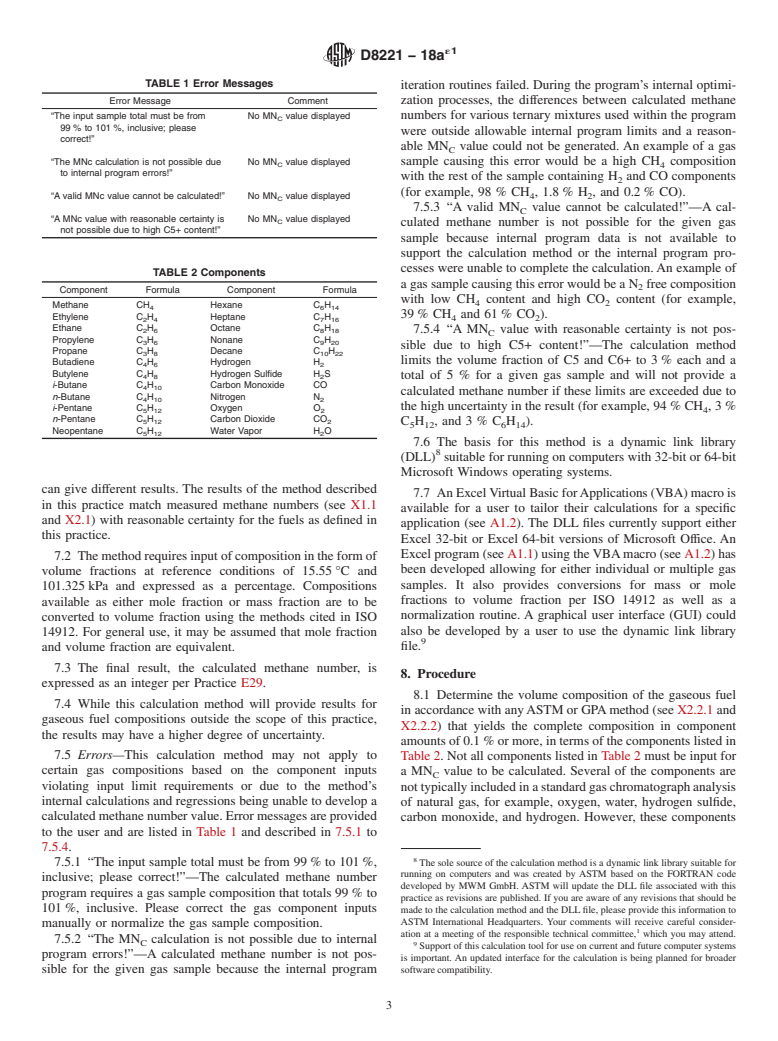
1.4 This calculation method applies to gaseous fuels comprising of hydrocarbons from methane to hexane and greater (C6+); carbon monoxide; hydrogen; hydrogen sulfide; nitrogen; and carbon dioxide. The calculation method addresses pentanes (C5) and higher hydrocarbons and limits the individual volume fraction of C5 and C6+ to 3 % each and a combined total of 5 %. (See EN 16726, Annex A.) The calculation method is performed on a dry, oxygen-free basis.
1.5 Units—The values stated in SI units are to be regarded as standard. Other units of measurement included in this standard are provided for information only and are not considered standard.
1.6 This standard does not purport to address all of the safety concerns, if any, associated with its use. It is the responsibility of the user of this standard to establish appropriate safety, health, and environmental practices and determine the applicability of regulatory limitations prior to use.
1.7 This international standard was developed in accordance with internationally recognized principles on standardization established in the Decision on Principles for the Development of International Standards, Guides and Recommendations issued by the World Trade Organization Technical Barriers to Trade (TBT) Committee.
General Information
Buy Standard



Standards Content (Sample)
NOTICE: This standard has either been superseded and replaced by a new version or withdrawn.
Contact ASTM International (www.astm.org) for the latest information
´1
Designation: D8221 − 18a
Standard Practice for
Determining the Calculated Methane Number (MN ) of
C
1
Gaseous Fuels Used in Internal Combustion Engines
This standard is issued under the fixed designation D8221; the number immediately following the designation indicates the year of
original adoption or, in the case of revision, the year of last revision. A number in parentheses indicates the year of last reapproval. A
superscript epsilon (´) indicates an editorial change since the last revision or reapproval.
1
ε NOTE—The Excel filenames in 2.4, A1.1.1, and A1.1.4.5 were updated editorially in August 2019.
1. Scope combined total of 5 %. (See EN 16726, Annex A.) The
calculation method is performed on a dry, oxygen-free basis.
1.1 This practice covers the method to determine the calcu-
lated methane number (MN ) of a gaseous fuel used in internal
C 1.5 Units—The values stated in SI units are to be regarded
combustion engines. The basis for the method is a dynamic
as standard. Other units of measurement included in this
link library (DLL) suitable for running on computers with
standard are provided for information only and are not consid-
Microsoft Windows operating systems.
ered standard.
1.2 This practice pertains to commercially available natural
1.6 This standard does not purport to address all of the
gas products that have been processed and are suitable for use
safety concerns, if any, associated with its use. It is the
in internal combustion engines. These fuels can be from
responsibility of the user of this standard to establish appro-
traditional geological or renewable sources and include pipe-
priate safety, health, and environmental practices and deter-
line gas, compressed natural gas (CNG), liquefied natural gas
mine the applicability of regulatory limitations prior to use.
(LNG), liquefied petroleum gas (LPG), and renewable natural
1.7 This international standard was developed in accor-
gas (RNG) as defined in Section 3.
dance with internationally recognized principles on standard-
1.3 The calculation method within this practice is based on
ization established in the Decision on Principles for the
2
the MWM Method as defined in EN 16726, Annex A. The
Development of International Standards, Guides and Recom-
calculation method is an optimization algorithm that uses
mendations issued by the World Trade Organization Technical
varying sequences of ternary and binary gas component tables
Barriers to Trade (TBT) Committee.
3
generated from the composition of a gaseous fuel sample.
Both the source code and a Microsoft Excel-based calculator
2. Referenced Documents
are available for this method.
4
2.1 ASTM Standards:
1.4 This calculation method applies to gaseous fuels com-
E29 Practice for Using Significant Digits in Test Data to
prising of hydrocarbons from methane to hexane and greater
Determine Conformance with Specifications
(C6+); carbon monoxide; hydrogen; hydrogen sulfide; nitro-
5
gen; and carbon dioxide. The calculation method addresses
2.2 CEN Standard:
pentanes (C5) and higher hydrocarbons and limits the indi-
EN 16726 Gas infrastructure—Quality of gas—Group H,
vidual volume fraction of C5 and C6+ to 3 % each and a
Annex A—Calculation of methane number of gaseous
fuels for engines
6
2.3 ISO Standard:
1
This practice is under the jurisdiction of ASTM Committee D03 on Gaseous
ISO 14912 Gas analysis—Conversion of gas mixture com-
Fuels and is the direct responsibility of Subcommittee D03.03 on Determination of
position data
Heating Value and Relative Density of Gaseous Fuels.
Current edition approved Dec. 1, 2018. Published April 2019. Originally
approved in 2018. Last previous edition approved in 2018 as D8221–18. DOI:
10.1520/D8221-18AE01.
2 4
European Standards (ENs) are documents that have been ratified by one of the For referenced ASTM standards, visit the ASTM website, www.astm.org, or
three European Standardization Organizations (ESOs), CEN, CENELEC or ETSI; contact ASTM Customer Service at service@astm.org. For Annual Book of ASTM
recognized as competent in the area of voluntary technical standardization as for the Standards volume information, refer to the standard’s Document Summary page on
EU Regulation 1025/2012. EN16726 was developed by the Technical Committee the ASTM website.
5
CEN/TC 234. Available from European Committee for Standardization (CEN), Avenue
3
Leiker, M., Christoph, K., Rankl, M., Cartellieri, W., and Pfeifer, U., “Evalu- Marnix 17, B-1000, Brussels, Belgium, http://www.cen.eu.
6
ation of Antiknocking Property of Gaseous Fuels by Means of Methane Number and Available from American National Standards Institute (ANSI), 25 W. 43rd St.,
its Practical Application to Gas Engines,” ASME, 72-DGP-4, 1972. 4th Floor, New York, NY 10036, http://www.ansi.org.
Copyright © ASTM International, 100 Barr Harbor Drive,
...
This document is not an ASTM standard and is intended only to provide the user of an ASTM standard an indication of what changes have been made to the previous version. Because
it may not be technically possible to adequately depict all changes accurately, ASTM recommends that users consult prior editions as appropriate. In all cases only the current version
of the standard as published by ASTM is to be considered the official document.
´1
Designation: D8221 − 18a D8221 − 18a
Standard Practice for
Determining the Calculated Methane Number (MN ) of
C
1
Gaseous Fuels Used in Internal Combustion Engines
This standard is issued under the fixed designation D8221; the number immediately following the designation indicates the year of
original adoption or, in the case of revision, the year of last revision. A number in parentheses indicates the year of last reapproval. A
superscript epsilon (´) indicates an editorial change since the last revision or reapproval.
1
ε NOTE—The Excel filenames in 2.4, A1.1.1, and A1.1.4.5 were updated editorially in August 2019.
1. Scope
1.1 This practice covers the method to determine the calculated methane number (MN ) of a gaseous fuel used in internal
C
combustion engines. The basis for the method is a dynamic link library (DLL) suitable for running on computers with Microsoft
Windows operating systems.
1.2 This practice pertains to commercially available natural gas products that have been processed and are suitable for use in
internal combustion engines. These fuels can be from traditional geological or renewable sources and include pipeline gas,
compressed natural gas (CNG), liquefied natural gas (LNG), liquefied petroleum gas (LPG), and renewable natural gas (RNG) as
defined in Section 3.
2
1.3 The calculation method within this practice is based on the MWM Method as defined in EN 16726, Annex A. The
calculation method is an optimization algorithm that uses varying sequences of ternary and binary gas component tables generated
3
from the composition of a gaseous fuel sample. Both the source code and a Microsoft Excel-based calculator are available for
this method.
1.4 This calculation method applies to gaseous fuels comprising of hydrocarbons from methane to hexane and greater (C6+);
carbon monoxide; hydrogen; hydrogen sulfide; nitrogen; and carbon dioxide. The calculation method addresses pentanes (C5) and
higher hydrocarbons and limits the individual volume fraction of C5 and C6+ to 3 % each and a combined total of 5 %. (See EN
16726, Annex A.) The calculation method is performed on a dry, oxygen-free basis.
1.5 Units—The values stated in SI units are to be regarded as standard. Other units of measurement included in this standard
are provided for information only and are not considered standard.
1.6 This standard does not purport to address all of the safety concerns, if any, associated with its use. It is the responsibility
of the user of this standard to establish appropriate safety, health, and environmental practices and determine the applicability of
regulatory limitations prior to use.
1.7 This international standard was developed in accordance with internationally recognized principles on standardization
established in the Decision on Principles for the Development of International Standards, Guides and Recommendations issued
by the World Trade Organization Technical Barriers to Trade (TBT) Committee.
2. Referenced Documents
4
2.1 ASTM Standards:
E29 Practice for Using Significant Digits in Test Data to Determine Conformance with Specifications
1
This practice is under the jurisdiction of ASTM Committee D03 on Gaseous Fuels and is the direct responsibility of Subcommittee D03.03 on Determination of Heating
Value and Relative Density of Gaseous Fuels.
Current edition approved Dec. 1, 2018. Published April 2019. Originally approved in 2018. Last previous edition approved in 2018 as D8221–18. DOI:
10.1520/D8221-18A.10.1520/D8221-18AE01.
2
European Standards (ENs) are documents that have been ratified by one of the three European Standardization Organizations (ESOs), CEN, CENELEC or ETSI;
recognized as competent in the area of voluntary technical standardization as for the EU Regulation 1025/2012. EN16726 was developed by the Technical Committee CEN/TC
234.
3
Leiker, M., Christoph, K., Rankl, M., Cartellieri, W., and Pfeifer, U., “Evaluation of Antiknocking Property of Gaseous Fuels by Means of Methane Number and its
Practical Application to Gas Engines,” ASME, 72-DGP-4, 1972.
4
For referenced ASTM standards, visit the ASTM website, www.astm.org, or contact ASTM Customer Service at service@astm.org. For Annual Book of ASTM Standards
volume information, refer to the standard’s Document Summary page on the ASTM website.
Copyright © ASTM International, 100 Barr Harbor Drive, PO Box C700, West Conshohocken, PA 19428-2959. United States
1
---------------------- Page: 1 ----------------------
´1
D8221 − 18a
5
2.2 CEN Standard:
EN 16726 Gas infrastructure—Quality of gas—Group H, An
...
Questions, Comments and Discussion
Ask us and Technical Secretary will try to provide an answer. You can facilitate discussion about the standard in here.