

ASTM F3254-22
(Specification)Standard Specification for Aircraft Interaction of Systems and Structures
General Information
- Abstract
SCOPE
1.1 This specification covers the airworthiness requirements that address the interaction of systems and structures. The material was developed through open consensus of international experts in general aviation. This information was created by focusing on Normal Category aeroplanes. The content may be more broadly applicable; it is the responsibility of the applicant to substantiate broader applicability as a specific means of compliance.
1.2 An applicant intending to propose this information as Means of Compliance for a design approval must seek guidance from their respective oversight authority (for example, published guidance from applicable Civil Aviation Authority (CAAs)) concerning the acceptable use and application thereof. For information on which oversight authorities have accepted this specification (in whole or in part) as an acceptable Means of Compliance to their regulatory requirements (hereinafter “the Rules”), refer to the ASTM Committee F44 web page (www.ASTM.org/COMMITTEE/F44.htm). Annex A1 maps the Means of Compliance of the ASTM Standards to EASA CS-23, amendment 5, or later, and FAA 14 CFR Part 23, amendment 64, or later.
1.3 This standard does not purport to address all of the safety concerns, if any, associated with its use. It is the responsibility of the user of this standard to establish appropriate safety, health, and environmental practices and determine the applicability of regulatory limitations prior to use.
1.4 This international standard was developed in accordance with internationally recognized principles on standardization established in the Decision on Principles for the Development of International Standards, Guides and Recommendations issued by the World Trade Organization Technical Barriers to Trade (TBT) Committee.
- Status
- Published
- Publication Date
- 31-Mar-2022
- Technical Committee
- F44 - General Aviation Aircraft
- Drafting Committee
- F44.30 - Structures
Buy Documents
ASTM F3254-22 - Standard Specification for Aircraft Interaction of Systems and Structures
REDLINE ASTM F3254-22 - Standard Specification for Aircraft Interaction of Systems and Structures
Overview
ASTM F3254-22: Standard Specification for Aircraft Interaction of Systems and Structures establishes the airworthiness requirements focused on how aircraft systems integrate and interact with primary structural components. Developed through the consensus of international general aviation experts, this standard is primarily intended for Normal Category aeroplanes but may be referenced for broader aviation applications. The document aims to provide aircraft designers, manufacturers, and regulators with a means of compliance for system-structure interaction, supporting both certification efforts and continued operational safety. Applicability to certification must be coordinated with relevant Civil Aviation Authorities (CAAs) such as the FAA or EASA.
Key Topics
- Airworthiness Requirements: The standard outlines criteria for analyzing how integrated aircraft systems and structural elements interact, ensuring the safety of flight in both normal operation and under failure conditions.
- Scope of Application: While targeting Normal Category aeroplanes, applicability for other types or categories must be substantiated on a case-by-case basis, with oversight from appropriate aviation authorities.
- System Failure Analysis: Guidance includes evaluating aircraft behavior when systems are fully operational and under various failure modes, with emphasis on load cases, structural performance, and failure probabilities.
- Safety Margins: The specification introduces quantitative safety margins based on system failure probability, requiring substantiation that both static strength and aeroelastic stability are preserved after system failures.
- Flight & Operational Limitations: Procedures for defining and handling in-flight or preflight operational limits in case of detected or suspected failures are detailed, supporting both immediate safety and longer-term maintenance strategies.
- Inspection & Maintenance Provisions: The document recognizes alternative safety measures such as periodic inspection or daily checks, where continuous monitoring is impractical, providing flexibility for different system architectures.
- Compliance Mapping: Annex A1 includes correlation tables mapping ASTM F3254-22 to EASA CS-23 and FAA 14 CFR Part 23 standards, enhancing regulatory alignment and supporting certification processes.
Applications
- Aircraft Design and Certification: ASTM F3254-22 offers a recognized framework for demonstrating compliance with airworthiness rules regarding system-structure interaction, essential during Type Certification and supplemental design changes.
- Safety Case Development: The standard enables engineers and designers to systematically assess the risks arising from potential interaction failures, incorporating quantitative probability methods for multiple failure condition classifications.
- Regulatory Submissions: When proposing F3254-22 as a Means of Compliance, applicants use the cross-referenced tables to ensure acceptability with authorities such as FAA and EASA.
- Maintenance Programs: Operators can develop inspection and maintenance tracking systems based on the standard’s requirements for structural system monitoring, helping to maintain ongoing airworthiness.
- Design Modifications: When introducing new systems or revising structures, following ASTM F3254-22 helps evaluate the impact on airworthiness, ensuring continued compliance after modifications.
Related Standards
To ensure comprehensive compliance and technical alignment, ASTM F3254-22 references several key standards and regulatory documents:
- ASTM F3060: Terminology for Aircraft - provides industry-accepted definitions and terminology.
- ASTM F3093/F3093M: Specification for Aeroelasticity Requirements - covers flutter and dynamic stability.
- ASTM F3115/F3115M: Specification for Structural Durability for Small Aeroplanes - addresses fatigue and life limitations.
- ASTM F3116/F3116M: Specification for Design Loads and Conditions - specifies load cases for aircraft structures.
- ASTM F3230: Practice for Safety Assessment of Systems and Equipment in Small Aircraft - supports risk evaluation processes.
- EASA CS-23: Certification Standards for Normal, Utility, Aerobatic, and Commuter Aeroplanes.
- FAA 14 CFR Part 23: Airworthiness Standards for Normal Category Airplanes.
Following ASTM F3254-22 drives best practices in system-structure integration, elevates compliance confidence, and supports robust certification processes for modern general aviation aircraft. For full regulatory acceptability, always consult the latest guidance from your oversight authority and related standards documentation.
Relations
- Effective Date
- 01-Oct-2023
- Effective Date
- 01-Jan-2020
- Effective Date
- 15-Feb-2019
- Effective Date
- 01-Nov-2018
- Effective Date
- 01-Nov-2016
- Effective Date
- 01-Apr-2016
- Effective Date
- 15-Sep-2015
- Effective Date
- 01-Jun-2015
- Effective Date
- 01-May-2015
- Effective Date
- 01-May-2015
- Effective Date
- 01-May-2015
- Effective Date
- 01-Mar-2015
- Effective Date
- 01-Dec-2014
Buy Documents
ASTM F3254-22 - Standard Specification for Aircraft Interaction of Systems and Structures
REDLINE ASTM F3254-22 - Standard Specification for Aircraft Interaction of Systems and Structures
Get Certified
Connect with accredited certification bodies for this standard

BSI Group
BSI (British Standards Institution) is the business standards company that helps organizations make excellence a habit.

Bureau Veritas
Bureau Veritas is a world leader in laboratory testing, inspection and certification services.

DNV
DNV is an independent assurance and risk management provider.
Sponsored listings
Frequently Asked Questions
ASTM F3254-22 is a technical specification published by ASTM International. Its full title is "Standard Specification for Aircraft Interaction of Systems and Structures". This standard covers: SCOPE 1.1 This specification covers the airworthiness requirements that address the interaction of systems and structures. The material was developed through open consensus of international experts in general aviation. This information was created by focusing on Normal Category aeroplanes. The content may be more broadly applicable; it is the responsibility of the applicant to substantiate broader applicability as a specific means of compliance. 1.2 An applicant intending to propose this information as Means of Compliance for a design approval must seek guidance from their respective oversight authority (for example, published guidance from applicable Civil Aviation Authority (CAAs)) concerning the acceptable use and application thereof. For information on which oversight authorities have accepted this specification (in whole or in part) as an acceptable Means of Compliance to their regulatory requirements (hereinafter “the Rules”), refer to the ASTM Committee F44 web page (www.ASTM.org/COMMITTEE/F44.htm). Annex A1 maps the Means of Compliance of the ASTM Standards to EASA CS-23, amendment 5, or later, and FAA 14 CFR Part 23, amendment 64, or later. 1.3 This standard does not purport to address all of the safety concerns, if any, associated with its use. It is the responsibility of the user of this standard to establish appropriate safety, health, and environmental practices and determine the applicability of regulatory limitations prior to use. 1.4 This international standard was developed in accordance with internationally recognized principles on standardization established in the Decision on Principles for the Development of International Standards, Guides and Recommendations issued by the World Trade Organization Technical Barriers to Trade (TBT) Committee.
SCOPE 1.1 This specification covers the airworthiness requirements that address the interaction of systems and structures. The material was developed through open consensus of international experts in general aviation. This information was created by focusing on Normal Category aeroplanes. The content may be more broadly applicable; it is the responsibility of the applicant to substantiate broader applicability as a specific means of compliance. 1.2 An applicant intending to propose this information as Means of Compliance for a design approval must seek guidance from their respective oversight authority (for example, published guidance from applicable Civil Aviation Authority (CAAs)) concerning the acceptable use and application thereof. For information on which oversight authorities have accepted this specification (in whole or in part) as an acceptable Means of Compliance to their regulatory requirements (hereinafter “the Rules”), refer to the ASTM Committee F44 web page (www.ASTM.org/COMMITTEE/F44.htm). Annex A1 maps the Means of Compliance of the ASTM Standards to EASA CS-23, amendment 5, or later, and FAA 14 CFR Part 23, amendment 64, or later. 1.3 This standard does not purport to address all of the safety concerns, if any, associated with its use. It is the responsibility of the user of this standard to establish appropriate safety, health, and environmental practices and determine the applicability of regulatory limitations prior to use. 1.4 This international standard was developed in accordance with internationally recognized principles on standardization established in the Decision on Principles for the Development of International Standards, Guides and Recommendations issued by the World Trade Organization Technical Barriers to Trade (TBT) Committee.
ASTM F3254-22 is classified under the following ICS (International Classification for Standards) categories: 03.120.10 - Quality management and quality assurance; 49.020 - Aircraft and space vehicles in general. The ICS classification helps identify the subject area and facilitates finding related standards.
ASTM F3254-22 has the following relationships with other standards: It is inter standard links to ASTM F3116/F3116M-23a, ASTM F3060-20, ASTM F3093/F3093M-19, ASTM F3116/F3116M-18, ASTM F3060-16a, ASTM F3060-16, ASTM F3060-15b, ASTM F3115/F3115M-15, ASTM F3093/F3093M-15, ASTM F3116/F3116M-15, ASTM F3060-15a, ASTM F3060-15, ASTM F3060-14. Understanding these relationships helps ensure you are using the most current and applicable version of the standard.
ASTM F3254-22 is available in PDF format for immediate download after purchase. The document can be added to your cart and obtained through the secure checkout process. Digital delivery ensures instant access to the complete standard document.
Standards Content (Sample)
This international standard was developed in accordance with internationally recognized principles on standardization established in the Decision on Principles for the
Development of International Standards, Guides and Recommendations issued by the World Trade Organization Technical Barriers to Trade (TBT) Committee.
Designation:F3254 −22
Standard Specification for
Aircraft Interaction of Systems and Structures
This standard is issued under the fixed designation F3254; the number immediately following the designation indicates the year of
original adoption or, in the case of revision, the year of last revision. A number in parentheses indicates the year of last reapproval. A
superscript epsilon (´) indicates an editorial change since the last revision or reapproval.
1. Scope 2. Referenced Documents
2.1 ASTM Standards:
1.1 This specification covers the airworthiness requirements
F3060 Terminology for Aircraft
that address the interaction of systems and structures. The
F3093/F3093M Specification for Aeroelasticity Require-
material was developed through open consensus of interna-
tional experts in general aviation.This information was created ments
F3115/F3115M Specification for Structural Durability for
by focusing on Normal Category aeroplanes. The content may
be more broadly applicable; it is the responsibility of the Small Aeroplanes
F3116/F3116M Specification for Design Loads and Condi-
applicant to substantiate broader applicability as a specific
means of compliance. tions
F3230 Practice for Safety Assessment of Systems and
1.2 An applicant intending to propose this information as
Equipment in Small Aircraft
Means of Compliance for a design approval must seek guid-
2.2 EASA Standard:
ance from their respective oversight authority (for example,
CS-23 Normal, Utility,Aerobatic and CommuterAeroplanes
published guidance from applicable Civil Aviation Authority
2.3 FAA Standard:
(CAAs)) concerning the acceptable use and application
14 CFR Part 23 Airworthiness Standards: Normal Category
thereof. For information on which oversight authorities have
Airplanes
accepted this specification (in whole or in part) as an accept-
able Means of Compliance to their regulatory requirements
3. Terminology
(hereinafter “the Rules”), refer to the ASTM Committee F44
3.1 A listing of terms, abbreviations, acronyms, and sym-
web page (www.ASTM.org/COMMITTEE/F44.htm). Annex
bols related to aircraft covered byASTM Committees F37 and
A1 maps the Means of Compliance of theASTM Standards to
F44 airworthiness design standards can be found in F3060
EASACS-23,amendment5,orlater,andFAA14CFRPart23,
Terminology forAircraft. Items listed here are more specific to
amendment 64, or later.
this specification.
1.3 This standard does not purport to address all of the
3.2 Definitions of Terms Specific to This Standard:
safety concerns, if any, associated with its use. It is the
3.2.1 extremely improbable—the allowable quantitative
responsibility of the user of this standard to establish appro-
probability based on the assessment level and catastrophic
priate safety, health, and environmental practices and deter-
failure condition classification.
mine the applicability of regulatory limitations prior to use.
3.2.1.1 Discussion—The term extremely improbable is de-
1.4 This international standard was developed in accor-
fined in Practice F3230. As used in this specification, it
dance with internationally recognized principles on standard-
represents the allowable quantitative probability to be used in
ization established in the Decision on Principles for the
this specification based on the assessment level and cata-
Development of International Standards, Guides and Recom-
strophic failure condition classification found in Practice
mendations issued by the World Trade Organization Technical
F3230.
Barriers to Trade (TBT) Committee.
For referenced ASTM standards, visit the ASTM website, www.astm.org, or
contact ASTM Customer Service at service@astm.org. For Annual Book of ASTM
ThisspecificationisunderthejurisdictionofASTMCommitteeF44onGeneral Standards volume information, refer to the standard’s Document Summary page on
Aviation Aircraft and is the direct responsibility of Subcommittee F44.30 on the ASTM website.
Structures. Available from European Union Aviation Safety Agency (EASA), Konrad-
Current edition approved April 1, 2022. Published April 2022. Originally Adenauer-Ufer 3, D-50668 Cologne, Germany, https://www.easa.europa.eu.
approved in 2019. Last previous edition approved in 2019 as F3254–19. DOI: Available from Federal Aviation Administration (FAA), 800 Independence
10.1520/F3254-22. Ave., SW, Washington, DC 20591, http://www.faa.gov.
Copyright © ASTM International, 100 Barr Harbor Drive, PO Box C700, West Conshohocken, PA 19428-2959. United States
F3254−22
3.2.2 failure condition—structural system failure condition
V'' = clearance speed as defined by Specification F3093/
that affects the structural performance of the aeroplane.
F3093M, requiring freedom from flutter, control
3.2.2.1 Discussion—Thetermfailureconditioninthisspeci-
reversal, and divergence for any condition of operation
fication applies only to structural system failure conditions that
withinthelimitV-nenvelopeandatallspeedsupto1.2
affectthestructuralperformanceoftheaeroplane(forexample,
V /1.2 M , limited to Mach 1.0 for subsonic
D D
system failure conditions that induce loads, change the re-
aeroplanes.
sponse of the aeroplane to inputs such as gusts or pilot actions,
4. Interaction of Systems and Structure
or lower flutter margins).
4.1 Applicability—For aeroplanes equipped with structural
3.2.3 flight limitation—limitations that can be applied to the
systems, the influence and failure of these systems must be
aeroplane flight conditions following an in-flight occurrence.
taken into account. Fig. 1 provides an assessment of the
3.2.3.1 Discussion—Example flight limitations include
applicability of this specification to a specific system, along
speed limitations and avoidance of severe weather. These
with the depth of analysis required to show compliance.
limitations are included in the flight manual.
4.2 General—The criteria in this specification address the
3.2.4 operational limitation—limitations, including flight
structural performance of aeroplanes equipped with structural
limitations, that can be applied to the aeroplane operating
systems.
conditions before flight.
4.2.1 The criteria defined herein only address the direct
3.2.4.1 Discussion—Example operational limitations in-
structural consequences of the system responses and perfor-
clude fuel, payload, and Master Minimum Equipment List
mances and cannot be considered in isolation but must be
limitations.
included in the overall safety evaluation of the aeroplane.
3.2.5 probable—the allowable quantitative probability
These criteria are only applicable to structure whose failure
based on the assessment level and minor failure condition
could prevent continued safe flight and landing. Specific
classification.
criteria that define acceptable limits on handling characteristics
3.2.5.1 Discussion—The term probable is defined in Prac-
or stability requirements when operating in the system de-
tice F3230. As used in this specification, it represents the
graded or inoperative mode are not provided in this specifica-
allowable quantitative probability to be used in this specifica-
tion.
tion based on the assessment level and minor failure condition
4.2.2 Depending upon the specific characteristics of the
classification found in Practice F3230.
aeroplane, additional studies may be required that go beyond
the criteria provided in this specification in order to demon-
3.2.6 remote—the allowable quantitative probability based
strate the capability of the aeroplane to meet other realistic
on the assessment level and major failure condition classifica-
conditions such as alternative gust or maneuver descriptions
tion.
for an aeroplane equipped with a load alleviation system.
3.2.6.1 Discussion—The term remote is defined in Practice
F3230.As used in this specification, it represents the allowable
4.3 System Fully Operative—With the structural system
quantitativeprobabilitytobeusedinthisspecificationbasedon
fully operative, the following apply:
the assessment level and major failure condition classification
4.3.1 Limit loads must be derived in all normal operating
found in Practice F3230.
configurations of the system from all the limit conditions
specified in Specification F3116/F3116M (or used instead of
3.2.7 structural performance—capabilityoftheaeroplaneto
those specified in Specification F3116/F3116M), taking into
meet the applicable structural requirements.
account any special behavior of such a system or associated
3.2.8 structural system—system where the intended func-
functions or any effect on the structural performance of the
tion is to alter an aeroplane’s structural design envelope or
aeroplane up to limit loads. In particular, any significant
where failure or malfunction adversely affects structural per-
nonlinearity (rate of displacement of control surface,
formance.
thresholds, or any other system nonlinearities) must be ac-
3.2.8.1 Discussion—Example structural systems include,
counted for in a realistic or conservative way when deriving
but are not limited to, active flight control systems, stability
limit loads from limit conditions.
augmentation systems, load alleviation systems, flutter control
4.3.2 The aeroplane must meet the applicable static strength
systems, flight-envelope protection systems, control surface
requirements using the specified factors to derive ultimate
limiting systems, rudder bias systems, autopilot systems, and
loads from the limit loads defined in 4.3.1. The effect of
fuel management systems.
nonlinearities must be investigated beyond limit conditions to
ensure the behavior of the system presents no anomaly
3.3 Symbols:
compared to the behavior below limit conditions. However,
P = probability of occurrence of failure mode j (per hour)
j conditions beyond limit conditions need not be considered
Q = probability of being in failure condition j
j
when it can be shown that the aeroplane has design features
T = average time spent in failure condition j (in hours)
j
that will not allow it to exceed those limit conditions.
V' = clearance speed as defined by Specification F3093/
4.3.3 The aeroplane must meet the aeroelastic stability
F3093M, requiring freedom from flutter, control
requirements of Specification F3093/F3093M.
reversal, and divergence up to V /M after the speci-
D D
4.3.4 The aeroplane must meet the structural durability
fied system failure.
requirements of Specification F3115/F3115M.
F3254−22
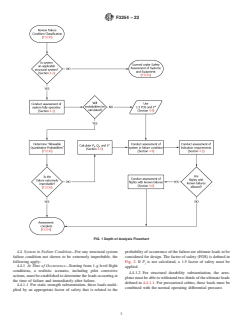
FIG. 1Depth of Analysis Flowchart
4.4 System in Failure Condition—For any structu
...
This document is not an ASTM standard and is intended only to provide the user of an ASTM standard an indication of what changes have been made to the previous version. Because
it may not be technically possible to adequately depict all changes accurately, ASTM recommends that users consult prior editions as appropriate. In all cases only the current version
of the standard as published by ASTM is to be considered the official document.
Designation: F3254 − 19 F3254 − 22
Standard Specification for
Aircraft Interaction of Systems and Structures
This standard is issued under the fixed designation F3254; the number immediately following the designation indicates the year of
original adoption or, in the case of revision, the year of last revision. A number in parentheses indicates the year of last reapproval. A
superscript epsilon (´) indicates an editorial change since the last revision or reapproval.
1. Scope
1.1 This specification covers the airworthiness requirements that address the interaction of systems and structures. The material
was developed through open consensus of international experts in general aviation. This information was created by focusing on
Normal Category aeroplanes. The content may be more broadly applicable; it is the responsibility of the applicant to substantiate
broader applicability as a specific means of compliance.
1.2 An applicant intending to propose this information as Means of Compliance for a design approval must seek guidance from
their respective oversight authority (for example, published guidance from applicable Civil Aviation Authority (CAAs)) concerning
the acceptable use and application thereof. For information on which oversight authorities have accepted this specification (in
whole or in part) as an acceptable Means of Compliance to their regulatory requirements (hereinafter “the Rules”), refer to the
ASTM Committee F44 web page (www.ASTM.org/COMMITTEE/F44.htm). Annex A1 maps the Means of Compliance of the
ASTM Standards to EASA CS-23, amendment 5, or later, and FAA 14 CFR Part 23, amendment 64, or later.
1.3 This standard does not purport to address all of the safety concerns, if any, associated with its use. It is the responsibility
of the user of this standard to establish appropriate safety, health, and environmental practices and determine the applicability of
regulatory limitations prior to use.
1.4 This international standard was developed in accordance with internationally recognized principles on standardization
established in the Decision on Principles for the Development of International Standards, Guides and Recommendations issued
by the World Trade Organization Technical Barriers to Trade (TBT) Committee.
2. Referenced Documents
2.1 ASTM Standards:
F3060 Terminology for Aircraft
F3093/F3093M Specification for Aeroelasticity Requirements
F3115/F3115M Specification for Structural Durability for Small Aeroplanes
F3116/F3116M Specification for Design Loads and Conditions
F3230 Practice for Safety Assessment of Systems and Equipment in Small Aircraft
2.2 EASA Standard:
CS-23 Normal, Utility, Aerobatic and Commuter Aeroplanes
2.3 FAA Standard:
14 CFR Part 23 Airworthiness Standards: Normal Category Airplanes
This specification is under the jurisdiction of ASTM Committee F44 on General Aviation Aircraft and is the direct responsibility of Subcommittee F44.30 on Structures.
Current edition approved May 1, 2019April 1, 2022. Published June 2019April 2022. Originally approved in 2019. Last previous edition approved in 2019 as F3254–19.
DOI: 10.1520/F3254–19.10.1520/F3254-22.
For referenced ASTM standards, visit the ASTM website, www.astm.org, or contact ASTM Customer Service at service@astm.org. For Annual Book of ASTM Standards
volume information, refer to the standard’s Document Summary page on the ASTM website.
Available from European Union Aviation Safety Agency (EASA), Konrad-Adenauer-Ufer 3, D-50668 Cologne, Germany, https://www.easa.europa.eu.
Available from Federal Aviation Administration (FAA), 800 Independence Ave., SW, Washington, DC 20591, http://www.faa.gov.
Copyright © ASTM International, 100 Barr Harbor Drive, PO Box C700, West Conshohocken, PA 19428-2959. United States
F3254 − 22
3. Terminology
3.1 A listing of terms, abbreviations, acronyms, and symbols related to aircraft covered by ASTM Committees F37 and F44
airworthiness design standards can be found in F3060 Terminology for Aircraft. Items listed here are more specific to this
specification.
3.2 Definitions of Terms Specific to This Standard:
3.2.1 extremely improbable—the allowable quantitative probability based on the assessment level and catastrophic failure
condition classification.
3.2.1.1 Discussion—
The term extremely improbable is defined in Practice F3230. As used in this specification, it represents the allowable quantitative
probability to be used in this specification based on the assessment level and catastrophic failure condition classification found in
Practice F3230.
3.2.2 failure condition—structural system failure condition that affects the structural performance of the aeroplane.
3.2.2.1 Discussion—
The term failure condition in this specification applies only to structural system failure conditions that affect the structural
performance of the aeroplane (for example, system failure conditions that induce loads, change the response of the aeroplane to
inputs such as gusts or pilot actions, or lower flutter margins).
3.2.3 flight limitation—limitations that can be applied to the aeroplane flight conditions following an in-flight occurrence.
3.2.3.1 Discussion—
Example flight limitations include speed limitations and avoidance of severe weather. These limitations are included in the flight
manual.
3.2.4 operational limitation—limitations, including flight limitations, that can be applied to the aeroplane operating conditions
before flight.
3.2.4.1 Discussion—
Example operational limitations include fuel, payload, and Master Minimum Equipment List limitations.
3.2.5 probable—the allowable quantitative probability based on the assessment level and minor failure condition classification.
3.2.5.1 Discussion—
The term probable is defined in Practice F3230. As used in this specification, it represents the allowable quantitative probability
to be used in this specification based on the assessment level and minor failure condition classification found in Practice F3230.
3.2.6 remote—the allowable quantitative probability based on the assessment level and major failure condition classification.
3.2.6.1 Discussion—
The term remote is defined in Practice F3230. As used in this specification, it represents the allowable quantitative probability to
be used in this specification based on the assessment level and major failure condition classification found in Practice F3230.
3.2.7 structural performance—capability of the aeroplane to meet the applicable structural requirements.
3.2.8 structural system—system where the intended function is to alter an aeroplane’s structural design envelope or where failure
or malfunction adversely affects structural performance.
3.2.8.1 Discussion—
Example structural systems include, but are not limited to, active flight control systems, stability augmentation systems, load
alleviation systems, flutter control systems, flight-envelope protection systems, control surface limiting systems, rudder bias
systems, autopilot systems, and fuel management systems.
3.3 Symbols:
P = probability of occurrence of failure mode j (per hour)
j
Q = probability of being in failure condition j
j
T = average time spent in failure condition j (in hours)
j
V' = clearance speed as defined by Specification F3093/F3093M, requiring freedom from flutter, control reversal, and
divergence up to V /M after the specified system failure.
D D
F3254 − 22
V'' = clearance speed as defined by Specification F3093/F3093M, requiring freedom from flutter, control reversal, and
divergence for any condition of operation within the limit V-n envelope and at all speeds up to 1.2 V /1.2 M , limited to
D D
Mach 1.0 for subsonic aeroplanes.
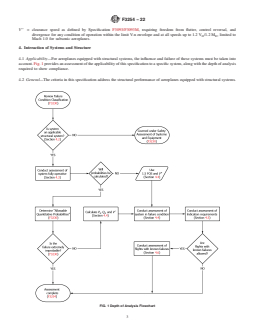
4. Interaction of Systems and Structure
4.1 Applicability—For aeroplanes equipped with structural systems, the influence and failure of these systems must be taken into
account. Fig. 1 provides an assessment of the applicability of this specification to a specific system, along with the depth of analysis
required to show compliance.
4.2 General—The criteria in this specification address the structural performance of aeroplanes equipped with structural systems.
FIG. 1 Depth of Analysis Flowchart
F3254 − 22
4.2.1 The criteria defined herein only address the direct structural consequences of the system responses and performances and
cannot be considered in isolation but must be included in the overall safety evaluation of the aeroplane. These criteria are only
applicable to structure whose failure could prevent continued safe flight and landing. Specific criteria that define acceptable limits
on handling characteristics or stability requirements when operating in the system degraded or inoperative mode are not provided
in this specification.
4.2.2 Depending upon the specific characteristics of the aeroplane, additional studies may be required that go beyond the criteria
provided in this specification in order to demonstrate the capability of the aeroplane to meet other realistic conditions such as
alternative gust or maneuver descriptions for an aeroplane equipped with a load alleviation system.
4.3 System Fully Operative—With the structural system fully operative, the following apply:
4.3.1 Limit loads must be derived in all normal operating configurations of the system from all the limit conditions specified in
Specification F3116/F3116M (or used instead of those specified in Specification F3116/F3116M), taking into account any special
behavior of such a system or associated functions or any effect on the structural performance of the aeroplane up to limit loads.
In particular, any significant nonlinearity (rate of displacement of control surface, thresholds, or any other system nonlinearities)
must be accounted for in a realistic or conservative way when deriving limit loads from limit conditions.
4.3.2 The aeroplane must meet the applicable static strength requirements using the specified factors to derive ultimate loads from
the limit loads defined in 4.3.1. The effect of nonlinearities must be investigated beyond limit conditions to ensure the behavior
of the system presents no anomaly compared to the behavior below limit conditions. However, conditions beyond limit conditions
need not be considered when it can be shown that the aeroplane has design features that will not allow it to exceed those limit
conditions.
4.3.3 The aeroplane must meet the aeroelastic stability requirements of Specification F3093/F3093M.
4.3.4 The aeroplane must meet the structural durability require
...