

ASTM D3111-19
(Practice)Standard Practice for Flexibility Determination of Hot-Melt Adhesives by Mandrel Bend Test
General Information
- Abstract
SIGNIFICANCE AND USE
5.1 The “Mandrel Bend” test is simple and fast. It requires little investment in equipment and little operator training. The prime purpose is to determine whether a hot-melt adhesive meets flexibility requirements. This test is also useful for comparing flexibility of several adhesives. It can be used to design adhesives by comparing the flexibility of various formulations to meet specific end use parameters. The adhesive flexibility can be determined at temperatures other than ambient by conditioning the test apparatus and test specimens at the desired temperature and performing the test under these temperature conditions.
SCOPE
1.1 This practice covers the determination of the flexibility of a hot-melt adhesive in sheet form under specific test conditions. This is a working practice. Its results are useful for comparing adhesives, not for absolute characterization of adhesives.
1.2 The values stated in SI units are to be regarded as the standard. The values given in parentheses are for information only.
1.3 This standard does not purport to address all of the safety concerns, if any, associated with its use. It is the responsibility of the user of this standard to establish appropriate safety, health, and environmental practices and determine the applicability of regulatory limitations prior to use.
1.4 This international standard was developed in accordance with internationally recognized principles on standardization established in the Decision on Principles for the Development of International Standards, Guides and Recommendations issued by the World Trade Organization Technical Barriers to Trade (TBT) Committee.
- Status
- Published
- Publication Date
- 31-Mar-2019
- Technical Committee
- D10 - Packaging
- Drafting Committee
- D10.14 - Tape and Labels
Buy Documents


ASTM D3111-19 - Standard Practice for Flexibility Determination of Hot-Melt Adhesives by Mandrel Bend Test
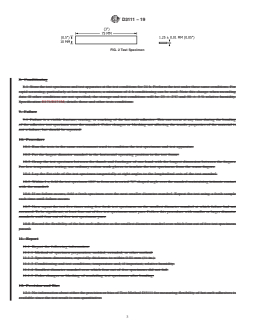
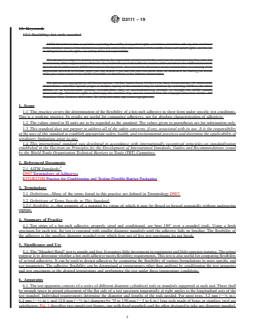
REDLINE ASTM D3111-19 - Standard Practice for Flexibility Determination of Hot-Melt Adhesives by Mandrel Bend Test
Overview
ASTM D3111-19: Standard Practice for Flexibility Determination of Hot-Melt Adhesives by Mandrel Bend Test is an internationally recognized guideline published by ASTM International. This standard outlines a practical, reliable method for assessing the flexibility of hot-melt adhesives in sheet form. The procedure involves bending adhesive samples over cylindrical mandrels of different diameters to identify the smallest mandrel on which the adhesive does not fracture or crack, thereby providing a comparative measure of flexibility.
This mandrel bend test is valued within the adhesives and packaging industries for its simplicity, cost-effectiveness, and minimal equipment requirements. By offering a standardized methodology, ASTM D3111-19 helps ensure consistent quality and performance in hot-melt adhesive formulations across a variety of applications.
Key Topics
- Mandrel Bend Test Methodology: The core of ASTM D3111-19 is the stepwise bending of standardized adhesive specimens over mandrels of decreasing diameter, permitting precise comparison across adhesive types.
- Flexibility Assessment: Rather than providing absolute material characterization, this standard is designed for comparative evaluation. Flexibility is reported as the smallest mandrel diameter over which a majority (four out of five) of samples do not fail.
- Specimen Preparation and Conditioning: Detailed guidance is given on specimen dimensions, appropriate preparation (molded or extruded), and conditioning (minimum 24 hours at specified temperature and humidity) to ensure repeatable results.
- Test Conditions Variability: Testing can be conducted at various temperatures by conditioning both specimens and apparatus. This flexibility allows for assessment under non-ambient, application-relevant conditions.
- Failure Criteria: Clear indicators, such as visible cracks or fracturing, are used to define adhesive failure. Non-structural changes like color shifts or blushing are documented but not considered failures.
- Reporting Requirements: Reports should include details about preparation, test environment, specimen dimensions, mandrel diameters, and any noteworthy observations.
Applications
ASTM D3111-19 provides practical value in several key areas:
- Quality Assurance: Manufacturers use this practice to confirm that hot-melt adhesives meet specified flexibility requirements before product release.
- Adhesive Development: Formulators compare flexibility of new adhesive formulations, optimizing them for specific end-use conditions and environmental parameters.
- Comparative Testing: The methodology allows for straightforward comparison of different commercial adhesives, supporting purchasing and specification decisions.
- Performance Screening: Rapid, low-cost evaluation enables routine screening of adhesives in R&D and production environments.
- Temperature-Specific Assessments: The ability to modify conditioning and test temperatures empowers users to simulate and qualify adhesives for specialized temperature requirements.
Industries that benefit from this standard include packaging, labeling, automotive, and product assembly, where hot-melt adhesives are required to maintain integrity during flexing, handling, or use.
Related Standards
To ensure comprehensive testing and consistent terminology, ASTM D3111-19 references and aligns with several related ASTM standards:
- ASTM D907: Terminology of Adhesives - provides essential definitions used within the adhesives field.
- ASTM E171/E171M: Practice for Conditioning and Testing Flexible Barrier Packaging - specifies environmental conditioning protocols relevant to this and similar test methods.
Users are encouraged to consult these standards for complete understanding and seamless integration within broader quality and testing frameworks.
Keywords: ASTM D3111-19, hot-melt adhesive flexibility, mandrel bend test, adhesive testing, ASTM adhesive standards, flexibility determination, packaging adhesives, adhesive quality assurance, adhesive comparison
Relations
- Effective Date
- 01-Apr-2019
- Refers
ASTM E171/E171M-11(2020) - Standard Practice for Conditioning and Testing Flexible Barrier Packaging - Effective Date
- 01-May-2020
- Refers
ASTM E171/E171M-11(2015) - Standard Practice for Conditioning and Testing Flexible Barrier Packaging - Effective Date
- 01-Oct-2015
- Effective Date
- 01-Jul-2012
- Effective Date
- 01-May-2012
- Effective Date
- 01-Dec-2011
- Refers
ASTM E171/E171M-11 - Standard Practice for Conditioning and Testing Flexible Barrier Packaging - Effective Date
- 15-Nov-2011
- Effective Date
- 01-Jan-2011
- Effective Date
- 01-Oct-2008
- Effective Date
- 15-Aug-2008
- Effective Date
- 01-Mar-2008
- Effective Date
- 01-Dec-2006
- Effective Date
- 01-Apr-2005
- Effective Date
- 01-Apr-2005
- Effective Date
- 01-Dec-2004
Buy Documents
ASTM D3111-19 - Standard Practice for Flexibility Determination of Hot-Melt Adhesives by Mandrel Bend Test
REDLINE ASTM D3111-19 - Standard Practice for Flexibility Determination of Hot-Melt Adhesives by Mandrel Bend Test
Get Certified
Connect with accredited certification bodies for this standard

DIN CERTCO
DIN Group product certification.

Smithers Quality Assessments
US management systems and product certification.
Sponsored listings
Frequently Asked Questions
ASTM D3111-19 is a standard published by ASTM International. Its full title is "Standard Practice for Flexibility Determination of Hot-Melt Adhesives by Mandrel Bend Test". This standard covers: SIGNIFICANCE AND USE 5.1 The “Mandrel Bend” test is simple and fast. It requires little investment in equipment and little operator training. The prime purpose is to determine whether a hot-melt adhesive meets flexibility requirements. This test is also useful for comparing flexibility of several adhesives. It can be used to design adhesives by comparing the flexibility of various formulations to meet specific end use parameters. The adhesive flexibility can be determined at temperatures other than ambient by conditioning the test apparatus and test specimens at the desired temperature and performing the test under these temperature conditions. SCOPE 1.1 This practice covers the determination of the flexibility of a hot-melt adhesive in sheet form under specific test conditions. This is a working practice. Its results are useful for comparing adhesives, not for absolute characterization of adhesives. 1.2 The values stated in SI units are to be regarded as the standard. The values given in parentheses are for information only. 1.3 This standard does not purport to address all of the safety concerns, if any, associated with its use. It is the responsibility of the user of this standard to establish appropriate safety, health, and environmental practices and determine the applicability of regulatory limitations prior to use. 1.4 This international standard was developed in accordance with internationally recognized principles on standardization established in the Decision on Principles for the Development of International Standards, Guides and Recommendations issued by the World Trade Organization Technical Barriers to Trade (TBT) Committee.
SIGNIFICANCE AND USE 5.1 The “Mandrel Bend” test is simple and fast. It requires little investment in equipment and little operator training. The prime purpose is to determine whether a hot-melt adhesive meets flexibility requirements. This test is also useful for comparing flexibility of several adhesives. It can be used to design adhesives by comparing the flexibility of various formulations to meet specific end use parameters. The adhesive flexibility can be determined at temperatures other than ambient by conditioning the test apparatus and test specimens at the desired temperature and performing the test under these temperature conditions. SCOPE 1.1 This practice covers the determination of the flexibility of a hot-melt adhesive in sheet form under specific test conditions. This is a working practice. Its results are useful for comparing adhesives, not for absolute characterization of adhesives. 1.2 The values stated in SI units are to be regarded as the standard. The values given in parentheses are for information only. 1.3 This standard does not purport to address all of the safety concerns, if any, associated with its use. It is the responsibility of the user of this standard to establish appropriate safety, health, and environmental practices and determine the applicability of regulatory limitations prior to use. 1.4 This international standard was developed in accordance with internationally recognized principles on standardization established in the Decision on Principles for the Development of International Standards, Guides and Recommendations issued by the World Trade Organization Technical Barriers to Trade (TBT) Committee.
ASTM D3111-19 is classified under the following ICS (International Classification for Standards) categories: 83.180 - Adhesives. The ICS classification helps identify the subject area and facilitates finding related standards.
ASTM D3111-19 has the following relationships with other standards: It is inter standard links to ASTM D3111-10(2018), ASTM E171/E171M-11(2020), ASTM E171/E171M-11(2015), ASTM D907-12a, ASTM D907-12, ASTM D907-11a, ASTM E171/E171M-11, ASTM D907-11, ASTM D907-08b, ASTM D907-08a, ASTM D907-08, ASTM D907-06, ASTM D907-05, ASTM D907-05e1, ASTM D907-04a. Understanding these relationships helps ensure you are using the most current and applicable version of the standard.
ASTM D3111-19 is available in PDF format for immediate download after purchase. The document can be added to your cart and obtained through the secure checkout process. Digital delivery ensures instant access to the complete standard document.
Standards Content (Sample)
This international standard was developed in accordance with internationally recognized principles on standardization established in the Decision on Principles for the
Development of International Standards, Guides and Recommendations issued by the World Trade Organization Technical Barriers to Trade (TBT) Committee.
Designation: D3111 − 19
Standard Practice for
Flexibility Determination of Hot-Melt Adhesives by Mandrel
Bend Test
This standard is issued under the fixed designation D3111; the number immediately following the designation indicates the year of
original adoption or, in the case of revision, the year of last revision. A number in parentheses indicates the year of last reapproval. A
superscript epsilon (´) indicates an editorial change since the last revision or reapproval.
1. Scope 3.2.1 flexibility, n—that property of a material by virtue of
which it may be flexed or bowed repeatedly without undergo-
1.1 This practice covers the determination of the flexibility
ing rupture.
of a hot-melt adhesive in sheet form under specific test
conditions. This is a working practice. Its results are useful for
4. Summary of Practice
comparing adhesives, not for absolute characterization of
4.1 Test strips of a hot-melt adhesive, properly sized and
adhesives.
conditioned, are bent 180° over a mandrel (rod). Using a fresh
1.2 The values stated in SI units are to be regarded as the
specimen for each test, the test is repeated with smaller
standard. The values given in parentheses are for information
diameter mandrels until the adhesive fails on bending. The
only.
flexibilityoftheadhesiveisthesmallestdiametermandrelover
1.3 This standard does not purport to address all of the
which four out of five test specimens do not break.
safety concerns, if any, associated with its use. It is the
responsibility of the user of this standard to establish appro-
5. Significance and Use
priate safety, health, and environmental practices and deter-
5.1 The “Mandrel Bend” test is simple and fast. It requires
mine the applicability of regulatory limitations prior to use.
little investment in equipment and little operator training. The
1.4 This international standard was developed in accor-
prime purpose is to determine whether a hot-melt adhesive
dance with internationally recognized principles on standard-
meets flexibility requirements. This test is also useful for
ization established in the Decision on Principles for the
comparing flexibility of several adhesives. It can be used to
Development of International Standards, Guides and Recom-
design adhesives by comparing the flexibility of various
mendations issued by the World Trade Organization Technical
formulations to meet specific end use parameters.The adhesive
Barriers to Trade (TBT) Committee.
flexibility can be determined at temperatures other than ambi-
ent by conditioning the test apparatus and test specimens at the
2. Referenced Documents
desired temperature and performing the test under these
temperature conditions.
2.1 ASTM Standards:
D907 Terminology of Adhesives
6. Apparatus
E171/E171M Practice for Conditioning and Testing Flexible
Barrier Packaging
6.1 The test apparatus consists of a series of different
diameter cylindrical rods or mandrels supported at each end.
3. Terminology
Thereshallbeenoughspacetopermitplacementoftheflatside
of a test specimen tangentially at right angles to the longitu-
3.1 Definitions—Many of the terms found in this practice
dinal axis of the test mandrel. Individual requirements deter-
are defined in Terminology D907.
mine the diameter and lengths of the rods needed. For most
3.2 Definitions of Terms Specific to This Standard:
1 1 1
tests, 3.2 mm (; ⁄8 in.), 6.4 mm (; ⁄4 in.), and 12.8 mm (; ⁄2
in.) diameter by 75 to 150-mm (;3 to 6-in.) long rods made of
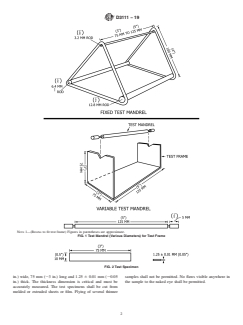
brass or stainless steel are satisfactory. Fig. 1 describes two
This practice is under the jurisdiction of ASTM Committee D10 on Packaging
simple test frames, one with fixed mandrels and the other
and is the direct responsibility of Subcommittee D10.14 on Tape and Labels.
designed to take any diameter mandrel.
Current edition approved April 1, 2019. Published June 2019. Originally
approvedin1972.Lastpreviouseditionapprovedin2018asD3111–10(2018).DOI:
7. Test Specimen
10.1520/D3111-19.
For referenced ASTM standards, visit the ASTM website, www.astm.org, or
7.1 The test specimen dimensions can be varied depending
contact ASTM Customer Service at service@astm.org. For Annual Book of ASTM
on the end use requirements of the hot-melt adhesive. Fig. 2
Standards volume information, refer to the standard’s Document Summary page on
the ASTM website. describes a recommended specimen size. It is 10 mm (;0.4
Copyright © ASTM International, 100 Barr Harbor Drive, PO Box C700, West Conshohocken, PA
...
This document is not an ASTM standard and is intended only to provide the user of an ASTM standard an indication of what changes have been made to the previous version. Because
it may not be technically possible to adequately depict all changes accurately, ASTM recommends that users consult prior editions as appropriate. In all cases only the current version
of the standard as published by ASTM is to be considered the official document.
Designation: D3111 − 10 (Reapproved 2018) D3111 − 19
Standard Test Method Practice for
Flexibility Determination of Hot-Melt Adhesives by Mandrel
Bend Test Method
This standard is issued under the fixed designation D3111; the number immediately following the designation indicates the year of
original adoption or, in the case of revision, the year of last revision. A number in parentheses indicates the year of last reapproval. A
superscript epsilon (´) indicates an editorial change since the last revision or reapproval.
1. Scope
1.1 This test method covers the determination of the flexibility of a hot-melt adhesive in sheet form under specific test
conditions. This is a working test. Its results are useful for comparing adhesives, not for absolute characterization of adhesives.
1.2 The values stated in SI units are to be regarded as the standard. The values given in parentheses are for information only.
1.3 This standard does not purport to address all of the safety concerns, if any, associated with its use. It is the responsibility
of the user of this standard to establish appropriate safety, health, and environmental practices and determine the applicability of
regulatory limitations prior to use.
1.4 This international standard was developed in accordance with internationally recognized principles on standardization
established in the Decision on Principles for the Development of International Standards, Guides and Recommendations issued
by the World Trade Organization Technical Barriers to Trade (TBT) Committee.
2. Referenced Documents
2.1 ASTM Standards:
D907 Terminology of Adhesives
E171/E171M Practice for Conditioning and Testing Flexible Barrier Packaging
3. Terminology
3.1 Definitions—Many of the terms found in this test method are defined in Terminology D907.
3.2 Definitions of Terms Specific to This Standard:
3.2.1 flexibility, n—that property of a material by virtue of which it may be flexed or bowed repeatedly without undergoing
rupture.
4. Summary of Test Method
4.1 Test strips of a hot-melt adhesive properly sized and conditioned, are bent 180° over a mandrel (rod). Using a fresh specimen
for each test, the test is repeated with smaller diameter mandrels until the adhesive fails on bending. The flexibility of the adhesive
is the smallest diameter mandrel over which four out of five test specimens do not break.
5. Significance and Use
5.1 The “Mandrel Bend” test is simple and fast. It requires little investment in equipment and little operator training. The prime
purpose is to determine whether a hot-melt adhesive meets flexibility requirements. This test is also useful for comparing flexibility
of several adhesives. It can be used to design adhesives by comparing the flexibility of various formulations to meet specific end
use parameters. The adhesive flexibility can be determined at temperatures other than ambient by conditioning the test apparatus
and test specimens at the desired temperature and performing the test under these temperature conditions.
6. Apparatus
6.1 The test apparatus consists of a series of different diameter cylindrical rods or mandrels supported at each end. There shall
be enough space to permit placement of the flat side of a test specimen tangentially at right angles to the longitudinal axis of the
This test method practice is under the jurisdiction of ASTM Committee D10 on Packaging and is the direct responsibility of Subcommittee D10.14 on Tape and Labels.
Current edition approved Dec. 15, 2018April 1, 2019. Published January 2019June 2019. Originally approved in 1972. Last previous edition approved in 20102018 as
D3111 – 10.D3111–10(2018). DOI: 10.1520/D3111-10R18.10.1520/D3111-19.
For referenced ASTM standards, visit the ASTM website, www.astm.org, or contact ASTM Customer Service at service@astm.org. For Annual Book of ASTM Standards
volume information, refer to the standard’s Document Summary page on the ASTM website.
Copyright © ASTM International, 100 Barr Harbor Drive, PO Box C700, West Conshohocken, PA 19428-2959. United States
D3111 − 19
test mandrel. Individual requirements determine the diameter and lengths of the rods needed. For most tests, 3.2 mm (; ⁄8 in.),
1 1
6.4 mm (; ⁄4 in.), and 12.8 mm (; ⁄2 in.) diameter by 75 to 150-mm (;3 to 6-in.) long rods made of brass or stainless steel are
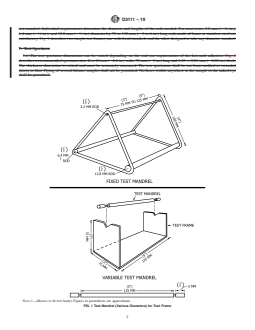
satisfactory. Fig. 1 describes two simple test frames, one with fixed mandrels and the other designed to take any diameter mandrel.
7. Test Specimen
7.1 The test specimen dimensions can be varied depending on the end use requirements of the hot-melt adhesive. Fig. 2
describes a recommended specimen size. It is 10 mm (;0.4 in.) wide, 75 mm (;3 in.) long and 1.25 6 0.01 mm (;0.05 in.) thick.
The thickness dimension is critical and must be accurately measured. The test specimens shall be cut from molded or extruded
sheets or film. Plying of several thinner samples shall not be permitted. No flaws visible anywhere in the sample to the naked eye
shall be permitted.
NOTE 1—(Recess to fit test frame) Figures in parentheses are approximate.
FIG. 1 Test Mandrel (Various Diameters) for Test Frame
D3111 − 19
FIG. 2 Test Specimen
8. Conditioning
8.1 Store the test specimens and test apparatus at the test conditions for 24 h. Perform the test under these same conditions. For
rapid screening, particularly at low temperatures, a minimum of 4 h conditioning can be used. Note this change when recording
data. If other conditions are not specified, the storage and test conditions will be 23 6 2°C and 50 6 5 % relative humidity.
Specification E171/E171M, details these and other tests conditions.
9. Failure
9.1 Failure is a visible fracture, crazing, or cracking of the hot-melt adhesive. This can occur at any time during the bending
of the adhesive test specimen over the mandrel. Color changes or blushing not affecting the tensile properties of the material is
not a failure, but should be reported.
10. Procedure
10.1 Run the tests in the same environment used to condition the test specimens and test apparatus.
10.2 Put the largest diameter mandrel in the horizontal operating position in the test frame.
10.3 Grasp the test specimen between the thumb and forefinger of one hand with the longest dimension between the fingers.
For low temperature testing, use ordinary cotton work gloves to insulate the test specimens from the warm fingers.
10.4 Lay the flat-side of the test specimen tangentially at right angles to the longitudinal axis of the test mandrel.
10.5 Within 1 s, fold the test specimen 180° to form an inverted “U” shaped angle over the mandrel maintaining intimate contact
with the mandrel.
10.6 If no failure occurs, fold a fresh specimen over the next smaller diameter mandrel. Repeat the test using a fresh sample
each time until failure occurs.
10.7 Now repeat the test five times using five fresh test specimens on the smallest diameter mandrel at which failure had not
occurred. To be significant, at least four out of five test specimens must pass. Follow this procedure with smaller or larger diameter
mandrels until four out of five test specimens pass.
10.8 Record the flexibility of the hot-melt adhesive as the smallest diameter mandrel over which four out of five test specimens
passed.
11. Report
11.1 Report the following information:
11.1.1 Method of specimen preparation, molded, extruded, or other method.
11.1.2 Specimen dimensions, especially thickness to within 0.01 mm ( ⁄2 in.).
11.1.3 Conditioning and test conditions, temperature and, if important, relative humidity.
11.1.4 Smallest diameter mandrel over which four out of five specimens did not fail.
11.1.5 Color changes or blushing of nonfailing test specimens after bending.
12. Precision and Bias
12.1 No information about either the precision or bias of Test Method D3111 for measuring flexibility of hot-melt adhesives is
available since the test result is non-quantitative.
D3111 − 19
13. Keywords
13.1 flexibility; hot melt; mandrel
ASTM International takes no position respecting the validity of any patent rights asserted in connection with any item mentioned
in this standard. Users of this standard are expressly advised that determination of the validity of any such patent rights, and the risk
of infringement of such rights, are entirely their own responsibility.
This standard is subject to revision at any time by the responsible technical committee and must be reviewed every five years and
if n
...