

ASTM D5749-24
(Specification)Standard Specification for Reinforced and Plain Gummed Tape for Sealing and Securing
General Information
- Abstract
ABSTRACT
This specification covers reinforced (Type I) and plain (Type II) paper gummed adhesive tapes used for securing and banding paper products and sealing fiberboard boxes. Type I gummed tape may be strippable (Class 1) or nonstrippable (Class 2), while Type II paper-backed gummed tape, whether Grade A (light duty), B (medium duty), or C (heavy duty), is nonstrippable. The tapes shall be manufactured from kraft paper, but the use of recycled pulp in the paper is encouraged as well, and the adhesive used must not have an offensive odor and shall conform to the environmental considerations specified. Type I tapes shall consist of two strips of paper in roll form, while Type II tapes shall consist of one strip of paper in roll form. Upon manufacture, the tape shall be clean and free of folds, sharp creases, tears, cuts, and holes. The tapes shall be examined for visual defects, defects in roll construction, and defects in dimensions. Tests for adhesiveness, tensile strength, and elongation shall be performed as well, and shall conform to the physical properties specified.
SCOPE
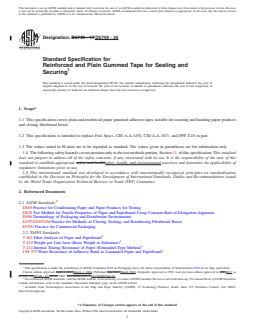
1.1 This specification covers plain and reinforced paper gummed adhesive tapes suitable for securing and banding paper products and closing fiberboard boxes.
1.2 This specification is intended to replace Fed. Specs. CID A-A-1492, CID A-A-1671, and PPP-T-45 in part.
1.3 The values stated in SI units are to be regarded as standard. The values given in parentheses are for information only.
1.4 The following safety hazards caveat pertains only to the test methods portion, Section 11, of this specification: This standard does not purport to address all of the safety concerns, if any, associated with its use. It is the responsibility of the user of this standard to establish appropriate safety, health, and environmental practices and determine the applicability of regulatory limitations prior to use.
1.5 This international standard was developed in accordance with internationally recognized principles on standardization established in the Decision on Principles for the Development of International Standards, Guides and Recommendations issued by the World Trade Organization Technical Barriers to Trade (TBT) Committee.
- Status
- Published
- Publication Date
- 29-Feb-2024
- Technical Committee
- D10 - Packaging
- Drafting Committee
- D10.14 - Tape and Labels
Buy Documents
ASTM D5749-24 - Standard Specification for Reinforced and Plain Gummed Tape for Sealing and Securing
REDLINE ASTM D5749-24 - Standard Specification for Reinforced and Plain Gummed Tape for Sealing and Securing
Overview
ASTM D5749-24 specifies the requirements for reinforced and plain gummed adhesive paper tapes used for sealing, securing, and banding paper products and closing fiberboard boxes. Established by ASTM International, this standard ensures that both reinforced (Type I) and plain (Type II) gummed tapes meet rigorous performance, safety, and environmental criteria suitable for commercial packaging, storage, and shipment applications.
This document replaces several federal specifications and aligns with internationally recognized practices to enhance global trade and packaging efficiency. The use of recycled pulp in tape manufacturing is encouraged, fostering environmental responsibility in the packaging industry.
Key Topics
Tape Types and Grades
- Type I: Reinforced gummed tape, available as light, medium, or heavy-duty options, supporting domestic and commercial packaging needs. Sub-classifications designate strippable and nonstrippable tapes.
- Type II: Plain, single-ply gummed tape, also categorized into light, medium, and heavy-duty grades, suitable for various load requirements.
Material and Construction
- Kraft paper is used as the base material, with the option to include recycled content.
- Reinforced tapes include embedded fibers for added strength, while plain tapes are single-ply.
- Adhesives must be free from offensive odors and adhere to strict environmental and health guidelines.
Performance Requirements
- Physical properties such as adhesiveness, tensile strength, tearing resistance, and elongation are tested to ensure tape reliability.
- Rolls must be clean, free of defects (tears, folds, contamination), and properly wound to prevent unwinding or damage.
Environmental and Safety Considerations
- No intentional addition of hazardous substances such as lead, cadmium, mercury, or hexavalent chromium.
- Packaging materials must conform to environmental best practices, especially for disposal and recycling.
Applications
The ASTM D5749-24 standard is widely used in commercial, industrial, and logistics settings where the secure sealing of fiberboard boxes and paper packages is essential. Key areas of application include:
- Sealing Shipping Cartons: Ensures sturdy, tamper-evident closure for domestic and international shipments.
- Banding Paper Products: Suitable for securing bundles of paper, books, or documents in storage or transit.
- General Packaging: Provides abrasion protection for fragile items and supports unitization of lighter or heavier loads as needed.
- Government and Commercial Procurement: Frequently cited in purchasing specifications to replace legacy federal standards such as CID A-A-1492, CID A-A-1671, and PPP-T-45.
Compliance with ASTM D5749-24 helps organizations meet quality assurance, environmental, and regulatory requirements in packaging operations, supporting efficient supply chain and logistics management.
Related Standards
- ASTM D1974/D1974M: Practice for closing, sealing, and reinforcing fiberboard boxes.
- ASTM D3951: Practice for commercial packaging.
- TAPPI T 401: Fiber analysis of paper and paperboard.
- TAPPI T 410: Weight per unit area (basis weight).
- TAPPI T 414: Internal tearing resistance of paper.
- TAPPI UM 575: Water resistance of adhesive bond in laminated paper products.
- ANSI/ASQC Z1.4 / Z1.9: Sampling procedures for inspection by attributes and variables.
- ISO 9002: Quality management systems for production and installation.
These related packaging and quality management standards work in conjunction to ensure robust, safe, and environmentally responsible packaging solutions.
Keywords: reinforced tape, plain gummed tape, sealing, securing, fiberboard boxes, ASTM D5749, packaging standards, commercial packaging, kraft paper, environmentally friendly tape.
Relations
- Replaces
ASTM D5749-17 - Standard Specification for Reinforced and Plain Gummed Tape for Sealing and Securing - Effective Date
- 01-Mar-2024
- Effective Date
- 01-Mar-2024
Buy Documents
ASTM D5749-24 - Standard Specification for Reinforced and Plain Gummed Tape for Sealing and Securing
REDLINE ASTM D5749-24 - Standard Specification for Reinforced and Plain Gummed Tape for Sealing and Securing
Get Certified
Connect with accredited certification bodies for this standard

DIN CERTCO
DIN Group product certification.

Smithers Quality Assessments
US management systems and product certification.
Sponsored listings
Frequently Asked Questions
ASTM D5749-24 is a technical specification published by ASTM International. Its full title is "Standard Specification for Reinforced and Plain Gummed Tape for Sealing and Securing". This standard covers: ABSTRACT This specification covers reinforced (Type I) and plain (Type II) paper gummed adhesive tapes used for securing and banding paper products and sealing fiberboard boxes. Type I gummed tape may be strippable (Class 1) or nonstrippable (Class 2), while Type II paper-backed gummed tape, whether Grade A (light duty), B (medium duty), or C (heavy duty), is nonstrippable. The tapes shall be manufactured from kraft paper, but the use of recycled pulp in the paper is encouraged as well, and the adhesive used must not have an offensive odor and shall conform to the environmental considerations specified. Type I tapes shall consist of two strips of paper in roll form, while Type II tapes shall consist of one strip of paper in roll form. Upon manufacture, the tape shall be clean and free of folds, sharp creases, tears, cuts, and holes. The tapes shall be examined for visual defects, defects in roll construction, and defects in dimensions. Tests for adhesiveness, tensile strength, and elongation shall be performed as well, and shall conform to the physical properties specified. SCOPE 1.1 This specification covers plain and reinforced paper gummed adhesive tapes suitable for securing and banding paper products and closing fiberboard boxes. 1.2 This specification is intended to replace Fed. Specs. CID A-A-1492, CID A-A-1671, and PPP-T-45 in part. 1.3 The values stated in SI units are to be regarded as standard. The values given in parentheses are for information only. 1.4 The following safety hazards caveat pertains only to the test methods portion, Section 11, of this specification: This standard does not purport to address all of the safety concerns, if any, associated with its use. It is the responsibility of the user of this standard to establish appropriate safety, health, and environmental practices and determine the applicability of regulatory limitations prior to use. 1.5 This international standard was developed in accordance with internationally recognized principles on standardization established in the Decision on Principles for the Development of International Standards, Guides and Recommendations issued by the World Trade Organization Technical Barriers to Trade (TBT) Committee.
ABSTRACT This specification covers reinforced (Type I) and plain (Type II) paper gummed adhesive tapes used for securing and banding paper products and sealing fiberboard boxes. Type I gummed tape may be strippable (Class 1) or nonstrippable (Class 2), while Type II paper-backed gummed tape, whether Grade A (light duty), B (medium duty), or C (heavy duty), is nonstrippable. The tapes shall be manufactured from kraft paper, but the use of recycled pulp in the paper is encouraged as well, and the adhesive used must not have an offensive odor and shall conform to the environmental considerations specified. Type I tapes shall consist of two strips of paper in roll form, while Type II tapes shall consist of one strip of paper in roll form. Upon manufacture, the tape shall be clean and free of folds, sharp creases, tears, cuts, and holes. The tapes shall be examined for visual defects, defects in roll construction, and defects in dimensions. Tests for adhesiveness, tensile strength, and elongation shall be performed as well, and shall conform to the physical properties specified. SCOPE 1.1 This specification covers plain and reinforced paper gummed adhesive tapes suitable for securing and banding paper products and closing fiberboard boxes. 1.2 This specification is intended to replace Fed. Specs. CID A-A-1492, CID A-A-1671, and PPP-T-45 in part. 1.3 The values stated in SI units are to be regarded as standard. The values given in parentheses are for information only. 1.4 The following safety hazards caveat pertains only to the test methods portion, Section 11, of this specification: This standard does not purport to address all of the safety concerns, if any, associated with its use. It is the responsibility of the user of this standard to establish appropriate safety, health, and environmental practices and determine the applicability of regulatory limitations prior to use. 1.5 This international standard was developed in accordance with internationally recognized principles on standardization established in the Decision on Principles for the Development of International Standards, Guides and Recommendations issued by the World Trade Organization Technical Barriers to Trade (TBT) Committee.
ASTM D5749-24 is classified under the following ICS (International Classification for Standards) categories: 83.180 - Adhesives. The ICS classification helps identify the subject area and facilitates finding related standards.
ASTM D5749-24 has the following relationships with other standards: It is inter standard links to ASTM D5749-17, ASTM D1974/D1974M-22. Understanding these relationships helps ensure you are using the most current and applicable version of the standard.
ASTM D5749-24 is available in PDF format for immediate download after purchase. The document can be added to your cart and obtained through the secure checkout process. Digital delivery ensures instant access to the complete standard document.
Standards Content (Sample)
This international standard was developed in accordance with internationally recognized principles on standardization established in the Decision on Principles for the
Development of International Standards, Guides and Recommendations issued by the World Trade Organization Technical Barriers to Trade (TBT) Committee.
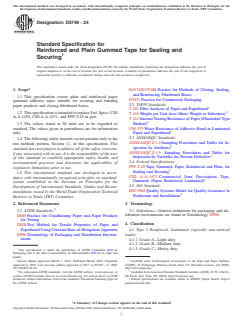
Designation: D5749 − 24
Standard Specification for
Reinforced and Plain Gummed Tape for Sealing and
Securing
This standard is issued under the fixed designation D5749; the number immediately following the designation indicates the year of
original adoption or, in the case of revision, the year of last revision. A number in parentheses indicates the year of last reapproval. A
superscript epsilon (´) indicates an editorial change since the last revision or reapproval.
1. Scope* D1974/D1974M Practice for Methods of Closing, Sealing,
and Reinforcing Fiberboard Boxes
1.1 This specification covers plain and reinforced paper
D3951 Practice for Commercial Packaging
gummed adhesive tapes suitable for securing and banding
2.2 TAPPI Standards:
paper products and closing fiberboard boxes.
T 401 Fiber Analysis of Paper and Paperboard
1.2 This specification is intended to replace Fed. Specs. CID
T 410 Weight per Unit Area (Basis Weight or Substance)
A-A-1492, CID A-A-1671, and PPP-T-45 in part.
T 414 Internal Tearing Resistance of Paper (Elmendorf-Type
1.3 The values stated in SI units are to be regarded as Method)
standard. The values given in parentheses are for information UM 575 Water Resistance of Adhesive Bond in Laminated
only. Paper and Paperboard
2.3 ANSI/ASQC Standards:
1.4 The following safety hazards caveat pertains only to the
ANSI/ASQC Z 1.4 Sampling Procedures and Tables for In-
test methods portion, Section 11, of this specification: This
spection by Attributes
standard does not purport to address all of the safety concerns,
ANSI/ASQC Z 1.9 Sampling Procedures and Tables for
if any, associated with its use. It is the responsibility of the user
Inspection by Variables for Percent Defective
of this standard to establish appropriate safety, health, and
2.4 Federal Specifications:
environmental practices and determine the applicability of
PPP-T-45 Tape, Gummed, Paper, Reinforced and Plain, for
regulatory limitations prior to use.
Sealing and Securing
1.5 This international standard was developed in accor-
CID A-A-1671 Commercial Item Description Tape,
dance with internationally recognized principles on standard-
Gummed, (Paper, Reinforced, Laminated)
ization established in the Decision on Principles for the
2.5 ISO Standard:
Development of International Standards, Guides and Recom-
ISO 9002 Quality Systems Model for Quality Assurance in
mendations issued by the World Trade Organization Technical
Production and Installations
Barriers to Trade (TBT) Committee.
2. Referenced Documents 3. Terminology
3.1 Definitions—General definitions for packaging and dis-
2.1 ASTM Standards:
D685 Practice for Conditioning Paper and Paper Products tribution environments are found in Terminology D996.
for Testing
4. Classification
D828 Test Method for Tensile Properties of Paper and
Paperboard Using Constant-Rate-of-Elongation Apparatus 4.1 Type I Reinforced, Laminated (typically non-unitized
D996 Terminology of Packaging and Distribution Environ- loads):
ments 4.1.1 Grade A—Light duty.
4.1.2 Grade B—Medium duty.
4.1.3 Grade C—Heavy duty.
This specification is under the jurisdiction of ASTM Committee D10 on
Packaging and is the direct responsibility of Subcommittee D10.14 on Tape and
Labels.
Current edition approved March 1, 2024. Published March 2024. Originally Available from Technological Association of the Pulp and Paper Industry
approved in 1995. Last previous edition approved in 2017 as D5749 – 17. DOI: (TAPPI), 15 Technology Parkway South, Suite 115, Peachtree Corners, GA 30092,
10.1520/D5749-24. http://www.tappi.org.
2 4
For referenced ASTM standards, visit the ASTM website, www.astm.org, or Available from American National Standards Institute (ANSI), 25 W. 43rd St.,
contact ASTM Customer Service at service@astm.org. For Annual Book of ASTM 4th Floor, New York, NY 10036, http://www.ansi.org.
Standards volume information, refer to the standard’s Document Summary page on Federal specifications are available online at ASSIST Quick Search, https://
the ASTM website. quicksearch.dla.mil/.
*A Summary of Changes section appears at the end of this standard
Copyright © ASTM International, 100 Barr Harbor Drive, PO Box C700, West Conshohocken, PA 19428-2959. United States
D5749 − 24
4.2 Type II Plain, Single Ply (typically unitized loads): 7.3 Adhesives—The adhesives used shall not have an offen-
4.2.1 Grade A—Light duty, for lightweight packages. sive odor (dry or wet) and shall meet the environmental
4.2.2 Grade B—Medium duty, for medium-sized packages. considerations of 16.1. Adhesive shall be capable of being
4.2.3 Grade C—Heavy duty, for heavy-duty packages. quickly activated with water. The wetted adhesive shall show
pronounced tackiness and shall cause the tape to remain so
5. Significance and Use
firmly affixed that it cannot be removed without failure of
either the tape or paper when tested in accordance with 13.6.1.
5.1 Type I is a reinforced gummed tape intended for use in
closing methods in Practice D1974/D1974M for domestic
7.4 Reinforcing Materials—The reinforcing fibers used in
storage and shipments of fiberboard boxes, or closing wrappers
fabricating Type I tapes shall be composed of glass, polyester,
of packages and banding of paper and paper products.
both, or other suitable fibers, of such size as to permit the
reinforced tape to meet the requirements set forth in Table 2
5.2 Type II is a plain paper gummed tape intended for use in
when tested as described in 13.5.
closing methods in Practice D1974/D1974M for general clos-
ing of fiberboard boxes or wrappers of packages; or for
7.5 Laminating Materials—The laminating material for
protection against abrasion on fragile products.
Type I tape shall be non-asphaltic, water resistant, flexible, and
non-staining. Water resistance of the finished tape shall be
6. Ordering Information
tested in accordance with TAPPI UM 575 using a 2 h soak for
6.1 The inquiry or order shall include the following:
commercial use and a 24 h soak for DoD use. Test specimen
6.1.1 ASTM designation and date of issue, dimension can be as specified in UM 575, or 25.4 cm (10 in.)
6.1.2 Type and grade required (5.1),
by tape width.
6.1.3 If a core is required (7.7),
7.6 Construction:
6.1.4 If tape is to be wound gummed side out (7.7),
7.6.1 Type I tape shall consist of two strips of paper in roll
6.1.5 Roll width and length (9.1 and 9.2),
form, securely laminated together with reinforcing fibers em-
6.1.6 Acceptance sampling plan and desired acceptance
bedded in the laminate. The reinforcing laminated tape shall be
quality level (Section 12),
completely and uniformly coated on one side with an adhesive.
6.1.7 When paper-certification is required (15.1),
The tape shall be reinforced by not less than 2 fibers/25 mm
6.1.8 When testing and inspection certification is required
(1 in.) on average in both the machine and crosswise direc-
(15.1),
tions. If a diamond pattern is employed for crosswise
6.1.9 Level of packaging and packing if other than commer-
reinforcement, the spacing between the parallel sides of the
cial (Section 17), and
diamond shall not be more than 32 mm (1.25 in.). In addition
6.1.10 When packaging for shipments to the U.S. Govern-
to the diamond-patterned reinforcement, a three-way tape shall
ment.
be reinforced in the machine direction by not less than 2
fibers/25 mm (1 in.) on average.
7. Materials and Manufacture
7.6.2 Type II tapes, all grades, shall consist of one strip of
7.1 The materials used in the construction of the tape shall
paper in roll form of the applicable grade, completely and
be such as to ensure performance of the tape over the range of
uniformly coated on one side with an adhesive.
the following service conditions: −18 °C to +60 °C (0 °F
7.7 Rolls—Unless otherwise specified, the tape shall be
to +140 °F) for Type I and –34 °C to +204 °C (–30 °F to
evenly and tightly wound in rolls with the gummed side in
+400 °F) for Type II and shall conform to the requirements of
(6.1.4). Type I and Type II tapes shall not be required to have
this specification.
a core. If a core is required, then the inside diameter of the core
7.2 Paper: 1
shall be not less than 13 mm ( ⁄2 in.). The end of the outer leaf
7.2.1 Stock—The paper used in the fabrication of the tape
of the tape shall be adhered to the next layer to prevent
shall be a kraft paper. The use of recycled pulp in the paper is
unwinding. The tape in each roll shall be furnished in one
encouraged.
continuous length and have no more than three splices per roll.
7.2.2 Weight—The weight of the paper prior to gumming
shall conform to the requirement of Table 1, when tested as
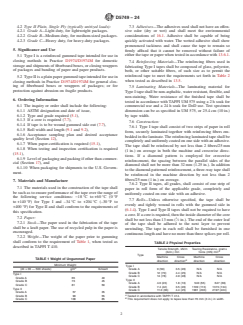
TABLE 2 Physical Properties
described in TAPPI T 410.
Tensile Strength, kN/m Tearing Resistance, grams
A
(lb/in.) min force (mN) min
Type
Machine Cross Machine Cross
TABLE 1 Weight of Ungummed Paper
B
direction direction direction direction
Minimum Weight
Type I
Grade A 9 (50) 3.5 (20) N/A N/A
(24 × 36 — 500 sheets) g/m lb/ream
Grade B 12 (70) 4.4 (25) N/A N/A
Type I
Grade C 14 (78) 4.9 (28) N/A N/A
Grade A 65 40
Type II
Grade B 73 45
Grade A 4.0 (23) 1.8 (10) 540 (55) 647 (66)
Grade C 81 50
Grade B 7.4 (42) 3.5 (20) 1109 (113) 1315 (134)
Type II
Grade C 11.0 (63) 4.4 (25) 1991 (203) 2197 (224)
Grade A 57 35
A
Grade B 90 55 Tested in accordance with TAPPI T 414.
B
Grade C 138 85
This requirement does not apply to tapes less than 76 mm (3 in.) in width.
D5749 − 24
All splices shall be neatly and evenly made with glue or acceptance comply with all the requirements of the contract or
double-sided pressure sensitive tape and shall not separate order. Sampling in quality conformance does not authorize
upon unwinding. submission of known defective material, either indicated or
actual, nor does it commit the buyer to accept defective
8. Physical Properties
material.
8.1 The tape shall meet the physical property requirements
13.3 Test of Component Materials:
in Table 2.
13.3.1 Paper—The paper component shall be tested for the
stock requirements in 7.2.1 as described in TAPPI T 401 and
9. Dimensions, Mass, and Permissible Variations
for basis weight requirements in 7.2.2 as described in TAPPI
9.1 The width of the roll for Type I shall be 70 mm, 72 mm,
T 410. The lot shall consist of all paper received at one time
and 76 mm (2.75 in., 2.82 in., and 3 in.); For Type II 64 mm
from one source of supply for use in fabrication of one type and
and 76 mm (2.5 in. and 3 in.). Other widths may be commer-
grade of tape. The lot size shall be expressed in units of
cially available.
kilograms (pounds). The sample unit shall be 0.65 m
9.1.1 A width tolerance of 61.5 mm (6 ⁄16 in.) shall be
(1000 in. ) of paper. The sample size shall be as described in
allowed on all widths.
12.1. The test reports shall include all values upon which
results are based. There shall be no failures to meet the
9.2 Length:
composite or lot average requirements. A composite shall
9.2.1 Type I—The length of the roll shall be available in
consist of small portions taken from all sample units and
137 m (450 ft). Other lengths may be commercially available,
combined into a single sample.
as specified (6.1.5).
13.3.2 Reinforcing Material—The manufacturer shall sub-
9.2.2 Type II—The length of the Grade A roll shall be
mit a certification of compliance stating that the composition of
available in 152 m (500 ft). The length of the Grade B roll shall
the reinforcing material used in Type I tape is in conformance
be available in 185 m
...
This document is not an ASTM standard and is intended only to provide the user of an ASTM standard an indication of what changes have been made to the previous version. Because
it may not be technically possible to adequately depict all changes accurately, ASTM recommends that users consult prior editions as appropriate. In all cases only the current version
of the standard as published by ASTM is to be considered the official document.
Designation: D5749 − 17 D5749 − 24
Standard Specification for
Reinforced and Plain Gummed Tape for Sealing and
Securing
This standard is issued under the fixed designation D5749; the number immediately following the designation indicates the year of
original adoption or, in the case of revision, the year of last revision. A number in parentheses indicates the year of last reapproval. A
superscript epsilon (´) indicates an editorial change since the last revision or reapproval.
1. Scope*
1.1 This specification covers plain and reinforced paper gummed adhesive tapes suitable for securing and banding paper products
and closing fiberboard boxes.
1.2 This specification is intended to replace Fed. Specs. CID A-A-1492, CID A-A-1671, and PPP-T-45 in part.
1.3 The values stated in SI units are to be regarded as standard. The values given in parentheses are for information only.
1.4 The following safety hazards caveat pertains only to the test methods portion, Section 11, of this specification: This standard
does not purport to address all of the safety concerns, if any, associated with its use. It is the responsibility of the user of this
standard to establish appropriate safety and healthsafety, health, and environmental practices and determine the applicability of
regulatory limitations prior to use.
1.5 This international standard was developed in accordance with internationally recognized principles on standardization
established in the Decision on Principles for the Development of International Standards, Guides and Recommendations issued
by the World Trade Organization Technical Barriers to Trade (TBT) Committee.
2. Referenced Documents
2.1 ASTM Standards:
D685 Practice for Conditioning Paper and Paper Products for Testing
D828 Test Method for Tensile Properties of Paper and Paperboard Using Constant-Rate-of-Elongation Apparatus
D996 Terminology of Packaging and Distribution Environments
D1974/D1974M Practice for Methods of Closing, Sealing, and Reinforcing Fiberboard Boxes
D3951 Practice for Commercial Packaging
2.2 TAPPI Standards:
T 401 Fiber Analysis of Paper and Paperboard
T 410 Weight per Unit Area (Basis Weight or Substance)
T 414 Internal Tearing Resistance of Paper (Elmendorf-Type Method)
UM 575 Water Resistance of Adhesive Bond in Laminated Paper and Paperboard
This specification is under the jurisdiction of ASTM Committee D10 on Packaging and is the direct responsibility of Subcommittee D10.14 on Tape and Labels.
Current edition approved April 1, 2017March 1, 2024. Published June 2017March 2024. Originally approved in 1995. Last previous edition approved in 20122017 as
D5749 – 01D5749 – 17.(2012). DOI: 10.1520/D5749-17.10.1520/D5749-24.
For referenced ASTM standards, visit the ASTM website, www.astm.org, or contact ASTM Customer Service at service@astm.org. For Annual Book of ASTM Standards
volume information, refer to the standard’s Document Summary page on the ASTM website.
Available from Technological Association of the Pulp and Paper Industry (TAPPI), 15 Technology Parkway South, Suite 115, Peachtree Corners, GA 30092,
http://www.tappi.org.
*A Summary of Changes section appears at the end of this standard
Copyright © ASTM International, 100 Barr Harbor Drive, PO Box C700, West Conshohocken, PA 19428-2959. United States
D5749 − 24
2.3 ANSI/ASQC Standards:
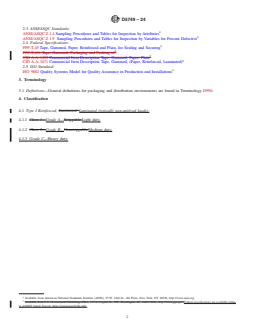
ANSI/ASQC Z 1.4 Sampling Procedures and Tables for Inspection by Attributes
ANSI/ASQC Z 1.9 Sampling Procedures and Tables for Inspection by Variables for Percent Defective
2.4 Federal Specifications:
PPP-T-45 Tape, Gummed, Paper, Reinforced and Plain, for Sealing and Securing
PPP-T-681 Tape, Gummed, Packaging and Packing of
CID A-A-1492 Commercial Item Description Tape, Gummed, Paper, Plain
CID A-A-1671 Commercial Item Description Tape, Gummed, (Paper, Reinforced, Laminated)
2.5 ISO Standard:
ISO 9002 Quality Systems Model for Quality Assurance in Production and Installations
3. Terminology
3.1 Definitions—General definitions for packaging and distribution environments are found in Terminology D996.
4. Classification
4.1 Type I Reinforced, Laminated: Laminated (typically non-unitized loads):
4.1.1 Class 1—Grade A—Strippable.Light duty.
4.1.2 Class 2—Grade B—Nonstrippable.Medium duty.
4.1.3 Grade C—Heavy duty.
Available from American National Standards Institute (ANSI), 25 W. 43rd St., 4th Floor, New York, NY 10036, http://www.ansi.org.
Available from U.S. Government Publishing Office, 732 N. Capitol St., NW, Washington, DC 20401-0001, http://www.gpo.gov.Federal specifications are available online
at ASSIST Quick Search, https://quicksearch.dla.mil/.
D5749 − 24
4.2 Type II Plain, Single Ply, Strippable: Ply (typically unitized loads):
4.2.1 Grade A—Light duty, for lightweight packages.
4.2.2 Grade B—Medium duty, for medium-sized packages.
4.2.3 Grade C—Heavy duty, for heavy-duty packages.
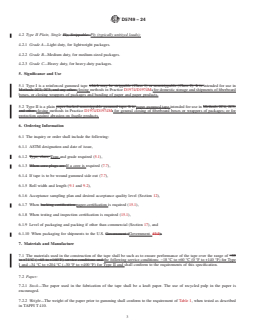
5. Significance and Use
5.1 Type I is a reinforced gummed tape which may be strippable (Class 1) or nonstrippable (Class 2). It is intended for use in
Methods 2C2, 2C3, and any other closing methods in Practice D1974/D1974M. for domestic storage and shipments of fiberboard
boxes, or closing wrappers of packages and banding of paper and paper products.
5.2 Type II is a plain paper-backed nonstrippable gummed tape. It is paper gummed tape intended for use in Methods 2C4, 2C5,
and other closing methods in Practice D1974/D1974M. for general closing of fiberboard boxes or wrappers of packages; or for
protection against abrasion on fragile products.
6. Ordering Information
6.1 The inquiry or order shall include the following:
6.1.1 ASTM designation and date of issue,
6.1.2 Type, class, Type and grade required (5.1),
6.1.3 When core plugs are If a core is required (7.7),
6.1.4 If tape is to be wound gummed side out (7.7),
6.1.5 Roll width and length (9.1 and 9.2),
6.1.6 Acceptance sampling plan and desired acceptance quality level (Section 12),
6.1.7 When backing certification paper-certification is required (15.1),
6.1.8 When testing and inspection certification is required (15.1),
6.1.9 Level of packaging and packing if other than commercial (Section 17), and
6.1.10 When packaging for shipments to the U.S. Government (Government. 17.2).
7. Materials and Manufacture
7.1 The materials used in the construction of the tape shall be such as to ensure performance of the tape over the range of −55
to +71°C ( −65 to +160°F) service conditions and the following service conditions: −18 °C to +60 °C (0 °F to +140 °F) for Type
I and –34 °C to +204 °C (–30 °F to +400 °F) for Type II and shall conform to the requirements of this specification.
7.2 Paper:
7.2.1 Stock—The paper used in the fabrication of the tape shall be a kraft paper. The use of recycled pulp in the paper is
encouraged.
7.2.2 Weight—The weight of the paper prior to gumming shall conform to the requirement of Table 1, when tested as described
in TAPPI T 410.
D5749 − 24
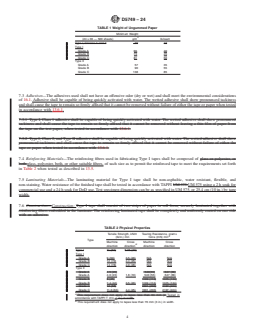
TABLE 1 Weight of Ungummed Paper
Minimum Weight
(24 × 36 — 500 sheets) g/m lb/ream
Type I, Classes 1 and 2 30 43
Type I
Grade A 65 40
Grade B 73 45
Grade C 81 50
Type II
Grade A 57 35
Grade B 90 55
Grade C 138 85
7.3 Adhesives—The adhesives used shall not have an offensive odor (dry or wet) and shall meet the environmental considerations
of 16.1. Adhesive shall be capable of being quickly activated with water. The wetted adhesive shall show pronounced tackiness
and shall cause the tape to remain so firmly affixed that it cannot be removed without failure of either the tape or paper when tested
in accordance with 13.6.1.
7.3.1 Type I, Class 1 adhesive shall be capable of being quickly activated with water. The wetted adhesive shall show pronounced
tackiness and shall cause the tape to remain so firmly affixed that it cannot be removed without leaving a thin film of paper from
the tape on the test paper, when tested in accordance with 13.6.1.
7.3.2 Type I, Class 2, and Type II adhesive shall be capable of being quickly activated with water. The wetted adhesive shall show
pronounced tackiness and shall cause the tape to remain so firmly affixed that it cannot be removed without failure of either the
tape or paper when tested in accordance with 13.6.1.
7.4 Reinforcing Materials—The reinforcing fibers used in fabricating Type I tapes shall be composed of glass or polyester, or
both,glass, polyester, both, or other suitable fibers, of such size as to permit the reinforced tape to meet the requirements set forth
in Table 2 when tested as described in 13.5.
7.5 Laminating Materials—The laminating material for Type I tape shall be non-asphaltic, water resistant, flexible, and
non-staining. Water resistance of the finished tape shall be tested in accordance with TAPPI UM 575.UM 575 using a 2 h soak for
commercial use and a 24 h soak for DoD use. Test specimen dimension can be as specified in UM 575, or 25.4 cm (10 in.) by tape
width.
7.6 Construction—Construction: Type I tape shall consist of two strips of paper in roll form, securely laminated together with
reinforcing fibers embedded in the laminate. The reinforcing laminated tape shall be completely and uniformly coated on one side
with an adhesive.
TABLE 2 Physical Properties
Tensile Strength, kN/m Tearing Resistance, grams
A
(lb/in.) min force (mN) min
Type
Machine Cross Machine Cross
B
direction direction direction direction
Type I 11 (63) 5.25 (30)
Type I
Grade A 9 (50) 3.5 (20) N/A N/A
Grade B 12 (70) 4.4 (25) N/A N/A
Grade C 14 (78) 4.9 (28) N/A N/A
Type II
Grade A 4.5 (26) 540(55) 647 (66)
Grade A 4.0 (23) 1.8 (10) 540 (55) 647 (66)
Grade B 8 (45) 1109 (113) 1315 (134)
Grade B 7.4 (42) 3.5 (20) 1109 (113) 1315 (134)
Grade C 12 (68) 1991 (203) 2197 (224)
Grade C 11.0 (63) 4.4 (25) 1991 (203) 2197 (224)
A
This requirement does not apply to tapes less than 63 mm (2 Tested in
accordance with TAPPI T 414. ⁄2 in.) in width.
B
This requirement does not apply to tapes less than 76 mm (3 in.) in width.
D5749 − 24
7.6.1 The Type I tape shall consist of two strips of paper in roll form, securely laminated together with reinforcing fibers embedded
in the laminate. The reinforcing laminated tape shall be completely and uniformly coated on one side with an adhesive. The tape
shall be reinforced by not less than 2 fibers/25 mm (1 in.) fibers/25 mm (1 in.) on average in both the machine and crosswise
directions. If a diamond pattern is employed for crosswise reinforcement, the spacing between the parallel sides of the diamond
shall not be more than 32 mm (1.25 in.). 32 mm (1.25 in.). In addition to the diamond-patterned reinforcement, a three-way tape
shall be reinforced in the machine direction by not less than 2 fibers/25 mm (1 in.) fibers/25 mm (1 in.) on average.
7.6.2 Type II tapes, all grades, shall consist of one strip of paper in roll form of the applicable grade, completely and uniformly
coated on one side with an adhesive.
7.7 Rolls—Unless otherwise specified, the tape shall be evenly wound and tightly wound in rolls with the gummed side in (6.1.4).
Type II shall be wound on a core having sufficient rigidity to prevent distortion of the roll under normal conditions of transportation
and use. The I and Type II tapes shall not be required to have a core. If a core is required, then the inside diameter of the core
shall be not less than 13 mm 13 mm ( ⁄2 in.). When specified, Type II tape shall have the core secure with a plug ( in.). 6.1.3). Type
I tape shall not be required to have a core. The end of the outer leaf of the tape shall be adhered to the next layer to prevent
unwinding. The tape in each roll shall be furnished in one continuous length and have no more than three splices per roll. All splices
shall be neatly and evenly made with glue or double sided double-sided pressure sensitive tape and shall not separate upon
unwinding.
8. Physical Properties
8.1 The tape shall meet the physical property requirements in Table 2.
9. Dimensions, Mass, and Permissible Variations
9.1 The width of the roll for Type I shall be 70, 72, and 76 mm (2.75, 2.82, and 3 in.); 70 mm, 72 mm, and 76 mm (2.75 in.,
2.82 in., and 3 in.); For Type II 25, 38.5, 50, 70, and 76 mm (1, 164 mm and 76 mm (2.5 in. ⁄2, 2, 2.75, and 3 in.).and 3 in.). Other
widths may be commercially available.
9.1.1 A width tolerance of 61.5 mm 61.5 mm (6 ⁄16 in.) in.) shall be allowed on all widths.
9.2 Length:
9.2.1 Type I—The length of the roll shall be a minimum of 140 m (450 ft) or other commercially available lengths, available in
137 m (450 ft). Other lengths may be commercially available, as specified (6.1.5).
9.2.2 Type II—The length of the ClassGrade A roll shall be 150 m (500 ft) or other commercially available length (available in
152 m6.1.5). (500 ft). The length of the ClassGrade B roll shall be 185 m (600 ft), or other commercially available length (available
in 185 m6.1.5). (600 ft). The length of the ClassGrade C roll shall be 115 m (375 ft), or other commercially available length
available in 115 m (375 ft). Other lengths may be commercially available, as specified (6.1.5).
10. Workmanship, Finish, and Appearance
10.1 The tape shall be clean and free of folds, sharp creases, tears, cuts, and holes. The adhesive coating shall cover the entire area
of one side of the tape. The tape shall be cleanly cut without nicks, or ragged or fuzzy edges, and shall conform to the l
...