

ASTM D6195-22
(Test Method)Standard Test Methods for Loop Tack
General Information
- Abstract
SIGNIFICANCE AND USE
5.1 These test methods provide a quantitative measure of the pressure-sensitive tack property of an adhesive.
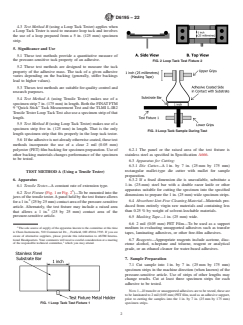
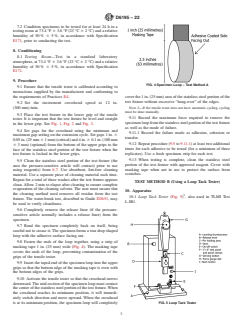
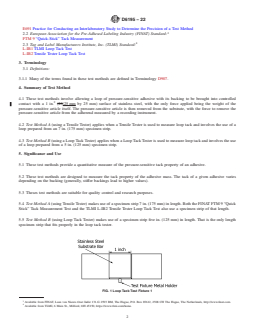
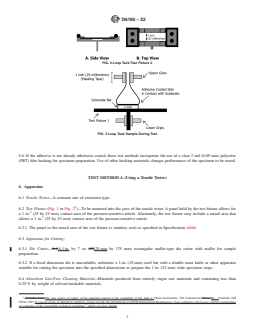
FIG. 1 Loop Tack Test Fixture 1
FIG. 2 Loop Tack Test Fixture 2
FIG. 3 Loop Tack Sample During Test
5.2 These test methods are designed to measure the tack property of the adhesive mass. The tack of a given adhesive varies depending on the backing (generally, stiffer backings lead to higher values).
5.3 Theses test methods are suitable for quality control and research purposes.
5.4 Test Method A (using Tensile Tester) makes use of a specimen strip 7 in. (175 mm) in length. Both the FINAT FTM 9 “Quick Stick” Tack Measurement Test and the TLMI L-IB2 Tensile Tester Loop Tack Test also use a specimen strip of that length.
5.5 Test Method B (using Loop Tack Tester) makes use of a specimen strip five in. (125 mm) in length. That is the only length specimen strip that fits properly in the loop tack tester.
5.6 If the adhesive is not already otherwise coated, these test methods incorporate the use of a clear 2 mil (0.05 mm) polyester (PET) film backing for specimen preparation. Use of other backing materials changes performance of the specimen to be tested.
SCOPE
1.1 These test methods cover the determination of properties of a pressure-sensitive adhesive. These test methods are applicable to those adhesives that form a bond of measurable strength rapidly upon contact with another surface. Tack force may be measured as the force required to separate the adhesive from the adherend at the interface shortly after they have been brought into contact under a load equal only to the weight of the pressure-sensitive article (for example, tape, label, sticker, etc.) on a 1 in.2 contact area.
1.2 The following test methods are included:
1.2.1 Test Method A (using Tensile Tester), and
1.2.2 Test Method B (using Loop Tack Tester).
1.3 The values stated in inch-pound units are to be regarded as the standard because the industry standard width for pressure-sensitive tape is 1 inch. The values given in parentheses are mathematical conversions to SI units that are provided for information only and are not considered standard.
1.4 This standard does not purport to address all of the safety concerns, if any, associated with its use. It is the responsibility of the user of this standard to establish appropriate safety, health, and environmental practices and determine the applicability of regulatory limitations prior to use.
1.5 This international standard was developed in accordance with internationally recognized principles on standardization established in the Decision on Principles for the Development of International Standards, Guides and Recommendations issued by the World Trade Organization Technical Barriers to Trade (TBT) Committee.
- Status
- Published
- Publication Date
- 30-Sep-2022
- Technical Committee
- D10 - Packaging
- Drafting Committee
- D10.14 - Tape and Labels
Overview
ASTM D6195-22: Standard Test Methods for Loop Tack establishes quantitative procedures for measuring the loop tack property of pressure-sensitive adhesives (PSAs). These test methods are designed to assess the instant bonding ability-often called "tack"-of adhesives that form bonds of measurable strength immediately upon contact with another surface. Loop tack measurement is critical for manufacturers and researchers working in industries producing tapes, labels, stickers, and similar pressure-sensitive articles.
The standard outlines two primary methods:
- Test Method A: Utilizes a tensile tester with a 7-inch specimen strip.
- Test Method B: Utilizes a loop tack tester with a 5-inch specimen strip.
ASTM D6195-22 is suitable for use in both quality control and R&D environments, helping organizations assure performance consistency and evaluate adhesive formulations for product development.
Key Topics
Essential Focus Areas within ASTM D6195-22:
- Loop Tack Measurement: Provides a method to determine the force required to separate an adhesive loop from a standardized surface, usually stainless steel, shortly after contact with only the article's own weight as pressure.
- Test Methods: Two recognized approaches:
- Test Method A: Tensile tester, 7-inch (175 mm) strip, widely comparable to FINAT FTM 9 and TLMI L-IB2 methods.
- Test Method B: Loop tack tester, 5-inch (125 mm) strip, standardized for commercial loop tack testers.
- Specimen Preparation: Involves specific backing materials, most commonly a 2 mil (0.05 mm) polyester (PET) film for uncoated adhesives, to ensure accuracy and reproducibility.
- Environmental Conditioning: Specimens are conditioned and tested under controlled temperature and humidity, minimizing variability.
- Reporting Results: Detailed documentation is required, including test method, adhesive details, cleaning methods, failure mode, conditioning parameters, and statistical analysis (average, standard deviation).
Applications
Practical Uses for ASTM D6195-22:
- Adhesive Quality Control: Enables tape, label, and sticker manufacturers to verify the consistency and performance of pressure-sensitive adhesives before distribution.
- Product Development: Assists R&D teams in screening and optimizing adhesives for various backing materials and end-use conditions.
- Comparative Testing: Useful for benchmarking adhesive products against industry standards or competing products, ensuring reliable quick-sticking properties.
- Materials Research: Offers a standardized measure to study the effect of backing stiffness, adhesive formulations, and environmental conditions on tack performance.
Manufacturers, converters, and suppliers of PSAs rely on loop tack results to support marketing claims and meet customer requirements for applications requiring instant adhesion, such as labeling, packaging, and automotive assembly.
Related Standards
ASTM D6195-22 references and aligns with several key industry standards for adhesion testing:
- ASTM Terminology D907: Essential adhesive-related definitions.
- ASTM E4: Practices for force calibration of testing machines.
- ASTM D2651: Preparation of metal surfaces for adhesive bonding.
- ASTM E171: Conditioning and testing of flexible barrier packaging.
- ASTM E177: Use of terms precision and bias in ASTM test methods.
- FINAT FTM 9: Quick-stick tack measurement for PSAs.
- TLMI L-IB1 & L-IB2: Loop tack test methods as used in the label industry.
By adhering to ASTM D6195-22, organizations gain internationally recognized, reproducible methods for assessing the tack performance of pressure-sensitive adhesives, thereby supporting product reliability and compliance across global markets.
Keywords: ASTM D6195, loop tack, adhesive tack testing, pressure-sensitive adhesives, quality control, labeling, packaging, tack force, standardized test methods.
Relations
- Effective Date
- 01-May-2016
- Effective Date
- 01-Jun-2014
- Effective Date
- 01-May-2014
- Effective Date
- 01-May-2013
- Effective Date
- 01-May-2013
- Effective Date
- 01-Jul-2012
- Effective Date
- 01-May-2012
- Effective Date
- 01-Dec-2011
- Effective Date
- 01-Nov-2011
- Effective Date
- 01-Jan-2011
- Effective Date
- 01-Oct-2010
- Effective Date
- 01-Sep-2010
- Effective Date
- 01-Jun-2010
- Effective Date
- 01-Nov-2009
- Effective Date
- 01-Apr-2009
Get Certified
Connect with accredited certification bodies for this standard

DIN CERTCO
DIN Group product certification.

Smithers Quality Assessments
US management systems and product certification.
Sponsored listings
Frequently Asked Questions
ASTM D6195-22 is a standard published by ASTM International. Its full title is "Standard Test Methods for Loop Tack". This standard covers: SIGNIFICANCE AND USE 5.1 These test methods provide a quantitative measure of the pressure-sensitive tack property of an adhesive. FIG. 1 Loop Tack Test Fixture 1 FIG. 2 Loop Tack Test Fixture 2 FIG. 3 Loop Tack Sample During Test 5.2 These test methods are designed to measure the tack property of the adhesive mass. The tack of a given adhesive varies depending on the backing (generally, stiffer backings lead to higher values). 5.3 Theses test methods are suitable for quality control and research purposes. 5.4 Test Method A (using Tensile Tester) makes use of a specimen strip 7 in. (175 mm) in length. Both the FINAT FTM 9 “Quick Stick” Tack Measurement Test and the TLMI L-IB2 Tensile Tester Loop Tack Test also use a specimen strip of that length. 5.5 Test Method B (using Loop Tack Tester) makes use of a specimen strip five in. (125 mm) in length. That is the only length specimen strip that fits properly in the loop tack tester. 5.6 If the adhesive is not already otherwise coated, these test methods incorporate the use of a clear 2 mil (0.05 mm) polyester (PET) film backing for specimen preparation. Use of other backing materials changes performance of the specimen to be tested. SCOPE 1.1 These test methods cover the determination of properties of a pressure-sensitive adhesive. These test methods are applicable to those adhesives that form a bond of measurable strength rapidly upon contact with another surface. Tack force may be measured as the force required to separate the adhesive from the adherend at the interface shortly after they have been brought into contact under a load equal only to the weight of the pressure-sensitive article (for example, tape, label, sticker, etc.) on a 1 in.2 contact area. 1.2 The following test methods are included: 1.2.1 Test Method A (using Tensile Tester), and 1.2.2 Test Method B (using Loop Tack Tester). 1.3 The values stated in inch-pound units are to be regarded as the standard because the industry standard width for pressure-sensitive tape is 1 inch. The values given in parentheses are mathematical conversions to SI units that are provided for information only and are not considered standard. 1.4 This standard does not purport to address all of the safety concerns, if any, associated with its use. It is the responsibility of the user of this standard to establish appropriate safety, health, and environmental practices and determine the applicability of regulatory limitations prior to use. 1.5 This international standard was developed in accordance with internationally recognized principles on standardization established in the Decision on Principles for the Development of International Standards, Guides and Recommendations issued by the World Trade Organization Technical Barriers to Trade (TBT) Committee.
SIGNIFICANCE AND USE 5.1 These test methods provide a quantitative measure of the pressure-sensitive tack property of an adhesive. FIG. 1 Loop Tack Test Fixture 1 FIG. 2 Loop Tack Test Fixture 2 FIG. 3 Loop Tack Sample During Test 5.2 These test methods are designed to measure the tack property of the adhesive mass. The tack of a given adhesive varies depending on the backing (generally, stiffer backings lead to higher values). 5.3 Theses test methods are suitable for quality control and research purposes. 5.4 Test Method A (using Tensile Tester) makes use of a specimen strip 7 in. (175 mm) in length. Both the FINAT FTM 9 “Quick Stick” Tack Measurement Test and the TLMI L-IB2 Tensile Tester Loop Tack Test also use a specimen strip of that length. 5.5 Test Method B (using Loop Tack Tester) makes use of a specimen strip five in. (125 mm) in length. That is the only length specimen strip that fits properly in the loop tack tester. 5.6 If the adhesive is not already otherwise coated, these test methods incorporate the use of a clear 2 mil (0.05 mm) polyester (PET) film backing for specimen preparation. Use of other backing materials changes performance of the specimen to be tested. SCOPE 1.1 These test methods cover the determination of properties of a pressure-sensitive adhesive. These test methods are applicable to those adhesives that form a bond of measurable strength rapidly upon contact with another surface. Tack force may be measured as the force required to separate the adhesive from the adherend at the interface shortly after they have been brought into contact under a load equal only to the weight of the pressure-sensitive article (for example, tape, label, sticker, etc.) on a 1 in.2 contact area. 1.2 The following test methods are included: 1.2.1 Test Method A (using Tensile Tester), and 1.2.2 Test Method B (using Loop Tack Tester). 1.3 The values stated in inch-pound units are to be regarded as the standard because the industry standard width for pressure-sensitive tape is 1 inch. The values given in parentheses are mathematical conversions to SI units that are provided for information only and are not considered standard. 1.4 This standard does not purport to address all of the safety concerns, if any, associated with its use. It is the responsibility of the user of this standard to establish appropriate safety, health, and environmental practices and determine the applicability of regulatory limitations prior to use. 1.5 This international standard was developed in accordance with internationally recognized principles on standardization established in the Decision on Principles for the Development of International Standards, Guides and Recommendations issued by the World Trade Organization Technical Barriers to Trade (TBT) Committee.
ASTM D6195-22 is classified under the following ICS (International Classification for Standards) categories: 83.180 - Adhesives. The ICS classification helps identify the subject area and facilitates finding related standards.
ASTM D6195-22 has the following relationships with other standards: It is inter standard links to ASTM D2651-01(2016), ASTM E4-14, ASTM E177-14, ASTM E177-13, ASTM E691-13, ASTM D907-12a, ASTM D907-12, ASTM D907-11a, ASTM E691-11, ASTM D907-11, ASTM E177-10, ASTM A666-10, ASTM E4-10, ASTM E4-09a, ASTM E4-09. Understanding these relationships helps ensure you are using the most current and applicable version of the standard.
ASTM D6195-22 is available in PDF format for immediate download after purchase. The document can be added to your cart and obtained through the secure checkout process. Digital delivery ensures instant access to the complete standard document.
Standards Content (Sample)
This international standard was developed in accordance with internationally recognized principles on standardization established in the Decision on Principles for the
Development of International Standards, Guides and Recommendations issued by the World Trade Organization Technical Barriers to Trade (TBT) Committee.
Designation: D6195 − 22
Standard Test Methods for
Loop Tack
This standard is issued under the fixed designation D6195; the number immediately following the designation indicates the year of
original adoption or, in the case of revision, the year of last revision. A number in parentheses indicates the year of last reapproval. A
superscript epsilon (´) indicates an editorial change since the last revision or reapproval.
1. Scope Stainless Steel Sheet, Strip, Plate, and Flat Bar
D907 Terminology of Adhesives
1.1 These test methods cover the determination of proper-
D2651 GuideforPreparationofMetalSurfacesforAdhesive
ties of a pressure-sensitive adhesive. These test methods are
Bonding
applicable to those adhesives that form a bond of measurable
E4 Practices for Force Calibration and Verification of Test-
strength rapidly upon contact with another surface. Tack force
ing Machines
may be measured as the force required to separate the adhesive
E171 Practice for Conditioning and Testing Flexible Barrier
from the adherend at the interface shortly after they have been
Packaging
brought into contact under a load equal only to the weight of
E177 Practice for Use of the Terms Precision and Bias in
the pressure-sensitive article (for example, tape, label, sticker,
2 ASTM Test Methods
etc.) ona1in. contact area.
E691 Practice for Conducting an Interlaboratory Study to
1.2 The following test methods are included:
Determine the Precision of a Test Method
1.2.1 Test Method A (using Tensile Tester), and
2.2 European Association for the Pre-Adhesed Labeling
1.2.2 Test Method B (using Loop Tack Tester).
Industry (FINAT) Standard:
1.3 The values stated in inch-pound units are to be regarded
FTM 9 “Quick-Stick” Tack Measurement
as the standard because the industry standard width for
2.3 Tag and Label Manufacturers Institute, Inc. (TLMI)
pressure-sensitive tape is 1 inch. The values given in paren- 4
Standard:
theses are mathematical conversions to SI units that are
L-IB1 TLMI Loop Tack Test
provided for information only and are not considered standard.
L-IB2 Tensile Tester Loop Tack Test
1.4 This standard does not purport to address all of the
safety concerns, if any, associated with its use. It is the 3. Terminology
responsibility of the user of this standard to establish appro-
3.1 Definitions:
priate safety, health, and environmental practices and deter-
3.1.1 Many of the terms found in these test methods are
mine the applicability of regulatory limitations prior to use.
defined in Terminology D907.
1.5 This international standard was developed in accor-
dance with internationally recognized principles on standard-
4. Summary of Test Method
ization established in the Decision on Principles for the
4.1 These test methods involve allowing a loop of pressure-
Development of International Standards, Guides and Recom-
sensitive adhesive with its backing to be brought into con-
mendations issued by the World Trade Organization Technical
trolled contact witha1in. (25 mm by 25 mm) surface of
Barriers to Trade (TBT) Committee.
stainless steel, with the only force applied being the weight of
the pressure-sensitive article itself. The pressure-sensitive ar-
2. Referenced Documents
ticle is then removed from the substrate, with the force to
2.1 ASTM Standards:
remove the pressure-sensitive article from the adherend mea-
A666 Specification forAnnealed or Cold-WorkedAustenitic
sured by a recording instrument.
4.2 Test Method A (using a Tensile Tester) applies when a
These test methods are under the jurisdiction of ASTM Committee D10 on TensileTesterisusedtomeasurelooptackandinvolvestheuse
Packaging and are the direct responsibility of Subcommittee D10.14 on Tape and
of a loop prepared from an 7 in. (175 mm) specimen strip.
Labels.
Current edition approved Oct. 1, 2022. Published November 2022. Originally
approved in 1997. Last previous edition approved in 2019 as D6195 – 03 (2019).
DOI: 10.1520/D6195-22. Available from FINAT, Laan van Nieuw-Oost Indië 131-G 2593 BM, The
For referenced ASTM standards, visit the ASTM website, www.astm.org, or Hague, P.O. Box 85612, 2508 CH The Hague, The Netherlands, http://
contact ASTM Customer Service at service@astm.org. For Annual Book of ASTM www.finat.com.
Standards volume information, refer to the standard’s Document Summary page on Available from TLMI, 6 Main St., Milford, OH 45150, https://www.tlmi.com/
the ASTM website. home.
Copyright © ASTM International, 100 Barr Harbor Drive, PO Box C700, West Conshohocken, PA 19428-2959. United States
D6195 − 22
4.3 Test Method B (using a Loop Tack Tester) applies when
a Loop Tack Tester is used to measure loop tack and involves
the use of a loop prepared from a 5 in. (125 mm) specimen
strip.
5. Significance and Use
5.1 These test methods provide a quantitative measure of
the pressure-sensitive tack property of an adhesive.
FIG. 2 Loop Tack Test Fixture 2
5.2 These test methods are designed to measure the tack
property of the adhesive mass. The tack of a given adhesive
varies depending on the backing (generally, stiffer backings
lead to higher values).
5.3 Theses test methods are suitable for quality control and
research purposes.
5.4 Test Method A (using Tensile Tester) makes use of a
specimen strip 7 in. (175 mm) in length. Both the FINAT FTM
9 “Quick Stick” Tack Measurement Test and the TLMI L-IB2
Tensile Tester Loop Tack Test also use a specimen strip of that
length.
5.5 Test Method B (using Loop Tack Tester) makes use of a
specimen strip five in. (125 mm) in length. That is the only
FIG. 3 Loop Tack Sample During Test
length specimen strip that fits properly in the loop tack tester.
5.6 Iftheadhesiveisnotalreadyotherwisecoated,thesetest
methods incorporate the use of a clear 2 mil (0.05 mm)
polyester (PET) film backing for specimen preparation. Use of
6.2.1 The panel or the raised area of the test fixture is
other backing materials changes performance of the specimen
stainless steel as specified in Specification A666.
to be tested.
6.3 Apparatus for Cutting:
6.3.1 Die Cutter—A 1 in. by 7 in. (25 mm by 175 mm)
rectangular mallet-type die cutter with mallet for sample
TEST METHOD A (Using a Tensile Tester)
preparation.
6. Apparatus
6.3.2 If a fixed dimension die is unavailable, substitute a
1-in. (25-mm) steel bar with a double razor knife or other
6.1 Tensile Tester—A constant rate of extension type.
apparatus suitable for cutting the specimen into the specified
6.2 Test Fixture (Fig. 1 or Fig. 2 )—To be mounted into the
dimensions to prepare the 1 in. (25 mm) wide specimen strips.
jaws of the tensile tester.Apanel held by the test fixture allows
6.4 Absorbent Lint-Free Cleaning Material—Materials pro-
fora1in. (25by25mm)contactareaofthepressure-sensitive
duced from entirely virgin raw materials and containing less
article. Alternately, the test fixture may include a raised area
than 0.25 % by weight of solvent-leechable materials.
that allowsa1in. (25 by 25 mm) contact area of the
pressure-sensitive article.
6.5 Masking Tape—1 in. (25 mm) wide.
6.6 2 mil (0.05 mm) PET Film—To be used as a support
The sole source of supply of the apparatus known to the committee at this time medium in evaluating unsupported adhesives such as transfer
is Chem Instruments, 510 Commercial Dr., , Fairfield, OH 45014-7593. If you are
tapes, laminating adhesives, or other free-film adhesives.
aware of alternative suppliers, please provide this information to ASTM Interna-
tional Headquarters.Your comments will receive careful consideration at a meeting 6.7 Reagents—Appropriate reagents include acetone, diac-
of the responsible technical committee, which you may attend.
etone alcohol, n-heptane and toluene, reagent or analytical
grade, or an ethanol cleaner for water-based adhesives.
7. Sample Preparation
7.1 Cut sample into 1 in. by 7 in. (25 mm by 175 mm)
specimen strips in the machine direction (when known) of the
pressure-sensitive article. Use of strips of other lengths may
change results. Cut at least three specimen strips for each
adhesive to be tested.
NOTE 1—If transfer or unsupported adhesives are to be tested, these are
to be laminated to 2 mil (0.05 mm) PETfilm, used as an adhesive support,
prior to cutting the samples into the 1 in. by 7 in. (25 mm by 175 mm)
FIG. 1 Loop Tack Test Fixture 1 specimen strips.
D6195 − 22
7.2 Condition specimens to be tested for at least 24 h in a
testing room at 73.4 °F 6 3.6 °F (23 °C 6 2 °C) and a relative
humidity of 50 % 6 5 %, in accordance with Specification
E171, prior to conducting the test.
8. Conditioning
8.1 Testing Room—Test in a standard laboratory
atmosphere, at 73.4 °F 6 3.6 °F (23 °C 6 2 °C) and a relative
humidity of 50 % 6 5 %, in accordance with Specification
E171.
9. Procedure
FIG. 4 Specimen Loop – Test Method A
9.1 Ensure that the tensile tester is calibrated according to
instructions supplied by the manufacturer and conforming to
the requirements of Practices E4. cover the 1 in. (25 mm) area of the stainless steel portion of the
test fixture without excessive “hang-over” of the edges.
9.2 Set the instrument crosshead speed at 12 in.
(300 mm)⁄min.
NOTE 2—If the tensile tester does not have automatic cycling, cycling
must be done manually.
9.3 Place the test fixture in the lower grip of the tensile
9.11 Record the maximum force required to remove the
tester. It is important that the test fixture be level and straight
specimenloopfromthestainlesssteelportionofthetestfixture
in the lower grip. See Fig. 1, Fig. 2 and Fig. 3.
as well as the mode of failure.
9.4 Set gaps for the crosshead using the minimum and
9.11.1 Record the failure mode as adhesion, cohesion or
maximum gap setting on the extension cycle. Set gaps 1 in. 6
transfer.
0.05in.(25 mm 61mm)(critical)and4 in. 60.1in.(100 mm
9.12 Repeat procedure (9.5 to 9.11.1) at least two additional
6 3 mm) (optional) from the bottom of the upper grips to the
times for each adhesive to be tested (for a minimum of three
face of the stainless steel portion of the test fixture when the
replicates). Use a fresh specimen strip for each test.
test fixture is locked in the lower grips.
9.13 When testing is complete, clean the stainless steel
9.5 Clean the stainless steel portion of the test fixture (the
portion of the test fixture with approved reagent. Cover with
area the pressure-sensitive article will contact) prior to use
masking tape when not in use to protect the surface from
using reagent(s) from 6.7. Use absorbent, lint-free cleaning
scratches.
material. Use a separate piece of cleaning material each time.
Repeat for a total of three washes after the test fixture appears
TEST METHOD B (Using a Loop Tack Tester)
clean.Allow 2 min to elapse after cleaning to ensure complete
evaporation of the cleaning solvent. The user must ensure that
10. Apparatus
the clea
...
This document is not an ASTM standard and is intended only to provide the user of an ASTM standard an indication of what changes have been made to the previous version. Because
it may not be technically possible to adequately depict all changes accurately, ASTM recommends that users consult prior editions as appropriate. In all cases only the current version
of the standard as published by ASTM is to be considered the official document.
Designation: D6195 − 03 (Reapproved 2019) D6195 − 22
Standard Test Methods for
Loop Tack
This standard is issued under the fixed designation D6195; the number immediately following the designation indicates the year of
original adoption or, in the case of revision, the year of last revision. A number in parentheses indicates the year of last reapproval. A
superscript epsilon (´) indicates an editorial change since the last revision or reapproval.
1. Scope
1.1 These test methods cover the determination of properties of a pressure-sensitive adhesive. These test methods are applicable
to those adhesives that form a bond of measurable strength rapidly upon contact with another surface. Tack force may be measured
as the force required to separate the adhesive from the adherend at the interface shortly after they have been brought into contact
under a load equal only to the weight of the pressure-sensitive article (for example, tape, label, sticker, etc.) on a 1 in. contact
area.
1.2 The following test methods are included:
1.2.1 Test Method A (using Tensile Tester), and
1.2.2 Test Method B (using Loop Tack Tester).
1.3 The values stated in inch-pound units are to be regarded as the standard because the industry standard width for
pressure-sensitive tape is 1 inch. The values given in parentheses are mathematical conversions to SI units that are provided for
information only and are not considered standard.
1.4 This standard does not purport to address all of the safety concerns, if any, associated with its use. It is the responsibility
of the user of this standard to establish appropriate safety, health, and environmental practices and determine the applicability of
regulatory limitations prior to use.
1.5 This international standard was developed in accordance with internationally recognized principles on standardization
established in the Decision on Principles for the Development of International Standards, Guides and Recommendations issued
by the World Trade Organization Technical Barriers to Trade (TBT) Committee.
2. Referenced Documents
2.1 ASTM Standards:
A666 Specification for Annealed or Cold-Worked Austenitic Stainless Steel Sheet, Strip, Plate, and Flat Bar
D907 Terminology of Adhesives
D2651 Guide for Preparation of Metal Surfaces for Adhesive Bonding
E4 Practices for Force Calibration and Verification of Testing Machines
E171 Practice for Conditioning and Testing Flexible Barrier Packaging
E177 Practice for Use of the Terms Precision and Bias in ASTM Test Methods
These test methods are under the jurisdiction of ASTM Committee D10 on Packaging and are the direct responsibility of Subcommittee D10.14 on Tape and Labels.
Current edition approved Aug. 1, 2019Oct. 1, 2022. Published August 2019November 2022. Originally approved in 1997. Last previous edition approved in 20112019
as D6195 – 03 (2011).(2019). DOI: 10.1520/D6195-03R19.10.1520/D6195-22.
For referenced ASTM standards, visit the ASTM website, www.astm.org, or contact ASTM Customer Service at service@astm.org. For Annual Book of ASTM Standards
volume information, refer to the standard’s Document Summary page on the ASTM website.
Copyright © ASTM International, 100 Barr Harbor Drive, PO Box C700, West Conshohocken, PA 19428-2959. United States
D6195 − 22
E691 Practice for Conducting an Interlaboratory Study to Determine the Precision of a Test Method
2.2 European Association for the Pre-Adhesed Labeling Industry (FINAT) Standard:
FTM 9 “Quick-Stick” Tack Measurement
2.3 Tag and Label Manufacturers Institute, Inc. (TLMI) Standard:
L-IB1 TLMI Loop Tack Test
L-IB2 Tensile Tester Loop Tack Test
3. Terminology
3.1 Definitions:
3.1.1 Many of the terms found in these test methods are defined in Terminology D907.
4. Summary of Test Method
4.1 These test methods involve allowing a loop of pressure-sensitive adhesive with its backing to be brought into controlled
contact with a 1 in. (25(25 mm by 25 mm) surface of stainless steel, with the only force applied being the weight of the
pressure-sensitive article itself. The pressure-sensitive article is then removed from the substrate, with the force to remove the
pressure-sensitive article from the adherend measured by a recording instrument.
4.2 Test Method A (using a Tensile Tester) applies when a Tensile Tester is used to measure loop tack and involves the use of a
loop prepared from an 7 in. (175 mm) specimen strip.
4.3 Test Method B (using a Loop Tack Tester) applies when a Loop Tack Tester is used to measure loop tack and involves the use
of a loop prepared from a 5 in. (125 mm) specimen strip.
5. Significance and Use
5.1 These test methods provide a quantitative measure of the pressure-sensitive tack property of an adhesive.
5.2 These test methods are designed to measure the tack property of the adhesive mass. The tack of a given adhesive varies
depending on the backing (generally, stiffer backings lead to higher values).
5.3 Theses test methods are suitable for quality control and research purposes.
5.4 Test Method A (using Tensile Tester) makes use of a specimen strip 7 in. (175 mm) in length. Both the FINAT FTM 9 “Quick
Stick” Tack Measurement Test and the TLMI L-IB2 Tensile Tester Loop Tack Test also use a specimen strip of that length.
5.5 Test Method B (using Loop Tack Tester) makes use of a specimen strip five in. (125 mm) in length. That is the only length
specimen strip that fits properly in the loop tack tester.
FIG. 1 Loop Tack Test Fixture 1
Available from FINAT, Laan van Nieuw-Oost Indië 131-G 2593 BM, The Hague, P.O. Box 85612, 2508 CH The Hague, The Netherlands, http://www.finat.com.
Available from TLMI, 6 Main St., Milford, OH 45150, https://www.tlmi.com/home.
D6195 − 22
FIG. 2 Loop Tack Test Fixture 2
FIG. 3 Loop Tack Sample During Test
5.6 If the adhesive is not already otherwise coated, these test methods incorporate the use of a clear 2 mil (0.05 mm) polyester
(PET) film backing for specimen preparation. Use of other backing materials changes performance of the specimen to be tested.
TEST METHOD A (Using a Tensile Tester)
6. Apparatus
6.1 Tensile Tester—A constant rate of extension type.
6.2 Test Fixture (Fig. 1 or Fig. 2 )—To be mounted into the jaws of the tensile tester. A panel held by the test fixture allows for
a 1 in. (25 by 25 mm) contact area of the pressure-sensitive article. Alternately, the test fixture may include a raised area that
allows a 1 in. (25 by 25 mm) contact area of the pressure-sensitive article.
6.2.1 The panel or the raised area of the test fixture is stainless steel as specified in Specification A666.
6.3 Apparatus for Cutting:
6.3.1 Die Cutter—A 1A 1 in. by 7 in. (25(25 mm by 175 mm) rectangular mallet-type die cutter with mallet for sample
preparation.
6.3.2 If a fixed dimension die is unavailable, substitute a 1-in. (25-mm) steel bar with a double razor knife or other apparatus
suitable for cutting the specimen into the specified dimensions to prepare the 1 in. (25 mm) wide specimen strips.
6.4 Absorbent Lint-Free Cleaning Material—Materials produced from entirely virgin raw materials and containing less than
0.25 % by weight of solvent-leechable materials.
Available from The sole source of supply of the apparatus known to the committee at this time is Chem Instruments, 510 Commercial Drive, Dr., , Fairfield, OH
45014-7593. If you are aware of alternative suppliers, please provide this information to ASTM International Headquarters. Your comments will receive careful consideration
at a meeting of the responsible technical committee, which you may attend.
D6195 − 22
6.5 Masking Tape—1 in. (25 mm) wide.
6.6 2 mil (0.05 mm) PET Film—To be used as a support medium in evaluating unsupported adhesives such as transfer tapes,
laminating adhesives, or other free-film adhesives.
6.7 Reagents—Appropriate reagents include acetone, diacetone alcohol, n-heptane and toluene, reagent or analytical grade, or an
ethanol cleaner for water-based adhesives.
7. Sample Preparation
7.1 Cut sample into 11 in. by 7 in. (25(25 mm by 175 mm) specimen strips in the machine direction (when known) of the
pressure-sensitive article. Use of strips of other lengths may change results. Cut at least three specimen strips for each adhesive
to be tested.
NOTE 1—If transfer or unsupported adhesives are to be tested, these are to be laminated to 2 mil (0.05 mm) PET film, used as an adhesive support, prior
to cutting the samples into the 11 in. by 7 in. (25(25 mm by 175 mm) specimen strips.
7.2 Condition specimens to be tested for at least 24 h in a testing room at 73.473.4 °F 6 3.6°F (233.6 °F (23 °C 6 2°C)2 °C) and
a relative humidity of 5050 % 6 5 %, in accordance with Specification E171, prior to conducting the test.
8. Conditioning
8.1 Testing Room—Test in a standard laboratory atmosphere, at 73.473.4 °F 6 3.6°F (233.6 °F (23 °C 6 2°C)2 °C) and a relative
humidity of 5050 % 6 5 %, in accordance with Specification E171.
9. Procedure
9.1 Ensure that the tensile tester is calibrated according to instructions supplied by the manufacturer and conforming to the
requirements of Practices E4.
9.2 Set the instrument crosshead speed at 12 in. (300 (300 mm) mm)/min.⁄min.
9.3 Place the test fixture in the lower grip of the tensile tester. It is important that the test fixture be level and straight in the lower
grip. See Fig. 1, Fig. 2 and Fig. 3.
9.4 Set gaps for the crosshead using the minimum and maximum gap setting on the extension cycle. Set gaps 11 in. 6 0.05 in.
(25(25 mm 6 1 mm) (critical) and 44 in. 6 0.1 in. (100(100 mm 6 3 mm) (optional) from the bottom of the upper grips to the
face of the stainless steel portion of the test fixture when the test fixture is locked in the lower grips. Set the chart recorder speed
for 2 in. (50 mm)/min. Set the chart recorder load scale to 20 lb (90 N) full scale.
9.5 Clean the stainless steel portion of the test fixture (the area the pressure-sensitive article will contact) prior to use using
reagent(s) from 6.7. Use absorbent, lint-free cleaning material. Use a separate piece of cleaning material each time. Repeat for a
total of three washes after the test fixture appears clean. Allow 2 min to elapse after cleaning to ensure complete evaporation of
the cleaning solvent. The user must ensure that the cleaning method used removes all residue from the test fixture. The water-break
test, described in Guide D2651, may be used to verify cleanliness.
9.6 Completely remove the release liner (if the pressure-sensitive article normally includes a release liner) from the specimen.
9.7 Bend the specimen completely back on itself, being careful not to crease it. The specimen forms a tear drop shaped loop with
the adhesive surface facing out.
9.8 Fasten the ends of the loop together, using a strip of masking tape 1 in. (25 mm) wide (Fig. 4). The masking tape covers the
ends of the loop, preventing contamination of the grips of the tensile tester.
D6195 − 22
FIG. 4 Specimen Loop -– Test Method A
9.9 Insert the taped end of the specimen loop into the upper grips
...