

ASTM A705/A705M-23
(Specification)Standard Specification for Age-Hardening Stainless Steel Forgings
General Information
- Abstract
ABSTRACT
This specification covers age-hardening stainless steel forgings for general use. Materials for forgings shall consist of billets or bars and shall either be forged, rolled, or cast or a section cut from an ingot. The steel specimens shall be solution annealed and age hardened and shall conform to the required values of tensile strength, yield strength, elongation, reduction of area, hardness and impact Charpy-V. The steel materials shall conform to the required chemical compositions of carbon, manganese, phosphorus, sulfur, silicon, chromium, nickel, aluminum, molybdenum, titanium, copper, nitrogen, columbium, and tantalum.
SCOPE
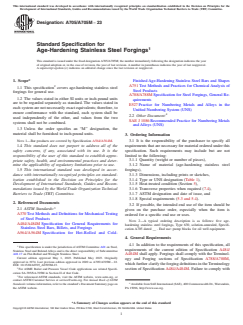
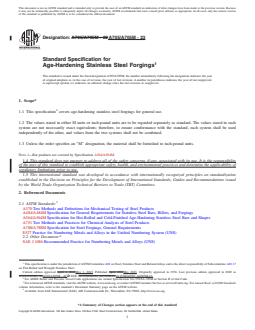
1.1 This specification2 covers age-hardening stainless steel forgings for general use.
1.2 The values stated in either SI units or inch-pound units are to be regarded separately as standard. The values stated in each system are not necessarily exact equivalents; therefore, to ensure conformance with the standard, each system shall be used independently of the other, and values from the two systems shall not be combined.
1.3 Unless the order specifies an “M” designation, the material shall be furnished to inch-pound units.
Note 1: Bar products are covered by Specification A564/A564M.
1.4 This standard does not purport to address all of the safety concerns, if any, associated with its use. It is the responsibility of the user of this standard to establish appropriate safety, health, and environmental practices and determine the applicability of regulatory limitations prior to use.
1.5 This international standard was developed in accordance with internationally recognized principles on standardization established in the Decision on Principles for the Development of International Standards, Guides and Recommendations issued by the World Trade Organization Technical Barriers to Trade (TBT) Committee.
- Status
- Published
- Publication Date
- 30-Apr-2023
- Technical Committee
- A01 - Steel, Stainless Steel and Related Alloys
- Drafting Committee
- A01.17 - Flat-Rolled and Wrought Stainless Steel
Buy Documents
ASTM A705/A705M-23 - Standard Specification for Age-Hardening Stainless Steel Forgings
REDLINE ASTM A705/A705M-23 - Standard Specification for Age-Hardening Stainless Steel Forgings
Overview
ASTM A705/A705M-23: Standard Specification for Age-Hardening Stainless Steel Forgings establishes requirements for age-hardening stainless steel forgings intended for general use. This international standard, developed by ASTM, covers forgings manufactured from billets or bars that are formed via forging, rolling, or casting-or as cut sections from ingots. The specification defines properties and testing criteria vital to ensure forgings meet the expectations for mechanical performance and chemical composition. ASTM A705/A705M supports both SI and inch-pound units, regulating their use independently to guarantee accuracy and compliance.
Key Topics
- Scope and Applicability: Addresses the requirements for age-hardening stainless steel forgings, encompassing a broad range of industrial and commercial applications.
- Material Requirements: Specifies that eligible steel originates from billets or bars using approved manufacturing processes-such as forging, rolling, or sectioning from ingots.
- Heat Treatment: Mandates solution annealing and age hardening to achieve desired mechanical and physical characteristics.
- Mechanical Properties: Forgings must comply with standards for tensile strength, yield strength, elongation, reduction of area, hardness, and impact resistance using Charpy-V notch testing.
- Chemical Composition: Strict limits on essential elements-including carbon, manganese, phosphorus, sulfur, silicon, chromium, nickel, aluminum, molybdenum, titanium, copper, nitrogen, columbium (niobium), and tantalum-ensure material consistency.
- Ordering Requirements: Purchasers must specify details such as quantity, type or UNS designation, dimensions, heat treatment, and any additional requirements to ensure product suitability.
Applications
ASTM A705/A705M-23 age-hardening stainless steel forgings play a critical role in industries where high strength, toughness, and corrosion resistance are essential. The specification is widely applied in:
- Oil and Gas: Used for pump blocks, valve components, and high-performance connectors.
- Aerospace: Utilized in landing gear, engine components, and fasteners where strength-to-weight ratio and resistance to corrosion are vital.
- Power Generation: Forgings for turbine parts and structural applications requiring durability.
- Manufacturing Equipment: Components subject to cyclic loading, wear, or challenging environments.
The ability to tailor mechanical properties through specified heat treatments enhances their suitability for demanding service conditions. Product consistency and rigorous testing ensure forgings reliably meet quality and safety expectations within these critical sectors.
Related Standards
Several standards intersect with ASTM A705/A705M-23, providing additional requirements for mechanical testing, material specification, and industry-specific applications:
- ASTM A370 - Test Methods and Definitions for Mechanical Testing of Steel Products.
- ASTM A484/A484M - General Requirements for Stainless Steel Bars, Billets, and Forgings.
- ASTM A564/A564M - Hot-Rolled and Cold-Finished Age-Hardening Stainless Steel Bars and Shapes.
- ASTM A751 - Test Methods and Practices for Chemical Analysis of Steel Products.
- ASTM A788/A788M - General Requirements for Steel Forgings.
- SAE J1086 - Practice for Numbering Metals and Alloys (UNS system).
Practical Value
Adopting ASTM A705/A705M-23:
- Ensures consistency in supply chains with clear, internationally recognized requirements.
- Reduces risk of material failure through detailed mechanical and chemical property verification.
- Supports certification and compliance for safety-critical applications in regulated industries.
- Optimizes performance by facilitating the selection of age-hardening stainless steel forgings tailored to specific engineering demands.
For reliable, high-strength stainless steel forgings, adherence to ASTM A705/A705M-23 is an industry best practice, enhancing product quality and customer confidence.
Relations
- Effective Date
- 01-Mar-2024
- Effective Date
- 01-Jan-2024
- Effective Date
- 01-Sep-2023
- Effective Date
- 01-Mar-2023
- Effective Date
- 05-May-2020
- Effective Date
- 01-Sep-2019
- Effective Date
- 01-Jul-2019
- Effective Date
- 01-May-2019
- Effective Date
- 01-May-2019
- Effective Date
- 01-Nov-2018
- Effective Date
- 01-Nov-2018
- Effective Date
- 01-Sep-2018
- Effective Date
- 01-Mar-2018
- Effective Date
- 01-Jan-2018
- Refers
ASTM A370-17a - Standard Test Methods and Definitions for Mechanical Testing of Steel Products - Effective Date
- 15-Nov-2017
Buy Documents
ASTM A705/A705M-23 - Standard Specification for Age-Hardening Stainless Steel Forgings
REDLINE ASTM A705/A705M-23 - Standard Specification for Age-Hardening Stainless Steel Forgings
Get Certified
Connect with accredited certification bodies for this standard

Element Materials Technology
Materials testing and product certification.

Inštitut za kovinske materiale in tehnologije
Institute of Metals and Technology. Materials testing, metallurgical analysis, NDT.
Sponsored listings
Frequently Asked Questions
ASTM A705/A705M-23 is a technical specification published by ASTM International. Its full title is "Standard Specification for Age-Hardening Stainless Steel Forgings". This standard covers: ABSTRACT This specification covers age-hardening stainless steel forgings for general use. Materials for forgings shall consist of billets or bars and shall either be forged, rolled, or cast or a section cut from an ingot. The steel specimens shall be solution annealed and age hardened and shall conform to the required values of tensile strength, yield strength, elongation, reduction of area, hardness and impact Charpy-V. The steel materials shall conform to the required chemical compositions of carbon, manganese, phosphorus, sulfur, silicon, chromium, nickel, aluminum, molybdenum, titanium, copper, nitrogen, columbium, and tantalum. SCOPE 1.1 This specification2 covers age-hardening stainless steel forgings for general use. 1.2 The values stated in either SI units or inch-pound units are to be regarded separately as standard. The values stated in each system are not necessarily exact equivalents; therefore, to ensure conformance with the standard, each system shall be used independently of the other, and values from the two systems shall not be combined. 1.3 Unless the order specifies an “M” designation, the material shall be furnished to inch-pound units. Note 1: Bar products are covered by Specification A564/A564M. 1.4 This standard does not purport to address all of the safety concerns, if any, associated with its use. It is the responsibility of the user of this standard to establish appropriate safety, health, and environmental practices and determine the applicability of regulatory limitations prior to use. 1.5 This international standard was developed in accordance with internationally recognized principles on standardization established in the Decision on Principles for the Development of International Standards, Guides and Recommendations issued by the World Trade Organization Technical Barriers to Trade (TBT) Committee.
ABSTRACT This specification covers age-hardening stainless steel forgings for general use. Materials for forgings shall consist of billets or bars and shall either be forged, rolled, or cast or a section cut from an ingot. The steel specimens shall be solution annealed and age hardened and shall conform to the required values of tensile strength, yield strength, elongation, reduction of area, hardness and impact Charpy-V. The steel materials shall conform to the required chemical compositions of carbon, manganese, phosphorus, sulfur, silicon, chromium, nickel, aluminum, molybdenum, titanium, copper, nitrogen, columbium, and tantalum. SCOPE 1.1 This specification2 covers age-hardening stainless steel forgings for general use. 1.2 The values stated in either SI units or inch-pound units are to be regarded separately as standard. The values stated in each system are not necessarily exact equivalents; therefore, to ensure conformance with the standard, each system shall be used independently of the other, and values from the two systems shall not be combined. 1.3 Unless the order specifies an “M” designation, the material shall be furnished to inch-pound units. Note 1: Bar products are covered by Specification A564/A564M. 1.4 This standard does not purport to address all of the safety concerns, if any, associated with its use. It is the responsibility of the user of this standard to establish appropriate safety, health, and environmental practices and determine the applicability of regulatory limitations prior to use. 1.5 This international standard was developed in accordance with internationally recognized principles on standardization established in the Decision on Principles for the Development of International Standards, Guides and Recommendations issued by the World Trade Organization Technical Barriers to Trade (TBT) Committee.
ASTM A705/A705M-23 is classified under the following ICS (International Classification for Standards) categories: 77.140.85 - Iron and steel forgings. The ICS classification helps identify the subject area and facilitates finding related standards.
ASTM A705/A705M-23 has the following relationships with other standards: It is inter standard links to ASTM A370-24, ASTM A484/A484M-24, ASTM A484/A484M-23a, ASTM A484/A484M-23, ASTM A484/A484M-20a, ASTM A484/A484M-19, ASTM A370-19, ASTM A788/A788M-19, ASTM A564/A564M-19, ASTM A788/A788M-18b, ASTM A484/A484M-18a, ASTM A788/A788M-18a, ASTM A788/A788M-18, ASTM A484/A484M-18, ASTM A370-17a. Understanding these relationships helps ensure you are using the most current and applicable version of the standard.
ASTM A705/A705M-23 is available in PDF format for immediate download after purchase. The document can be added to your cart and obtained through the secure checkout process. Digital delivery ensures instant access to the complete standard document.
Standards Content (Sample)
This international standard was developed in accordance with internationally recognized principles on standardization established in the Decision on Principles for the
Development of International Standards, Guides and Recommendations issued by the World Trade Organization Technical Barriers to Trade (TBT) Committee.
Designation: A705/A705M − 23
Standard Specification for
Age-Hardening Stainless Steel Forgings
This standard is issued under the fixed designation A705/A705M; the number immediately following the designation indicates the year
of original adoption or, in the case of revision, the year of last revision. A number in parentheses indicates the year of last reapproval.
A superscript epsilon (´) indicates an editorial change since the last revision or reapproval.
1. Scope* Finished Age-Hardening Stainless Steel Bars and Shapes
A751 Test Methods and Practices for Chemical Analysis of
1.1 This specification covers age-hardening stainless steel
Steel Products
forgings for general use.
A788/A788M Specification for Steel Forgings, General Re-
1.2 The values stated in either SI units or inch-pound units
quirements
are to be regarded separately as standard. The values stated in
E527 Practice for Numbering Metals and Alloys in the
each system are not necessarily exact equivalents; therefore, to
Unified Numbering System (UNS)
ensure conformance with the standard, each system shall be
2.2 Other Document:
used independently of the other, and values from the two
SAE J 1086 Recommended Practice for Numbering Metals
systems shall not be combined.
and Alloys (UNS)
1.3 Unless the order specifies an “M” designation, the
material shall be furnished to inch-pound units.
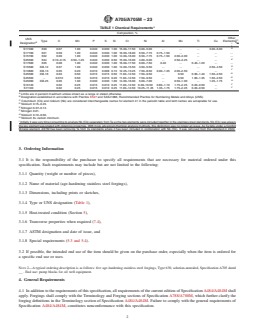
3. Ordering Information
NOTE 1—Bar products are covered by Specification A564/A564M.
3.1 It is the responsibility of the purchaser to specify all
requirements that are necessary for material ordered under this
1.4 This standard does not purport to address all of the
safety concerns, if any, associated with its use. It is the specification. Such requirements may include but are not
limited to the following:
responsibility of the user of this standard to establish appro-
priate safety, health, and environmental practices and deter- 3.1.1 Quantity (weight or number of pieces),
3.1.2 Name of material (age-hardening stainless steel
mine the applicability of regulatory limitations prior to use.
1.5 This international standard was developed in accor- forgings),
3.1.3 Dimensions, including prints or sketches,
dance with internationally recognized principles on standard-
ization established in the Decision on Principles for the 3.1.4 Type or UNS designation (Table 1),
3.1.5 Heat-treated condition (Section 5),
Development of International Standards, Guides and Recom-
mendations issued by the World Trade Organization Technical 3.1.6 Transverse properties when required (7.4),
Barriers to Trade (TBT) Committee. 3.1.7 ASTM designation and date of issue, and
3.1.8 Special requirements (5.3 and 5.4).
2. Referenced Documents
3.2 If possible, the intended end use of the item should be
2.1 ASTM Standards:
given on the purchase order, especially when the item is
A370 Test Methods and Definitions for Mechanical Testing
ordered for a specific end use or uses.
of Steel Products
NOTE 2—A typical ordering description is as follows: five age-
A484/A484M Specification for General Requirements for
hardening stainless steel forgings, Type 630, solution-annealed, Specifi-
Stainless Steel Bars, Billets, and Forgings
cation A705 dated __ . End use: pump blocks for oil well equipment.
A564/A564M Specification for Hot-Rolled and Cold-
4. General Requirements
4.1 In addition to the requirements of this specification, all
This specification is under the jurisdiction of ASTM Committee A01 on Steel,
requirements of the current edition of Specification A484/
Stainless Steel and Related Alloys and is the direct responsibility of Subcommittee
A01.17 on Flat-Rolled and Wrought Stainless Steel.
A484M shall apply. Forgings shall comply with the Terminol-
Current edition approved May 1, 2023. Published May 2023. Originally
ogy and Forging sections of Specification A788/A788M,
approved in 1974. Last previous edition approved in 2020 as A705/A705M – 22.
which further clarify the forging definitions in the Terminology
DOI: 10.1520/A0705_A0705M-23.
section of Specification A484/A484M. Failure to comply with
For ASME Boiler and Pressure Vessel Code applications see related Specifi-
cation SA-705/SA-705M in Section II of that Code.
For referenced ASTM standards, visit the ASTM website, www.astm.org, or
contact ASTM Customer Service at service@astm.org. For Annual Book of ASTM
Standards volume information, refer to the standard’s Document Summary page on Available from SAE International (SAE), 400 Commonwealth Dr., Warrendale,
the ASTM website. PA 15096, http://www.sae.org.
*A Summary of Changes section appears at the end of this standard
Copyright © ASTM International, 100 Barr Harbor Drive, PO Box C700, West Conshohocken, PA 19428-2959. United States
A705/A705M − 23
A
TABLE 1 Chemical Requirements
Composition, %
Other
UNS C,
Type C Mn P S Si Cr Ni Al Mo Ti Cu Elements
B
Designation
I
D
S17400 630 0.07 1.00 0.040 0.030 1.00 15.00–17.50 3.00–5.00 . . . 3.00–5.00
S17700 631 0.09 1.00 0.040 0.030 1.00 16.00–18.00 6.50–7.75 0.75–1.50 . . . .
S15700 632 0.09 1.00 0.040 0.030 1.00 14.00–16.00 6.50–7.75 0.75–1.50 2.00–3.00 . . .
E
S35500 634 0.10–0.15 0.50–1.25 0.040 0.030 0.50 15.00–16.00 4.00–5.00 . 2.50–3.25 . .
S17600 635 0.08 1.00 0.040 0.030 1.00 16.00–17.50 6.00–7.50 0.40 . 0.40–1.20 . .
D
S15500 XM-12 0.07 1.00 0.040 0.030 1.00 14.00–15.50 3.50–5.50 . . . 2.50–4.50
F
S13800 XM-13 0.05 0.20 0.010 0.008 0.10 12.25–13.25 7.50–8.50 0.90–1.35 2.00–2.50 . .
G
S45500 XM-16 0.03 0.50 0.015 0.015 0.50 11.00–12.50 7.50–9.50 . 0.50 0.90–1.40 1.50–2.50
G
S45503 . 0.010 0.50 0.010 0.010 0.20 11.00–12.50 7.50–9.50 . 0.50 1.00–1.35 1.50–2.50
H
S45000 XM-25 0.05 1.00 0.030 0.030 1.00 14.00–16.00 5.00–7.00 . 0.50–1.00 . 1.25–1.75
F
S10120 0.02 0.25 0.015 0.010 0.25 11.00–12.50 9.00–10.50 0.80–1.10 1.75–2.25 0.20–0.50 .
F
S11100 0.02 0.25 0.015 0.010 0.25 11.00–12.50 10.25–11.25 1.35–1.75 1.75–2.25 0.20–0.50 .
A
Limits are in percent maximum unless shown as a range or stated otherwise.
B
Designation established in accordance with Practice E527 and SAEJ1086, Recommended Practice for Numbering Metals and Alloys (UNS).
C
Columbium (Cb) and niobium (Nb) are considered interchangeable names for element 41 in the periodic table and both names are acceptable for use.
D
Niobium 0.15–0.45.
E
Nitrogen 0.07–0.13.
F
Nitrogen 0.01.
G
Niobium 0.10–0.50.
H
Niobium 8× carbon minimum.
I
Initially it was very time consuming to analyze Nb (Cb) separately from Ta so the two elements were included together in the stainless steel standards. Nb (Cb) was always
the key element associated with obtaining properties. With more advanced chemical analysis methods, this distinction was no longer an issue. As Ta falls under a Conflict
Mineral element, ASTM has been removing Ta from its standards where it has been included in combination with Nb (Cb). It was removed from this standard in 2022.
the general requirements of Specification A484/A484M, con- 6. Chemical Composition
stitutes nonconformance with this specification.
6.1 The steel shall conform to the chemical composition
limits specified in Table 1.
5. Materials and Manufacture
6.2 Methods and practices relating to chemical analysis
5.1 Material for forgings shall consist of billets or bars,
required by this specification shall be in accordance with Test
either forged, rolled, or cast, or a section cut from an ingot. The
Methods, Practices, and Terminology A751.
cuts shall be made to the required length by a suitable process.
This material may be specified to Specification A564/A564M.
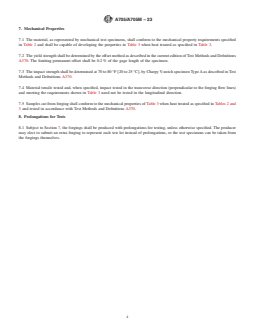
7. Mechanical Properties
5.2 The material shall be forged by hammering, pressing,
rolling, extruding, or upsetting to produce a wrought structure 7.1 The material, as represented by mechanical test
throughout and shall be brought as nearly as possible to the specimens, shall conform to the mechanical property require-
finished shape and size by hot working.
ments specified in Table 2 and shall be capable of developing
the properties in Table 3 when heat treated as specified in Table
5.3 When specified on the order, sample forging may be
3.
sectioned and etched to show flow lines and the condition in
regard to internal imperfections. When so specified, the ques-
7.2 The yield strength shall be determined by the offset
tion of acceptable and unacceptable metal flow shall be subject
method as described in the current edition of Test Methods and
to agreement between the manufacturer and the purchaser prior
Definitions A370. The limiting permanent offset shall be 0.2 %
to order entry.
of the gage length of the specimen.
5.4 When specified on the order, the manufacturer shall
7.3 The impact strength shall be determined at 70 to 80 °F
submit for approval of the purchaser a sketch showing the
[20 to 25 °C], by Charpy V-notch specimen Type A as
shape of the rough forging before machining, or before heat
described in Test Methods and Definitions A370.
treating for mechanical properties.
7.4 Material tensile tested and, when specified, impact
5.5 The grain size shall be as fine as practicable and
tested in the transverse direction (perpendicular to the forging
precautions shall be taken to minimize grain growth.
flow lines) and meeting the requirements shown in Table 3
5.6 Material of types other than XM-9 shall be furnished in
need not be tested in the longitudinal direction.
the solution-annealed condition, or in the equalized and over-
tempered condition, as noted in Table 2, unless otherwise 7.5 Samples cut from forging shall conform to the mechani-
specified by the purchaser. cal properties of Table 3 when heat treated as specified in
Tables 2 and 3 and tested in accordance with Test Methods and
5.6.1 Types 630, XM-16, and XM-25 may be furnished in
the solution-annealed or age-hardened condition. Definitions A370.
A705/A705M − 23
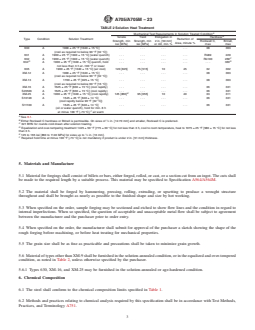
TABLE 2 Solution Heat Treatment
A
Mechanical Test Requirements in Solution Treated Condition
B
Tensile Yield Elongation in Hardness
Type Condition Solution Treatment Reduction of
Strength, min Strength, min 2 in. [50 mm] Rockwell C, Brinell,
Area, minute %
ksi [MPa] ksi [MPa] or 4D, min. % max max
630 A 1900 ± 25 °F [1040 ± 15 °C] . . . . . . . . . . . . 38 363
(cool as required to below 90 °F [32 °C])
631 A 1900 ± 25 °F [1040 ± 15 °C] (water quench) . . . . . . . . . . . . Rb89 229
C
632 A 1900 ± 25 °F [1040 ± 15 °C] (water quench) . . . . . . . . . . . . Rb100 269
D D
634 A 1900 ± 25 °F [1040 ± 15 °C] quench, hold . . . . . . . . . . . . . . . 363
not less than 3 h at -100 °F or lower
635 A 1900 ± 25 °F [1040 ± 15 °C] (air cool) 120 [825] 75 [515] 10 45 32 302
XM-12 A 1900 ± 25 °F [1040 ± 15 °C] . . . . . . . . . . . . 38 363
(cool as required to below 90 °F [32 °C])
XM-13 A 1700 ± 25 °F [925 ± 15 °C] . . . . . . . . . . . . 38 363
(cool as required to below 60 °F [16 °C])
XM-16 A 1525 ± 25 °F [830 ± 15 °C] (cool rapidly) . . . . . . . . . . . . 36 331
S45503 A 1525 ± 25 °F [830 ± 15 °C] (cool rapidly) . . . . . . . . . . . . 36 331
E
XM-25 A 1900 ± 25 °F [1040 ± 15 °C] (cool rapidly) 125 [860] 95 [655] 10 40 33 311
S10120 A 1545 ± 25 °F [840 ± 14 °C] . . . . . . . . . . . . 36 331
(cool rapidly below 90 °F [32 °C])
S11100 A 1545 ± 25 °F [840 ± 14 °C] . . . . . . . . . . . . 36 331
(oil or water quench), hold for min. 8 h
F
at minus 100 °F [-73 °C], air warm
A
See 6.1.
B
Either Rockwell C hardness or Brinell is permissible. On sizes of ⁄2 in. [12.70 mm] and smaller, Rockwell C is preferred.
C
321 BHN for rounds cold drawn after solution treating.
D
Equalization and over-tempering treatment 1425 ± 50 °F [775 ± 30 °C] for not less than 3 h, cool to room temperature, heat to 1075 ± 25 °F [580 ± 15 °C] for not less
than 3 h.
E
125 to 165 ksi [860 to 1140 MPa] for sizes up to ⁄2 in. [13 mm].
F
Required hold time at minus 100 °F [-73 °C] is not mandatory if product is under 2 in. [51 mm] thickness.
8. Prolongations for Tests producer may elect to submit an extra forging to represent each
test lot instead of prolongations, or the test specimens can be
8.1 Subject to Section 7, the forgings shall be produced with
taken from the forgings themselves.
prolongations for testing, unless otherwise specified. The
...
This document is not an ASTM standard and is intended only to provide the user of an ASTM standard an indication of what changes have been made to the previous version. Because
it may not be technically possible to adequately depict all changes accurately, ASTM recommends that users consult prior editions as appropriate. In all cases only the current version
of the standard as published by ASTM is to be considered the official document.
Designation: A705/A705M − 22 A705/A705M − 23
Standard Specification for
Age-Hardening Stainless Steel Forgings
This standard is issued under the fixed designation A705/A705M; the number immediately following the designation indicates the year
of original adoption or, in the case of revision, the year of last revision. A number in parentheses indicates the year of last reapproval.
A superscript epsilon (´) indicates an editorial change since the last revision or reapproval.
1. Scope*
1.1 This specification covers age-hardening stainless steel forgings for general use.
1.2 The values stated in either SI units or inch-pound units are to be regarded separately as standard. The values stated in each
system are not necessarily exact equivalents; therefore, to ensure conformance with the standard, each system shall be used
independently of the other, and values from the two systems shall not be combined.
1.3 Unless the order specifies an “M” designation, the material shall be furnished to inch-pound units.
NOTE 1—Bar products are covered by Specification A564/A564M.
1.4 This standard does not purport to address all of the safety concerns, if any, associated with its use. It is the responsibility
of the user of this standard to establish appropriate safety, health, and environmental practices and determine the applicability of
regulatory limitations prior to use.
1.5 This international standard was developed in accordance with internationally recognized principles on standardization
established in the Decision on Principles for the Development of International Standards, Guides and Recommendations issued
by the World Trade Organization Technical Barriers to Trade (TBT) Committee.
2. Referenced Documents
2.1 ASTM Standards:
A370 Test Methods and Definitions for Mechanical Testing of Steel Products
A484/A484M Specification for General Requirements for Stainless Steel Bars, Billets, and Forgings
A564/A564M Specification for Hot-Rolled and Cold-Finished Age-Hardening Stainless Steel Bars and Shapes
A751 Test Methods and Practices for Chemical Analysis of Steel Products
A788/A788M Specification for Steel Forgings, General Requirements
E527 Practice for Numbering Metals and Alloys in the Unified Numbering System (UNS)
2.2 Other Document:
SAE J 1086 Recommended Practice for Numbering Metals and Alloys (UNS)
This specification is under the jurisdiction of ASTM Committee A01 on Steel, Stainless Steel and Related Alloys and is the direct responsibility of Subcommittee A01.17
on Flat-Rolled and Wrought Stainless Steel.
Current edition approved April 1, 2022May 1, 2023. Published April 2022May 2023. Originally approved in 1974. Last previous edition approved in 2020 as
ɛ1
A705/A705M – 20A705/A705M – 22. . DOI: 10.1520/A0705_A0705M-22.10.1520/A0705_A0705M-23.
For ASME Boiler and Pressure Vessel Code applications see related Specification SA-705/SA-705M in Section II of that Code.
For referenced ASTM standards, visit the ASTM website, www.astm.org, or contact ASTM Customer Service at service@astm.org. For Annual Book of ASTM Standards
volume information, refer to the standard’s Document Summary page on the ASTM website.
Available from SAE International (SAE), 400 Commonwealth Dr., Warrendale, PA 15096, http://www.sae.org.
*A Summary of Changes section appears at the end of this standard
Copyright © ASTM International, 100 Barr Harbor Drive, PO Box C700, West Conshohocken, PA 19428-2959. United States
A705/A705M − 23
A
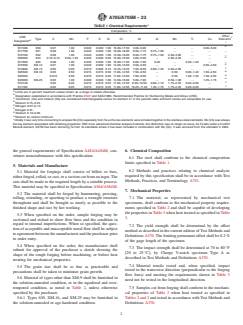
TABLE 1 Chemical Requirements
Composition, %
Other
UNS
C
C,
Type C Mn P S Si Cr Ni Al Mo Ti Cu Elements
B
Designation
I
D
S17400 630 0.07 1.00 0.040 0.030 1.00 15.00–17.50 3.00–5.00 . . . 3.00–5.00
S17700 631 0.09 1.00 0.040 0.030 1.00 16.00–18.00 6.50–7.75 0.75–1.50 . . . .
S15700 632 0.09 1.00 0.040 0.030 1.00 14.00–16.00 6.50–7.75 0.75–1.50 2.00–3.00 . . .
E
S35500 634 0.10–0.15 0.50–1.25 0.040 0.030 0.50 15.00–16.00 4.00–5.00 . 2.50–3.25 . .
S17600 635 0.08 1.00 0.040 0.030 1.00 16.00–17.50 6.00–7.50 0.40 . 0.40–1.20 . .
D
S15500 XM-12 0.07 1.00 0.040 0.030 1.00 14.00–15.50 3.50–5.50 . . . 2.50–4.50
F
S13800 XM-13 0.05 0.20 0.010 0.008 0.10 12.25–13.25 7.50–8.50 0.90–1.35 2.00–2.50 . .
G
S45500 XM-16 0.03 0.50 0.015 0.015 0.50 11.00–12.50 7.50–9.50 . 0.50 0.90–1.40 1.50–2.50
G
S45503 . 0.010 0.50 0.010 0.010 0.20 11.00–12.50 7.50–9.50 . 0.50 1.00–1.35 1.50–2.50
H
S45000 XM-25 0.05 1.00 0.030 0.030 1.00 14.00–16.00 5.00–7.00 . 0.50–1.00 . 1.25–1.75
F
S10120 0.02 0.25 0.015 0.010 0.25 11.00–12.50 9.00–10.50 0.80–1.10 1.75–2.25 0.20–0.50 .
F
S11100 0.02 0.25 0.015 0.010 0.25 11.00–12.50 10.25–11.25 1.35–1.75 1.75–2.25 0.20–0.50 .
A
Limits are in percent maximum unless shown as a range or stated otherwise.
B
Designation established in accordance with Practice E527 and SAEJ1086, Recommended Practice for Numbering Metals and Alloys (UNS).
C
Columbium (Cb) and niobium (Nb) are considered interchangeable names for element 41 in the periodic table and both names are acceptable for use.
D
Niobium 0.15–0.45.
E
Nitrogen 0.07–0.13.
F
Nitrogen 0.01.
G
Niobium 0.10–0.50.
H
Niobium 8× carbon minimum.
I
Initially it was very time consuming to analyze Nb (Cb) separately from Ta so the two elements were included together in the stainless steel standards. Nb (Cb) was always
the key element associated with obtaining properties. With more advanced chemical analysis methods, this distinction was no longer an issue. As Ta falls under a Conflict
Mineral element, ASTM has been removing Ta from its standards where it has been included in combination with Nb (Cb). It was removed from this standard in 2022.
3. Ordering Information
3.1 It is the responsibility of the purchaser to specify all requirements that are necessary for material ordered under this
specification. Such requirements may include but are not limited to the following:
3.1.1 Quantity (weight or number of pieces),
3.1.2 Name of material (age-hardening stainless steel forgings),
3.1.3 Dimensions, including prints or sketches,
3.1.4 Type or UNS designation (Table 1),
3.1.5 Heat-treated condition (Section 5),
3.1.6 Transverse properties when required (7.4),
3.1.7 ASTM designation and date of issue, and
3.1.8 Special requirements (5.3 and 5.4).
3.2 If possible, the intended end use of the item should be given on the purchase order, especially when the item is ordered for
a specific end use or uses.
NOTE 2—A typical ordering description is as follows: five age-hardening stainless steel forgings, Type 630, solution-annealed, Specification A705 dated
__ . End use: pump blocks for oil well equipment.
4. General Requirements
4.1 In addition to the requirements of this specification, all requirements of the current edition of Specification A484/A484M shall
apply. Forgings shall comply with the Terminology and Forging sections of Specification A788/A788M, which further clarify the
forging definitions in the Terminology section of Specification A484/A484M. Failure to comply with the general requirements of
Specification A484/A484M, constitutes nonconformance with this specification.
A705/A705M − 23
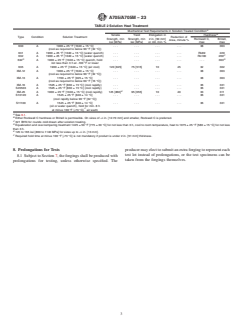
TABLE 2 Solution Heat Treatment
A
Mechanical Test Requirements in Solution Treated Condition
B
Tensile Yield Elongation in Hardness
Type Condition Solution Treatment Reduction of
Strength, min Strength, min 2 in. [50 mm] Rockwell C, Brinell,
Area, minute %
ksi [MPa] ksi [MPa] or 4D, min. % max max
630 A 1900 ± 25 °F [1040 ± 15 °C] . . . . . . . . . . . . 38 363
(cool as required to below 90 °F [32 °C])
631 A 1900 ± 25 °F [1040 ± 15 °C] (water quench) . . . . . . . . . . . . Rb89 229
C
632 A 1900 ± 25 °F [1040 ± 15 °C] (water quench) . . . . . . . . . . . . Rb100 269
D D
634 A 1900 ± 25 °F [1040 ± 15 °C] quench, hold . . . . . . . . . . . . . . . 363
not less than 3 h at -100 °F or lower
635 A 1900 ± 25 °F [1040 ± 15 °C] (air cool) 120 [825] 75 [515] 10 45 32 302
XM-12 A 1900 ± 25 °F [1040 ± 15 °C] . . . . . . . . . . . . 38 363
(cool as required to below 90 °F [32 °C])
XM-13 A 1700 ± 25 °F [925 ± 15 °C] . . . . . . . . . . . . 38 363
(cool as required to below 60 °F [16 °C])
XM-16 A 1525 ± 25 °F [830 ± 15 °C] (cool rapidly) . . . . . . . . . . . . 36 331
S45503 A 1525 ± 25 °F [830 ± 15 °C] (cool rapidly) . . . . . . . . . . . . 36 331
E
XM-25 A 1900 ± 25 °F [1040 ± 15 °C] (cool rapidly) 125 [860] 95 [655] 10 40 33 311
S10120 A 1545 ± 25 °F [840 ± 14 °C] . . . . . . . . . . . . 36 331
(cool rapidly below 90 °F [32 °C])
S11100 A 1545 ± 25 °F [840 ± 14 °C] . . . . . . . . . . . . 36 331
(oil or water quench), hold for min. 8 h
F
at minus 100 °F [-73 °C], air warm
A
See 6.1.
B
Either Rockwell C hardness or Brinell is permissible. On sizes of ⁄2 in. [12.70 mm] and smaller, Rockwell C is preferred.
C
321 BHN for rounds cold drawn after solution treating.
D
Equalization and over-tempering treatment 1425 ± 50 °F [775 ± 30 °C] for not less than 3 h, cool to room temperature, heat to 1075 ± 25 °F [580 ± 15 °C] for not less
than 3 h.
E
125 to 165 ksi [860 to 1140 MPa] for sizes up to ⁄2 in. [13 mm].
F
Required hold time at minus 100 °F [-73 °C] is not mandatory if product is under 2 in. [51 mm] thickness.
5. Materials and Manufacture
5.1 Material for forgings shall consist of billets or bars, either forged, rolled, or cast, or a section cut from an ingot. The cuts shall
be made to the required length by a suitable process. This material may be specified to Specification A564/A564M.
5.2 The material shall be forged by hammering, pressing, rolling, extruding, or upsetting to produce a wrought structure
throughout and shall be brought as nearly as possible to the finished shape and size by hot working.
5.3 When specified on the order, sample forging may be sectioned and etched to show flow lines and the condition in regard to
internal imperfections. When so specified, the question of acceptable and unacceptable metal flow shall be subject to agreement
between the manufacturer and the purchaser prior to order entry.
5.4 When specified on the order, the manufacturer shall submit for approval of the purchaser a sketch showing the shape of the
rough forging before machining, or before heat treating for mechanical properties.
5.5 The grain size shall be as fine as practicable and precautions shall be taken to minimize grain growth.
5.6 Material of types other than XM-9 shall be furnished in the solution-annealed condition, or in the equalized and over-tempered
condition, as noted in Table 2, unless otherwise specified by the purchaser.
5.6.1 Types 630, XM-16, and XM-25 may be furnished in the solution-annealed or age-hardened condition.
6. Chemical Composition
6.1 The steel shall conform to the chemical composition limits specified in Table 1.
6.2 Methods and practices relating to chemical analysis required by this specification shall be in accordance with Test Methods,
Practices, and Terminology A751.
A705/A705M − 23
7. Mechanical Properties
7.1 The material, as represented by mechanical test specimens, shall conform to the mechanical property requirements specified
in Table 2 and shall be capable of developing the properties in Table 3 when heat treated as specified in Table 3.
7.2 The yield strength shall be determined by the offset method as described in the current edition of Test Methods and Definitions
A370. The limiting permanent offset shall be 0.2 % of the gage length of the specimen.
7.3 The impact strength shall be determined at 70 to 80 °F [20 to 25 °C], by Charpy V-notch specimen Type A as described in Test
Methods and Definitions A370.
7.4 Material tensile tested and, when specified, impact tested in the transverse direction (perpendicular to the forging flow lines)
and meeting the requirements shown in Table 3 need not be tested in the longitudinal direction.
7.5 Samples cut from forging shall conform to the mechanical properties of Table 3 when heat treated as specified in Tables 2 and
3 and tested in accordance with Test Methods and Definitions A370.
8. Prolongations for Tests
8.1 Subject to Section 7, the forgings shall be produced with prolongations for testing, unless otherwise specified. The producer
may elect to submit an extra forging to represent each test lot instead of prolongations, or the test specimens can be taken from
the forgings themselves.
A705/A705M − 23
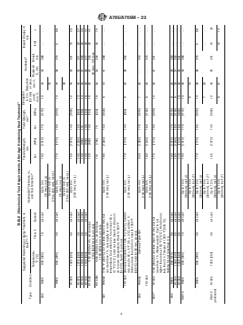
A
TABLE 3 Mechanical Test Requirements After Age Hardening Heat Treatment
Elongation
Suggested Hardening or Aging Treatment, or Tensile Strength, Yield Strength, Impact Charpy-V,
G
Hardness
B,C,D F
in 2 in. Reduction
Both min min min
Applicable Thickness, in.,
Type Condition
...