

ASTM D7750-23
(Test Method)Standard Test Method for Cure Behavior of Thermosetting Resins by Dynamic Mechanical Procedures using an Encapsulated Specimen Rheometer
General Information
- Abstract
SIGNIFICANCE AND USE
5.1 This method provides a simple means of characterizing the cure behavior of a thermosetting resin specimen that is a representation of a composite part. The diameter of the specimen is approximately 38 mm and the thickness ranges from 2.6 mm to 3.2 mm. This corresponds to a sample volume of approximately 3 cm3 to 4 cm3. The data may be used for quality control, research and development, and verifying the cure within processing equipment including autoclaves.
5.2 Dynamic mechanical testing provides a sensitive method for determining cure characteristics by measuring the elastic and loss moduli as a function of temperature or time, or both. Plots of cure behavior and tan delta of a material provide graphical representation indicative of cure behavior under a specified time-temperature profile. The presence of fibers within the resin may change the dynamic properties measured within a material. However, it is still possible to compare different resins with the same fiber structure and obtain the relative difference due to the resin cure properties.
5.3 This method can be used to assess the following:
5.3.1 Cure behavior, as well as changes as a function of temperature or time, or both,
5.3.2 Processing behavior, as well as changes as a function of temperature or time, or both,
5.3.3 The effects of processing treatments,
5.3.4 Relative resin behavioral properties, including cure behavior, damping and impact resistance,
5.3.5 The effects of reinforcement on cure; the reinforcement can be a fiber or a filler,
5.3.6 The effects of materials used to bond the resin and reinforcement,
5.3.7 The effect of formulation additives that might affect processability or performance.
5.4 This provides a method to assess the cure properties of a thermosetting resin containing woven fiber or other reinforcing materials.
5.5 This method is valid for a wide range of oscillation frequencies typically from 0.002 Hz to 50 Hz.
Note 1: It is recommended tha...
SCOPE
1.1 This method covers the use of dynamic mechanical instrumentation for determination and reporting of the thermal advancement of cure behavior of thermosetting resin on an inert filler or fiber in a laboratory. It may also be used for determining the cure properties of resins without fillers or fibers. These encapsulated specimens are deformed in torsional shear using dynamic mechanical methods.
1.2 This method is intended to provide means for determining the cure behavior of thermosetting resins on fibers over a range of temperatures from room temperature to 250 °C by forced-constant amplitude techniques (in accordance with Practice D4065). Plots of complex modulus, complex viscosity, and damping ratio or tan delta as a function of time or temperature, or both, quantify the thermal advancement or cure characteristics of a resin or a resin on filler or fiber.
1.3 Test data obtained by this method is relevant and appropriate for optimizing cure cycles.
1.4 The values stated in SI units are to be regarded as standard. No other units of measurement are included in this standard.
1.4.1 Exception—The Fahrenheit temperature measurement in 10.1 is provided for information only and is not considered standard.
1.5 This standard does not purport to address all of the safety concerns, if any, associated with its use. It is the responsibility of the user of this standard to establish appropriate safety, health, and environmental practices and determine the applicability of regulatory limitations prior to use.
1.6 This international standard was developed in accordance with internationally recognized principles on standardization established in the Decision on Principles for the Development of International Standards, Guides and Recommendations issued by the World Trade Organization Technical Barriers to Trade (TBT) Committee.
- Status
- Published
- Publication Date
- 31-Mar-2023
- Technical Committee
- D30 - Composite Materials
- Drafting Committee
- D30.03 - Constituent/Precursor Properties
Buy Documents
ASTM D7750-23 - Standard Test Method for Cure Behavior of Thermosetting Resins by Dynamic Mechanical Procedures using an Encapsulated Specimen Rheometer
REDLINE ASTM D7750-23 - Standard Test Method for Cure Behavior of Thermosetting Resins by Dynamic Mechanical Procedures using an Encapsulated Specimen Rheometer
Overview
ASTM D7750-23, “Standard Test Method for Cure Behavior of Thermosetting Resins by Dynamic Mechanical Procedures using an Encapsulated Specimen Rheometer,” provides a reliable laboratory method for characterizing the cure behavior of thermosetting resins. Using a dynamic mechanical analyzer (DMA) or encapsulated specimen rheometer, this test measures the thermal advancement of cure in resins - both with and without reinforcements such as fibers or fillers. This approach can be applied across a temperature range from room temperature up to 250°C, making it suitable for a variety of resin systems commonly used in composite manufacturing.
Dynamic mechanical analysis enables detailed evaluation of properties such as viscoelastic moduli and complex viscosity, producing data essential for quality control, research and development, process verification, and optimization within industrial settings, including autoclaves.
Key Topics
- Cure Behavior Assessment: The method provides precise determination of cure states, including the gel point and glass transition temperature (Tg), by analyzing how the elastic (storage) modulus and viscous (loss) modulus evolve with time and temperature.
- Processing Behavior Analysis: Enables monitoring of processing conditions and response to manufacturing treatments, supporting process optimization and troubleshooting.
- Reinforcement Effects: Evaluates the influence of various reinforcement types (fibers, fillers) and bonding agents on the cure kinetics and dynamic mechanical properties.
- Additives Evaluation: Assesses how additives or formulation changes impact processability and final performance.
- Frequency Range: Applicable for oscillation frequencies from 0.002 Hz to 50 Hz, offering flexibility for different material behaviors and testing protocols.
- Data Interpretation: Plots such as modulus, tan delta, and viscosity versus time or temperature provide a graphical representation of the curing process.
Applications
ASTM D7750-23 is widely used across industries specializing in polymer composites and thermosetting resins, including aerospace, automotive, wind energy, sporting goods, and construction. Practical applications include:
- Quality Control: Manufacturers use this standard to ensure incoming resin batches and final products consistently meet required curing specifications.
- Process Optimization: The method supports the development and refinement of cure cycles, maximizing performance and minimizing defects in composite parts.
- Material Development: R&D teams rely on the data to compare cure profiles among resin formulations, including the effects of new additives or reinforcements.
- Troubleshooting Production Issues: Inconsistent cure can lead to component failures. This test method helps identify and resolve such issues by simulating the thermal and mechanical conditions of processing.
- Verification of Composite Manufacturing: By mimicking autoclave or other processing environments, it validates that cure reactions are uniform across complex part geometries.
Related Standards
ASTM D7750-23 references a suite of related standards for composite materials and dynamic mechanical analysis:
- ASTM D4065 - Practice for Plastics: Dynamic Mechanical Properties: Determination and Report of Procedures
- ASTM D4473 - Test Method for Plastics: Dynamic Mechanical Properties: Cure Behavior
- ASTM D7028 - Test Method for Glass Transition Temperature (DMA Tg) of Polymer Matrix Composites by DMA
- ASTM D3878 - Terminology for Composite Materials
- ASTM D4092 - Terminology for Plastics: Dynamic Mechanical Properties
- ASTM D4000 - Classification System for Specifying Plastic Materials
- ASTM D6507 - Practice for Fiber Reinforcement Orientation Codes for Composite Materials
Adopting these referenced standards alongside ASTM D7750-23 ensures comprehensive, reliable testing and reporting of thermoset resin cure behavior for industrial and research applications.
Keywords: ASTM D7750-23, thermosetting resin cure, dynamic mechanical analysis, encapsulated specimen rheometer, composites quality control, cure behavior, gel point, glass transition temperature, viscoelastic properties, process optimization.
Relations
- Effective Date
- 01-Jan-2024
- Effective Date
- 15-Oct-2019
- Refers
ASTM D6507-19 - Standard Practice for Fiber Reinforcement Orientation Codes for Composite Materials - Effective Date
- 15-Oct-2019
- Effective Date
- 15-Apr-2019
- Effective Date
- 01-Apr-2018
- Effective Date
- 01-Aug-2016
- Refers
ASTM D6507-16 - Standard Practice for Fiber Reinforcement Orientation Codes for Composite Materials - Effective Date
- 01-Jul-2016
- Effective Date
- 01-Aug-2015
- Effective Date
- 01-Jul-2015
- Effective Date
- 01-May-2013
- Effective Date
- 01-May-2012
- Effective Date
- 01-Apr-2011
- Refers
ASTM D6507-11 - Standard Practice for Fiber Reinforcement Orientation Codes for Composite Materials - Effective Date
- 01-Mar-2011
- Effective Date
- 01-Jul-2010
- Effective Date
- 01-May-2010
Buy Documents
ASTM D7750-23 - Standard Test Method for Cure Behavior of Thermosetting Resins by Dynamic Mechanical Procedures using an Encapsulated Specimen Rheometer
REDLINE ASTM D7750-23 - Standard Test Method for Cure Behavior of Thermosetting Resins by Dynamic Mechanical Procedures using an Encapsulated Specimen Rheometer
Get Certified
Connect with accredited certification bodies for this standard

DIN CERTCO
DIN Group product certification.

Smithers Quality Assessments
US management systems and product certification.
Sponsored listings
Frequently Asked Questions
ASTM D7750-23 is a standard published by ASTM International. Its full title is "Standard Test Method for Cure Behavior of Thermosetting Resins by Dynamic Mechanical Procedures using an Encapsulated Specimen Rheometer". This standard covers: SIGNIFICANCE AND USE 5.1 This method provides a simple means of characterizing the cure behavior of a thermosetting resin specimen that is a representation of a composite part. The diameter of the specimen is approximately 38 mm and the thickness ranges from 2.6 mm to 3.2 mm. This corresponds to a sample volume of approximately 3 cm3 to 4 cm3. The data may be used for quality control, research and development, and verifying the cure within processing equipment including autoclaves. 5.2 Dynamic mechanical testing provides a sensitive method for determining cure characteristics by measuring the elastic and loss moduli as a function of temperature or time, or both. Plots of cure behavior and tan delta of a material provide graphical representation indicative of cure behavior under a specified time-temperature profile. The presence of fibers within the resin may change the dynamic properties measured within a material. However, it is still possible to compare different resins with the same fiber structure and obtain the relative difference due to the resin cure properties. 5.3 This method can be used to assess the following: 5.3.1 Cure behavior, as well as changes as a function of temperature or time, or both, 5.3.2 Processing behavior, as well as changes as a function of temperature or time, or both, 5.3.3 The effects of processing treatments, 5.3.4 Relative resin behavioral properties, including cure behavior, damping and impact resistance, 5.3.5 The effects of reinforcement on cure; the reinforcement can be a fiber or a filler, 5.3.6 The effects of materials used to bond the resin and reinforcement, 5.3.7 The effect of formulation additives that might affect processability or performance. 5.4 This provides a method to assess the cure properties of a thermosetting resin containing woven fiber or other reinforcing materials. 5.5 This method is valid for a wide range of oscillation frequencies typically from 0.002 Hz to 50 Hz. Note 1: It is recommended tha... SCOPE 1.1 This method covers the use of dynamic mechanical instrumentation for determination and reporting of the thermal advancement of cure behavior of thermosetting resin on an inert filler or fiber in a laboratory. It may also be used for determining the cure properties of resins without fillers or fibers. These encapsulated specimens are deformed in torsional shear using dynamic mechanical methods. 1.2 This method is intended to provide means for determining the cure behavior of thermosetting resins on fibers over a range of temperatures from room temperature to 250 °C by forced-constant amplitude techniques (in accordance with Practice D4065). Plots of complex modulus, complex viscosity, and damping ratio or tan delta as a function of time or temperature, or both, quantify the thermal advancement or cure characteristics of a resin or a resin on filler or fiber. 1.3 Test data obtained by this method is relevant and appropriate for optimizing cure cycles. 1.4 The values stated in SI units are to be regarded as standard. No other units of measurement are included in this standard. 1.4.1 Exception—The Fahrenheit temperature measurement in 10.1 is provided for information only and is not considered standard. 1.5 This standard does not purport to address all of the safety concerns, if any, associated with its use. It is the responsibility of the user of this standard to establish appropriate safety, health, and environmental practices and determine the applicability of regulatory limitations prior to use. 1.6 This international standard was developed in accordance with internationally recognized principles on standardization established in the Decision on Principles for the Development of International Standards, Guides and Recommendations issued by the World Trade Organization Technical Barriers to Trade (TBT) Committee.
SIGNIFICANCE AND USE 5.1 This method provides a simple means of characterizing the cure behavior of a thermosetting resin specimen that is a representation of a composite part. The diameter of the specimen is approximately 38 mm and the thickness ranges from 2.6 mm to 3.2 mm. This corresponds to a sample volume of approximately 3 cm3 to 4 cm3. The data may be used for quality control, research and development, and verifying the cure within processing equipment including autoclaves. 5.2 Dynamic mechanical testing provides a sensitive method for determining cure characteristics by measuring the elastic and loss moduli as a function of temperature or time, or both. Plots of cure behavior and tan delta of a material provide graphical representation indicative of cure behavior under a specified time-temperature profile. The presence of fibers within the resin may change the dynamic properties measured within a material. However, it is still possible to compare different resins with the same fiber structure and obtain the relative difference due to the resin cure properties. 5.3 This method can be used to assess the following: 5.3.1 Cure behavior, as well as changes as a function of temperature or time, or both, 5.3.2 Processing behavior, as well as changes as a function of temperature or time, or both, 5.3.3 The effects of processing treatments, 5.3.4 Relative resin behavioral properties, including cure behavior, damping and impact resistance, 5.3.5 The effects of reinforcement on cure; the reinforcement can be a fiber or a filler, 5.3.6 The effects of materials used to bond the resin and reinforcement, 5.3.7 The effect of formulation additives that might affect processability or performance. 5.4 This provides a method to assess the cure properties of a thermosetting resin containing woven fiber or other reinforcing materials. 5.5 This method is valid for a wide range of oscillation frequencies typically from 0.002 Hz to 50 Hz. Note 1: It is recommended tha... SCOPE 1.1 This method covers the use of dynamic mechanical instrumentation for determination and reporting of the thermal advancement of cure behavior of thermosetting resin on an inert filler or fiber in a laboratory. It may also be used for determining the cure properties of resins without fillers or fibers. These encapsulated specimens are deformed in torsional shear using dynamic mechanical methods. 1.2 This method is intended to provide means for determining the cure behavior of thermosetting resins on fibers over a range of temperatures from room temperature to 250 °C by forced-constant amplitude techniques (in accordance with Practice D4065). Plots of complex modulus, complex viscosity, and damping ratio or tan delta as a function of time or temperature, or both, quantify the thermal advancement or cure characteristics of a resin or a resin on filler or fiber. 1.3 Test data obtained by this method is relevant and appropriate for optimizing cure cycles. 1.4 The values stated in SI units are to be regarded as standard. No other units of measurement are included in this standard. 1.4.1 Exception—The Fahrenheit temperature measurement in 10.1 is provided for information only and is not considered standard. 1.5 This standard does not purport to address all of the safety concerns, if any, associated with its use. It is the responsibility of the user of this standard to establish appropriate safety, health, and environmental practices and determine the applicability of regulatory limitations prior to use. 1.6 This international standard was developed in accordance with internationally recognized principles on standardization established in the Decision on Principles for the Development of International Standards, Guides and Recommendations issued by the World Trade Organization Technical Barriers to Trade (TBT) Committee.
ASTM D7750-23 is classified under the following ICS (International Classification for Standards) categories: 83.080.10 - Thermosetting materials. The ICS classification helps identify the subject area and facilitates finding related standards.
ASTM D7750-23 has the following relationships with other standards: It is inter standard links to ASTM D7028-07(2024), ASTM D3878-19a, ASTM D6507-19, ASTM D3878-19, ASTM D3878-18, ASTM D3878-16, ASTM D6507-16, ASTM D7028-07(2015), ASTM D3878-15, ASTM D3878-07(2013), ASTM D4000-12, ASTM D4000-11, ASTM D6507-11, ASTM D4000-10a, ASTM D4000-10. Understanding these relationships helps ensure you are using the most current and applicable version of the standard.
ASTM D7750-23 is available in PDF format for immediate download after purchase. The document can be added to your cart and obtained through the secure checkout process. Digital delivery ensures instant access to the complete standard document.
Standards Content (Sample)
This international standard was developed in accordance with internationally recognized principles on standardization established in the Decision on Principles for the
Development of International Standards, Guides and Recommendations issued by the World Trade Organization Technical Barriers to Trade (TBT) Committee.
Designation: D7750 − 23
Standard Test Method for
Cure Behavior of Thermosetting Resins by Dynamic
Mechanical Procedures using an Encapsulated Specimen
Rheometer
This standard is issued under the fixed designation D7750; the number immediately following the designation indicates the year of
original adoption or, in the case of revision, the year of last revision. A number in parentheses indicates the year of last reapproval. A
superscript epsilon (´) indicates an editorial change since the last revision or reapproval.
1. Scope mendations issued by the World Trade Organization Technical
Barriers to Trade (TBT) Committee.
1.1 This method covers the use of dynamic mechanical
instrumentation for determination and reporting of the thermal
2. Referenced Documents
advancement of cure behavior of thermosetting resin on an
2.1 ASTM Standards:
inert filler or fiber in a laboratory. It may also be used for
D3878 Terminology for Composite Materials
determining the cure properties of resins without fillers or
D4000 Classification System for Specifying Plastic Materi-
fibers. These encapsulated specimens are deformed in torsional
als
shear using dynamic mechanical methods.
D4065 Practice for Plastics: Dynamic Mechanical Proper-
1.2 This method is intended to provide means for determin-
ties: Determination and Report of Procedures
ing the cure behavior of thermosetting resins on fibers over a
D4092 Terminology for Plastics: Dynamic Mechanical
range of temperatures from room temperature to 250 °C by
Properties
forced-constant amplitude techniques (in accordance with
D4473 Test Method for Plastics: Dynamic Mechanical Prop-
Practice D4065). Plots of complex modulus, complex
erties: Cure Behavior
viscosity, and damping ratio or tan delta as a function of time
D6507 Practice for Fiber Reinforcement Orientation Codes
or temperature, or both, quantify the thermal advancement or
for Composite Materials
cure characteristics of a resin or a resin on filler or fiber.
D7028 Test Method for Glass Transition Temperature (DMA
Tg) of Polymer Matrix Composites by Dynamic Mechani-
1.3 Test data obtained by this method is relevant and
appropriate for optimizing cure cycles. cal Analysis (DMA)
E380 Practice for Use of the International System of Units
1.4 The values stated in SI units are to be regarded as
(SI) (the Modernized Metric System) (Withdrawn 1997)
standard. No other units of measurement are included in this
standard.
3. Terminology
1.4.1 Exception—The Fahrenheit temperature measurement
3.1 Definitions: For most definitions applicable to this
in 10.1 is provided for information only and is not considered
method refer to Terminology D4092.
standard.
3.2 Definitions of Terms Specific to This Standard:
1.5 This standard does not purport to address all of the
3.2.1 Encapsulated Sample Parallel Plate Rheometer—
safety concerns, if any, associated with its use. It is the
Dynamic Mechanical Analyzer apparatus that holds the speci-
responsibility of the user of this standard to establish appro-
men under pressure within a confined cavity. The apparatus is
priate safety, health, and environmental practices and deter-
designed to contain the resin within the specimen throughout
mine the applicability of regulatory limitations prior to use.
the progress of the cure.
1.6 This international standard was developed in accor-
dance with internationally recognized principles on standard-
4. Summary of Test Method
ization established in the Decision on Principles for the
4.1 A small circular specimen is assembled from uncured
Development of International Standards, Guides and Recom-
thermoset resin materials that correspond to a representation of
1 2
This test method is under the jurisdiction of ASTM Committee D30 on For referenced ASTM standards, visit the ASTM website, www.astm.org, or
Composite Materials and is the direct responsibility of Subcommittee D30.03 on contact ASTM Customer Service at service@astm.org. For Annual Book of ASTM
Constituent/Precursor Properties. Standards volume information, refer to the standard’s Document Summary page on
Current edition approved April 1, 2023. Published May 2023. Originally the ASTM website.
approved in 2012. Last previous edition approved in 2017 as D7750 – 12 (2017). The last approved version of this historical standard is referenced on
DOI: 10.1520/D7750-23. www.astm.org.
Copyright © ASTM International, 100 Barr Harbor Drive, PO Box C700, West Conshohocken, PA 19428-2959. United States
D7750 − 23
information. Slower frequencies will miss important cure properties.
a composite part. This specimen is placed in mechanical
Faster frequencies will reduce sensitivity to cure.
oscillation at a fixed frequency at either isothermal conditions,
a linear temperature increase or a time-temperature relation
6. Interferences
simulating a processing condition. The lower plate oscillates
and transmits torque from the lower plate through the sample
6.1 Apparent discrepancies in results may arise when using
into the upper plate. The resulting torque measured at the upper
different experimental conditions. These apparent differences
plate is converted to shear modulus using equations that
from results observed in another study can usually be recon-
compensate for the shape and size of the sample. The shear
ciled without changing the observed data, by reporting in full
modulus is separated into a component that is in phase with the
(as described in this method) the conditions under which the
applied strain or elastic shear modulus and a component that is
data were obtained. One essential condition within this method
90° out of phase with the applied strain or loss shear modulus.
that must be noted is the presence of pressure within the
The elastic and loss modulus of the specimen are measured as
specimen chamber which ensures good precision.
a function of time. During cure, the elastic shear modulus will
6.2 In many cases, the specimens made with this method
initially decrease as the temperature is increased due to a
will be significantly smaller than the parts in production. It is
decrease in the viscosity of the resin in the sample. When cure
essential that specimens be made from representative samples
occurs in the sample, the elastic shear modulus increases.
of uncured material used to make parts. This will ensure that
the data is representative of the part cure.
5. Significance and Use
6.3 The result is a response to the thermal advancement or
5.1 This method provides a simple means of characterizing
cure behavior of the resin. The cure behavior is also influenced
the cure behavior of a thermosetting resin specimen that is a
by the reinforcement and materials used to enhance the bond
representation of a composite part. The diameter of the
between the resin and reinforcement.
specimen is approximately 38 mm and the thickness ranges
from 2.6 mm to 3.2 mm. This corresponds to a sample volume
6.4 The data will represent the cure of the system at the
3 3
of approximately 3 cm to 4 cm . The data may be used for
measured temperature. Parts are often significantly thicker than
quality control, research and development, and verifying the
the specimen. There may be a significant difference between
cure within processing equipment including autoclaves.
the temperature versus time profile on the inside and the
outside of those composite parts. Thermocouples can be used
5.2 Dynamic mechanical testing provides a sensitive
method for determining cure characteristics by measuring the to measure both temperatures during a cure process of a thick
part. The measured temperature versus time data can be used to
elastic and loss moduli as a function of temperature or time, or
both. Plots of cure behavior and tan delta of a material provide define temperature versus time profiles for dynamic cure
specimens using the procedures of this standard. The results
graphical representation indicative of cure behavior under a
specified time-temperature profile. The presence of fibers can be used to compare the cure response for the inside and the
outside of the composite part.
within the resin may change the dynamic properties measured
within a material. However, it is still possible to compare
7. Apparatus
different resins with the same fiber structure and obtain the
relative difference due to the resin cure properties.
7.1 The function of the apparatus is to hold a resin specimen
5.3 This method can be used to assess the following:
with inert reinforcement, such as fibers, under pressure and yet
5.3.1 Cure behavior, as well as changes as a function of
prevent the escape of resin. Thereby, the reinforcement to resin
temperature or time, or both,
ratio will remain constant throughout the test. The material acts
5.3.2 Processing behavior, as well as changes as a function
as the elastic and dissipative element in a mechanically driven
of temperature or time, or both,
oscillatory shear system. This dynamic mechanical instrument
5.3.3 The effects of processing treatments,
operates in torsional shear using one of the following modes
5.3.4 Relative resin behavioral properties, including cure
for measuring cure behavior:
behavior, damping and impact resistance,
7.1.1 Forced, constant amplitude, fixed frequency,
5.3.5 The effects of reinforcement on cure; the reinforce-
7.1.2 Forced, variable amplitude, fixed frequency.
ment can be a fiber or a filler,
7.2 The apparatus shall consist of the following:
5.3.6 The effects of materials used to bond the resin and
7.2.1 Parallel plates with serrated or radial grooved sur-
reinforcement,
faces. The diameter of the dies shall be 40 mm 6 2 mm. The
5.3.7 The effect of formulation additives that might affect
depth of the grooves shall be limited to 1.0 mm or less to keep
processability or performance.
a constant reinforcement to resin ratio.
5.4 This provides a method to assess the cure properties of
7.2.2 Encapsulated Specimen Cavity—The specimen shall
a thermosetting resin containing woven fiber or other reinforc-
be encapsulated by the two parallel plates and a series of
ing materials.
mechanical components at the outer plate diameter designed to
5.5 This method is valid for a wide range of oscillation
contain the specimen under pressure without loss of resin.
frequencies typically from 0.002 Hz to 50 Hz.
These components shall include an O-ring inserted at the outer
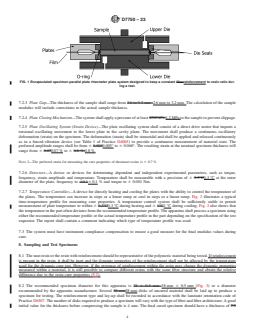
diameter of the specimen (Fig. 1). The O-ring meets ASTM
NOTE 1—It is recommended that low-frequency test conditions, gener-
ally 1 Hz to 2 Hz, be used to generate more definitive cure-behavior International size No. 2-127.
D7750 − 23
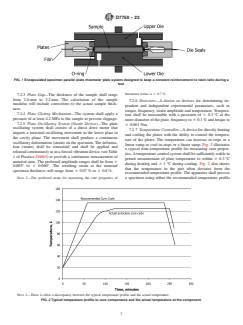
FIG. 1 Encapsulated specimen parallel plate rheometer plate system designed to keep a constant reinforcement to resin ratio during a
test.
thermoset resins is 6 0.7 %.
7.2.3 Plate Gap—The thickness of the sample shall range
from 2.6 mm to 3.2 mm. The calculation of the sample
7.2.6 Detectors—A device or devices for determining de-
modulus will include corrections to the actual sample thick-
pendent and independent experimental parameters, such as
ness.
torque, frequency, strain amplitude and temperature. Tempera-
7.2.4 Plate Closing Mechanism—The system shall apply a
ture shall be measurable with a precision of 6 0.3 °C at the
pressure of at least 4.2 MPa to the sample to prevent slippage.
outer diameter of the plate, frequency to 6 0.1 % and torque to
7.2.5 Plate Oscillating System (Strain Device)—The plate
6 0.001 Nm.
oscillating system shall consist of a direct drive motor that
7.2.7 Temperature Controller—A device for directly heating
imparts a torsional oscillating movement to the lower plate in
and cooling the plates with the ability to control the tempera-
the cavity plane. The movement shall produce a continuous
ture of the plates. The temperature can increase in steps or a
oscillatory deformation (strain) on the specimen. The deforma-
linear ramp or cool in steps or a linear ramp. Fig. 2 illustrates
tion (strain) shall be sinusoidal and shall be applied and
a typical time-temperature profile for measuring cure proper-
released continuously as in a forced-vibration device (see Table
ties. A temperature control system shall be sufficiently stable to
1 of Practice D4065) to provide a continuous measurement of
permit measurement of plate temperature to within 6 0.3 °C
material state. The preferred amplitude ranges shall be from 6
during heating and 6 1 °C during cooling. Fig. 2 also shows
0.005° to 6 0.060°. The resulting strain at the nominal
that the temperature in the part often deviates from the
specimen thickness will range from 6 0.07 % to 6 0.8 %.
recommended temperature profile. The apparatus shall process
NOTE 2—The preferred strain for measuring the cure properties of a specimen using either the recommended temperature profile
NOTE 1—There is often a discrepancy between the typical temperature profile and the actual temperature.
FIG. 2 Typical temperature profile to cure components and the actual temperature at the component.
D7750 − 23
or the actual temperature profile in the part depending on the resins or other materials that can diffuse out of the specimen.
specification of the test requestor. The report shall contain a The film must be capable of the applied temperature. Different
comment indicating which type of temperature profile was films can be used at different temperature ranges.
used.
8.4 Low viscosity neat resins can be measured under pres-
7.3 The system must have instrument compliance compen- sure either with or without reinforcement.
sation to ensure a good measure for the final modulus values
8.5 A valid result is obtained when the elastomeric O-ring
during cure.
remains intact at the outer diameter of the specimen and the
cured sample thickness is within the acceptable range. Also,
8. Sampling and Test Specimens
any shape imparted by the plate surface such as grooves must
8.1 The neat resin or the resin with reinforcement should be
match the corresponding shape on the cured specimen.
representative of the polymeric
...
This document is not an ASTM standard and is intended only to provide the user of an ASTM standard an indication of what changes have been made to the previous version. Because
it may not be technically possible to adequately depict all changes accurately, ASTM recommends that users consult prior editions as appropriate. In all cases only the current version
of the standard as published by ASTM is to be considered the official document.
Designation: D7750 − 12 (Reapproved 2017) D7750 − 23
Standard Test Method for
Cure Behavior of Thermosetting Resins by Dynamic
Mechanical Procedures using an Encapsulated Specimen
Rheometer
This standard is issued under the fixed designation D7750; the number immediately following the designation indicates the year of
original adoption or, in the case of revision, the year of last revision. A number in parentheses indicates the year of last reapproval. A
superscript epsilon (´) indicates an editorial change since the last revision or reapproval.
1. Scope
1.1 This method covers the use of dynamic mechanical instrumentation for determination and reporting of the thermal
advancement of cure behavior of thermosetting resin on an inert filler or fiber in a laboratory. It may also be used for determining
the cure properties of filled resins and resins without reinforcements.without fillers or fibers. These encapsulated specimens are
deformed in torsional shear using dynamic mechanical methods.
1.2 This method is intended to provide means for determining the cure behavior of thermosetting resins on fibers over a range of
temperatures from room temperature to 250°C250 °C by forced-constant amplitude techniques (in accordance with Practice
D4065). Plots of complex modulus, complex viscosity, and damping ratio or tan delta as a function of time or temperature, or both,
quantify the thermal advancement or cure characteristics of a resin or a resin on filler or fiber.
1.3 Test data obtained by this method is relevant and appropriate for optimizing cure cycles.
1.4 The values stated in SI units are to be regarded as standard. No other units of measurement are included in this standard.
1.4.1 Exception—The fahrenheitFahrenheit temperature measurement in 10.1 is provided for information only and is not
considered standard.
1.5 This standard does not purport to address all of the safety concerns, if any, associated with its use. It is the responsibility
of the user of this standard to establish appropriate safety and healthsafety, health, and environmental practices and determine
the applicability of regulatory limitations prior to use.
1.6 This international standard was developed in accordance with internationally recognized principles on standardization
established in the Decision on Principles for the Development of International Standards, Guides and Recommendations issued
by the World Trade Organization Technical Barriers to Trade (TBT) Committee.
2. Referenced Documents
2.1 ASTM Standards:
D3878 Terminology for Composite Materials
This test method is under the jurisdiction of ASTM Committee D30 on Composite Materials and is the direct responsibility of Subcommittee D30.03 on
Constituent/Precursor Properties.
Current edition approved Aug. 1, 2017April 1, 2023. Published September 2017May 2023. Originally approved in 2012. Last previous edition approved in 2017 as
D7750–12. DOI: 10.1520/D7750-12R17. – 12 (2017). DOI: 10.1520/D7750-23.
For referenced ASTM standards, visit the ASTM website, www.astm.org, or contact ASTM Customer Service at service@astm.org. For Annual Book of ASTM Standards
volume information, refer to the standard’s Document Summary page on the ASTM website.
Copyright © ASTM International, 100 Barr Harbor Drive, PO Box C700, West Conshohocken, PA 19428-2959. United States
D7750 − 23
D4000 Classification System for Specifying Plastic Materials
D4065 Practice for Plastics: Dynamic Mechanical Properties: Determination and Report of Procedures
D4092 Terminology for Plastics: Dynamic Mechanical Properties
D4473 Test Method for Plastics: Dynamic Mechanical Properties: Cure Behavior
D6507 Practice for Fiber Reinforcement Orientation Codes for Composite Materials
D7028 Test Method for Glass Transition Temperature (DMA Tg) of Polymer Matrix Composites by Dynamic Mechanical
Analysis (DMA)
E380 Practice for Use of the International System of Units (SI) (the Modernized Metric System) (Withdrawn 1997)
3. Terminology
3.1 Definitions: For most definitions applicable to this method refer to Terminology D4092.
3.2 Definitions of Terms Specific to This Standard:
3.2.1 Encapsulated Sample Parallel Plate Rheometer—Dynamic Mechanical Analyzer apparatus that holds the specimen under
pressure within a confined cavity. The apparatus is designed to contain the resin within the specimen throughout the progress of
the cure.
4. Summary of Test Method
4.1 A small circular specimen is assembled from uncured thermoset resin materials that correspond to a representation of a
composite part. This specimen is placed in mechanical oscillation at a fixed frequency at either isothermal conditions, a linear
temperature increase or a time-temperature relation simulating a processing condition. The lower plate oscillates and transmits
torque from the lower plate through the sample into the upper plate. The resulting torque measured at the upper plate is converted
to shear modulus using equations that compensate for the shape and size of the sample. The shear modulus is separated into a
component that is in phase with the applied strain or elastic shear modulus and a component that is 90° out of phase with the
applied strain or loss shear modulus. The elastic and loss modulus of the specimen are measured as a function of time. During cure,
the elastic shear modulus will initially decrease as the temperature is increased due to a decrease in the viscosity of the resin in
the sample. When cure occurs in the sample, the elastic shear modulus increases.
5. Significance and Use
5.1 This method provides a simple means of characterizing the cure behavior of a thermosetting resin specimen that is a
representation of a composite part. The diameter of the specimen is approximately 38 mm 38 mm and the thickness ranges from
3 3
2.6 to 3.2 mm. 2.6 mm to 3.2 mm. This corresponds to a sample volume of approximately 33 cm to 4 cm4 cm . The data may
be used for quality control, research and development, and verifying the cure within processing equipment including autoclaves.
5.2 Dynamic mechanical testing provides a sensitive method for determining cure characteristics by measuring the elastic and loss
moduli as a function of temperature or time, or both. Plots of cure behavior and tan delta of a material provide graphical
representation indicative of cure behavior under a specified time-temperature profile. The presence of fibers within the resin may
change the dynamic properties measured within a material. However, it is still possible to compare different resins with the same
fiber structure and obtain the relative difference due to the resin cure properties.
5.3 This method can be used to assess the following:
5.3.1 Cure behavior, as well as changes as a function of temperature or time, or both,
5.3.2 Processing behavior, as well as changes as a function of temperature or time, or both,
5.3.3 The effects of processing treatments,
5.3.4 Relative resin behavioral properties, including cure behavior, damping and impact resistance,
5.3.5 The effects of reinforcement on cure.cure; the reinforcement can be a fiber or a filler,
The last approved version of this historical standard is referenced on www.astm.org.
D7750 − 23
5.3.6 The effects of materials used to bond the resin and reinforcement,
5.3.7 The effect of formulation additives that might affect processability or performance.
5.4 This provides a method to assess the cure properties of a thermosetting resin containing woven fiber or other reinforcing
materials.
5.5 This method is valid for a wide range of oscillation frequencies typically from 0.002 to 50 Hz.0.002 Hz to 50 Hz.
NOTE 1—It is recommended that low-frequency test conditions, generally 1 to 2 Hz, 1 Hz to 2 Hz, be used to generate more definitive cure-behavior
information. Slower frequencies will miss important cure properties. Faster frequencies will reduce sensitivity to cure.
6. Interferences
6.1 Apparent discrepancies in results may arise when using different experimental conditions. These apparent differences from
results observed in another study can usually be reconciled without changing the observed data, by reporting in full (as described
in this method) the conditions under which the data were obtained. One essential condition within this method that must be noted
is the presence of pressure within the specimen chamber which ensures good precision.
6.2 In many cases, the specimens made with this method will be significantly smaller than the parts in production. It is essential
that specimens be made from representative samples of uncured material used to make parts. This will ensure that the data is
representative of the part cure.
6.3 The result is a response to the thermal advancement or cure behavior of the resin. The cure behavior is also influenced by the
reinforcement and materials used to enhance the bond between the resin and reinforcement. The reinforcement can be a fiber or
a filler.
6.4 The data will represent the cure of the system at the measured temperature. Parts are often significantly thicker than the
specimen. There may be a significant difference between the temperature versus time profile on the inside and the outside of those
composite parts. Thermocouples can be used to measure both temperatures during a cure process of a thick part. The measured
temperature versus time data can be used to define temperature versus time profiles for dynamic cure specimens using the
procedures of this standard. The results can be used to compare the cure response for the inside and the outside of the composite
part.
7. Apparatus
7.1 The function of the apparatus is to hold a resin specimen with inert reinforcement, such as fibers, under pressure and yet
prevent the escape of resin. Thereby, the fiberreinforcement to resin ratio will remain constant throughout the test. The material
acts as the elastic and dissipative element in a mechanically driven oscillatory shear system. This dynamic mechanical instrument
operates in torsional shear using one of the following modes for measuring cure behavior:
7.1.1 Forced, constant amplitude, fixed frequency,
7.1.2 Forced, variable amplitude, fixed frequency.
7.2 The apparatus shall consist of the following:
7.2.1 Parallel plates with serrated or radial grooved surfaces. The diameter of the dies shall be 40 6 2 mm. 40 mm 6 2 mm. The
depth of the grooves shall be limited to 1.0 mm 1.0 mm or less to keep a constant fiberreinforcement to resin ratio.
7.2.2 Encapsulated Specimen Cavity—The specimen shall be encapsulated by the two parallel plates and a series of mechanical
components at the outer plate diameter designed to contain the specimen under pressure without loss of resin. These components
shall include an O-ring inserted at the outer diameter of the specimen (Fig. 1). The O-ring meets ASTM International size No.
2-127.
D7750 − 23
FIG. 1 Encapsulated specimen parallel plate rheometer plate system designed to keep a constant fiberreinforcement to resin ratio dur-
ing a test.
7.2.3 Plate Gap—The thickness of the sample shall range from 2.6 to 3.2 mm. 2.6 mm to 3.2 mm. The calculation of the sample
modulus will include corrections to the actual sample thickness.
7.2.4 Plate Closing Mechanism—The system shall apply a pressure of at least 4200 kPa 4.2 MPa to the sample to prevent slippage.
7.2.5 Plate Oscillating System (Strain Device)—The plate oscillating system shall consist of a direct drive motor that imparts a
torsional oscillating movement to the lower plate in the cavity plane. The movement shall produce a continuous oscillatory
deformation (strain) on the specimen. The deformation (strain) shall be sinusoidal and shall be applied and released continuously
as in a forced-vibration device (see Table 1 of Practice D4065) to provide a continuous measurement of material state. The
preferred amplitude ranges shall be from 6 0.0050.005° to 6 0.060°. The resulting strain at the nominal specimen thickness will
range from 6 0.070.07 % to 6 0.8 %.0.8 %.
NOTE 2—The preferred strain for measuring the cure properties of thermoset resins is 6 0.7 %.
7.2.6 Detectors—A device or devices for determining dependent and independent experimental parameters, such as torque,
frequency, strain amplitude and temperature. Temperature shall be measurable with a precision of 6 0.3°C0.3 °C at the outer
diameter of the plate, frequency to 60.16 0.1 % and torque to 6 0.001 Nm.
7.2.7 Temperature Controller—A device for directly heating and cooling the plates with the ability to control the temperature of
the plates. The temperature can increase in steps or a linear ramp or cool in steps or a linear ramp. Fig. 2 illustrates a typical
time-temperature profile for measuring cure properties. A temperature control system shall be sufficiently stable to permit
measurement of plate temperature to within 6 0.3°C0.3 °C during heating and 6 1°C1 °C during cooling. Fig. 2 also shows that
the temperature in the part often deviates from the recommended temperature profile. The apparatus shall process a specimen using
either the recommended temperature profile or the actual temperature profile in the part depending on the specification of the test
requestor. The report shall contain a comment indicating which type of temperature profile was used.
7.3 The system must have instrument compliance compensation to ensure a good measure for the final modulus values during
cure.
8. Sampling and Test Specimens
8.1 The neat resin or the resin with reinforcement should be representative of the polymeric material being tested. If reinforcement
is present in the resin, it shall be inert and the dynamic properties of the reinforcement shall not be affected by the temperature
used for the dynamic cure test. However, if the presence of reinforcement within the resin may change the dynamic properties
measured within a material, it is still possible to compare different resins with the same fiber structure and obtain the relative
difference due to the resin cure properties (5.2).
8.2 The recommended specimen diameter for this apparatus is 38 6 0.5 mm 38 mm 6 0.5 mm (Fig. 3) or a diameter
recommended by the apparatus manufacturer. Several 38-mm38 mm disks of uncured material shall be laid up to produce a
specimen for testing. The reinforcement type and lay-up shall be recorded in accordance with the laminate orientation code of
Practice D6507. The number of disks required to produce a specimen
...