

ASTM D6902-04(2023)
(Test Method)Standard Test Method for Laboratory Measurement of Formaldehyde Evolved During the Curing of Melamine-Formaldehyde-Based Coatings
General Information
- Abstract
SIGNIFICANCE AND USE
5.1 This test method measures the amount of formaldehyde that is evolved from a coating containing melamine-formaldehyde resin(s) during cure at elevated temperature. Cure formaldehyde results from a side-reaction during cross-linking of functionalized polymers with melamine-formaldehyde resins. Cure formaldehyde is evolved in the final bake or cure oven, when the coating temperature is high enough to initiate cross-linking. Formaldehyde can be released from a coating during application, solvent flash-off and cure. Free formaldehyde is primarily evolved during coating application and solvent flash-off. Test Method D1979 measures “free formaldehyde” in amino resins and Test Method D6191 measures formaldehyde evolved from coatings at ambient temperature. This method measures only the formaldehyde released during heat cure, which is primarily “cure formaldehyde.”
5.2 This test method is not intended to duplicate the evolved formaldehyde from an industrial process, but serves as a reproducible comparative laboratory evaluation.
5.3 This test method has not been evaluated with catalyzed coating systems that cure at or below 40 °C, such as those used by the wood-finishing industry, and would likely require special adaptation for this application.
SCOPE
1.1 This test method is for the determination of formaldehyde evolved from melamine-formaldehyde-based coatings during the cure step. The results may be used to determine the “cure formaldehyde” evolved from a sample under controlled laboratory conditions.
1.2 The values stated in SI units are to be regarded as the standard. The values given in parentheses are for information only.
1.3 This test method is capable of measuring from 500 μg/g to 22 000 μg formaldehyde/g dry coating under the test conditions specified (3 000 ml/min total flow, 50 ml/min DNPH tube flow). The ratio of total flow to DNPH tube flow could be adjusted to extend the range of the method.
1.4 This standard does not purport to address all of the safety concerns, if any, associated with its use. It is the responsibility of the user of this standard to establish appropriate safety, health, and environmental practices and determine the applicability of regulatory limitations prior to use.
1.5 This international standard was developed in accordance with internationally recognized principles on standardization established in the Decision on Principles for the Development of International Standards, Guides and Recommendations issued by the World Trade Organization Technical Barriers to Trade (TBT) Committee.
- Status
- Published
- Publication Date
- 30-Jun-2023
- Technical Committee
- D01 - Paint and Related Coatings, Materials, and Applications
- Drafting Committee
- D01.21 - Chemical Analysis of Paints and Paint Materials
Overview
ASTM D6902-04(2023): Standard Test Method for Laboratory Measurement of Formaldehyde Evolved During the Curing of Melamine-Formaldehyde-Based Coatings defines a laboratory-based procedure for quantifying formaldehyde emissions released during the heat curing process of coatings that contain melamine-formaldehyde resin systems. Developed by ASTM International, this standard supports manufacturers, laboratories, and regulatory bodies in assessing "cure formaldehyde"-the formaldehyde formed and released as a by-product of the cross-linking reaction during curing at elevated temperatures. This methodology provides a reproducible and comparative way to evaluate different coatings and formulations under controlled laboratory conditions.
Key Topics
- Formaldehyde Emission During Curing: Focuses on measuring only the formaldehyde generated and released as a result of the curing reaction ("cure formaldehyde"), distinct from “free formaldehyde” emitted during application or solvent evaporation.
- Laboratory Evaluation: Provides a highly controlled and standardized method, ensuring results are comparable across samples and laboratories. Not intended to exactly replicate full-scale industrial emissions, but valuable for research, quality control, and comparative analysis.
- Measurement Range: Capable of accurately quantifying formaldehyde emissions from 500 μg/g up to 22,000 μg/g dry coating under specified flow and temperature conditions.
- Test Procedure: Involves preparing a coating sample, subjecting it to prescribed curing and evaporation steps, and collecting evolved formaldehyde using a DNPH-silica cartridge, followed by HPLC/UV analysis.
- Precision and Repeatability: Backed by interlaboratory testing, the method delivers defined repeatability and reproducibility, making results robust for technical and compliance purposes.
- Limitations: Not validated for catalyzed coatings that cure at or below 40°C (common in wood finishing), and users are responsible for safety, health, and environmental considerations.
Applications
- Coatings Industry Quality Control: Paint and coatings manufacturers use ASTM D6902 to assess and compare the formaldehyde emission potential of melamine-formaldehyde-based products during development and batch testing.
- Regulatory Compliance and Environmental Health: Supports compliance with environmental regulations regarding volatile organic compounds (VOC) and hazardous air pollutants (HAPs), specifically related to formaldehyde release.
- Comparative Product Testing: Enables laboratories and product engineers to evaluate alternative resins, additives, and formulations by providing consistent, reliable data on cure-time formaldehyde emissions.
- Research and Product Development: Used by R&D teams for benchmarking and optimizing coating chemistries to minimize formaldehyde emissions, especially for products targeting low-VOC and low-emission markets.
- Supplier and Customer Specifications: Provides a common, internationally-recognized method for suppliers and buyers to compare coating materials for environmental footprint and indoor air quality impact.
Related Standards
- ASTM D1979: Test Method for Free Formaldehyde Content of Amino Resins (withdrawn) - measures free residual formaldehyde, not that evolved during cure.
- ASTM D6191: Test Method for Measurement of Evolved Formaldehyde from Water Reducible Air-Dry Coatings - assesses emissions at ambient temperature.
- ASTM E691: Practice for Conducting an Interlaboratory Study to Determine the Precision of a Test Method - referenced for precision and bias analysis.
- Additional relevant ASTM standards pertain to analytical reagents and equipment used for chromatographic analysis of volatile organic compounds.
Keywords: ASTM D6902, formaldehyde emission, melamine-formaldehyde, coating cure, VOC, DNPH, HPLC, environmental compliance, paint testing, laboratory method, volatile organic compounds, indoor air quality.
By adopting ASTM D6902-04(2023), organizations can ensure reliable assessment of formaldehyde emissions during the curing of melamine-formaldehyde-based coatings, supporting safer products, compliance efforts, and innovation in coatings chemistry.
Relations
- Effective Date
- 01-May-2013
- Effective Date
- 01-Nov-2011
- Effective Date
- 01-Nov-2008
- Effective Date
- 01-Oct-2008
- Effective Date
- 01-Nov-2005
- Effective Date
- 10-Mar-2003
- Effective Date
- 10-May-1999
- Refers
ASTM D1979-97 - Standard Test Method for Free Formaldehyde Content of Amino Resins (Withdrawn 2006) - Effective Date
- 10-Nov-1997
Get Certified
Connect with accredited certification bodies for this standard

DIN CERTCO
DIN Group product certification.

Smithers Quality Assessments
US management systems and product certification.
Sponsored listings
Frequently Asked Questions
ASTM D6902-04(2023) is a standard published by ASTM International. Its full title is "Standard Test Method for Laboratory Measurement of Formaldehyde Evolved During the Curing of Melamine-Formaldehyde-Based Coatings". This standard covers: SIGNIFICANCE AND USE 5.1 This test method measures the amount of formaldehyde that is evolved from a coating containing melamine-formaldehyde resin(s) during cure at elevated temperature. Cure formaldehyde results from a side-reaction during cross-linking of functionalized polymers with melamine-formaldehyde resins. Cure formaldehyde is evolved in the final bake or cure oven, when the coating temperature is high enough to initiate cross-linking. Formaldehyde can be released from a coating during application, solvent flash-off and cure. Free formaldehyde is primarily evolved during coating application and solvent flash-off. Test Method D1979 measures “free formaldehyde” in amino resins and Test Method D6191 measures formaldehyde evolved from coatings at ambient temperature. This method measures only the formaldehyde released during heat cure, which is primarily “cure formaldehyde.” 5.2 This test method is not intended to duplicate the evolved formaldehyde from an industrial process, but serves as a reproducible comparative laboratory evaluation. 5.3 This test method has not been evaluated with catalyzed coating systems that cure at or below 40 °C, such as those used by the wood-finishing industry, and would likely require special adaptation for this application. SCOPE 1.1 This test method is for the determination of formaldehyde evolved from melamine-formaldehyde-based coatings during the cure step. The results may be used to determine the “cure formaldehyde” evolved from a sample under controlled laboratory conditions. 1.2 The values stated in SI units are to be regarded as the standard. The values given in parentheses are for information only. 1.3 This test method is capable of measuring from 500 μg/g to 22 000 μg formaldehyde/g dry coating under the test conditions specified (3 000 ml/min total flow, 50 ml/min DNPH tube flow). The ratio of total flow to DNPH tube flow could be adjusted to extend the range of the method. 1.4 This standard does not purport to address all of the safety concerns, if any, associated with its use. It is the responsibility of the user of this standard to establish appropriate safety, health, and environmental practices and determine the applicability of regulatory limitations prior to use. 1.5 This international standard was developed in accordance with internationally recognized principles on standardization established in the Decision on Principles for the Development of International Standards, Guides and Recommendations issued by the World Trade Organization Technical Barriers to Trade (TBT) Committee.
SIGNIFICANCE AND USE 5.1 This test method measures the amount of formaldehyde that is evolved from a coating containing melamine-formaldehyde resin(s) during cure at elevated temperature. Cure formaldehyde results from a side-reaction during cross-linking of functionalized polymers with melamine-formaldehyde resins. Cure formaldehyde is evolved in the final bake or cure oven, when the coating temperature is high enough to initiate cross-linking. Formaldehyde can be released from a coating during application, solvent flash-off and cure. Free formaldehyde is primarily evolved during coating application and solvent flash-off. Test Method D1979 measures “free formaldehyde” in amino resins and Test Method D6191 measures formaldehyde evolved from coatings at ambient temperature. This method measures only the formaldehyde released during heat cure, which is primarily “cure formaldehyde.” 5.2 This test method is not intended to duplicate the evolved formaldehyde from an industrial process, but serves as a reproducible comparative laboratory evaluation. 5.3 This test method has not been evaluated with catalyzed coating systems that cure at or below 40 °C, such as those used by the wood-finishing industry, and would likely require special adaptation for this application. SCOPE 1.1 This test method is for the determination of formaldehyde evolved from melamine-formaldehyde-based coatings during the cure step. The results may be used to determine the “cure formaldehyde” evolved from a sample under controlled laboratory conditions. 1.2 The values stated in SI units are to be regarded as the standard. The values given in parentheses are for information only. 1.3 This test method is capable of measuring from 500 μg/g to 22 000 μg formaldehyde/g dry coating under the test conditions specified (3 000 ml/min total flow, 50 ml/min DNPH tube flow). The ratio of total flow to DNPH tube flow could be adjusted to extend the range of the method. 1.4 This standard does not purport to address all of the safety concerns, if any, associated with its use. It is the responsibility of the user of this standard to establish appropriate safety, health, and environmental practices and determine the applicability of regulatory limitations prior to use. 1.5 This international standard was developed in accordance with internationally recognized principles on standardization established in the Decision on Principles for the Development of International Standards, Guides and Recommendations issued by the World Trade Organization Technical Barriers to Trade (TBT) Committee.
ASTM D6902-04(2023) is classified under the following ICS (International Classification for Standards) categories: 83.080.10 - Thermosetting materials. The ICS classification helps identify the subject area and facilitates finding related standards.
ASTM D6902-04(2023) has the following relationships with other standards: It is inter standard links to ASTM E691-13, ASTM E691-11, ASTM D6191-97(2008)e1, ASTM E691-08, ASTM E691-05, ASTM D6191-97(2003), ASTM E691-99, ASTM D1979-97. Understanding these relationships helps ensure you are using the most current and applicable version of the standard.
ASTM D6902-04(2023) is available in PDF format for immediate download after purchase. The document can be added to your cart and obtained through the secure checkout process. Digital delivery ensures instant access to the complete standard document.
Standards Content (Sample)
This international standard was developed in accordance with internationally recognized principles on standardization established in the Decision on Principles for the
Development of International Standards, Guides and Recommendations issued by the World Trade Organization Technical Barriers to Trade (TBT) Committee.
Designation: D6902 − 04 (Reapproved 2023)
Standard Test Method for
Laboratory Measurement of Formaldehyde Evolved During
the Curing of Melamine-Formaldehyde-Based Coatings
This standard is issued under the fixed designation D6902; the number immediately following the designation indicates the year of
original adoption or, in the case of revision, the year of last revision. A number in parentheses indicates the year of last reapproval. A
superscript epsilon (´) indicates an editorial change since the last revision or reapproval.
1. Scope D1979 Test Method for Free Formaldehyde Content of
Amino Resins (Withdrawn 2006)
1.1 This test method is for the determination of formalde-
D6191 Test Method for Measurement of Evolved Formalde-
hyde evolved from melamine-formaldehyde-based coatings
hyde from Water Reducible Air-Dry Coatings
during the cure step. The results may be used to determine the
E691 Practice for Conducting an Interlaboratory Study to
“cure formaldehyde” evolved from a sample under controlled
Determine the Precision of a Test Method
laboratory conditions.
3. Terminology
1.2 The values stated in SI units are to be regarded as the
standard. The values given in parentheses are for information
3.1 Definitions of Terms Specific to This Standard:
only.
3.1.1 cure formaldehyde, n—the formaldehyde generated as
the result of a chemical reaction during coating curing.
1.3 This test method is capable of measuring from 500 μg/g
to 22 000 μg formaldehyde/g dry coating under the test
3.1.2 free formaldehyde, n—the residual formaldehyde in a
conditions specified (3 000 ml/min total flow, 50 ml/min
coating due to the raw materials.
DNPH tube flow). The ratio of total flow to DNPH tube flow
4. Summary of Test Method
could be adjusted to extend the range of the method.
4.1 Approximately 0.2 g of coating formulation is placed in
1.4 This standard does not purport to address all of the
an aluminum foil pan, dried in a vacuum oven at 40 °C (to
safety concerns, if any, associated with its use. It is the
remove free formaldehyde and solvents) and then baked at the
responsibility of the user of this standard to establish appro-
optimum process cure temperature for 30 min. Formaldehyde
priate safety, health, and environmental practices and deter-
emissions are collected from the cure chamber on a DNPH/
mine the applicability of regulatory limitations prior to use.
Silica tube, which is then extracted and the extract analyzed by
1.5 This international standard was developed in accor-
HPLC/UV. The amount of formaldehyde evolved from the
dance with internationally recognized principles on standard-
coating during the cure step is calculated on both a wet-weight
ization established in the Decision on Principles for the
and dry-weight basis. The test is run in triplicate plus a blank
Development of International Standards, Guides and Recom-
and system standard.
mendations issued by the World Trade Organization Technical
Barriers to Trade (TBT) Committee.
5. Significance and Use
5.1 This test method measures the amount of formaldehyde
2. Referenced Documents
that is evolved from a coating containing melamine-
2.1 ASTM Standards:
formaldehyde resin(s) during cure at elevated temperature.
D362 Specification for Industrial Grade Toluene (Withdrawn
Cure formaldehyde results from a side-reaction during cross-
1989)
linking of functionalized polymers with melamine-
formaldehyde resins. Cure formaldehyde is evolved in the final
bake or cure oven, when the coating temperature is high
This test method is under the jurisdiction of ASTM Committee D01 on Paint
enough to initiate cross-linking. Formaldehyde can be released
and Related Coatings, Materials, and Applications and is the direct responsibility of
Subcommittee D01.21 on Chemical Analysis of Paints and Paint Materials.
from a coating during application, solvent flash-off and cure.
Current edition approved July 1, 2023. Published August 2023. Originally
Free formaldehyde is primarily evolved during coating appli-
approved in 2003. Last previous edition approved in 2017 as D6902 – 04 (2017).
cation and solvent flash-off. Test Method D1979 measures
DOI: 10.1520/D6902-04R23.
“free formaldehyde” in amino resins and Test Method D6191
For referenced ASTM standards, visit the ASTM website, www.astm.org, or
contact ASTM Customer Service at service@astm.org. For Annual Book of ASTM
measures formaldehyde evolved from coatings at ambient
Standards volume information, refer to the standard’s Document Summary page on
temperature. This method measures only the formaldehyde
the ASTM website.
released during heat cure, which is primarily “cure formalde-
The last approved version of this historical standard is referenced on
www.astm.org. hyde.”
Copyright © ASTM International, 100 Barr Harbor Drive, PO Box C700, West Conshohocken, PA 19428-2959. United States
D6902 − 04 (2023)
5.2 This test method is not intended to duplicate the evolved 6.15 Water Trap, 1000 mL vacuum flask with stopper.
formaldehyde from an industrial process, but serves as a
6.16 Thermometer, thermocouple with temperature readout
reproducible comparative laboratory evaluation.
calibrated in range of 50 °F to 400 °F.
5.3 This test method has not been evaluated with catalyzed
7. Reagents and Materials
coating systems that cure at or below 40 °C, such as those used
by the wood-finishing industry, and would likely require
7.1 Purity of Reagents—Use reagent grade chemicals in all
special adaptation for this application.
tests, unless otherwise specified. Other grades may be used,
provided it is first ascertained that the reagent is sufficiently
6. Apparatus
high purity to permit its use without lessening the accuracy of
6.1 High Pressure Liquid Chromatograph (HPLC), either a
the determination.
gradient or isocratic system. A gradient system is preferred
7.2 Toluene, technical grade, Specification D362.
when other aldehydes or ketones are present.
7.3 Tetrahydrofuran, HPLC Grade.
NOTE 1—The system shall be equipped with a temperature-controlled
column oven. A liquid autosampler is optional.
7.4 Water, HPLC Grade.
6.2 Column, a C ODS packed with 5 μm pellicular beads
18 7.5 Acetonitrile, HPLC Grade.
with the dimensions of approximately 4 mm by 75 mm or 150
7.6 DNPH-Silica Cartridge, Waters Sep-Pak Cartridges,
mm. A 2 cm guard column packed with the same material is
Part # WAT037500.
recommended to protect the analytical column.
7.7 Formaldehyde/2,4-dinitrophenylhydrazone (DNPH)
6.3 Detector, UV/VIS detector capable of measuring absor-
Complex, may be purchased or prepared in the laboratory.
bance at 360 nm.
7.8 Calcium Nitrate Tetrahydrate, reagent grade.
6.4 Integrator, peak integration system.
7.9 Paraformaldehyde, reagent grade.
6.5 Air Sampling Pump, an air sampling pump with the
capability of maintaining a constant flow rate between 3 L ⁄min
8. Hazards
and 4 L/min. Both an inlet and outlet port must be available for
8.1 Check the supplier’s Safety Data Sheet (SDS) on all
measuring flow. An SKC AirCheck Sampler Model 224-
chemicals before use.
PCXR8 has been found suitable.
6.6 Flow Meters—An in-line mass flow meter or flow
9. Preparation of Apparatus
sensor capable of measuring 30 mL ⁄min to 120 mL/min with at
9.1 Install the column in the chromatograph following the
least 3 % accuracy. A flow meter or bubble meter capable of
manufacturer’s directions and establish the operating condi-
measuring 3 L ⁄min to 4 L/min with at least 5 % accuracy.
tions required to give the desired separation (see Table 1).
6.7 Glass Purge Chamber—A glass purge chamber with a
Allow sufficient time for the instrument to reach equilibrium as
mouth at least 60 mm wide and a lid with an air-tight gasket
indicated by a stable baseline.
seal. One liter reaction flask, reaction flask head with two
9.2 Purge Chamber Set Up:
threads, two 5029 tetrafluorethylene polymer bushings and
9.2.1 Assemble apparatus (empty purge chamber, impinger,
FETFE O-Ring and 124 mm anodized 2 piece clamp, Ace
pump, flow meters and valving) as shown in Fig. 1 with a
Glass part numbers 6511-53, 6513-SP, and 6508-6.
DNPH cartridge in line (use two DNPH cartridges for water-
6.8 Valves—Two metering valves to adjust split flow rate.
borne coatings and paraformaldehyde calibration check).
One valve must be constructed of stainless steel. A Swagelok
9.2.2 Add 500 g of calcium nitrate tetrahydrate to 250 mL of
506-1-316 has been found suitable.
reagent grade water to form a near saturated solution. Place this
6.9 Aluminum Foil Dishes, 58 mm in diameter by 18 mm
mixture in the constant humidity Insert the Sherer Impinger so
high with a smooth (planar) bottom surface.
6.10 Forced Draft Oven, oven, capable of maintaining
160 °C (320 °F), of adequate size to accommodate one or more
TABLE 1 Instrument Conditions
purge chambers.
Detector UV/VIS Absorbance 360 nm
Column (Isocratic) C ODS 4 mm by 75 mm
6.11 Vacuum Oven, capable of maintaining 40 °C and a
Mobile Phase (Isocratic) Water/Acetonitrile/Tetrahydrofuran
vacuum of 0.1 Barr to 0.2 Barr (~100 mm Hg). 65/30/5 volume/volume
Column (Gradient) C ODS 4 mm by 150 mm
6.12 Volumetric Glassware, various volumetric flasks and
Mobile Phase (Gradient) Water/Acetonitrile/Tetrahydrofuran
A: 65/30/10 volume/volume
pipettes for preparation of calibration standards. Also, 5 mL
B: 40/60/0 volume/volume
volumetric flasks for sample elution.
100 % A for 1 min then linear gradient
to 100 % B in 10 min
6.13 Analytical Balance—Four-place analytical balance ca-
Flow Rate 1.5 mL/min
pable of measuring to 60.1 mg (0.0001 g).
Column Temperature 40 °C
Run Time (Isocratic) 10 min
6.14 Sherer Impinger Diffuser, A 25 mm dia, 275 mL with
Run Time (Gradient) 15 min
impinger stopper, Ace Glass part number 7538-29 has been
Injection Volume 10 μL to 20 μL
found suitable.
D6902 − 04 (2023)
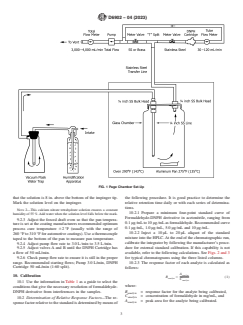
FIG. 1 Page Chamber Set-Up
that the solution is 8 in. above the bottom of the impinger tip. the following procedure. It is good practice to determine the
Mark the solution level on the impinger. relative retention time daily or with each series of determina-
tions.
NOTE 2—This calcium nitrate tetrahydrate solution ensures a constant
10.2.1 Prepare a minimum four-point standard curve of
humidity of 55 %. Add water when the solution level falls below the mark.
Formaldehyde-DNPH derivative in acetonitrile, ranging from
9.2.3 Adjust the forced draft oven so that the pan tempera-
0.1 μg ⁄mL to 10 μg ⁄mL as formaldehyde. Recommended curve
ture is set at the coating manufacturers recommended optimum
0.1 μg ⁄mL, 1.0 μg ⁄mL, 5.0 μg ⁄mL and 10 μg ⁄mL.
process cure temperature 62 °F (usually with the range of
10.2.2 Inject a 10 μL to 20 μL aliquot of the standard
260 °F to 310 °F for automotive coatings). Use a thermocouple
mixture into the HPLC. At the end of the chromatographic run,
taped to the bottom of the pan to measure pan temperature.
calibrate the integrator by following the manufacturer’s proce-
9.2.4 Adjust pump flow rate to 3.0 L ⁄min to 3.5 L ⁄min.
dure for external standard calibration. If this capability is not
9.2.5 Adjust valves A and B until the DNPH Cartridge has
available, refer to the following calculations. See Figs. 2 and 3
a flow of 50 mL/min.
for typical chromatograms using the three listed columns.
9.2.6 Check pump flow rate to ensure it is still in the proper
range. Recommended starting flows; Pump 3.0 L/min, DNPH
10.2.3 The response factor of each analyte
...