

ASTM B833-20
(Specification)Standard Specification for Zinc and Zinc Alloy Wire for Thermal Spraying (Metallizing) for the Corrosion Protection of Steel
General Information
- Abstract
ABSTRACT
This specification covers zinc and zinc alloy wire used to deposit zinc coatings by thermal spraying (metallizing) for the corrosion protection of steel and iron. Zinc and zinc alloy wire provided under this specification is intended for use in oxy-fuel and electric arc thermal spraying equipment. The zinc used to manufacture the wire shall conform to the requirements for high grade zinc (Z15001) or special high grade zinc (Z13001). The wire shall conform to the chemical requirements for aluminum, cadmium, copper, iron, lead, tin, antimony, silver, bismuth, arsenic, nickel, magnesium, molybdenum, titanium, and zinc. The wire shall be clean and free of corrosion, adhering foreign material, scale, seams, nicks, burrs, bends or kinks which would interfere with the operation of thermal spraying equipment. The wire shall uncoil readily and shall be a continuous length per spool, coil, or drum. Splices or welds are permitted, provided that they do not interfere with the thermal spray equipment or coating process.
SCOPE
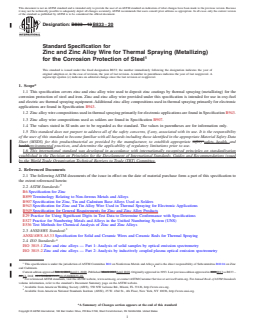
1.1 This specification covers zinc and zinc alloy wire used to deposit zinc coatings by thermal spraying (metallizing) for the corrosion protection of steel and iron. Zinc and zinc alloy wire provided under this specification is intended for use in oxy-fuel and electric arc thermal spraying equipment. Additional zinc alloy compositions used in thermal spraying primarily for electronic applications are found in Specification B943.
1.2 Zinc alloy wire compositions used in thermal spraying primarily for electronic applications are found in Specification B943.
1.3 Zinc alloy wire compositions used as solders are found in Specification B907.
1.4 The values stated in SI units are to be regarded as the standard. The values in parentheses are for information only.
1.5 This standard does not purport to address all of the safety concerns, if any, associated with its use. It is the responsibility of the user of this standard to become familiar with all hazards including those identified in the appropriate Material Safety Data Sheet (MSDS) for this product/material as provided by the manufacturer, to establish appropriate safety, health, and environmental practices, and determine the applicability of regulatory limitations prior to use.
1.6 This international standard was developed in accordance with internationally recognized principles on standardization established in the Decision on Principles for the Development of International Standards, Guides and Recommendations issued by the World Trade Organization Technical Barriers to Trade (TBT) Committee.
- Status
- Published
- Publication Date
- 31-Mar-2020
- Technical Committee
- B02 - Nonferrous Metals and Alloys
- Drafting Committee
- B02.04 - Zinc and Cadmium
Buy Documents
ASTM B833-20 - Standard Specification for Zinc and Zinc Alloy Wire for Thermal Spraying (Metallizing) for the Corrosion Protection of Steel
REDLINE ASTM B833-20 - Standard Specification for Zinc and Zinc Alloy Wire for Thermal Spraying (Metallizing) for the Corrosion Protection of Steel
Overview
ASTM B833-20 is the standard specification for zinc and zinc alloy wire used in thermal spraying (metallizing) processes designed to provide corrosion protection for steel and iron surfaces. Developed by ASTM International, this standard outlines the quality, chemical composition, and physical requirements for zinc and zinc-aluminum alloy wires specifically produced for use in oxy-fuel and electric arc thermal spraying equipment. The standard is critical for industries requiring long-lasting protective coatings against atmospheric corrosion, especially in challenging environments.
Key Topics
Material Requirements
Wires must be produced from high-grade (Z15001) or special high-grade (Z13001) zinc, with strict limits on other elements such as aluminum, cadmium, copper, iron, lead, tin, antimony, silver, bismuth, arsenic, nickel, magnesium, molybdenum, and titanium to ensure optimal corrosion resistance and performance.Chemical Composition
The specification details permissible alloying elements and their maximum allowable concentrations, ensuring consistency and quality in corrosion protection applications.Physical and Mechanical Properties
- Wires must exhibit clean surfaces without corrosion, foreign materials, or defects that could interfere with spraying equipment.
- Wire diameters and permissible tolerances are specified to support reliable and continuous feeding in thermal spray guns.
- Mechanical properties such as tensile strength and elongation are provided for reference to assist in process selection and ensure feed reliability.
Workmanship and Packaging
- Wires must be coiled or spooled as continuous lengths, free from kinks or bends that would hinder operations.
- Packaging must be robust to prevent damage during shipping and handling, with clear marking for identification.
- Nonconductive packaging materials are required for electric arc spraying wires.
Testing and Certification
Acceptance criteria for chemical composition and mechanical properties are established, with guidelines for sampling, testing, certification, and dispute resolution in case of nonconformance.
Applications
Corrosion Protection of Structural Steel
Widely used in infrastructure projects such as bridges, towers, pipelines, and marine structures, zinc and zinc alloy thermal spray coatings provide sacrificial protection against environmental degradation.Industrial and Marine Equipment
Essential for equipment that must endure harsh marine or industrial atmospheres, prolonging service life and reducing maintenance costs.Repair and Remanufacturing
Applied in maintenance or restoration settings to repair worn or corroded steel components.Flexible Usage in Spraying Technologies
Compatible with both oxy-fuel and electric arc thermal spray systems, making the specification suitable for a broad variety of thermal spraying operations.
Related Standards
- ASTM B6 - Specification for Zinc (establishes the grade of zinc required)
- ASTM B943 - Specification for Zinc and Tin Alloy Wire Used in Thermal Spraying for Electronic Applications
- ASTM B907 - Specification for Zinc, Tin, and Cadmium Base Alloys Used as Solders
- ASTM B949 - General Requirements for Zinc and Zinc Alloy Products
- ANSI/AWS A5.33 - Specification for Solid and Ceramic Wires and Ceramic Rods for Thermal Spraying
- ISO 3815-1 and ISO 3815-2 - Methods for chemical analysis of zinc and zinc alloys
Practical Value
Complying with ASTM B833-20 ensures that zinc and zinc alloy wires used in thermal spray and metallizing applications deliver consistent, high-quality, and durable corrosion protection. Adhering to this standard is essential for manufacturers, contractors, and asset owners looking to extend the life of steel infrastructure or equipment and to meet the demands of rigorous quality management systems. The standardized requirements also facilitate international trade, procurement, and project specification, making the selection and use of protective wire for thermal spraying straightforward and reliable.
Relations
- Effective Date
- 01-Apr-2020
- Effective Date
- 01-Oct-2016
- Effective Date
- 01-Oct-2015
- Effective Date
- 01-Jun-2015
- Effective Date
- 01-Oct-2014
- Refers
ASTM B949-13 - Standard Specification for General Requirements for Zinc and Zinc Alloy Products - Effective Date
- 01-Aug-2013
- Effective Date
- 01-Feb-2013
- Effective Date
- 01-Feb-2013
- Effective Date
- 01-Feb-2013
- Effective Date
- 01-Feb-2013
- Effective Date
- 01-May-2012
- Effective Date
- 01-Oct-2009
- Effective Date
- 01-Oct-2009
- Effective Date
- 01-Oct-2009
- Effective Date
- 01-Oct-2009
Buy Documents
ASTM B833-20 - Standard Specification for Zinc and Zinc Alloy Wire for Thermal Spraying (Metallizing) for the Corrosion Protection of Steel
REDLINE ASTM B833-20 - Standard Specification for Zinc and Zinc Alloy Wire for Thermal Spraying (Metallizing) for the Corrosion Protection of Steel
Get Certified
Connect with accredited certification bodies for this standard

DVS-ZERT GmbH
German welding certification society.
CARES (UK Certification Authority for Reinforcing Steels)
UK certification for reinforcing steels and construction.
EWF/IIW (European/International Welding Federation)
International welding personnel certification.
Sponsored listings
Frequently Asked Questions
ASTM B833-20 is a technical specification published by ASTM International. Its full title is "Standard Specification for Zinc and Zinc Alloy Wire for Thermal Spraying (Metallizing) for the Corrosion Protection of Steel". This standard covers: ABSTRACT This specification covers zinc and zinc alloy wire used to deposit zinc coatings by thermal spraying (metallizing) for the corrosion protection of steel and iron. Zinc and zinc alloy wire provided under this specification is intended for use in oxy-fuel and electric arc thermal spraying equipment. The zinc used to manufacture the wire shall conform to the requirements for high grade zinc (Z15001) or special high grade zinc (Z13001). The wire shall conform to the chemical requirements for aluminum, cadmium, copper, iron, lead, tin, antimony, silver, bismuth, arsenic, nickel, magnesium, molybdenum, titanium, and zinc. The wire shall be clean and free of corrosion, adhering foreign material, scale, seams, nicks, burrs, bends or kinks which would interfere with the operation of thermal spraying equipment. The wire shall uncoil readily and shall be a continuous length per spool, coil, or drum. Splices or welds are permitted, provided that they do not interfere with the thermal spray equipment or coating process. SCOPE 1.1 This specification covers zinc and zinc alloy wire used to deposit zinc coatings by thermal spraying (metallizing) for the corrosion protection of steel and iron. Zinc and zinc alloy wire provided under this specification is intended for use in oxy-fuel and electric arc thermal spraying equipment. Additional zinc alloy compositions used in thermal spraying primarily for electronic applications are found in Specification B943. 1.2 Zinc alloy wire compositions used in thermal spraying primarily for electronic applications are found in Specification B943. 1.3 Zinc alloy wire compositions used as solders are found in Specification B907. 1.4 The values stated in SI units are to be regarded as the standard. The values in parentheses are for information only. 1.5 This standard does not purport to address all of the safety concerns, if any, associated with its use. It is the responsibility of the user of this standard to become familiar with all hazards including those identified in the appropriate Material Safety Data Sheet (MSDS) for this product/material as provided by the manufacturer, to establish appropriate safety, health, and environmental practices, and determine the applicability of regulatory limitations prior to use. 1.6 This international standard was developed in accordance with internationally recognized principles on standardization established in the Decision on Principles for the Development of International Standards, Guides and Recommendations issued by the World Trade Organization Technical Barriers to Trade (TBT) Committee.
ABSTRACT This specification covers zinc and zinc alloy wire used to deposit zinc coatings by thermal spraying (metallizing) for the corrosion protection of steel and iron. Zinc and zinc alloy wire provided under this specification is intended for use in oxy-fuel and electric arc thermal spraying equipment. The zinc used to manufacture the wire shall conform to the requirements for high grade zinc (Z15001) or special high grade zinc (Z13001). The wire shall conform to the chemical requirements for aluminum, cadmium, copper, iron, lead, tin, antimony, silver, bismuth, arsenic, nickel, magnesium, molybdenum, titanium, and zinc. The wire shall be clean and free of corrosion, adhering foreign material, scale, seams, nicks, burrs, bends or kinks which would interfere with the operation of thermal spraying equipment. The wire shall uncoil readily and shall be a continuous length per spool, coil, or drum. Splices or welds are permitted, provided that they do not interfere with the thermal spray equipment or coating process. SCOPE 1.1 This specification covers zinc and zinc alloy wire used to deposit zinc coatings by thermal spraying (metallizing) for the corrosion protection of steel and iron. Zinc and zinc alloy wire provided under this specification is intended for use in oxy-fuel and electric arc thermal spraying equipment. Additional zinc alloy compositions used in thermal spraying primarily for electronic applications are found in Specification B943. 1.2 Zinc alloy wire compositions used in thermal spraying primarily for electronic applications are found in Specification B943. 1.3 Zinc alloy wire compositions used as solders are found in Specification B907. 1.4 The values stated in SI units are to be regarded as the standard. The values in parentheses are for information only. 1.5 This standard does not purport to address all of the safety concerns, if any, associated with its use. It is the responsibility of the user of this standard to become familiar with all hazards including those identified in the appropriate Material Safety Data Sheet (MSDS) for this product/material as provided by the manufacturer, to establish appropriate safety, health, and environmental practices, and determine the applicability of regulatory limitations prior to use. 1.6 This international standard was developed in accordance with internationally recognized principles on standardization established in the Decision on Principles for the Development of International Standards, Guides and Recommendations issued by the World Trade Organization Technical Barriers to Trade (TBT) Committee.
ASTM B833-20 is classified under the following ICS (International Classification for Standards) categories: 25.220.20 - Surface treatment. The ICS classification helps identify the subject area and facilitates finding related standards.
ASTM B833-20 has the following relationships with other standards: It is inter standard links to ASTM B833-13, ASTM B899-16, ASTM B899-15, ASTM E536-15, ASTM B899-14, ASTM B949-13, ASTM B6-13, ASTM B899-13, ASTM B943-13, ASTM B907-13, ASTM B6-12, ASTM B899-09, ASTM B6-09, ASTM B899-09e1, ASTM B943-09. Understanding these relationships helps ensure you are using the most current and applicable version of the standard.
ASTM B833-20 is available in PDF format for immediate download after purchase. The document can be added to your cart and obtained through the secure checkout process. Digital delivery ensures instant access to the complete standard document.
Standards Content (Sample)
This international standard was developed in accordance with internationally recognized principles on standardization established in the Decision on Principles for the
Development of International Standards, Guides and Recommendations issued by the World Trade Organization Technical Barriers to Trade (TBT) Committee.
Designation:B833 −20
Standard Specification for
Zinc and Zinc Alloy Wire for Thermal Spraying (Metallizing)
for the Corrosion Protection of Steel
This standard is issued under the fixed designation B833; the number immediately following the designation indicates the year of
original adoption or, in the case of revision, the year of last revision. A number in parentheses indicates the year of last reapproval. A
superscript epsilon (´) indicates an editorial change since the last revision or reapproval.
1. Scope* 2.2 ASTM Standards:
B6 Specification for Zinc
1.1 This specification covers zinc and zinc alloy wire used
B899 Terminology Relating to Non-ferrous Metals and Al-
to deposit zinc coatings by thermal spraying (metallizing) for
loys
the corrosion protection of steel and iron. Zinc and zinc alloy
B907 Specification for Zinc, Tin and Cadmium Base Alloys
wire provided under this specification is intended for use in
Used as Solders
oxy-fuel and electric arc thermal spraying equipment. Addi-
B943 Specification for Zinc and Tin Alloy Wire Used in
tional zinc alloy compositions used in thermal spraying pri-
Thermal Spraying for Electronic Applications
marily for electronic applications are found in Specification
B949 Specification for General Requirements for Zinc and
B943.
Zinc Alloy Products
1.2 Zinc alloy wire compositions used in thermal spraying
E29 Practice for Using Significant Digits in Test Data to
primarily for electronic applications are found in Specification
Determine Conformance with Specifications
B943.
E527 Practice for Numbering Metals and Alloys in the
Unified Numbering System (UNS)
1.3 Zinc alloy wire compositions used as solders are found
in Specification B907. E536 Test Methods for ChemicalAnalysis of Zinc and Zinc
Alloys
1.4 The values stated in SI units are to be regarded as the
2.3 ANSI/AWS Standard:
standard. The values in parentheses are for information only.
ANSI/AWS A5.33 Specification for Solid and Ceramic
1.5 This standard does not purport to address all of the
Wires and Ceramic Rods for Thermal Spraying
safety concerns, if any, associated with its use. It is the
2.4 ISO Standards:
responsibility of the user of this standard to become familiar
ISO 3815-1 Zinc and zinc alloys — Part 1:Analysis of solid
with all hazards including those identified in the appropriate
samples by optical emission spectrometry
Material Safety Data Sheet (MSDS) for this product/material
ISO 3815-2 Zinc and zinc alloys — Part 2: Analysis by
as provided by the manufacturer, to establish appropriate
inductively coupled plasma optical emission spectrometry
safety, health, and environmental practices, and determine the
applicability of regulatory limitations prior to use.
3. Terminology
1.6 This international standard was developed in accor-
3.1 Terms shall be defined in accordance with Terminology
dance with internationally recognized principles on standard-
B899.
ization established in the Decision on Principles for the
Development of International Standards, Guides and Recom-
4. Ordering Information
mendations issued by the World Trade Organization Technical
Barriers to Trade (TBT) Committee. 4.1 In order to make the application of this specification
complete, the purchaser shall supply the following information
2. Referenced Documents
to the seller in the purchase order or other governing docu-
ments:
2.1 The following ASTM documents of the issue in effect
on the date of material purchase form a part of this specifica-
tion to the extent referenced herein:
For referenced ASTM standards, visit the ASTM website, www.astm.org, or
contact ASTM Customer Service at service@astm.org. For Annual Book of ASTM
This specification is under the jurisdiction of ASTM Committee B02 on Standards volume information, refer to the standard’s Document Summary page on
Nonferrous Metals and Alloys and is the direct responsibility of Subcommittee the ASTM website.
B02.04 on Zinc and Cadmium. Available from American Welding Society (AWS), 550 NW LeJeune Rd.,
Current edition approved April 1, 2020. Published April 2020. Originally Miami, FL 33126, http://www.aws.org.
approved in 1993. Last previous edition approved in 2013 as B833 – 13. DOI: Available fromAmerican National Standards Institute (ANSI), 25 W. 43rd St.,
10.1520/B0833-20. 4th Floor, New York, NY 10036, http://www.ansi.org.
*A Summary of Changes section appears at the end of this standard
Copyright © ASTM International, 100 Barr Harbor Drive, PO Box C700, West Conshohocken, PA 19428-2959. United States
B833−20
4.1.1 Name, designation, and date of issue of this 7. Physical Properties and Mechanical Properties
specification,
7.1 Appendix X1 shows typical physical properties for zinc
4.1.2 Quantity (mass(weight) in kilograms (pounds)),
and zinc alloy wire and does not constitute a part of this
4.1.3 Diameter (see Table 1),
specification but is provided for informational purposes only.
4.1.4 Acceptance tests if other than specified (see Section
7.2 Appendix X2 shows typical mechanical properties for
10),
zinc and zinc alloy wire and does not constitute a part of this
4.1.5 Certification (see Section 14),
specification but is provided for informational purposes only.
4.1.6 Packagingandpackingmaterials(seeSection15),and
7.2.1 Mechanicalpropertiesareimportantsothewirecanbe
4.1.7 Supplementary requirements, if applicable.
fed into a thermal spray gun without breaking or jamming.
4.2 See Specification B949.
7.2.2 Mechanical properties of zinc and zinc alloy wire will
vary depending upon the wire diameter and processing factors.
5. Materials and Manufacture
8. Dimensions, Weights, and Permissible Variations
5.1 The zinc used to manufacture the wire shall conform to
the requirements for High Grade Zinc (Z15001) or Special
8.1 The wire shall conform to the sizes, tolerances, and
High Grade Zinc (Z13001) as specified in Specification B6.
weights per unit length listed in Table 1.
5.2 See Specification B949.
9. Workmanship, Finish, and Appearance
6. Chemical Composition
9.1 The wire shall be clean and free of corrosion, adhering
foreign material, scale, seams, nicks, burrs, and other defects
6.1 The wire shall conform to the requirements prescribed
which would interfere with the operation of thermal spraying
in Table 2.
equipment. The wire shall uncoil readily and be free of bends
6.2 The manufacturer shall perform chemical analyses as
or kinks that would prevent its passage through the thermal
directed byTest Methods E536, ISO 3815-1, ISO 3815-2 or by
spray gun.
other methods of at least equal accuracy to confirm that the
wire conforms to the requirements of composition. In case of 9.2 The wire shall be a continuous length per spool, coil, or
drum. Splices or welds are permitted, provided that they do not
dispute, Test Method E536 shall be accepted.Analysis of alloy
wires not covered by Test Method E536 shall be agreed upon interfere with the thermal spray equipment or coating process.
between the manufacturer and the purchaser.
9.3 The starting end of each coil shall be tagged to indicate
winding direction and to be readily identifiable with ASTM
NOTE 1—Test Method E536 is not directly applicable, in an unmodified
form, to alloys 85Zn/15Al or 87Zn/13Al. designation.
NOTE 2—By mutual agreement between supplier and purchaser, analy-
9.4 See Specification B949.
sis may be required and limits established for elements or compounds not
specified in Table 2.
10. Acceptance Tests
6.2.1 Analysis may be performed on finished wire, on
10.1 The seller shall provide, at the buyer’s option, either a
material selected when the wire is cast, or on samples taken
certification or a manufacturer’s declaration that the raw
from semi-finished wire.
material used to manufacture the wire met the requirements of
6.2.2 If analysis is performed on finished wire, the number
composition specified in 5.1.
and selection of samples shall be agreed upon by the buyer and
seller.
11. Sampling
6.2.3 If the analysis is performed on material selected while
11.1 Selection of samples of wire shall be agreed upon
the wire is being cast, at least one sample shall be selected for
between the purchaser and the supplier. Agreement may also
each source of molten metal.
include requirements of the number of tests and retests.
6.2.4 If the analysis is performed on samples taken from
semi-finished
...
This document is not an ASTM standard and is intended only to provide the user of an ASTM standard an indication of what changes have been made to the previous version. Because
it may not be technically possible to adequately depict all changes accurately, ASTM recommends that users consult prior editions as appropriate. In all cases only the current version
of the standard as published by ASTM is to be considered the official document.
Designation: B833 − 13 B833 − 20
Standard Specification for
Zinc and Zinc Alloy Wire for Thermal Spraying (Metallizing)
for the Corrosion Protection of Steel
This standard is issued under the fixed designation B833; the number immediately following the designation indicates the year of
original adoption or, in the case of revision, the year of last revision. A number in parentheses indicates the year of last reapproval. A
superscript epsilon (´) indicates an editorial change since the last revision or reapproval.
1. Scope*
1.1 This specification covers zinc and zinc alloy wire used to deposit zinc coatings by thermal spraying (metallizing) for the
corrosion protection of steel and iron. Zinc and zinc alloy wire provided under this specification is intended for use in oxy-fuel
and electric arc thermal spraying equipment. Additional zinc alloy compositions used in thermal spraying primarily for electronic
applications are found in Specification B943.
1.2 Zinc alloy wire compositions used in thermal spraying primarily for electronic applications are found in Specification B943.
1.3 Zinc alloy wire compositions used as solders are found in Specification B907.
1.4 The values stated in SI units are to be regarded as the standard. The values in parentheses are for information only.
1.5 This standard does not purport to address all of the safety concerns, if any, associated with its use. It is the responsibility
of the user of this standard to become familiar with all hazards including those identified in the appropriate Material Safety Data
Sheet (MSDS) for this product/material as provided by the manufacturer, to establish appropriate safety safety, health, and
healthenvironmental practices, and determine the applicability of regulatory limitations prior to use.
1.6 This international standard was developed in accordance with internationally recognized principles on standardization
established in the Decision on Principles for the Development of International Standards, Guides and Recommendations issued
by the World Trade Organization Technical Barriers to Trade (TBT) Committee.
2. Referenced Documents
2.1 The following ASTM documents of the issue in effect on the date of material purchase form a part of this specification to
the extent referenced herein:
2.2 ASTM Standards:
B6 Specification for Zinc
B899 Terminology Relating to Non-ferrous Metals and Alloys
B907 Specification for Zinc, Tin and Cadmium Base Alloys Used as Solders
B943 Specification for Zinc and Tin Alloy Wire Used in Thermal Spraying for Electronic Applications
B949 Specification for General Requirements for Zinc and Zinc Alloy Products
E29 Practice for Using Significant Digits in Test Data to Determine Conformance with Specifications
E527 Practice for Numbering Metals and Alloys in the Unified Numbering System (UNS)
E536 Test Methods for Chemical Analysis of Zinc and Zinc Alloys
2.3 ANSI/AWS Standard:
ANSI/AWS A5.33 Specification for Solid and Ceramic Wires and Ceramic Rods for Thermal Spraying
2.4 ISO Standards:
ISO 3815-1 Zinc and zinc alloys — Part 1: Analysis of solid samples by optical emission spectrometry
ISO 3815-2 Zinc and zinc alloys — Part 2: Analysis by inductively coupled plasma optical emission spectrometry
This specification is under the jurisdiction of ASTM Committee B02 on Nonferrous Metals and Alloys and is the direct responsibility of Subcommittee B02.04 on Zinc
and Cadmium.
Current edition approved Feb. 1, 2013April 1, 2020. Published March 2013April 2020. Originally approved in 1993. Last previous edition approved in 20092013 as B833 –
06.13. DOI: 10.1520/B0833-13.10.1520/B0833-20.
For referenced ASTM standards, visit the ASTM website, www.astm.org, or contact ASTM Customer Service at service@astm.org. For Annual Book of ASTM Standards
volume information, refer to the standard’s Document Summary page on the ASTM website.
Available from American Welding Society (AWS), 550 NW LeJeune Rd., Miami, FL 33126, http://www.aws.org.
Available from American National Standards Institute (ANSI), 25 W. 43rd St., 4th Floor, New York, NY 10036, http://www.ansi.org.
*A Summary of Changes section appears at the end of this standard
Copyright © ASTM International, 100 Barr Harbor Drive, PO Box C700, West Conshohocken, PA 19428-2959. United States
B833 − 20
3. Terminology
3.1 Terms shall be defined in accordance with Terminology B899.
4. Ordering Information
4.1 In order to make the application of this specification complete, the purchaser shall supply the following information to the
seller in the purchase order or other governing documents:
4.1.1 Name, designation, and date of issue of this specification,
4.1.2 Quantity (mass(weight) in kilograms (pounds)),
4.1.3 Diameter (see Table 1),
4.1.4 Acceptance tests if other than specified (see Section 10),
4.1.5 Certification (see Section 1114),
4.1.6 Packaging and packing materials (see Section 1215), and
4.1.7 Supplementary requirements, if applicable.
4.2 See Specification B949.
5. Materials and Manufacture
5.1 The zinc used to manufacture the wire shall conform to the requirements for High Grade Zinc (Z15001) or Special High
Grade Zinc (Z13001) as specified in Specification B6.
5.2 See Specification B949.
6. Chemical Composition
6.1 The wire shall conform to the requirements prescribed in Table 2.
6.2 The manufacturer shall perform chemical analyses as directed by Test Methods E536, ISO 3815-1, ISO 3815-2 or by other
methods of at least equal accuracy to confirm that the wire conforms to the requirements of composition. In case of dispute, Test
Method E536 shall be accepted. Analysis of alloy wires not covered by Test Method E536 shall be agreed upon between the
manufacturer and the purchaser.
NOTE 1—Test Method E536 is not directly applicable, in an unmodified form, to alloys 85Zn/15Al or 87Zn/13Al.
NOTE 2—By mutual agreement between supplier and purchaser, analysis may be required and limits established for elements or compounds not
specified in Table 2.
6.2.1 Analysis may be performed on finished wire, on material selected when the wire is cast, or on samples taken from
semi-finished wire.
6.2.2 If analysis is performed on finished wire, the number and selection of samples shall be agreed upon by the buyer and seller.
6.2.3 If the analysis is performed on material selected while the wire is being cast, at least one sample shall be selected for each
source of molten metal.
6.2.4 If the analysis is performed on samples taken from semi-finished product, at least one sample shall be analyzed for each
4500 kg (10 000 lbs) or fraction thereof.
7. Physical Properties and Mechanical Properties
7.1 Appendix X1 shows typical physical properties for zinc and zinc alloy wire and does not constitute a part of this
specification but is provided for informational purposes only.
7.2 Appendix X2 shows typical mechanical properties for zinc and zinc alloy wire and does not constitute a part of this
specification but is provided for informational purposes only.
TABLE 1 Dimensions, Weights, and Permissible Variations
Nominal Wire Diameter Permissible Variation Nominal Weight Per Unit Length
mm (in.) mm (in.) g/m (lb/ft)
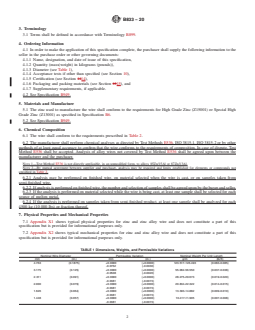
4.763 (0.1875) +0.0000 (+0.0000) 123.517-126.493 (0.083-0.085)
-0.0762 (-0.0030)
3.175 (0.125) +0.0000 (+0.0000) 55.062-56.550 (0.037-0.038)
-0.0508 (-0.0020)
2.311 (0.091) +0.0000 (+0.0000) 28.275-29.673 (0.019-0.020)
-0.0381 (-0.0015)
2.000 (0.079) +0.0000 (+0.0000) 20.834-22.322 (0.014-0.015)
-0.0381 (-0.0015)
1.626 (0.064) +0.0000 (+0.0000) 13.393-14.882 (0.009-0.010)
-0.0381 (-0.0015)
1.448 (0.057) +0.0000 (+0.0000) 10.417-11.905 (0.007-0.008)
-0.0381 (-0.0015)
B833 − 20
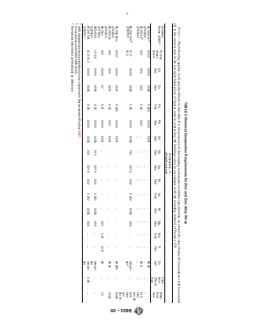
TABLE 2 Chemical Composition Requirements for Zinc and Zinc Alloy Wires
NOTE 1—The following applies to all specified limits in this table. For the purposes of determining conformance with this specification, an observed value obtained from analysis shall be rounded
off to the nearest unit in the last right-hand place of figures used in expressing the limiting value, in accordance with the rounding method of Practice E29.
Composition, %
(Weight percent)
Common Total
Al, max Other,
A
Name (UNS) Cd, Cu, Fe, Pb, Sn, Sb, Ag, Bi, As, Ni, Mg, Mo, Ti, Zn, Non-
unless Total
max max max max max max max max max max max max max min ZN+Al,
noted max
max
B
99.99 Zinc 0.002 0.003 0.005 0.003 0.003 0.001 . . . . . . . . 99.99 . .
(Z13005) . . . . . . . . . . .
B
99.9 Zinc 0.01 0.02 0.02 0.02 0.03 . . . . . . . . . 99.9 . 0.10
(Z15005) . . . . . . . . . . . total
non-Zn
B
85 Zn/15 Al 14.0- 0.005 0.005 0.06 0.005 0.003 0.01 0.015 0.02 0.002 0.005 0.02 . . remain- . 0.05
C
(Z30700)
16.0 der total
non
Zn+Al
99.995 Zinc 0.001 0.003 0.001 0.002 0.003 0.001 . . . . . . . . 99.995 . 0.005
(Z12004)
99.95 Zinc 0.01 0.02 0.001 0.02 0.03 0.001 . . . . . . . . 99.95 . 0.050
(Z14004)
99 Zinc 0.01 0.005 0.7 0.01 0.005 0.001 . . . . . 0.01 0.01 0.18 99 . 1.0
(Z17000)
98Zn/2Al 1.5-2.5 0.005 0.005 0.02 0.005 0.003 0.10 0.015 0.02 0.002 0.005 0.02 . . remain- . .
(Z30402) der
87Zn/13Al 12.0-14.0 0.005 0.005 0.06 0.005 0.003 0.01 0.015 0.02 0.002 0.005 0.02 . . remain- 0.05 .
(Z30701) der
A
UNS designations were established in accordance with Recommended Practice E527.
B
In accordance with ANSI/AWS A5.33.
C
Remainder determined arithmetically by difference.
B833 − 20
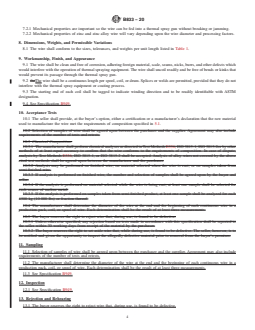
7.2.1 Mechanical properties are important so the wire can be fed into a thermal spray gun without breaking or jamming.
7.2.2 Mechanical properties of zinc and zinc alloy wire will vary depending upon
...