

ASTM F2460-19
(Practice)Standard Practice for Special Requirements for Bumper Boats
General Information
- Abstract
SIGNIFICANCE AND USE
3.1 The purpose of this practice is to delineate information and to establish procedures for the operation of a bumper boat amusement ride.
3.2 The device is a single craft, unattached to other craft or common frame system. It is non-human powered without connection to a common energy source. It is driver controlled with respect to acceleration, speed, and steering.
SCOPE
1.1 This practice establishes criteria for the design, manufacture, and operations of bumper boats. These are boats used to bump into each other intentionally as directed by drivers as a form of entertainment. Boats are fitted with an inflatable or impact attenuating device to allow for such bumping.
1.2 This practice follows Practices F1193 and F770 as the basic level of safety for bumper boats. These practices shall be followed for all bumper boats under this practice. This practice shall include all modifications, improvements, and deviations to design, quality, manufacture, construction, ownership, operation, inspection, and maintenance of a bumper boat
1.3 This practice does not apply to personal watercraft, human powered watercraft, or watercraft used for general purposes by private owners.
1.4 This standard does not purport to address all of the safety concerns, if any, associated with its use. It is the responsibility of the user of this standard to establish appropriate safety, health, and environmental practices and determine the applicability of regulatory limitations prior to use.
1.5 This international standard was developed in accordance with internationally recognized principles on standardization established in the Decision on Principles for the Development of International Standards, Guides and Recommendations issued by the World Trade Organization Technical Barriers to Trade (TBT) Committee.
- Status
- Published
- Publication Date
- 14-Oct-2019
- Technical Committee
- F24 - Amusement Rides and Devices
- Drafting Committee
- F24.60 - Special Rides/Attractions




Overview
ASTM F2460-19 - Standard Practice for Special Requirements for Bumper Boats provides comprehensive criteria for the design, manufacturing, operation, and maintenance of bumper boats used in amusement settings. This internationally recognized ASTM standard sets out the essential requirements to ensure the safety, quality, and consistent performance of bumper boats as amusement rides. The standard applies specifically to single-craft, driver-controlled bumper boats that are non-human powered and unattached to other crafts or common energy sources.
By referencing and building upon other key ASTM practices, ASTM F2460-19 establishes a reliable framework that supports the safe operation and management of bumper boat attractions in amusement and leisure environments.
Key Topics
Scope and Applicability
- Defines the type of watercraft covered, specifically bumper boats designed for intentional, driver-controlled collisions within amusement rides
- Excludes personal watercraft, human-powered watercraft, and boats used for general or private purposes
Design Requirements
- Boats must feature inflatable or impact-attenuating devices to allow for safe bumping
- Throttle or power controls must automatically return to stop or slow speed when released
- Battery-powered boats require adequate ventilation and must be equipped with automatic circuit protection devices meeting SAE J1171 external ignition protection standards
- All moving drive components (propellers, impellers) must be guarded, with guards featuring openings no greater than 16 mm in width
Quality, Manufacture, and Construction
- Adheres to ASTM F1193 and F1159 for quality assurance in manufacture and construction processes
Operation and Ownership
- Recommends adherence to ASTM F770 for operation, inspection, and ownership responsibilities
- Requires additional safety features such as heat shields and appropriate fire extinguishers per NFPA 10-2002
Maintenance
- Mandates regular maintenance as outlined in ASTM F770, ensuring continued safety and functionality
User Responsibilities
- Outlines duties for ride patrons, emphasizing responsible behavior and adherence to safety instructions
Applications
ASTM F2460-19 serves as a core safety and operational guideline for:
- Amusement and Theme Parks: Ensures bumper boat rides are designed, operated, and maintained to high safety standards, protecting riders and operators.
- Family Entertainment Centers: Supports quality, maintenance, and inspection processes to minimize hazards.
- Regulatory Compliance: Offers a standardized foundation for meeting local, national, and international safety regulations for amusement rides.
- Manufacturers and Suppliers: Provides a clear checklist for the design, production, and quality assurance of bumper boats intended for commercial amusement use.
- Inspectors and Safety Auditors: Offers concrete benchmarks for assessing ride compliance and operational safety.
By adhering to ASTM F2460-19, amusement ride operators and manufacturers can foster safer environments, thereby improving user trust and satisfaction while helping to reduce liability risks.
Related Standards
ASTM F2460-19 references several important standards to promote a holistic approach to amusement ride safety, including:
- ASTM F1193: Quality, Manufacture, and Construction of Amusement Rides and Devices
- ASTM F770: Ownership, Operation, Maintenance, and Inspection of Amusement Rides and Devices
- ASTM F1159: Design of Amusement Rides and Devices Outside the Purview of Other F24 Design Standards
- NFPA 10-2002: National Fire Protection Association Standard for Portable Fire Extinguishers
- SAE J1171: External Ignition Protection of Marine Electrical Devices
Implementing ASTM F2460-19 in tandem with these referenced standards supports robust safety management and operational excellence for bumper boat amusement rides. For further details and official documentation, visit the ASTM International website.
Relations
- Effective Date
- 15-Oct-2019
- Effective Date
- 01-Jun-2018
- Effective Date
- 15-May-2018
- Effective Date
- 01-May-2017
- Effective Date
- 01-May-2017
- Effective Date
- 15-Feb-2016
- Effective Date
- 01-Nov-2015
- Effective Date
- 01-May-2015
- Effective Date
- 01-Mar-2015
- Effective Date
- 15-Jan-2015
- Effective Date
- 01-Oct-2014
- Effective Date
- 01-Sep-2014
- Effective Date
- 01-Apr-2014
- Effective Date
- 01-Sep-2013
- Effective Date
- 01-Dec-2011
Get Certified
Connect with accredited certification bodies for this standard

DNV
DNV is an independent assurance and risk management provider.

Lloyd's Register
Lloyd's Register is a global professional services organisation specialising in engineering and technology.

FSC International
Forest Stewardship Council certification.
Sponsored listings
Frequently Asked Questions
ASTM F2460-19 is a standard published by ASTM International. Its full title is "Standard Practice for Special Requirements for Bumper Boats". This standard covers: SIGNIFICANCE AND USE 3.1 The purpose of this practice is to delineate information and to establish procedures for the operation of a bumper boat amusement ride. 3.2 The device is a single craft, unattached to other craft or common frame system. It is non-human powered without connection to a common energy source. It is driver controlled with respect to acceleration, speed, and steering. SCOPE 1.1 This practice establishes criteria for the design, manufacture, and operations of bumper boats. These are boats used to bump into each other intentionally as directed by drivers as a form of entertainment. Boats are fitted with an inflatable or impact attenuating device to allow for such bumping. 1.2 This practice follows Practices F1193 and F770 as the basic level of safety for bumper boats. These practices shall be followed for all bumper boats under this practice. This practice shall include all modifications, improvements, and deviations to design, quality, manufacture, construction, ownership, operation, inspection, and maintenance of a bumper boat 1.3 This practice does not apply to personal watercraft, human powered watercraft, or watercraft used for general purposes by private owners. 1.4 This standard does not purport to address all of the safety concerns, if any, associated with its use. It is the responsibility of the user of this standard to establish appropriate safety, health, and environmental practices and determine the applicability of regulatory limitations prior to use. 1.5 This international standard was developed in accordance with internationally recognized principles on standardization established in the Decision on Principles for the Development of International Standards, Guides and Recommendations issued by the World Trade Organization Technical Barriers to Trade (TBT) Committee.
SIGNIFICANCE AND USE 3.1 The purpose of this practice is to delineate information and to establish procedures for the operation of a bumper boat amusement ride. 3.2 The device is a single craft, unattached to other craft or common frame system. It is non-human powered without connection to a common energy source. It is driver controlled with respect to acceleration, speed, and steering. SCOPE 1.1 This practice establishes criteria for the design, manufacture, and operations of bumper boats. These are boats used to bump into each other intentionally as directed by drivers as a form of entertainment. Boats are fitted with an inflatable or impact attenuating device to allow for such bumping. 1.2 This practice follows Practices F1193 and F770 as the basic level of safety for bumper boats. These practices shall be followed for all bumper boats under this practice. This practice shall include all modifications, improvements, and deviations to design, quality, manufacture, construction, ownership, operation, inspection, and maintenance of a bumper boat 1.3 This practice does not apply to personal watercraft, human powered watercraft, or watercraft used for general purposes by private owners. 1.4 This standard does not purport to address all of the safety concerns, if any, associated with its use. It is the responsibility of the user of this standard to establish appropriate safety, health, and environmental practices and determine the applicability of regulatory limitations prior to use. 1.5 This international standard was developed in accordance with internationally recognized principles on standardization established in the Decision on Principles for the Development of International Standards, Guides and Recommendations issued by the World Trade Organization Technical Barriers to Trade (TBT) Committee.
ASTM F2460-19 is classified under the following ICS (International Classification for Standards) categories: 47.080 - Small craft. The ICS classification helps identify the subject area and facilitates finding related standards.
ASTM F2460-19 has the following relationships with other standards: It is inter standard links to ASTM F2460-11, ASTM F770-18, ASTM F1193-18, ASTM F770-17e1, ASTM F770-17, ASTM F1193-16, ASTM F1159-15b, ASTM F770-15, ASTM F1159-15a, ASTM F1159-15, ASTM F1159-14, ASTM F1193-14, ASTM F770-14, ASTM F770-13, ASTM F1159-11. Understanding these relationships helps ensure you are using the most current and applicable version of the standard.
ASTM F2460-19 is available in PDF format for immediate download after purchase. The document can be added to your cart and obtained through the secure checkout process. Digital delivery ensures instant access to the complete standard document.
Standards Content (Sample)
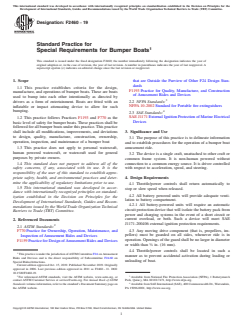
This international standard was developed in accordance with internationally recognized principles on standardization established in the Decision on Principles for the
Development of International Standards, Guides and Recommendations issued by the World Trade Organization Technical Barriers to Trade (TBT) Committee.
Designation: F2460 − 19
Standard Practice for
Special Requirements for Bumper Boats
This standard is issued under the fixed designation F2460; the number immediately following the designation indicates the year of
original adoption or, in the case of revision, the year of last revision. A number in parentheses indicates the year of last reapproval. A
superscript epsilon (´) indicates an editorial change since the last revision or reapproval.
1. Scope that are Outside the Purview of Other F24 Design Stan-
dards
1.1 This practice establishes criteria for the design,
F1193 Practice for Quality, Manufacture, and Construction
manufacture, and operations of bumper boats. These are boats
of Amusement Rides and Devices
used to bump into each other intentionally as directed by
2.2 NFPA Standards:
drivers as a form of entertainment. Boats are fitted with an
inflatable or impact attenuating device to allow for such NFPA 10-2002 Standard for Portable fire extinguishers
bumping.
2.3 SAE Standards:
SAE J1171 External Ignition Protection of Marine Electrical
1.2 This practice follows Practices F1193 and F770 as the
Devices
basic level of safety for bumper boats. These practices shall be
followed for all bumper boats under this practice. This practice
3. Significance and Use
shall include all modifications, improvements, and deviations
to design, quality, manufacture, construction, ownership,
3.1 The purpose of this practice is to delineate information
operation, inspection, and maintenance of a bumper boat
and to establish procedures for the operation of a bumper boat
amusement ride.
1.3 This practice does not apply to personal watercraft,
human powered watercraft, or watercraft used for general
3.2 The device is a single craft, unattached to other craft or
purposes by private owners.
common frame system. It is non-human powered without
1.4 This standard does not purport to address all of the connection to a common energy source. It is driver controlled
safety concerns, if any, associated with its use. It is the with respect to acceleration, speed, and steering.
responsibility of the user of this standard to establish appro-
priate safety, health, and environmental practices and deter- 4. Design Requirements
mine the applicability of regulatory limitations prior to use.
4.1 Throttle/power controls shall return automatically to
1.5 This international standard was developed in accor-
stop or slow speed when released.
dance with internationally recognized principles on standard-
4.2 All battery powered units will provide adequate venti-
ization established in the Decision on Principles for the
lation to battery compartment.
Development of International Standards, Guides and Recom-
4.2.1 All battery-powered units will require an automatic
mendations issued by the World Trade Organization Technical
circuit protection device that will isolate the battery pack from
Barriers to Trade (TBT) Committee.
power and charging systems in the event of a short circuit or
current overload, or both. Such a device will meet SAE
2. Referenced Documents
J1171-200406 external ignition protection requirements.
2.1 ASTM Standards:
4.3 Any moving drive component (that is, propellers, im-
F770 Practice for Ownership, Operation, Maintenance, and
pellers) must be guarded on all sides, whenever ride is in
Inspection of Amusement Rides and Devices
operation. Openings of the guard shall be no larger in diameter
F1159 Practice for Design ofAmusement Rides and Devices
or width than ⁄8 in. (16 mm).
4.4 Throttle/power controls shall be located in such a
This practice is under the jurisdiction ofASTM Committee F24 on Amusement
manner as to prevent accidental activation during loading or
Rides and Devices and is the direct responsibility of Subcommittee F24.60 on
unloading of boat.
Special Rides/Attraction
...
This document is not an ASTM standard and is intended only to provide the user of an ASTM standard an indication of what changes have been made to the previous version. Because
it may not be technically possible to adequately depict all changes accurately, ASTM recommends that users consult prior editions as appropriate. In all cases only the current version
of the standard as published by ASTM is to be considered the official document.
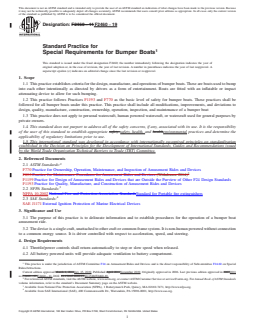
Designation: F2460 − 11 F2460 − 19
Standard Practice for
Special Requirements for Bumper Boats
This standard is issued under the fixed designation F2460; the number immediately following the designation indicates the year of
original adoption or, in the case of revision, the year of last revision. A number in parentheses indicates the year of last reapproval. A
superscript epsilon (´) indicates an editorial change since the last revision or reapproval.
1. Scope
1.1 This practice establishes criteria for the design, manufacture, and operations of bumper boats. These are boats used to bump
into each other intentionally as directed by drivers as a form of entertainment. Boats are fitted with an inflatable or impact
attenuating device to allow for such bumping.
1.2 This practice follows Practices F1193 and F770 as the basic level of safety for bumper boats. These practices shall be
followed for all bumper boats under this practice. This practice shall include all modifications, improvements, and deviations to
design, quality, manufacture, construction, ownership, operation, inspection, and maintenance of a bumper boat
1.3 This practice does not apply to personal watercraft, human powered watercraft, or watercraft used for general purposes by
private owners.
1.4 This standard does not purport to address all of the safety concerns, if any, associated with its use. It is the responsibility
of the user of this standard to establish appropriate safety safety, health, and healthenvironmental practices and determine the
applicability of regulatory limitations prior to use.
1.5 This international standard was developed in accordance with internationally recognized principles on standardization
established in the Decision on Principles for the Development of International Standards, Guides and Recommendations issued
by the World Trade Organization Technical Barriers to Trade (TBT) Committee.
2. Referenced Documents
2.1 ASTM Standards:
F770 Practice for Ownership, Operation, Maintenance, and Inspection of Amusement Rides and Devices
F853 Practice for Maintenance Procedures for Amusement Rides and Devices (Withdrawn 2014)
F1159 Practice for Design of Amusement Rides and Devices that are Outside the Purview of Other F24 Design Standards
F1193 Practice for Quality, Manufacture, and Construction of Amusement Rides and Devices
2.2 NFPA Standards:
NFPA 10-2002 National Fire and Protection Association StandardsStandard for Portable fire extinguishers
2.3 SAE Standards:
SAE J1171 External Ignition Protection of Marine Electrical Devices
3. Significance and Use
3.1 The purpose of this practice is to delineate information and to establish procedures for the operation of a bumper boat
amusement ride.
3.2 The device is a single craft, unattached to other craft or common frame system. It is non-human powered without connection
to a common energy source. It is driver controlled with respect to acceleration, speed, and steering.
4. Design Requirements
4.1 Throttle/power controls shall return automatically to stop or slow speed when released.
4.2 All battery powered units will provide adequate ventilation to battery compartment.
This practice is under the jurisdiction of ASTM Committee F24 on Amusement Rides and Devices and is the direct responsibility of Subcommittee F24.60 on Special
Rides/Attractions.
Current edition approved March 1, 2011Oct. 15, 2019. Published April 2011November 2019. Originally approved in 2006. Last previous edition approved in 20072011
as F2460 – 07.F2460 – 11. DOI: 10.1520/F2460-11.10.1520/F2460-19.
For referenced ASTM standards, visit the ASTM website, www.astm.org, or contact ASTM Customer Service at service@astm.org. For Annual Book of ASTM Standards
volume information, refer to the standard’s Document Summary page on the ASTM website.
Available from National Fire Protection Association (NFPA), 1 Batterymarch Park, Quincy, MA 02169-7471, http://www.nfpa.org.
Available from SAE International (SAE), 400 Commonwealth Dr., Warrendale, PA 1
...