

ASTM F3052-14(2020)e1
(Guide)Standard Guide for Conducting Small Boat Stability Test (Deadweight Survey and Air Inclining Experiment) to Determine Lightcraft Weight and Centers of Gravity of a Small Craft
General Information
- Abstract
SIGNIFICANCE AND USE
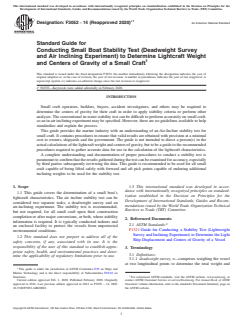
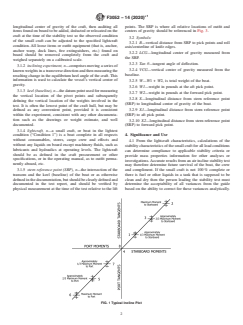
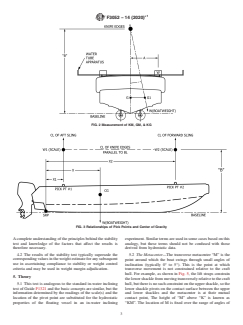
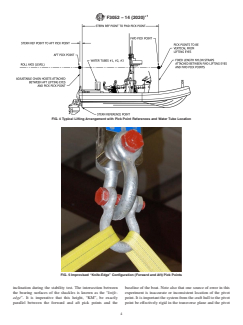
4.1 From the lightcraft characteristics, calculations of the stability characteristics of the small craft for all load conditions can determine compliance to applicable stability criteria or provide mass properties information for other analyses or investigations. Accurate results from an air incline stability test may therefore determine future survival of the boat, the crew and compliment. If the small craft is not 100 % complete or there is fuel or other liquids in a tank that is supposed to be clean and dry then the person leading the stability test must determine the acceptability of all variances from the guide based on the ability to correct for these variances analytically. A complete understanding of the principles behind the stability test and knowledge of the factors that affect the results is therefore necessary.
4.2 The results of the stability test typically supersede the corresponding values in the weight estimate for any subsequent use in ascertaining compliance to stability or weight control criteria and may be used in weight margin adjudication.
SCOPE
1.1 This guide covers the determination of a small boat’s lightcraft characteristics. The air incline stability test can be considered two separate tasks; a deadweight survey and an air-inclining experiment. The stability test is recommended, but not required, for all small craft upon their construction completion or after major conversions, or both, where stability information is required. It is typically conducted indoors and an enclosed facility to protect the vessels from unprotected environmental conditions.
1.2 This standard does not purport to address all of the safety concerns, if any, associated with its use. It is the responsibility of the user of this standard to establish appropriate safety, health, and environmental practices and determine the applicability of regulatory limitations prior to use.
1.3 This international standard was developed in accordance with internationally recognized principles on standardization established in the Decision on Principles for the Development of International Standards, Guides and Recommendations issued by the World Trade Organization Technical Barriers to Trade (TBT) Committee.
- Status
- Published
- Publication Date
- 31-Jan-2020
- Technical Committee
- F25 - Ships and Marine Technology
- Drafting Committee
- F25.01 - Structures
Overview
ASTM F3052-14(2020)e1 is a standard guide developed by ASTM International for conducting stability tests on small boats. The guide outlines procedures for performing a deadweight survey and an air inclining experiment to precisely determine the lightcraft weight and the centers of gravity (CG) of small craft. Accurately establishing these mass properties is essential for compliance with stability criteria and other analyses that impact the safety and operational performance of small vessels. This standard is particularly valuable for operators, builders, engineers, and investigators requiring reliable methods that minimize errors due to environmental conditions or incomplete vessel configuration.
Key Topics
- Lightcraft Characteristics: Guidance on determining a small craft’s condition with all permanent equipment, minus consumables, cargo, fluids (except machinery lubricants), and crew effects.
- Deadweight Survey: Procedures for weighing the vessel at two longitudinal points and adjusting for all removable or variable items to ascertain the lightcraft state.
- Air Inclining Experiment: Moving known weights transversely to induce heel, then measuring the equilibrium heel angle to calculate the vertical and longitudinal centers of gravity.
- Measurement Techniques: Use of calibrated scales, pendulums, water tubes, digital inclinometers, and laser levels to ensure precise measurement of inclination angles and weight distribution.
- Standardized Procedures: Emphasis on repeatability, accuracy, and documentation, allowing results to withstand scrutiny in regulatory or investigative contexts.
- Correcting for Variances: Methodology for handling incomplete boats or onboard fluids, requiring analytical correction for deviations from ideal test conditions.
- Safety and Environmental Considerations: Guidance to maintain safe practices, especially when conducting tests with suspended boats or under potentially hazardous conditions.
Applications
ASTM F3052-14(2020)e1 is applicable to a range of small craft, especially those that can be safely lifted and tested indoors or in protected outdoor facilities. Key applications include:
- Boatbuilders and Designers: Ensures reliable baseline weight and CG data after new construction or major conversions. This is critical for verifying stability compliance before delivery or after modifications.
- Marine Surveyors and Investigators: Provides standardized methods for post-incident investigations or litigation, helping determine if vessel mass properties contributed to accidents.
- Regulatory Compliance: Results inform compliance with stability regulations and may be required by authorities such as the US Coast Guard or for navy craft.
- Operational Planning and Safety: Accurate mass properties data underpins crew safety, proper loading, and operational readiness.
- Weight Margin Adjudication: Used to adjudicate surplus or deficit in vessel mass margins, guiding future modifications or repairs.
Related Standards
For comprehensive stability assessments or to complement this guide, the following standards may be relevant:
- ASTM F1321: Guide for Conducting a Stability Test (Lightweight Survey and Inclining Experiment) to Determine the Light Ship Displacement and Centers of Gravity of a Vessel.
- Other Regulatory Standards: National and international regulations on vessel stability and mass properties assessment, such as ISO small craft standards or IMO codes for larger ships.
- WTO TBT Principles: This standard was developed in coordination with the World Trade Organization Technical Barriers to Trade (TBT) Committee principles, supporting international harmonization.
By following ASTM F3052-14(2020)e1, stakeholders in the marine industry can ensure their small craft meet crucial stability and safety requirements through a standardized, precise approach to determining lightcraft weight and centers of gravity. Proper use of this standard enhances confidence in vessel safety, supports regulatory compliance, and delivers reliable data for engineering or investigative needs.
Relations
- Effective Date
- 01-Feb-2020
- Effective Date
- 01-Oct-2013
- Effective Date
- 01-Oct-2013
- Effective Date
- 01-Nov-2008
- Effective Date
- 01-Jul-2004
- Effective Date
- 01-Jan-1992
Get Certified
Connect with accredited certification bodies for this standard

DNV
DNV is an independent assurance and risk management provider.

Lloyd's Register
Lloyd's Register is a global professional services organisation specialising in engineering and technology.

FSC International
Forest Stewardship Council certification.
Sponsored listings
Frequently Asked Questions
ASTM F3052-14(2020)e1 is a guide published by ASTM International. Its full title is "Standard Guide for Conducting Small Boat Stability Test (Deadweight Survey and Air Inclining Experiment) to Determine Lightcraft Weight and Centers of Gravity of a Small Craft". This standard covers: SIGNIFICANCE AND USE 4.1 From the lightcraft characteristics, calculations of the stability characteristics of the small craft for all load conditions can determine compliance to applicable stability criteria or provide mass properties information for other analyses or investigations. Accurate results from an air incline stability test may therefore determine future survival of the boat, the crew and compliment. If the small craft is not 100 % complete or there is fuel or other liquids in a tank that is supposed to be clean and dry then the person leading the stability test must determine the acceptability of all variances from the guide based on the ability to correct for these variances analytically. A complete understanding of the principles behind the stability test and knowledge of the factors that affect the results is therefore necessary. 4.2 The results of the stability test typically supersede the corresponding values in the weight estimate for any subsequent use in ascertaining compliance to stability or weight control criteria and may be used in weight margin adjudication. SCOPE 1.1 This guide covers the determination of a small boat’s lightcraft characteristics. The air incline stability test can be considered two separate tasks; a deadweight survey and an air-inclining experiment. The stability test is recommended, but not required, for all small craft upon their construction completion or after major conversions, or both, where stability information is required. It is typically conducted indoors and an enclosed facility to protect the vessels from unprotected environmental conditions. 1.2 This standard does not purport to address all of the safety concerns, if any, associated with its use. It is the responsibility of the user of this standard to establish appropriate safety, health, and environmental practices and determine the applicability of regulatory limitations prior to use. 1.3 This international standard was developed in accordance with internationally recognized principles on standardization established in the Decision on Principles for the Development of International Standards, Guides and Recommendations issued by the World Trade Organization Technical Barriers to Trade (TBT) Committee.
SIGNIFICANCE AND USE 4.1 From the lightcraft characteristics, calculations of the stability characteristics of the small craft for all load conditions can determine compliance to applicable stability criteria or provide mass properties information for other analyses or investigations. Accurate results from an air incline stability test may therefore determine future survival of the boat, the crew and compliment. If the small craft is not 100 % complete or there is fuel or other liquids in a tank that is supposed to be clean and dry then the person leading the stability test must determine the acceptability of all variances from the guide based on the ability to correct for these variances analytically. A complete understanding of the principles behind the stability test and knowledge of the factors that affect the results is therefore necessary. 4.2 The results of the stability test typically supersede the corresponding values in the weight estimate for any subsequent use in ascertaining compliance to stability or weight control criteria and may be used in weight margin adjudication. SCOPE 1.1 This guide covers the determination of a small boat’s lightcraft characteristics. The air incline stability test can be considered two separate tasks; a deadweight survey and an air-inclining experiment. The stability test is recommended, but not required, for all small craft upon their construction completion or after major conversions, or both, where stability information is required. It is typically conducted indoors and an enclosed facility to protect the vessels from unprotected environmental conditions. 1.2 This standard does not purport to address all of the safety concerns, if any, associated with its use. It is the responsibility of the user of this standard to establish appropriate safety, health, and environmental practices and determine the applicability of regulatory limitations prior to use. 1.3 This international standard was developed in accordance with internationally recognized principles on standardization established in the Decision on Principles for the Development of International Standards, Guides and Recommendations issued by the World Trade Organization Technical Barriers to Trade (TBT) Committee.
ASTM F3052-14(2020)e1 is classified under the following ICS (International Classification for Standards) categories: 47.080 - Small craft. The ICS classification helps identify the subject area and facilitates finding related standards.
ASTM F3052-14(2020)e1 has the following relationships with other standards: It is inter standard links to ASTM F3052-14, ASTM F1321-13, ASTM F1321-13e1, ASTM F1321-92(2008), ASTM F1321-92(2004), ASTM F1321-92. Understanding these relationships helps ensure you are using the most current and applicable version of the standard.
ASTM F3052-14(2020)e1 is available in PDF format for immediate download after purchase. The document can be added to your cart and obtained through the secure checkout process. Digital delivery ensures instant access to the complete standard document.
Standards Content (Sample)
This international standard was developed in accordance with internationally recognized principles on standardization established in the Decision on Principles for the
Development of International Standards, Guides and Recommendations issued by the World Trade Organization Technical Barriers to Trade (TBT) Committee.
´1
Designation: F3052 − 14 (Reapproved 2020) An American National Standard
Standard Guide for
Conducting Small Boat Stability Test (Deadweight Survey
and Air Inclining Experiment) to Determine Lightcraft Weight
and Centers of Gravity of a Small Craft
This standard is issued under the fixed designation F3052; the number immediately following the designation indicates the year of
original adoption or, in the case of revision, the year of last revision. A number in parentheses indicates the year of last reapproval. A
superscript epsilon (´) indicates an editorial change since the last revision or reapproval.
ε NOTE—Keywords were added editorially in February 2020.
INTRODUCTION
Small craft operators, builders, buyers, accident investigators, and others may be required to
determine the centers of gravity for their craft in order to apply stability criteria or perform other
analyses. The conventional in-water stability test can be difficult to perform accurately on small craft,
so an in-air inclining experiment may be specified. However, there are no guidelines available to help
standardize and explain the process.
This guide provides the marine industry with an understanding of an Air-Incline stability test for
small craft. It contains procedures to ensure that valid results are obtained with precision at a minimal
cost to owners, shipyards and the government. The guide is not intended to direct a person(s) in the
actualcalculationsofthelightcraftweightandcentersofgravity,buttobeaguidetotherecommended
procedures required to gather accurate data for use in the calculation of the lightcraft characteristics.
A complete understanding and documentation of proper procedures to conduct a stability test is
paramounttoconfirmthattheresultsgatheredduringthetestcanbeexaminedforaccuracy,especially
by third parties subsequently reviewing the data. This guide is recommended to be used for all small
craft capable of being lifted safely with forward and aft pick points capable of enduring additional
inclining weights to be used for the stability test.
1. Scope 1.3 This international standard was developed in accor-
dance with internationally recognized principles on standard-
1.1 This guide covers the determination of a small boat’s
ization established in the Decision on Principles for the
lightcraft characteristics. The air incline stability test can be
Development of International Standards, Guides and Recom-
considered two separate tasks; a deadweight survey and an
mendations issued by the World Trade Organization Technical
air-inclining experiment. The stability test is recommended,
Barriers to Trade (TBT) Committee.
but not required, for all small craft upon their construction
completion or after major conversions, or both, where stability
2. Referenced Documents
information is required. It is typically conducted indoors and
2.1 ASTM Standards:
an enclosed facility to protect the vessels from unprotected
F1321 Guide for Conducting a Stability Test (Lightweight
environmental conditions.
Survey and Inclining Experiment) to Determine the Light
1.2 This standard does not purport to address all of the
Ship Displacement and Centers of Gravity of a Vessel
safety concerns, if any, associated with its use. It is the
responsibility of the user of this standard to establish appro-
3. Terminology
priate safety, health, and environmental practices and deter-
3.1 Definitions:
mine the applicability of regulatory limitations prior to use.
3.1.1 deadweight survey, n—comprises weighing the vessel
at two longitudinal points to determine the total weight and
This guide is under the jurisdiction of ASTM Committee F25 on Ships and
Marine Technology and is the direct responsibility of Subcommittee F25.01 on
Structures. For referenced ASTM standards, visit the ASTM website, www.astm.org, or
Current edition approved Feb. 1, 2020. Published February 2020. Originally contact ASTM Customer Service at service@astm.org. For Annual Book of ASTM
approved in 2014. Last previous edition approved in 2014 as F3052 – 14. DOI: Standards volume information, refer to the standard’s Document Summary page on
10.1520/F3052-14R20E01. the ASTM website.
Copyright © ASTM International, 100 Barr Harbor Drive, PO Box C700, West Conshohocken, PA 19428-2959. United States
´1
F3052 − 14 (2020)
longitudinal center of gravity of the craft, then auditing all points. The SRP is where all relative locations of outfit and
items found on board to be added, deducted or relocated on the centers of gravity should be referenced in Fig. 3.
craft at the time of the stability test so the observed condition
3.2 Symbols:
of the small craft can be adjusted to the specified lightcraft
3.2.1 B—vertical distance from SRP to pick points and roll
condition. All loose items or outfit equipment (that is, anchor,
axis/centerline of knife edges.
anchor warp, dock lines, fire extinguishers, etc.) found on
3.2.2 LCG—longitudinal center of gravity measured from
board should be removed completely from the craft and
the SRP.
weighed separately on a calibrated scale.
3.2.3 Tan θ—tangent angle of deflection.
3.1.2 inclining experiment, n—comprises moving a series of
3.2.4 VCG—vertical center of gravity measured from the
knownweightsinatransversedirectionandthenmeasuringthe
baseline.
resulting change in the equilibrium heel angle of the craft.This
information is used to calculate the vessel’s vertical center of
3.2.5 W—W1+ W2, is total weight of the boat.
gravity.
3.2.6 W1—weight in pounds at the aft pick point.
3.1.3 keel(baseline),n—thedatumpointusedformeasuring
3.2.7 W2—weight in pounds at the forward pick point.
the vertical location of the pivot points and subsequently
3.2.8 X—longitudinal distance from stern reference point
defining the vertical location of the weights involved in the
(SRP) to longitudinal center of gravity of the boat.
test. It is often the lowest point of the craft hull, but may be
3.2.9 X1—longitudinal distance from stern reference point
defined as any convenient point, provided it is consistent
(SRP) to aft pick point.
within the experiment, consistent with any other documenta-
tion such as the drawings or weight estimate, and well
3.2.10 X2—longitudinal distance from stern reference point
documented.
(SRP) to forward pick point.
3.1.4 lightcraft, n—a small craft, or boat in the lightest
4. Significance and Use
condition (“Condition 1”) is a boat complete in all respects
without consumables, stores, cargo crew and effects and
4.1 From the lightcraft characteristics, calculations of the
without any liquids on board except machinery fluids, such as
stability characteristics of the small craft for all load conditions
lubricants and hydraulics at operating levels. The lightcraft
can determine compliance to applicable stability criteria or
should be as defined in the craft procurement or other
provide mass properties information for other analyses or
specifications, or in the operating manual, as to outfit perma-
investigations.Accurate results from an air incline stability test
nently aboard, etc.
may therefore determine future survival of the boat, the crew
3.1.5 stern reference point (SRP), n—the intersection of the and compliment. If the small craft is not 100 % complete or
transom and the keel (baseline) of the boat or as otherwise there is fuel or other liquids in a tank that is supposed to be
definedinthedocumentation,butshouldbeclearlydefinedand clean and dry then the person leading the stability test must
determine the acceptability of all variances from the guide
documented in the test report, and should be verified by
physical measurement at the time of the test relative to the lift based on the ability to correct for these variances analytically.
FIG. 1 Typical Incline Plot
´1
F3052 − 14 (2020)
FIG. 2 Measurement of KM, GM, & KG
FIG. 3 Relationships of Pick Points and Center of Gravity
Acomplete understanding of the principles behind the stability experiment. Similar terms are used in some cases based on this
test and knowledge of the factors that affect the results is analogy, but these terms should not be confused with those
therefore necessary. derived from hydrostatic data.
4.2 The results of the stability test typically supersede the
5.2 The Metacenter—The transverse metacenter “M” is the
correspondingvaluesintheweightestimateforanysubsequent
point around which the boat swings through small angles of
use in ascertaining compliance to stability or weight control
inclination (typically 0° to 5°). This is the point at which
criteria and may be used in weight margin adjudication.
transverse movement is not constrained relative to the craft
hull. For example, as shown in Fig. 5, the lift straps constrain
5. Theory
thelowershacklefrommovingtransverselyrelativetothecraft
5.1 This test is analogous to the standard in-water inclining hull,butthereisnosuchconstraintontheuppershackle,sothe
test of Guide F1321 and the basic concepts are similar, but the lower shackle pivots on the contact surface between the upper
information determined by the readings of the scale(s) and the and lower shackles and the metacenter is at their mutual
location of the pivot point are substituted for the hydrostatic contact point, The height of “M” above “K” is known as
properties of the floating vessel in an in-water inclining “KM”. The location of M is fixed over the range of angles of
´1
F3052 − 14 (2020)
FIG. 4 Typical Lifting Arrangement with Pick Point References and Water Tube Location
FIG. 5 Improvised “Knife-Edge” Configuration (Forward and Aft) Pick Points
inclination during the stability test. The intersection between baseline of the boat. Note also that one source of error in this
the bearing surfaces of the shackles is known as the “knife- experiment is inaccurate or inconsistent location of the pivot
edge”. It is imperative that this height, “KM”, be exactly point. It is important the system from the craft hull to the pivot
parallel between the forward and aft pick points and the point be effectively rigid in the transverse plane and the pivot
´1
F3052 − 14 (2020)
point itself be completely free to rotate through the full range nations thereof can be used. At least three independent means
of observed angles of inclination without any binding. of measuring the angle should be used.
5.3 Metacentric Height—The vertical distance between the 5.7 When pendulums are used, the two sides of the triangle
center of gravity “G” and “M” is called the metacentric height,
definedbythependulumaremeasured,“Y”,isthelengthofthe
“GM”.At small angles of inclination, GM is equal to the initial
pendulumfromthepivotpointtotheruledbattenand“Z”isthe
slopeoftherightingarm“GZ”curveandiscalculatedbasedon
distance the pendulum deflects from the initial reference
the relationship:
position along the ruled batten where transverse deflections are
measured. Tangent “θ” is then calculated, see Fig. 6:
GZ 5GMsinθ (1)
tanθ 5 Z⁄Y (7)
GM is a measure of stiffness in roll that can be calculated
during the air inclining experiment. Moving a weight “w”
Plotting the readings during the stability test will aid in the
across the deck a distance “A” will cause a shift in the overall
discovery of a bad shift in weight or deflection. Since Eq 1
center of gravity “GG ” of the small craft equal to:
should be constant, the incline plot theoretically should be a
straight line. Deviations from a straight line are indicators that
w A
~ !~ !
GG 5 (2)
S D
there are other moments acting adversely on the craft or the
W
height of “B” is not the same at the fore and after sling pick
and parallel to the movement of “w”.The small craft will list
points. These errors should be identified and corrected and the
over to a new equilibrium heel angle. Because the angle of
weight shift repeated until a straight line can be achieved.
inclinationduringthestabilitytestissmall,theshiftof“G”can
5.8 Free Surface—During the stability test, the inclining of
be approximated by:
the vessel should result solely from the movement of the
w A
~ !~ !
inclining weights. It should not be inhibited or exaggerated by
GM 5 (3)
S D
W tan θ
~ !
unknown moments of shifting of liquids or on board compo-
nents so all such liquids or other weights should be removed or
Because the GM and weight remain constant throughout the
documented so that they can be corrected for during the
entire air inclining experiment, the ratio in Eq 3 will remain
analysis. Note also that any free surface has the effect of
constant. A series of weight shifts will result in a plot of
reducing the observed roll stiffness of the system, because it is
tangents at the corresponding moments. This ratio is the slope
similar to an additional inclining weight. This means that free
of the best represented straight line drawn through the plotted
surface effects have the effect of raising the observed KG and
points as shown in Fig. 1. The line does not necessarily pass
therefore are subtracted from the observed KG resulting in a
through the origin or any other particular point, for no single
lower lightcraft KG.
point is more significant than any other point. Therefore, a
5.8.1 Tankage During the Air-Inclining—There should not
linear regression analysis should be used to fit a straight line
be any liquids on board with the exception of machinery fluids,
through the points.
such as lubricants and hydraulics at operating levels as defined
5.4 Calculating the Height of the Center of Gravity Above
in the specified lightcraft condition. Unless the exact weight
the Keel—KM remains constant throughout the entire stability
and distance of liquid shifted can be precisely calculated, the
test and is represented as “B”, see Fig. 2. The metacentric
GM from Eq 1 will be in error. Free surface should be
height, GM, as calculated in Eq 3, is determined from the
minimized by emptying the tanks completely and making sure
inclining experiment. The difference between KM and GM is
all bilges are dry. The shifting of fluids within tanks due to the
the center of gravity, KG. Therefore, the center of gravity
entrapment of air or pocketing within a complex tank causes
above the keel is:
considerable errors in the computation of the GM. Note
KG 5 B 2GG1cosθ
especially that tanks near to empty or full may exhibit heeling
moments that vary with the inclining angle as the fluid in the
wA (4)
KG 5 B 2 cosθ
W tank touches the top of the tank or as part of the bottom of a
tank goes dry. These varying moments severely degrade the
5.5 Calculating the Weight of the Boat—The weight of the
accuracy of the test, so tank loads that may produce these
boat is obtained by adding the two calibrated scale readings,
effects should be avoided.
W1 + W2, Fig. 3. The distance “X” of the longitudinal center
of gravity from the stern reference point (SRP) is calculated by
6. Preparations for the Stability Tests
taking the moments:
6.1 General Condition of the Small Craft—The boat should
W1X11W2X2 5 W X (5)
~ !
be as complete as possible at the time of the stability test. The
W1X11W2X2
boat will be inspected and any standing water and loose items
X 5 (6)
W
of “outfit” (anchor, anchor warp, dock lines, fire extinguishers,
5.6 Measuring the Angle of Inclination—Each incidence etc.) found on board should be removed completely or stored
where an inclining weight, “w”, is shifted a distance, “x”, the securely as specified in any procurement documentation or
boat will settle to some final equilibrium heel angle, “θ”. To operator’s manuals if they are defined as part of lightcraft in
accurately measure this angle, pendulums, a digital that documentation. Seacocks and drainage pipes should be
inclinometer, a set of water tubes, pendulums or any combi- dry. The exterior of the hull(s) should be clean and dry. Fig. 4
´1
F3052 − 14 (2020)
FIG. 6 Angle of Inclination versus Pendulum Length
is an example of a typical lifting arrangement diagram used in baselineislevelwithinoneinchoverthelengthofthecraftand
an air incline stability test. parallel with the forward and aft metacenters or knife edges,
6.1.1 The small craft should have structurally sufficient whichshouldalsobelevelwithinoneinch.InFig.3,theheight
lifting points forward and aft or should be lifted by slings or by of “B” must be equal at the forward and aft pick points within
rigid frames designed for the purpose. The lift means should one inch.At each pick point, there should be a calibrated scale
notshiftinanyrespectduringthetest.Slingsshouldbemarked with a rated capacity greater than that of the total estimated
at the contact point with the hull or secured by tape to the hull weight of the boat. It is possible to use one scale and a link of
such that any slipping can be readily observed. the same length (within ⁄8 in.) instead of two scales. In this
6.1.2 The boat should be suspended by slings or other case, the craft should be lifted twice, once with the scale in the
hoistinggearforwardandaft.Eachslingshouldbeverticaland forward position and the link aft and once with the positions
should connect to a “knife-edge” defining the metacenter. The reversed, but the requirements above for level positions of the
arrangement of shackles, as shown in Fig. 5 is a typical such metacenters should be verified in both lifts. The subsequent
configuration. The slings should be adjusted so that the craft inclining process may be done with the link and scale in either
´1
F3052 − 14 (2020)
position. The scale(s) should have a current calibration suspended weights are used, verify that they are free to swing
certificate, which should be copied and recorded on the test transversely throughout the range of inclining angles.
documentation.
6.3.4 At least three inclined positions should be done from
level in each direction (port and starboard). This requires three
6.2 Tankage—All tank(s) should be empty and clean.
weights or groups of weights of roughly equal size, on each
Alternatively, the fuel tank(s) can be pressed full or 100 %.
side,thatcanbemovedseparatelyforeach“move”orposition,
6.2.1 Pressed Tanks—Tanks that are completely full with no
for a total of six weights or weight groups.
voids caused by trim, heel, or inadequate venting. Anything
6.3.5 Test weights should be certified using a certified scale.
less than 100 % is unacceptable. 98 % condition regarded for
Performing the weighing close to the time of the stability test
full operational purposes is unacceptable. The craft should be
will ensure accuracy.
rolled side to side to eliminate entrapped air before starting the
6.3.6 An additional crane, not one being used for the
air incline. Special care should be taken when pressing fuel
stability test, or some other means, such as a forklift may be
tanks to prevent accidental over flow or pollution.
required during the stability test to shift test weights in a safe
6.2.2 Empty Tanks—It is generally not sufficient to pump
and efficient manner.
tanks until suction is lost. All attempts should be made to
6.3.7 Consider where the test weights will reside on the
ensure a tank(s) are empty prior to the stability test. This may
deck of the boat during weight movements. If deck strength is
require physical inspection through a manhole or other means
a concern, check the scantlings below the deck to determine if
such as a video bore scope.
the existing scantlings can support the additional weight.
6.2.3 Slack Tanks—Half full tank(s) are undesirable during
6.3.8 Test weight centers of gravity should be at the same
the stability test and are susceptible to errors in the air
vertical and longitudinal location in both the original and
inclination plot.
shifted positions.
6.3 Test Weights—The total weight used should be sufficient
6.4 Pendulums:
to provide a minimum inclination of 1 degree and a maximum
6.4.1 Pendulums should be arranged to be conveniently
of 4 degrees of list.
situated, in any location on the boat, longitudinally and
6.3.1 Ameanstoestimatetheamountofweightneededisas
transversely, and importantly where personnel can accurately
follows:
read them without disturbing the boat, typically aft of the
6.3.1.1 Measure the maximum athwartships distance, x, transomoftheboatorforwardofthebow.Nopendulumorany
available on deck to shift incline weights. othermeansofmeasuringangleshouldrequireapersonaboard
the boat. No pendulum or any other means of measuring angle
6.3.1.2 Take the combined weight readings from the fore
should require a person be under the boat, and no person
and aft scales used for the experiment.
should be under the boat while suspended as any part of this
6.3.1.3 Estimate a reasonable GM of the boat (as defined by
procedure. It also is preferable that no person be required to
this test, not the hydrostatic GM), typically, this is no less than
board the boat once it is suspended.
1.5 ft. This can be done by using the KG from the construction
6.4.2 The pendulum(s) should be long enough to give a
weight estimate compared to the metacenter as defined by the
measured deflection of at least 4–6 in. to each side, and a
height B in Fig. 3. In the absence of a weight estimate, KG is
precision equivalent to a ⁄8 in. deflection of an eight foot
generally near the sheerline.
pendulum. Generally this requires a pendulum length of about
6.3.1.4 Calculatethetotalinclineweight, w,requiredtoheel
8–10 ft. A longer pendulum produces more accurate results,
the boat within the limits of inclination in 6.3.
however, may take more time to settle down which in this case
~GM!~tan θ!~W!
the accuracy of the results may be questionable. With smaller
w 5 (8)
S D
x
~ !
boats, increasing the weight as prescribed in 6.3 will increase
the heel thus utilizing a shorter length pendulum.As shown in
where:
Fig. 6, pendulums must be at least 87 in. long to get at least 6
θ = the desired angle of inclination between 1 and 4 degrees.
in. of deflection to either side without exceeding the 4 degree
6.3.2 It is prudent to have additional weights readily acces-
maximum heel.
sible to compensate for any inaccuracies.
6.4.3 The pendulums are fixed to a point on the craft, as is
the batten used to record deflections. The damping trough
6.3.3 Test weights should be compact and easily moveable
bypersonnelorcraneandinsuchconfigurationthatthevertical should be below the batten and may be on the boat or on the
floor,butifitisontheflooritsweightanditsfreesurfaceeffect
centers can be accurately determined. Mark each weight
accordingly with an identification number and weight. One neednotbedeductedfromthecraftweightcondition.Notethat
he damping trough is not connected to the battens or the
means of accurately determining the effective centers of the
weights and making them convenient to handle without requir- pendulum, so it may be moved as required to ensure that the
bob doesn’t contact the sides of the trough. This also means
ing anyone to get onto the boat is to suspend the weights from
the boat gunwales. The accuracy of the process can be that the trough need not be of any particular shape as long as
it allows the bob to be free from contact with the sides; a
improved by providing a definite point of suspension, such as
regular round bucket is generally acceptable.
a hook from a beam placed on the boat or an angle on the side
of the hull that the suspension strap passes over. The center of 6.4.4 Aweighted winged pendulum bob (such as two angles
gravity of the weight is then the point of suspension. If connected at their heels) should be immersed in a trough filled
´1
F3052 − 14 (2020)
with a liquid to dampen oscillations after each weight move- readings. Generally, when using three water tubes in parallel
ment. Liquid detergent generally works well. The trough with one another, different colored dye is added to each water
should be deep enough to prevent the pendulum bob from
tube to allow personnel recording the deflections to do so
touching the bottom.
without discrepancy. This also ensures that the port and
6.4.5 Battens used to record the readings should be smooth,
starboard legs of the tube are correctly matched. Note that a
easy to read and securely fixed in position so that an inadver-
stopcock on each end of each tube allows them to be moved or
tent contact will not create a bad reading. They should be
otherwise inclined without loss of the fluid, but verify that the
marked with a horizontal datum line that defines the lower
stopcocks are fully open during each measurement.
pointoftheverticalheightofthependulum.Thebattensshould
6.5.5 Rulersorbattensshouldbefixedtotheverticalendsof
bealignedclose,butnottouchingthependulum.Thedeflection
the water tube apparatus to easily read the deflection in the
used to calculate the inclining angle comprises the location of
watertube,asshowninFig.8.Measurementsofthedeflections
the pendulum string where it crosses the datum line of the
recorded must be readable to ⁄16 in. and a minimum of 6 in. of
batten.This is recorded on battens which may comprise a scale
deflection must be attained above and below the zero point on
for noting the deflections or a mark able surface. If necessary,
each side of the vessel.
a mirror or other reflective surface one or behind the batten
may be used to visually align the pendulum line and its image 6.5.6 The water tube apparatus is usually located in an
and thereby correct for any error due to misalignment. unobstructed section of the boat deck where it can pass freely
fromsidetoside.Notethatthetubeconnectingthewaterlevels
6.5 Water Tubes:
may run freely vertically and fore and aft, etc. as convenient
6.5.1 Water tubes may be substituted for pendulums;
provided that no point on the tube is higher than the measure-
however, at least one pendulum must be used for the test.
ment area and that no air pockets are formed.
6.5.2 At a minimum, three (3) water tubes should be
arranged to allow personnel to read and record deflections
6.6 Digital Inclinometers:
causedbytheweightshiftduringthestabilitytestoneitherside
6.6.1 A calibrated digital inclinometer may be used for
of the boat. Like the pendulum, the greater the span between
quick reference validation and not to substitute the pendulums
the vertical ends of the water tube apparatus, the higher the
or water tubes. They should be located with the active axis
deflection readings when shifting the weight. Water tubes
athwartships and in an unobstructed area easily viewed by
should be arranged to give equivalent measurement precision
personneltorecord.Theyshouldhaveaprecisionequivalentto
as a pendulum. Water tubes should be located forward,
atleast 60.01degreesandanaccuracyof 60.05degrees.Ifthe
midship, and aft.
reading does not stabilize at a single number, an average of at
6.5.3 The flexible water tubes should be long enough to lay
least five maximum-minimum swings (therefore, ten readings)
freely athwartships on the boat and extend vertically on the
should be recorded for each weight movement.
ends of an apparatus, see Fig. 7. The tubes should not come in
contact with the ground.
6.6.2 Manufacturer’s data or certification for the inclinom-
6.5.4 Make sure the water tube is free of any air bubbles.
eter must also be submitted.
Trapped air bubbles will cause an error in the deflection
FIG. 7 Typical Water Tube Arrangements
´1
F3052 − 14 (2020)
FIG. 8 Typical Water Tube Deflection Recording Station
6.7 Laser Level: 6.7.3 A laser level or optical transit can be used for
6.7.1 A laser level can be used during a stability test to determining the inclination of the boat. If used, this should be
check for even trim of the boat. onlyoneofatleastthreeindependentmeansofdeterminingthe
6.7.2 A laser transit can be used to assure the knife-edge inclination of the boat and should be shown by calculation to
pick points and the boat baseline are level and parallel. give equivalent precision to 0.1 % slope.
´1
F3052 − 14 (2020)
6.8 List and Trim—The most crucial procedure for the 7.2.4 A sufficiently long measuring tape (steel, 100 ft) for
stability test is to ensure that the boat should be as close as measuring the movement of the inclining weights;
possible to even trim and list hanging from fore and aft cranes.
7.2.5 Duct tape;
A water tube or laser transit can be used to ensure the boat is
7.2.6 Ladders to access the hull when lifted;
level and that the fore and aft pick/lift points are the exact
7.2.7 Digital camera;
distance from the baseline.With inclining weights in the initial
7.2.7.1 It is important to record where and the timing of
position, up to ⁄2 ° of list is acceptable. If the list exceeds the
when a photograph was taken to avoid any discrepancies later
acceptable limit, use leveling weights to put the vessel at an
when generating the final report.
acceptable condition.
7.2.8 Flashlight;
7.2.9 Calculator;
6.9 Communication Arrangements:
7.2.10 Permanent marker;
6.9.1 One person at a central location within the stability
7.2.11 Graph paper to plot inclining moments, sufficient
test facility should have ultimate control over all personnel
involved with the test. number of pads of paper to record information or a single
computer station configured to track the air inclining results, or
6.9.2 If necessary, efficient two-way communications be-
tween central control and weight handlers and central control both;
and data collectors.
7.2.12 At least two (2) calibrated scales rated to accept the
6.9.3 Ultimately, the stability test should be administered total estimated weight of the craft;
indoors in an enclosed facility with no less than two cranes to
7.2.13 At least two (2) adjustable chain hoists or other
avoidanyenvironmentaleffects(thatis,wind,rain,etc.)during
means of adjusting the length of the lift gear between the boat
the test; however, if an enclosed facility cannot be provided, a
and the knife edge if the craft has dedicated lift points that are
test can be satisfactorily administered outdoors in calm condi-
appropriate for this test;
tions (that is, no wind, no rain, etc.). The test leader should
7.2.14 Assortment of shackles to provide extra length of
determine the results satisfactory by monitoring the plot and
straps if needed;
noting any major deflections or errors.
7.2.15 If the craft does not have appropriate lift points, two
(2) nylon slings rated at the capacity of one of the scales and
6.10 General:
slings of adequate length (that is, approximately 30 ft) fitted
6.1
...