

ASTM D8093-19
(Guide)Standard Guide for Nondestructive Evaluation of Nuclear Grade Graphite
General Information
- Abstract
SIGNIFICANCE AND USE
4.1 Nuclear grade graphite is a composite material made from petroleum or a coal-tar-based coke and a pitch binder. Manufacturing graphite is an iterative process of baking and pitch impregnation of a formed billet prior to final graphitization, which occurs at temperatures greater than 2500 °C. The impregnation and rebake step is repeated several times until the desired product density is obtained. Integral to this process is the use of isotropic cokes and a forming process (that is, isostatically molded, vibrationally molded, or extruded) that is intended to obtain an isotropic or near isotropic material. However, the source, size, and blend of the starting materials as well as the forming process of the green billet will impart unique material properties as well as variations within the final product. There will be density variations from the billet surface inward and different physical properties with and transverse to the grain direction. Material variations are expected within individual billets as well as billet-to-billet and lot-to-lot. Other manufacturing defects of interest include large pores, inclusions, and cracks. In addition to the material variation inherent to the manufacturing process, graphite will experience changes in volume, mechanical strength, and thermal properties while in service in a nuclear reactor along with the possibility of cracking due to stress and oxidation resulting from constituents in the gas coolant or oxygen ingress. Therefore, there is the recognized need to be able to nondestructively characterize a variety of material attributes such as uniformity, isotropy, and porosity distributions as a means to assure consistent stock material. This need also includes the ability to detect isolated defects such as cracks, large pores and inclusions, or distributed material damage such as material loss due to oxidation. The use of this guide is to acquire a basic understanding of the unique attributes of nuclear grade graphite and its a...
SCOPE
1.1 This guide provides general tutorial information regarding the application of conventional nondestructive evaluation technologies (NDE) to nuclear grade graphite. An introduction will be provided to the characteristics of graphite that defines the inspection technologies that can be applied and the limitations imposed by the microstructure. This guide does not provide specific techniques or acceptance criteria for end-user examinations but is intended to provide information that will assist in identifying and developing suitable approaches.
1.2 The values stated in SI units are to be regarded as the standard.
1.2.1 Exception—Alternative units provided in parentheses are for information only.
1.3 This standard does not purport to address all of the safety concerns, if any, associated with its use. It is the responsibility of the user of this standard to establish appropriate safety, health, and environmental practices and determine the applicability of regulatory limitations prior to use.
1.4 This international standard was developed in accordance with internationally recognized principles on standardization established in the Decision on Principles for the Development of International Standards, Guides and Recommendations issued by the World Trade Organization Technical Barriers to Trade (TBT) Committee.
- Status
- Published
- Publication Date
- 31-Oct-2019
- Technical Committee
- D02 - Petroleum Products, Liquid Fuels, and Lubricants
- Drafting Committee
- D02.F0 - Manufactured Carbon and Graphite Products
Overview
ASTM D8093-19: Standard Guide for Nondestructive Evaluation of Nuclear Grade Graphite provides critical guidance for applying nondestructive evaluation (NDE) technologies to nuclear-grade graphite. Developed by ASTM International, this standard assists users in understanding how graphite’s unique properties impact the application and limitations of conventional NDE methods. While it does not prescribe specific inspection techniques or acceptance criteria, it offers a comprehensive tutorial to identify and develop suitable NDE approaches for the quality assurance of graphite used in nuclear reactors.
Nuclear-grade graphite, produced through an iterative process involving petroleum or coal-tar-based coke and a pitch binder, is a composite material crucial to nuclear applications. Its manufacturing process leads to inherent material variations-such as differences in density, isotropy, and porosity-making nondestructive methods essential for evaluating the integrity and uniformity of graphite components.
Key Topics
Material Properties and Microstructure:
- Graphite exhibits variable microstructure based on raw materials, forming methods, and process parameters.
- Density, grain size, porosity, and isotropy can vary across and within billets, influencing mechanical and thermal performance.
- Defects of interest include cracks, pores, inclusions, and changes due to service-induced stress or oxidation.
Nondestructive Evaluation Techniques for Graphite:
- Eddy Current Testing (ET): Well-suited for detecting surface and near-surface anomalies such as cracks or inclusions by measuring changes in electrical conductivity and magnetic permeability. However, effectiveness is influenced by graphite’s low electrical conductivity and coarse microstructure.
- Ultrasonic Testing (UT): Utilized for volumetric interrogation to identify internal flaws and assess material uniformity. Acoustic velocity and signal attenuation are affected by porosity and grain size, limiting penetration and defect detectability.
- Radiographic (X-Ray) Testing (RT): Effective for volumetric analysis and identification of large internal defects through attenuation differences. Computed tomography can provide detailed spatial information about the material’s structure.
- Advanced Methods: Techniques like air-coupled and laser ultrasonics are explored to mitigate contamination risks and improve non-contact inspection capabilities, though they present challenges in sensitivity and signal reliability.
Applications
Nuclear Reactor Components:
- Quality assurance of graphite moderators and reflectors by detecting defects and ensuring material consistency.
- Monitoring service-induced changes such as stress cracking, oxidation, and mechanical degradation to support predictive maintenance and operational safety.
Material Qualification and Selection:
- Evaluation of billet uniformity and specification compliance during graphite manufacturing to minimize material property variations.
- Validation of graphite’s isotropy and porosity distribution, critical for its function in high-reliability nuclear environments.
Research and Development:
- Assisting engineers and material scientists in selecting and optimizing NDE methods suitable for new graphite grades or forms.
- Supporting the development of improved manufacturing processes with better control over graphite’s microstructural properties.
Related Standards
- ASTM D7219: Specification for Isotropic and Near-isotropic Nuclear Graphites, detailing key material requirements for nuclear-grade graphite.
- ASTM E94: Guide for Radiographic Examination Using Industrial Radiographic Film.
- ASTM E1025: Practice for Design and Manufacture of Hole-Type Image Quality Indicators for Radiography.
- ASTM E1441: Guide for Computed Tomography (CT) applications in material inspections.
Practical Value
ASTM D8093-19 is instrumental for quality control professionals, engineers, and researchers involved in the fabrication and inspection of nuclear-grade graphite. By guiding the selection and optimization of NDE methods tailored to graphite's unique challenges, it underpins the safety, longevity, and efficiency of critical nuclear components. Adhering to internationally recognized standardization principles, this guide supports global compliance and interoperability within the nuclear industry.
Keywords: ASTM D8093-19, nondestructive evaluation, nuclear grade graphite, graphite NDE, ultrasonic testing, eddy current testing, radiographic testing, graphite quality assurance, nuclear reactor materials, graphite microstructure, material integrity.
Relations
- Effective Date
- 01-Nov-2019
- Effective Date
- 01-Nov-2019
- Effective Date
- 01-Feb-2018
- Refers
ASTM D7219-08(2014) - Standard Specification for Isotropic and Near-isotropic Nuclear Graphites - Effective Date
- 01-May-2014
- Effective Date
- 01-Jul-2011
- Effective Date
- 01-May-2008
- Effective Date
- 01-Dec-2005
- Effective Date
- 01-Nov-2005
- Effective Date
- 01-Jun-2005
- Effective Date
- 01-Jan-2004
- Effective Date
- 10-Jul-2000
- Effective Date
- 10-Mar-2000
- Effective Date
- 10-Jul-1998
Get Certified
Connect with accredited certification bodies for this standard

ECOCERT
Organic and sustainability certification.

Eurofins Food Testing Global
Global leader in food, environment, and pharmaceutical product testing.

Intertek Bangladesh
Intertek certification and testing services in Bangladesh.
Sponsored listings
Frequently Asked Questions
ASTM D8093-19 is a guide published by ASTM International. Its full title is "Standard Guide for Nondestructive Evaluation of Nuclear Grade Graphite". This standard covers: SIGNIFICANCE AND USE 4.1 Nuclear grade graphite is a composite material made from petroleum or a coal-tar-based coke and a pitch binder. Manufacturing graphite is an iterative process of baking and pitch impregnation of a formed billet prior to final graphitization, which occurs at temperatures greater than 2500 °C. The impregnation and rebake step is repeated several times until the desired product density is obtained. Integral to this process is the use of isotropic cokes and a forming process (that is, isostatically molded, vibrationally molded, or extruded) that is intended to obtain an isotropic or near isotropic material. However, the source, size, and blend of the starting materials as well as the forming process of the green billet will impart unique material properties as well as variations within the final product. There will be density variations from the billet surface inward and different physical properties with and transverse to the grain direction. Material variations are expected within individual billets as well as billet-to-billet and lot-to-lot. Other manufacturing defects of interest include large pores, inclusions, and cracks. In addition to the material variation inherent to the manufacturing process, graphite will experience changes in volume, mechanical strength, and thermal properties while in service in a nuclear reactor along with the possibility of cracking due to stress and oxidation resulting from constituents in the gas coolant or oxygen ingress. Therefore, there is the recognized need to be able to nondestructively characterize a variety of material attributes such as uniformity, isotropy, and porosity distributions as a means to assure consistent stock material. This need also includes the ability to detect isolated defects such as cracks, large pores and inclusions, or distributed material damage such as material loss due to oxidation. The use of this guide is to acquire a basic understanding of the unique attributes of nuclear grade graphite and its a... SCOPE 1.1 This guide provides general tutorial information regarding the application of conventional nondestructive evaluation technologies (NDE) to nuclear grade graphite. An introduction will be provided to the characteristics of graphite that defines the inspection technologies that can be applied and the limitations imposed by the microstructure. This guide does not provide specific techniques or acceptance criteria for end-user examinations but is intended to provide information that will assist in identifying and developing suitable approaches. 1.2 The values stated in SI units are to be regarded as the standard. 1.2.1 Exception—Alternative units provided in parentheses are for information only. 1.3 This standard does not purport to address all of the safety concerns, if any, associated with its use. It is the responsibility of the user of this standard to establish appropriate safety, health, and environmental practices and determine the applicability of regulatory limitations prior to use. 1.4 This international standard was developed in accordance with internationally recognized principles on standardization established in the Decision on Principles for the Development of International Standards, Guides and Recommendations issued by the World Trade Organization Technical Barriers to Trade (TBT) Committee.
SIGNIFICANCE AND USE 4.1 Nuclear grade graphite is a composite material made from petroleum or a coal-tar-based coke and a pitch binder. Manufacturing graphite is an iterative process of baking and pitch impregnation of a formed billet prior to final graphitization, which occurs at temperatures greater than 2500 °C. The impregnation and rebake step is repeated several times until the desired product density is obtained. Integral to this process is the use of isotropic cokes and a forming process (that is, isostatically molded, vibrationally molded, or extruded) that is intended to obtain an isotropic or near isotropic material. However, the source, size, and blend of the starting materials as well as the forming process of the green billet will impart unique material properties as well as variations within the final product. There will be density variations from the billet surface inward and different physical properties with and transverse to the grain direction. Material variations are expected within individual billets as well as billet-to-billet and lot-to-lot. Other manufacturing defects of interest include large pores, inclusions, and cracks. In addition to the material variation inherent to the manufacturing process, graphite will experience changes in volume, mechanical strength, and thermal properties while in service in a nuclear reactor along with the possibility of cracking due to stress and oxidation resulting from constituents in the gas coolant or oxygen ingress. Therefore, there is the recognized need to be able to nondestructively characterize a variety of material attributes such as uniformity, isotropy, and porosity distributions as a means to assure consistent stock material. This need also includes the ability to detect isolated defects such as cracks, large pores and inclusions, or distributed material damage such as material loss due to oxidation. The use of this guide is to acquire a basic understanding of the unique attributes of nuclear grade graphite and its a... SCOPE 1.1 This guide provides general tutorial information regarding the application of conventional nondestructive evaluation technologies (NDE) to nuclear grade graphite. An introduction will be provided to the characteristics of graphite that defines the inspection technologies that can be applied and the limitations imposed by the microstructure. This guide does not provide specific techniques or acceptance criteria for end-user examinations but is intended to provide information that will assist in identifying and developing suitable approaches. 1.2 The values stated in SI units are to be regarded as the standard. 1.2.1 Exception—Alternative units provided in parentheses are for information only. 1.3 This standard does not purport to address all of the safety concerns, if any, associated with its use. It is the responsibility of the user of this standard to establish appropriate safety, health, and environmental practices and determine the applicability of regulatory limitations prior to use. 1.4 This international standard was developed in accordance with internationally recognized principles on standardization established in the Decision on Principles for the Development of International Standards, Guides and Recommendations issued by the World Trade Organization Technical Barriers to Trade (TBT) Committee.
ASTM D8093-19 is classified under the following ICS (International Classification for Standards) categories: 71.060.10 - Chemical elements. The ICS classification helps identify the subject area and facilitates finding related standards.
ASTM D8093-19 has the following relationships with other standards: It is inter standard links to ASTM D8093-16, ASTM D7219-19, ASTM E1025-18, ASTM D7219-08(2014), ASTM E1441-11, ASTM D7219-08, ASTM E1441-00(2005), ASTM D7219-05, ASTM E1025-05, ASTM E94-04, ASTM E1441-00, ASTM E94-00, ASTM E1025-98. Understanding these relationships helps ensure you are using the most current and applicable version of the standard.
ASTM D8093-19 is available in PDF format for immediate download after purchase. The document can be added to your cart and obtained through the secure checkout process. Digital delivery ensures instant access to the complete standard document.
Standards Content (Sample)
This international standard was developed in accordance with internationally recognized principles on standardization established in the Decision on Principles for the
Development of International Standards, Guides and Recommendations issued by the World Trade Organization Technical Barriers to Trade (TBT) Committee.
Designation: D8093 − 19
Standard Guide for
Nondestructive Evaluation of Nuclear Grade Graphite
This standard is issued under the fixed designation D8093; the number immediately following the designation indicates the year of
original adoption or, in the case of revision, the year of last revision.Anumber in parentheses indicates the year of last reapproval.A
superscript epsilon (´) indicates an editorial change since the last revision or reapproval.
1. Scope* Grouping Classification of Hole-Type Image Quality In-
dicators (IQI) Used for Radiography
1.1 This guide provides general tutorial information regard-
E1441Guide for Computed Tomography (CT)
ing the application of conventional nondestructive evaluation
technologies (NDE) to nuclear grade graphite.An introduction
3. Summary of Guide
will be provided to the characteristics of graphite that defines
3.1 This guide describes the impact specific material prop-
the inspection technologies that can be applied and the limita-
erties have on the application of three nondestructive evalua-
tions imposed by the microstructure. This guide does not
tion technologies: Eddy current/electromagentic testing (ET)
provide specific techniques or acceptance criteria for end-user
(surface/near surface interrogation), ultrasonic testing (UT)
examinations but is intended to provide information that will
(volumetric interrogation), radiographic (X-ray) testing (RT)
assist in identifying and developing suitable approaches.
(volumetric interrogation), to nuclear grade graphite.
1.2 The values stated in SI units are to be regarded as the
standard.
4. Significance and Use
1.2.1 Exception—Alternative units provided in parentheses
4.1 Nuclear grade graphite is a composite material made
are for information only.
from petroleum or a coal-tar-based coke and a pitch binder.
1.3 This standard does not purport to address all of the
Manufacturing graphite is an iterative process of baking and
safety concerns, if any, associated with its use. It is the
pitch impregnation of a formed billet prior to final
responsibility of the user of this standard to establish appro-
graphitization, which occurs at temperatures greater than
priate safety, health, and environmental practices and deter-
2500°C.The impregnation and rebake step is repeated several
mine the applicability of regulatory limitations prior to use.
times until the desired product density is obtained. Integral to
1.4 This international standard was developed in accor-
thisprocessistheuseofisotropiccokesandaformingprocess
dance with internationally recognized principles on standard-
(that is, isostatically molded, vibrationally molded, or ex-
ization established in the Decision on Principles for the
truded) that is intended to obtain an isotropic or near isotropic
Development of International Standards, Guides and Recom-
material. However, the source, size, and blend of the starting
mendations issued by the World Trade Organization Technical
materialsaswellastheformingprocessofthegreenbilletwill
Barriers to Trade (TBT) Committee.
impart unique material properties as well as variations within
the final product. There will be density variations from the
2. Referenced Documents
billet surface inward and different physical properties with and
2.1 ASTM Standards:
transverse to the grain direction. Material variations are ex-
D7219 Specification for Isotropic and Near-isotropic
pected within individual billets as well as billet-to-billet and
Nuclear Graphites
lot-to-lot.Othermanufacturingdefectsofinterestincludelarge
E94Guide for Radiographic Examination Using Industrial
pores, inclusions, and cracks. In addition to the material
Radiographic Film
variation inherent to the manufacturing process, graphite will
E1025 Practice for Design, Manufacture, and Material
experience changes in volume, mechanical strength, and ther-
mal properties while in service in a nuclear reactor along with
the possibility of cracking due to stress and oxidation resulting
This guide is under the jurisdiction of ASTM Committee D02 on Petroleum
from constituents in the gas coolant or oxygen ingress.
Products, Liquid Fuels, and Lubricants and is the direct responsibility of Subcom-
Therefore, there is the recognized need to be able to nonde-
mittee D02.F0 on Manufactured Carbon and Graphite Products.
structively characterize a variety of material attributes such as
Current edition approved Nov. 1, 2019. Published December 2019. Originally
uniformity, isotropy, and porosity distributions as a means to
approved in 2016. Last previous edition approved in 2016 as D8093–16. DOI:
10.1520/D8093-19.
assure consistent stock material. This need also includes the
For referenced ASTM standards, visit the ASTM website, www.astm.org, or
abilitytodetectisolateddefectssuchascracks,largeporesand
contact ASTM Customer Service at service@astm.org. For Annual Book of ASTM
inclusions,ordistributedmaterialdamagesuchasmaterialloss
Standards volume information, refer to the standard’s Document Summary page on
the ASTM website. due to oxidation. The use of this guide is to acquire a basic
*A Summary of Changes section appears at the end of this standard
Copyright © ASTM International, 100 Barr Harbor Drive, PO Box C700, West Conshohocken, PA 19428-2959. United States
D8093 − 19
understandingoftheuniqueattributesofnucleargradegraphite (GMR) devices. The approaches and test probes that can be
and its application that either permits or hinders the use of implemented are diverse and dependent on the type, size, and
conventional eddy current, ultrasonic, or X-ray inspection locationofthematerialanomalyorconditionofinterestaswell
technologies. as the test piece electromagnetic properties, geometry, surface
condition, microstructure, temperature, and so forth.
5. Graphite Properties
6.2 Eddycurrentscanbeusedtoinspectnucleargraphitefor
5.1 Table 1 provides a summary of pertinent material
the presence of surface/near surface cracks, voids, and inclu-
properties for a limited selection of commercial nuclear graph-
sions as well as to characterize the distribution of porosity or
ite types.
other distributed flaw populations that affect the bulk electrical
5.2 The composite nature of graphite results in a multipart conductivity.Aspects to consider when applying eddy currents
to nuclear graphite include its low electrical conductivity,
microstructure with variably shaped and sized porosity (see
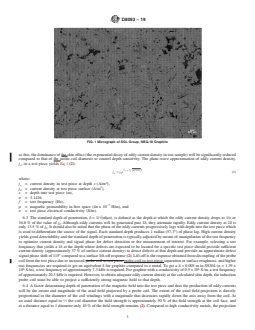
Fig. 1).The innate porosity in essence forms a flaw population microstructure, and test conditions. The measured electrical
conductivity of nuclear graphite is in the range of 0.1 ×
that, in part, dictates not only material properties, but the
6 6
minimum size limit of isolated flaws that conventional NDE 10 S⁄mto0.9×10 S⁄m, making it less than or nearly equal
in conductivity to low conductivity metal alloys such as
technologies can and or should differentiate. However, this is
Ti-6Al-4V titanium (0.58 × 10 S/m), Inconel 600 (1.02 ×
not to overlook the potential need to detect and characterize
6 6 3
10 S⁄m), and stainless steel 304 (1.39 × 10 S⁄m) (1). For
distributed flaw populations such as oxidation or radiation
low conductivity materials such as this, the dominance of the
damage that may be dimensionally smaller than the inherent
skin effect (the exponential decay of eddy current density in
porosity. The nature of the microstructure along with the
test sample) will be significantly reduced compared to that of
material properties of low electrical conductivity, low acoustic
the probe coil diameter to control depth sensitivity. The
velocity, and limited material constituents will dictate how the
plane-wave approximation of eddy current density, j , in a test
various NDE technologies can be applied and limit the
x
information available from the examinations. piece yields Eq 1 (2):
~2 x = πfµ σ !
~ !
j 5 j e (1)
6. Eddy Current Examinations x 0
where:
6.1 Eddy current testing (ET) is an established inspection
technology well suited for surface/near surface inspection of
j = current density in test piece at depth x (A/m ),
x
electrically conductive components. ETis based on generating j = current density at test piece surface (A/m ),
eddy currents in an electrically conductive test sample through x = depth into test piece (m),
inductive coupling with a test coil. The characteristics and π = 3.1416,
f = test frequency (Hz),
depth of the interrogating eddy currents are governed by the
–7
µ = magnetic permeability in free space (4πx10 H/m),
bulk electromagnetic properties of the test piece, test piece
and
geometry, test frequency, and degree of electromagnetic cou-
σ = test piece electrical conductivity (S/m).
pling. The primary electromagnetic properties of interest are
electrical conductivity and magnetic permeability. Any mate-
6.3 The standard depth of penetration, δ=1/√(πfµσ), is
rial or physical condition (for example, cracks, porosity,
defined as the depth at which the eddy current density drops to
changes in grain structure, or different phases) that locally
1/eor36.8%ofthevalueofj .Althougheddycurrentswillbe
affects one or both of these properties can be detected and
generated past 1δ, they attenuate rapidly. Eddy current density
characterized.Typically,materialanomaliesaresensedthrough
at2δisonly13.5%ofj .Itshouldalsobenotedthatthephase
changes in the drive coil impedance when coupled to the test
piece but can also be detected by means of secondary pickup
induction coils or other magnetic field measurement 3
The boldface numbers in parentheses refer to a list of references at the end of
technologies, for example, Hall or giant magnetoresistive this standard.
A
TABLE 1 Graphite Properties
Maximum
Graphite Electrical Resistivity L-Wave Acoustic S-Wave Acoustic Velocity
Average Forming
Density (kg/m ) (µΩ-m) Velocity (km/s) (km/s)
Designation/
Particle (Grain) Process
Manufacturer
WG AG WG AG WG AG WG AG
Size (mm)
PCEA/ GrafTech
1.775e+003 1.781e+003 7.49 8.01 2.65 2.56 1.59 1.58 0.7 Extruded
International
NBG-17/ SGL Vibrationally
1.850e+003 1.843e+003 9.51 9.84 2.77 2.76 1.61 1.61 0.8
Group molded
NBG-18/ SGL Vibrationally
1.871e+003 1.872e+003 9.57 9.16 2.87 2.93 1.67 1.68 1.6
Group molded
IG-110/ Toyo Isostatically
1.777e+003 1.778e+003 11.24 10.98 2.46 2.51 1.56 1.57 0.01
Tanso USA Inc. molded
IG-430/ Toyo Isostatically
1.812e+003 1.814e+003 9.78 8.62 2.40 2.57 1.54 1.58 0.01
Tanso USA Inc. molded
A
Idaho National LaboratoryAGC 2 sample measurements:Average values for small, evenly distributed samples sectioned from a single billet, against grain (AG) and with
grain (WG) directions are determined by orientation of the primary sample axis when sectioned from billet.
D8093 − 19
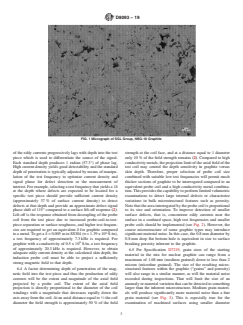
FIG. 1 Micrograph of SGL Group, NBG-18 Graphite
of the eddy currents progressively lags with depth into the test strength at the coil face, and at a distance equal to 1 diameter
piece which is used to differentiate the source of the signal. only 10% of the field strength remains (2). Compared to high
Each standard depth produces 1 radian (57.3°) of phase lag. conductivitymetals,theprojectionlimitoftheaxialfieldofthe
High current density yields good detectability and the standard test coil may control the depth sensitivity in graphite versus
depth of penetration is typically adjusted by means of manipu- skin depth. Therefore, proper selection of probe coil size
lation of the test frequency to optimize current density and combined with suitable low test frequencies will permit much
signal phase for defect detection or the measurement of thicker sections of graphite to be interrogated compared to an
interest.Forexample,selectingatestfrequencythatyieldsa1δ equivalent probe coil and a high conductivity metal combina-
at the depth where defects are expected to be located for a tion.Thisprovidesthecapabilitytoperformlimitedvolumetric
specific test piece should provide sufficient current density examinations to detect large internal defects or characterize
(approximately 37% of surface current density) to detect variations in bulk microstructural features such as porosity.
defects at that depth and provide an approximate defect signal Notethattheareainterrogatedbytheprobecoilisproportional
phase shift of 115° compared to a surface lift-off response (2). to its size and orientation. To improve detection of smaller
Lift-off is the response obtained from decoupling of the probe surface defects, that is, concentrate eddy currents near the
coil from the test piece due to increased probe-coil-to-test- surface in a confined space, high test frequencies and smaller
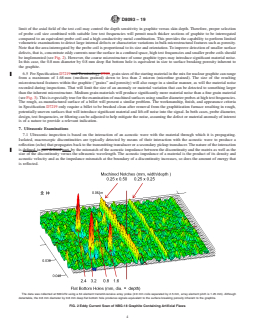
piece separation or surface roughness, and higher test frequen- probe coils should be implemented (see Fig. 2). However, the
cies are required to get an equivalent δ for graphite compared coarse microstructure of some graphite types may introduce
toametal.Togetaδ=0.005minSS304(σ=1.39x10 S⁄m), significant material noise. In this case, the 0.8mm diameter by
a test frequency of approximately 7.3kHz is required. For 0.8mm deep flat bottom hole is equivalent in size to surface
graphite with a conductivity of 0.5 x 10 S⁄m, a test frequency breaking porosity inherent to the graphite.
of approximately 20.3kHz is required. However, to obtain
6.5 Per Specification D7219, grain sizes of the starting
adequate eddy current density at the calculated skin depth, the
material in the mix for nuclear graphite can range from a
induction probe coil must be able to project a sufficiently
maximum of 1.68mm (medium grained) down to less than 2
strong magnetic field to that depth.
micron (microfine grained). The size of the resulting micro-
6.4 A factor determining depth of penetration of the mag- structural features within the graphite (“grains” and porosity)
netic field into the test piece and thus the production of eddy will also range in a similar manner, as will the material noise
currents will be the extent and magnitude of the axial field recorded during inspections. That will limit the size of an
projected by a probe coil. The extent of the axial field anomalyormaterialvariationthatcanbedetectedtosomething
projection is directly proportional to the diameter of the coil larger than the inherent microstructure. Medium grain materi-
windings with a magnitude that decreases rapidly down the als will produce significantly more material noise than a fine
axisawayfromthecoil.Atanaxialdistanceequalto ⁄3thecoil grain material (see Fig. 3). This is especially true for the
diameter the field strength is approximately 50% of the field examination of machined surfaces using smaller diameter
D8093 − 19
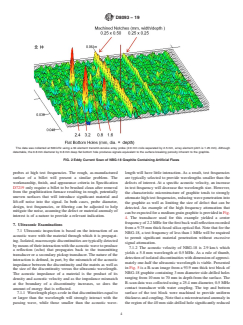
The data was collected at 500 kHz using a 64 element transmit-receive array probe (2.0 mm coils separated by 2.5 mm, array element pitch is 1.25 mm). Although
detectable, the 0.8 mm diameter by 0.8 mm deep flat bottom hole produces signals equivalent to the surface breaking porosity inherent to the graphite.
FIG. 2 Eddy Current Scan of NBG-18 Graphite Containing Artificial Flaws
probes at high test frequencies. The rough, as-manufactured length will have little interaction. As a result, test frequencies
surface of a billet will present a similar problem. The are typically selected to provide wavelengths smaller than the
workmanship, finish, and appearance criteria in Specification
defects of interest. At a specific acoustic velocity, an increase
D7219 only require a billet to be brushed clean after removal
in test frequency will decrease the wavelength size. However,
from the graphitization furnace resulting in rough, potentially
the characteristic microstructure of graphite tends to strongly
uneven surfaces that will introduce significant material and
attenuate high test frequencies, reducing wave penetration into
lift-off noise into the signal. In both cases, probe diameter,
the graphite as well as limiting the size of defect that can be
design, test frequencies, or filtering can be adjusted to help
detected. An example of the high frequency attenuation that
mitigate the noise, assuming the defect or material anomaly of
canbeexpectedforamediumgraingraphiteisprovidedinFig.
interest is of a nature to provide a relevant indication.
4. The transducer used for this example yielded a center
frequencyof2.2MHzforthefirstbackwallreflectionrecorded
7. Ultrasonic Examinations
from a 9.75mm thick fused silica optical flat. Note that for the
7.1 Ultrasonic inspection is based on the interaction of an
NBG-18, a test frequency of less than 1MHz will be required
acoustic wave with the material through which it is propagat-
to permit significant material penetration without excessive
ing.Isolated,macroscopicdiscontinuitiesaretypicallydetected
signal attenuation.
bymeansoftheirinteractionwiththeacousticwavetoproduce
7.1.2 The acoustic velocity of NBG-18 is 2.9km⁄s which
a reflection (echo) that propagates back to the transmitting
yields a 5.8mm wavelength at 0.5MHz. As a rule of thumb,
transducer or a secondary pickup transducer. The nature of the
detectionofisolateddiscontinuitieswithdimensionofapproxi-
interaction is defined, in part, by the mismatch of the acoustic
mately one-half the ultrasonic wavelength is viable. Presented
impedance between the discontinuity and the matrix as well as
in Fig. 5 is a B-scan image from a 93.9mm thick test block of
the size of the discontinuity versus the ultrasonic wavelength.
NBG-18 graphite containing 3mm diameter side-drilled holes
The acoustic impedance of a material is the product of its
ranging from 10mm to 70mm in depth from the surface. The
density and acoustic velocity and as the impedance mismatch
B-scan data was collected using a 25.4mm diameter, 0.5MHz
at the boundary of a discontinuity increases, so does the
contact transducer with water coupling. The top and bottom
amount of energy that is reflected.
surface of the test block were machined to provide uniform
7.1.1 Wavelengthplaysaroleinthatdiscontinuitiesequalto
thicknessandcoupling.Notethatamicrostructuralanomalyin
or larger than the wavelength will strongly interact with the
passing wave, while those smaller than the acoustic wave- the region of the 40mm side-drilled hole significantly reduced
D8093 − 19
The approximate dimensions of each C-scan is 40 mm by 40 mm. The data was collected at 500 kHz using a 64 element transmit-receive array probe (2.0 mm coils
separated by 2.5 mm, array element pitch is 1.25 mm).Two C-scans are obtained during a single scan.The transverse C-scan is primarily sensitive to transverse-oriented
defects while the axial C-scan is sensitive to axial-oriented defects.
FIG. 3 Eddy Current C-Scans Comparing the Material Noise Obtained from Medium Grain (NBG-18, 1.6 mm and NBG-17, 0.8 mm Grain
Size) Versus Superfine Grain (IG-430 and IG-110, 10 µm Grain Size) Nuclear Graphites
the signal-to-noise ratio for this indication. Using instrumen- 7.1.4 Ultrasonics can also be used to perform material
tation or techniques that increase the acoustic energy intro- characterization or detect distributed flaw populations by
duced into the material (such as high-energy narrowband means of measurement of various wave propagation properties
techniques)willimproveacousticwavepenetrationandsignal- such as velocity, attenuation, or scattering. Elastic interactions
to-noiseratiosformaterialanomalies.Finergraingraphitewill as defined by the elastic constants influence acoustic velocity
still exhibit significant attenuation. Overall, the intrinsic mate- which can also be modified by acoustic energy scattered from
rialvariationsoftenobservedingraphitewillreducedepthand the microstructure. Anelastic interactions result in loss of
sizing accuracy. propagating wave energy by mechanisms that produce heat or
7.1.3 Fig. 6 compares ultrasonic back wall echoes from the transformation into different forms of sound. Of the three
93.9mmthickNBG-18graphite(1.6mmgrainsize)testblock properties, velocity measurements will be the most viable
to those from an 88.8mm thick IG-110 graphite (10µm grain approach to acquiring information regarding material unifor-
size) test block. The A-scans were collected using the same mity(microstructureandporosity),isotropy,orthepresenceof
instrument settings and the same 25.4mm diameter, 2.25MHz distributed flaw populations. Fig. 7 compares time-of-flight
transducer used in Fig. 4.Although the superfine grain IG-110 C-scans from sections of machined NBG-17 and NBG-18 test
graphite suffers less attenuation, the center frequency of the blocks. The data were collected using a 25.4mm, 0.5MHz
backwallreflectionstilldropstoapproximately1MHz(wave- contact transducer with water couplant. The values presented
form and Fourier transform bottom of Fig. 6) from the aretheroundtriptime-of-flighttothemaximumnegativepeak
2.25MHzcenterfrequencyoftheinputsignalandhasahighly amplitude of the back wall reflection. Neglecting possible
attenuated second back wall reflection. variations in thickness due to tolerances in machining, the
D8093 − 19
A square wave pulser-receiver was used with 25.4 mm diameter, 2.25 MHz, and 0.5 MHz contact transducers with water couplant. Pulse width was set using fixed
instrument settings, and no frequency filters were engaged. (a): Complete A-scans with multiple backwall reflections. (b): First backwall reflection using 2.25 MHz
transducer and corresponding waveform Fourier transform. The 0.6 MHz center frequency of the reflection indicates significant attenuation of the high frequency content
in the propagating wave.
FIG. 4 Ultrasonic Pulse-Echo A-Scans, Collected at One Location from a 93.9 mm Thick Machined NBG-18 Graphite Plate
0.406m thick NBG-18 test block had a 5µs range in time-of- ties.Also note that a transmit-receive arrangement for a roller
flight values compared to 1µs range of the 0.467m thick probe would help to remove the signal interference introduced
NBG-17 test block. These ultrasonic scans illustrate that the by the probe structure and test piece front surface at the depth
variation in acoustic velocity provides a measure of the of the side-drilled hole.
uniformity of the microstructure and therefore the uniformity
7.2 Noncontacting laser-based, air-coupled, or electromag-
of the mechanical properties within each test piece.
netically coupled ultrasonic approaches will eliminate the
7.1.5 The prior examples all used contact transducers with
potential for material contamination by means of surface
water coupling. Requirements to prevent contamination of the
contact. Combinations of the different approaches, for
graphite may prevent the use of liquid coupling. Alternative
example, laser generation with EMAT detection, have also
technologies include dry contact roller probes, laser-based
been investigated (3). Although applicable, these approaches
generation and detection, air-coupled transducers, and
also have limitations with respect to sensitivity and their
electromagnetic-based transducers. However, compared to
application to graphite.
liquid-coupled piezoelectric transducers, the efficiencies of
7.3 Air-coupled ultrasound has been utilized for material
ultrasonic wave generation and detection in the test piece for
interrogation primarily to detect defects in low-impedance
theseapproachesarereduced.Forcomparison,theresponsefor
solids such as foams, plastics, and composite materials. The
a 0.5MHz liquid-coupled transducer to an equivalent simu-
challenge in using air-coupled ultrasound for solid materials is
lated dry contact roller probe is provided in Fig. 8. Transducer
thelargeimpedancemismatchbetweentheairandthematerial
and instrument settings were the same for the two measure-
that results in low energy transmission into the material. A
ments. Although demonstrated to be a viable approach to
similar loss of energy will occur at the transducer-air interface
ultrasonic coupling into graphite, a significant reduction in
without impedance matching. The reflection coefficient, R, for
signal amplitude and quality is observed for the simulated
an acoustic wave at normal incidence is (4):
roller probe. The loss of signal amplitude and quality will
reduce measurement reliability and defect detection capabili- R 5 ~Z 2 Z ! ⁄ ~Z 1 Z ! (2)
p 2 1 2 1
D8093 − 19
The data was collected using a 25.4 mm diameter, 0.5 MHz contact transducer with water couplant. Note that the back wall echo varied in both amplitude and time,
indicating material conditions exist within the test sample that alter signal attenuation and velocity. This will reduce defect depth and sizing accuracy.
FIG. 5 B-Scan Image of NBG-18 Test Block Containing 3 mm Diameter Side-Drilled Holes
The recorded waveforms indicate that the attenuation in IG-110 is lower than in the coarser grain NBG-18.Also, the Fourier transform for the arrival in IG-110 suggests
that higher frequencies are more strongly attenuated.
FIG. 6 Ultrasonic A-Scans Comparing Ultrasonic Wave Amplitudes for a Medium Grain NBG-18 (1.6 mm Grain Size) Graphite to a Super-
fine IG-110 (10 µm Grain Size) Graphite
D8093 − 19
Acquired using a 25.4 mm diameter, 0.5 MHz contact transducer with water couplant. The time-of-flight values presented are the round trip times to the maximum
negative peak of the back wall reflection.
FIG. 7 Time-of-Flight C-Scans of NBG-17 and NBG-18 Machined Test Blocks
where: nificantly improve the signal-to-noise ratio for the low ampli-
tuderesponses.Anotherfactoraffectingair-coupledultrasonics
R = reflection coefficient based on acoustic pressure ratios,
p
is that sound is strongly attenuated above 1MHz in air. This
Z = ρ c = acoustic impedance (kg/m -s),
n n n
c = acoustic velocity of material n (m/s), and characteristic limits most applications to test frequencies less
n
ρ = density of material n (kg/m ). than 1MHz which does match with the test frequencies
n
6 2 practical for thick graphite sections.With an optimized system
7.3.1 At an air- (Z = 0.0004 x 10 kg⁄m -s) (3) graphite (Z
6 2 and careful alignment, air-coupled ultrasonics can be used to
≈4.7x10 kg⁄m -s) interface, the reflection coefficient is
perform basic ultrasonic measurements such as velocity or
approximately 0.99, indicating almost complete reflection of
detect relatively large defects (see Fig. 9).
the acoustic wave. To overcome these issues, sensitive-low
noise instrumentation is combined with optimized transducers 7.4 Laser ultrasonics is a noncontact approach to generate
anddrivesignalstoproducehighsoundpressures,forexample, and detect ultrasonic waves in materials. While laser-coupled
using high voltage drives, air impedance matching, and tone ultrasound does not require physical contact, it does involve
bursts with resonant element
...
This document is not an ASTM standard and is intended only to provide the user of an ASTM standard an indication of what changes have been made to the previous version. Because
it may not be technically possible to adequately depict all changes accurately, ASTM recommends that users consult prior editions as appropriate. In all cases only the current version
of the standard as published by ASTM is to be considered the official document.
Designation: D8093 − 16 D8093 − 19 An American National Standard
Standard Guide for
Nondestructive Evaluation of Nuclear Grade Graphite
This standard is issued under the fixed designation D8093; the number immediately following the designation indicates the year of
original adoption or, in the case of revision, the year of last revision. A number in parentheses indicates the year of last reapproval. A
superscript epsilon (´) indicates an editorial change since the last revision or reapproval.
1. Scope Scope*
1.1 This guide provides general tutorial information regarding the application of conventional nondestructive evaluation
technologies (NDE) to nuclear grade graphite. An introduction will be provided to the characteristics of graphite that defines the
inspection technologies that can be applied and the limitations imposed by the microstructure. This guide does not provide specific
techniques or acceptance criteria for end-user examinations but is intended to provide information that will assist in identifying
and developing suitable approaches.
1.2 The values stated in SI units are to be regarded as the standard.
1.2.1 Exception—Alternative units provided in parentheses are for information only.
1.3 This standard does not purport to address all of the safety concerns, if any, associated with its use. It is the responsibility
of the user of this standard to establish appropriate safety safety, health, and healthenvironmental practices and determine the
applicability of regulatory limitations prior to use.
1.4 This international standard was developed in accordance with internationally recognized principles on standardization
established in the Decision on Principles for the Development of International Standards, Guides and Recommendations issued
by the World Trade Organization Technical Barriers to Trade (TBT) Committee.
2. Referenced Documents
2.1 ASTM Standards:
C709 Terminology Relating to Manufactured Carbon and Graphite (Withdrawn 2017)
D7219 Specification for Isotropic and Near-isotropic Nuclear Graphites
E94 Guide for Radiographic Examination Using Industrial Radiographic Film
E1025 Practice for Design, Manufacture, and Material Grouping Classification of Hole-Type Image Quality Indicators (IQI)
Used for Radiography
E1441 Guide for Computed Tomography (CT)
3. Summary of Guide
3.1 This guide describes the impact specific material properties have on the application of three nondestructive evaluation
technologies: Eddy current/electromagentic testing (ET) (surface/near surface interrogation), ultrasonic testing (UT) (volumetric
interrogation), radiographic (X-ray) testing (RT) (volumetric interrogation), to nuclear grade graphite.
4. Significance and Use
4.1 Nuclear grade graphite is a composite material made from petroleum or a coal-tar-based coke and a pitch binder.
Manufacturing graphite is an iterative process of baking and pitch impregnation of a formed billet prior to final graphitization,
which occurs at temperatures greater than 2500 °C. The impregnation and rebake step is repeated several times until the desired
product density is obtained. Integral to this process is the use of isotropic cokes and a forming process (that is, isostatically molded,
vibrationally molded, or extruded) that is intended to obtain an isotropic or near isotropic material. However, the source, size, and
blend of the starting materials as well as the forming process of the green billet will impart unique material properties as well as
variations within the final product. There will be density variations from the billet surface inward and different physical properties
with and transverse to the grain direction. Material variations are expected within individual billets as well as billet-to-billet and
This guide is under the jurisdiction of ASTM Committee D02 on Petroleum Products, Liquid Fuels, and Lubricants and is the direct responsibility of Subcommittee
D02.F0 on Manufactured Carbon and Graphite Products.
Current edition approved Dec. 1, 2016Nov. 1, 2019. Published March 2017December 2019. Originally approved in 2016. Last previous edition approved in 2016 as
D8093 – 16. DOI: 10.1520/D8093-16.10.1520/D8093-19.
For referenced ASTM standards, visit the ASTM website, www.astm.org, or contact ASTM Customer Service at service@astm.org. For Annual Book of ASTM Standards
volume information, refer to the standard’s Document Summary page on the ASTM website.
*A Summary of Changes section appears at the end of this standard
Copyright © ASTM International, 100 Barr Harbor Drive, PO Box C700, West Conshohocken, PA 19428-2959. United States
D8093 − 19
lot-to-lot. Other manufacturing defects of interest include large pores, inclusions, and cracks. In addition to the material variation
inherent to the manufacturing process, graphite will experience changes in volume, mechanical strength, and thermal properties
while in service in a nuclear reactor along with the possibility of cracking due to stress and oxidation resulting from constituents
in the gas coolant or oxygen ingress. Therefore, there is the recognized need to be able to nondestructively characterize a variety
of material attributes such as uniformity, isotropy, and porosity distributions as a means to assure consistent stock material. This
need also includes the ability to detect isolated defects such as cracks, large pores and inclusions, or distributed material damage
such as material loss due to oxidation. The use of this guide is to acquire a basic understanding of the unique attributes of nuclear
grade graphite and its application that either permits or hinders the use of conventional eddy current, ultrasonic, or X-ray inspection
technologies.
5. Graphite Properties
5.1 Table 1 provides a summary of pertinent material properties for a limited selection of commercial nuclear graphite types.
5.2 The composite nature of graphite results in a multipart microstructure with variably shaped and sized porosity (see Fig. 1).
The innate porosity in essence forms a flaw population that, in part, dictates not only material properties, but the minimum size
limit of isolated flaws that conventional NDE technologies can and or should differentiate. However, this is not to overlook the
potential need to detect and characterize distributed flaw populations such as oxidation or radiation damage that may be
dimensionally smaller than the inherent porosity. The nature of the microstructure along with the material properties of low
electrical conductivity, low acoustic velocity, and limited material constituents will dictate how the various NDE technologies can
be applied and limit the information available from the examinations.
6. Eddy Current Examinations
6.1 Eddy current testing (ET) is an established inspection technology well suited for surface/near surface inspection of
electrically conductive components. ET is based on generating eddy currents in an electrically conductive test sample through
inductive coupling with a test coil. The characteristics and depth of the interrogating eddy currents are governed by the bulk
electromagnetic properties of the test piece, test piece geometry, test frequency, and degree of electromagnetic coupling. The
primary electromagnetic properties of interest are electrical conductivity and magnetic permeability. Any material or physical
condition (for example, cracks, porosity, changes in grain structure, or different phases) that locally affects one or both of these
properties can be detected and characterized. Typically, material anomalies are sensed through changes in the drive coil impedance
when coupled to the test piece but can also be detected by means of secondary pickup induction coils or other magnetic field
measurement technologies, for example, Hall or giant magnetoresistive (GMR) devices. The approaches and test probes that can
be implemented are diverse and dependent on the type, size, and location of the material anomaly or condition of interest as well
as the test piece electromagnetic properties, geometry, surface condition, microstructure, temperature, and so forth.
6.2 Eddy currents can be used to inspect nuclear graphite for the presence of surface/near surface cracks, voids, and inclusions
as well as to characterize the distribution of porosity or other distributed flaw populations that affect the bulk electrical
conductivity. Aspects to consider when applying eddy currents to nuclear graphite include its low electrical conductivity,
microstructure, and test conditions. The measured electrical conductivity of nuclear graphite is in the range of 0.1 × 10 S ⁄m to
0.9 × 10 S ⁄m, making it less than or nearly equal in conductivity to low conductivity metal alloys such as Ti-6Al-4V titanium
6 6 6 3
(0.58 × 10 S/m), Inconel 600 (1.02 × 10 S ⁄m), and stainless steel 304 (1.39 × 10 S ⁄m) (1). For low conductivity materials such
A
TABLE 1 Graphite Properties
Maximum
Graphite Electrical Resistivity L-Wave Acoustic S-Wave Acoustic Velocity
Average Forming
Designation/ Density (kg/m ) (μΩ-m) Velocity (km/s) (km/s)
Particle (Grain) Process
Manufacturer
WG AG WG AG WG AG WG AG
Size (mm)
PCEA/ GrafTech
1.775e+003 1.781e+003 7.49 8.01 2.65 2.56 1.59 1.58 0.7 Extruded
International
NBG-17/ SGL Vibrationally
1.850e+003 1.843e+003 9.51 9.84 2.77 2.76 1.61 1.61 0.8
Group molded
NBG-18/ SGL Vibrationally
1.871e+003 1.872e+003 9.57 9.16 2.87 2.93 1.67 1.68 1.6
Group molded
IG-110/ Toyo Isostatically
1.777e+003 1.778e+003 11.24 10.98 2.46 2.51 1.56 1.57 0.01
Tanso USA Inc. molded
IG-430/ Toyo Isostatically
1.812e+003 1.814e+003 9.78 8.62 2.40 2.57 1.54 1.58 0.01
Tanso USA Inc. molded
A
Idaho National Laboratory AGC 2 sample measurements: Average values for small, evenly distributed samples sectioned from a single billet, against grain (AG) and with
grain (WG) directions are determined by orientation of the primary sample axis when sectioned from billet.
The last approved version of this historical standard is referenced on www.astm.org.
The boldface numbers in parentheses refer to a list of references at the end of this standard.
D8093 − 19
FIG. 1 Micrograph of SGL Group, NBG-18 Graphite
as this, the dominance of the skin effect (the exponential decay of eddy current density in test sample) will be significantly reduced
compared to that of the probe coil diameter to control depth sensitivity. The plane-wave approximation of eddy current density,
j , in a test piece yields Eq 1 (2):
x
~2 x = π f μ σ !
~ !
j 5 j e (1)
x 0
where:
j = current density in test piece at depth x (A/m ),
x
j = current density at test piece surface (A/m ),
x = depth into test piece (m),
π = 3.1416,
f = test frequency (Hz),
–7
μ = magnetic permeability in free space (4π x 10 H/m), and
σ = test piece electrical conductivity (S/m).
6.3 The standard depth of penetration, δ = 1/√(πfμσ), is defined as the depth at which the eddy current density drops to 1/e or
36.8 % of the value of j . Although eddy currents will be generated past 1δ, they attenuate rapidly. Eddy current density at 2δ is
only 13.5 % of j . It should also be noted that the phase of the eddy currents progressively lags with depth into the test piece which
is used to differentiate the source of the signal. Each standard depth produces 1 radian (57.3°) of phase lag. High current density
yields good detectability and the standard depth of penetration is typically adjusted by means of manipulation of the test frequency
to optimize current density and signal phase for defect detection or the measurement of interest. For example, selecting a test
frequency that yields a 1δ at the depth where defects are expected to be located for a specific test piece should provide sufficient
current density (approximately 37 % of surface current density) to detect defects at that depth and provide an approximate defect
signal phase shift of 115° compared to a surface lift-off response (2). Lift-off is the response obtained from decoupling of the probe
coil from the test piece due to increased probe coil to test piece probe-coil-to-test-piece separation or surface roughness, and higher
test frequencies are required to get an equivalent δ for graphite compared to a metal. To get a δ = 0.005 m in SS304 (σ = 1.39 x
6 6
10 S ⁄m), a test frequency of approximately 7.3 kHz is required. For graphite with a conductivity of 0.5 x 10 S ⁄m, a test frequency
of approximately 20.3 kHz is required. However, to obtain adequate eddy current density at the calculated skin depth, the induction
probe coil must be able to project a sufficiently strong magnetic field to that depth.
6.4 A factor determining depth of penetration of the magnetic field into the test piece and thus the production of eddy currents
will be the extent and magnitude of the axial field projected by a probe coil. The extent of the axial field projection is directly
proportional to the diameter of the coil windings with a magnitude that decreases rapidly down the axis away from the coil. At
an axial distance equal to ⁄3 the coil diameter the field strength is approximately 50 % of the field strength at the coil face, and
at a distance equal to 1 diameter only 10 % of the field strength remains (2). Compared to high conductivity metals, the projection
D8093 − 19
limit of the axial field of the test coil may control the depth sensitivity in graphite versus skin depth. Therefore, proper selection
of probe coil size combined with suitable low test frequencies will permit much thicker sections of graphite to be interrogated
compared to an equivalent probe coil and a high conductivity metal combination. This provides the capability to perform limited
volumetric examinations to detect large internal defects or characterize variations in bulk microstructural features such as porosity.
Note that the area interrogated by the probe coil is proportional to its size and orientation. To improve detection of smaller surface
defects, that is, concentrate eddy currents near the surface in a confined space, high test frequencies and smaller probe coils should
be implemented (see Fig. 2). However, the coarse microstructure of some graphite types may introduce significant material noise.
In this case, the 0.8 mm diameter by 0.8 mm deep flat bottom hole is equivalent in size to surface breaking porosity inherent to
the graphite.
6.5 Per Specification D7219 and Terminology C709, grain sizes of the starting material in the mix for nuclear graphite can range
from a maximum of 1.68 mm (medium grained) down to less than 2 micron (microfine grained). The size of the resulting
microstructural features within the graphite (“grains” and porosity) will also range in a similar manner, as will the material noise
recorded during inspections. That will limit the size of an anomaly or material variation that can be detected to something larger
than the inherent microstructure. Medium grain materials will produce significantly more material noise than a fine grain material
(see Fig. 3). This is especially true for the examination of machined surfaces using smaller diameter probes at high test frequencies.
The rough, as-manufactured surface of a billet will present a similar problem. The workmanship, finish, and appearance criteria
in Specification D7219 only require a billet to be brushed clean after removal from the graphitization furnace resulting in rough,
potentially uneven surfaces that will introduce significant material and lift-off noise into the signal. In both cases, probe diameter,
design, test frequencies, or filtering can be adjusted to help mitigate the noise, assuming the defect or material anomaly of interest
is of a nature to provide a relevant indication.
7. Ultrasonic Examinations
7.1 Ultrasonic inspection is based on the interaction of an acoustic wave with the material through which it is propagating.
Isolated, macroscopic discontinuities are typically detected by means of their interaction with the acoustic wave to produce a
reflection (echo) that propagates back to the transmitting transducer or a secondary pickup transducer. The nature of the interaction
is defined, in part defined part, by the mismatch of the acoustic impedance between the discontinuity and the matrix as well as the
size of the discontinuity versus the ultrasonic wavelength. The acoustic impedance of a material is the product of its density and
acoustic velocity and as the impedance mismatch at the boundary of a discontinuity increases, so does the amount of energy that
is reflected.
The data was collected at 500 kHz using a 64 element transmit-receive array probe (2.0 mm coils separated by 2.5 mm, array element pitch is 1.25 mm). Although
detectable, the 0.8 mm diameter by 0.8 mm deep flat bottom hole produces signals equivalent to the surface breaking porosity inherent to the graphite.
FIG. 2 Eddy Current Scan of NBG-18 Graphite Containing Artificial Flaws
D8093 − 19
The approximate dimensions of each C-scan is 40 mm by 40 mm. The data was collected at 500 kHz using a 64 element transmit-receive array probe (2.0 mm coils
separated by 2.5 mm, array element pitch is 1.25 mm). Two C-scans are obtained during a single scan. The transverse C-scan is primarily sensitive to transverse-oriented
defects while the axial C-scan is sensitive to axial-oriented defects.
FIG. 3 Eddy Current C-Scans Comparing the Material Noise Obtained from Medium Grain (NBG-18, 1.6 mm and NBG-17, 0.8 mm Grain
Size) Versus Superfine Grain (IG-430 and IG-110, 10 μm Grain Size) Nuclear Graphites
7.1.1 Wavelength plays a role in that discontinuities equal to or larger than the wavelength will strongly interact with the passing
wave, while those smaller than the acoustic wavelength will have little interaction. As a result, test frequencies are typically
selected to provide wavelengths smaller than the defects of interest. At a specific acoustic velocity, an increase in test frequency
will decrease the wavelength size. However, the characteristic microstructure of graphite tends to strongly attenuate high test
frequencies, reducing waveformwave penetration into the graphite as well as limiting the size of defect that can be detected. An
example of the high frequency attenuation that can be expected for a medium grain graphite is provided in Fig. 4. The transducer
used for this example yielded a center frequency of 2.2 MHz for the first back wall reflection recorded from a 9.75 mm thick fused
silica optical flat. Note that for the NBG-18, a test frequency of less than 1 MHz will be required to permit significant material
penetration without excessive signal attenuation.
7.1.2 The acoustic velocity of NBG-18 is 2.9 km ⁄s which yields a 5.8 mm wavelength at 0.5 MHz. As a rule of thumb, detection
of isolated discontinuities with dimension of approximately one-half the ultrasonic wavelength is viable. Presented in Fig. 5 is a
B-scan image from a 93.9 mm thick test block of NBG-18 graphite containing 3 mm diameter side-drilled holes ranging from
10 mm to 70 mm in depth from the surface. The B-scan data was collected using a 25.4 mm diameter, 0.5 MHz contact transducer
with water coupling. The top and bottom surface of the test block waswere machined to provide uniform thickness and coupling.
Note that a microstructural anomaly in the region of the 40 mm side-drilled hole significantly reduced the signal-to-noise ratio for
this indication. Using instrumentation or techniques that increase the acoustic energy introduced into the material, for example,
high energy narrowband techniques, will help to material (such as high-energy narrowband techniques) will improve acoustic wave
penetration and signal-to-noise ratios for material anomalies. Finer grain graphite will suffer less but still havestill exhibit
significant attenuation. Overall, the intrinsic material variations often observed in graphite will reduce depth and sizing accuracy.
D8093 − 19
A square wave pulser-receiver was used with 25.4 mm diameter, 2.25 MHz, and 0.5 MHz contact transducers with water couplant. Pulse width was set using fixed
instrument settings, and no frequency filters were engaged. (a): Complete A-scans with multiple backwall reflections. (b): First backwall reflection using 2.25 MHz
transducer and corresponding waveform FFT. Fourier transform. The 0.6 MHz center frequency of the reflection indicates significant attenuation of the high frequency
content in the propagating wave.
FIG. 4 Ultrasonic Pulse-Echo A-Scans, Collected at One Location from a 93.9 mm Thick Machined NBG-18 Graphite Plate
7.1.3 Fig. 6 compares ultrasonic back wall echoes from the 93.9 mm thick NBG-18 graphite (1.6 mm grain size) test block to
those from an 88.8 mm thick IG-110 graphite (10 μm grain size) test block. The A-scans were collected using the same instrument
settings and the same 25.4 mm diameter, 2.25 MHz transducer used in Fig. 4. Although the superfine grain IG-110 graphite suffers
less attenuation, the center frequency of the back wall reflection still drops to approximately 1 MHz (waveform and FFT Fourier
transform bottom of Fig. 6) from the 2.25 MHz center frequency of the input signal and has a highly attenuated second back wall
reflection.
7.1.4 Ultrasonics can also be used to perform material characterization or detect distributed flaw populations by means of
measurement of various wave propagation properties such as velocity, attenuation, or scattering. Elastic interactions as defined by
the elastic constants influence acoustic velocity which can also be modified by acoustic energy scattered from the microstructure.
Anelastic interactions result in loss of propagating wave energy by mechanisms that produce heat or transformation into different
forms of sound. Of the three properties, velocity measurements will be the most viable approach to acquiring information regarding
material uniformity (microstructure and porosity), isotropy, or the presence of distributed flaw populations. Fig. 7 compares
time-of-flight C-scans from sections of machined NBG-17 and NBG-18 test blocks. The data waswere collected using a 25.4 mm,
0.5 MHz contact transducer with water couplant. The values presented are the round trip time-of-flight to the maximum negative
peak amplitude of the back wall reflection. Neglecting possible variations in thickness due to tolerances in machining, the 0.406 m
thick NBG-18 test block had a 5 μs range in time-of-flight values compared to 1 μs range of the 0.467 m thick NBG-17 test block.
These ultrasonic scans illustrate that the variation in acoustic velocity provides a measure of the uniformity of the microstructure
and therefore the uniformity of the mechanical properties within each test piece.
7.1.5 The prior examples all used contact transducers with water coupling. Requirements to prevent contamination of the
graphite may prevent the use of liquid coupling. Alternative technologies include dry contact roller probes, laser-based generation
and detection, air-coupled transducers, and electromagnetic-based transducers. However, compared to liquid-coupled piezoelectric
transducers, the efficiencyefficiencies of ultrasonic wave generation and detection in the test piece for these approaches are reduced.
For comparison, the response for a 0.5 MHz liquid-coupled transducer to an equivalent simulated dry contact roller probe is
provided in Fig. 8. Transducer and instrument settings were the same for the two measurements. Although demonstrated to be a
viable approach to ultrasonic coupling into graphite, a significant reduction in signal amplitude and quality is observed for the
simulated roller probe. The loss of signal amplitude and quality will reduce measurement reliability and defect detection
D8093 − 19
The data was collected using a 25.4 mm diameter, 0.5 MHz contact transducer with water couplant. Note that the back wall echo varied in both amplitude and time,
indicating material conditions exist within the test sample that alter signal attenuation and velocity. This will reduce defect depth and sizing accuracy.
FIG. 5 B-Scan Image of NBG-18 Test Block Containing 3 mm Diameter Side-Drilled Holes
As demonstrated by the recorded waveform and FFT, the IG-110 does not attenuate the amplitude or higher frequencies as much as the coarser grain NBG-18.The
recorded waveforms indicate that the attenuation in IG-110 is lower than in the coarser grain NBG-18. Also, the Fourier transform for the arrival in IG-110 suggests that
higher frequencies are more strongly attenuated.
FIG. 6 Ultrasonic A-Scans Comparing Ultrasonic Wave AttenuationAmplitudes for a Medium Grain NBG-18 (1.6 mm Grain Size) Graphite
to a Superfine IG-110 (10 μm Grain Size) Graphite
D8093 − 19
Acquired using a 25.4 mm diameter, 0.5 MHz contact transducer with water couplant. The time-of-flight values presented are the round trip times to the maximum
negative peak of the back wall reflection.
FIG. 7 Time-of-Flight C-Scans of NBG-17 and NBG-18 Machined Test Blocks
capabilities. Also note that a transmit-receive arrangement for a roller probe would help to remove the signal interference
introduced by the probe structure and test piece front surface at the depth of the side-drilled hole.
7.2 Noncontacting laser-based, air-coupled, or electromagnetically coupled ultrasonic approaches will eliminate the potential
for material contamination by means of surface contact. Combinations of the different approaches, for example, laser generation
with EMAT detection, have also been investigated (3). Although applicable, these approaches also have limitations with respect
to sensitivity and their application to graphite.
7.3 Air-coupled ultrasound has been utilized for material interrogation primarily to detect defects in low-impedance solids such
as foams, plastics, and composite materials. The challenge in using air-coupled ultrasound for solid materials is the large
impedance mismatch between the air and the material that results in low energy transmission into the material. A similar loss of
energy will occur at the transducer-air interface without impedance matching. The reflection coefficient, R, for a normal incidence
an acoustic wave at normal incidence is (4):
Rp 5 Z 2 Z ⁄ Z 1 Z (2)
~ ! ~ !
2 1 1 2
R 5 Z 2 Z ⁄ Z 1 Z (2)
~ ! ~ !
p 2 1 2 1
D8093 − 19
FIG. 8 A-Scan Comparison for 0.5 MHz Water-Coupled Contact Transducer to a Simulated 0.5 MHz Dry-Coupled Roller Probe
where:
Rp = reflection coefficient based on acoustic pressure ratios,
R = reflection coefficient based on acoustic pressure ratios,
p
Z = ρ c = acoustic impedance (kg/m -s),
n n n
c = acoustic velocity of material n (m/s), and
n
ρ = density of material n (kg/m ).
n
6 2 6 2
7.3.1 At an air- (Z = 0.0004 x 10 kg ⁄m -s) (3) graphite (Z ≈ 4.7 x 10 kg ⁄m -s) interface, the reflection coefficient is
approximately 0.99, indicating almost complete reflection of the acoustic wave. To overcome these issues, sensitive-low noise
instrumentation is combined with optimized transducers and drive signals to produce high sound pressures, for example, using high
voltage drives, air impedance matching, and tone bursts with resonant elements. In addition, digital filters and signal processing
approaches have been implemented to significantly improve the signal-to-noise ratio for the low amplitude responses. Another
factor affecting air-coupled ultrasonics is that sound is strongly attenuated above 1 MHz in air. This characteristic limits most
applications to test frequencies less than 1 MHz which does match with the test frequencies practical for thick graphite sections.
With an optimized system and careful alignment, air-coupled ultrasonics can be used to perform basic ultrasonic measurements
such as velocity or detect relatively large defects (see Fig. 9).
7.4 Laser ultrasonics is a noncontact approach to generate and detect ultrasonic waves in materials. While laser-coupled
ultrasound does not require physical contact, it does involve converting between mechanical and opticalconversion of optical to
mechanical energy. It is principally limited by the amount of ultrasonic energy that can be produced in the sample and the amount
of ultrasonic energy
...