

ASTM D4927-20
(Test Method)Standard Test Methods for Elemental Analysis of Lubricant and Additive Components-Barium, Calcium, Phosphorus, Sulfur, and Zinc by Wavelength-Dispersive X-Ray Fluorescence Spectroscopy
General Information
- Abstract
SIGNIFICANCE AND USE
4.1 Some oils are formulated with organo-metallic additives which act as detergents, antioxidants, antiwear agents, and so forth. Some of these additives contain one or more of these elements: barium, calcium, phosphorus, sulfur, and zinc. These test methods provide a means of determining the concentration of these elements which in turn provides an indication of the additive content of these oils.
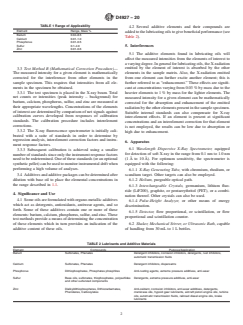
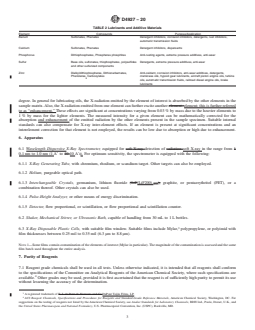
4.2 Several additive elements and their compounds are added to the lubricating oils to give beneficial performance (see Table 2).
SCOPE
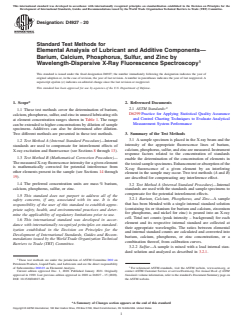
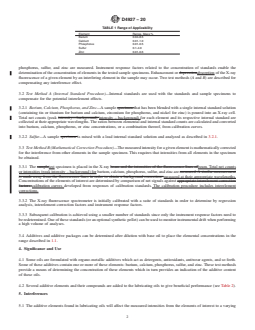
1.1 These test methods cover the determination of barium, calcium, phosphorus, sulfur, and zinc in unused lubricating oils at element concentration ranges shown in Table 1. The range can be extended to higher concentrations by dilution of sample specimens. Additives can also be determined after dilution. Two different methods are presented in these test methods.
1.2 Test Method A (Internal Standard Procedure)-Internal standards are used to compensate for interelement effects of X-ray excitation and fluorescence (see Sections 8 through 13).
1.3 Test Method B (Mathematical Correction Procedure)-The measured X-ray fluorescence intensity for a given element is mathematically corrected for potential interference from other elements present in the sample (see Sections 14 through 19).
1.4 The preferred concentration units are mass % barium, calcium, phosphorus, sulfur, or zinc.
1.5 This standard does not purport to address all of the safety concerns, if any, associated with its use. It is the responsibility of the user of this standard to establish appropriate safety, health, and environmental practices and determine the applicability of regulatory limitations prior to use.
1.6 This international standard was developed in accordance with internationally recognized principles on standardization established in the Decision on Principles for the Development of International Standards, Guides and Recommendations issued by the World Trade Organization Technical Barriers to Trade (TBT) Committee.
- Status
- Published
- Publication Date
- 30-Nov-2020
- Technical Committee
- D02 - Petroleum Products, Liquid Fuels, and Lubricants
- Drafting Committee
- D02.03 - Elemental Analysis
Buy Documents
ASTM D4927-20 - Standard Test Methods for Elemental Analysis of Lubricant and Additive Components—Barium, Calcium, Phosphorus, Sulfur, and Zinc by Wavelength-Dispersive X-Ray Fluorescence Spectroscopy
REDLINE ASTM D4927-20 - Standard Test Methods for Elemental Analysis of Lubricant and Additive Components—Barium, Calcium, Phosphorus, Sulfur, and Zinc by Wavelength-Dispersive X-Ray Fluorescence Spectroscopy
Overview
ASTM D4927-20 is a standard developed by ASTM International addressing the elemental analysis of lubricant and additive components-specifically barium, calcium, phosphorus, sulfur, and zinc-using wavelength-dispersive X-ray fluorescence (WDXRF) spectroscopy. This standard provides test methods to accurately determine the concentration of these key elements in unused lubricating oils and related additive packages. Accurate analysis is essential for understanding lubricant formulations, verifying additive levels, and maintaining quality control in the production and certification of lubricants.
ASTM D4927-20 offers two main analytical approaches:
- Test Method A: Internal Standard Procedure, which uses internal standards to adjust for interelement effects during X-ray analysis.
- Test Method B: Mathematical Correction Procedure, where measured X-ray fluorescence intensities are mathematically corrected for interferences.
Key Topics
- Elemental coverage: Quantifies barium, calcium, phosphorus, sulfur, and zinc, covering a wide range of concentrations in lubricating oils.
- Applicability: Suitable for unused lubricating oils; the procedure can be adjusted for higher concentrations by dilution.
- Precision and reliability: The standard details required quality control measures, calibration processes, and outlines requirements for instrument performance verification.
- Significance: The presence and concentration of these elements are direct indicators of the additive content in lubricating oils, impacting performance characteristics such as detergency, antiwear, antioxidation, and corrosion inhibition.
- Sample Preparation: Guidelines for preparing calibration standards and managing potential interelement interference.
- Data Reporting: All results are reported in mass percent for each element, supporting consistent communications and regulatory reporting.
Applications
ASTM D4927-20 is widely applicable in industries where lubricating oil quality is critical. Key uses include:
- Lubricant Formulation: Oil manufacturers employ these test methods to verify the correct formulation and additive blending.
- Quality Assurance: Ensures batch-to-batch consistency by monitoring additive element concentrations.
- Regulatory Compliance: Assists producers and laboratories in meeting technical requirements for lubricant certification.
- Research & Development: Utilized in the development of new lubricant formulations where additive content must be tightly controlled.
- Performance Monitoring: Identifies deviations in additive content that could affect performance, lifespan, or warranty of machinery.
Common industries adopting this standard include automotive, aerospace, industrial machinery, railway, and marine sectors.
Related Standards
Several other ASTM and international standards are relevant to elemental analysis in lubricants and related products, including:
- ASTM D6299: Practice for Applying Statistical Quality Assurance and Control Charting Techniques to Evaluate Analytical Measurement System Performance
- ASTM D5185: Standard Test Method for Multielement Determination of Used and Unused Lubricating Oils by Inductively Coupled Plasma Atomic Emission Spectrometry (ICP-AES)
- ASTM D4951: Standard Test Method for Detection of Additive Elements in Lubricating Oils by ICP-AES
- ASTM D6443: Standard Test Method for Determination of Calcium, Chlorine, Magnesium, Phosphorus, Sulfur, and Zinc in Unused Lubricating Oils by Wavelength-Dispersive X-ray Fluorescence Spectrometry
- ISO 14596: Petroleum products - Determination of sulfur content by WDXRF spectrometry
ASTM D4927-20 is integral for laboratories, producers, and users of lubricants worldwide seeking robust, accurate, and standardized elemental analysis of crucial additive components by WDXRF technology. It supports the assurance of lubricant quality, certification, and performance in demanding industrial environments.
Relations
- Effective Date
- 01-Dec-2023
- Effective Date
- 15-Dec-2017
- Effective Date
- 15-Nov-2017
- Effective Date
- 01-Jan-2017
- Effective Date
- 01-Oct-2013
- Effective Date
- 01-Mar-2010
- Effective Date
- 01-Mar-2010
- Effective Date
- 01-Nov-2009
- Effective Date
- 15-Oct-2008
- Effective Date
- 01-Nov-2007
- Effective Date
- 01-Nov-2007
- Effective Date
- 10-Jun-2002
- Effective Date
- 10-Jun-2002
- Effective Date
- 10-Dec-2000
Buy Documents
ASTM D4927-20 - Standard Test Methods for Elemental Analysis of Lubricant and Additive Components—Barium, Calcium, Phosphorus, Sulfur, and Zinc by Wavelength-Dispersive X-Ray Fluorescence Spectroscopy
REDLINE ASTM D4927-20 - Standard Test Methods for Elemental Analysis of Lubricant and Additive Components—Barium, Calcium, Phosphorus, Sulfur, and Zinc by Wavelength-Dispersive X-Ray Fluorescence Spectroscopy
Get Certified
Connect with accredited certification bodies for this standard

Element Materials Technology
Materials testing and product certification.

ABS Group Brazil
ABS Group certification services in Brazil.

ABS Quality Evaluations Inc.
American Bureau of Shipping quality certification.
Sponsored listings
Frequently Asked Questions
ASTM D4927-20 is a standard published by ASTM International. Its full title is "Standard Test Methods for Elemental Analysis of Lubricant and Additive Components-Barium, Calcium, Phosphorus, Sulfur, and Zinc by Wavelength-Dispersive X-Ray Fluorescence Spectroscopy". This standard covers: SIGNIFICANCE AND USE 4.1 Some oils are formulated with organo-metallic additives which act as detergents, antioxidants, antiwear agents, and so forth. Some of these additives contain one or more of these elements: barium, calcium, phosphorus, sulfur, and zinc. These test methods provide a means of determining the concentration of these elements which in turn provides an indication of the additive content of these oils. 4.2 Several additive elements and their compounds are added to the lubricating oils to give beneficial performance (see Table 2). SCOPE 1.1 These test methods cover the determination of barium, calcium, phosphorus, sulfur, and zinc in unused lubricating oils at element concentration ranges shown in Table 1. The range can be extended to higher concentrations by dilution of sample specimens. Additives can also be determined after dilution. Two different methods are presented in these test methods. 1.2 Test Method A (Internal Standard Procedure)-Internal standards are used to compensate for interelement effects of X-ray excitation and fluorescence (see Sections 8 through 13). 1.3 Test Method B (Mathematical Correction Procedure)-The measured X-ray fluorescence intensity for a given element is mathematically corrected for potential interference from other elements present in the sample (see Sections 14 through 19). 1.4 The preferred concentration units are mass % barium, calcium, phosphorus, sulfur, or zinc. 1.5 This standard does not purport to address all of the safety concerns, if any, associated with its use. It is the responsibility of the user of this standard to establish appropriate safety, health, and environmental practices and determine the applicability of regulatory limitations prior to use. 1.6 This international standard was developed in accordance with internationally recognized principles on standardization established in the Decision on Principles for the Development of International Standards, Guides and Recommendations issued by the World Trade Organization Technical Barriers to Trade (TBT) Committee.
SIGNIFICANCE AND USE 4.1 Some oils are formulated with organo-metallic additives which act as detergents, antioxidants, antiwear agents, and so forth. Some of these additives contain one or more of these elements: barium, calcium, phosphorus, sulfur, and zinc. These test methods provide a means of determining the concentration of these elements which in turn provides an indication of the additive content of these oils. 4.2 Several additive elements and their compounds are added to the lubricating oils to give beneficial performance (see Table 2). SCOPE 1.1 These test methods cover the determination of barium, calcium, phosphorus, sulfur, and zinc in unused lubricating oils at element concentration ranges shown in Table 1. The range can be extended to higher concentrations by dilution of sample specimens. Additives can also be determined after dilution. Two different methods are presented in these test methods. 1.2 Test Method A (Internal Standard Procedure)-Internal standards are used to compensate for interelement effects of X-ray excitation and fluorescence (see Sections 8 through 13). 1.3 Test Method B (Mathematical Correction Procedure)-The measured X-ray fluorescence intensity for a given element is mathematically corrected for potential interference from other elements present in the sample (see Sections 14 through 19). 1.4 The preferred concentration units are mass % barium, calcium, phosphorus, sulfur, or zinc. 1.5 This standard does not purport to address all of the safety concerns, if any, associated with its use. It is the responsibility of the user of this standard to establish appropriate safety, health, and environmental practices and determine the applicability of regulatory limitations prior to use. 1.6 This international standard was developed in accordance with internationally recognized principles on standardization established in the Decision on Principles for the Development of International Standards, Guides and Recommendations issued by the World Trade Organization Technical Barriers to Trade (TBT) Committee.
ASTM D4927-20 is classified under the following ICS (International Classification for Standards) categories: 75.100 - Lubricants, industrial oils and related products. The ICS classification helps identify the subject area and facilitates finding related standards.
ASTM D4927-20 has the following relationships with other standards: It is inter standard links to ASTM D6299-23a, ASTM D6299-17b, ASTM D6299-17a, ASTM D6299-17, ASTM D6299-13e1, ASTM D6299-10, ASTM D6299-10e2, ASTM D6299-09, ASTM D6299-08, ASTM D6299-07e1, ASTM D6299-07, ASTM D6299-02e1, ASTM D6299-02, ASTM D6299-00. Understanding these relationships helps ensure you are using the most current and applicable version of the standard.
ASTM D4927-20 is available in PDF format for immediate download after purchase. The document can be added to your cart and obtained through the secure checkout process. Digital delivery ensures instant access to the complete standard document.
Standards Content (Sample)
This international standard was developed in accordance with internationally recognized principles on standardization established in the Decision on Principles for the
Development of International Standards, Guides and Recommendations issued by the World Trade Organization Technical Barriers to Trade (TBT) Committee.
Designation: D4927 − 20
Standard Test Methods for
Elemental Analysis of Lubricant and Additive Components—
Barium, Calcium, Phosphorus, Sulfur, and Zinc by
Wavelength-Dispersive X-Ray Fluorescence Spectroscopy
This standard is issued under the fixed designation D4927; the number immediately following the designation indicates the year of
original adoption or, in the case of revision, the year of last revision. A number in parentheses indicates the year of last reapproval. A
superscript epsilon (´) indicates an editorial change since the last revision or reapproval.
This standard has been approved for use by agencies of the U.S. Department of Defense.
1. Scope* 2. Referenced Documents
2.1 ASTM Standards:
1.1 These test methods cover the determination of barium,
D6299 Practice for Applying Statistical Quality Assurance
calcium,phosphorus,sulfur,andzincinunusedlubricatingoils
and Control Charting Techniques to Evaluate Analytical
at element concentration ranges shown in Table 1. The range
Measurement System Performance
can be extended to higher concentrations by dilution of sample
specimens. Additives can also be determined after dilution.
3. Summary of the Test Methods
Two different methods are presented in these test methods.
3.1 Asample specimen is placed in the X-ray beam and the
1.2 Test Method A (Internal Standard Procedure)—Internal
intensity of the appropriate fluorescence lines of barium,
standards are used to compensate for interelement effects of
calcium,phosphorus,sulfur,andzincaremeasured.Instrument
X-ray excitation and fluorescence (see Sections 8 through 13).
response factors related to the concentration of standards
1.3 Test Method B (Mathematical Correction Procedure)—
enable the determination of the concentration of elements in
The measured X-ray fluorescence intensity for a given element
thetestedsamplespecimens.Enhancementorabsorptionofthe
is mathematically corrected for potential interference from
X-ray fluorescence of a given element by an interfering
other elements present in the sample (see Sections 14 through
element in the sample may occur. Two test methods (A and B)
19).
are described for compensating any interference effect.
1.4 The preferred concentration units are mass % barium,
3.2 Test Method A (Internal Standard Procedure)—Internal
calcium, phosphorus, sulfur, or zinc.
standards are used with the standards and sample specimens to
compensate for the potential interelement effects.
1.5 This standard does not purport to address all of the
3.2.1 Barium, Calcium, Phosphorus, and Zinc—A sample
safety concerns, if any, associated with its use. It is the
that has been blended with a single internal standard solution
responsibility of the user of this standard to establish appro-
(containing tin or titanium for barium and calcium, zirconium
priate safety, health, and environmental practices and deter-
for phosphorus, and nickel for zinc) is poured into an X-ray
mine the applicability of regulatory limitations prior to use.
cell. Total net counts (peak intensity – background) for each
1.6 This international standard was developed in accor-
element and its respective internal standard are collected at
dance with internationally recognized principles on standard-
their appropriate wavelengths. The ratios between elemental
ization established in the Decision on Principles for the
and internal standard counts are calculated and converted into
Development of International Standards, Guides and Recom-
barium, calcium, phosphorus, or zinc concentrations, or a
mendations issued by the World Trade Organization Technical
combination thereof, from calibration curves.
Barriers to Trade (TBT) Committee.
3.2.2 Sulfur—A sample is mixed with a lead internal stan-
dard solution and analyzed as described in 3.2.1.
These test methods are under the jurisdiction of ASTM Committee D02 on
Petroleum Products, Liquid Fuels, and Lubricants and are the direct responsibility
of Subcommittee D02.03 on Elemental Analysis. For referenced ASTM standards, visit the ASTM website, www.astm.org, or
Current edition approved Dec. 1, 2020. Published January 2021. Originally contact ASTM Customer Service at service@astm.org. For Annual Book of ASTM
approved in 1989. Last previous edition approved in 2020 as D4927 – 15 (2020). Standards volume information, refer to the standard’s Document Summary page on
DOI: 10.1520/D4927-20. the ASTM website.
*A Summary of Changes section appears at the end of this standard
Copyright © ASTM International, 100 Barr Harbor Drive, PO Box C700, West Conshohocken, PA 19428-2959. United States
D4927 − 20
TABLE 1 Range of Applicability
4.2 Several additive elements and their compounds are
Element Range, Mass % addedtothelubricatingoilstogivebeneficialperformance(see
Barium 0.04-8.5
Table 2).
Calcium 0.01-1.0
Phosphorus 0.01-0.5
Sulfur 0.1-4.0
5. Interferences
Zinc 0.01-0.6
5.1 The additive elements found in lubricating oils will
affect the measured intensities from the elements of interest to
avaryingdegree.Ingeneralforlubricatingoils,theX-radiation
3.3 Test Method B (Mathematical Correction Procedure)— emitted by the element of interest is absorbed by the other
elements in the sample matrix. Also, the X-radiation emitted
The measured intensity for a given element is mathematically
corrected for the interference from other elements in the from one element can further excite another element; this is
sample specimen. This requires that intensities from all ele- further referred to as “enhancement.” These effects are signifi-
ments in the specimen be obtained.
cant at concentrations varying from 0.03 % by mass due to the
3.3.1 The test specimen is placed in the X-ray beam. Total
heavier elements to 1 % by mass for the lighter elements. The
net counts or intensities (peak intensity – background) for
measured intensity for a given element can be mathematically
barium, calcium, phosphorus, sulfur, and zinc are measured at
corrected for the absorption and enhancement of the emitted
their appropriate wavelengths. Concentrations of the elements
radiationbytheotherelementspresentinthesamplespecimen.
of interest are determined by comparison of net signals against
Suitable internal standards can also compensate for X-ray
calibration curves developed from responses of calibration
inter-element effects. If an element is present at significant
standards. The calibration procedure includes interelement
concentrations and an interelement correction for that element
corrections.
is not employed, the results can be low due to absorption or
3.3.2 The X-ray fluorescence spectrometer is initially cali-
high due to enhancement.
brated with a suite of standards in order to determine by
regression analysis, interelement correction factors and instru-
6. Apparatus
ment response factors.
6.1 Wavelength Dispersive X-Ray Spectrometer, equipped
3.3.3 Subsequent calibration is achieved using a smaller
for detection of soft X-ray in the range from 0.1 nm to 1.0 nm
number of standards since only the instrument response factors
˚ ˚
needtoberedetermined.Oneofthesestandards(oranoptional (1 A to 10 A). For optimum sensitivity, the spectrometer is
equipped with the following:
syntheticpellet)canbeusedtomonitorinstrumentaldriftwhen
performing a high volume of analyses.
6.1.1 X-Ray Generating Tube, with chromium, rhodium, or
scandium target. Other targets can also be employed.
3.4 Additivesandadditivepackagescanbedeterminedafter
dilution with base oil to place the elemental concentrations in
6.1.2 Helium, purgeable optical path.
the range described in 1.1.
6.1.3 Interchangeable Crystals, germanium, lithium fluo-
ride (LiF200), graphite, or pentaerythritol (PET), or a combi-
4. Significance and Use
nation thereof. Other crystals can also be used.
4.1 Some oils are formulated with organo-metallic additives
6.1.4 Pulse-Height Analyzer, or other means of energy
which act as detergents, antioxidants, antiwear agents, and so
discrimination.
forth. Some of these additives contain one or more of these
6.1.5 Detector, flow proportional, or scintillation, or flow
elements: barium, calcium, phosphorus, sulfur, and zinc.These
proportional and scintillation counter.
test methods provide a means of determining the concentration
of these elements which in turn provides an indication of the 6.2 Shaker, Mechanical Stirrer, or Ultrasonic Bath, capable
additive content of these oils. of handling from 30 mL to 1 L bottles.
TABLE 2 Lubricants and Additive Materials
Element Compounds Purpose/Application
Barium Sulfonates, Phenates Detergent inhibitors, corrosion inhibitors, detergents, rust inhibitors,
automatic transmission fluids
Calcium Sulfonates, Phenates Detergent inhibitors, dispersants
Phosphorus Dithiophosphates, Phosphates phosphites Anti-rusting agents, extreme pressure additives, anti-wear
Sulfur Base oils, sulfonates, thiophosphates, polysulfides Detergents, extreme pressure additives, anti-wear
and other sulfurized components
Zinc Dialkyldithiophosphates, Dithiocarbamates, Anti-oxidant, corrosion inhibitors, anti-wear additives, detergents,
Phenolates, Carboxylates crankcase oils, hypoid gear lubricants, aircraft piston engine oils, turbine
oils, automatic transmission fluids, railroad diesel engine oils, brake
lubricants
D4927 − 20
6.3 X-Ray Disposable Plastic Cells, with suitable film concentration that can be used is 4.0 % by mass 6 0.1 % by
window. Suitable films include Mylar, polypropylene, or masstitaniumortin),thelaboratoryneedstoadjusttheamount
polyimid with film thicknesses between 0.25 mil to 0.35 mil of sample taken in 9.1 to yield an equivalent titanium or tin
(6.3 µm to 8.8 µm). concentration level in the internal standard. Other titanium or
tin containing organic matrices (free of other metals, sulfur,
NOTE 1—Some films contain contamination of the elements of interest
and phosphorus) may be substituted, provided the titanium or
(Mylar in particular). The magnitude of the contamination is assessed and
the same film batch used throughout the entire analysis. tin is stable in solution, the concentration is known (≥4.0 % by
mass 6 0.1 % by mass titanium or tin), and the laboratory can
7. Purity of Reagents
adjust the amount of sample taken in 9.1 to yield an equivalent
7.1 Reagent grade chemicals shall be used in all tests. titaniumortinconcentrationlevelintheinternalstandardifthe
Unless otherwise indicated, it is intended that all reagents shall titaniumortinconcentrationdoesnotinitiallycontain8.0 %by
conform to the specifications of the Committee on Analytical mass 6 0.1 % by mass titanium or tin.
Reagents of the American Chemical Society, where such
8.4.3 Zirconium Octoate, preferably containing 12.0 % by
specifications are available. Other grades may be used, pro-
mass 6 0.1 % by mass zirconium. If the laboratory uses
vided it is first ascertained that the reagent is of sufficiently
zirconium octoate with a lower mass % zirconium concentra-
high purity to permit its use without lessening the accuracy of
tion level, the laboratory needs to evaporate away the petro-
the determination.
leum solvent to yield a solution that contains 12.0 % by mass
6 0.1 % by mass zirconium. Other zirconium containing
TEST METHOD A (INTERNAL STANDARD
organic matrices (free of other metals, sulfur, and phosphorus)
PROCEDURE)
maybesubstituted,providedthezirconiumisstableinsolution
and the concentration is known and does not exceed 12.0 % by
8. Reagents and Materials
mass 6 0.1 % by mass zirconium. If the zirconium concentra-
8.1 Helium, for optical path of spectrometer.
tionis<12.0 %bymass 60.1 %bymass,thelaboratoryneeds
8.2 P-10 Ionization Gas, 90 % by volume argon and 10 %
toevaporateawaythepetroleumsolventtoyieldasolutionthat
by volume methane for the flow proportional counter. contains 12.0 % by mass 6 0.1 % by mass zirconium.
8.4.4 Lead Naphthenate, containing 24.0 % by mass 6
8.3 Diluent Solvent, a suitable solvent free of metals, sulfur,
0.1 % by mass lead.
and phosphorus (for example, kerosene, white oil, or xylenes).
8.4 Internal Standard Materials: 8.5 Calibration Standard Materials:
8.4.1 Nickel Octoate, preferably containing 5.0 % by mass
NOTE 3—In addition to calibration standards identified in 8.5.1 – 8.5.5,
60.1 %bymassnickel.Ifthenickelconcentrationishigheror
single-elementormultielementcalibrationstandardsmayalsobeprepared
lower (minimum concentration that can be used is 2.5 % by
from materials similar to the samples being analyzed, provided the
mass 6 0.1 % by mass nickel), the laboratory needs to adjust
calibration standards to be used have previously been characterized by
the amount of sample taken in 9.1 to yield an equivalent nickel independent primary (for example, gravimetric or volumetric) analytical
techniques to establish the elemental concentration mass percent levels.
concentration level in the internal standard. Other nickel-
containing organic matrices (free of other metals, sulfur, and
8.5.1 Barium 2-Ethylhexoide or Sulfonate, with concentra-
phosphorus) may be substituted provided the nickel is stable in
tions ≥4 % by mass barium and certified to better than 60.1 %
solution, the concentration is known (≥2.5 % by mass 6 0.1 %
absolute (95 % confidence limit), so that calibration standards
by mass nickel), and the laboratory can adjust the amount of
can be prepared as stated in 10.1.1 and 10.1.2.
sample taken in 9.1 to yield an equivalent nickel concentration
8.5.2 Calcium Octoate or Sulfonate, with concentrations
level in the internal standard if the nickel concentration does
≥4 % by mass calcium and certified to better than 60.1 %
not initially contain 5.0 % by mass 6 0.1 % by mass nickel.
absolute (95 % confidence limit), so that calibration standards
can be prepared as stated in 10.1.1 and 10.1.2.
NOTE 2—Many X-ray tubes emit copper X rays which increase in
intensity with age. This does not present a problem when using copper as
8.5.3 Bis(2-Ethylhexyl)Hydrogen Phosphate, 97 % purity
an internal standard for zinc providing that frequent calibrations are
(9.62 % by mass phosphorus). Other phosphorus containing
performed. No problem exists when using nickel as internal for zinc and
organic matrices (free of other metals) may be substituted
nickel is the preferred internal standard material. The use of a primary
beam filter (such as, for example, 100 micron Al) when measuring Cu is provided the phosphorus is stable in solution and the concen-
recommended to fully avoid problems with the tube contamination.
tration is ≥4 % by mass phosphorus and certified to better than
60.1 % absolute (95 % confidence limit), so that calibration
8.4.2 Titanium 2-Ethylhexoide or Tin Octoate, preferably
standards can be prepared as stated in 10.1.1 and 10.1.2.
containing 8.0 % by mass 6 0.1 % by mass titanium or tin. If
the titanium or tin concentration is higher or lower (minimum
8.5.4 Zinc Sulfonate or Octoate,withconcentration≥4%by
mass zinc and certified to better than 60.1 % absolute (95 %
confidence limit), so that calibration standards can be prepared
A registered trademark of DuPont Teijin Films, LP.
4 as stated in 10.1.1 and 10.1.2.
ACS Reagent Chemicals, Specifications and Procedures for Reagents and
Standard-Grade Reference Materials, American Chemical Society, Washington,
8.5.5 Di-n-Butyl Sulfide, 97 % purity, (21.9 % by mass
DC. For suggestions on the testing of reagents not listed by theAmerican Chemical
sulfur). Other sulfur containing organic matrices (free of
Society, see Analar Standards for Laboratory Chemicals, BDH Ltd., Poole, Dorset,
metals) may be substituted, provided the sulfur is stable in
U.K., and the United States Pharmacopeia and National Formulary, U.S. Pharma-
copeial Convention, Inc. (USPC), Rockville, MD. solution and the concentration is ≥2 % by mass sulfur and
D4927 − 20
certified to better than 60.1 % absolute (95 % confidence 10.1.5 Add 8.00 g 6 0.001 g of each standard to a respec-
limit), so that calibration standards can be prepared as stated in tive bottle containing the internal standards and shake or stir
10.1.2.
well (minimum of 10 min) to mix the constituents.
8.6 Quality Control (QC) Samples, preferably are portions
10.2 Sulfur:
of one or more lubricating oils or additives that are stable and
10.2.1 Prepare five standards covering the range from
representative of the samples of interest. These QC samples
0.00 %bymassto2.00 %bymasssulfurinthediluentsolvent.
can be used to check the validity of the testing process and
10.2.2 Dispense 1.000 g 6 0.001 g of lead internal standard
performance of the instrument as described in Section 12.
into 30 mL bottles (one bottle for each standard).
9. Preparation of Internal Standards
10.2.3 Add 9.000 g 6 0.001 g of each standard to each
9.1 Barium, Calcium, Phosphorus, and Zinc—Dispense
respective bottle containing internal standard. Shake or stir
240 g 6 0.5 g of nickel octoate (5.0 % 6 0.1 % by mass
contents for a minimum of 10 min using apparatus defined in
nickel), 30 g 6 0.1 g of titanium 2-ethylhexoide (8.0 % 6
6.2.
0.1 % by mass titanium) or 30 g 6 0.1 g of tin octoate (8.0 %
6 0.1 % by mass tin), and 450 g 6 1 g of diluent solvent into
11. Instrument Calibration for Barium, Calcium,
a 1 L bottle. Shake or stir the bottle for a minimum of 10 min.
Phosphorus, Sulfur, and Zinc
If the laboratory uses internal materials that have different
11.1 Fill respective X-ray cups at least half full with the
elemental concentrations than those explicitly stated in 8.4.1
and 8.4.2, it will be necessary for the laboratory to adjust the calibration standard solutions. Make sure that no wrinkles or
amount of sample taken in order to obtain an equivalent
bulges are present in the film. The film must be flat.
elemental concentration in the internal standard blend that is
11.2 Place the sample cups in the X-ray beam in order to
prepared according to the following equations:
measure and record the net intensity (peak intensity minus
A 5 240 3 ~5/x! (1)
background intensity) for both the analyte signal and the
B 5 30 3 8/y (2)
~ !
internal standard signal. Table 3 provides suggested crystal
parameters. Up to 60 s counting periods may be used at each
C 5 720 2 A1B (3)
@ #
wavelength position. Do this for each of the calibration
where:
standards for each of the elements.
A = nickel containing material in blend, g,
B = titanium or tin containing material in blend, g, NOTE 4—The parameters indicated in Table 3 are presented for
guidance only and they will vary according to the instrument used.
C = diluent to add to blend, g,
x = nickel in material chosen as an internal standard,
11.3 Calculate the ratio, R, of the net element counts to their
mass %, and
corresponding net internal standard counts for all of the net
y = titanium or tin in material chosen as an internal
elements and standards as follows:
standard, mass %.
R 5 E/I (4)
9.2 Sulfur—Lead naphthenate, 24 % by mass lead, serves as
a suitable internal standard. (Warning—Hazardous. Lead
where:
naphthenate is toxic and precautions should be taken to avoid
E = net element counts, and
inhalation of vapors, ingestion, or skin contact.) No further
I = net internal standard counts.
treatment of this compound is necessary.
NOTE 5—Many modern X-ray spectrometer instruments will calculate
this ratio automatically and store the information in the instrument
10. Preparation of Calibration Standards
computer system.
10.1 Barium, Calcium, Phosphorus, and Zinc:
NOTE 6—Many modern X-ray spectrometer instruments use count rate
10.1.1 For concentrations less than 0.1 % by mass, prepare
(intensity, expressed in kcps) instead of counts collected in a given
measuring time.
standards containing 0.00 % by mass, 0.01 % by mass,
0.025 % by mass, 0.050 % by mass, 0.075 % by mass, and
11.4 Perform regression analyses for each calibration ele-
0.10 % by mass of each respective element in the diluent
ment by ratioing the net element counts to the net internal
solvent.
standard counts versus the element concentration (mass %) on
10.1.2 For concentrations greater than 0.1 % by mass,
linear graph paper or by way of the instrument computer
prepare standards containing 0.00 % by mass, 0.10 % by mass,
system. Following apparatus supplier guidance, the measure-
...
This document is not an ASTM standard and is intended only to provide the user of an ASTM standard an indication of what changes have been made to the previous version. Because
it may not be technically possible to adequately depict all changes accurately, ASTM recommends that users consult prior editions as appropriate. In all cases only the current version
of the standard as published by ASTM is to be considered the official document.
Designation: D4927 − 15 (Reapproved 2020) D4927 − 20
Standard Test Methods for
Elemental Analysis of Lubricant and Additive Components—
Barium, Calcium, Phosphorus, Sulfur, and Zinc by
Wavelength-Dispersive X-Ray Fluorescence Spectroscopy
This standard is issued under the fixed designation D4927; the number immediately following the designation indicates the year of
original adoption or, in the case of revision, the year of last revision. A number in parentheses indicates the year of last reapproval. A
superscript epsilon (´) indicates an editorial change since the last revision or reapproval.
This standard has been approved for use by agencies of the U.S. Department of Defense.
1. Scope Scope*
1.1 These test methods cover the determination of barium, calcium, phosphorus, sulfur, and zinc in unused lubricating oils at
element concentration ranges shown in Table 1. The range can be extended to higher concentrations by dilution of sample
specimens. Additives can also be determined after dilution. Two different methods are presented in these test methods.
1.2 Test Method A (Internal Standard Procedure)—Internal standards are used to compensate for interelement effects of X-ray
excitation and fluorescence (see Sections 8 through 13).
1.3 Test Method B (Mathematical Correction Procedure)—The measured X-ray fluorescence intensity for a given element is
mathematically corrected for potential interference from other elements present in the sample (see Sections 14 through 19).
1.4 The preferred concentration units are mass % barium, calcium, phosphorus, sulfur, or zinc.
1.5 This standard does not purport to address all of the safety concerns, if any, associated with its use. It is the responsibility
of the user of this standard to establish appropriate safety, health, and environmental practices and determine the applicability of
regulatory limitations prior to use.
1.6 This international standard was developed in accordance with internationally recognized principles on standardization
established in the Decision on Principles for the Development of International Standards, Guides and Recommendations issued
by the World Trade Organization Technical Barriers to Trade (TBT) Committee.
2. Referenced Documents
2.1 ASTM Standards:
D6299 Practice for Applying Statistical Quality Assurance and Control Charting Techniques to Evaluate Analytical Measure-
ment System Performance
3. Summary of the Test Methods
3.1 A sample specimen is placed in the X-ray beam and the intensity of the appropriate fluorescence lines of barium, calcium,
These test methods are under the jurisdiction of ASTM Committee D02 on Petroleum Products, Liquid Fuels, and Lubricants and are the direct responsibility of
Subcommittee D02.03 on Elemental Analysis.
Current edition approved May 1, 2020Dec. 1, 2020. Published June 2020January 2021. Originally approved in 1989. Last previous edition approved in 20152020 as
D4927 – 15.D4927 – 15 (2020). DOI: 10.1520/D4927-15R20.10.1520/D4927-20.
For referenced ASTM standards, visit the ASTM website, www.astm.org, or contact ASTM Customer Service at service@astm.org. For Annual Book of ASTM Standards
volume information, refer to the standard’s Document Summary page on the ASTM website.
*A Summary of Changes section appears at the end of this standard
Copyright © ASTM International, 100 Barr Harbor Drive, PO Box C700, West Conshohocken, PA 19428-2959. United States
D4927 − 20
TABLE 1 Range of Applicability
Element Range, Mass %
Barium 0.04-8.5
Calcium 0.01-1.0
Phosphorus 0.01-0.5
Sulfur 0.1-4.0
Zinc 0.01-0.6
phosphorus, sulfur, and zinc are measured. Instrument response factors related to the concentration of standards enable the
determination of the concentration of elements in the tested sample specimens. Enhancement or depressionabsorption of the X-ray
fluorescence of a given element by an interfering element in the sample may occur. Two test methods (A and B) are described for
compensating any interference effect.
3.2 Test Method A (Internal Standard Procedure)—Internal standards are used with the standards and sample specimens to
compensate for the potential interelement effects.
3.2.1 Barium, Calcium, Phosphorus, and Zinc—A sample specimen that has been blended with a single internal standard solution
(containing tin or titanium for barium and calcium, zirconium for phosphorus, and nickel for zinc) is poured into an X-ray cell.
Total net counts (peak intensity—background) intensity – background) for each element and its respective internal standard are
collected at their appropriate wavelengths. The ratios between elemental and internal standard counts are calculated and converted
into barium, calcium, phosphorus, or zinc concentrations, or a combination thereof, from calibration curves.
3.2.2 Sulfur—A sample specimen is mixed with a lead internal standard solution and analyzed as described in 3.2.1.
3.3 Test Method B (Mathematical Correction Procedure)—The measured intensity for a given element is mathematically corrected
for the interference from other elements in the sample specimen. This requires that intensities from all elements in the specimen
be obtained.
3.3.1 The sampletest specimen is placed in the X-ray beam and the intensities of the fluorescence lines ofbeam. Total net counts
or intensities (peak intensity – background) for barium, calcium, phosphorus, sulfur, and zinc are measured. A similar measurement
is made away from the fluorescence lines in order to obtain a background correction. measured at their appropriate wavelengths.
Concentrations of the elements of interest are determined by comparison of net signals against appropriate interelement correction
factors calibration curves developed from responses of calibration standards. The calibration procedure includes interelement
corrections.
3.3.2 The X-ray fluorescence spectrometer is initially calibrated with a suite of standards in order to determine by regression
analysis, interelement correction factors and instrument response factors.
3.3.3 Subsequent calibration is achieved using a smaller number of standards since only the instrument response factors need to
be redetermined. One of these standards (or an optional synthetic pellet) can be used to monitor instrumental drift when performing
a high volume of analyses.
3.4 Additives and additive packages can be determined after dilution with base oil to place the elemental concentrations in the
range described in 1.1.
4. Significance and Use
4.1 Some oils are formulated with organo-metallic additives which act as detergents, antioxidants, antiwear agents, and so forth.
Some of these additives contain one or more of these elements: barium, calcium, phosphorus, sulfur, and zinc. These test methods
provide a means of determining the concentration of these elements which in turn provides an indication of the additive content
of these oils.
4.2 Several additive elements and their compounds are added to the lubricating oils to give beneficial performance (see Table 2).
5. Interferences
5.1 The additive elements found in lubricating oils will affect the measured intensities from the elements of interest to a varying
D4927 − 20
TABLE 2 Lubricants and Additive Materials
Element Compounds Purpose/Application
Barium Sulfonates, Phenates Detergent inhibitors, corrosion inhibitors, detergents, rust inhibitors,
automatic transmission fluids
Calcium Sulfonates, Phenates Detergent inhibitors, dispersants
Phosphorus Dithiophosphates, Phosphates phosphites Anti-rusting agents, extreme pressure additives, anti-wear
Sulfur Base oils, sulfonates, thiophosphates, polysulfides Detergents, extreme pressure additives, anti-wear
and other sulfurized components
Zinc Dialkyldithiophosphates, Dithiocarbamates, Anti-oxidant, corrosion inhibitors, anti-wear additives, detergents,
Phenolates, Carboxylates crankcase oils, hypoid gear lubricants, aircraft piston engine oils, turbine
oils, automatic transmission fluids, railroad diesel engine oils, brake
lubricants
degree. In general for lubricating oils, the X-radiation emitted by the element of interest is absorbed by the other elements in the
sample matrix. Also, the X-radiation emitted from one element can further excite another element. element; this is further referred
to as “enhancement.” These effects are significant at concentrations varying from 0.03 % by mass due to the heavier elements to
1 % by mass for the lighter elements. The measured intensity for a given element can be mathematically corrected for the
absorption and enhancement of the emitted radiation by the other elements present in the sample specimen. Suitable internal
standards can also compensate for X-ray inter-element effects. If an element is present at significant concentrations and an
interelement correction for that element is not employed, the results can be low due to absorption or high due to enhancement.
6. Apparatus
6.1 Wavelength Dispersive X-Ray Spectrometer, equipped for soft X-ray detection of radiation soft X-ray in the range from 1
0.1 nm to 1.0 nm (1 A˚ to 10 10 A˚.). For optimum sensitivity, the spectrometer is equipped with the following:
6.1.1 X-Ray Generating Tube, with chromium, rhodium, or scandium target. Other targets can also be employed.
6.1.2 Helium, purgeable optical path.
6.1.3 Interchangeable Crystals, germanium, lithium fluoride (LiF(LiF200), ), graphite, or pentaerythritol (PET), or a
combination thereof. Other crystals can also be used.
6.1.4 Pulse-Height Analyzer, or other means of energy discrimination.
6.1.5 Detector, flow proportional, or scintillation, or flow proportional and scintillation counter.
6.2 Shaker, Mechanical Stirrer, or Ultrasonic Bath, capable of handling from 30 mL to 1 L bottles.
6.3 X-Ray Disposable Plastic Cells, with suitable film window. Suitable films include Mylar, polypropylene, or polyimid with
film thicknesses between 0.25 mil to 0.35 mil (6.3 μm to 8.8 μm).
NOTE 1—Some films contain contamination of the elements of interest (Mylar in particular). The magnitude of the contamination is assessed and the same
film batch used throughout the entire analysis.
7. Purity of Reagents
7.1 Reagent grade chemicals shall be used in all tests. Unless otherwise indicated, it is intended that all reagents shall conform
to the specifications of the Committee on Analytical Reagents of the American Chemical Society, where such specifications are
available. Other grades may be used, provided it is first ascertained that the reagent is of sufficiently high purity to permit its use
without lessening the accuracy of the determination.
A registered trademark of E. I. du Pont de Nemours and Co.DuPont Teijin Films, LP.
ACS Reagent Chemicals, Specifications and Procedures for Reagents and Standard-Grade Reference Materials, American Chemical Society, Washington, DC. For
suggestions on the testing of reagents not listed by the American Chemical Society, see Analar Standards for Laboratory Chemicals, BDH Ltd., Poole, Dorset, U.K., and
the United States Pharmacopeia and National Formulary, U.S. Pharmacopeial Convention, Inc. (USPC), Rockville, MD.
D4927 − 20
TEST METHOD A (INTERNAL STANDARD PROCEDURE)
8. Reagents and Materials
8.1 Helium, for optical path of spectrometer.
8.2 P-10 Ionization Gas, 90 % by volume argon and 10 % by volume methane for the flow proportional counter.
8.3 Diluent Solvent, a suitable solvent free of metals, sulfur, and phosphorus (for example, kerosene, white oil, or xylenes).
8.4 Internal Standard Materials:
8.4.1 Nickel Octoate, preferably containing 5.0 % by mass 6 0.1 % by mass nickel. If the nickel concentration is higher or lower
(minimum concentration that can be used is 2.5 % by mass 6 0.1 % by mass nickel), the laboratory needs to adjust the amount
of sample taken in 9.1 to yield an equivalent nickel concentration level in the internal standard. Other nickel-containing organic
matrices (free of other metals, sulfur, and phosphorus) may be substituted provided the nickel is stable in solution, the
concentration is known (≥2.5 % by mass 6 0.1 % by mass nickel), and the laboratory can adjust the amount of sample taken in
9.1 to yield an equivalent nickel concentration level in the internal standard if the nickel concentration does not initially contain
5.0 % by mass 6 0.1 % by mass nickel.
NOTE 2—Many X-ray tubes emit copper X rays which increase in intensity with age. This does not present a problem when using copper as an internal
standard for zinc providing that frequent calibrations are performed. No problem exists when using nickel as internal for zinc and nickel is the preferred
internal standard material. The use of a primary beam filter (such as, for example, 100 micron Al) when measuring Cu is recommended to fully avoid
problems with the tube contamination.
8.4.2 Titanium 2-Ethylhexoide or Tin Octoate, preferably containing 8.0 % by mass 6 0.1 % by mass titanium or tin. If the
titanium or tin concentration is higher or lower (minimum concentration that can be used is 4.0 % by mass 6 0.1 % by mass
titanium or tin), the laboratory needs to adjust the amount of sample taken in 9.1 to yield an equivalent titanium or tin concentration
level in the internal standard. Other titanium or tin containing organic matrices (free of other metals, sulfur, and phosphorus) may
be substituted, provided the titanium or tin is stable in solution, the concentration is known (≥4.0 % by mass 6 0.1 % by mass
titanium or tin), and the laboratory can adjust the amount of sample taken in 9.1 to yield an equivalent titanium or tin concentration
level in the internal standard if the titanium or tin concentration does not initially contain 8.0 % by mass 6 0.1 % by mass titanium
or tin.
8.4.3 Zirconium Octoate, preferably containing 12.0 % by mass 6 0.1 % by mass zirconium. If the laboratory uses zirconium
octoate with a lower mass % zirconium concentration level, the laboratory needs to evaporate away the petroleum solvent to yield
a solution that contains 12.0 % by mass 6 0.1 % by mass zirconium. Other zirconium containing organic matrices (free of other
metals, sulfur, and phosphorus) may be substituted, provided the zirconium is stable in solution and the concentration is known
and does not exceed 12.0 % by mass 6 0.1 % by mass zirconium. If the zirconium concentration is <12.0 % by mass 6 0.1 %
by mass , mass, the laboratory needs to evaporate away the petroleum solvent to yield a solution that contains 12.0 % by mass 6
0.1 % by mass zirconium.
8.4.4 Lead Naphthenate, containing 24.0 % by mass 6 0.1 % by mass lead.
8.5 Calibration Standard Materials:
NOTE 3—In addition to calibration standards identified in 8.5.1 – 8.5.5, single-element or multielement calibration standards may also be prepared from
materials similar to the samples being analyzed, provided the calibration standards to be used have previously been characterized by independent primary
(for example, gravimetric or volumetric) analytical techniques to establish the elemental concentration mass percent levels.
8.5.1 Barium 2-Ethylhexoide or Sulfonate, with concentrations ≥4 mass % ≥4 % by mass barium and certified to better than
60.1 % absolute (95 % confidence limit), so that calibration standards can be prepared as stated in 10.1.1 and 10.1.2.
8.5.2 Calcium Octoate or Sulfonate, with concentrations ≥ 4 mass % ≥4 % by mass calcium and certified to better than 60.1 %
absolute (95 % confidence limit), so that calibration standards can be prepared as stated in 10.1.1 and 10.1.2.
D4927 − 20
8.5.3 Bis(2-Ethylhexyl)Hydrogen Phosphate, 97 % purity (9.62 % by mass phosphorus). Other phosphorus containing organic
matrices (free of other metals) may be substituted provided the phosphorus is stable in solution and the concentration is ≥4 mass %
≥4 % by mass phosphorus and certified to better than 60.1 % absolute (95 % confidence limit), so that calibration standards can
be prepared as stated in 10.1.1 and 10.1.2.
8.5.4 Zinc Sulfonate or Octoate, with concentration ≥4 mass % ≥4 % by mass zinc and certified to better than 60.1 % absolute
(95 % confidence limit), so that calibration standards can be prepared as stated in 10.1.1 and 10.1.2.
8.5.5 Di-n-Butyl Sulfide, 97 % purity, (21.9 % by mass sulfur). Other sulfur containing organic matrices (free of metals) may be
substituted, provided the sulfur is stable in solution and the concentration is ≥2 % by mass sulfur and certified to better than
60.1 % absolute (95 % confidence limit), so that calibration standards can be prepared as stated in 10.1.2.
8.6 Quality Control (QC) Samples, preferably are portions of one or more lubricating oils or additives that are stable and
representative of the samples of interest. These QC samples can be used to check the validity of the testing process and
performance of the instrument as described in Section 12.
9. Preparation of Internal Standards
9.1 Barium, Calcium, Phosphorus, and Zinc—Dispense 240 g 6 0.5 g of nickel octoate (5.0 % 6 0.1 % by mass nickel), 30 g 6
0.1 g of titanium 2-ethylhexoide (8.0 % 6 0.1 % by mass titanium) or 30 g 6 0.1 g of tin octoate (8.0 % 6 0.1 % by mass tin),
and 450 g 6 1 g of diluent solvent into a 1 L bottle. Shake or stir the bottle for a minimum of 10 min. If the laboratory uses internal
materials that have different elemental concentrations than those explicitly stated in 8.4.1 and 8.4.2, it will be necessary for the
laboratory to adjust the amount of sample taken in order to obtain an equivalent elemental concentration in the internal standard
blend that is prepared according to the following equations:
A 5 240 3 5/x (1)
~ !
B 5 30 3 8/y (2)
~ !
C 5 720 2 @A1B# (3)
where:
A = nickel containing material in blend, g,
B = titanium or tin containing material in blend, g,
C = diluent to add to blend, g,
x = nickel in material chosen as an internal standard, mass %, and
y = titanium or tin in material chosen as an internal standard, mass %.
9.2 Sulfur—Lead naphthenate, 24 % by mass lead, serves as a suitable internal standard. (Warning—Hazardous. Lead
naphthenate is toxic and precautions should be taken to avoid inhalation of vapors, ingestion, or skin contact.) No further treatment
of this compound is necessary.
10. Preparation of Calibration Standards
10.1 Barium, Calcium, Phosphorus, and Zinc:
10.1.1 For concentrations less than 0.1 % by mass, prepare standards containing 0.00 % by mass, 0.01 % by mass, 0.025 % by
mass, 0.050 % by mass, 0.075 % by mass, and 0.10 % by mass of each respective element in the diluent solvent.
10.1.2 For concentrations greater than 0.1 % by mass, prepare standards containing 0.00 % by mass, 0.10 % by mass, 0.25 % by
mass, 0.50 % by mass, 0.75 % by mass, and 1.00 % by mass of each respective element in the diluent solvent.
10.1.3 Dispense 1.000 g 6 0.001 g of the zirconium internal standard solution described in 8.4.3 into a 30 mL bottle. Prepare an
individual bottle for each of the calibration standards.
10.1.4 Dispense 1.000 g 6 0.001 g of the internal standard solution described in 9.1 into a 30 mL bottle. Repeat for all of the
calibration-standard bottles.
D4927 − 20
10.1.5 Add 8.00 g 6 0.001 g of each standard to a respective bottle containing the internal standards and shake or stir well
(minimum of 10 min) to mix the constituents.
10.2 Sulfur:
10.2.1 Prepare five standards covering the range from 0.00 % by mass to 2.00 % by mass sulfur in the diluent solvent.
10.2.2 Dispense 1.000 g 6 0.001 g of lead internal standard into 30 mL bottles (one bottle for each standard).
10.2.3 Add 9.000 g 6 0.001 g of each standard to each respective bottle containing internal standard. Shake or stir contents for
a minimum of 10 min using apparatus defined in 6.2.
11. Instrument Calibration for Barium, Calcium, Phosphorus, Sulfur, and Zinc
11.1 Fill respective X-ray cups at least half full with the calibration standard solutions. Make sure that no wrinkles or bulges are
present in the film. The film must be flat.
11.2 Place the sample cups in the X-ray beam in order to measure and record the net intensity (peak intensity—background
intensity minus background intensity) for both the analyte signal and the internal standard signal accordingsignal. Table 3 to the
wavelengths and conditions suggested in provides suggested crystal parameters. Table 3. Up to 60 s counting periods may be used
at each wavelength position. Do this for each of the calibration standards for each of the elements.
NOTE 4—The parameters indicated in Table 3 are presented for guidance only and they will vary according to the instrument used.
11.3 Calculate the ratio, R, of the net element counts to their corresponding net internal standard counts for all of the net elements
and standards as follows:
R 5 E/I (4)
where:
E = net element counts, and
I = net internal standard counts.
NOTE 5—Many modern X-ray spectrometer instruments will calculate this ratio automatically and store the information in the instrument computer
system.
NOTE 6—Many modern X-ray spectrometer instruments use count rate (intensity, expressed in kcps) instead of counts collected in a given measuring time.
11.4 Perform regression analyses for each calibration element by ratioing the net element counts to the net internal standard counts
versus the element concentration (mass %) on linear graph paper or by way of the instrument computer system. It is r
...