

ASTM D1217-20
(Test Method)Standard Test Method for Density and Relative Density (Specific Gravity) of Liquids by Bingham Pycnometer
General Information
- Abstract
SIGNIFICANCE AND USE
5.1 Density is a fundamental physical property which can be used in conjunction with other properties to characterize pure hydrocarbons and their mixtures.
5.2 This test method was originally developed for the determination of the density of the ASTM Knock Test Reference Fuels n-heptane and isooctane, with an accuracy of 0.00003 g/mL. Although it is no longer employed extensively for this purpose, this test method is useful whenever accurate densities of pure hydrocarbons or petroleum fractions with boiling points between 90 °C and 110 °C are required.
SCOPE
1.1 This test method covers the measurement of the density of pure hydrocarbons or petroleum distillates boiling between 90 °C and 110 °C that can be handled in a normal fashion as a liquid at the specified test temperatures of 20 °C and 25 °C.
1.2 This test method provides a calculation procedure for the conversion of density to relative density (specific gravity).
1.3 WARNING—Mercury has been designated by many regulatory agencies as a hazardous substance that can cause serious medical issues. Mercury, or its vapor, has been demonstrated to be hazardous to health and corrosive to materials. Use Caution when handling mercury and mercury-containing products. See the applicable product Safety Data Sheet (SDS) for additional information. The potential exists that selling mercury or mercury-containing products, or both, is prohibited by local or national law. Users must determine legality of sales in their location.
1.4 The values stated in SI units are to be regarded as standard. No other units of measurement are included in this standard.
1.5 This standard does not purport to address all of the safety concerns, if any, associated with its use. It is the responsibility of the user of this standard to establish appropriate safety, health, and environmental practices and determine the applicability of regulatory limitations prior to use. Specific warning statements are given in Section 7.
1.6 This international standard was developed in accordance with internationally recognized principles on standardization established in the Decision on Principles for the Development of International Standards, Guides and Recommendations issued by the World Trade Organization Technical Barriers to Trade (TBT) Committee.
- Status
- Published
- Publication Date
- 30-Apr-2020
- Technical Committee
- D02 - Petroleum Products, Liquid Fuels, and Lubricants
- Drafting Committee
- D02.04.0D - Physical and Chemical Methods
Buy Documents
ASTM D1217-20 - Standard Test Method for Density and Relative Density (Specific Gravity) of Liquids by Bingham Pycnometer
REDLINE ASTM D1217-20 - Standard Test Method for Density and Relative Density (Specific Gravity) of Liquids by Bingham Pycnometer
Overview
ASTM D1217-20: Standard Test Method for Density and Relative Density (Specific Gravity) of Liquids by Bingham Pycnometer is a widely recognized ASTM International standard. It specifies a laboratory procedure for the accurate determination of the density and relative density (specific gravity) of pure hydrocarbons or petroleum distillates, particularly those with boiling points between 90 °C and 110 °C. This method uses the Bingham pycnometer, providing results at test temperatures of 20 °C and 25 °C. Density measurement is a critical property for characterizing fluids in the petroleum and hydrocarbon industries and is essential in quality control, product specification, and process monitoring.
Key Topics
- Scope of Application: The method targets pure hydrocarbons and petroleum distillates that remain liquid and can be handled under standard laboratory conditions at specified temperatures.
- Accurate Measurement: Allows density determination with high precision, supporting calculations of relative density (specific gravity).
- Test Apparatus: Utilizes a Bingham-type pycnometer (borosilicate glass, typically 25 mL), a constant-temperature bath, precision thermometers, and analytical balance.
- Calibration and Procedure: Emphasizes the necessity for clean apparatus, precise temperature control, and careful sample handling to avoid errors.
- Air and Water Corrections: Includes corrections for air buoyancy and uses certified water density reference values for improved accuracy.
- Safety and Compliance: Cites health and safety risks concerning hazardous substances, especially mercury, and encourages responsible handling as per SDS requirements and compliance with local regulations.
Applications
The ASTM D1217-20 standard is applicable across a range of industries and laboratory settings:
- Petroleum and Petrochemical Industries: Used for the determination of density in refinery streams, blending stocks, and quality control of pure hydrocarbon products.
- Reference Fuel Analysis: Historically developed for precise measurement of ASTM Knock Test Reference Fuels such as n-heptane and isooctane.
- Product Characterization: Useful in documenting the physical properties of intermediate or finished hydrocarbon products, enabling comparison and quality control.
- Research and Development: Supports studies involving detailed characterization of liquid hydrocarbons and petroleum distillates.
- Regulatory Compliance: Assists in meeting industry standards and regulatory requirements for product certification and transportation.
Related Standards
- ASTM D4052: Test Method for Density, Relative Density, and API Gravity of Liquids by Digital Density Meter - an alternative or complementary method.
- ASTM E1: Specification for ASTM Liquid-in-Glass Thermometers - relevant for temperature measurement.
- International Guidelines: Developed under World Trade Organization principles for standardization, ensuring global relevance.
Practical Value
Implementing ASTM D1217-20 ensures precise and reliable density data, supporting:
- Accurate product labeling and quality assurance
- Appropriate blending of fuels and hydrocarbon fractions
- Consistency and comparability in laboratory results
- Confidence in meeting international trade and regulatory expectations
Keywords: ASTM D1217-20, density, relative density, specific gravity, Bingham pycnometer, petroleum distillates, hydrocarbons, laboratory method, quality control, fuel analysis, standard test method.
Relations
- Effective Date
- 01-May-2020
- Effective Date
- 01-May-2013
- Effective Date
- 01-Nov-2007
- Effective Date
- 01-Nov-2005
- Effective Date
- 01-Nov-2003
- Effective Date
- 10-May-2003
- Effective Date
- 10-Oct-2001
- Effective Date
- 10-Oct-2001
- Effective Date
- 10-Oct-2001
- Effective Date
- 10-Apr-1996
- Effective Date
- 01-May-2020
- Referred By
ASTM C729-11(2022) - Standard Test Method for Density of Glass by the Sink-Float Comparator - Effective Date
- 01-May-2020
- Referred By
ASTM D6448-16(2022) - Standard Specification for Industrial Burner Fuels from Used Lubricating Oils - Effective Date
- 01-May-2020
- Effective Date
- 01-May-2020
- Effective Date
- 01-May-2020
Buy Documents
ASTM D1217-20 - Standard Test Method for Density and Relative Density (Specific Gravity) of Liquids by Bingham Pycnometer
REDLINE ASTM D1217-20 - Standard Test Method for Density and Relative Density (Specific Gravity) of Liquids by Bingham Pycnometer
Get Certified
Connect with accredited certification bodies for this standard

Element Materials Technology
Materials testing and product certification.

ABS Group Brazil
ABS Group certification services in Brazil.

ABS Quality Evaluations Inc.
American Bureau of Shipping quality certification.
Sponsored listings
Frequently Asked Questions
ASTM D1217-20 is a standard published by ASTM International. Its full title is "Standard Test Method for Density and Relative Density (Specific Gravity) of Liquids by Bingham Pycnometer". This standard covers: SIGNIFICANCE AND USE 5.1 Density is a fundamental physical property which can be used in conjunction with other properties to characterize pure hydrocarbons and their mixtures. 5.2 This test method was originally developed for the determination of the density of the ASTM Knock Test Reference Fuels n-heptane and isooctane, with an accuracy of 0.00003 g/mL. Although it is no longer employed extensively for this purpose, this test method is useful whenever accurate densities of pure hydrocarbons or petroleum fractions with boiling points between 90 °C and 110 °C are required. SCOPE 1.1 This test method covers the measurement of the density of pure hydrocarbons or petroleum distillates boiling between 90 °C and 110 °C that can be handled in a normal fashion as a liquid at the specified test temperatures of 20 °C and 25 °C. 1.2 This test method provides a calculation procedure for the conversion of density to relative density (specific gravity). 1.3 WARNING—Mercury has been designated by many regulatory agencies as a hazardous substance that can cause serious medical issues. Mercury, or its vapor, has been demonstrated to be hazardous to health and corrosive to materials. Use Caution when handling mercury and mercury-containing products. See the applicable product Safety Data Sheet (SDS) for additional information. The potential exists that selling mercury or mercury-containing products, or both, is prohibited by local or national law. Users must determine legality of sales in their location. 1.4 The values stated in SI units are to be regarded as standard. No other units of measurement are included in this standard. 1.5 This standard does not purport to address all of the safety concerns, if any, associated with its use. It is the responsibility of the user of this standard to establish appropriate safety, health, and environmental practices and determine the applicability of regulatory limitations prior to use. Specific warning statements are given in Section 7. 1.6 This international standard was developed in accordance with internationally recognized principles on standardization established in the Decision on Principles for the Development of International Standards, Guides and Recommendations issued by the World Trade Organization Technical Barriers to Trade (TBT) Committee.
SIGNIFICANCE AND USE 5.1 Density is a fundamental physical property which can be used in conjunction with other properties to characterize pure hydrocarbons and their mixtures. 5.2 This test method was originally developed for the determination of the density of the ASTM Knock Test Reference Fuels n-heptane and isooctane, with an accuracy of 0.00003 g/mL. Although it is no longer employed extensively for this purpose, this test method is useful whenever accurate densities of pure hydrocarbons or petroleum fractions with boiling points between 90 °C and 110 °C are required. SCOPE 1.1 This test method covers the measurement of the density of pure hydrocarbons or petroleum distillates boiling between 90 °C and 110 °C that can be handled in a normal fashion as a liquid at the specified test temperatures of 20 °C and 25 °C. 1.2 This test method provides a calculation procedure for the conversion of density to relative density (specific gravity). 1.3 WARNING—Mercury has been designated by many regulatory agencies as a hazardous substance that can cause serious medical issues. Mercury, or its vapor, has been demonstrated to be hazardous to health and corrosive to materials. Use Caution when handling mercury and mercury-containing products. See the applicable product Safety Data Sheet (SDS) for additional information. The potential exists that selling mercury or mercury-containing products, or both, is prohibited by local or national law. Users must determine legality of sales in their location. 1.4 The values stated in SI units are to be regarded as standard. No other units of measurement are included in this standard. 1.5 This standard does not purport to address all of the safety concerns, if any, associated with its use. It is the responsibility of the user of this standard to establish appropriate safety, health, and environmental practices and determine the applicability of regulatory limitations prior to use. Specific warning statements are given in Section 7. 1.6 This international standard was developed in accordance with internationally recognized principles on standardization established in the Decision on Principles for the Development of International Standards, Guides and Recommendations issued by the World Trade Organization Technical Barriers to Trade (TBT) Committee.
ASTM D1217-20 is classified under the following ICS (International Classification for Standards) categories: 75.080 - Petroleum products in general. The ICS classification helps identify the subject area and facilitates finding related standards.
ASTM D1217-20 has the following relationships with other standards: It is inter standard links to ASTM D1217-15, ASTM E1-13, ASTM E1-07, ASTM E1-05, ASTM E1-03a, ASTM E1-03, ASTM E1-98e1, ASTM E1-01, ASTM E1-98, ASTM D4052-96(2002)e1, ASTM D1480-21, ASTM C729-11(2022), ASTM D6448-16(2022), ASTM D2892-20, ASTM D1555-21. Understanding these relationships helps ensure you are using the most current and applicable version of the standard.
ASTM D1217-20 is available in PDF format for immediate download after purchase. The document can be added to your cart and obtained through the secure checkout process. Digital delivery ensures instant access to the complete standard document.
Standards Content (Sample)
This international standard was developed in accordance with internationally recognized principles on standardization established in the Decision on Principles for the
Development of International Standards, Guides and Recommendations issued by the World Trade Organization Technical Barriers to Trade (TBT) Committee.
Designation:D1217 −20
Standard Test Method for
Density and Relative Density (Specific Gravity) of Liquids by
Bingham Pycnometer
This standard is issued under the fixed designation D1217; the number immediately following the designation indicates the year of
original adoption or, in the case of revision, the year of last revision. A number in parentheses indicates the year of last reapproval. A
superscript epsilon (´) indicates an editorial change since the last revision or reapproval.
This standard has been approved for use by agencies of the U.S. Department of Defense.
1. Scope* 2. Referenced Documents
2.1 ASTM Standards:
1.1 This test method covers the measurement of the density
D4052 Test Method for Density, Relative Density, and API
of pure hydrocarbons or petroleum distillates boiling between
Gravity of Liquids by Digital Density Meter
90 °C and 110 °C that can be handled in a normal fashion as a
E1 Specification for ASTM Liquid-in-Glass Thermometers
liquid at the specified test temperatures of 20 °C and 25 °C.
1.2 This test method provides a calculation procedure for
3. Terminology
the conversion of density to relative density (specific gravity).
3.1 Definitions:
1.3 WARNING—Mercury has been designated by many
3.1.1 density, n—mass per unit volume at a specified
regulatory agencies as a hazardous substance that can cause
temperature. D4052
serious medical issues. Mercury, or its vapor, has been dem-
3.1.2 relative density, n—the ratio of the density of a
onstrated to be hazardous to health and corrosive to materials.
material at a stated temperature to the density of water at a
Use Caution when handling mercury and mercury-containing
stated temperature. D4052
products. See the applicable product Safety Data Sheet (SDS)
for additional information. The potential exists that selling
4. Summary of Test Method
mercury or mercury-containing products, or both, is prohibited
4.1 The liquid sample is introduced into a pycnometer,
by local or national law. Users must determine legality of sales
in their location. equilibrated to the desired temperature, and weighed. The
relative density (specific gravity) or density is then calculated
1.4 The values stated in SI units are to be regarded as
from this weight and the previously determined weight of
standard. No other units of measurement are included in this
water that is required to fill the pycnometer at the same
standard.
temperature, both weights being corrected for the buoyancy of
1.5 This standard does not purport to address all of the
air.
safety concerns, if any, associated with its use. It is the
responsibility of the user of this standard to establish appro-
5. Significance and Use
priate safety, health, and environmental practices and deter-
5.1 Densityisafundamentalphysicalpropertywhichcanbe
mine the applicability of regulatory limitations prior to use.
used in conjunction with other properties to characterize pure
Specific warning statements are given in Section 7.
hydrocarbons and their mixtures.
1.6 This international standard was developed in accor-
5.2 This test method was originally developed for the
dance with internationally recognized principles on standard-
determination of the density of the ASTM Knock Test Refer-
ization established in the Decision on Principles for the
ence Fuels n-heptane and isooctane, with an accuracy of
Development of International Standards, Guides and Recom-
0.00003 g/mL. Although it is no longer employed extensively
mendations issued by the World Trade Organization Technical
for this purpose, this test method is useful whenever accurate
Barriers to Trade (TBT) Committee.
densities of pure hydrocarbons or petroleum fractions with
boiling points between 90 °C and 110 °C are required.
This test method is under the jurisdiction of ASTM Committee D02 on
Petroleum Products, Liquid Fuels, and Lubricants and is the direct responsibility of
Subcommittee D02.04.0D on Physical and Chemical Methods. For referenced ASTM standards, visit the ASTM website, www.astm.org, or
Current edition approved May 1, 2020. Published May 2020. Originally contact ASTM Customer Service at service@astm.org. For Annual Book of ASTM
approved in 1952. Last previous edition approved in 2015 as D1217 – 15. DOI: Standards volume information, refer to the standard’s Document Summary page on
10.1520/D1217-20. the ASTM website.
*A Summary of Changes section appears at the end of this standard
Copyright © ASTM International, 100 Barr Harbor Drive, PO Box C700, West Conshohocken, PA 19428-2959. United States
D1217−20
6.7 Chromic Acid Cleaning Apparatus, similar to that
shown in Fig. 4.
6.8 Balance, capable of reproducing weighings within
0.1 mg. Mechanical balances should have sensitivity which
causes the pointer to be deflected 2 or 3 scale divisions per
1 mg when carrying a load of 30 g or less on each pan. The
balance should be located in a room shielded from drafts and
fumes and in which the temperature changes between related
weighings (empty and filled pycnometer) do not cause a
significant change in the ratio of the balance arms. Otherwise
weighings shall be made by the method of substitution, in
which the calibrated weights and pycnometer are alternately
weighed on the same balance pan. The same balance shall be
used for all related weighings.
6.9 Weights, whose relative values are known to the nearest
0.05 mg or better.The same set of weights shall be used for the
calibration of the pycnometer and the determination of densi-
ties.
7. Reagents and Materials
7.1 Acetone—(Warning—Extremely flammable. Use ad-
equate ventilation.)
7.2 Isopentane—(Warning—Extremely flammable. Avoid
buildupofvaporsandremoveallsourcesofignition,especially
non-explosion proof electrical apparatus.)
7.3 Chromic Acid (Potassium Dichromate/Conc. Sulfuric
Acid)—(Warning—Causes severe burns. A recognized car-
cinogen. Do not get in eyes, or on skin or clothing.)
FIG. 1 Bingham-Type Pycnometer, 25 mL
8. Preparation of Apparatus
8.1 Thoroughly clean the pycnometer with hot chromic acid
cleaning solution by means of the assembly shown in Fig. 4.
6. Apparatus
Chromic acid solution (Warning—See 7.3) is the most effec-
6.1 Pycnometer, Bingham-type, conforming to the dimen-
tive cleaning agent. However, surfactant cleaning fluids have
sions given in Fig. 1, constructed of borosilicate glass, and
also been used successfully. Mount the apparatus firmly and
having a total weight not exceeding 30 g.
connect the trap to the vacuum. Warm the necessary amount of
6.2 Constant-Temperature Bath, provided with suitable py-
cleaning acid in the beaker, place the pycnometer on the
cnometer holders or clips and means for maintaining tempera- ground joint, and evacuate by opening the stopcock to vacuum.
tures constant to 60.01 °C in the desired range.
Fill the pycnometer with acid by turning the stopcock, repeat
several times or remove the filled pycnometer, and allow it to
6.3 Bath Thermometer,graduatedin0.1 °Csubdivisionsand
stand for several hours at 50 °C to 60 °C. Remove the acid
standardizedfortheicepointandtherangeofusetothenearest
from the pycnometer by evacuation, empty the acid from the
0.01 °C. ASTM Saybolt Viscosity Thermometer 17C as pre-
trap, and flush the pycnometer with water. Cleaning should be
scribed in Specification E1, designed for tests at 21.1 °C and
made in this manner whenever the pycnometer is to be
25 °C, is recommended. A standardized platinum resistance
calibrated or whenever liquid fails to drain cleanly from the
thermometer may also be used, and offers the best means for
walls of the pycnometer or its capillary. Ordinarily, the
observing minute temperature changes in the bath. Whichever
pycnometer may be cleaned between determinations by wash-
means are available, it must be realized that for most hydro-
ing with a suitable solvent, rinsing with pure, dry acetone,
carbons the density coefficient is about 0.0008 units/°C, and
followed by isopentane, and vacuum drying.
therefore an error of 60.013 °C would cause an error of
60.00001 in density.
8.2 Transfer the pycnometer to the cleaner assembly shown
in Fig. 3, with vacuum line and trap attached to the side tube
6.4 Hypodermic Syringe, 30 mL capacity, of chemically
as indicated. Place the pycnometer on the cleaner with the
resistant glass, equipped with a 152 mm needle made of
upper hypodermic needle extending upward into the
stainless steel tubing as shown in Fig. 2.
pycnometer, and press the edge of the ground joint on the
6.5 Draw-Off Needle, made of stainless steel tubing as
rubber stopper until the vacuum holds it in place. Draw out all
shown in Fig. 2.
the liquid or sample. Immerse the lower end of the hypodermic
6.6 Solvent-Cleaning Assembly, as shown in Fig. 3. tubeinasuitablesolventanddraw20mL to 25mLthroughthe
D1217−20
FIG. 2 Accessories for Bingham-Type Pycnometer
FIG. 3 Cleaner Assembly for Bingham-Type Pycnometer
pycnometer.Leavingthepycnometerinplace,drawairthrough temperature to be used in the determination. Repeat until at
it until it is dry. Clean the hypodermic syringe with the same least three values agree to 60.2 mg.
apparatus.
10. Procedure
9. Calibration of Pycnometer
10.1 Using another 25 mL pycnometer as a tare (Note 1),
weigh the clean, dry pycnometer to 0.1 mg and record the
9.1 Proceeding as directed in Section 10, determine the
weight.
weight of freshly-boiled and cooled distilled water (distilled
from alkaline permanganate through a tin condenser) held by
NOTE 1—It is convenient to use the lightest of a set of pycnometers as
the pycnometer when equilibrated to volume at the bath a tare. For best results the treatment and environment of both pycnometer
D1217−20
FIG. 4 All-Glass Pycnometer Cleaner Assembly for Use with Hot Chromic Acid Cleaning Solution
and tare should be identical fo
...
This document is not an ASTM standard and is intended only to provide the user of an ASTM standard an indication of what changes have been made to the previous version. Because
it may not be technically possible to adequately depict all changes accurately, ASTM recommends that users consult prior editions as appropriate. In all cases only the current version
of the standard as published by ASTM is to be considered the official document.
Designation: D1217 − 15 D1217 − 20
Standard Test Method for
Density and Relative Density (Specific Gravity) of Liquids by
Bingham Pycnometer
This standard is issued under the fixed designation D1217; the number immediately following the designation indicates the year of
original adoption or, in the case of revision, the year of last revision. A number in parentheses indicates the year of last reapproval. A
superscript epsilon (´) indicates an editorial change since the last revision or reapproval.
This standard has been approved for use by agencies of the U.S. Department of Defense.
1. Scope*
1.1 This test method covers the measurement of the density of pure hydrocarbons or petroleum distillates boiling between 90 °C
and 110 °C that can be handled in a normal fashion as a liquid at the specified test temperatures of 20 °C and 25 °C.
1.2 This test method provides a calculation procedure for the conversion of density to relative density (specific gravity).
1.3 WARNING—Mercury has been designated by many regulatory agencies as a hazardous materialsubstance that can cause
central nervous system, kidney and liver damage. serious medical issues. Mercury, or its vapor, may has been demonstrated to be
hazardous to health and corrosive to materials. Caution should be taken Use Caution when handling mercury and mercury
containing mercury-containing products. See the applicable product Material Safety Data Sheet (MSDS) for details and EPA’s
website—http://www.epa.gov/mercury/faq.htm—for additional information. Users should be aware (SDS) for additional informa-
tion. The potential exists that selling mercury and/or mercury containing products in your state or country may be prohibited by
law.or mercury-containing products, or both, is prohibited by local or national law. Users must determine legality of sales in their
location.
1.4 The values stated in SI units are to be regarded as standard. No other units of measurement are included in this standard.
1.5 This standard does not purport to address all of the safety concerns, if any, associated with its use. It is the responsibility
of the user of this standard to establish appropriate safety safety, health, and healthenvironmental practices and determine the
applicability of regulatory limitations prior to use. Specific warning statements are given in Section 7.
1.6 This international standard was developed in accordance with internationally recognized principles on standardization
established in the Decision on Principles for the Development of International Standards, Guides and Recommendations issued
by the World Trade Organization Technical Barriers to Trade (TBT) Committee.
2. Referenced Documents
2.1 ASTM Standards:
D4052 Test Method for Density, Relative Density, and API Gravity of Liquids by Digital Density Meter
E1 Specification for ASTM Liquid-in-Glass Thermometers
3. Terminology
3.1 Definitions:
3.1.1 density, n—mass per unit volume at a specified temperature. D4052
3.1.2 relative density, n—the ratio of the density of a material at a stated temperature to the density of water at a stated
temperature. D4052
4. Summary of Test Method
4.1 The liquid sample is introduced into a pycnometer, equilibrated to the desired temperature, and weighed. The relative
density (specific gravity) or density is then calculated from this weight and the previously determined weight of water that is
required to fill the pycnometer at the same temperature, both weights being corrected for the buoyancy of air.
This test method is under the jurisdiction of ASTM Committee D02 on Petroleum Products, Liquid Fuels, and Lubricants and is the direct responsibility of Subcommittee
D02.04.0D on Physical and Chemical Methods.
Current edition approved Dec. 1, 2015May 1, 2020. Published February 2016May 2020. Originally approved in 1952. Last previous edition approved in 20122015 as
D1217 – 12.D1217 – 15. DOI: 10.1520/D1217-15.10.1520/D1217-20.
For referenced ASTM standards, visit the ASTM website, www.astm.org, or contact ASTM Customer Service at service@astm.org. For Annual Book of ASTM Standards
volume information, refer to the standard’s Document Summary page on the ASTM website.
*A Summary of Changes section appears at the end of this standard
Copyright © ASTM International, 100 Barr Harbor Drive, PO Box C700, West Conshohocken, PA 19428-2959. United States
D1217 − 20
FIG. 1 Bingham-Type Pycnometer, 25 mL
5. Significance and Use
5.1 Density is a fundamental physical property which can be used in conjunction with other properties to characterize pure
hydrocarbons and their mixtures.
5.2 This test method was originally developed for the determination of the density of the ASTM Knock Test Reference Fuels
n-heptane and isooctane, with an accuracy of 0.00003 g/mL. Although it is no longer employed extensively for this purpose, this
test method is useful whenever accurate densities of pure hydrocarbons or petroleum fractions with boiling points between 90 °C
and 110 °C are required.
6. Apparatus
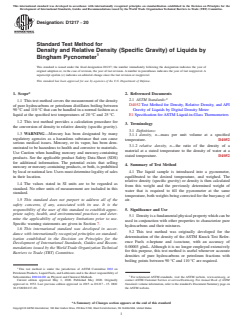
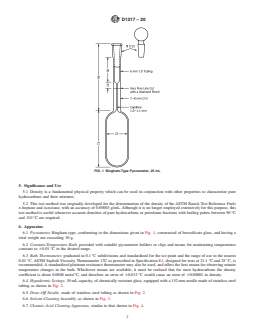
6.1 Pycnometer, Bingham-type, conforming to the dimensions given in Fig. 1, constructed of borosilicate glass, and having a
total weight not exceeding 30 g.
6.2 Constant-Temperature Bath, provided with suitable pycnometer holders or clips and means for maintaining temperatures
constant to 60.01 °C in the desired range.
6.3 Bath Thermometer, graduated in 0.1 °C subdivisions and standardized for the ice point and the range of use to the nearest
0.01 °C. ASTM Saybolt Viscosity Thermometer 17C as prescribed in Specification E1, designed for tests at 21.1 °C and 25 °C, is
recommended. A standardized platinum resistance thermometer may also be used, and offers the best means for observing minute
temperature changes in the bath. Whichever means are available, it must be realized that for most hydrocarbons the density
coefficient is about 0.0008 units/°C, and therefore an error of 60.013 °C would cause an error of 60.00001 in density.
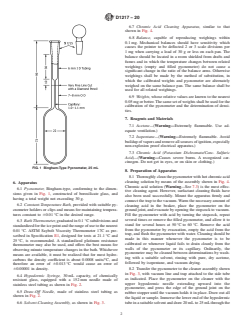
6.4 Hypodermic Syringe, 30 mL capacity, of chemically resistant glass, equipped with a 152 mm needle made of stainless steel
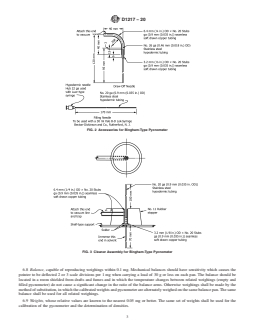
tubing as shown in Fig. 2.
6.5 Draw-Off Needle, made of stainless steel tubing as shown in Fig. 2.
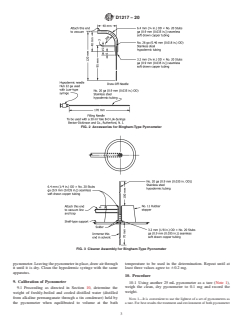
6.6 Solvent-Cleaning Assembly, as shown in Fig. 3.
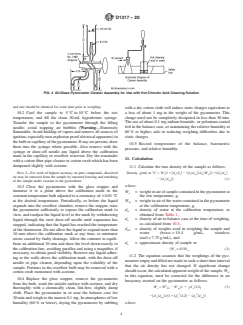
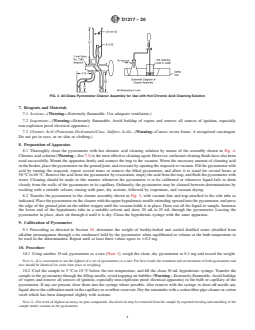
6.7 Chromic Acid Cleaning Apparatus, similar to that shown in Fig. 4.
D1217 − 20
FIG. 2 Accessories for Bingham-Type Pycnometer
FIG. 3 Cleaner Assembly for Bingham-Type Pycnometer
6.8 Balance, capable of reproducing weighings within 0.1 mg. Mechanical balances should have sensitivity which causes the
pointer to be deflected 2 or 3 scale divisions per 1 mg when carrying a load of 30 g or less on each pan. The balance should be
located in a room shielded from drafts and fumes and in which the temperature changes between related weighings (empty and
filled pycnometer) do not cause a significant change in the ratio of the balance arms. Otherwise weighings shall be made by the
method of substitution, in which the calibrated weights and pycnometer are alternately weighed on the same balance pan. The same
balance shall be used for all related weighings.
6.9 Weights, whose relative values are known to the nearest 0.05 mg or better. The same set of weights shall be used for the
calibration of the pycnometer and the determination of densities.
D1217 − 20
FIG. 4 All-Glass Pycnometer Cleaner Assembly for Use with Hot Chromic Acid Cleaning Solution
7. Reagents and Materials
7.1 Acetone—(Warning—Extremely flammable. Use adequate ventilation.)
7.2 Isopentane—(Warning—Extremely flammable. Avoid buildup of vapors and remove all sources of ignition, especially
non-explosion proof electrical apparatus.)
7.3 Chromic Acid (Potassium Dichromate/Conc. Sulfuric Acid)—(Warning—Causes severe burns. A recognized carcinogen.
Do not get in eyes, or on skin or clothing.)
8. Preparation of Apparatus
8.1 Thoroughly clean the pycnometer with hot chromic acid cleaning solution by means of the assembly shown in Fig. 4.
Chromic acid solution (Warning—See 7.3) is the most effective cleaning agent. However, surfactant cleaning fluids have also been
used successfully. Mount the apparatus firmly and connect the trap to the vacuum. Warm the necessary amount of cleaning acid
in the beaker, place the pycnometer on the ground joint, and evacuate by opening the stopcock to vacuum. Fill the pycnometer with
acid by turning the stopcock, repeat several times or remove the filled pycnometer, and allow it to stand for several hours at
50 °C to 60 °C. Remove the acid from the pycnometer by evacuation, empty the acid from the trap, and flush the pycnometer with
water. Cleaning should be made in this manner whenever the pycnometer is to be calibrated or whenever liquid fails to drain
cleanly from the walls of the pycnometer or its capillary. Ordinarily, the pycnometer may be cleaned between determinations by
washing with a suitable solvent, rinsing with pure, dry acetone, followed by isopentane, and vacuum drying.
8.2 Transfer the pycnometer to the cleaner assembly shown in Fig. 3, with vacuum line and trap attached to the side tube as
indicated. Place the pycnometer on the cleaner with the upper hypodermic needle extending upward into the pycnometer, and press
the edge of the ground joint on the rubber stopper until the vacuum holds it in place. Draw out all the liquid or sample. Immerse
the lower end of the hypodermic tube in a suitable solvent and draw 20 mL to 25 mL through the pycnometer. Leaving the
pycnometer in place, draw air through it until it is dry. Clean the hypodermic syringe with the same apparatus.
9. Calibration of Pycnometer
9.1 Proceeding as directed in Section 10, determine the weight of freshly-boiled and cooled distilled water (distilled from
alkaline permanganate through a tin condenser) held by the pycnometer when equilibrated to volume at the bath temperature to
be used in the determination. Repeat until at least three values agree to 60.2 mg.
10. Procedure
10.1 Using another 25 mL pycnometer as a tare (Note 1), weigh the clean, dry pycnometer to 0.1 mg and record the weight.
NOTE 1—It is convenient to use the lightest of a set of pycnometers as a tare. For best results the treatment and environment of both pycnometer and
tare should be identical for some time prior to weighing.
...