

ASTM B224-16(2022)
(Classification)Standard Classification of Coppers
General Information
- Abstract
SIGNIFICANCE AND USE
4.1 This classification lists the types of copper available from refineries or fabricators, or both, defines the common terms used, and gives the characteristics of many of the coppers available. It is useful to the neophyte looking for the appropriate copper for a particular application.
SCOPE
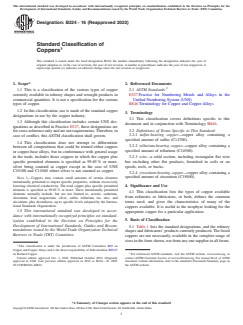
1.1 This is a classification of the various types of copper currently available in refinery shapes and wrought products in commercial quantities. It is not a specification for the various types of copper.
1.2 In this classification, use is made of the standard copper designations in use by the copper industry.
1.3 Although this classification includes certain UNS designations as described in Practice E527, these designations are for cross-reference only and are not requirements. Therefore, in case of conflict, this ASTM classification shall govern.
1.4 This classification does not attempt to differentiate between all compositions that could be termed either coppers or copper-base alloys, but in conformance with general usage in the trade, includes those coppers in which the copper plus specific permitted elements is specified as 99.85 % or more, silver being counted as copper except in the case of UNS C10100 and C11040 where silver is not counted as copper.
Note 1: Coppers may contain small amounts of certain elements intentionally permitted to impart specific properties, without excessively lowering electrical conductivity. The total copper plus specific permitted elements is specified as 99.85 % or more. These intentionally permitted elements normally include, but are not limited to, arsenic, cadmium, chromium, lead, magnesium, silver, sulfur, tellurium, tin, zinc, and zirconium, plus deoxidizers, up to specific levels adopted by the International Standards Organization.
1.5 This international standard was developed in accordance with internationally recognized principles on standardization established in the Decision on Principles for the Development of International Standards, Guides and Recommendations issued by the World Trade Organization Technical Barriers to Trade (TBT) Committee.
- Status
- Published
- Publication Date
- 30-Sep-2022
- Technical Committee
- B05 - Copper and Copper Alloys
- Drafting Committee
- B05.07 - Refined Copper


Overview
ASTM B224-16(2022): Standard Classification of Coppers provides a comprehensive framework for identifying and classifying various types of copper available in refinery and wrought product forms in commercial quantities. Developed by ASTM International, this standard offers clear definitions of standard terms, describes distinguishing characteristics, and supports industry professionals in selecting suitable copper grades for various applications. ASTM B224-16 emphasizes the use of established copper designations within the industry, making it a fundamental resource for both beginners and seasoned professionals working with copper materials.
Key Topics
The standard addresses several key areas relevant to copper classification:
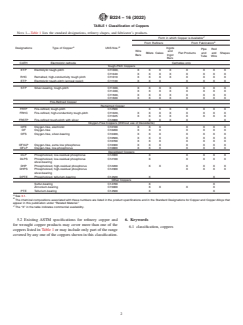
- Copper Types Covered: Includes electrolytic tough-pitch (ETP), remelted high-conductivity, oxygen-free (OF and OFE), deoxidized coppers, sulfur-bearing, tellurium-bearing, and zirconium-bearing coppers.
- Standard Designations: Utilizes industry-accepted copper designations, including Unified Numbering System (UNS) numbers for cross-referencing, while prioritizing ASTM classification in case of conflicts.
- Product Forms: Lists refinery and fabricator outputs such as ingots, billets, cakes, rods, bars, pipes, wire, and flat products.
- Chemical Composition: Focuses on coppers containing not less than 99.85% copper plus permitted elements, with exceptions and rules for counting silver content in specific alloys (such as UNS C10100 and C11040).
- Terminology: Defines relevant terms specific to copper and copper alloys, aiding consistent use and communication across the supply chain.
- Limitations: Clarifies that this document is a classification, not a specification, and does not cover all potential copper-base alloy compositions.
Applications
ASTM B224-16(2022) is a crucial reference for several practical scenarios:
- Material Selection: Supports engineers, manufacturers, and procurement specialists in identifying the appropriate type of copper for electrical, construction, plumbing, and industrial uses.
- Procurement and Sourcing: Helps buyers and supply chain managers specify and source copper materials with confidence, ensuring compatibility with industry standards.
- Product Development: Assists designers and metallurgists in choosing copper grades best suited to product requirements, such as electrical conductivity, corrosion resistance, or mechanical properties.
- Industry Training: Provides a foundational overview for individuals new to the copper industry, clarifying terminology and standard designations.
Typical industries that rely on this classification include electrical equipment manufacturing, plumbing products, architectural applications, and more, where correct copper selection is vital for performance and compliance.
Related Standards
Several related ASTM standards support or complement ASTM B224-16(2022):
- ASTM E527 - Practice for Numbering Metals and Alloys in the Unified Numbering System (UNS), offering guidance on UNS designation usage.
- ASTM B846 - Terminology for Copper and Copper Alloys, providing definitions for terms used throughout the copper industry.
These standards help ensure clear communication and consistency when referencing copper materials in technical documentation and procurement.
Keywords: ASTM B224-16, copper classification, copper types, standard copper designations, refinery copper, wrought copper products, UNS designation, copper alloys, copper terminology, ASTM standards
By following the guidance of ASTM B224-16(2022), professionals can ensure they are using the most appropriate and industry-recognized copper classifications for their projects and products.
Relations
- Effective Date
- 01-Aug-2019
- Effective Date
- 01-Jan-2019
- Effective Date
- 01-Jun-2011
- Effective Date
- 01-Jan-2011
- Effective Date
- 15-Nov-2009
- Effective Date
- 01-Nov-2009
- Effective Date
- 15-Nov-2006
- Effective Date
- 15-May-2006
- Effective Date
- 01-Nov-2005
- Effective Date
- 10-Apr-2003
- Effective Date
- 10-May-2001
- Effective Date
- 10-May-2001
- Effective Date
- 10-May-2001
- Effective Date
- 10-Mar-1997
Get Certified
Connect with accredited certification bodies for this standard

Element Materials Technology
Materials testing and product certification.

Inštitut za kovinske materiale in tehnologije
Institute of Metals and Technology. Materials testing, metallurgical analysis, NDT.
Sponsored listings
Frequently Asked Questions
ASTM B224-16(2022) is a standard published by ASTM International. Its full title is "Standard Classification of Coppers". This standard covers: SIGNIFICANCE AND USE 4.1 This classification lists the types of copper available from refineries or fabricators, or both, defines the common terms used, and gives the characteristics of many of the coppers available. It is useful to the neophyte looking for the appropriate copper for a particular application. SCOPE 1.1 This is a classification of the various types of copper currently available in refinery shapes and wrought products in commercial quantities. It is not a specification for the various types of copper. 1.2 In this classification, use is made of the standard copper designations in use by the copper industry. 1.3 Although this classification includes certain UNS designations as described in Practice E527, these designations are for cross-reference only and are not requirements. Therefore, in case of conflict, this ASTM classification shall govern. 1.4 This classification does not attempt to differentiate between all compositions that could be termed either coppers or copper-base alloys, but in conformance with general usage in the trade, includes those coppers in which the copper plus specific permitted elements is specified as 99.85 % or more, silver being counted as copper except in the case of UNS C10100 and C11040 where silver is not counted as copper. Note 1: Coppers may contain small amounts of certain elements intentionally permitted to impart specific properties, without excessively lowering electrical conductivity. The total copper plus specific permitted elements is specified as 99.85 % or more. These intentionally permitted elements normally include, but are not limited to, arsenic, cadmium, chromium, lead, magnesium, silver, sulfur, tellurium, tin, zinc, and zirconium, plus deoxidizers, up to specific levels adopted by the International Standards Organization. 1.5 This international standard was developed in accordance with internationally recognized principles on standardization established in the Decision on Principles for the Development of International Standards, Guides and Recommendations issued by the World Trade Organization Technical Barriers to Trade (TBT) Committee.
SIGNIFICANCE AND USE 4.1 This classification lists the types of copper available from refineries or fabricators, or both, defines the common terms used, and gives the characteristics of many of the coppers available. It is useful to the neophyte looking for the appropriate copper for a particular application. SCOPE 1.1 This is a classification of the various types of copper currently available in refinery shapes and wrought products in commercial quantities. It is not a specification for the various types of copper. 1.2 In this classification, use is made of the standard copper designations in use by the copper industry. 1.3 Although this classification includes certain UNS designations as described in Practice E527, these designations are for cross-reference only and are not requirements. Therefore, in case of conflict, this ASTM classification shall govern. 1.4 This classification does not attempt to differentiate between all compositions that could be termed either coppers or copper-base alloys, but in conformance with general usage in the trade, includes those coppers in which the copper plus specific permitted elements is specified as 99.85 % or more, silver being counted as copper except in the case of UNS C10100 and C11040 where silver is not counted as copper. Note 1: Coppers may contain small amounts of certain elements intentionally permitted to impart specific properties, without excessively lowering electrical conductivity. The total copper plus specific permitted elements is specified as 99.85 % or more. These intentionally permitted elements normally include, but are not limited to, arsenic, cadmium, chromium, lead, magnesium, silver, sulfur, tellurium, tin, zinc, and zirconium, plus deoxidizers, up to specific levels adopted by the International Standards Organization. 1.5 This international standard was developed in accordance with internationally recognized principles on standardization established in the Decision on Principles for the Development of International Standards, Guides and Recommendations issued by the World Trade Organization Technical Barriers to Trade (TBT) Committee.
ASTM B224-16(2022) is classified under the following ICS (International Classification for Standards) categories: 77.120.30 - Copper and copper alloys. The ICS classification helps identify the subject area and facilitates finding related standards.
ASTM B224-16(2022) has the following relationships with other standards: It is inter standard links to ASTM B846-19a, ASTM B846-19, ASTM B846-11a, ASTM B846-11, ASTM B846-09a, ASTM B846-09, ASTM B846-06a, ASTM B846-06, ASTM B846-05, ASTM E527-83(2003), ASTM B846-01, ASTM B846-99e1, ASTM B846-01e1, ASTM E527-83(1997)e1. Understanding these relationships helps ensure you are using the most current and applicable version of the standard.
ASTM B224-16(2022) is available in PDF format for immediate download after purchase. The document can be added to your cart and obtained through the secure checkout process. Digital delivery ensures instant access to the complete standard document.
Standards Content (Sample)
This international standard was developed in accordance with internationally recognized principles on standardization established in the Decision on Principles for the
Development of International Standards, Guides and Recommendations issued by the World Trade Organization Technical Barriers to Trade (TBT) Committee.
Designation: B224 −16 (Reapproved 2022)
Standard Classification of
Coppers
This standard is issued under the fixed designation B224; the number immediately following the designation indicates the year of
original adoption or, in the case of revision, the year of last revision. A number in parentheses indicates the year of last reapproval. A
superscript epsilon (´) indicates an editorial change since the last revision or reapproval.
1. Scope* 2. Referenced Documents
1.1 This is a classification of the various types of copper 2.1 ASTM Standards:
currently available in refinery shapes and wrought products in E527 Practice for Numbering Metals and Alloys in the
commercial quantities. It is not a specification for the various Unified Numbering System (UNS)
types of copper. B846 Terminology for Copper and Copper Alloys
1.2 In this classification, use is made of the standard copper
3. Terminology
designations in use by the copper industry.
3.1 This classification covers definitions specific to this
1.3 Although this classification includes certain UNS des-
document and in conjunction with Terminology B846.
ignations as described in Practice E527, these designations are
3.2 Definitions of Terms Specific to This Standard:
forcross-referenceonlyandarenotrequirements.Therefore,in
3.2.1 sulfur-bearing copper—copper alloy containing a
case of conflict, this ASTM classification shall govern.
specified amount of sulfur (C14700).
1.4 This classification does not attempt to differentiate
3.2.2 tellurium-bearing copper—copper alloy containing a
between all compositions that could be termed either coppers
specified amount of tellurium (C14500).
or copper-base alloys, but in conformance with general usage
in the trade, includes those coppers in which the copper plus 3.2.3 wire—a solid section, including rectangular flat wire
specific permitted elements is specified as 99.85 % or more, but excluding other flat products, furnished in coils or on
spools, reels, or bucks.
silver being counted as copper except in the case of UNS
C10100 and C11040 where silver is not counted as copper.
3.2.4 zirconium-bearing copper—copper alloy containing a
specified amount of zirconium (C15000).
NOTE 1—Coppers may contain small amounts of certain elements
intentionally permitted to impart specific properties, without excessively
lowering electrical conductivity. The total copper plus specific permitted 4. Significance and Use
elements is specified as 99.85 % or more. These intentionally permitted
4.1 This classification lists the types of copper available
elements normally include, but are not limited to, arsenic, cadmium,
from refineries or fabricators, or both, defines the common
chromium, lead, magnesium, silver, sulfur, tellurium, tin, zinc, and
zirconium, plus deoxidizers, up to specific levels adopted by the Interna-
terms used, and gives the characteristics of many of the
tional Standards Organization.
coppers available. It is useful to the neophyte looking for the
1.5 This international standard was developed in accor-
appropriate copper for a particular application.
dance with internationally recognized principles on standard-
5. Basis of Classification
ization established in the Decision on Principles for the
Development of International Standards, Guides and Recom-
5.1 Table 1 lists the standard designations, and the refinery
mendations issued by the World Trade Organization Technical
shapes and fabricators’ products currently produced. The listed
Barriers to Trade (TBT) Committee.
coppers are not necessarily available in the complete range of
sizesintheformshown,norfromanyonesupplierinallforms.
This classification is under the jurisdiction of ASTM Committee B05 on
Copper and CopperAlloys and is the direct responsibility of Subcommittee B05.07
on Refined Copper. For referenced ASTM standards, visit the ASTM website, www.astm.org, or
Current edition approved Oct. 1, 2022. Published October 2022. Originally contact ASTM Customer Service at service@astm.org. For Annual Book of ASTM
approved in 1948. Last previous edition approved in 2016 as B224 – 16. DOI: Standards volume information, refer to the standard’s Document Summary page on
10.1520/B0224-16R22. the ASTM website.
*A Summary of Changes section appears at the end of this standard
Copyright © ASTM International, 100 Barr Harbor Drive, PO Box C7
...