

ASTM C1713-23
(Specification)Standard Specification for Mortars for the Repair of Historic Masonry
General Information
- Abstract
SCOPE
1.1 This specification covers mortar for the repair of masonry constructed with methods and materials that pre-date the origination of current standards of construction. The mortar may be used for non-structural purposes such as repointing of the masonry, or for structural purposes such as, but not restricted to, re-construction or repair of mortar joints that contribute to the structural integrity of the masonry.
1.2 Masonry includes the following units laid in mortar: (1) cast stone, (2) clay brick and tile, (3) concrete masonry, (4) natural stone, (5) terra cotta, and (6) calcium silicate.
1.3 This specification may be used to pre-qualify mortar for a project.
1.4 Mortars tested using this specification are laboratory-prepared mortars and do not represent in-place, site mortars.
1.5 This specification provides a basis for the design of an appropriate mortar formulation based upon performance, material and aesthetic requirements. Use of this specification requires a thorough understanding of the function, maintenance, and repair requirements for the preservation and continued performance of the masonry assembly in the context of the assembly’s structure, water management, and long-term performance.
1.6 The values stated in inch-pound units are to be regarded as standard. The values given in parentheses are mathematical conversions to SI units that are provided for information only and are not considered standard.
1.7 This standard does not purport to address all of the safety concerns, if any, associated with its use. It is the responsibility of the user of this standard to establish appropriate safety, health, and environmental practices and determine the applicability of regulatory limitations prior to use.
1.8 This international standard was developed in accordance with internationally recognized principles on standardization established in the Decision on Principles for the Development of International Standards, Guides and Recommendations issued by the World Trade Organization Technical Barriers to Trade (TBT) Committee.
- Status
- Published
- Publication Date
- 31-Mar-2023
- Technical Committee
- C12 - Mortars and Grouts for Unit Masonry
- Drafting Committee
- C12.03 - Specifications for Mortars
Buy Documents
ASTM C1713-23 - Standard Specification for Mortars for the Repair of Historic Masonry
REDLINE ASTM C1713-23 - Standard Specification for Mortars for the Repair of Historic Masonry
Overview
ASTM C1713-23 is the recognized standard specification for mortars used in the repair of historic masonry. Developed and published by ASTM International, this standard addresses mortar applications for masonry structures constructed with materials and techniques that predate modern construction norms. ASTM C1713 plays a vital role in guiding restoration, repair, and repointing activities that ensure historic masonry's structural integrity and visual continuity.
This specification applies to both non-structural uses, such as repointing masonry joints, and structural uses, such as reconstruction and repair of load-bearing mortar joints. ASTM C1713-23 establishes requirements for laboratory-prepared mortar formulations, emphasizing compatibility with historic construction methods and materials. The standard supports preservation efforts by detailing material requirements, proportioning guidelines, and appropriate testing methods, allowing professionals to design safe, effective, and appropriate repair mortars.
Key Topics
- Scope of Use: Defines mortar standards for the repair of masonry made with cast stone, clay brick and tile, concrete masonry, natural stone, terra cotta, and calcium silicate units.
- Material Specifications: Stipulates required properties for binders (like hydrated lime, hydraulic lime, natural cement, and Portland cement), aggregates, water, admixtures, and pigments.
- Proportioning & Properties: Allows specification of mortars either by defined material proportions or by required performance properties. Proportioning and mix ratios are established to match or complement existing historic assemblies.
- Physical Testing: Details necessary laboratory procedures for assessing compressive strength, water retention, air content, absorption rate, porosity, and bond strength, ensuring new mortar is compatible and durable.
- Curing & Performance: Recognizes differences in curing times for different mortar types (e.g., lime mortars require longer carbonation periods than hydraulic cement mortars), as related to both laboratory testing and field performance.
- Quality Assurance: Requires verification of constituent materials through certification, and performance testing to ensure compliance with project specifications.
- Preservation Focus: Emphasizes the importance of matching mortar properties to original materials to maintain both the aesthetic and physical performance of historic masonry.
Applications
ASTM C1713-23 serves a wide range of preservation, conservation, and construction professionals, including architects, engineers, conservators, and masonry contractors focused on historic structures. Example applications include:
- Repointing: Suitable for filling deteriorated mortar joints in historic brick, stone, or masonry walls while maintaining historical authenticity.
- Masonry Reconstruction: Used for rebuilding collapsed or structurally compromised sections of historic walls, ensuring that new mortar contributes to the wall's integrity.
- Patch Repair: Ideal for targeted repairs where mortar has been lost due to weathering, moisture, or salt action.
- Aesthetic Matching: Guides the selection of materials and pigments to visually match existing mortar, preserving the original appearance of historic facades.
- Water Management: Ensures that new mortars maintain appropriate water vapor permeability, essential for moisture control in heritage buildings.
Related Standards
Professionals using ASTM C1713-23 should also be aware of related ASTM standards that complement its guidance:
- ASTM C207: Specification for Hydrated Lime for Masonry Purposes
- ASTM C144: Specification for Aggregate for Masonry Mortar
- ASTM C270: Specification for Mortar for Unit Masonry
- ASTM C150: Specification for Portland Cement
- ASTM C1329: Specification for Mortar Cement
- ASTM C1384: Specification for Admixtures for Masonry Mortars
- ASTM C1072: Test Methods for Masonry Flexural Bond Strength
- ASTM E2260: Guide for Repointing Historic Masonry
These related standards provide additional specifications for materials, mixing, installation, and quality assurance, supporting comprehensive, standards-based approaches to historic masonry repair and preservation projects.
Keywords: ASTM C1713-23, historic masonry, mortar repair, masonry preservation, repointing, restoration mortar, heritage construction, masonry standards, compatibility, compressive strength, water retention, historic building restoration
Relations
- Effective Date
- 01-Mar-2024
- Effective Date
- 01-Jan-2024
- Effective Date
- 15-Dec-2023
- Effective Date
- 01-Dec-2023
- Effective Date
- 01-Dec-2023
- Effective Date
- 15-Nov-2023
- Effective Date
- 15-Jul-2020
- Effective Date
- 01-Jun-2020
- Effective Date
- 01-Nov-2019
- Effective Date
- 01-May-2019
- Effective Date
- 01-May-2019
- Effective Date
- 01-Apr-2019
- Effective Date
- 01-Feb-2019
- Effective Date
- 01-Dec-2018
- Effective Date
- 01-Jul-2018
Buy Documents
ASTM C1713-23 - Standard Specification for Mortars for the Repair of Historic Masonry
REDLINE ASTM C1713-23 - Standard Specification for Mortars for the Repair of Historic Masonry
Get Certified
Connect with accredited certification bodies for this standard

DIBt (Deutsches Institut für Bautechnik)
German Institute for Building Technology.
DIN CERTCO
DIN Group product certification.

Aboma Certification B.V.
Specialized in construction, metal, and transport sectors.
Sponsored listings
Frequently Asked Questions
ASTM C1713-23 is a technical specification published by ASTM International. Its full title is "Standard Specification for Mortars for the Repair of Historic Masonry". This standard covers: SCOPE 1.1 This specification covers mortar for the repair of masonry constructed with methods and materials that pre-date the origination of current standards of construction. The mortar may be used for non-structural purposes such as repointing of the masonry, or for structural purposes such as, but not restricted to, re-construction or repair of mortar joints that contribute to the structural integrity of the masonry. 1.2 Masonry includes the following units laid in mortar: (1) cast stone, (2) clay brick and tile, (3) concrete masonry, (4) natural stone, (5) terra cotta, and (6) calcium silicate. 1.3 This specification may be used to pre-qualify mortar for a project. 1.4 Mortars tested using this specification are laboratory-prepared mortars and do not represent in-place, site mortars. 1.5 This specification provides a basis for the design of an appropriate mortar formulation based upon performance, material and aesthetic requirements. Use of this specification requires a thorough understanding of the function, maintenance, and repair requirements for the preservation and continued performance of the masonry assembly in the context of the assembly’s structure, water management, and long-term performance. 1.6 The values stated in inch-pound units are to be regarded as standard. The values given in parentheses are mathematical conversions to SI units that are provided for information only and are not considered standard. 1.7 This standard does not purport to address all of the safety concerns, if any, associated with its use. It is the responsibility of the user of this standard to establish appropriate safety, health, and environmental practices and determine the applicability of regulatory limitations prior to use. 1.8 This international standard was developed in accordance with internationally recognized principles on standardization established in the Decision on Principles for the Development of International Standards, Guides and Recommendations issued by the World Trade Organization Technical Barriers to Trade (TBT) Committee.
SCOPE 1.1 This specification covers mortar for the repair of masonry constructed with methods and materials that pre-date the origination of current standards of construction. The mortar may be used for non-structural purposes such as repointing of the masonry, or for structural purposes such as, but not restricted to, re-construction or repair of mortar joints that contribute to the structural integrity of the masonry. 1.2 Masonry includes the following units laid in mortar: (1) cast stone, (2) clay brick and tile, (3) concrete masonry, (4) natural stone, (5) terra cotta, and (6) calcium silicate. 1.3 This specification may be used to pre-qualify mortar for a project. 1.4 Mortars tested using this specification are laboratory-prepared mortars and do not represent in-place, site mortars. 1.5 This specification provides a basis for the design of an appropriate mortar formulation based upon performance, material and aesthetic requirements. Use of this specification requires a thorough understanding of the function, maintenance, and repair requirements for the preservation and continued performance of the masonry assembly in the context of the assembly’s structure, water management, and long-term performance. 1.6 The values stated in inch-pound units are to be regarded as standard. The values given in parentheses are mathematical conversions to SI units that are provided for information only and are not considered standard. 1.7 This standard does not purport to address all of the safety concerns, if any, associated with its use. It is the responsibility of the user of this standard to establish appropriate safety, health, and environmental practices and determine the applicability of regulatory limitations prior to use. 1.8 This international standard was developed in accordance with internationally recognized principles on standardization established in the Decision on Principles for the Development of International Standards, Guides and Recommendations issued by the World Trade Organization Technical Barriers to Trade (TBT) Committee.
ASTM C1713-23 is classified under the following ICS (International Classification for Standards) categories: 91.100.10 - Cement. Gypsum. Lime. Mortar. The ICS classification helps identify the subject area and facilitates finding related standards.
ASTM C1713-23 has the following relationships with other standards: It is inter standard links to ASTM E96/E96M-24, ASTM C10/C10M-24, ASTM C109/C109M-23, ASTM C1384-23, ASTM C1400-23, ASTM E96/E96M-23, ASTM C305-20, ASTM C61/C61M-00(2020), ASTM C10/C10M-19, ASTM C270-19a, ASTM C270-19ae1, ASTM C150/C150M-19, ASTM C270-19, ASTM C1180-18, ASTM C780-18. Understanding these relationships helps ensure you are using the most current and applicable version of the standard.
ASTM C1713-23 is available in PDF format for immediate download after purchase. The document can be added to your cart and obtained through the secure checkout process. Digital delivery ensures instant access to the complete standard document.
Standards Content (Sample)
This international standard was developed in accordance with internationally recognized principles on standardization established in the Decision on Principles for the
Development of International Standards, Guides and Recommendations issued by the World Trade Organization Technical Barriers to Trade (TBT) Committee.
Designation: C1713 − 23
Standard Specification for
Mortars for the Repair of Historic Masonry
This standard is issued under the fixed designation C1713; the number immediately following the designation indicates the year of
original adoption or, in the case of revision, the year of last revision. A number in parentheses indicates the year of last reapproval. A
superscript epsilon (´) indicates an editorial change since the last revision or reapproval.
1. Scope Development of International Standards, Guides and Recom-
mendations issued by the World Trade Organization Technical
1.1 This specification covers mortar for the repair of ma-
Barriers to Trade (TBT) Committee.
sonry constructed with methods and materials that pre-date the
origination of current standards of construction. The mortar
2. Referenced Documents
may be used for non-structural purposes such as repointing of
2.1 ASTM Standards:
the masonry, or for structural purposes such as, but not
C5 Specification for Quicklime for Structural Purposes
restricted to, re-construction or repair of mortar joints that
C10/C10M Specification for Natural Cement
contribute to the structural integrity of the masonry.
C61/C61M Specification for Gypsum Keene’s Cement
1.2 Masonry includes the following units laid in mortar: (1)
C91/C91M Specification for Masonry Cement
cast stone, (2) clay brick and tile, (3) concrete masonry, (4)
C109/C109M Test Method for Compressive Strength of
natural stone, (5) terra cotta, and (6) calcium silicate.
Hydraulic Cement Mortars (Using 2-in. or [50 mm] Cube
Specimens)
1.3 This specification may be used to pre-qualify mortar for
C110 Test Methods for Physical Testing of Quicklime,
a project.
Hydrated Lime, and Limestone
1.4 Mortars tested using this specification are laboratory-
C136/C136M Test Method for Sieve Analysis of Fine and
prepared mortars and do not represent in-place, site mortars.
Coarse Aggregates
1.5 This specification provides a basis for the design of an
C141/C141M Specification for Hydrated Hydraulic Lime for
appropriate mortar formulation based upon performance, ma-
Structural Purposes
terial and aesthetic requirements. Use of this specification
C144 Specification for Aggregate for Masonry Mortar
requires a thorough understanding of the function,
C150/C150M Specification for Portland Cement
maintenance, and repair requirements for the preservation and
C207 Specification for Hydrated Lime for Masonry Pur-
continued performance of the masonry assembly in the context
poses
of the assembly’s structure, water management, and long-term
C216 Specification for Facing Brick (Solid Masonry Units
performance.
Made from Clay or Shale)
C270 Specification for Mortar for Unit Masonry
1.6 The values stated in inch-pound units are to be regarded
C305 Practice for Mechanical Mixing of Hydraulic Cement
as standard. The values given in parentheses are mathematical
Pastes and Mortars of Plastic Consistency
conversions to SI units that are provided for information only
C511 Specification for Mixing Rooms, Moist Cabinets,
and are not considered standard.
Moist Rooms, and Water Storage Tanks Used in the
1.7 This standard does not purport to address all of the
Testing of Hydraulic Cements and Concretes
safety concerns, if any, associated with its use. It is the
C595/C595M Specification for Blended Hydraulic Cements
responsibility of the user of this standard to establish appro-
C780 Test Method for Preconstruction and Construction
priate safety, health, and environmental practices and deter-
Evaluation of Mortars for Plain and Reinforced Unit
mine the applicability of regulatory limitations prior to use.
Masonry
1.8 This international standard was developed in accor-
C948 Test Method for Dry and Wet Bulk Density, Water
dance with internationally recognized principles on standard-
Absorption, and Apparent Porosity of Thin Sections of
ization established in the Decision on Principles for the
Glass-Fiber Reinforced Concrete
C979/C979M Specification for Pigments for Integrally Col-
ored Concrete
This specification is under the jurisdiction of ASTM Committee C12 on
Mortars and Grouts for Unit Masonry and is the direct responsibility of Subcom-
mittee C12.03 on Specifications for Mortars. For referenced ASTM standards, visit the ASTM website, www.astm.org, or
Current edition approved April 1, 2023. Published April 2023. Originally contact ASTM Customer Service at service@astm.org. For Annual Book of ASTM
approved in 2010. Last previous edition approved in 2017 as C1713 – 17. DOI: Standards volume information, refer to the standard’s Document Summary page on
10.1520/C1713–23. the ASTM website.
Copyright © ASTM International, 100 Barr Harbor Drive, PO Box C700, West Conshohocken, PA 19428-2959. United States
C1713 − 23
C1072 Test Methods for Measurement of Masonry Flexural 3.3.5 minimum compressive strength (Fc), n—lower allow-
Bond Strength able limit on the ultimate strength of a hardened mortar sample
C1093 Practice for Accreditation of Testing Agencies for subjected to compression measured as force per unit area at the
Masonry specified curing time (CT).
C1157/C1157M Performance Specification for Hydraulic
3.3.6 total porosity, n—volume percentage of all pores or
Cement
void space in the mortar at the specified curing time (CT).
C1180 Terminology of Mortar and Grout for Unit Masonry
3.3.7 water retention, n—as defined in Terminology C1180.
C1329/C1329M Specification for Mortar Cement
Test shall be conducted on a sample in its plastic state.
C1384 Specification for Admixtures for Masonry Mortars
3.3.8 water vapor permeability (WVP), n—ability of a
C1400 Guide for Reduction of Efflorescence Potential in
mortar to pass water through it in vapor form at the specified
New Masonry Walls
curing time (CT).
C1403 Test Method for Rate of Water Absorption of Ma-
sonry Mortars
4. Constituent Materials
C1489 Specification for Lime Putty for Structural Purposes
4.1 Binder Materials shall be classified into the following
C1506 Test Method for Water Retention of Hydraulic
groups:
Cement-Based Mortars and Plasters
4.1.1 Group L—Lime (non-hydraulic) shall conform to the
C1707 Specification for Pozzolanic Hydraulic Lime for
following specifications:
Structural Purposes
4.1.1.1 Hydrated Lime shall conform to Specification C207,
E96/E96M Test Methods for Gravimetric Determination of
Water Vapor Transmission Rate of Materials Types S or SA. Types N and NA hydrated limes are permitted
if soaked or shown by test or performance record to be not
E2260 Guide for Repointing (Tuckpointing) Historic Ma-
sonry detrimental to the mortar.
4.1.1.2 Lime putty shall conform to Specification C1489.
3. Terminology
NOTE 1—Specification C5, Appendix 1, may be used, and the resulting
putty should meet the requirements of Specification C1489.
3.1 The terms used in this specification are identified in
Terminology C1180.
4.1.2 Group HL—Hydraulic Lime shall conform to the
following specifications:
3.2 Definitions of Terms Specific to This Standard:
3.2.1 aggregate, n—material as defined in Terminology 4.1.2.1 Hydraulic Hydrated Lime—shall conform to Speci-
C1180, but limited to the material groups listed under Section fication C141/C141M.
4 of this specification.
4.1.2.2 Pozzolanic Hydraulic Lime—shall conform to
Specification C1707.
3.2.2 binder, n—material as defined in Terminology C1180,
4.1.3 Group HC—Hydraulic Cements shall conform to the
but limited to the cementitious material groups listed under
following specifications:
Section 4 of this specification to be mixed with potable water.
4.1.3.1 Blended Hydraulic Cement—shall conform to Speci-
3.2.3 curing, n—process by which a mortar gains its long-
fication C595/C595M.
term, final-state properties.
NOTE 2—Blended hydraulic cement may not be appropriate for struc-
3.2.4 curing time (CT), n—number of days in which a
tures built before the second half of the 20th century.
hardened state sample is cured before testing.
4.1.3.2 Performance Hydraulic Cement—shall conform to
3.2.5 historic masonry, n—masonry that may have been
Specification C1157/C1157M.
constructed with methods and materials that pre-date the
origination of current standards.
NOTE 3—Performance hydraulic cement may not be appropriate for
structures built before the second half of the 20th century.
3.3 Properties, as determined by Section 8 of this specifi-
cation: 4.1.3.3 Masonry Cement—shall conform to Specification
C91/C91M.
3.3.1 absorption rate (AR), n—a measure of the hardened
mortar’s ability to absorb water from a dry condition, measured 4.1.3.4 Mortar Cement—shall conform to Specification
as the initial flow of water into the mortar, as defined under Test C1329/C1329M.
Method C1403 and evaluated at the specified curing time (CT).
4.1.3.5 Natural Cement—shall conform to Specification
3.3.2 air content, n—cumulative volume of air in a mortar,
C10/C10M.
as a percentage of the total volume of mortar in its plastic state.
4.1.3.6 Portland Cement—shall conform to Specification
3.3.3 flexural bond strength (FBS), n—maximum flexural
C150/C150M.
tensile stress that causes failure of the bond between the mortar
NOTE 4—For interior gypsum mortar based systems requiring gypsum
cement refer to Specification C61/C61M and consult with the product
and masonry unit in a tested assembly at the specified curing
manufacturer regarding exposure suitability.
time (CT).
3.3.4 maximum compressive strength (Fcmx), n—upper al- 4.2 Aggregates—Aggregate shall conform to Specification
lowable limit on the ultimate strength of a hardened mortar C144. Aggregates that conform to all aspects of Specification
sample subjected to compression measured as force per unit C144 except for the gradation limits are permitted if demon-
area at the specified curing time (CT). strated by their history of performance under equivalent
C1713 − 23
units, and equal to or greater than that of the substrate mortar where
conditions and mortar formulation to be non-detrimental to the
present.
mortar. To determine aggregate gradation, use Test Method
NOTE 8—Vapor permeability will generally decrease with increasing
C136/C136M.
hydraulic constituents; however, aggregate gradation and admixtures can
greatly influence the value.
NOTE 5—The need to aesthetically match the color and texture of an
existing mortar may be justification for deviating from the gradation limits
of Specification C144. 7. Test Samples and Preparation
4.3 Water—Water shall be clean and free of oils, acids,
7.1 Material Proportioning—Laboratory mixed mortar
alkalies, salts, organic materials, or other substances that are
specified by volume proportions shall contain the mortar
deleterious to mortar or any metal used in the masonry.
materials as indicated in the mortar specification. Volume
proportions shall be converted to weights using the batch factor
4.4 Admixtures:
calculated as follows:
4.4.1 Admixtures—shall meet the requirements of Specifi-
7.1.1 Material Proportioning for Test Batches of Mortar:
cation C1384. Calcium chloride is not permitted. Other admix-
7.1.1.1 Batch factor = 1440/ [1280 kg/m (bulk density of
tures that are outside the scope of Specification C1384 are
aggregate) times total aggregate volume proportion].
permitted if they contain no more than 0.3 % water-soluble
alkali and if demonstrated by their history of performance
NOTE 9—A batch size using 1440 g of aggregate will typically result in
under equivalent conditions and mortar formulation to be enough mortar for water retention testing and one set of three 2-in. cubes
for compressive strength testing. Several batches with the same water to
non-detrimental to the mortar and items in contact.
binder ratio may be necessary to complete all tests.
4.4.2 Pigments—Pigments shall meet the requirements of
7.1.1.2 Oven dry and cool to room temperature all aggregate
Specification C979/C979M. Pigments which are not described
used for test mortars. Mortars preblended with aggregate
by Specification C979/C979M are permitted if demonstrated
require no proportioning.
by their history of performance under equivalent conditions
7.1.2 Constituent materials shall have the bulk densities as
and mortar formulation to be non-detrimental to the mortar.
noted in Table 2.
Pigment addition shall not exceed 10 % by weight of the binder
materials except for carbon black which is limited to 2 %
7.2 Masonry Units for Use in Water Vapor Permeability and
unless otherwise demonstrated by history of performance
Bond Strength—Masonry units shall be the actual masonry
under equivalent conditions and mortar formulation to be
units to be used in the field, or if unavailable, a brick meeting
non-detrimental to the mortar.
Specification C216, Grade SW with absorption properties
similar to the in-situ masonry units, if known.
5. Mortar Proportioning
7.3 Mortar Mixing—Mix the mortar in accordance with
5.1 Binder/Aggregate Ratio:
Practice C305 with the exception that for Group L and Group
5.1.1 Combine the mortars in volume ratios of 1 part total
HL mortars and those combined mortars at or greater than
binder materials to 2 to 3 ⁄2 parts aggregate.
45 % lime by binder volume the initial (low speed) mixing
5.1.2 Mortars specified outside volume ratios of 1 part total
time is extended to up to 2 minutes, the resting time is extended
binder materials to 2 to 3 ⁄2 parts aggregate shall be permitted
to 1.5 minutes, and the final (medium speed) mixing time is
if shown by history of use or by mortar testing per this
extended to up to 8 minutes, as best suits the formulation for
specification to be not detrimental to the mortar.
complete intermixing of components without segregation or
over entrapment of air.
NOTE 6—Most common mortars have total binder to aggregate ratios of
1 part total cementitious materials to 2 ⁄2 to 3 part aggregate, whereas
NOTE 10—These time extensions allow for the full wetting of the
some earlier mortars may have ratios as high as 1 to 1.
mortar constituents.
5.2 Air Entraining Binders—Air entraining binders shall not
7.4 Mortar Test Sample Molding:
be used in combination with other air entraining binders or
7.4.1 For total porosity, absorption rate and compressive
with a separate air entrainment admixture.
strength testing, mold the 2-in. (50-mm) cubes in accordance
with Test Method C109/C109M, subsections on Specimen
6. Requirements
Molds and Molding Test Specimens. For mortars to be used as
unit bedding, add enough water to obtain flow of 110 6 5 %.
6.1 Establishing Mortar Proportions:
For mortars to be used as repointing mortars, add enough water
6.1.1 Specify mortars by (1) proportion specification, con-
to obtain a Vicat Cone Penetrometer value (Test Method C780,
stituent materials and their respective volume proportions, or
Annex A1, Consistency by Cone Penetration Test Method) of
(2) property specification, constituent materials (or proprietary
15 mm 6 5 %.
products names) and required properties, in accordance with
7.4.2 For vapor transmission and bond strength testing mold
Table 1.
the samples according to Test Method C1072, with the excep-
6.1.1.1 Specifiers using the proportion specification shall
tion that for the vapor transmission the specimen is two brick,
select binder and aggregate proportions based upon an estab-
and cheese cloth is to be used as a bond break, and mortar is to
lished history of performance or testing that documents satis-
have flow values of 120 6 5%. If the binder material to
factory performance of the combinations and proportions
aggregate volume ratio has not been specified, use a value of
specified, and in conformance with Section 5 of this specifi-
1:3 binder to aggregate ratio measured by volume with sand
cation.
NOTE 7—WVP of the mortar should be greater than that of the masonry meeting Specification C144.
C1713 − 23
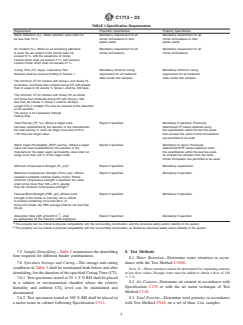
TABLE 1 Specification Requirements
Requirement Proportion Specification Property Specification
Water Retention (%)—Water retention value shall not Mandatory requirement for all Mandatory requirement for all
be less than 75 %. mortar formulations in their mortar formulations in their
plastic states plastic states
Air Content (%)—When an air entraining admixture Mandatory requirement for all Mandatory requirement for all
is used, the air content of the mortar shall not mortar formulations mortar formulations
exceed 12 %, with the exceptions of mortar
cement which shall not exceed 17 % and masonry
cement mortar which shall not exceed 21 %.
Curing Time (CT, days)—Laboratory Test Mandatory minimum curing Mandatory minimum curing
Samples shall be cured according to Section 7. requirement for all hardened requirement for all hardened
state mortar test samples state mortar test samples
The minimum CT for mortars with Group L and Group HL
as binders, and those that combine Group HC with greater
than or equal to 45 volume % Group L shall be 120 days.
The minimum CT for mortars with Group HC as binder
and those that combined Group HC with Group L with
less than 45 volume % Group L shall be 28 days.
Longer CTs or multiple CTs may be required at the discretion
of the specifier.
The above is for Laboratory Sample
Testing Only.
Total Porosity (TP, %)—Where a target value Report if specified. Mandatory if specified. Previously
has been established by the specifier or the manufacturer, determined TP values obtained using
the total porosity % shall not range more than 0.75 to this specification within the last five years
1.25 times the target value. from at least five same mortar formulations
are permitted to be used.
Water Vapor Permeability (WVP, perms)—Where a target Report if specified. Mandatory to report. Previously
value has been established by the specifier or the determined WVP values obtained under
manufacturer the water vapor permeability value shall not this specification within the last five years
range more than ±25 % of the target value. for at least five samples from the same
mortar formulation are permitted to be used.
A
Minimum Compressive Strength (Fc, psi) Report if specified. Mandatory requirement.
Maximum Compressive Strength (Fcmx, psi)—Where Report if specified. Mandatory if specified.
needed to establish material quality control. Where
minimum compressive strength is specified, the value
shall not be more than 100 ± 20 % greater
B
than the minimum compressive strength.
Flexural Bond Strength (FBS, psi)—Where bond Report if specified. Mandatory if specified.
strength of the mortar to masonry unit is critical.
In mortars containing more than 50 % of
Group HC binder, the FBS average shall be not less than
29 psi.
Absorption Rate (AR, g/min/30 in. ) , shall Report if specified. Mandatory if specified.
be appropriate for the masonry units employed.
A
This property can be critical to physical compatibility with the surrounding construction, and the structural safety and/or stability of the system.
B
This property can be critical to physical compatibility with the surrounding construction, as limited by structural safety and/or stability of the system.
7.5 Sample Demolding—Table 3 summarizes the demolding 8. Test Methods
time required for different binder combinations.
8.1 Water Retention—Determine water retention in accor-
dance with the Test Method C1506.
7.6 Specimen Storage and Curing—The storage and curing
conditions in Table 3 shall be maintained both before and after
NOTE 11—Water retention cannot be determined for repointing mortars
demolding, for the duration of the specified Curing Time (CT). at low flow values. Enough water must be added to obtain a flow of 110
6 5 %.
7.6.1 Test specimens stored at 70 6 5 % RH shall be placed
8.2 Air Content—Determine air content in accordance with
in a cabinet or environmental chamber where the relative
Specification C270 or with the air meter technique of Test
humidity and ambient CO level can be maintained and
Method C110.
documented.
7.6.2 Test specimens stored at 100 % RH shall be placed in 8.3 Total Porosity—Determine total porosity in accordance
a moist room or cabinet following Specification C511. with Test Method C948, on a set of three 2-in. samples.
C1713 − 23
TABLE 2 Bulk Density of Constituent Materials
Binder/Aggregate Material Bulk Density
Group L Binder Hydrated Lime 40 pcf (640 kg/m )
Lime Putty 80 pcf (1280 kg/m )
Group HL Binder Hydrated Hydraulic Lime Obtain from manufacturer
Group HC Binder Pozzolanic Hydraulic Lime Obtain from manufacturer
Portland Cement Obtain from manufacturer
Masonry Cement Obtain from manufacturer
Mortar Cement Obtain from manufacturer
Natural Cement Obtain from manufacturer
Blended Hydraulic Cement Obtain from manufacturer
Hydraulic Cement
Pre-blended Binder Any or all of the above Obtain from manufacturer
3 A
Aggregate 80 pcf (1280 kg/m )
A
The sand is oven dried for laboratory testing to reduce the potential of variability due to sand moisture content and to permit better accounting of materials used for air
content calculations. It is not necessary for the purpose of this specification to measure the unit weight of the dry sand. Although the unit weight of dry sand will typically
3 3
be 85 to 100 pcf (1360 to 1760 kg/m ), experience has shown the use of an assumed unit weight of 80 lb (1280 kg/m ) for dry sand will result in a laboratory mortar ratio
of aggregate to binder that is similar to that of the corresponding field mortar made using damp loose (bulked) sand.
TABLE 3 Storage Time in Molds
Binder Type Time in Molds Specimen Storage Conditions
Group L and Group HL only Minimum 5 days or until the sample 70 ± 5 % RH for Group L
and combined mortars with is sufficiently stable to demold 90 ± 5 % RH for Group HL
45 % or more lime by binder volume
Group HC only and combined 2 to 5 days as needed 100 % RH
mortars with less than 45 %
lime by binder volume
8.4 Absorption Rate—Determine absorption rate in accor- 9. Quality Assurance
dance with Test Method C1403 using three 2-in. cubes,
9.1 Compliance of volume specified mortars to this speci-
performing weight measurements at 1 and 3 min in addition to
fication shall be verified by:
the times specified therein, with reported units converted to
2 9.1.1 Confirmation that the materials in Section 4 of this
g/min/30 in. .
specification are used shall be verified by letters of certification
8.5 Water Vapor Permeability—Determine in accordance
or mill reports from the manufacturer.
with Test Method E96/E96M. The mortar shall be prepared
9.1.2 Proportions of material shall be verified by weigh
according to 7.3. At the time of testing, samples will be cut to
scale certificates or described procedures for proportioning and
fit over a testing cup measuring 50 6 2.5 mm on a side, in a
mixing the approved materials.
manner so as not to adversely affect the result.
NOTE 12—The testing laboratories performing the testing specified
8.6 Compressive Strength—Determine in accordance with herein should be evaluated in accordance with Practice C1093.
Test Method C109/C109M (using 2-in. or 50-mm cube
specimens), except that samples shall be cured in accordance 10. Keywords
with 7.6 of this specification.
10.1 absorption rate; air content; compressive strength;
8.7 Flexural Bond Strength—Determine in accordance with flexural bond strength; hydrated lime; hydraulic cement; hy-
Test Method C1072 using masonry units as described in 7.2. draulic lime; lime putty; masonry; natural cement; portland
cement masonry cement; preservation; repointing; total poros-
Assembly shall be cured in accordance with 7.6 of this
specification. ity; water retention; water vapor permeability
C1713 − 23
APPENDIXES
(Nonmandatory Information)
X1. EVALUATION, SELECTION AND USE OF MORTAR FOR REPAIR OF HISTORIC MASONRY
X1.1 Scope—This specification covers mortar for the repair specifier must have a thorough understanding of the available
of masonry that was constructed with methods and materials materials, which include binders (cementitious materials),
that pre-date the origination of current standards of construc- aggregate, water and sometimes admixtures, and their role in
tion. The mortar may be used for non-structural purposes such the mortar properties that will result. The property-specifier
as repointing of the masonry, or for structural purposes such as, must have a thorough understanding of the properties that are
but not restricted to, reconstruction or repair of mortar joints required, as well as the properties that can be achieved with the
that contribute to the structural integrity of the masonry. This available materials. The specifier is cautioned not to intermix
appendix is a guide to the use of this specification and provides the requirements of the proportion specification and the prop-
additional information for use in evaluating and specifying erty specification in such a way as creates unachievable
mortars for the repair of historic masonry. Repeated reference requirements for given formulations, but must rather, base the
is made to the Appendix X1 of Specification C270, which use of all overlapping requirements on a thorough understand-
provides nonmandatory information that can be used as a ing of the properties that will result from the specified
supplement to this appendix. The reader is encouraged to read proportions.
all of Appendix X1 and X2 in Specification C270 as well as the
X1.3.3 Proportion Specification can be useful for projects
other appendices in Specification C270 as they will provide
where manufactured property-specified mortars are not avail-
helpful information beyond what is specifically referenced
able or may not best suit the requirements of the work, or
herein.
where the size of the project is such that it is not expedient for
a contractor or manufacturer to produce a pre-tested, prequali-
X1.2 Significance and Use—Masonry mortar is a versatile
fied mortar for the specific requirements of the job, as well as
material capable of satisfying a variety of diverse requirements
in cases where mortar formulations have been developed by the
and significantly influences the performance of the masonry
specifier for mixing on site.
assembly as a whole. In the repair of existing masonry, it is
critical that the mortar being used in the repair is both
NOTE X1.1—It is the intent of this specification to encourage the growth
aesthetically and physically compatible with the existing
of a public domain repository of mortar formulations and their correlated
mortar, as well as the masonry assembly as a whole. In many
properties that will be helpful in guiding the process for selection of
cases, this may be achieved with nearly equal success by a mortar formulations that must satisfy the specific needs of the project.
variety of different mortar types that all satisfy the same
X1.3.3.1 Examples of Proportion Specification—When us-
requirements. A thorough understanding of both existing mor-
ing proportion specification, the specifier must list the constitu-
tar materials and those used in the repair and their properties,
ent materials in the mortar with their relative proportions by
and their relation to the historic masonry assembly being
volume. For example:
repaired will enable selection of a mortar that will perform
“Mortar A and its constituents shall meet the requirements of ASTM
satisfactorily.
C1713, and shall consist of 1 part portland cement, 3 parts hydrated
lime and 12 parts bulked sand by volume.”
X1.3 Specifying Mortars for Repair of Historic Masonry:
or:
“Mortar B and its constituents shall meet the requirements of ASTM
X1.3.1 Understanding the Existing Masonry Assembly and
C1713 and shall consist of 2 parts natural cement, 1 part hydrated
Functional Requirements of Mortar for Repair—In order to lime and 7 parts bulked sand by volume with an air content of 8 %
plus or minus 2 %.”
properly specify a mortar that is appropriate for the repair of an
or:
historic masonry assembly, the user of this specification
“Mortar C and its constituents shall meet the requirements of ASTM
(specifier) must first understand the materials and functional C1713, and shall consist of 2 parts lime putty and 5 parts bulked
sand by weight.”
requirements of the existing masonry assembly, the way in
which the assembly has and will behave, how well it has
X1.3.3.2 Additional requirements can be put into the speci-
performed, and how appropriate the existing mortar and
fication regarding sand gradation, additives and pigments for
masonry units have been for the assembly’s usage requirements
exposed applications, such as:
and environment. Based upon this understanding, the specifier
must then determine what materials and mortar properties are “For architecturally exposed mortar, the aggregate type and
gradation shall match the existing exposed original mortar sand and,
most appropriate for the
...
This document is not an ASTM standard and is intended only to provide the user of an ASTM standard an indication of what changes have been made to the previous version. Because
it may not be technically possible to adequately depict all changes accurately, ASTM recommends that users consult prior editions as appropriate. In all cases only the current version
of the standard as published by ASTM is to be considered the official document.
Designation: C1713 − 17 C1713 − 23
Standard Specification for
Mortars for the Repair of Historic Masonry
This standard is issued under the fixed designation C1713; the number immediately following the designation indicates the year of
original adoption or, in the case of revision, the year of last revision. A number in parentheses indicates the year of last reapproval. A
superscript epsilon (´) indicates an editorial change since the last revision or reapproval.
1. Scope
1.1 This specification covers mortar for the repair of masonry that was constructed with methods and materials that pre-date the
origination of current standards of construction that are compatible with it. construction. The mortar may be used for non-structural
purposes such as repointing of the masonry, or for structural purposes such as, but not restricted to, re-construction or repair of
mortar joints that contribute to the structural integrity of the masonry.
1.2 Masonry includes the following units laid in mortar: (1) cast stone, (2) clay masonry unitsbrick and clay brick and tile, (3)
concrete masonry units, masonry, (4) natural stone, and (5) terra cotta.cotta, and (6) calcium silicate.
1.3 This specification may be used to pre-qualify mortar for a project.
1.4 Mortars tested using this specification are laboratory-prepared mortars and do not represent in-place, site mortars.
1.5 This specification provides a basis for the design of an appropriate mortar formulation based upon performance, material and
aesthetic requirements. Use of this specification should be based on requires a thorough understanding of the function,
maintenance, and repair requirements for the preservation and continued performance of the masonry assembly in the context of
the building structure assembly’s structure, water management, and long-term performance. The user of this specification is
responsible for examining all criteria and selecting the appropriate mortar formulation and properties required.
1.6 The values stated in inch-pound units are to be regarded as standard. The values given in parentheses are mathematical
conversions to SI units that are provided for information only and are not considered standard.
1.7 This standard does not purport to address all of the safety concerns, if any, associated with its use. It is the responsibility of
the user of this standard to establish appropriate safety and health practices and determine the applicability of regulatory
limitations prior to use.
1.7 This standard does not purport to address all of the safety concerns, if any, associated with its use. It is the responsibility
of the user of this standard to establish appropriate safety, health, and environmental practices and determine the applicability of
regulatory limitations prior to use.
1.8 This international standard was developed in accordance with internationally recognized principles on standardization
established in the Decision on Principles for the Development of International Standards, Guides and Recommendations issued
by the World Trade Organization Technical Barriers to Trade (TBT) Committee.
This specification is under the jurisdiction of ASTM Committee C12 on Mortars and Grouts for Unit Masonry and is the direct responsibility of Subcommittee C12.03
on Specifications for Mortars.
Current edition approved June 1, 2017April 1, 2023. Published July 2017April 2023. Originally approved in 2010. Last previous edition approved in 20152017 as
C1713 – 15.C1713 – 17. DOI: 10.1520/C1713–17.10.1520/C1713–23.
Copyright © ASTM International, 100 Barr Harbor Drive, PO Box C700, West Conshohocken, PA 19428-2959. United States
C1713 − 23
2. Referenced Documents
2.1 ASTM Standards:
C5 Specification for Quicklime for Structural Purposes
C10C10/C10M Specification for Natural Cement
C61C61/C61M Specification for Gypsum Keene’s Cement
C91C91/C91M Specification for Masonry Cement
C109/C109M Test Method for Compressive Strength of Hydraulic Cement Mortars (Using 2-in. or [50 mm] Cube Specimens)
C110 Test Methods for Physical Testing of Quicklime, Hydrated Lime, and Limestone
C136C136/C136M Test Method for Sieve Analysis of Fine and Coarse Aggregates
C141C141/C141M Specification for Hydrated Hydraulic Lime for Structural Purposes
C144 Specification for Aggregate for Masonry Mortar
C150C150/C150M Specification for Portland Cement
C207 Specification for Hydrated Lime for Masonry Purposes
C216 Specification for Facing Brick (Solid Masonry Units Made from Clay or Shale)
C270 Specification for Mortar for Unit Masonry
C305 Practice for Mechanical Mixing of Hydraulic Cement Pastes and Mortars of Plastic Consistency
C511 Specification for Mixing Rooms, Moist Cabinets, Moist Rooms, and Water Storage Tanks Used in the Testing of Hydraulic
Cements and Concretes
C595C595/C595M Specification for Blended Hydraulic Cements
C780 Test Method for Preconstruction and Construction Evaluation of Mortars for Plain and Reinforced Unit Masonry
C948 Test Method for Dry and Wet Bulk Density, Water Absorption, and Apparent Porosity of Thin Sections of Glass-Fiber
Reinforced Concrete
C979C979/C979M Specification for Pigments for Integrally Colored Concrete
C1072 Test Methods for Measurement of Masonry Flexural Bond Strength
C1093 Practice for Accreditation of Testing Agencies for Masonry
C1157C1157/C1157M Performance Specification for Hydraulic Cement
C1180 Terminology of Mortar and Grout for Unit Masonry
C1329C1329/C1329M Specification for Mortar Cement
C1384 Specification for Admixtures for Masonry Mortars
C1400 Guide for Reduction of Efflorescence Potential in New Masonry Walls
C1403 Test Method for Rate of Water Absorption of Masonry Mortars
C1489 Specification for Lime Putty for Structural Purposes
C1506 Test Method for Water Retention of Hydraulic Cement-Based Mortars and Plasters
C1707 Specification for Pozzolanic Hydraulic Lime for Structural Purposes
E96/E96M Test Methods for Gravimetric Determination of Water Vapor Transmission Rate of Materials
E2260 Guide for Repointing (Tuckpointing) Historic Masonry
3. Terminology
3.1 The terms used in this specification are identified in Terminology C1180.
3.2 Definitions of Terms Specific to This Standard:
3.2.1 aggregate, n—material as defined in Terminology C1180, but limited to the material groups listed under Section 4 of this
specification.
3.2.2 binder, n—material as defined in Terminology C1180, but limited to the cementitious material groups listed under Section
4 of this specification to be mixed with potable water.
3.2.3 curing, n—process by which a mortar gains its long-term, final-state properties.
3.2.4 curing time (CT), n—number of days in which a hardened state sample is cured before testing.
For referenced ASTM standards, visit the ASTM website, www.astm.org, or contact ASTM Customer Service at service@astm.org. For Annual Book of ASTM Standards
volume information, refer to the standard’s Document Summary page on the ASTM website.
C1713 − 23
3.2.5 historic masonry, n—masonry that may have been constructed with methods and materials that pre-date the origination of
current standards.
3.3 Properties, as determined by Section 8 of this specification:
3.3.1 absorption rate (AR), n—a measure of the hardened mortar’s ability to absorb water from a dry condition, measured as the
initial flow of water into the mortar, as defined under Test Method C1403 and evaluated at the specified curing time (CT).
3.3.2 air content, n—cumulative volume of air in a mortar, as a percentage of the total volume of mortar in its plastic state.
3.3.3 flexural bond strength (FBS), n—maximum flexural tensile stress that causes failure of the bond between the mortar and
masonry unit in a tested assembly at the specified curing time (CT).
3.3.4 maximum compressive strength (Fcmx), n—upper allowable limit on the ultimate strength of a hardened mortar sample
subjected to compression measured as force per unit area at the specified curing time (CT).
3.3.5 minimum compressive strength (Fc), n—lower allowable limit on the ultimate strength of a hardened mortar sample
subjected to compression measured as force per unit area at the specified curing time (CT).
3.3.6 total porosity, n—volume percentage of all pores or void space in the mortar at the specified curing time (CT).
3.3.7 water retention, n—as defined in Terminology C1180. Test shall be conducted on a sample in its plastic state.
3.3.8 water vapor permeability (WVP), n—ability of a mortar to pass water through it in vapor form at the specified curing time
(CT).
4. Constituent Materials
4.1 Binder Materials shall be classified into the following groups:
4.1.1 Group L—Lime (non-hydraulic) shall conform to the following specifications:
4.1.1.1 Hydrated Lime shall conform to Specification C207, Types S or SA. Types N and NA hydrated limes are permitted if
soaked or shown by test or performance record to be not detrimental to the mortar.
4.1.1.2 Lime putty shall conform to Specification C1489.
NOTE 1—Specification C5, Appendix 1, may be used, and the resulting putty should meet the requirements of Specification C1489.
4.1.2 Group HL—Hydraulic Lime shall conform to the following specifications:
4.1.2.1 Hydraulic Hydrated Lime—shall conform to Specification C141C141/C141M.
4.1.2.2 Pozzolanic Hydraulic Lime—shall conform to Specification C1707.
4.1.3 Group HC—Hydraulic Cements shall conform to the following specifications:
4.1.3.1 Blended Hydraulic Cement—shall conform to Specification C595C595/C595M.
NOTE 2—Blended hydraulic cement may not be appropriate for structures built before the second half of the 20th century.
4.1.3.2 Performance Hydraulic Cement—shall conform to Specification C1157C1157/C1157M.
NOTE 3—Performance hydraulic cement may not be appropriate for structures built before the second half of the 20th century.
C1713 − 23
4.1.3.3 Masonry Cement—shall conform to Specification C91C91/C91M.
4.1.3.4 Mortar Cement—shall conform to Specification C1329C1329/C1329M.
4.1.3.5 Natural Cement—shall conform to Specification C10C10/C10M.
4.1.3.6 Portland Cement—shall conform to Specification C150C150/C150M.
NOTE 4—For interior gypsum mortar based systems requiring gypsum cement refer to Specification C61C61/C61M and consult with the product
manufacturer regarding exposure suitability.
4.2 Aggregates—Aggregate shall conform to Specification C144. Aggregates that conform to all aspects of Specification C144
except for the gradation limits are permitted if demonstrated by their history of performance under equivalent conditions and
mortar formulation to be non-detrimental to the mortar. To determine aggregate gradation, use Test Method C136C136/C136M.
NOTE 5—The need to aesthetically match the color and texture of an existing mortar may be justification for deviating from the gradation limits of
Specification C144.
4.3 Water—Water shall be clean and free of oils, acids, alkalies, salts, organic materials, or other substances that are deleterious
to mortar or any metal used in the masonry.
4.4 Admixtures:
4.4.1 Admixtures—shall meet the requirements of Specification C1384. Calcium chloride is not permitted. Other admixtures that
are outside the scope of Specification C1384 are permitted if they contain no more than 0.3 % water-soluble alkali and if
demonstrated by their history of performance under equivalent conditions and mortar formulation to be non-detrimental to the
mortar and items in contact.
4.4.2 Pigments—Pigments shall meet the requirements of Specification C979C979/C979M. Pigments which are not described by
Specification C979C979/C979M are permitted if demonstrated by their history of performance under equivalent conditions and
mortar formulation to be non-detrimental to the mortar. Pigment addition shall not exceed 10 % by weight of the binder materials
except for carbon black which is limited to 2 % unless otherwise demonstrated by history of performance under equivalent
conditions and mortar formulation to be non-detrimental to the mortar.
5. Mortar Proportioning
5.1 Binder/Aggregate Ratio:
5.1.1 Combine the mortars in volume ratios of 1 part total binder materials to 2 to 3 ⁄2 parts aggregate.
5.1.2 Mortars specified outside volume ratios of 1 part total binder materials to 2 to 3 ⁄2 parts aggregate shall be permitted if shown
by history of use or by mortar testing per this specification to be not detrimental to the mortar.
NOTE 6—Most common mortars have total binder to aggregate ratios of 1 part total cementitious materials to 2 ⁄2 to 3 part aggregate, whereas some earlier
mortars may have ratios as high as 1 to 1.
5.2 Air Entraining Binders—Air entraining binders shall not be used in combination with other air entraining binders or with a
separate air entrainment admixture.
6. Requirements
6.1 Establishing Mortar Proportions:
6.1.1 Specify mortars by (1) proportion specification, constituent materials and their respective volume proportions, or (2)
property specification, constituent materials (or proprietary products names) and required properties, in accordance with Table 1.
C1713 − 23
TABLE 1 Specification Requirements
Requirement Proportion Specification Property Specification
Water Retention (%)—Water retention value shall not Mandatory requirement for all Mandatory requirement for all
be less than 75 %. mortar formulations in their mortar formulations in their
plastic states plastic states
Air Content (%)—When an air entraining admixture Mandatory requirement for all Mandatory requirement for all
is used, the air content of the mortar shall not mortar formulations mortar formulations
exceed 12 %, with the exceptions of mortar
cement which shall not exceed 17 % and masonry
cement mortar which shall not exceed 21 %.
Curing Time (CT, days)—Laboratory Test Mandatory minimum curing Mandatory minimum curing
Samples shall be cured according to Section 7. requirement for all hardened requirement for all hardened
state mortar test samples state mortar test samples
The minimum CT for mortars with Group L and Group HL
as binders, and those that combine Group HC with greater
than or equal to 45 volume % Group L shall be 120 days.
The minimum CT for mortars with Group HC as binder
and those that combined Group HC with Group L with
less than 45 volume % Group L shall be 28 days.
Longer CTs or multiple CTs may be required at the discretion
of the specifier.
The above is for Laboratory Sample
Testing Only.
Total Porosity (TP, %)—Where a target value Report if specified. Mandatory if specified. Previously
has been established by the specifier or the manufacturer, determined TP values obtained using
the total porosity % shall not range more than 0.75 to this specification within the last five years
1.25 times the target value. from at least five same mortar formulations
are permitted to be used.
Water Vapor Permeability (WVP, perms)—Where a target Report if specified. Mandatory to report. Previously
value has been established by the specifier or the determined WVP values obtained under
manufacturer the water vapor permeability value shall not this specification within the last five years
range more than ±25 % of the target value. for at least five samples from the same
mortar formulation are permitted to be used.
A
Minimum Compressive Strength (Fc, psi) Report if specified. Mandatory requirement.
Maximum Compressive Strength (Fcmx, psi)—Where Report if specified. Mandatory if specified.
needed to establish material quality control. Where
minimum compressive strength is specified, the value
shall not be more than 100 ± 20 % greater
B
than the minimum compressive strength.
Flexural Bond Strength (FBS, psi)—Where bond Report if specified. Mandatory if specified.
strength of the mortar to masonry unit is critical.
In mortars containing more than 50 % of
Group HC binder, the FBS average shall be not less than
29 psi.
Absorption Rate (AR, g/min/30 in. ) , shall Report if specified. Mandatory if specified.
be appropriate for the masonry units employed.
A
This property can be critical to physical compatibility with the surrounding construction, and the structural safety and/or stability of the system.
B
This property can be critical to physical compatibility with the surrounding construction, as limited by structural safety and/or stability of the system.
6.1.1.1 Specifiers using the proportion specification shall select binder and aggregate proportions based upon an established
history of performance or testing that documents satisfactory performance of the combinations and proportions specified, and in
conformance with Section 5 of this specification.
NOTE 7—WVP of the mortar should be greater than that of the masonry units, and equal to or greater than that of the substrate mortar where present.
NOTE 8—Vapor permeability will generally decrease with increasing hydraulic constituents; however, aggregate gradation and admixtures can greatly
influence the value.
7. Test Samples and Preparation
7.1 Material Proportioning—Laboratory mixed mortar specified by volume proportions shall contain the mortar materials as
indicated in the mortar specification. Volume proportions shall be converted to weights using the batch factor calculated as follows:
C1713 − 23
7.1.1 Material Proportioning for Test Batches of Mortar:
7.1.1.1 Batch factor = 1440/ [1280 kg/m (bulk density of aggregate) times total aggregate volume proportion].
NOTE 9—A batch size using 1440 g of aggregate will typically result in enough mortar for water retention testing and one set of three 2-in. cubes for
compressive strength testing. Several batches with the same water to binder ratio may be necessary to complete all tests.
7.1.1.2 Oven dry and cool to room temperature all aggregate used for test mortars. Mortars preblended with aggregate require no
proportioning.
7.1.2 Constituent materials shall have the bulk densities as noted in Table 2.
7.2 Masonry Units for Use in Water Vapor Permeability and Bond Strength—Masonry units shall be the actual masonry units to
be used in the field, or if unavailable, a brick meeting Specification C216, Grade SW with absorption properties similar to the
in-situ masonry units, if known.
7.3 Mortar Mixing—Mix the mortar in accordance with Practice C305 with the exception that for Group L and Group HL mortars
and those combined mortars at or greater than 45 % lime by binder volume the initial (low speed) mixing time is extended to up
to 2 minutes, the resting time is extended to 1.5 minutes, and the final (medium speed) mixing time is extended to up to 8 minutes,
as best suits the formulation for complete intermixing of components without segregation or over entrapment of air.
NOTE 10—These time extensions allow for the full wetting of the mortar constituents.
7.4 Mortar Test Sample Molding:
7.4.1 For total porosity, absorption rate and compressive strength testing, mold the 2-in. (50-mm) cubes in accordance with Test
Method C109/C109M, subsections on Specimen Molds and Molding Test Specimens. For mortars to be used as unit bedding, add
enough water to obtain flow of 110 6 5 %. For mortars to be used as repointing mortars, add enough water to obtain a Vicat Cone
Penetrometer value (Test Method C780, Annex A1, Consistency by Cone Penetration Test Method) of 15 mm 6 5 %.
7.4.2 For vapor transmission and bond strength testing mold the samples according to Test Method C1072, with the exception that
for the vapor transmission the specimen is two brick, and cheese cloth is to be used as a bond break, and mortar is to have flow
values of 120 6 5%. If the binder material to aggregate volume ratio has not been specified, use a value of 1:3 binder to aggregate
ratio measured by volume with sand meeting Specification C144.
7.5 Sample Demolding—Table 3 summarizes the demolding time required for different binder combinations.
TABLE 2 Bulk Density of Constituent Materials
Binder/Aggregate Material Bulk Density
Group L Binder Hydrated Lime 40 pcf (640 kg/m )
Lime Putty 80 pcf (1280 kg/m )
Group HL Binder Hydrated Hydraulic Lime Obtain from manufacturer
Group HC Binder Pozzolanic Hydraulic Lime Obtain from manufacturer
Portland Cement Obtain from manufacturer
Masonry Cement Obtain from manufacturer
Mortar Cement Obtain from manufacturer
Natural Cement Obtain from manufacturer
Blended Hydraulic Cement Obtain from manufacturer
Hydraulic Cement
Pre-blended Binder Any or all of the above Obtain from manufacturer
3 A
Aggregate 80 pcf (1280 kg/m )
A
The sand is oven dried for laboratory testing to reduce the potential of variability due to sand moisture content and to permit better accounting of materials used for air
content calculations. It is not necessary for the purpose of this specification to measure the unit weight of the dry sand. Although the unit weight of dry sand will typically
3 3
be 85 to 100 pcf (1360 to 1760 kg/m ), experience has shown the use of an assumed unit weight of 80 lb (1280 kg/m ) for dry sand will result in a laboratory mortar ratio
of aggregate to binder that is similar to that of the corresponding field mortar made using damp loose (bulked) sand.
C1713 − 23
TABLE 3 Storage Time in Molds
Binder Type Time in Molds Specimen Storage Conditions
Group L and Group HL only Minimum 5 days or until the sample 70 ± 5 % RH for Group L
and combined mortars with is sufficiently stable to demold 90 ± 5 % RH for Group HL
45 % or more lime by binder volume
Group HC only and combined 2 to 5 days as needed 100 % RH
mortars with less than 45 %
lime by binder volume
7.6 Specimen Storage and Curing—The storage and curing conditions in Table 3 shall be maintained both before and after
demolding, for the duration of the specified Curing Time (CT).
7.6.1 Test specimens stored at 70 6 5 % RH shall be placed in a cabinet or environmental chamber where the relative humidity
and ambient CO level can be maintained and documented.
7.6.2 Test specimens stored at 100 % RH shall be placed in a moist room or cabinet following Specification C511.
8. Test Methods
8.1 Water Retention—Determine water retention in accordance with the Test Method C1506.
NOTE 11—Water retention cannot be determined for repointing mortars at low flow values. Enough water must be added to obtain a flow of 110 6 5 %.
8.2 Air Content—Determine air content in accordance with Specification C270 or with the air meter technique of Test Method
C110.
8.3 Total Porosity—Determine total porosity in accordance with Test Method C948, on a set of three 2-in. samples.
8.4 Absorption Rate—Determine absorption rate in accordance with Test Method C1403 using three 2-in. cubes, performing
weight measurements at 1 and 3 min in addition to the times specified therein, with reported units converted to g/min/30 in. .
8.5 Water Vapor Permeability—Determine in accordance with Test Method E96/E96M. The mortar shall be prepared according
to 7.3. At the time of testing, samples will be cut to fit over a testing cup measuring 50 6 2.5 mm on a side, in a manner so as
not to adversely affect the result.
8.6 Compressive Strength—Determine in accordance with Test Method C109/C109M (using 2-in. or 50-mm cube specimens),
except that samples shall be cured in accordance with 7.6 of this specification.
8.7 Flexural Bond Strength—Determine in accordance with Test Method C1072 using masonry units as described in 7.2. Assembly
shall be cured in accordance with 7.6 of this specification.
9. Quality Assurance
9.1 Compliance of volume specified mortars to this specification shall be verified by:
9.1.1 Confirmation that the materials in Section 4 of this specification are used shall be verified by letters of certification or mill
reports from the manufacturer.
9.1.2 Proportions of material shall be verified by weigh scale certificates or described procedures for proportioning and mixing
the approved materials.
NOTE 12—The testing laboratories performing the testing specified herein should be evaluated in accordance with Practice C1093.
C1713 − 23
10. Keywords
10.1 absorption rate; air content; compressive strength; flexural bond strength; hydrated lime; hydraulic cement; hydraulic lime;
lime putty; masonry; natural cement; portland cement masonry cement; preservation; repointing; total porosity; water retention;
water vapor permeability
APPENDIXES
(Nonmandatory Information)
X1. EVALUATION, SELECTION AND USE OF MORTAR FOR REPAIR OF HISTORIC MASONRY
X1.1 Scope—This specification covers mortar for the repair of masonry that was constructed with methods and materials that
pre-date the origination of current standards of construction. The mortar may be used for non-structural purposes such as repointing
of the masonry, or for structural purposes such as, but not restricted to, reconstruction or repair of mortar joints that contribute to
the structural integrity of the masonry. This appendix is a guide to the use of this specification and provides additional information
for use in evaluating and specifying mortars for the repair of historic masonry. Repeated reference is made to the Appendix X1
of Specification C270, which provides nonmandatory information that can be used as a supplement to this appendix. The reader
is encouraged to read all of Appendix X1 and X2 in Specification C270 as well as the other appendices in Specification C270 as
they will provide helpful information beyond what is specifically referenced herein.
X1.2 Significance and Use—Masonry mortar is a versatile material capable of satisfying a variety of diverse requirements and
significantly influences the performance of the masonry assembly as a whole. In the repair of existing masonry, it is critical that
the mortar being used in the repair is both aesthetically and physically compatible with the existing mortar, as well as the masonry
assembly as a whole. In many cases, this may be achieved with nearly equal success by a variety of different mortar types that
all satisfy the same requirements. A thorough understanding of both existing mortar materials and those used in the repair and their
properties, and their relation to the historic masonry assembly being repaired will enable selection of a mortar that will perform
satisfactorily.
X1.3 Specifying Mortars for Repair of Historic Masonry:
X1.3.1 Understanding the Existing Masonry Assembly and Functional Requirements of Mortar for Repair—In order to properly
specify a mortar that is appropriate for the repair of an historic masonry assembly, the user of this specification (specifier) must
first understand the materials and functional requirements of the existing masonry assembly, the way in which the assembly has
and will behave, how well it has performed, and how appropriate the existing mortar and masonry units have been for the
assembly’s usage requirements and environment. Based upon this understanding, the specifier must then determine what materials
and mortar properties are most appropriate for the mortar that will be used for the repairs.
X1.3.2 Proportion vs. Property Specification—This specification provides two ways of specifying mortars: (1) by proportion and
(2) by property, whichever better suits the requirements of the work. The specifier may also designate or restrict allowed material
types to be used in a property-specified mortar, and require verification of expected properties on a proportion-specified mortar.
In all cases, the proportion-specifier must have a thorough understanding of the available materials, which include binders
(cementitious materials), aggregate, water and sometimes admixtures, and their role in the mortar properties that will result. The
property-specifier must have a thorough understanding of the properties that are required, as well as the properties that can be
achieved with the available materials. The specifier is cautioned not to intermix the requirements of the proportion specification
and the property specification in such a way as creates unachievable requirements for given formulations, but must rather, base
the use of all overlapping requirements on a thorough understanding of the properties that will result from the specified proportions.
X1.3.3 Proportion Specification can be useful for projects where manufactured property-specified mortars are not available or may
C1713 − 23
not best suit the requirements of the work, or where the size of the project is such that it is not expedient for a contractor or
manufacturer to produce a pre-tested, prequalified mortar for the specific requirements of the job, as well as in cases where mortar
formulations have been developed by the specifier for mixing on site.
NOTE X1.1—It is the intent of this specification to encourage the growth of a public domain repository of mortar formulations and their correlated
properties that will be helpful in guiding the process for selection of mortar formulations that must satisfy the specific needs of the project.
X1.3.3.1 Examples of Proportion Specification—When using proportion specification, the specifier must
...