

ASTM C887-20
(Specification)Standard Specification for Packaged, Dry, Combined Materials for Surface Bonding Mortar
General Information
- Abstract
ABSTRACT
This specification covers the materials, properties, and packaging of dry, combined materials for use as surface bonding mortar with concrete masonry units that have not been prefaced, coated, or painted. The materials used as ingredients shall consist of the following: cements which shall be a Portland cement, blended hydraulic cement, hydraulic cement, or masonry cement; Type S or SA hydrated lime; Class N, F, or S pozzolan; aggregates; glass fibers; and additives. Physical properties of the packaged materials shall conform to the flexural strength, compressive strength, time of setting, and water retention requirements. The net weight, amount of mixing water, unit weight, and yield of the surface bonding mortar shall be calculated and reported.
SCOPE
1.1 This specification covers the materials, properties, and packaging of dry, combined materials for use as surface bonding mortar with concrete masonry units that have not been prefaced, coated, or painted.
1.2 This specification does not cover design or application. Consult the manufacturer for specific recommendations.
1.3 Appendix X1 of this specification contains the recommended tests for evaluation of surface bonded masonry assemblages used to establish design loads for the composite wall.
1.4 Appendix X2 through Appendix X5 of this specification contain additional tests that may be performed on surface bonding mortar.
1.5 The values stated in inch-pound units are to be regarded as standard. The values given in parentheses are mathematical conversions to SI units that are provided for information only and are not considered standard.
1.6 This standard does not purport to address all of the safety concerns, if any, associated with its use. It is the responsibility of the user of this standard to establish appropriate safety, health, and environmental practices and determine the applicability of regulatory limitations prior to use. This hazard statement applies only to Section 9 of this specification.
1.7 This international standard was developed in accordance with internationally recognized principles on standardization established in the Decision on Principles for the Development of International Standards, Guides and Recommendations issued by the World Trade Organization Technical Barriers to Trade (TBT) Committee.
- Status
- Published
- Publication Date
- 14-Jun-2020
- Technical Committee
- C12 - Mortars and Grouts for Unit Masonry
- Drafting Committee
- C12.06 - Surface Bonding
Buy Documents
ASTM C887-20 - Standard Specification for Packaged, Dry, Combined Materials for Surface Bonding Mortar
REDLINE ASTM C887-20 - Standard Specification for Packaged, Dry, Combined Materials for Surface Bonding Mortar
Overview
ASTM C887-20: Standard Specification for Packaged, Dry, Combined Materials for Surface Bonding Mortar provides guidelines for the materials, properties, and packaging requirements of prepackaged, dry, combined materials specifically intended for surface bonding mortars applied to uncoated concrete masonry units. This specification ensures consistency, quality, and compatibility of such mortars for construction projects, focusing on product ingredients, physical properties, and packaging standards. It is managed by ASTM Committee C12 on Mortars and Grouts for Unit Masonry.
Key Topics
1. Material Composition
- Surface bonding mortars covered by ASTM C887-20 are made from specified hydraulic cements, blended cements, or masonry cement.
- Additional ingredients include hydrated lime, specified classes of pozzolans, suitable aggregates (with controlled maximum particle size), glass fibers for reinforcement, and permissible additives for functions such as plasticity, coloring, water repellency, or set acceleration.
2. Physical Properties
- The packaged material must meet minimum flexural and compressive strength requirements at specified curing times.
- Critical attributes such as time of setting and water retention are tested to ensure appropriate workability and durability in service.
- Mixing procedures and test sample preparation are standardized to promote reliable performance.
3. Packaging Requirements
- All packages must be clearly marked with the standard’s designation (C887), net weight, batch codes, and manufacturer’s recommended water content.
- Packaging materials must offer low water vapor transmission rates to maintain material integrity.
- Package mass and conditions are regulated to comply with national requirements (e.g., NIST Handbook 133 in the US, Consumer Packaging and Labelling Regulations in Canada).
4. Test Methods & Reporting
- Sampling and testing protocols are defined for product consistency.
- Evaluation includes tests for flexural strength, compressive strength, setting time, and water retention.
- Reports must detail net weight, mixing water quantity, unit weight, yield, water retention, and all strength results at the specified ages.
Applications
Surface bonding mortars specified under ASTM C887-20 are widely used to:
- Provide structural surface coatings for dry-stacked, uncoated concrete masonry units
- Aid in waterproofing and weather protection of masonry assemblies
- Enhance flexural and compressive strength of masonry surfaces
- Improve durability and resistance to environmental challenges
Such mortars offer benefits in new construction, repair, and restoration of unpainted or uncoated concrete block structures. They are especially valuable for dry stacking applications, where conventional jointed mortaring is not used. Thanks to standardized physical and chemical properties, project teams can confidently select products that will perform reliably across diverse climates and applications.
Related Standards
For broader compliance and integration in masonry projects, reference is often made to related ASTM standards, including:
- ASTM C91: Specification for Masonry Cement
- ASTM C109: Test Method for Compressive Strength of Hydraulic Cement Mortars
- ASTM C144: Specification for Aggregate for Masonry Mortar
- ASTM C150: Specification for Portland Cement
- ASTM C207: Specification for Hydrated Lime for Masonry Purposes
- ASTM C618: Specification for Coal Fly Ash and Natural Pozzolan
- ASTM C305: Practice for Mechanical Mixing of Mortars
These documents help ensure compatibility of materials, uniform test methods, and consistent results across different components of masonry construction, supporting quality control and regulatory compliance.
Keywords: ASTM C887, surface bonding mortar, dry combined materials, concrete masonry, packaged mortar, construction standards, strength requirements, masonry units, mortar properties, ASTM masonry standards.
Relations
- Effective Date
- 01-Mar-2024
- Effective Date
- 15-Dec-2023
- Effective Date
- 15-Dec-2023
- Effective Date
- 15-Nov-2023
- Effective Date
- 15-Jul-2020
- Effective Date
- 01-Oct-2019
- Effective Date
- 01-Oct-2019
- Effective Date
- 01-Apr-2019
- Effective Date
- 15-Dec-2018
- Effective Date
- 01-Dec-2018
- Effective Date
- 01-Dec-2018
- Effective Date
- 01-Dec-2018
- Effective Date
- 01-Nov-2018
- Effective Date
- 01-Nov-2018
- Effective Date
- 01-Sep-2018
Buy Documents
ASTM C887-20 - Standard Specification for Packaged, Dry, Combined Materials for Surface Bonding Mortar
REDLINE ASTM C887-20 - Standard Specification for Packaged, Dry, Combined Materials for Surface Bonding Mortar
Get Certified
Connect with accredited certification bodies for this standard

DIBt (Deutsches Institut für Bautechnik)
German Institute for Building Technology.
DIN CERTCO
DIN Group product certification.

Aboma Certification B.V.
Specialized in construction, metal, and transport sectors.
Sponsored listings
Frequently Asked Questions
ASTM C887-20 is a technical specification published by ASTM International. Its full title is "Standard Specification for Packaged, Dry, Combined Materials for Surface Bonding Mortar". This standard covers: ABSTRACT This specification covers the materials, properties, and packaging of dry, combined materials for use as surface bonding mortar with concrete masonry units that have not been prefaced, coated, or painted. The materials used as ingredients shall consist of the following: cements which shall be a Portland cement, blended hydraulic cement, hydraulic cement, or masonry cement; Type S or SA hydrated lime; Class N, F, or S pozzolan; aggregates; glass fibers; and additives. Physical properties of the packaged materials shall conform to the flexural strength, compressive strength, time of setting, and water retention requirements. The net weight, amount of mixing water, unit weight, and yield of the surface bonding mortar shall be calculated and reported. SCOPE 1.1 This specification covers the materials, properties, and packaging of dry, combined materials for use as surface bonding mortar with concrete masonry units that have not been prefaced, coated, or painted. 1.2 This specification does not cover design or application. Consult the manufacturer for specific recommendations. 1.3 Appendix X1 of this specification contains the recommended tests for evaluation of surface bonded masonry assemblages used to establish design loads for the composite wall. 1.4 Appendix X2 through Appendix X5 of this specification contain additional tests that may be performed on surface bonding mortar. 1.5 The values stated in inch-pound units are to be regarded as standard. The values given in parentheses are mathematical conversions to SI units that are provided for information only and are not considered standard. 1.6 This standard does not purport to address all of the safety concerns, if any, associated with its use. It is the responsibility of the user of this standard to establish appropriate safety, health, and environmental practices and determine the applicability of regulatory limitations prior to use. This hazard statement applies only to Section 9 of this specification. 1.7 This international standard was developed in accordance with internationally recognized principles on standardization established in the Decision on Principles for the Development of International Standards, Guides and Recommendations issued by the World Trade Organization Technical Barriers to Trade (TBT) Committee.
ABSTRACT This specification covers the materials, properties, and packaging of dry, combined materials for use as surface bonding mortar with concrete masonry units that have not been prefaced, coated, or painted. The materials used as ingredients shall consist of the following: cements which shall be a Portland cement, blended hydraulic cement, hydraulic cement, or masonry cement; Type S or SA hydrated lime; Class N, F, or S pozzolan; aggregates; glass fibers; and additives. Physical properties of the packaged materials shall conform to the flexural strength, compressive strength, time of setting, and water retention requirements. The net weight, amount of mixing water, unit weight, and yield of the surface bonding mortar shall be calculated and reported. SCOPE 1.1 This specification covers the materials, properties, and packaging of dry, combined materials for use as surface bonding mortar with concrete masonry units that have not been prefaced, coated, or painted. 1.2 This specification does not cover design or application. Consult the manufacturer for specific recommendations. 1.3 Appendix X1 of this specification contains the recommended tests for evaluation of surface bonded masonry assemblages used to establish design loads for the composite wall. 1.4 Appendix X2 through Appendix X5 of this specification contain additional tests that may be performed on surface bonding mortar. 1.5 The values stated in inch-pound units are to be regarded as standard. The values given in parentheses are mathematical conversions to SI units that are provided for information only and are not considered standard. 1.6 This standard does not purport to address all of the safety concerns, if any, associated with its use. It is the responsibility of the user of this standard to establish appropriate safety, health, and environmental practices and determine the applicability of regulatory limitations prior to use. This hazard statement applies only to Section 9 of this specification. 1.7 This international standard was developed in accordance with internationally recognized principles on standardization established in the Decision on Principles for the Development of International Standards, Guides and Recommendations issued by the World Trade Organization Technical Barriers to Trade (TBT) Committee.
ASTM C887-20 is classified under the following ICS (International Classification for Standards) categories: 91.100.10 - Cement. Gypsum. Lime. Mortar. The ICS classification helps identify the subject area and facilitates finding related standards.
ASTM C887-20 has the following relationships with other standards: It is inter standard links to ASTM E96/E96M-24, ASTM C109/C109M-23, ASTM C1232-23, ASTM E96/E96M-23, ASTM C305-20, ASTM C348-19, ASTM E119-19, ASTM C150/C150M-19, ASTM C1600/C1600M-18, ASTM C1180-18, ASTM C349-18, ASTM C348-18, ASTM E119-18c, ASTM E119-18ce1, ASTM E119-18b. Understanding these relationships helps ensure you are using the most current and applicable version of the standard.
ASTM C887-20 is available in PDF format for immediate download after purchase. The document can be added to your cart and obtained through the secure checkout process. Digital delivery ensures instant access to the complete standard document.
Standards Content (Sample)
This international standard was developed in accordance with internationally recognized principles on standardization established in the Decision on Principles for the
Development of International Standards, Guides and Recommendations issued by the World Trade Organization Technical Barriers to Trade (TBT) Committee.
Designation:C887 −20
Standard Specification for
Packaged, Dry, Combined Materials for Surface Bonding
Mortar
This standard is issued under the fixed designation C887; the number immediately following the designation indicates the year of
original adoption or, in the case of revision, the year of last revision. A number in parentheses indicates the year of last reapproval. A
superscript epsilon (´) indicates an editorial change since the last revision or reapproval.
1. Scope* 2. Referenced Documents
1.1 This specification covers the materials, properties, and 2.1 ASTM Standards:
packaging of dry, combined materials for use as surface C91/C91M Specification for Masonry Cement
bondingmortarwithconcretemasonryunitsthathavenotbeen C109/C109M Test Method for Compressive Strength of
prefaced, coated, or painted. Hydraulic Cement Mortars (Using 2-in. or [50 mm] Cube
Specimens)
1.2 This specification does not cover design or application.
C138/C138M Test Method for Density (UnitWeight),Yield,
Consult the manufacturer for specific recommendations.
and Air Content (Gravimetric) of Concrete
1.3 Appendix X1 of this specification contains the recom-
C144 Specification for Aggregate for Masonry Mortar
mended tests for evaluation of surface bonded masonry assem-
C150/C150M Specification for Portland Cement
blages used to establish design loads for the composite wall.
C187 Test Method for Amount of Water Required for Nor-
mal Consistency of Hydraulic Cement Paste
1.4 Appendix X2 through Appendix X5 of this specification
contain additional tests that may be performed on surface C191 TestMethodsforTimeofSettingofHydraulicCement
by Vicat Needle
bonding mortar.
C207 Specification for Hydrated Lime for Masonry Pur-
1.5 The values stated in inch-pound units are to be regarded
poses
as standard. The values given in parentheses are mathematical
C260/C260M Specification for Air-Entraining Admixtures
conversions to SI units that are provided for information only
for Concrete
and are not considered standard.
C305 Practice for Mechanical Mixing of Hydraulic Cement
1.6 This standard does not purport to address all of the
Pastes and Mortars of Plastic Consistency
safety concerns, if any, associated with its use. It is the
C348 Test Method for Flexural Strength of Hydraulic-
responsibility of the user of this standard to establish appro-
Cement Mortars
priate safety, health, and environmental practices and deter-
C349 Test Method for Compressive Strength of Hydraulic-
mine the applicability of regulatory limitations prior to use.
Cement Mortars (Using Portions of Prisms Broken in
This hazard statement applies only to Section 9 of this
Flexure)
specification.
C359 Test Method for Early Stiffening of Hydraulic Cement
1.7 This international standard was developed in accor-
(Mortar Method)
dance with internationally recognized principles on standard-
C494/C494M Specification for Chemical Admixtures for
ization established in the Decision on Principles for the
Concrete
Development of International Standards, Guides and Recom-
C511 Specification for Mixing Rooms, Moist Cabinets,
mendations issued by the World Trade Organization Technical
Moist Rooms, and Water Storage Tanks Used in the
Barriers to Trade (TBT) Committee.
Testing of Hydraulic Cements and Concretes
C595/C595M Specification for Blended Hydraulic Cements
This specification is under the jurisdiction of ASTM Committee C12 on
Mortars and Grouts for Unit Masonry and is the direct responsibility of Subcom-
mittee C12.06 on Surface Bonding. For referenced ASTM standards, visit the ASTM website, www.astm.org, or
Current edition approved June 15, 2020. Published July 2020. Originally contact ASTM Customer Service at service@astm.org. For Annual Book of ASTM
approved in 1979. Last previous edition approved in 2019 as C887 – 19a. DOI: Standards volume information, refer to the standard’s Document Summary page on
10.1520/C0887-20. the ASTM website.
*A Summary of Changes section appears at the end of this standard
Copyright © ASTM International, 100 Barr Harbor Drive, PO Box C700, West Conshohocken, PA 19428-2959. United States
C887−20
C618 Specification for Coal Fly Ash and Raw or Calcined recommended application thickness of the surface bonding
Natural Pozzolan for Use in Concrete mortar with uniform distribution of particle size.
C666/C666M Test Method for Resistance of Concrete to 4.1.4.1 All aggregates shall be dried, without
Rapid Freezing and Thawing decomposition,toamoisturecontentoflessthan0.1weight %,
C1157/C1157M Performance Specification for Hydraulic computed on material dried substantially to constant weight at
Cement 221 to 230°F (105 to 110°C).
C1180 Terminology of Mortar and Grout for Unit Masonry 4.1.5 Glass Fibers—Glassfibersshallbechoppedstrandsof
C1232 Terminology for Masonry a minimum ⁄2-in. (13-mm) length to provide significant
C1600/C1600M Specification for Rapid Hardening Hydrau- reinforcement in a cementitious matrix.
lic Cement 4.1.5.1 Glass fibers for use in surface bonding mortar, that
E72 Test Methods of Conducting Strength Tests of Panels willbesubjectedtowetting,humidatmosphere,orcontactwith
for Building Construction moist ground have the potential to react with the available
E96/E96M Test Methods for Water Vapor Transmission of alkaliespresentintheportland-cementmatrix,causingstrength
Materials reduction of the surface bonding mortar.
E119 Test Methods for Fire Tests of Building Construction 4.1.5.2 The producer shall show evidence satisfactory to the
and Materials purchaser that glass composition, cement matrix, or both, have
E447 Test Method for Compressive Strength of Laboratory been designed to reduce significantly or eliminate this unfa-
Constructed Masonry Prisms (Withdrawn 1997) vorable reaction.
E514/E514M Test Method for Water Penetration and Leak- 4.1.6 Additives—Additives may be added as part of the
age Through Masonry packaged, dry, combined materials for purposes such as
E518/E518M Test Methods for Flexural Bond Strength of plasticity, air entrainment, water repellency, set acceleration,
Masonry chemical bonding, and coloring. See Specifications C260/
E519/E519M Test Method for Diagonal Tension (Shear) in C260M and C494/C494M.
Masonry Assemblages 4.1.6.1 Admixtures or mortar colors shall not be added to
the surface bonding mortars at the time of mixing unless
3. Terminology
provided for in the contract specifications, and, after the
materials are so added, the surface bonding mortars shall
3.1 Definitions—For definitions of terms used in this
conform to the physical requirements prescribed in Table 1.
specification, refer to Terminology C1180 and Terminology
4.1.6.2 Antifreeze Compounds—No antifreeze liquid, salts,
C1232.
or other substances shall be used in surface bonding mortar to
3.2 Definitions of Terms Specific to This Standard:
lower the freezing point.
3.2.1 surface bonding mortar, n—a product containing hy-
draulic cement, glass fiber reinforcement with or without NOTE 1—Calcium chloride, when provided for in the contract
specifications, and expressly recommended by the manufacturer, may be
inorganic fillers, or organic modifiers in a prepackaged form
used as an accelerator in amounts not exceeding ⁄2 % by weight of the
requiring only the addition of water prior to application.
total bag weight.
4. Materials and Manufacture
5. Proportioning
4.1 The materials used as ingredients in packaged, dry,
5.1 The proportions of materials such as hydraulic cements,
combined materials for surface bonding mortar shall conform
aggregate, and glass fibers shall be such that the requirements
to the following requirements:
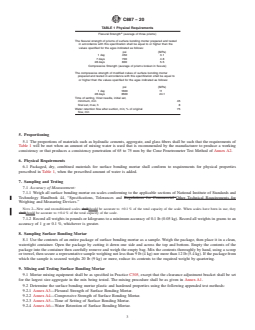
4.1.1 Hydraulic Cements—Hydraulic cements used shall TABLE 1 Physical Requirements
A
conform to the following ASTM specifications:
Flexural Strength (average of three prisms)
4.1.1.1 Portland Cement—Type I, IA, II, IIA, III, or IIIAof
The flexural strength of prisms of surface bonding mortar prepared and tested
Specification C150/C150M.
in accordance with this specification shall be equal to or higher than the
4.1.1.2 Blended Hydraulic Cements—Type IS, ISA, IP, or
values specified for the ages indicated as follows:
psi (MPa)
IPA of Specification C595/C595M.
1 day 450 3.1
4.1.1.3 Hydraulic Cement—Type GU, HE, MS, or MH of
7 days 700 4.8
Specification C1157/C1157M.
28 days 800 5.5
Compressive Strength (average of prisms broken in flexure)
4.1.1.4 Masonry Cement—Specification C91/C91M.
4.1.1.5 Rapid Hardening Hydraulic Cement, Type GRH,
The compressive strength of modified cubes of surface bonding mortar
MRH, VRH, or URH of Specification C1600/C1600M.
prepared and tested in accordance with this specification shall be equal to
or higher than the values specified for the ages indicated as follows:
4.1.2 Hydrated Lime—Type S or SAof Specification C207.
4.1.3 Pozzolan—Class N, F, or C of Specification C618.
psi (MPa)
4.1.4 Aggregates—Aggregates shall conform to Specifica-
1 day 1600 11
28 days 3500 24.1
tion C144 with the exception of grading. The maximum
Time of setting, Vicat needle, initial set,
allowable particle size shall not exceed one third of the
minimum, min 45
final set, max, h 8
Water retention flow after suction, min, % of original 75
The last approved version of this historical standard is referenced on flow, min
www.astm.org.
C887−20
of Table 1 will be met when an amount of mixing water is used to 3 in. (65 to 75 mm). Determine the consistency and weight
thatisrecommendedbythemanufacturertoproduceaworking of 400 mL of the mortar, in accordance with Annex A2, then
consistency or that produces a consistency penetration of 65 to mold 1.575 by 1.575 by 6.3-in. (40 by 40 by 160-mm) prisms
75 mm by the Cone Penetrometer Test Method of Annex A2. in the quantity necessary to test for the desired ages. If
insufficientmortarisavailable,makefurtherbatchesofmortars
6. Physical Requirements
using the same water to achieve the required consistency.
6.1 Packaged, dry, combined materials for surface bonding 9.3.1 Calculate the unit weight in pounds per cubic foot
(kilograms per cubic metre) and yield in cubic feet (cubic
mortar shall conform to requirements for physical properties
prescribed in Table 1, when the prescribed amount of water is metres) or the yield in square feet per inch (square metres per
millimetre) of thickness, from the weight of the mortar in the
added.
400-mL measure used for the consistency test in Annex A2.
7. Sampling and Testing
9.3.2 Specimens for flexural strength shall be 1.575 by
1.575 by 6.3-in. (40 by 40 by 160-mm) prisms molded, cured,
7.1 Accuracy of Measurement:
and tested in accordance with Annex A3, with the broken
7.1.1 Weigh all surface bonding mortar on scales conform-
halves of prisms tested in compression as modified cubes in
ing to the applicable sections of National Institute of Standards
accordance with Annex A4.
and Technology Handbook 44, “Specifications, Tolerances and
Other Technical Requirements for Weighing and Measuring 9.3.3 Determine the time of setting by Vicat needles in
Devices.” accordance with Annex A5.
9.3.4 Determine the water retention in accordance with
NOTE 2—New and reconditioned scales should be accurate to 60.1 %
Annex A6.
of the total capacity of the scale. When scales have been in use, they
should be accurate to 60.4 % of the total capacity of the scale.
9.4 The report of the tests shall include the following:
7.1.2 Record all weights in pounds or kilograms to a
9.4.1 Net weight of dry, combined material in the bag
minimum accuracy of 0.1 lb (0.05 kg). Record all weights in
determined to 0.1 lb (0.05 kg), by subtracting the weight of the
grams to an accuracy of1gor0.1%, whichever is greater.
empty bag from the gross weight of the package.
9.4.2 Amount of mixing water, W, calculated in pounds
8. Sampling Surface Bonding Mortar
(kilograms) per bag based on printed weight of the bag (Note
8.1 Usethecontentsofanentirepackageofsurfacebonding
3).
mortar as a sample.Weigh the package, then place it in a clean,
9.4.3 Unit weight, U, in pounds per cubic foot (kilograms
watertight container. Open the package by cutting it down one
percubicmetre)inaccordancewithTestMethodC138/C138M
side and across the top and bottom. Empty the contents of the
(Note 3).
packageintothecontainerthencarefullyremoveandweighthe
9.4.4 Yield, Y, of surface bonding mortar calculated from
emptybag.Mixthecontentsthoroughlybyhand,usingascoop
the unit weight in cubic feet (cubic metres) per bag, based on
or trowel, then secure a representative sample weighing not
printed weight of bag (Note 1).
lessthan9lb(4kg)normorethan12lb(5.4kg).Ifthepackage
from which the sample is secured weighs 20 lb (9 kg) or more,
NOTE 3—Calculate W, U, and Y as follows:
reduce its contents to the required weight by quartering.
W 5 R B (1)
w
9. Mixing and Testing Surface Bonding Mortar
U 5 0.156 W
m
9.1 Mortar mixing equipment shall be as specified in Prac-
Y 5 ~11R ! B/U
w
ticeC305,exceptthattheclearanceadjustmentbracketshallbe
set for the largest size aggregate in the mix being tested. The
where:
mixing procedure shall be as given in Annex A1.
R = ratio of weight of mixing water to weight of dry,
w
9.2 Determine the surface bonding mortar plastic and hard- combined material in batch of surface bonding mortar
ened properties using the following appended test methods: calculated to three decimal places,
9.2.1 Annex A3—Flexural Strength of Surface Bonding B = the printed bag weight, and
W = weight in grams of surface bonding mortar in the
Mortar.
m
400-mL measure.
9.2.2 Annex A4—Compressive Strength of Surface Bond-
ing Mortar.
9.4.5 Water retention in percent.
9.2.3 Annex A5—Time of Setting of Surface Bonding
9.4.6 Flexural Strength at ages specified in Table 1.
Mortar.
9.4.7 Compressive strength at ages specified in Table 1.
9.2.4 Annex A6—Water Retention of Surface Bonding
9.4.8 Time of setting, initial and final in hours.
Mortar.
9.3 Mix a representative portion of the sample of the dry,
10. Rejection
combined surface bonding mortar weighing 3000 6 3 g. Use a
proportionate amount of the water recommended by the 10.1 The purchaser has the right to reject material that fails
manufacturer to produce a working consistency or a sufficient to conform to the requirements of this specification. Rejection
amount of mixing water to produce a cone penetration of 2 ⁄2 shall be reported to the producer or supplier in writing.
C887−20
NOTE 6—In the United States, requirements for the net mass of
11. Marking and Packaging
packages are commonly governed by state law based on NIST Handbook
11.1 All packages shall be identified as conforming to
133. NIST HB 133 describes the sampling of lots for the determination of
Specification C887 and the net weight in each bag printed
average net mass and the requirement that average net mass for a lot meet
or exceed the printed package net mass. NIST HB 133 also describes the
thereon.
maximum allowable variation of individual packages from the printed
11.2 All packages shall be marked appropriately with the
package net mass. NIST HB 133 is available from the National Institute
manufacturer’s code or open date of production.All containers of Standards and Technology (NIST) at https://www.nist.gov/pml/
weights-and measures/publications/nist-handbooks/handbook-133 (as of
shall have a prominently located CAUTION STATEMENT,
January10,2020).“MaximumAllowableVariations(MAVs)forPackages
warning of potential hazard to handlers of materials therein.
Labeled by Weight” are listed in Table 2-5 of this handbook. The MAVs
11.3 The minimum yield in cubic feet (cubic metres) or the are not defined as a single percentage value. Instead they are defined as a
specific mass for a defined range of contents. The MAVs range from
yield in square feet per inch (square metres per millimetre) of
approximately 3 % for a 3-pound package to 1% for a 50-pound package
thickness, and the amount of water recommended for mixing
to 2 % for packages of 55 pounds and more. If not stated in the purchase
shall be marked on the package.
documents,applicableregulationsshouldbeconfirmedandcompliedwith
by the manufacturer.
NOTE 4—The amount of water recommended by the manufacturer
NOTE 7—In Canada, accuracy for the average net contents and the
shouldbetheamountrequiredtoproduceaworkingconsistencyunderthe
tolerances for individual package contents are specified in the Consumer
conditions defined in Specification C511 for cement mixing rooms.
Packaging and Labelling Regulations (C.R.C., c.417). These regulations
11.4 Container Construction—The material from which the
are available from the Government of Canada at https://laws-
lois.justice.gc.ca/eng/regulations/C.R.C.%2C_c._417/index.html (as of
containers are made shall have water vapor transmission not
January 10, 2020). Schedule I, PART III provides “Tolerances for Net
greaterthan100g/m in24hasdeterminedinaccordancewith
Quantities Declared in Metric Units of Mass or Volume for Prepackaged
Procedure B of Test Methods E96/E96M.
Products other than Catch Weight Products” and PART IV provides
tolerances in Canadian Units. Current Canadian regulations define an
12. Package Mass and Condition
allowed tolerance of 1.5 % for packages containing between 1 kg and
10 kg, 1 % for packages greater than 15 kg. Other tolerances are defined
12.1 The average net mass of packages for any shipment
for other masses. Schedule II describes sampling and determining the
shall not be less than the net mass printed on the package.
average net contents in a sample. If not stated in the purchase documents,
applicable regulations should be confirmed and complied with by the
12.2 The net mass of an individual package shall not be
manufacturer.
more than 2 % higher nor 2% lower than the net mass printed
on the package, unless otherwise required by government 12.3 Packages shall be provided undamaged such that all
product can be used.
regulations or stated in purchase documents.
NOTE 5—United States and Canadian government regulations describe
13. Keywords
the sampling of packages for determination of the average net mass in a
13.1 dry stacked; fiber reinforced; mortar; packaged; sur-
lot. Government regulations also describe the allowed variation in the net
mass of individual packages from the value printed on the package. face bonding
ANNEXES
(Mandatory Information)
A1. LABORATORY MECHANICAL MIXING OF SURFACE BONDING MORTAR
A1.1 Scope A1.4 Procedure for Mixing Surface Bonding Mortar
A1.4.1 Place the dry paddle and dry bowl in the mixing
A1.1.1 This method covers the mechanical mixing of sur-
position in the mixer and introduce the materials for a batch as
face bonding mortars of plastic consistency.
follows:
A1.2 Apparatus A1.4.1.1 Place all the mixing water in the bowl.
A1.4.1.2 Add the surface bonding mortar to the water.
A1.2.1 The apparatus shall be in accordance with the
A1.4.1.3 Start the mixer and mix at a slow speed (140 6 5
requirements of Practice C305.
rad/min) for 1 min.
A1.4.1.4 Quickly switch to medium speed (285 6 10 rpm)
A1.3 Temperature and Humidity
and mix for 30 s.
A1.3.1 The temperature and humidity of the room shall be
A1.4.1.5 Stop the mixer and let the mortar stand for 1 ⁄2
maintained under the conditions defined in Specification C511
min. During the first 15 s of this interval, quickly scrape down
for cement mixing rooms. The temperature of the mixing
intothebatchanymaterialthatmayhavecollectedonthesides
water, dry materials, paddle, and bowl shall be within the same of the bowl; then, for the remainder of this interval, cover the
range at the time of test. bowl with the lid.
C887−20
A1.4.1.6 Remove the lid and finish mixing for 1 min at
medium speed (285 6 10 rad per min).
A1.4.1.7 In any case requiring a remixing interval, any
mortaradheringtothesideofthebowlshallbescrapedquickly
down into the batch with the scraper prior to remixing.
A2. CONSISTENCY TEST OF SURFACE BONDING MORTAR BY CONE PENETROMETER
A2.1 Scope a hemisphere a distance of ⁄8 in. (3.2 mm) making the overall
length 3 ⁄2 in. (89 mm). The base of the cone shall be drilled
A2.1.1 This method covers the procedure for determining
and tapped on the centerline for threading to a stainless steel
the consistency of surface bonding mortars by measuring the
tube of proper size and able to slide freely in the guides of the
penetration of a conical plunger into a mortar sample.
apparatus. The weight of the tube shall be adjusted so that the
A2.2 Apparatus combined weight of the cone, tube, and index pointer is 200 6
2g.
A2.2.1 Unit Measure—A cylindrical measure having an
inside diameter of 3 6 ⁄16 in. (76 6 1.5 mm) and a depth of
A2.3 Procedure
approximately3 ⁄32in.(88.1mm),adjustedbystandardization
A2.3.1 Immediately after the surface bonding mortar is
with water to contain 400 6 1 mL at the conditions defined in
mixed, in accordance with Annex A1, fill the unit measure.
Specification C511 for cement mixing rooms (see Note A2.1).
Using the spoon, place the mortar gently into the measure in
For purposes of this test, the capacity of the measure in
three layers of equal volume, spading each layer 20 times with
millilitres is the weight of the water content of the measure, in
the spatula in one complete revolution around the inner surface
grams, divided by 0.998. The measure shall have a uniform
of the measure. After the measure has been filled and spaded,
wall thickness. The thickness of the wall and bottom shall be
tap the sides of the measure lightly with the side of the tapping
not less than 0.115 in. The measure shall be made of a metal
stick once each at five different points at approximately equal
not attacked by the cement mortar.
spacing around the outside of the measure in order to preclude
NOTE A2.1—The 400-mL measure can be calibrated readily by filling
entrapment of extraneous air.Then cut the mortar off to a plane
with distilled water at the conditions defined in Specification C511 for
surface flush with the top of the measure, by drawing the
cement mixing rooms to a point where the meniscus extends appreciably
straightedge with a sawing motion across the top of the
above the top of the measure, placing a clean piece of plate glass on the
measure,makingtwopassesovertheentiresurface,thesecond
top of the measure, and allowing the excess water to be squeezed out.The
absence of air bubbles as seen through the glass ensures that the measure
pass being made at right angles to the first. Take care in the
is completely full. Carefully wipe excess water from the sides of the
striking-off operation that no loose sand grains or glass fibers
container before weighing.
cause the straightedge to ride above the top surface of the
A2.2.2 Straightedge—Asteelstraightedgenotlessthan4in.
measure. Complete the entire operation of filling and striking
(101.6 mm) long and not less than ⁄16 in. (1.59 mm) nor more 1
off the measure within 1 ⁄2 min. Wipe off all mortar and water
than ⁄8 in. (3.2 mm) in thickness.
adhering to the outside of the measure.
A2.2.3 Spatula—A spatula with a metal blade 6 in. (152.4
A2.3.2 Weigh the filled 400-mL measure to the nearest 1 g.
mm) in length and ⁄2 in. (12.7 mm) in width with straight
A2.3.3 Raise the penetration plunger and slide the unit
edges and a wooden handle.
measure underneath the plunger until the point of the plunger
A2.2.4 Tapping Stick—A maple wood rod, having a diam-
rests on the edge of the container. Tighten the set screw just
eter of ⁄8 in. (15.9 mm) and a length of 6 in. (152.4 mm).
enoughtoholdtheplungerandmovetheindicatoroppositethe
A2.2.5 Spoon—Metal, kitchen-type, with the handle cut off
zero point of the scale.
to make the overall length approximately 9 in. (228.6 mm) and
A2.3.4 Center the container under the plunger and release
with the bowl of the spoon being approximately 4 in. (101.6
the plunger with a swift, definite turn of the set screw while
mm)long,2 ⁄2in.(63.5mm)inwidthatthewidestportion,and
holding the entire apparatus firmly with the other hand.
1 3
⁄2 to ⁄4 in. (12.7 to 19.05 mm) deep.
A2.3.5 Read the depth of penetration in millimetres when
A2.2.6 Cone Penetrometer—AVicat apparatus, conforming
the plunger comes to rest or at the end of 30 s.
to the physical requirements of Method C187, shall be modi-
fied to allow reading cone penetrations to a depth of 3 ⁄2 in. (89
A2.4 Report
mm). The frame shall be raised 2 in. (50.8 mm) to accommo-
A2.4.1 Report the depth of cone penetration to the nearest 1
date the unit measure and the plunger in the raised position.
mm.
The indicator scale shall be extended to allow measuring a full
dropof89mm.Theplungershallbeanaluminumcone,1 ⁄8in. A2.4.2 Report the weight of mortar in the 400-mL measure
(41.3 mm) in diameter by 3 ⁄8 in. (92.08 mm) long, blunted to to the nearest 1 g.
C887−20
A3. FLEXURAL STRENGTH OF SURFACE BONDING MORTAR
A3.1 Scope length of the molds. Following the cutting operation, repair
tears or cracks in the top surfaces and then make the surfaces
A3.1.1 This method covers the determination of the flexural
of the specimens plane by two or three light longitudinal
strength of surface bonding mortar. The portions of the mortar
strokes of the trowel held with the leading edge slightly raised.
prisms tested in flexure according to this method shall be used
A3.5.5 Storage of Test Specimens—Immediately upon
for the determination of compressive strength (Annex A4).
completion of molding, place the test specimens in the moist
A3.2 Apparatus
closet or moist room. Keep all test specimens, immediately
after molding, in the molds on the base plates in the moist
A3.2.1 The apparatus required for this test is that specified
closet or moist room from 20 to 24 h with their upper surfaces
in Test Method C348, except that the consistency test shall be
exposed to the moist air but protected from dripping water.
in accordance with Annex A2.
Then remove the prisms from the molds and place in the moist
A3.3 Number of Specimens
cabinet until age of test in such a manner as to allow free
circulation of air around at least five faces of the specimens.
A3.3.1 Three or more specimens shall be made for each
period of test specified.
A3.5.6 Determination of Flexural Strength—Test the speci-
mens in accordance with the applicable sections of Test
A3.4 Preparing Specimen Molds
Method C348, except that the portions of prisms to be tested in
A3.4.1 Prepare the specimen molds in accordance with Test compression as modified cubes shall be covered with plastic
Method C348.
until time of test regardless of test age.
A3.5 Procedure A3.6 Calculation
A3.5.1 The quantity of surface bonding mortar to be mixed A3.6.1 Record the total maximum load indicated by the
at one time in a batch shall be 3 kg. testing machine and calculate the flexural strength in pounds
per square inch to the nearest 5 psi (0.05 MPa) as follows:
A3.5.2 Preparation of Mortar—Mechanically mix in accor-
A3.6.1.1 In U.S. Customary Units:
dance with the procedure given in Annex A1.
S 5 1.8 P (A3.1)
f
A3.5.3 Determination of Consistency—Following the pro-
cedure outlined in Annex A2, fill the unit measure and weigh
where:
to the nearest 1.0 g. Then immediately determine the cone
S = flexural strength, psi, and
f
penetration.
P = total maximum load, lbf.
A3.5.4 Molding Test Specimens:
A3.6.1.2 In SI units:
A3.5.4.1 Immediately after completion of the cone penetra-
S 5 0.0028 P (A3.2)
f
tion test and within a total elapsed time of not more than 2 ⁄2
where:
min after completion of mixing, start molding the test
...
This document is not an ASTM standard and is intended only to provide the user of an ASTM standard an indication of what changes have been made to the previous version. Because
it may not be technically possible to adequately depict all changes accurately, ASTM recommends that users consult prior editions as appropriate. In all cases only the current version
of the standard as published by ASTM is to be considered the official document.
Designation: C887 − 19a C887 − 20
Standard Specification for
Packaged, Dry, Combined Materials for Surface Bonding
Mortar
This standard is issued under the fixed designation C887; the number immediately following the designation indicates the year of
original adoption or, in the case of revision, the year of last revision. A number in parentheses indicates the year of last reapproval. A
superscript epsilon (´) indicates an editorial change since the last revision or reapproval.
1. Scope*
1.1 This specification covers the materials, properties, and packaging of dry, combined materials for use as surface bonding
mortar with concrete masonry units that have not been prefaced, coated, or painted.
1.2 This specification does not cover design or application. Consult the manufacturer for specific recommendations.
1.3 Appendix X1 of this specification contains the recommended tests for evaluation of surface bonded masonry assemblages
used to establish design loads for the composite wall.
1.4 Appendix X2 through Appendix X5 of this specification contain additional tests that may be performed on surface bonding
mortar.
1.5 The values stated in inch-pound units are to be regarded as standard. The values given in parentheses are mathematical
conversions to SI units that are provided for information only and are not considered standard.
1.6 This standard does not purport to address all of the safety concerns, if any, associated with its use. It is the responsibility
of the user of this standard to establish appropriate safety, health, and environmental practices and determine the applicability of
regulatory limitations prior to use. This hazard statement applies only to Section 9 of this specification.
1.7 This international standard was developed in accordance with internationally recognized principles on standardization
established in the Decision on Principles for the Development of International Standards, Guides and Recommendations issued
by the World Trade Organization Technical Barriers to Trade (TBT) Committee.
2. Referenced Documents
2.1 ASTM Standards:
C91/C91M Specification for Masonry Cement
C109/C109M Test Method for Compressive Strength of Hydraulic Cement Mortars (Using 2-in. or [50 mm] Cube Specimens)
C138/C138M Test Method for Density (Unit Weight), Yield, and Air Content (Gravimetric) of Concrete
C144 Specification for Aggregate for Masonry Mortar
C150/C150M Specification for Portland Cement
C187 Test Method for Amount of Water Required for Normal Consistency of Hydraulic Cement Paste
C191 Test Methods for Time of Setting of Hydraulic Cement by Vicat Needle
C207 Specification for Hydrated Lime for Masonry Purposes
C260/C260M Specification for Air-Entraining Admixtures for Concrete
C305 Practice for Mechanical Mixing of Hydraulic Cement Pastes and Mortars of Plastic Consistency
C348 Test Method for Flexural Strength of Hydraulic-Cement Mortars
C349 Test Method for Compressive Strength of Hydraulic-Cement Mortars (Using Portions of Prisms Broken in Flexure)
C359 Test Method for Early Stiffening of Hydraulic Cement (Mortar Method)
C494/C494M Specification for Chemical Admixtures for Concrete
C511 Specification for Mixing Rooms, Moist Cabinets, Moist Rooms, and Water Storage Tanks Used in the Testing of Hydraulic
Cements and Concretes
This specification is under the jurisdiction of ASTM Committee C12 on Mortars and Grouts for Unit Masonry and is the direct responsibility of Subcommittee C12.06
on Surface Bonding.
Current edition approved Dec. 1, 2019June 15, 2020. Published December 2019July 2020. Originally approved in 1979. Last previous edition approved in 2019 as
C887 – 19.C887 – 19a. DOI: 10.1520/C0887-19A.10.1520/C0887-20.
For referenced ASTM standards, visit the ASTM website, www.astm.org, or contact ASTM Customer Service at service@astm.org. For Annual Book of ASTM Standards
volume information, refer to the standard’s Document Summary page on the ASTM website.
*A Summary of Changes section appears at the end of this standard
Copyright © ASTM International, 100 Barr Harbor Drive, PO Box C700, West Conshohocken, PA 19428-2959. United States
C887 − 20
C595/C595M Specification for Blended Hydraulic Cements
C618 Specification for Coal Fly Ash and Raw or Calcined Natural Pozzolan for Use in Concrete
C666/C666M Test Method for Resistance of Concrete to Rapid Freezing and Thawing
C1157/C1157M Performance Specification for Hydraulic Cement
C1180 Terminology of Mortar and Grout for Unit Masonry
C1232 Terminology for Masonry
C1600/C1600M Specification for Rapid Hardening Hydraulic Cement
E72 Test Methods of Conducting Strength Tests of Panels for Building Construction
E96/E96M Test Methods for Water Vapor Transmission of Materials
E119 Test Methods for Fire Tests of Building Construction and Materials
E447 Test Method for Compressive Strength of Laboratory Constructed Masonry Prisms (Withdrawn 1997)
E514/E514M Test Method for Water Penetration and Leakage Through Masonry
E518/E518M Test Methods for Flexural Bond Strength of Masonry
E519/E519M Test Method for Diagonal Tension (Shear) in Masonry Assemblages
3. Terminology
3.1 Definitions—For definitions of terms used in this specification, refer to Terminology C1180 and Terminology C1232.
3.2 Definitions of Terms Specific to This Standard:
3.2.1 surface bonding mortar, n—a product containing hydraulic cement, glass fiber reinforcement with or without inorganic
fillers, or organic modifiers in a prepackaged form requiring only the addition of water prior to application.
4. Materials and Manufacture
4.1 The materials used as ingredients in packaged, dry, combined materials for surface bonding mortar shall conform to the
following requirements:
4.1.1 Hydraulic Cements—Hydraulic cements used shall conform to the following ASTM specifications:
4.1.1.1 Portland Cement—Type I, IA, II, IIA, III, or IIIA of Specification C150/C150M.
4.1.1.2 Blended Hydraulic Cements—Type IS, ISA, IP, or IPA of Specification C595/C595M.
4.1.1.3 Hydraulic Cement—Type GU, HE, MS, or MH of Specification C1157/C1157M.
4.1.1.4 Masonry Cement—Specification C91/C91M.
4.1.1.5 Rapid Hardening Hydraulic Cement, Type GRH, MRH, VRH, or URH of Specification C1600/C1600M.
4.1.2 Hydrated Lime—Type S or SA of Specification C207.
4.1.3 Pozzolan—Class N, F, or SC of Specification C618.
4.1.4 Aggregates—Aggregates shall conform to Specification C144 with the exception of grading. The maximum allowable
particle size shall not exceed one third of the recommended application thickness of the surface bonding mortar with uniform
distribution of particle size.
4.1.4.1 All aggregates shall be dried, without decomposition, to a moisture content of less than 0.1 weight %, computed on
material dried substantially to constant weight at 221 to 230°F (105 to 110°C).
4.1.5 Glass Fibers—Glass fibers shall be chopped strands of a minimum ⁄2-in. (13-mm) length to provide significant
reinforcement in a cementitious matrix.
4.1.5.1 Glass fibers for use in surface bonding mortar, that will be subjected to wetting, humid atmosphere, or contact with moist
ground have the potential to react with the available alkalies present in the portland-cement matrix, causing strength reduction of
the surface bonding mortar.
4.1.5.2 The producer shall show evidence satisfactory to the purchaser that glass composition, cement matrix, or both, have been
designed to reduce significantly or eliminate this unfavorable reaction.
4.1.6 Additives—Additives may be added as part of the packaged, dry, combined materials for purposes such as plasticity, air
entrainment, water repellency, set acceleration, chemical bonding, and coloring. See Specifications C260/C260M and C494/
C494M.
4.1.6.1 Admixtures or mortar colors shall not be added to the surface bonding mortars at the time of mixing unless provided
for in the contract specifications, and, after the materials are so added, the surface bonding mortars shall conform to the physical
requirements prescribed in Table 1.
4.1.6.2 Antifreeze Compounds—No antifreeze liquid, salts, or other substances shall be used in surface bonding mortar to lower
the freezing point.
NOTE 1—Calcium chloride, when provided for in the contract specifications, and expressly recommended by the manufacturer, may be used as an
accelerator in amounts not exceeding ⁄2 % by weight of the total bag weight.
The last approved version of this historical standard is referenced on www.astm.org.
C887 − 20
TABLE 1 Physical Requirements
A
Flexural Strength (average of three prisms)
The flexural strength of prisms of surface bonding mortar prepared and tested
in accordance with this specification shall be equal to or higher than the
values specified for the ages indicated as follows:
psi (MPa)
1 day 450 3.1
7 days 700 4.8
28 days 800 5.5
Compressive Strength (average of prisms broken in flexure)
The compressive strength of modified cubes of surface bonding mortar
prepared and tested in accordance with this specification shall be equal to
or higher than the values specified for the ages indicated as follows:
psi (MPa)
1 day 1600 11
28 days 3500 24.1
Time of setting, Vicat needle, initial set,
minimum, min 45
final set, max, h 8
Water retention flow after suction, min, % of original 75
flow, min
5. Proportioning
5.1 The proportions of materials such as hydraulic cements, aggregate, and glass fibers shall be such that the requirements of
Table 1 will be met when an amount of mixing water is used that is recommended by the manufacturer to produce a working
consistency or that produces a consistency penetration of 65 to 75 mm by the Cone Penetrometer Test Method of Annex A2.
6. Physical Requirements
6.1 Packaged, dry, combined materials for surface bonding mortar shall conform to requirements for physical properties
prescribed in Table 1, when the prescribed amount of water is added.
7. Sampling and Testing
7.1 Accuracy of Measurement:
7.1.1 Weigh all surface bonding mortar on scales conforming to the applicable sections of National Institute of Standards and
Technology Handbook 44, “Specifications, Tolerances and Regulations for Commercial Other Technical Requirements for
Weighing and Measuring Devices.”
NOTE 2—New and reconditioned scales shallshould be accurate to 60.1 % of the total capacity of the scale. When scales have been in use, they
shallshould be accurate to 60.4 % of the total capacity of the scale.
7.1.2 Record all weights in pounds or kilograms to a minimum accuracy of 0.1 lb (0.05 kg). Record all weights in grams to an
accuracy of 1 g or 0.1 %, whichever is greater.
8. Sampling Surface Bonding Mortar
8.1 Use the contents of an entire package of surface bonding mortar as a sample. Weigh the package, then place it in a clean,
watertight container. Open the package by cutting it down one side and across the top and bottom. Empty the contents of the
package into the container then carefully remove and weigh the empty bag. Mix the contents thoroughly by hand, using a scoop
or trowel, then secure a representative sample weighing not less than 9 lb (4 kg) nor more than 12 lb (5.4 kg). If the package from
which the sample is secured weighs 20 lb (9 kg) or more, reduce its contents to the required weight by quartering.
9. Mixing and Testing Surface Bonding Mortar
9.1 Mortar mixing equipment shall be as specified in Practice C305, except that the clearance adjustment bracket shall be set
for the largest size aggregate in the mix being tested. The mixing procedure shall be as given in Annex A1.
9.2 Determine the surface bonding mortar plastic and hardened properties using the following appended test methods:
9.2.1 Annex A3—Flexural Strength of Surface Bonding Mortar.
9.2.2 Annex A4—Compressive Strength of Surface Bonding Mortar.
9.2.3 Annex A5—Time of Setting of Surface Bonding Mortar.
9.2.4 Annex A6—Water Retention of Surface Bonding Mortar.
C887 − 20
9.3 Mix a representative portion of the sample of the dry, combined surface bonding mortar weighing 3000 6 3 g. Use a
proportionate amount of the water recommended by the manufacturer to produce a working consistency or a sufficient amount of
mixing water to produce a cone penetration of 2 ⁄2 to 3 in. (65 to 75 mm). Determine the consistency and weight of 400 mL of
the mortar, in accordance with Annex A2, then mold 1.575 by 1.575 by 6.3-in. (40 by 40 by 160-mm) prisms in the quantity
necessary to test for the desired ages. If insufficient mortar is available, make further batches of mortars using the same water to
achieve the required consistency.
9.3.1 Calculate the unit weight in pounds per cubic foot (kilograms per cubic metre) and yield in cubic feet (cubic metres) or
the yield in square feet per inch (square metres per millimetre) of thickness, from the weight of the mortar in the 400-mL measure
used for the consistency test in Annex A2.
9.3.2 Specimens for flexural strength shall be 1.575 by 1.575 by 6.3-in. (40 by 40 by 160-mm) prisms molded, cured, and tested
in accordance with Annex A3, with the broken halves of prisms tested in compression as modified cubes in accordance with Annex
A4.
9.3.3 Determine the time of setting by Vicat needles in accordance with Annex A5.
9.3.4 Determine the water retention in accordance with Annex A6.
9.4 The report of the tests shall include the following:
9.4.1 Net weight of dry, combined material in the bag determined to 0.1 lb (0.05 kg), by subtracting the weight of the empty
bag from the gross weight of the package.
9.4.2 Amount of mixing water, W, calculated in pounds (kilograms) per bag based on printed weight of the bag (Note 3).
9.4.3 Unit weight, U, in pounds per cubic foot (kilograms per cubic metre) in accordance with Test Method C138/C138M (Note
3).
9.4.4 Yield, Y, of surface bonding mortar calculated from the unit weight in cubic feet (cubic metres) per bag, based on printed
weight of bag (Note 1).
NOTE 3—Calculate W,U, and Y as follows:
W 5 R B (1)
w
U 5 0.156 W
m
Y 5 ~11R ! B/U
w
where:
R = ratio of weight of mixing water to weight of dry, combined material in batch of surface bonding mortar calculated to three
w
decimal places,
B = the printed bag weight, and
W = weight in grams of surface bonding mortar in the 400-mL measure.
m
9.4.5 Water retention in percent.
9.4.6 Flexural Strength at ages specified in Table 1.
9.4.7 Compressive strength at ages specified in Table 1.
9.4.8 Time of setting, initial and final in hours.
10. Rejection
10.1 The purchaser has the right to reject material that fails to conform to the requirements of this specification. Rejection shall
be reported to the producer or supplier in writing.
11. Marking and Packaging
11.1 All packages shall be identified as conforming to Specification C887 and the net weight in each bag printed thereon.
11.2 All packages shall be marked appropriately with the manufacturer’s code or open date of production. All containers shall
have a prominently located CAUTION STATEMENT, warning of potential hazard to handlers of materials therein.
11.3 The minimum yield in cubic feet (cubic metres) or the yield in square feet per inch (square metres per millimetre) of
thickness, and the amount of water recommended for mixing shall be marked on the package.
NOTE 4—The amount of water recommended by the manufacturer should be the amount required to produce a working consistency under normal
73.4°F (23°C) climatic conditions.the conditions defined in Specification C511 for cement mixing rooms.
11.4 Container Construction—The material from which the containers are made shall have water vapor transmission not greater
than 100 g/m in 24 h as determined in accordance with Procedure B of Test Methods E96/E96M.
12. Package Mass and Condition
12.1 The mean average net mass of packages in any shipment, as shown by weighing 50 packages taken at random, for any
shipment shall not be less than the net mass printed on the package.
C887 − 20
12.2 In the United States, package mass shall comply with the requirements specified in the National Institute of Standards and
Technology (NIST) Handbook 133 for “Maximum Allowable Variations (MAV) for Packages Labeled by Weight”, as defined in
the text and the MAV table.The net mass of an individual package shall not be more than 2 % higher nor 2% lower than the net
mass printed on the package, unless otherwise required by government regulations or stated in purchase documents.
NOTE 5—United States and Canadian government regulations describe the sampling of packages for determination of the average net mass in a lot.
Government regulations also describe the allowed variation in the net mass of individual packages from the value printed on the package.
NOTE 6—In the United States, requirements for the net mass of packages are commonly governed by state law based on NIST Handbook 133. NIST
HB 133 describes the sampling of lots for the determination of average net mass and the requirement that average net mass for a lot meet or exceed the
printed package net mass. NIST HB 133 also describes the maximum allowable variation of individual packages from the printed package net mass. NIST
HB 133 is available from the National Institute of Standards and Technology (NIST) at https://www.nist.gov/pml/weights-and measures/publications/
nist-handbooks/handbook-133 (as of January 10, 2020). “Maximum Allowable Variations (MAVs) for Packages Labeled by Weight” are listed in Table
2-5 of this handbook. The MAVs are not defined as a single percentage value. Instead they are defined as a specific mass for a defined range of contents.
The MAVs range from approximately 3 % for a 3-pound package to 1% for a 50-pound package to 2 % for packages of 55 pounds and more. If not stated
in the purchase documents, applicable regulations should be confirmed and complied with by the manufacturer.
NOTE 7—In Canada, accuracy for the average net contents and the tolerances for individual package contents are specified in the Consumer Packaging
and Labelling Regulations (C.R.C., c.417). These regulations are available from the Government of Canada at https://laws-lois.justice.gc.ca/eng/
regulations/C.R.C.%2C_c._417/index.html (as of January 10, 2020). Schedule I, PART III provides “Tolerances for Net Quantities Declared in Metric
Units of Mass or Volume for Prepackaged Products other than Catch Weight Products” and PART IV provides tolerances in Canadian Units. Current
Canadian regulations define an allowed tolerance of 1.5 % for packages containing between 1 kg and 10 kg, 1 % for packages greater than 15 kg. Other
tolerances are defined for other masses. Schedule II describes sampling and determining the average net contents in a sample. If not stated in the purchase
documents, applicable regulations should be confirmed and complied with by the manufacturer.
12.3 In Canada, package mass shall comply with the requirements specified in the Consumer Packaging and Labelling
Regulations (C.R.C., c. 417): as defined in the text and table of tolerances.
12.4 If local regulations supersede the NIST or Canada regulations, then package mass shall comply with the tolerances
specified in those local regulations.
12.5 In all locations the mass of an individual package shall not be more than 2% higher nor 2% lower than the mass printed
on the package.
12.3 Packages shall not be delivered broken.be provided undamaged such that all product can be used.
13. Keywords
13.1 dry stacked; fiber reinforced; mortar; packaged; surface bonding
ANNEXES
(Mandatory Information)
A1. LABORATORY MECHANICAL MIXING OF SURFACE BONDING MORTAR
A1.1 Scope
A1.1.1 This method covers the mechanical mixing of surface bonding mortars of plastic consistency.
A1.2 Apparatus
A1.2.1 The apparatus shall be in accordance with the requirements of Practice C305.
A1.3 Temperature and Humidity
A1.3.1 The temperature and humidity of the room shall be maintained between 68 and 81.5°F (20 and 27.5°C),under the
conditions defined in Specification C511 and the for cement mixing rooms. The temperature of the mixing water, dry materials,
paddle, and bowl shall be within the abovesame range at the time of test. The temperature of the mixing water shall not vary from
73.4°F (23°C) by more than 63°F (1.7°C).
A1.3.2 The relative humidity of the laboratory shall be not less than 50 %.
C887 − 20
A1.4 Procedure for Mixing Surface Bonding Mortar
A1.4.1 Place the dry paddle and dry bowl in the mixing position in the mixer and introduce the materials for a batch as follows:
A1.4.1.1 Place all the mixing water in the bowl.
A1.4.1.2 Add the surface bonding mortar to the water.
A1.4.1.3 Start the mixer and mix at a slow speed (140 6 5 rad/min) for 1 min.
A1.4.1.4 Quickly switch to medium speed (285 6 10 rpm) and mix for 30 s.
A1.4.1.5 Stop the mixer and let the mortar stand for 1 ⁄2 min. During the first 15 s of this interval, quickly scrape down into the
batch any material that may have collected on the sides of the bowl; then, for the remainder of this interval, cover the bowl with
the lid.
A1.4.1.6 Remove the lid and finish mixing for 1 min at medium speed (285 6 10 rad per min).
A1.4.1.7 In any case requiring a remixing interval, any mortar adhering to the side of the bowl shall be scraped quickly down into
the batch with the scraper prior to remixing.
A2. CONSISTENCY TEST OF SURFACE BONDING MORTAR BY CONE PENETROMETER
A2.1 Scope
A2.1.1 This method covers the procedure for determining the consistency of surface bonding mortars by measuring the penetration
of a conical plunger into a mortar sample.
A2.2 Apparatus
A2.2.1 Unit Measure—A cylindrical measure having an inside diameter of 3 6 ⁄16 in. (76 6 1.5 mm) and a depth of
approximately 3 ⁄32 in. (88.1 mm), adjusted by standardization with water to contain 400 6 1 mL at 73.4°F (23°C) the conditions
defined in Specification C511 for cement mixing rooms (see Note A2.1). For purposes of this test, the capacity of the measure in
millilitres is the weight of the water content of the measure, in grams, divided by 0.998. The measure shall have a uniform wall
thickness. The thickness of the wall and bottom shall be not less than 0.115 in. The measure shall be made of a metal not attacked
by the cement mortar.
NOTE A2.1—The 400-mL measure can be calibrated readily by filling with distilled water at 73°F (23°C) the conditions defined in Specification C511
for cement mixing rooms to a point where the meniscus extends appreciably above the top of the measure, placing a clean piece of plate glass on the
top of the measure, and allowing the excess water to be squeezed out. The absence of air bubbles as seen through the glass ensures that the measure is
completely full. Care should be taken that the excess water is wiped Carefully wipe excess water from the sides of the container before weighing.
A2.2.2 Straightedge—A steel straightedge not less than 4 in. (101.6 mm) long and not less than ⁄16 in. (1.59 mm) nor more than
⁄8 in. (3.2 mm) in thickness.
A2.2.3 Spatula—A spatula with a metal blade 6 in. (152.4 mm) in length and ⁄2 in. (12.7 mm) in width with straight edges and
a wooden handle.
A2.2.4 Tapping Stick—A maple wood rod, having a diameter of ⁄8 in. (15.9 mm) and a length of 6 in. (152.4 mm).
C887 − 20
A2.2.5 Spoon—Metal, kitchen-type, with the handle cut off to make the overall length approximately 9 in. (228.6 mm) and with
1 1 3
the bowl of the spoon being approximately 4 in. (101.6 mm) long, 2 ⁄2 in. (63.5 mm) in width at the widest portion, and ⁄2 to ⁄4
in. (12.7 to 19.05 mm) deep.
A2.2.6 Cone Penetrometer—A Vicat apparatus, conforming to the physical requirements of Method C187, shall be modified to
allow reading cone penetrations to a depth of 3 ⁄2 in. (89 mm). The frame shall be raised 2 in. (50.8 mm) to accommodate the unit
measure and the plunger in the raised position. The indicator scale shall be extended to allow measuring a full drop of 89 mm.
5 5
The plunger shall be an aluminum cone, 1 ⁄8 in. (41.3 mm) in diameter by 3 ⁄8 in. (92.08 mm) long, blunted to a hemisphere a
1 1
distance of ⁄8 in. (3.2 mm) making the overall length 3 ⁄2 in. (89 mm). The base of the cone shall be drilled and tapped on the
centerline for threading to a stainless steel tube of proper size and able to slide freely in the guides of the apparatus. The weight
of the tube shall be adjusted so that the combined weight of the cone, tube, and index pointer is 200 6 2 g.
A2.3 Procedure
A2.3.1 Immediately after the surface bonding mortar is mixed, in accordance with Annex A1, fill the unit measure. Using the
spoon, place the mortar gently into the measure in three layers of equal volume, spading each layer 20 times with the spatula in
one complete revolution around the inner surface of the measure. After the measure has been filled and spaded, tap the sides of
the measure lightly with the side of the tapping stick once each at five different points at approximately equal spacing around the
outside of the measure in order to preclude entrapment of extraneous air. Then cut the mortar off to a plane surface flush with the
top of the measure, by drawing the straightedge with a sawing motion across the top of the measure, making two passes over the
entire surface, the second pass being made at right angles to the first. Take care in the striking-off operation that no loose sand
grains or glass fibers cause the straightedge to ride above the top surface of the measure. Complete the entire operation of filling
and striking off the measure within 1 ⁄2 min. Wipe off all mortar and water adhering to the outside of the measure.
A2.3.2 Weigh the filled 400-mL measure to the nearest 1 g.
A2.3.3 Raise the penetration plunger and slide the unit measure underneath the plunger until the point of the plunger rests on the
edge of the container. Tighten the set screw just enough to hold the plunger and move the indicator opposite the zero point of the
scale.
A2.3.4 Center the container under the plunger and release the plunger with a swift, definite turn of the set screw while holding
the entire apparatus firmly with the other hand.
A2.3.5 Read the depth of penetration in millimetres when the plunger comes to rest or at the end of 30 s.
A2.4 Report
A2.4.1 Report the depth of cone penetration to the nearest 1 mm.
A2.4.2 Report the weight of mortar in the 400-mL measure to the nearest 1 g.
C887 − 20
A3. FLEXURAL STRENGTH OF SURFACE BONDING MORTAR
A3.1 Scope
A3.1.1 This method covers the determination of the flexural strength of surface bonding mortar. The portions of the mortar prisms
tested in flexure according to this method shall be used for the determination of compressive strength (Annex A4).
A3.2 Apparatus
A3.2.1 The apparatus required for this test is that specified in Test Method C348, except that the consistency test shall be in
accordance with Annex A2.
A3.3 Number of Specimens
A3.3.1 Three or more specimens shall be made for each period of test specified.
A3.4 Preparing Specimen Molds
A3.4.1 Prepare the specimen molds in accordance with Test Method C348.
A3.5 Procedure
A3.5.1 The quantity of surface bonding mortar to be mixed at one time in a batch shall be 3 kg.
A3.5.2 Preparation of Mortar—Mechanically mix in accordance with the procedure given in Annex A1.
A3.5.3 Determination of Consistency—Following the procedure outlined in Annex A2, fill the unit measure and weigh to the
nearest 1.0 g. Then immediately determine the cone penetration.
A3.5.4 Molding Test Specimens:
A3.5.4.1 Immediately after completion of the cone penetration test and within a total elapsed time of not more than 2 ⁄2 min after
completion of mixing, start molding the test specimens.
A3.5.4.2 Evenly distribute a layer of surface bonding mortar about ⁄4 in. (19 mm) in thickness in each of the three molds. Puddle
each specimen with the gloved fingers about 20 times per layer by pressing the mortar into the corners and along the surface of
the mold until a homogeneous specimen is obtained. Fill the molds to about 110 % of capacity and puddle the top layer. Then
smooth off the specimens by drawing the flat side of the trowel (with the leading edge slightly raised) once along the length of
the molds. Cut the mortar off flush with the top of the molds by the straight edge of the trowel (held nearly perpendicular to the
molds) with a sawing motion over the length of the molds. Following the cutting operation, repair tears or cracks in the top surfaces
and then make the surfaces of the specimens plane by two or three light longitudinal strokes of the trowel held with the leading
edge slightly raised.
A3.5.5 Storage of Test Specimens—Immediately upon completion of molding, place the test specimens in the moist closet or moist
room. Keep all test specimens, immediately after molding, in the molds on the base plates in the moist closet or moist room from
20 to 24 h with their upper surfaces exposed to the moist air but protected from dripping water. Then remove the prisms from the
molds and place in the moist cabinet until age of test in such a manner as to allow free circulation of air around at least five faces
of the specimens.
C887 − 20
A3.5.6 Determination of Flexural Strength—Test the specimens in accordance with the applicable sec
...