

ASTM C1019-20
(Test Method)Standard Test Method for Sampling and Testing Grout for Masonry
General Information
- Abstract
SIGNIFICANCE AND USE
3.1 Grout used in masonry is a fluid mixture of cementitious materials and aggregate with a high water content for ease of placement.
3.1.1 During construction, grout is placed within or between absorptive masonry units. Excess water must be removed from grout specimens in order to provide compressive strength test results more nearly indicative of the grout strength in the wall. In this test method, molds are made from masonry units having the same absorption and moisture content characteristics as those being used in the construction.
3.2 This test method is used to either help select grout proportions by comparing test values or as a quality control test for uniformity of grout preparation during construction.
3.3 The physical exposure condition and curing of the grout are not exactly reproduced, but this test method does subject the grout specimens to absorption conditions similar to those experienced by grout in the wall.
Note 2: Test results of grout specimens taken from a wall should not be compared to test results obtained with this test method.
SCOPE
1.1 This test method covers procedures for both field and laboratory sampling and compression testing of grout used in masonry construction. Grout for masonry is specified under Specification C476.
Note 1: The testing agency performing this test method should be evaluated in accordance with Practice C1093.
1.2 The values stated in inch-pound units are to be regarded as standard. The values given in parentheses are mathematical conversions to SI units that are provided for information only and are not considered standard.
1.3 This standard does not purport to address all of the safety concerns, if any, associated with its use. It is the responsibility of the user of this standard to establish appropriate safety, health, and environmental practices and determine the applicability of regulatory limitations prior to use.
1.4 This international standard was developed in accordance with internationally recognized principles on standardization established in the Decision on Principles for the Development of International Standards, Guides and Recommendations issued by the World Trade Organization Technical Barriers to Trade (TBT) Committee.
- Status
- Published
- Publication Date
- 30-Nov-2020
- Technical Committee
- C12 - Mortars and Grouts for Unit Masonry
- Drafting Committee
- C12.02 - Research and Methods of Test
Overview
ASTM C1019-20, titled Standard Test Method for Sampling and Testing Grout for Masonry, is a globally recognized ASTM standard that defines procedures for the field and laboratory sampling as well as compressive strength testing of grout used in masonry construction. Developed by ASTM Committee C12, this standard aims to ensure the reliability and quality of grout in masonry by detailing how to obtain, prepare, and test specimens, thereby supporting consistent construction practices and quality control.
This method is instrumental in both selecting appropriate grout proportions and serving as a quality control measure during masonry projects. By mandating that molds be made from the same type of masonry units in use on-site, C1019 accounts for the absorption and moisture characteristics that can impact grout performance, especially compressive strength.
Key Topics
Sampling Procedures: Establishes detailed steps for obtaining representative grout samples both in the field and laboratory settings. Samples are taken after the final slump adjustment and must adhere to specific timing and handling requirements to ensure accuracy.
Grout Specimen Molding: Requires molds to be constructed using masonry units matching those used in the project. This ensures that absorption characteristics mirror real conditions, making compressive strength results more relevant for actual wall performance.
Compressive Strength Testing: Outlines preparation, curing, and compression testing methodologies for grout specimens, referencing related standards for procedures and equipment.
Quality Control: The method is intended for both preliminary selection of grout mixtures and ongoing quality control to confirm uniformity and compliance with project specifications.
Reporting and Documentation: Specifies extensive reporting requirements, including grout mix design, slump, specimen dimensions, curing history, compressive strength results, and descriptions of failure.
Safety and Compliance: Emphasizes the responsibility of users to establish appropriate safety, health, and environmental practices, and to consider regulatory limitations.
Applications
Construction Quality Assurance: ASTM C1019 is widely used by contractors, engineers, and quality assurance professionals to verify that masonry grout meets design specifications for compressive strength.
Material Selection: The test method helps stakeholders compare the performance of different grout mixes under conditions that closely simulate those in actual masonry walls.
Regulatory Compliance: Many building codes and contract documents cite ASTM C1019 as a requirement for construction projects involving masonry units and grout.
Laboratory and Field Testing: The standard applies to both laboratory-controlled and field-prepared samples, ensuring its applicability throughout different phases and environments of construction.
Accreditation and Certification: The standard references Practice C1093 for evaluating testing agencies, supporting consistency in laboratory accreditation and technician certification.
Related Standards
ASTM C1019-20 interfaces with several other key ASTM standards in the concrete and masonry industry, including:
- ASTM C476 - Specification for Grout for Masonry: Provides the material specifications that the tested grout must meet.
- ASTM C39/C39M - Test Method for Compressive Strength of Cylindrical Concrete Specimens: Referenced for compression testing procedures.
- ASTM C143/C143M - Test Method for Slump of Hydraulic-Cement Concrete: Used for measuring the consistency of grout.
- ASTM C1064/C1064M - Test Method for Temperature of Freshly Mixed Hydraulic-Cement Concrete: Specifies temperature measurement techniques.
- ASTM C1611/C1611M - Test Method for Slump Flow of Self-Consolidating Concrete: Applicable for self-consolidating grout mixtures.
- ASTM C1093 - Practice for Accreditation of Testing Agencies for Masonry: Supports laboratory and agency qualification requirements.
- ASTM C511 - Specification for Environments for Curing Specimens: Ensures proper storage conditions for the test specimens.
Practical Value
Adhering to ASTM C1019-20 strengthens the reliability and safety of masonry construction by providing a standardized method for the sampling and testing of grout. This not only helps in the selection of optimal grout mixes but also plays a critical role in construction quality control, regulatory compliance, and risk mitigation. Widespread adoption of the standard supports consistent practices across construction sites and laboratories, ultimately ensuring the structural integrity and longevity of masonry buildings.
Keywords: ASTM C1019-20, grout testing, masonry standards, compressive strength, grout sampling, quality control, construction materials testing, masonry units, ASTM standards.
Relations
- Effective Date
- 01-Dec-2023
- Refers
ASTM C39/C39M-23 - Standard Test Method for Compressive Strength of Cylindrical Concrete Specimens - Effective Date
- 01-Dec-2023
- Effective Date
- 01-Dec-2019
- Effective Date
- 01-May-2018
- Refers
ASTM C39/C39M-17b - Standard Test Method for Compressive Strength of Cylindrical Concrete Specimens - Effective Date
- 01-Aug-2017
- Refers
ASTM C39/C39M-16b - Standard Test Method for Compressive Strength of Cylindrical Concrete Specimens - Effective Date
- 01-Aug-2016
- Effective Date
- 15-Jul-2016
- Refers
ASTM C39/C39M-16a - Standard Test Method for Compressive Strength of Cylindrical Concrete Specimens - Effective Date
- 01-Jul-2016
- Effective Date
- 15-Dec-2015
- Effective Date
- 15-Dec-2015
- Effective Date
- 01-Jun-2015
- Refers
ASTM C39/C39M-14a - Standard Test Method for Compressive Strength of Cylindrical Concrete Specimens - Effective Date
- 01-Jun-2014
- Effective Date
- 01-Apr-2014
- Refers
ASTM C39/C39M-14 - Standard Test Method for Compressive Strength of Cylindrical Concrete Specimens - Effective Date
- 01-Feb-2014
- Effective Date
- 15-Dec-2013
Get Certified
Connect with accredited certification bodies for this standard

DIBt (Deutsches Institut für Bautechnik)
German Institute for Building Technology.
DIN CERTCO
DIN Group product certification.

Aboma Certification B.V.
Specialized in construction, metal, and transport sectors.
Sponsored listings
Frequently Asked Questions
ASTM C1019-20 is a standard published by ASTM International. Its full title is "Standard Test Method for Sampling and Testing Grout for Masonry". This standard covers: SIGNIFICANCE AND USE 3.1 Grout used in masonry is a fluid mixture of cementitious materials and aggregate with a high water content for ease of placement. 3.1.1 During construction, grout is placed within or between absorptive masonry units. Excess water must be removed from grout specimens in order to provide compressive strength test results more nearly indicative of the grout strength in the wall. In this test method, molds are made from masonry units having the same absorption and moisture content characteristics as those being used in the construction. 3.2 This test method is used to either help select grout proportions by comparing test values or as a quality control test for uniformity of grout preparation during construction. 3.3 The physical exposure condition and curing of the grout are not exactly reproduced, but this test method does subject the grout specimens to absorption conditions similar to those experienced by grout in the wall. Note 2: Test results of grout specimens taken from a wall should not be compared to test results obtained with this test method. SCOPE 1.1 This test method covers procedures for both field and laboratory sampling and compression testing of grout used in masonry construction. Grout for masonry is specified under Specification C476. Note 1: The testing agency performing this test method should be evaluated in accordance with Practice C1093. 1.2 The values stated in inch-pound units are to be regarded as standard. The values given in parentheses are mathematical conversions to SI units that are provided for information only and are not considered standard. 1.3 This standard does not purport to address all of the safety concerns, if any, associated with its use. It is the responsibility of the user of this standard to establish appropriate safety, health, and environmental practices and determine the applicability of regulatory limitations prior to use. 1.4 This international standard was developed in accordance with internationally recognized principles on standardization established in the Decision on Principles for the Development of International Standards, Guides and Recommendations issued by the World Trade Organization Technical Barriers to Trade (TBT) Committee.
SIGNIFICANCE AND USE 3.1 Grout used in masonry is a fluid mixture of cementitious materials and aggregate with a high water content for ease of placement. 3.1.1 During construction, grout is placed within or between absorptive masonry units. Excess water must be removed from grout specimens in order to provide compressive strength test results more nearly indicative of the grout strength in the wall. In this test method, molds are made from masonry units having the same absorption and moisture content characteristics as those being used in the construction. 3.2 This test method is used to either help select grout proportions by comparing test values or as a quality control test for uniformity of grout preparation during construction. 3.3 The physical exposure condition and curing of the grout are not exactly reproduced, but this test method does subject the grout specimens to absorption conditions similar to those experienced by grout in the wall. Note 2: Test results of grout specimens taken from a wall should not be compared to test results obtained with this test method. SCOPE 1.1 This test method covers procedures for both field and laboratory sampling and compression testing of grout used in masonry construction. Grout for masonry is specified under Specification C476. Note 1: The testing agency performing this test method should be evaluated in accordance with Practice C1093. 1.2 The values stated in inch-pound units are to be regarded as standard. The values given in parentheses are mathematical conversions to SI units that are provided for information only and are not considered standard. 1.3 This standard does not purport to address all of the safety concerns, if any, associated with its use. It is the responsibility of the user of this standard to establish appropriate safety, health, and environmental practices and determine the applicability of regulatory limitations prior to use. 1.4 This international standard was developed in accordance with internationally recognized principles on standardization established in the Decision on Principles for the Development of International Standards, Guides and Recommendations issued by the World Trade Organization Technical Barriers to Trade (TBT) Committee.
ASTM C1019-20 is classified under the following ICS (International Classification for Standards) categories: 91.100.10 - Cement. Gypsum. Lime. Mortar. The ICS classification helps identify the subject area and facilitates finding related standards.
ASTM C1019-20 has the following relationships with other standards: It is inter standard links to ASTM C1064/C1064M-23, ASTM C39/C39M-23, ASTM C476-19, ASTM C476-18, ASTM C39/C39M-17b, ASTM C39/C39M-16b, ASTM C476-16, ASTM C39/C39M-16a, ASTM C1093-15ae1, ASTM C1093-15a, ASTM C1093-15, ASTM C39/C39M-14a, ASTM C1611/C1611M-14, ASTM C39/C39M-14, ASTM C1093-13ae1. Understanding these relationships helps ensure you are using the most current and applicable version of the standard.
ASTM C1019-20 is available in PDF format for immediate download after purchase. The document can be added to your cart and obtained through the secure checkout process. Digital delivery ensures instant access to the complete standard document.
Standards Content (Sample)
This international standard was developed in accordance with internationally recognized principles on standardization established in the Decision on Principles for the
Development of International Standards, Guides and Recommendations issued by the World Trade Organization Technical Barriers to Trade (TBT) Committee.
Designation: C1019 −20
Standard Test Method for
Sampling and Testing Grout for Masonry
This standard is issued under the fixed designation C1019; the number immediately following the designation indicates the year of
original adoption or, in the case of revision, the year of last revision. A number in parentheses indicates the year of last reapproval. A
superscript epsilon (´) indicates an editorial change since the last revision or reapproval.
This standard has been approved for use by agencies of the U.S. Department of Defense.
1. Scope Testing of Hydraulic Cements and Concretes
C617 Practice for Capping Cylindrical Concrete Specimens
1.1 This test method covers procedures for both field and
C1064/C1064M Test Method for Temperature of Freshly
laboratory sampling and compression testing of grout used in
Mixed Hydraulic-Cement Concrete
masonry construction. Grout for masonry is specified under
C1093 Practice for Accreditation of Testing Agencies for
Specification C476.
Masonry
NOTE 1—The testing agency performing this test method should be
C1611/C1611M Test Method for Slump Flow of Self-
evaluated in accordance with Practice C1093.
Consolidating Concrete
1.2 The values stated in inch-pound units are to be regarded
as standard. The values given in parentheses are mathematical
3. Significance and Use
conversions to SI units that are provided for information only
3.1 Groutusedinmasonryisafluidmixtureofcementitious
and are not considered standard.
materials and aggregate with a high water content for ease of
1.3 This standard does not purport to address all of the
placement.
safety concerns, if any, associated with its use. It is the
3.1.1 Duringconstruction,groutisplacedwithinorbetween
responsibility of the user of this standard to establish appro-
absorptive masonry units. Excess water must be removed from
priate safety, health, and environmental practices and deter-
grout specimens in order to provide compressive strength test
mine the applicability of regulatory limitations prior to use.
results more nearly indicative of the grout strength in the wall.
1.4 This international standard was developed in accor-
In this test method, molds are made from masonry units having
dance with internationally recognized principles on standard-
the same absorption and moisture content characteristics as
ization established in the Decision on Principles for the
those being used in the construction.
Development of International Standards, Guides and Recom-
3.2 This test method is used to either help select grout
mendations issued by the World Trade Organization Technical
proportionsbycomparingtestvaluesorasaqualitycontroltest
Barriers to Trade (TBT) Committee.
for uniformity of grout preparation during construction.
2. Referenced Documents
3.3 The physical exposure condition and curing of the grout
2.1 ASTM Standards:
are not exactly reproduced, but this test method does subject
C39/C39M Test Method for Compressive Strength of Cylin-
the grout specimens to absorption conditions similar to those
drical Concrete Specimens
experienced by grout in the wall.
C143/C143M Test Method for Slump of Hydraulic-Cement
NOTE 2—Test results of grout specimens taken from a wall should not
Concrete
be compared to test results obtained with this test method.
C476 Specification for Grout for Masonry
C511 Specification for Mixing Rooms, Moist Cabinets,
4. Apparatus
Moist Rooms, and Water Storage Tanks Used in the
4.1 Maximum-Minimum Thermometer.
4.2 Straightedge, a steel straightedge not less than 6 in.
This test method is under the jurisdiction ofASTM Committee C12 on Mortars
(152.4 mm) long and not less than ⁄16 in. (1.6 mm) in
and Grouts for Unit Masonry and is the direct responsibility of Subcommittee
C12.02 on Research and Methods of Test.
thickness.
Current edition approved Dec. 1, 2020. Published December 2020. Originally
4.3 TampingRod,around,straight,steelrodwithadiameter
approved in 1984. Last previous edition approved in 2019 as C1019 – 19. DOI:
3 1
10.1520/C1019-20.
of ⁄8 6 ⁄16 in. (10 6 2 mm) and a length of 12 6 4 inches.
For referenced ASTM standards, visit the ASTM website, www.astm.org, or
(300 6 100 millimetres). The rod shall have the tamping end
contact ASTM Customer Service at service@astm.org. For Annual Book of ASTM
or both ends rounded to a hemispherical tip of the same
Standards volume information, refer to the standard’s Document Summary page on
the ASTM website. diameter as the rod.
*A Summary of Changes section appears at the end of this standard
Copyright © ASTM International, 100 Barr Harbor Drive, PO Box C700, West Conshohocken, PA 19428-2959. United States
C1019 − 20
4.4 Nonabsorbent Blocks and Spacers, nonabsorbent, rigid
squares and rectangles with side dimensions so as to achieve
the desired grout specimen side dimensions and of sufficient
quantity or thickness to yield the desired grout specimen
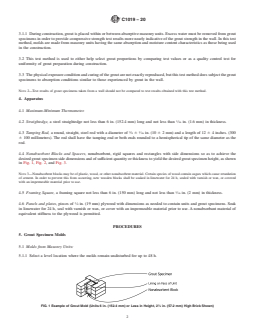
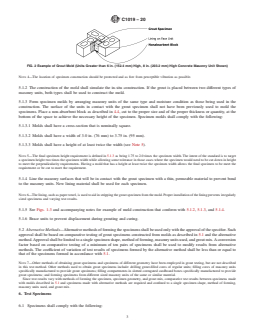
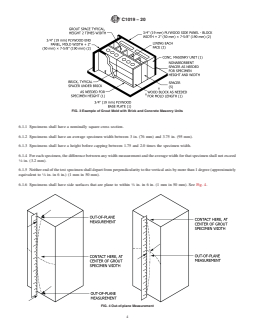
height, as shown in Fig. 1, Fig. 2, and Fig. 3.
NOTE 3—Nonabsorbent blocks may be of plastic, wood, or other
nonabsorbent material. Certain species of wood contain sugars which
cause retardation of cement. In order to prevent this from occurring, new
FIG. 2 Example of Grout Mold (Units Greater than 6 in. (152.4
wooden blocks shall be soaked in limewater for 24 h, sealed with varnish
mm) High, 8 in. (203.2 mm) High Concrete Masonry Unit Shown)
or wax, or covered with an impermeable material prior to use.
4.5 Framing Square, a framing square not less than 6 in.
(150 mm) long and not less than ⁄16 in. (2 mm) in thickness.
some tolerance in those cases where the specimen would need to be cut
4.6 Panels and plates, pieces of ⁄4 in. (19 mm) plywood down in height to meet the perpendicularity requirements. Having a mold
that has a height at least twice the specimen width allows the final
with dimensions as needed to contain units and grout speci-
specimen to be meet the requirement or be cut to meet the requirement.
mens. Soak in limewater for 24 h, seal with varnish or wax, or
5.1.4 Line the masonry surfaces that will be in contact with
cover with an impermeable material prior to use. A nonabsor-
the grout specimen with a thin, permeable material to prevent
bant material of equivalent stiffness to the plywood is permit-
bond to the masonry units. New lining material shall be used
ted.
for each specimen.
PROCEDURES
NOTE 6—The lining, such as paper towel, is used to aid in stripping the
grout specimen from the mold. Proper installation of the lining prevents
5. Grout Specimen Molds
irregularly sized specimens and varying test results.
5.1 Molds from Masonry Units:
5.1.5 See Figs. 1-3 and accompanying notes for example of
5.1.1 Select a level location where the molds remain undis-
mold construction that conform with 5.1.2, 5.1.3, and 5.1.4.
turbed for up to 48 h.
5.1.6 Brace units to prevent displacement during grouting
NOTE 4—The location of specimen construction should be protected and curing.
and as free from perceptible vibration as possible.
5.2 Alternative Methods—Alternative methods of forming
5.1.2 The construction of the mold shall simulate the in-situ
the specimens shall be used only with the approval of the
construction. If the grout is placed between two different types
specifier. Such approval shall be based on comparative testing
of masonry units, both types shall be used to construct the
of grout specimens constructed from molds as described in 5.1
mold.
and the alternative method. Approval shall be limited to a
5.1.3 Form specimen molds by arranging masonry units of
single specimen shape, method of forming, masonry units
thesametypeandmoistureconditionasthosebeingusedinthe
used, and grout mix.Aconversion factor based on comparative
construction. The surface of the units in contact with the grout
testing of a minimum of ten pairs of specimens shall be used to
specimen shall not have been previously used to mold the
modify results from alternative methods. The coefficient of
specimens.Placeanon-absorbentblockasdescribedin4.4,cut
variation of test results of specimens formed by the alternative
to the proper size and of the proper thickness or quantity, at the
method shall be less than or equal to that of the specimens
bottom of the space to achieve the necessary height of the
formed in accordance with 5.1.
specimen. Specimen molds shall comply with the following:
NOTE7—Othermethodsofobtaininggroutspecimensandspecimensof
5.1.3.1 Molds shall have a cross-section that is nominally different geometry have been employed in grout testing, but are not
described in this test method. Other methods used to obtain grout
square.
specimens include: drilling grout-filled cores of regular units; filling cores
5.1.3.2 Molds shall have a width of 3.0 in. (76 mm) to 3.75
of masonry units specifically manufactured to provide grout specimens;
in. (95 mm).
filling compartments in slotted corrugated cardboard boxes specifically
5.1.3.3 Molds shall have a height of at least twice the width
manufactured to provide grout specimens; and forming specimens from
different sized masonry units of the same or similar material.
(see Note 5).
Sincetestresultsvarywithmethodsofformingthespecimen,specimen
NOTE 5—The final specimen height requirement is defined in 5.1.3 as
geometry, and grout mix, comparative test results between specimens
being 1.75 to 2.0 times the specimen width. The intent of the standard is
made with molds described in 5.1 and specimens made with alternative
to target a specimen height two times the specimen width while allowing
methods are required and confined to a single specimen shape, method of
forming, masonry units used, and grout mix.
6. Test Specimens
6.1 Specimens shall comply with the following:
6.1.1 Specimens shall have a nominally square cross sec-
tion.
6.1.2 Specimens shall have an average specimen width
between 3 in. (76 mm) and 3.75 in. (95 mm).
6.1.3 Specimensshallhaveaheightbeforecappingbetween
FIG. 1 Example of Grout Mold (Units 6 in. (152.4 mm) or Less in
Height, 2 ⁄4 in. (57.2 mm) High Brick Shown) 1.75 and 2.0 times the specimen width.
C1019 − 20
FIG. 3 Example of Grout Mold with Brick and Concrete Masonry Units
NOTE 9—Frequency of sampling and age of test is to be determined by
6.1.4 For each specimen, the difference between any width
the specifier of this test method and is usually found in the construction
measurement and the average width for that specimen shall not
documents.
exceed ⁄8 in. (3.2 mm).
6.1.5 Neither end of the test specimen shall depart from
7. Sampling Grout
perpendicularity to the vertical axis by more than 1 degree
(approximately equivalent to ⁄8 in. in 6 in.) (1 mm in 50 mm). 7.1 SizeofSample—Groutsamplestobeusedforslumpand
6.1.6 Specimens shall have side surfaces that are plane to compressive strength tests shall be a minimum of ⁄2 ft (0.014
within ⁄8 in. in 6 in. (1 mm in 50 mm). See Fig. 4. m ).
NOTE 8—Subsection 10.7 provides for cutting or grinding the top or
7.2 Procedure—The procedures used in sampling shall in-
bottom of hardened specimens to achieve dimensional requirements.
clude the use of precautions that will assist in obtaining
6.2 Test at least three specimens at each age specified. samples that are representative of the nature and condition of
FIG. 4 Out-of-plane Measurement
C1019 − 20
the grout. After the final slump adjustment has been made, surface of the specimens damp by wetting the absorbent
sample grout as the grout is being placed. material and covering with a nonabsorbent, nonreactive mate-
7.2.1 Field Sampling—Collect two or more portions taken rial to retain the moisture. Do not disturb the specimens.
at regularly spaced intervals during the discharge of the middle
9.5 Between 15 and 30 min after filling the mold, add
portion of the batch. The elapsed time between obtaining the
sufficient grout without rodding to fill the depression caused by
first and final portions of the sample shall be not more than 15
initial water loss. Strike off the top surface of the specimen
min.
with a straightedge to produce a flat surface that is even with
7.2.2 Laboratory Sampling—The entire mixed batch of
the top edge of the mold. Cover immediately with a damp
grout is the sample.
absorbent material such as cloth or paper towel. Keep the top
surface of the specimen damp by wetting the absorbent
NOTE 10—The field technician sampling, making, and curing speci-
mens for acceptance testing should be certified (American Concrete
material and covering with a nonabsorbent, nonreactive mate-
...
This document is not an ASTM standard and is intended only to provide the user of an ASTM standard an indication of what changes have been made to the previous version. Because
it may not be technically possible to adequately depict all changes accurately, ASTM recommends that users consult prior editions as appropriate. In all cases only the current version
of the standard as published by ASTM is to be considered the official document.
Designation: C1019 − 19 C1019 − 20
Standard Test Method for
Sampling and Testing Grout for Masonry
This standard is issued under the fixed designation C1019; the number immediately following the designation indicates the year of
original adoption or, in the case of revision, the year of last revision. A number in parentheses indicates the year of last reapproval. A
superscript epsilon (´) indicates an editorial change since the last revision or reapproval.
This standard has been approved for use by agencies of the U.S. Department of Defense.
1. Scope
1.1 This test method covers procedures for both field and laboratory sampling and compression testing of grout used in masonry
construction. Grout for masonry is specified under Specification C476.
NOTE 1—The testing agency performing this test method should be evaluated in accordance with Practice C1093.
1.2 The values stated in inch-pound units are to be regarded as standard. The values given in parentheses are mathematical
conversions to SI units that are provided for information only and are not considered standard.
1.3 This standard does not purport to address all of the safety concerns, if any, associated with its use. It is the responsibility
of the user of this standard to establish appropriate safety, health, and environmental practices and determine the applicability of
regulatory limitations prior to use.
1.4 This international standard was developed in accordance with internationally recognized principles on standardization
established in the Decision on Principles for the Development of International Standards, Guides and Recommendations issued
by the World Trade Organization Technical Barriers to Trade (TBT) Committee.
2. Referenced Documents
2.1 ASTM Standards:
C39/C39M Test Method for Compressive Strength of Cylindrical Concrete Specimens
C143/C143M Test Method for Slump of Hydraulic-Cement Concrete
C476 Specification for Grout for Masonry
C511 Specification for Mixing Rooms, Moist Cabinets, Moist Rooms, and Water Storage Tanks Used in the Testing of Hydraulic
Cements and Concretes
C617 Practice for Capping Cylindrical Concrete Specimens
C1064/C1064M Test Method for Temperature of Freshly Mixed Hydraulic-Cement Concrete
C1093 Practice for Accreditation of Testing Agencies for Masonry
C1611/C1611M Test Method for Slump Flow of Self-Consolidating Concrete
3. Significance and Use
3.1 Grout used in masonry is a fluid mixture of cementitious materials and aggregate with a high water content for ease of
placement.
This test method is under the jurisdiction of ASTM Committee C12 on Mortars and Grouts for Unit Masonry and is the direct responsibility of Subcommittee C12.02
on Research and Methods of Test.
Current edition approved Dec. 1, 2019Dec. 1, 2020. Published January 2020December 2020. Originally approved in 1984. Last previous edition approved in 20182019
ɛ1
as C1019 – 18C1019 – 19. . DOI: 10.1520/C1019-19.10.1520/C1019-20.
For referenced ASTM standards, visit the ASTM website, www.astm.org, or contact ASTM Customer Service at service@astm.org. For Annual Book of ASTM Standards
volume information, refer to the standard’s Document Summary page on the ASTM website.
*A Summary of Changes section appears at the end of this standard
Copyright © ASTM International, 100 Barr Harbor Drive, PO Box C700, West Conshohocken, PA 19428-2959. United States
C1019 − 20
3.1.1 During construction, grout is placed within or between absorptive masonry units. Excess water must be removed from grout
specimens in order to provide compressive strength test results more nearly indicative of the grout strength in the wall. In this test
method, molds are made from masonry units having the same absorption and moisture content characteristics as those being used
in the construction.
3.2 This test method is used to either help select grout proportions by comparing test values or as a quality control test for
uniformity of grout preparation during construction.
3.3 The physical exposure condition and curing of the grout are not exactly reproduced, but this test method does subject the grout
specimens to absorption conditions similar to those experienced by grout in the wall.
NOTE 2—Test results of grout specimens taken from a wall should not be compared to test results obtained with this test method.
4. Apparatus
4.1 Maximum-Minimum Thermometer.
4.2 Straightedge, a steel straightedge not less than 6 in. (152.4 mm) long and not less than ⁄16 in. (1.6 mm) in thickness.
3 1
4.3 Tamping Rod, a round, straight, steel rod with a diameter of ⁄8 6 ⁄16 in. (10 6 2 mm) and a length of 12 6 4 inches. (300
6 100 millimetres). The rod shall have the tamping end or both ends rounded to a hemispherical tip of the same diameter as the
rod.
4.4 Nonabsorbent Blocks and Spacers, nonabsorbent, rigid squares and rectangles with side dimensions so as to achieve the
desired grout specimen side dimensions and of sufficient quantity or thickness to yield the desired grout specimen height, as shown
in Fig. 1, Fig. 2, and Fig. 3.
NOTE 3—Nonabsorbent blocks may be of plastic, wood, or other nonabsorbent material. Certain species of wood contain sugars which cause retardation
of cement. In order to prevent this from occurring, new wooden blocks shall be soaked in limewater for 24 h, sealed with varnish or wax, or covered
with an impermeable material prior to use.
4.5 Framing Square, a framing square not less than 6 in. (150 mm) long and not less than ⁄16 in. (2 mm) in thickness.
4.6 Panels and plates, pieces of ⁄4 in. (19 mm) plywood with dimensions as needed to contain units and grout specimens. Soak
in limewater for 24 h, seal with varnish or wax, or cover with an impermeable material prior to use. A nonabsorbant material of
equivalent stiffness to the plywood is permitted.
PROCEDURES
5. Grout Specimen Molds
5.1 Molds from Masonry Units:
5.1.1 Select a level location where the molds remain undisturbed for up to 48 h.
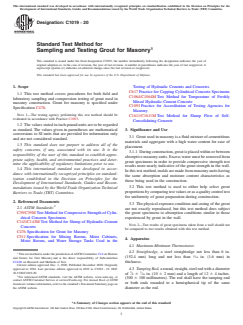
FIG. 1 Example of Grout Mold (Units 6 in. (152.4 mm) or Less in Height, 2 ⁄4 in. (57.2 mm) High Brick Shown)
C1019 − 20
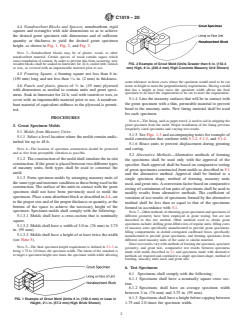
FIG. 2 Example of Grout Mold (Units Greater than 6 in. (152.4 mm) High, 8 in. (203.2 mm) High Concrete Masonry Unit Shown)
NOTE 4—The location of specimen construction should be protected and as free from perceptible vibration as possible.
5.1.2 The construction of the mold shall simulate the in-situ construction. If the grout is placed between two different types of
masonry units, both types shall be used to construct the mold.
5.1.3 Form specimen molds by arranging masonry units of the same type and moisture condition as those being used in the
construction. The surface of the units in contact with the grout specimen shall not have been previously used to mold the
specimens. Place a non-absorbent block as described in 4.4, cut to the proper size and of the proper thickness or quantity, at the
bottom of the space to achieve the necessary height of the specimen. Specimen molds shall comply with the following:
5.1.3.1 Molds shall have a cross-section that is nominally square.
5.1.3.2 Molds shall have a width of 3.0 in. (76 mm) to 3.75 in. (95 mm).
5.1.3.3 Molds shall have a height of at least twice the width (see Note 5).
NOTE 5—The final specimen height requirement is defined in 5.1.3 as being 1.75 to 2.0 times the specimen width. The intent of the standard is to target
a specimen height two times the specimen width while allowing some tolerance in those cases where the specimen would need to be cut down in height
to meet the perpendicularity requirements. Having a mold that has a height at least twice the specimen width allows the final specimen to be meet the
requirement or be cut to meet the requirement.
5.1.4 Line the masonry surfaces that will be in contact with the grout specimen with a thin, permeable material to prevent bond
to the masonry units. New lining material shall be used for each specimen.
NOTE 6—The lining, such as paper towel, is used to aid in stripping the grout specimen from the mold. Proper installation of the lining prevents irregularly
sized specimens and varying test results.
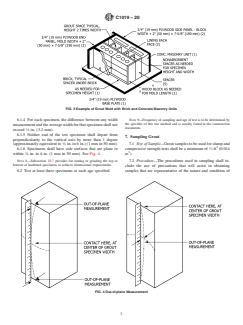
5.1.5 See Figs. 1-3 and accompanying notes for example of mold construction that conform with 5.1.2, 5.1.3, and 5.1.4.
5.1.6 Brace units to prevent displacement during grouting and curing.
5.2 Alternative Methods—Alternative methods of forming the specimens shall be used only with the approval of the specifier. Such
approval shall be based on comparative testing of grout specimens constructed from molds as described in 5.1 and the alternative
method. Approval shall be limited to a single specimen shape, method of forming, masonry units used, and grout mix. A conversion
factor based on comparative testing of a minimum of ten pairs of specimens shall be used to modify results from alternative
methods. The coefficient of variation of test results of specimens formed by the alternative method shall be less than or equal to
that of the specimens formed in accordance with 5.1.
NOTE 7—Other methods of obtaining grout specimens and specimens of different geometry have been employed in grout testing, but are not described
in this test method. Other methods used to obtain grout specimens include: drilling grout-filled cores of regular units; filling cores of masonry units
specifically manufactured to provide grout specimens; filling compartments in slotted corrugated cardboard boxes specifically manufactured to provide
grout specimens; and forming specimens from different sized masonry units of the same or similar material.
Since test results vary with methods of forming the specimen, specimen geometry, and grout mix, comparative test results between specimens made
with molds described in 5.1 and specimens made with alternative methods are required and confined to a single specimen shape, method of forming,
masonry units used, and grout mix.
6. Test Specimens
6.1 Specimens shall comply with the following:
C1019 − 20
FIG. 3 Example of Grout Mold with Brick and Concrete Masonry Units
6.1.1 Specimens shall have a nominally square cross section.
6.1.2 Specimens shall have an average specimen width between 3 in. (76 mm) and 3.75 in. (95 mm).
6.1.3 Specimens shall have a height before capping between 1.75 and 2.0 times the specimen width.
6.1.4 For each specimen, the difference between any width measurement and the average width for that specimen shall not exceed
⁄8 in. (3.2 mm).
6.1.5 Neither end of the test specimen shall depart from perpendicularity to the vertical axis by more than 1 degree (approximately
equivalent to ⁄8 in. in 6 in.) (1 mm in 50 mm).
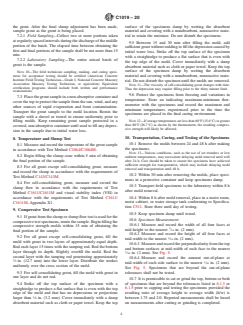
6.1.6 Specimens shall have side surfaces that are plane to within ⁄8 in. in 6 in. (1 mm in 50 mm). See Fig. 4.
FIG. 4 Out-of-plane Measurement
C1019 − 20
NOTE 8—Subsection 10.7 provides for cutting or grinding the top or bottom of hardened specimens to achieve dimensional requirements.
6.2 Test at least three specimens at each age specified.
NOTE 9—Frequency of sampling and age of test is to be determined by the specifier of this test method and is usually found in the construction documents.
7. Sampling Grout
3 3
7.1 Size of Sample—Grout samples to be used for slump and compressive strength tests shall be a minimum of ⁄2 ft (0.014 m ).
7.2 Procedure—The procedures used in sampling shall include the use of precautions that will assist in obtaining samples that are
representative of the nature and condition of the grout. After the final slump adjustment has been made, sample grout as the grout
is being placed.
7.2.1 Field Sampling—Collect two or more portions taken at regularly spaced intervals during the discharge of the middle portion
of the batch. The elapsed time between obtaining the first and final portions of the sample shall be not more than 15 min.
7.2.2 Laboratory Sampling—The entire mixed batch of grout is the sample.
NOTE 10—The field technician sampling, making, and curing specimens for acceptance testing should be certified (American Concrete Institute Field
Testing Technician—Grade I, National Concrete Masonry Association Masonry Testing Technician, or equivalent). Equivalent certification programs
should include both written and performance examinations.
7.3 Place the grout sample in a non-absorptive container and cover the top to protect the sample from the sun, wind, and any other
sources of rapid evaporation and from contamination. Transport the grout sample to the mold location. Remix the sample with a
shovel or trowel to ensure uniformity prior to filling molds. Keep remaining grout sample protected in a covered, non-absorpti
...