

ASTM C1403-22a
(Test Method)Standard Test Method for Rate of Water Absorption of Masonry Mortars
General Information
- Abstract
SIGNIFICANCE AND USE
4.1 This test method provides a laboratory procedure for determining the relative water absorption properties over time of mortars used for masonry construction. Because the specimens are made under laboratory conditions and do not take into account the effect of the masonry substrate or field mixing procedures, this method is not intended for field use. Data generated from this test method may be useful for determining the relative effectiveness of water repellent admixtures or the effect of other admixtures or mortar components on the water repellency of a mortar. However, use caution in interpreting the results. While the resistance of masonry to water penetration may be related to the water absorption of the mortar, it also depends on other factors, such as the workmanship, extent of bond, and the properties of the masonry units and mortar.
Note 1: This test method is specified in Specification C1384 for demonstrating compliance of mortar admixtures classified as Water Repellent. In this compliance testing, the admixed mortar is compared to a reference mortar made with the same mortar materials except that it does not include the admixture. For quality control testing of water repellent preblended dry mortar mixes, the reference mortar is not typically available since the water repellent additive is added during the manufacturing process prior to bagging the final product. In these cases, the procedure in Annex A1 can be used to determine the relative resistance of the mortar to absorption by capillary uptake.
SCOPE
1.1 This test method covers a standardized laboratory procedure for determining the relative water absorption by capillary uptake (wicking) characteristics of masonry mortars. This test method is not applicable for determining the effectiveness of water repellent coatings.
1.2 The text of this standard refers to notes and footnotes that provide explanatory material. These notes and footnotes (excluding those in tables and figures) shall not be considered as requirements of the standard.
1.3 The values stated in SI units are to be regarded as standard. No other units of measurement are included in this standard.
1.3.1 Inch-pound units are given in parentheses for temperature specification and are for information only.
1.4 This standard does not purport to address all of the safety concerns, if any, associated with its use. It is the responsibility of the user of this standard to establish appropriate safety, health, and environmental practices and determine the applicability of regulatory limitations prior to use.
1.5 This international standard was developed in accordance with internationally recognized principles on standardization established in the Decision on Principles for the Development of International Standards, Guides and Recommendations issued by the World Trade Organization Technical Barriers to Trade (TBT) Committee.
- Status
- Published
- Publication Date
- 30-Nov-2022
- Technical Committee
- C12 - Mortars and Grouts for Unit Masonry
- Drafting Committee
- C12.02 - Research and Methods of Test
Overview
ASTM C1403-22a is the internationally recognized standard test method for evaluating the rate of water absorption of masonry mortars under laboratory conditions. Developed by ASTM International, this standard outlines procedures to determine the relative water absorption properties of mortars used in masonry construction by measuring capillary uptake-often referred to as wicking. The standard is designed for laboratory use only, as it does not account for field variables such as masonry substrate effects or field mixing practices.
Water repellency in masonry mortars is crucial for ensuring long-lasting construction and preventing water ingress, which can contribute to deterioration and decrease the structural integrity of masonry walls. By following ASTM C1403-22a, manufacturers, quality control personnel, and researchers can assess how different mortar compositions and admixtures affect water absorption rates.
Key Topics
- Laboratory Test Procedures: The standard provides a detailed, repeatable laboratory procedure for preparing mortar specimens, curing, drying, and testing their rate of water absorption by capillary action.
- Scope and Limitations: ASTM C1403-22a is not intended for field use, nor does it assess water repellent coatings-its focus is specifically on the absorption characteristics of mortar itself.
- Measurement and Reporting: All measurements are made in SI units, using precise equipment such as calipers and balances. The results must include material proportions, types of admixtures, mortar characteristics, and detailed absorption test data for transparency and repeatability.
- Use of Control and Reference Mortars: For compliance testing of water repellent admixtures, the method involves comparison to a reference mortar without admixtures. The standard also provides a procedure for cases when a reference mortar is not available.
- Significance of Results: While test results help compare the effectiveness of water repellent admixtures, they should be interpreted cautiously. Field performance depends on other factors such as workmanship, bond quality, and properties of the masonry units as well as the mortar.
Applications
ASTM C1403-22a is widely applicable in various sectors, including:
- Mortar Admixture Testing: Used to demonstrate compliance of water repellent admixtures in accordance with ASTM C1384.
- Quality Control of Preblended Mortars: Particularly useful when assessing the relative water absorption resistance of preblended dry mortar mixes, especially when a reference mortar material is not readily available.
- Product Development and Research: Provides a consistent framework for laboratories and manufacturers developing new masonry mortars or water repellent admixtures, enabling comparison and benchmarking.
- Specification and Procurement: Assists designers, contractors, and specifiers in setting performance expectations for masonry mortar in projects where water resistance is a priority.
Related Standards
Key ASTM standards referenced in ASTM C1403-22a include:
- ASTM C1384 - Specification for Admixtures for Masonry Mortars
- ASTM C270 - Specification for Mortar for Unit Masonry
- ASTM C778 - Specification for Standard Sand
- ASTM C305 - Practice for Mechanical Mixing of Hydraulic Cement Pastes and Mortars
- ASTM C109/C109M - Test Method for Compressive Strength of Hydraulic Cement Mortars
- ASTM C230/C230M - Specification for Flow Table for Use in Tests of Hydraulic Cement
- ASTM C1437 - Test Method for Flow of Hydraulic Cement Mortar
- ASTM C511 - Specification for Mixing Rooms, Moist Cabinets, and Water Storage Tanks Used in Testing of Hydraulic Cements and Concretes
Practical Value
By adhering to ASTM C1403-22a, organizations ensure a consistent, reproducible approach to evaluating water absorption in masonry mortars, leading to better quality control, enhanced product performance, and informed material selection in masonry construction. This standard is essential for anyone involved in mortar formulation, testing, and specification who needs reliable data on water absorption properties to ensure durable, resilient masonry structures.
Relations
- Effective Date
- 15-Dec-2023
- Effective Date
- 01-Dec-2023
- Effective Date
- 15-Jul-2020
- Effective Date
- 01-May-2019
- Effective Date
- 01-May-2019
- Effective Date
- 01-Feb-2019
- Effective Date
- 01-Dec-2018
- Effective Date
- 01-Jun-2018
- Effective Date
- 01-Jun-2018
- Effective Date
- 01-Dec-2017
- Effective Date
- 15-Dec-2014
- Refers
ASTM C230/C230M-14 - Standard Specification for Flow Table for Use in Tests of Hydraulic Cement - Effective Date
- 01-Oct-2014
- Effective Date
- 01-Jun-2014
- Effective Date
- 01-Dec-2013
- Effective Date
- 15-Jun-2013
Get Certified
Connect with accredited certification bodies for this standard

DIBt (Deutsches Institut für Bautechnik)
German Institute for Building Technology.
DIN CERTCO
DIN Group product certification.

Aboma Certification B.V.
Specialized in construction, metal, and transport sectors.
Sponsored listings
Frequently Asked Questions
ASTM C1403-22a is a standard published by ASTM International. Its full title is "Standard Test Method for Rate of Water Absorption of Masonry Mortars". This standard covers: SIGNIFICANCE AND USE 4.1 This test method provides a laboratory procedure for determining the relative water absorption properties over time of mortars used for masonry construction. Because the specimens are made under laboratory conditions and do not take into account the effect of the masonry substrate or field mixing procedures, this method is not intended for field use. Data generated from this test method may be useful for determining the relative effectiveness of water repellent admixtures or the effect of other admixtures or mortar components on the water repellency of a mortar. However, use caution in interpreting the results. While the resistance of masonry to water penetration may be related to the water absorption of the mortar, it also depends on other factors, such as the workmanship, extent of bond, and the properties of the masonry units and mortar. Note 1: This test method is specified in Specification C1384 for demonstrating compliance of mortar admixtures classified as Water Repellent. In this compliance testing, the admixed mortar is compared to a reference mortar made with the same mortar materials except that it does not include the admixture. For quality control testing of water repellent preblended dry mortar mixes, the reference mortar is not typically available since the water repellent additive is added during the manufacturing process prior to bagging the final product. In these cases, the procedure in Annex A1 can be used to determine the relative resistance of the mortar to absorption by capillary uptake. SCOPE 1.1 This test method covers a standardized laboratory procedure for determining the relative water absorption by capillary uptake (wicking) characteristics of masonry mortars. This test method is not applicable for determining the effectiveness of water repellent coatings. 1.2 The text of this standard refers to notes and footnotes that provide explanatory material. These notes and footnotes (excluding those in tables and figures) shall not be considered as requirements of the standard. 1.3 The values stated in SI units are to be regarded as standard. No other units of measurement are included in this standard. 1.3.1 Inch-pound units are given in parentheses for temperature specification and are for information only. 1.4 This standard does not purport to address all of the safety concerns, if any, associated with its use. It is the responsibility of the user of this standard to establish appropriate safety, health, and environmental practices and determine the applicability of regulatory limitations prior to use. 1.5 This international standard was developed in accordance with internationally recognized principles on standardization established in the Decision on Principles for the Development of International Standards, Guides and Recommendations issued by the World Trade Organization Technical Barriers to Trade (TBT) Committee.
SIGNIFICANCE AND USE 4.1 This test method provides a laboratory procedure for determining the relative water absorption properties over time of mortars used for masonry construction. Because the specimens are made under laboratory conditions and do not take into account the effect of the masonry substrate or field mixing procedures, this method is not intended for field use. Data generated from this test method may be useful for determining the relative effectiveness of water repellent admixtures or the effect of other admixtures or mortar components on the water repellency of a mortar. However, use caution in interpreting the results. While the resistance of masonry to water penetration may be related to the water absorption of the mortar, it also depends on other factors, such as the workmanship, extent of bond, and the properties of the masonry units and mortar. Note 1: This test method is specified in Specification C1384 for demonstrating compliance of mortar admixtures classified as Water Repellent. In this compliance testing, the admixed mortar is compared to a reference mortar made with the same mortar materials except that it does not include the admixture. For quality control testing of water repellent preblended dry mortar mixes, the reference mortar is not typically available since the water repellent additive is added during the manufacturing process prior to bagging the final product. In these cases, the procedure in Annex A1 can be used to determine the relative resistance of the mortar to absorption by capillary uptake. SCOPE 1.1 This test method covers a standardized laboratory procedure for determining the relative water absorption by capillary uptake (wicking) characteristics of masonry mortars. This test method is not applicable for determining the effectiveness of water repellent coatings. 1.2 The text of this standard refers to notes and footnotes that provide explanatory material. These notes and footnotes (excluding those in tables and figures) shall not be considered as requirements of the standard. 1.3 The values stated in SI units are to be regarded as standard. No other units of measurement are included in this standard. 1.3.1 Inch-pound units are given in parentheses for temperature specification and are for information only. 1.4 This standard does not purport to address all of the safety concerns, if any, associated with its use. It is the responsibility of the user of this standard to establish appropriate safety, health, and environmental practices and determine the applicability of regulatory limitations prior to use. 1.5 This international standard was developed in accordance with internationally recognized principles on standardization established in the Decision on Principles for the Development of International Standards, Guides and Recommendations issued by the World Trade Organization Technical Barriers to Trade (TBT) Committee.
ASTM C1403-22a is classified under the following ICS (International Classification for Standards) categories: 91.100.10 - Cement. Gypsum. Lime. Mortar. The ICS classification helps identify the subject area and facilitates finding related standards.
ASTM C1403-22a has the following relationships with other standards: It is inter standard links to ASTM C109/C109M-23, ASTM C1384-23, ASTM C305-20, ASTM C270-19ae1, ASTM C270-19a, ASTM C270-19, ASTM C1180-18, ASTM C1384-18e1, ASTM C1384-18, ASTM C1384-17, ASTM C270-14a, ASTM C230/C230M-14, ASTM C270-14, ASTM C511-13, ASTM C1437-13. Understanding these relationships helps ensure you are using the most current and applicable version of the standard.
ASTM C1403-22a is available in PDF format for immediate download after purchase. The document can be added to your cart and obtained through the secure checkout process. Digital delivery ensures instant access to the complete standard document.
Standards Content (Sample)
This international standard was developed in accordance with internationally recognized principles on standardization established in the Decision on Principles for the
Development of International Standards, Guides and Recommendations issued by the World Trade Organization Technical Barriers to Trade (TBT) Committee.
Designation: C1403 − 22a
Standard Test Method for
Rate of Water Absorption of Masonry Mortars
This standard is issued under the fixed designation C1403; the number immediately following the designation indicates the year of
original adoption or, in the case of revision, the year of last revision. A number in parentheses indicates the year of last reapproval. A
superscript epsilon (´) indicates an editorial change since the last revision or reapproval.
1. Scope* of Hydraulic Cement
C270 Specification for Mortar for Unit Masonry
1.1 This test method covers a standardized laboratory pro-
C305 Practice for Mechanical Mixing of Hydraulic Cement
cedure for determining the relative water absorption by capil-
Pastes and Mortars of Plastic Consistency
lary uptake (wicking) characteristics of masonry mortars. This
C511 Specification for Mixing Rooms, Moist Cabinets,
test method is not applicable for determining the effectiveness
Moist Rooms, and Water Storage Tanks Used in the
of water repellent coatings.
Testing of Hydraulic Cements and Concretes
1.2 The text of this standard refers to notes and footnotes
C778 Specification for Standard Sand
that provide explanatory material. These notes and footnotes
C1180 Terminology of Mortar and Grout for Unit Masonry
(excluding those in tables and figures) shall not be considered
C1384 Specification for Admixtures for Masonry Mortars
as requirements of the standard.
C1437 Test Method for Flow of Hydraulic Cement Mortar
1.3 The values stated in SI units are to be regarded as
standard. No other units of measurement are included in this 3. Terminology
standard.
3.1 Definitions—For definitions of terms used in this test
1.3.1 Inch-poundunitsaregiveninparenthesesfortempera-
method, refer to Terminology C1180.
ture specification and are for information only.
1.4 This standard does not purport to address all of the
4. Significance and Use
safety concerns, if any, associated with its use. It is the
4.1 This test method provides a laboratory procedure for
responsibility of the user of this standard to establish appro-
determining the relative water absorption properties over time
priate safety, health, and environmental practices and deter-
of mortars used for masonry construction. Because the speci-
mine the applicability of regulatory limitations prior to use.
mensaremadeunderlaboratoryconditionsanddonottakeinto
1.5 This international standard was developed in accor-
account the effect of the masonry substrate or field mixing
dance with internationally recognized principles on standard-
procedures, this method is not intended for field use. Data
ization established in the Decision on Principles for the
generated from this test method may be useful for determining
Development of International Standards, Guides and Recom-
the relative effectiveness of water repellent admixtures or the
mendations issued by the World Trade Organization Technical
effect of other admixtures or mortar components on the water
Barriers to Trade (TBT) Committee.
repellencyofamortar.However,usecautionininterpretingthe
results. While the resistance of masonry to water penetration
2. Referenced Documents
may be related to the water absorption of the mortar, it also
2.1 ASTM Standards:
depends on other factors, such as the workmanship, extent of
C109/C109M Test Method for Compressive Strength of
bond, and the properties of the masonry units and mortar.
Hydraulic Cement Mortars (Using 2-in. or [50 mm] Cube
Specimens) NOTE 1—This test method is specified in Specification C1384 for
demonstrating compliance of mortar admixtures classified as Water
C230/C230M Specification for Flow Table for Use in Tests
Repellent. In this compliance testing, the admixed mortar is compared to
areferencemortarmadewiththesamemortarmaterialsexceptthatitdoes
not include the admixture. For quality control testing of water repellent
This test method is under the jurisdiction ofASTM Committee C12 on Mortars
preblended dry mortar mixes, the reference mortar is not typically
and Grouts for Unit Masonry and is the direct responsibility of Subcommittee
available since the water repellent additive is added during the manufac-
C12.02 on Research and Methods of Test.
turing process prior to bagging the final product. In these cases, the
Current edition approved Dec. 1, 2022. Published December 2022. Originally
procedure in AnnexA1 can be used to determine the relative resistance of
approved in 1999. Last previous edition approved in 2022 as C1403 – 22. DOI:
the mortar to absorption by capillary uptake.
10.1520/C1403-22A.
For referenced ASTM standards, visit the ASTM website, www.astm.org, or
contact ASTM Customer Service at service@astm.org. For Annual Book of ASTM
5. Apparatus
Standards volume information, refer to the standard’s Document Summary page on
the ASTM website. 5.1 Balance—A balance readable and accurate to 0.1 g.
*A Summary of Changes section appears at the end of this standard
Copyright © ASTM International, 100 Barr Harbor Drive, PO Box C700, West Conshohocken, PA 19428-2959. United States
C1403 − 22a
5.2 Uptake Container—A watertight container with a mini- 6.1.1 To test the behavior of mortar components indepen-
mum cross sectional area that is at least 50 % greater than the dent of the qualities of the masonry sand use a blend of equal
total area of the specimens’ test surface(s) and a minimum parts by weight of graded standard sand and standard 20 - 30
depth of 75 mm. Provide a cover for the container to minimize sand conforming to Specification C778.
evaporation.
6.2 Prepare 50-mm cube specimens according to Test
5.2.1 Usespecimensupportsthatallowaminimumof3mm
Method C109/C109M except the mortar shall be the mortar
clearance from the bottom of the container and that cover no
preparedin6.1andthemoldsshallbeasspecifiedin5.3.Make
more than 10 % of the area of the specimen’s test surface. Use
a minimum of three replicate specimens from each mortar
supportsmadeofamaterialthatdoesnotfloatinwaterandthat
batch.
does not rust, expand, or contract as a result of water exposure.
6.3 Immediately upon completion of casting, place the test
5.2.2 The container shall be flat so that when a specimen is
specimens in a moist closet or moist room conforming to the
set on the supports the water level as specified in 7.4 shall not
requirements of Specification C511. Keep all test specimens in
vary by more than 1 mm from one end of the specimen to the
their molds and in the moist closet or moist room for 24 6 1
opposite end.
h with their upper surfaces exposed to the moist air but
5.3 Specimen Molds—Metalnominal50-mmcubespecimen
protected from dripping water.
moldswithremovableplasticwatertightdisposableliners.The
6.4 At 24 6 1 h from the time of mixing remove the
plastic liners shall be rigid enough to retain their shape when
specimens from the molds. Mark the side of each specimen
free standing and filled with mortar.
indicating which surface is top, as cast. Cure the specimens in
NOTE 2—For this test method, actual specimen dimensions are mea-
a moisture tight plastic bag at 24 6 8°C (75 6 15°F) until
sured and used to calculate absorption per a unit area; therefore, 2-in. cube
placing in the oven in accordance with 6.5.
specimen molds can be used interchangeably with 50-mm cube specimen
molds.
6.5 Unless another age is specified, at the age of 28 days 6
5.4 Mixer, Bowl, and Paddle—An electrically-driven me- 12 h from the time of casting, remove the specimens from the
chanical mixer of the type equipped with paddle and mixing
plastic bag and dry in a ventilated oven at 110 6 5°C (230 6
bowl, as specified in Practice C305. 9°F) for not less than 24 h and until two successive weighings
at intervals of 2 h show an increment of loss not greater than
5.5 Flow Table and Flow Mold, conforming to the require-
0.2 % of the last previously determined weight of the speci-
ments of Specification C230/C230M.
men.Removethespecimensfromtheovenandcoolinambient
5.6 Tamper and Trowel, conforming to the requirements of
conditions (24 6 8°C (75 6 15°F)) and a relative humidity of
Test Method C109/C109M.
less than 80 % for a minimum of 2 h and until the specimens
reach ambient temperature. Begin testing within 24 h after
5.7 Moist Cabinet or Room, conforming to the requirements
reaching ambient temperature.
of Specification C511.
5.8 Oven—A ventilated oven of appropriate size capable of
7. Procedure
maintaining a uniform temperature of 110 6 5°C (230 6 9°F).
7.1 Calculate the area of the test surface for each specimen
5.9 Timing Device—A timing device readable and accurate
from the length and width of the test surface. The test surface
to1s.
is the top face of the cube, as cast. Using calipers, measure the
5.10 Calipers—Suitable calipers with parallel jaws for mea- length of the cube test surface to the nearest 0.1 mm at three
suring the dimensions of the hardened specimens to the nearest
locationsalongitsheightandrecordas L theaveragelengthin
0.1 mm. millimetres to the nearest 0.1 mm. Using calipers, measure the
width of the cube test surface to the nearest 0.1 mm at three
6. Specimen Preparation locations along its height and record as L the average width in
millimetres to the nearest 0.1 mm.
6.1 Prepare mortar according to Practice C305, adjusting
the water as necessary to obtain a flow of 110 6 5as 7.2 Record as W the initial weight in grams to the nearest
determined by Test Method C1437. Record the flow. If an
0.1 g of each individual specimen immediately prior to testing.
admixture is being added to the mortar, the dosage rate, time of
7.3 Place the uptake container on a flat level surface. Place
addition, and mixing sequence shall follow the manufacturer’s
all specimens in the uptake container(s) with their top faces, as
recommendation. If there is no manufacturer’s
cast, in contact with the specimen supports as illustrated in Fig.
recommendation, add a liquid admixture with the water and
1. Provide a minimum space of 12 mm between specimens and
addadryadmixturewiththecementitiouscomponents.Record
25 mm between specimens and the wall of the uptake con-
the type and amount of each material by weight used in the
tainer.
mortar. In addition, record the type and amount by weight or
volume of any admixture used and when it was added to the 7.4 Add room temperature (24 6 8°C (75 6 15°F) water to
mix. If applicable, record the kind of
...
This document is not an ASTM standard and is intended only to provide the user of an ASTM standard an indication of what changes have been made to the previous version. Because
it may not be technically possible to adequately depict all changes accurately, ASTM recommends that users consult prior editions as appropriate. In all cases only the current version
of the standard as published by ASTM is to be considered the official document.
Designation: C1403 − 22 C1403 − 22a
Standard Test Method for
Rate of Water Absorption of Masonry Mortars
This standard is issued under the fixed designation C1403; the number immediately following the designation indicates the year of
original adoption or, in the case of revision, the year of last revision. A number in parentheses indicates the year of last reapproval. A
superscript epsilon (´) indicates an editorial change since the last revision or reapproval.
1. Scope*
1.1 This test method covers a standardized laboratory procedure for determining the relative water absorption by capillary uptake
(wicking) characteristics of masonry mortars. This test method is not applicable for determining the effectiveness of water repellent
coatings.
1.2 The text of this standard refers to notes and footnotes that provide explanatory material. These notes and footnotes (excluding
those in tables and figures) shall not be considered as requirements of the standard.
1.3 The values stated in SI units are to be regarded as standard. No other units of measurement are included in this standard.
1.3.1 Inch-pound units are given in parentheses for temperature specification and are for information only.
1.4 This standard does not purport to address all of the safety concerns, if any, associated with its use. It is the responsibility
of the user of this standard to establish appropriate safety, health, and environmental practices and determine the applicability of
regulatory limitations prior to use.
1.5 This international standard was developed in accordance with internationally recognized principles on standardization
established in the Decision on Principles for the Development of International Standards, Guides and Recommendations issued
by the World Trade Organization Technical Barriers to Trade (TBT) Committee.
2. Referenced Documents
2.1 ASTM Standards:
C109/C109M Test Method for Compressive Strength of Hydraulic Cement Mortars (Using 2-in. or [50 mm] Cube Specimens)
C230/C230M Specification for Flow Table for Use in Tests of Hydraulic Cement
C270 Specification for Mortar for Unit Masonry
C305 Practice for Mechanical Mixing of Hydraulic Cement Pastes and Mortars of Plastic Consistency
C511 Specification for Mixing Rooms, Moist Cabinets, Moist Rooms, and Water Storage Tanks Used in the Testing of Hydraulic
Cements and Concretes
C778 Specification for Standard Sand
C1180 Terminology of Mortar and Grout for Unit Masonry
C1384 Specification for Admixtures for Masonry Mortars
C1437 Test Method for Flow of Hydraulic Cement Mortar
This test method is under the jurisdiction of ASTM Committee C12 on Mortars and Grouts for Unit Masonry and is the direct responsibility of Subcommittee C12.02
on Research and Methods of Test.
Current edition approved Aug. 1, 2022Dec. 1, 2022. Published August 2022December 2022. Originally approved in 1999. Last previous edition approved in 20152022
as C1403 – 15.C1403 – 22. DOI: 10.1520/C1403-22.10.1520/C1403-22A.
For referenced ASTM standards, visit the ASTM website, www.astm.org, or contact ASTM Customer Service at service@astm.org. For Annual Book of ASTM Standards
volume information, refer to the standard’s Document Summary page on the ASTM website.
*A Summary of Changes section appears at the end of this standard
Copyright © ASTM International, 100 Barr Harbor Drive, PO Box C700, West Conshohocken, PA 19428-2959. United States
C1403 − 22a
3. Terminology
3.1 Definitions—For definitions of terms used in this test method, refer to Terminology C1180.
4. Significance and Use
4.1 This test method provides a laboratory procedure for determining the relative water absorption properties over time of mortars
used for masonry construction. Because the specimens are made under laboratory conditions and do not take into account the effect
of the masonry substrate or field mixing procedures, this method is not intended for field use. Data generated from this test method
may be useful for determining the relative effectiveness of water repellent admixtures or the effect of other admixtures or mortar
components on the water repellency of a mortar. However, use caution in interpreting the results. While the resistance of masonry
to water penetration may be related to the water absorption of the mortar, it also depends on other factors, such as the workmanship,
extent of bond, and the properties of the masonry units and mortar.
NOTE 1—This test method is specified in Specification C1384 for demonstrating compliance of mortar admixtures classified as Water Repellent. In this
compliance testing, the admixed mortar is compared to a reference mortar made with the same mortar materials except that it does not include the
admixture. For quality control testing of water repellent preblended dry mortar mixes, the reference mortar is not typically available since the water
repellent additive is added during the manufacturing process prior to bagging the final product. In these cases, the procedure in Annex A1 can be used
to determine the relative resistance of the mortar to absorption by capillary uptake.
5. Apparatus
5.1 Balance—A balance readable and accurate to 0.1 g.
5.2 Uptake Container—A watertight container with a minimum cross sectional area that is at least 50 % greater than the total area
of the specimens’ test surface(s) and a minimum depth of 75 mm. Provide a cover for the container to minimize evaporation.
5.2.1 Use specimen supports that allow a minimum of 3 mm clearance from the bottom of the container and that cover no more
than 10 % of the area of the specimen’s test surface. Use supports made of a material that does not float in water and that does
not rust, expand, or contract as a result of water exposure.
5.2.2 The container shall be flat so that when a specimen is set on the supports the water level as specified in 7.4 shall not vary
by more than 1 mm from one end of the specimen to the opposite end.
5.3 Specimen Molds—Metal nominal 50-mm cube specimen molds with removable plastic water tight disposable liners. The
plastic liners shall be rigid enough to retain their shape when free standing and filled with mortar.
NOTE 2—For this test method, actual specimen dimensions are measured and used to calculate absorption per a unit area; therefore, 2-in. cube specimen
molds can be used interchangeably with 50-mm cube specimen molds.
5.4 Mixer, Bowl, and Paddle—An electrically-driven mechanical mixer of the type equipped with paddle and mixing bowl, as
specified in Practice C305.
5.5 Flow Table and Flow Mold, conforming to the requirements of Specification C230/C230M.
5.6 Tamper and Trowel, conforming to the requirements of Test Method C109/C109M.
5.7 Moist Cabinet or Room, conforming to the requirements of Specification C511.
5.8 Oven—A ventilated oven of appropriate size capable of maintaining a uniform temperature of 110 6 5°C (230 6 9°F).
5.9 Timing Device—A suitable timing device capable of indicating elapsed time up to 24 h to the nearest 1 min.readable and
accurate to 1 s.
5.10 Calipers—Suitable calipers with parallel jaws for measuring the dimensions of the hardened specimens to the nearest 0.1 mm.
C1403 − 22a
6. Specimen Preparation
6.1 Prepare mortar according to Practice C305, adjusting the water as necessary to obtain a flow of 110 6 5 as determined by Test
Method C1437. Record the flow. If an admixture is being added to the mortar, the dosage rate, time of addition, and mixing
sequence shall follow the manufacturer’s recommendation. If there is no manufacturer’s recommendation, add a liquid admixture
with the water and add a dry admixture with the cementitious components. Record the type and amount of each material by weight
used in the mortar. In addition, record the type and amount by weight or volume of any admixture used and when it was added
to the mix. If applicable, record the kind of mortar (cement-lime, mortar cement, or masonry cement), the type (O, N, S, or M),
and whether the mortar is made to the proportion or property specification of Specification C270.
6.1.1 To test the behavior of mortar components independent of the qualities of the masonry sand use a blend of equal parts by
weight of graded standard sand and standard 20 - 30 sand conforming to Specification C778.
6.2 Prepare 50-mm cube specimens according to Test Method C109/C109M except the mortar shall be the mortar prepared in 6.1
and the molds shall be as specified in 5.3. Make a minimum of three replicate specimens from each mortar batch.
6.3 Immediately upon completion of casting, place the test specimens in a moist closet or moist room conforming to the
requirements of Specification C511. Keep all test specimens in their molds and in the moist closet or moist room for 24 6 1 h with
their upper surfaces exposed to the moist air but protected from dripping water.
6.4 At 24 6 1 h from the time of mixing remove the specimens from the molds. Mark the side of each specimen indicating which
surface is top, as cast. Cure the specimens in a moisture tight plastic bag at 24 6 8°C (75 6 15°F) until placing in the oven in
accordance with 6.5.
6.5 Unless another age is specified, at the age of 28 days 6 12 h from the time of casting, remove the specimens from the plastic
bag and dry in a ventilated oven at 110 6 5°C (230 6 9°F) for not less than 24 h and until two successive weighings at intervals
of 2 h show an increment of loss not greater than 0.2 % of the last previously determined weight of the specimen. Remove the
specimens from the oven and cool in ambient conditions (24 6 8°C (75 6 15°F)) and a relative humidity of less than 80 % for
a minimum of 2 h and until the specimens reach ambient temperature. Begin testing within 24 h after reaching ambient
temperature.
7. Procedure
7.1 Calculate the area of the test surface for each specimen from the length and width of the test surface. The test surface is the
top face of the cube, as cast. Using calipers, measure the length of the cube test surface to the nearest 0.1 mm at three locations
along its height and record as L the average length in millimetres to the nearest 0.1 mm. Using calipers, measure the width of
the cube test surface to the nearest 0.1 mm at three locations along its height and record as L the average width in millimetres
to the nearest 0.1 mm.
7.2 Record as W the initial weight in grams to the nearest 0.1 g of each individual specimen immediately prior to testing.
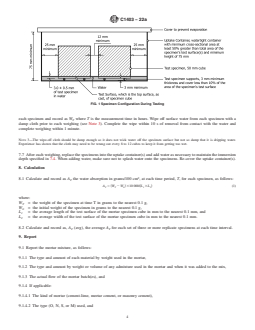
7.3 Place the uptake container on a flat level surface. Place all specimens in the uptake conta
...