

ASTM C1586-20
(Guide)Standard Guide for Quality Assurance of Mortars
General Information
- Abstract
SIGNIFICANCE AND USE
3.1 This document is intended to provide guidance and clarification to designers, specifiers, inspectors, testing agencies, producers, and users in specifying and evaluating masonry mortar.
3.2 Users of documents Specification C270 and Test Method C780 often confuse and sometimes inadvertently misuse parts of the two documents when specifying or evaluating masonry mortar. This guide seeks to address specific items within Specification C270 and Test Method C780 to help promote their proper use and interpretation.
SCOPE
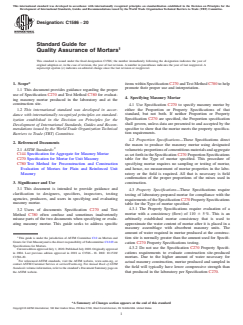
1.1 This document provides guidance regarding the proper use of Specification C270 and Test Method C780 for evaluating masonry mortar produced in the laboratory and at the construction site.
1.2 This international standard was developed in accordance with internationally recognized principles on standardization established in the Decision on Principles for the Development of International Standards, Guides and Recommendations issued by the World Trade Organization Technical Barriers to Trade (TBT) Committee.
- Status
- Published
- Publication Date
- 30-Jun-2020
- Technical Committee
- C12 - Mortars and Grouts for Unit Masonry
- Drafting Committee
- C12.03 - Specifications for Mortars


Overview
ASTM C1586-20: Standard Guide for Quality Assurance of Mortars is an international standard developed by ASTM that provides comprehensive guidance for designers, specifiers, inspectors, testing agencies, producers, and users of masonry mortars. The main purpose is to clarify the correct usage and interpretation of ASTM Specification C270 and Test Method C780 in the evaluation of masonry mortars, both in the laboratory and on construction sites. This guide aims to address common confusion and potential misapplication between these two critical references, ensuring masonry mortar quality and compliance across projects.
Key Topics
Proper Specification and Evaluation:
ASTM C1586-20 outlines best practices for specifying and evaluating masonry mortar. It distinguishes between the use of Proportion Specifications (based on mix ratios) and Property Specifications (based on laboratory-tested properties), helping users understand when and how to apply each approach.Quality Assurance Procedures:
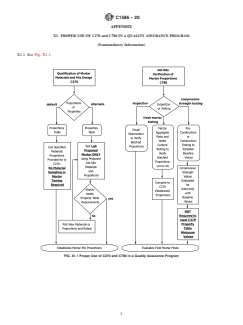
The guide details verification processes for materials, mix designs, and on-site mortar production. It emphasizes the importance of using consistent methods for measuring, sampling, and testing mortar both in the laboratory and at the job site to ensure conformance to project requirements.Correct Application of ASTM C270 and C780:
ASTM C1586-20 provides clarity on the intended scope of C270 and C780:- C270 is for setting mortar requirements via proportions or laboratory property performance.
- C780 is used for evaluating mortars prepared in the field, focusing on characteristics such as consistency, board life, aggregate ratio, and air content.
Limitations of Field Testing:
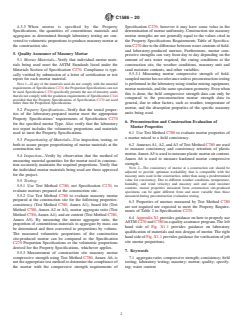
The document cautions against using laboratory property requirements (from C270) to judge site-produced mortar, as site conditions and additional water can cause field samples to differ significantly from lab-prepared specimens, especially in compressive strength.Inspection and Testing Recommendations:
It prescribes visual and documented verification of proper material usage and mix proportions. Testing via ASTM C780 should be applied for properties of field-prepared mortar, but compressive strength data from the field should be interpreted cautiously and not used to directly assess compliance with C270.
Applications
ASTM C1586-20 serves a vital role in the construction and masonry industries by:
Design and Specification:
Assisting project designers and specifiers in accurately referencing and applying ASTM mortar standards, reducing errors in project documentation.Construction Quality Control:
Enabling contractors, inspectors, and testing agencies to enforce consistent quality and verify that mortar used on-site meets standards for workability and performance.Materials Qualification:
Supporting producers and laboratories in qualifying mortar materials and mix designs before construction through proper laboratory procedures.Training and Best Practices:
Offering a base for training programs aimed at improving understanding of mortar quality assurance among all stakeholders.
Related Standards
ASTM C1586-20 references several key standards, including:
- ASTM C270 - Specification for Mortar for Unit Masonry: The main standard for defining acceptable mortar properties and proportions for masonry.
- ASTM C780 - Test Method for Preconstruction and Construction Evaluation of Mortars: The principal guide for field testing mortars for consistency, board life, aggregate ratio, air content, and compressive strength.
- ASTM C144 - Specification for Aggregate for Masonry Mortar: The standard specifying requirements for sand used in mortar.
Keywords: masonry mortar, quality assurance, mortar testing, ASTM C1586, specification C270, test method C780, field evaluation, laboratory evaluation, construction standards, mortar performance, mortar properties.
By following ASTM C1586-20, stakeholders ensure a clear, standardized approach to the quality assurance of masonry mortars in building projects worldwide.
Relations
- Effective Date
- 01-May-2019
- Effective Date
- 01-May-2019
- Effective Date
- 01-Feb-2019
- Effective Date
- 01-Jul-2018
- Effective Date
- 15-Dec-2017
- Effective Date
- 01-Jun-2017
- Effective Date
- 01-Dec-2016
- Effective Date
- 01-Sep-2016
- Effective Date
- 01-Dec-2015
- Effective Date
- 01-Jun-2015
- Effective Date
- 15-Dec-2014
- Effective Date
- 01-Dec-2014
- Effective Date
- 01-Aug-2014
- Effective Date
- 01-Jun-2014
- Effective Date
- 01-Apr-2014
Get Certified
Connect with accredited certification bodies for this standard

DIBt (Deutsches Institut für Bautechnik)
German Institute for Building Technology.
DIN CERTCO
DIN Group product certification.

Aboma Certification B.V.
Specialized in construction, metal, and transport sectors.
Sponsored listings
Frequently Asked Questions
ASTM C1586-20 is a guide published by ASTM International. Its full title is "Standard Guide for Quality Assurance of Mortars". This standard covers: SIGNIFICANCE AND USE 3.1 This document is intended to provide guidance and clarification to designers, specifiers, inspectors, testing agencies, producers, and users in specifying and evaluating masonry mortar. 3.2 Users of documents Specification C270 and Test Method C780 often confuse and sometimes inadvertently misuse parts of the two documents when specifying or evaluating masonry mortar. This guide seeks to address specific items within Specification C270 and Test Method C780 to help promote their proper use and interpretation. SCOPE 1.1 This document provides guidance regarding the proper use of Specification C270 and Test Method C780 for evaluating masonry mortar produced in the laboratory and at the construction site. 1.2 This international standard was developed in accordance with internationally recognized principles on standardization established in the Decision on Principles for the Development of International Standards, Guides and Recommendations issued by the World Trade Organization Technical Barriers to Trade (TBT) Committee.
SIGNIFICANCE AND USE 3.1 This document is intended to provide guidance and clarification to designers, specifiers, inspectors, testing agencies, producers, and users in specifying and evaluating masonry mortar. 3.2 Users of documents Specification C270 and Test Method C780 often confuse and sometimes inadvertently misuse parts of the two documents when specifying or evaluating masonry mortar. This guide seeks to address specific items within Specification C270 and Test Method C780 to help promote their proper use and interpretation. SCOPE 1.1 This document provides guidance regarding the proper use of Specification C270 and Test Method C780 for evaluating masonry mortar produced in the laboratory and at the construction site. 1.2 This international standard was developed in accordance with internationally recognized principles on standardization established in the Decision on Principles for the Development of International Standards, Guides and Recommendations issued by the World Trade Organization Technical Barriers to Trade (TBT) Committee.
ASTM C1586-20 is classified under the following ICS (International Classification for Standards) categories: 91.100.10 - Cement. Gypsum. Lime. Mortar. The ICS classification helps identify the subject area and facilitates finding related standards.
ASTM C1586-20 has the following relationships with other standards: It is inter standard links to ASTM C270-19a, ASTM C270-19ae1, ASTM C270-19, ASTM C780-18, ASTM C144-17, ASTM C780-17, ASTM C780-16a, ASTM C780-16, ASTM C780-15a, ASTM C780-15, ASTM C270-14a, ASTM C780-14b, ASTM C780-14a, ASTM C270-14, ASTM C780-14. Understanding these relationships helps ensure you are using the most current and applicable version of the standard.
ASTM C1586-20 is available in PDF format for immediate download after purchase. The document can be added to your cart and obtained through the secure checkout process. Digital delivery ensures instant access to the complete standard document.
Standards Content (Sample)
This international standard was developed in accordance with internationally recognized principles on standardization established in the Decision on Principles for the
Development of International Standards, Guides and Recommendations issued by the World Trade Organization Technical Barriers to Trade (TBT) Committee.
Designation: C1586 − 20
Standard Guide for
Quality Assurance of Mortars
This standard is issued under the fixed designation C1586; the number immediately following the designation indicates the year of
original adoption or, in the case of revision, the year of last revision. A number in parentheses indicates the year of last reapproval. A
superscript epsilon (´) indicates an editorial change since the last revision or reapproval.
1. Scope* items within Specification C270 andTest Method C780 to help
promote their proper use and interpretation.
1.1 This document provides guidance regarding the proper
use of Specification C270 and Test Method C780 for evaluat-
4. Specifying Masonry Mortar
ing masonry mortar produced in the laboratory and at the
construction site.
4.1 Use Specification C270 to specify masonry mortar by
either the Proportion or Property Specifications of that
1.2 This international standard was developed in accor-
standard, but not both. If neither Proportion or Property
dance with internationally recognized principles on standard-
Specification C270 are specified, the Proportion specification
ization established in the Decision on Principles for the
shall govern, unless data are presented to and accepted by the
Development of International Standards, Guides and Recom-
specifier to show that the mortar meets the property specifica-
mendations issued by the World Trade Organization Technical
tion requirements.
Barriers to Trade (TBT) Committee.
4.2 Proportion Specifications—These Specifications direct
2. Referenced Documents
the mason to produce the masonry mortar using designated
2.1 ASTM Standards: volumetricproportionsofcementitiousmaterialsandaggregate
C144 Specification for Aggregate for Masonry Mortar
as set forth in the Specification C270 Proportion Specifications
C270 Specification for Mortar for Unit Masonry table for the Type of mortar specified. This procedure of
C780 Test Method for Preconstruction and Construction
specifying mortar requires no sampling or testing of mortar,
Evaluation of Mortars for Plain and Reinforced Unit and hence, no measurement of mortar properties in the labo-
Masonry
ratory or the field is required. All that is necessary is field
confirmation of the proper proportions of the mixes used in
3. Significance and Use
construction.
3.1 This document is intended to provide guidance and
4.3 Property Specifications—These Specifications require
clarification to designers, specifiers, inspectors, testing
testing of laboratory-prepared mortar for compliance with the
agencies, producers, and users in specifying and evaluating
requirements of the Specification C270 Property Specifications
masonry mortar.
table for the Type of mortar specified.
4.3.1 The Property Specifications require evaluation of a
3.2 Users of documents Specification C270 and Test
mortar with a consistency (flow) of 110 6 5 %. This is an
Method C780 often confuse and sometimes inadvertently
arbitrarily established mortar consistency that is used to
misuse parts of the two documents when specifying or evalu-
approximate the water content of mortar after it is placed in a
ating masonry mortar. This guide seeks to address specific
masonry assemblage with absorbent masonry units. The
amount of water required in mortar produced at the construc-
tion site is normally greater than the amount used for Specifi-
This guide is under the jurisdiction of ASTM Committee C12 on Mortars and
Grouts for Unit Masonryand is the direct responsibility of Subcommittee C12.03 on
cation C270 Property Specifications testing.
Specifications for Mortars.
4.3.2 Do not use the Specification C270 Property Specifi-
Current edition approved July 1, 2020. Published July 2020. Originally approved
cations requirements to evaluate construction site-produced
in 2004. Last previous edition approved in 2018 as C1586 – 18. DOI: 10.1520/
C1586-20.
mortars. Due to the higher amount of water necessary for
For referenced ASTM standards, visit the ASTM website, www.astm.org, or
actual masonry construction, mortar produced and sampled in
contact ASTM Customer Service at service@astm.org. For Annual Book of ASTM
the field will typically have lower compressive strength than
Standards volume information, refer to the standard’s Document Summary page on
that produced in the laboratory per Specification C270.
the ASTM website.
*A Summary of Changes section appears at the end of this standard
Copyright © ASTM International, 100 Barr Harbor Drive, PO Box C700, West Conshohocken, PA 19428-2959. United States
C1586 − 20
4.3.3 When mortar is specified by the Property Specification C270; however it may have some value in the
Specifications, the quantities of cementitious materials and determination of mortar uniformity. Construction site masonry
aggregates as determined through laboratory testing are con- mortar strengths are not generally equal to the values cited in
verted to volumetric proportions to produce masonry mortar at the Property Specifications Requirements Table of Specifica-
the construction site. tionC270duetothedifferencebetweenwatercontentsoffield-
and laboratory-produced mortars. Furthermore, mortar com-
5. Quality Assurance of Masonry Mortar
pressive strengths can vary from day to day depending on the
5.1 Mortar Materials—Verify that individual mortar mate- amount of mix water required, the curing conditions at the
construction site, the weather conditions, masonry unit and
rials being used meet the ASTM Standards listed under the
Materials Section of Specification C270. Compliance is typi- sand moisture contents, and other variables.
5.5.3.1 Measuring mortar compressive strength of field-
cally verified by submission of a letter of certification or test
report for each mortar material. sampledmortarhasnorelevanceunlesspreconstructiontesting
NOTE 1—If any of the materials used do not comply with the material is performed in
...
This document is not an ASTM standard and is intended only to provide the user of an ASTM standard an indication of what changes have been made to the previous version. Because
it may not be technically possible to adequately depict all changes accurately, ASTM recommends that users consult prior editions as appropriate. In all cases only the current version
of the standard as published by ASTM is to be considered the official document.
Designation: C1586 − 18 C1586 − 20
Standard Guide for
Quality Assurance of Mortars
This standard is issued under the fixed designation C1586; the number immediately following the designation indicates the year of
original adoption or, in the case of revision, the year of last revision. A number in parentheses indicates the year of last reapproval. A
superscript epsilon (´) indicates an editorial change since the last revision or reapproval.
1. Scope*
1.1 This document provides guidance regarding the proper use of Specification C270 and Test Method C780 for evaluating
masonry mortar produced in the laboratory and at the construction site.
1.2 This international standard was developed in accordance with internationally recognized principles on standardization
established in the Decision on Principles for the Development of International Standards, Guides and Recommendations issued
by the World Trade Organization Technical Barriers to Trade (TBT) Committee.
2. Referenced Documents
2.1 ASTM Standards:
C144 Specification for Aggregate for Masonry Mortar
C270 Specification for Mortar for Unit Masonry
C780 Test Method for Preconstruction and Construction Evaluation of Mortars for Plain and Reinforced Unit Masonry
3. Significance and Use
3.1 This document is intended to provide guidance and clarification to designers, specifiers, inspectors, testing agencies,
producers, and users in specifying and evaluating masonry mortar.
3.2 Users of documents Specification C270 and Test Method C780 often confuse and sometimes inadvertently misuse parts of
the two documents when specifying or evaluating masonry mortar. This guide seeks to address specific items within Specification
C270 and Test Method C780 to help promote their proper use and interpretation.
4. Specifying Masonry Mortar
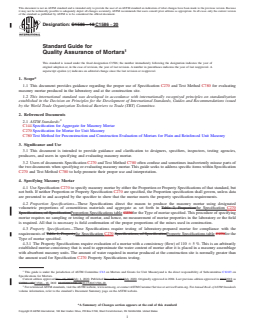
4.1 Use Specification C270 to specify masonry mortar by either the Proportion or Property Specifications of that standard, but
not both. If neither Proportion or Property Specification C270 are specified, the Proportion specification shall govern, unless data
are presented to and accepted by the specifier to show that the mortar meets the property specification requirements.
4.2 Proportion Specifications—These Specifications direct the mason to produce the masonry mortar using designated
volumetric proportions of cementitious materials and aggregate as set forth in Table 2, Proportionthe Specification C270
Specifications, of SpecificationProportion Specifications table C270for the Type of mortar specified. This procedure of specifying
mortar requires no sampling or testing of mortar, and hence, no measurement of mortar properties in the laboratory or the field
is required. All that is necessary is field confirmation of the proper proportions of the mixes used in construction.
4.3 Property Specifications—These Specifications require testing of laboratory-prepared mortar for compliance with the
requirements of Table 1, Propertythe Specification C270 Specifications, of SpecificationProperty Specifications table C270for the
Type of mortar specified.
4.3.1 The Property Specifications require evaluation of a mortar with a consistency (flow) of 110 6 5 %. This is an arbitrarily
established mortar consistency that is used to approximate the water content of mortar after it is placed in a masonry assemblage
with absorbent masonry units. The amount of water required in mortar produced at the construction site is normally greater than
the amount used for Specification C270 Property Specifications testing.
This guide is under the jurisdiction of ASTM Committee C12 on Mortars and Grouts for Unit Masonryand is the direct responsibility of Subcommittee C12.03 on
Specifications for Mortars.
Current edition approved Dec. 15, 2018July 1, 2020. Published December 2018July 2020. Originally approved in 2004. Last previous edition approved in 20172018 as
C1586 – 17.C1586 – 18. DOI: 10.1520/C1586-18.10.1520/C1586-20.
For referenced ASTM standards, visit the ASTM website, www.astm.org, or contact ASTM Customer Service at service@astm.org. For Annual Book of ASTM Standards
volume information, refer to the standard’s Document Summary page on the ASTM website.
*A Summary of Changes section appears at the end of this standard
Copyright © ASTM International, 100 Barr Harbor Drive, PO Box C700, West Conshohocken, PA 19428-2959. United States
C1586 − 20
4.3.2 Do not use the Specification C270 Property Specifications requirements to evaluate construction site-produced mortars.
Due to the higher amount of water necessary for actual masonry construction, mortar produced and sampled in the field will
typically have lower compressive strength than that produced in the laboratory per Specification C270.
4.3.3 When mortar is specified by the Property Specifications, the quantities of cementitious materials and aggregates as
determined through laboratory testing are converted to volumetric proportions to produce masonry mortar at the construction site.
5. Quality Assurance of Masonry Mortar
5.1 Mortar Materials—Verify that individual mortar materials being used meet the ASTM Standards listed under the Materials
Section of Specification C270. Compliance is typically verified by submission of a letter of certification or test report for each
mortar material.
NOTE 1—If any of the materials used do not comply with the material requirements of Specification C270, the Proportion Specifications can not be
used. Specification C270 specifically permits the use of masonry sands that do not comply with the gradation requirements of Specification C144 provided
that the Property Specifications of Specification C270 are used rather than the Proportion Specifications.
5.2 Property Specifications—Verify that the tested properties of the laboratory-prepared mortar meet the appropriate Property
Specifications’ requirements of Specification C270 for the specified mortar Type. Also verify that the laboratory test report includes
the volumetric proportions and materials used to meet the Property Specifications.
5.3 Proportioning of Materials—Use inspection, testing, or both to assure proper proportioning of mortar mat
...