

ASTM D5347-19a
(Test Method)Standard Test Method for Determination of the Ash Content of Fats and Oils
General Information
- Abstract
SIGNIFICANCE AND USE
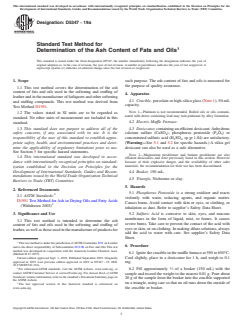
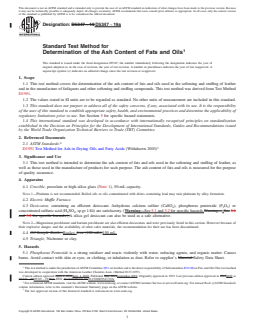
3.1 This test method is intended to determine the ash content of fats and oils used in the softening and stuffing of leather, as well as those used in the manufacture of products for such purpose. The ash content of fats and oils is measured for the purpose of quality assurance.
SCOPE
1.1 This test method covers the determination of the ash content of fats and oils used in the softening and stuffing of leather and in the manufacture of fatliquors and other softening and stuffing compounds. This test method was derived from Test Method D1951.
1.2 The values stated in SI units are to be regarded as standard. No other units of measurement are included in this standard.
1.3 This standard does not purport to address all of the safety concerns, if any, associated with its use. It is the responsibility of the user of this standard to establish appropriate safety, health, and environmental practices and determine the applicability of regulatory limitations prior to use. See Section 5 for specific hazard statements.
1.4 This international standard was developed in accordance with internationally recognized principles on standardization established in the Decision on Principles for the Development of International Standards, Guides and Recommendations issued by the World Trade Organization Technical Barriers to Trade (TBT) Committee.
- Status
- Published
- Publication Date
- 31-Aug-2019
- Technical Committee
- D31 - Leather
- Drafting Committee
- D31.08 - Fats and Oils




Overview
ASTM D5347-19a sets forth the standard test method for determining the ash content of fats and oils used in the softening and stuffing of leather, as well as in the manufacture of fatliquors and related softening compounds. Developed by ASTM International’s Committee D31 on Leather, this test method plays a vital role in the quality assurance of fats and oils utilized in leather processing and associated industries. The ash content is a crucial indicator of inorganic residue present in fats and oils, reflecting purity and suitability for industrial applications. All values and measurements in this standard are stated in SI units.
Key Topics
Scope and Relevance:
ASTM D5347-19a applies to fats and oils employed in:- Softening and stuffing leather
- Manufacturing fatliquors and softening compounds
Quality Assurance:
Determining ash content allows manufacturers and laboratories to validate that fats and oils meet predefined quality criteria, ensuring consistent product performance.Compliance and Safety:
The standard highlights the importance of safe laboratory practices when handling chemicals such as phosphorus pentoxide and sulfuric acid, for which appropriate hazard controls must be established.Testing Apparatus and Procedure:
The method outlines the use of:- Porcelain or high-silica glass crucibles (not platinum)
- Electric muffle furnace for incineration at 550 to 650°C
- Desiccators with approved desiccants to cool samples
- Precision weighing for accurate ash content calculation
Calculation of Ash Content:
The residue left after incineration is weighed and ash content is calculated as a percentage or in ppm, providing an objective measure for product evaluation.
Applications
ASTM D5347-19a is widely adopted across leather processing plants, laboratory settings, and quality control departments in related industries. Its primary applications include:
Leather Manufacturing:
Ensuring fats and oils used for softening and stuffing contain minimal impurities, thereby maintaining desired leather softness and workability.Production of Fatliquors:
Verifying the suitability of raw materials for making fatliquors and related softening agents.Supplier Quality Control:
Benchmarking ingredients against international quality standards before incorporation into finished goods.Product Development:
Evaluating new formulations of fats and oils for compliance and compatibility within existing manufacturing processes.
The standard enables manufacturers to meet regulatory and customer specifications, minimize product defect rates, and secure process consistency in competitive markets.
Related Standards
This method is directly derived from the now-withdrawn ASTM D1951 (Test Method for Ash in Drying Oils and Fatty Acids). Practitioners frequently reference related standards to ensure broader compliance:
- ASTM D1951: The precursor method for ash determination in oils and acids.
- ISO standards for fats and oils: Various ISO standards address additional physical and chemical properties.
- ASTM D31 Committee Publications: Other test methods relevant to quality and performance of leather processing materials.
Keywords:
ash content, ASTM D5347-19a, fats and oils, leather softening, fatliquors, stuffing compounds, quality assurance, laboratory testing, leather manufacturing
For detailed procedures and the most current requirements, consult the official ASTM standard or contact ASTM International through their website.
Relations
- Effective Date
- 01-Sep-2019
- Refers
ASTM D1951-86(1995)e1 - Standard Test Method for Ash in Drying Oils and Fatty Acids (Withdrawn 2003) - Effective Date
- 01-Jan-1995
- Effective Date
- 01-Sep-2019
Get Certified
Connect with accredited certification bodies for this standard

Element Materials Technology
Materials testing and product certification.

ABS Group Brazil
ABS Group certification services in Brazil.

ABS Quality Evaluations Inc.
American Bureau of Shipping quality certification.
Sponsored listings
Frequently Asked Questions
ASTM D5347-19a is a standard published by ASTM International. Its full title is "Standard Test Method for Determination of the Ash Content of Fats and Oils". This standard covers: SIGNIFICANCE AND USE 3.1 This test method is intended to determine the ash content of fats and oils used in the softening and stuffing of leather, as well as those used in the manufacture of products for such purpose. The ash content of fats and oils is measured for the purpose of quality assurance. SCOPE 1.1 This test method covers the determination of the ash content of fats and oils used in the softening and stuffing of leather and in the manufacture of fatliquors and other softening and stuffing compounds. This test method was derived from Test Method D1951. 1.2 The values stated in SI units are to be regarded as standard. No other units of measurement are included in this standard. 1.3 This standard does not purport to address all of the safety concerns, if any, associated with its use. It is the responsibility of the user of this standard to establish appropriate safety, health, and environmental practices and determine the applicability of regulatory limitations prior to use. See Section 5 for specific hazard statements. 1.4 This international standard was developed in accordance with internationally recognized principles on standardization established in the Decision on Principles for the Development of International Standards, Guides and Recommendations issued by the World Trade Organization Technical Barriers to Trade (TBT) Committee.
SIGNIFICANCE AND USE 3.1 This test method is intended to determine the ash content of fats and oils used in the softening and stuffing of leather, as well as those used in the manufacture of products for such purpose. The ash content of fats and oils is measured for the purpose of quality assurance. SCOPE 1.1 This test method covers the determination of the ash content of fats and oils used in the softening and stuffing of leather and in the manufacture of fatliquors and other softening and stuffing compounds. This test method was derived from Test Method D1951. 1.2 The values stated in SI units are to be regarded as standard. No other units of measurement are included in this standard. 1.3 This standard does not purport to address all of the safety concerns, if any, associated with its use. It is the responsibility of the user of this standard to establish appropriate safety, health, and environmental practices and determine the applicability of regulatory limitations prior to use. See Section 5 for specific hazard statements. 1.4 This international standard was developed in accordance with internationally recognized principles on standardization established in the Decision on Principles for the Development of International Standards, Guides and Recommendations issued by the World Trade Organization Technical Barriers to Trade (TBT) Committee.
ASTM D5347-19a is classified under the following ICS (International Classification for Standards) categories: 75.080 - Petroleum products in general. The ICS classification helps identify the subject area and facilitates finding related standards.
ASTM D5347-19a has the following relationships with other standards: It is inter standard links to ASTM D5347-19, ASTM D1951-86(1995)e1, ASTM D7666-12(2019). Understanding these relationships helps ensure you are using the most current and applicable version of the standard.
ASTM D5347-19a is available in PDF format for immediate download after purchase. The document can be added to your cart and obtained through the secure checkout process. Digital delivery ensures instant access to the complete standard document.
Standards Content (Sample)
This international standard was developed in accordance with internationally recognized principles on standardization established in the Decision on Principles for the
Development of International Standards, Guides and Recommendations issued by the World Trade Organization Technical Barriers to Trade (TBT) Committee.
Designation: D5347 − 19a
Standard Test Method for
Determination of the Ash Content of Fats and Oils
This standard is issued under the fixed designation D5347; the number immediately following the designation indicates the year of
original adoption or, in the case of revision, the year of last revision. A number in parentheses indicates the year of last reapproval. A
superscript epsilon (´) indicates an editorial change since the last revision or reapproval.
1. Scope such purpose. The ash content of fats and oils is measured for
the purpose of quality assurance.
1.1 This test method covers the determination of the ash
content of fats and oils used in the softening and stuffing of
4. Apparatus
leather and in the manufacture of fatliquors and other softening
4.1 Crucible, porcelain or high-silica glass (Note 1), 50-mL
and stuffing compounds. This test method was derived from
capacity.
Test Method D1951.
NOTE 1—Platinum is not recommended. Boiled oils or oils contami-
1.2 The values stated in SI units are to be regarded as
nated with driers containing lead may ruin platinum by alloy formation.
standard. No other units of measurement are included in this
4.2 Electric Muffle Furnace.
standard.
1.3 This standard does not purport to address all of the 4.3 Desiccator, containing an efficient desiccant.Anhydrous
safety concerns, if any, associated with its use. It is the calcium sulfate (CaSO ), phosphorus pentoxide (P O)or
4 2 5
responsibility of the user of this standard to establish appro- concentrated sulfuric acid (H SO , sp gr 1.84) are satisfactory.
2 4
priate safety, health, and environmental practices and deter- (Warning—See 5.1 and 5.2 for specific hazards.) A silica gel
mine the applicability of regulatory limitations prior to use. desiccant can also be used as a safe alternative.
See Section 5 for specific hazard statements.
NOTE 2—Magnesium perchlorate and barium perchlorate are also
1.4 This international standard was developed in accor-
efficient desiccators and were previously listed in this section. However
dance with internationally recognized principles on standard-
because of their explosive danger, and the availability of other safer
materials, the recommendation for their use has been discontinued.
ization established in the Decision on Principles for the
Development of International Standards, Guides and Recom-
4.4 Beaker, 150 mL.
mendations issued by the World Trade Organization Technical
4.5 Triangle, Nichrome or clay.
Barriers to Trade (TBT) Committee.
5. Hazards
2. Referenced Documents
5.1 Phosphorus Pentoxide is a strong oxidizer and reacts
2.1 ASTM Standards:
violently with water, reducing agents, and organic matter.
D1951 Test Method for Ash in Drying Oils and Fatty Acids
Causes burns. Avoid contact with skin or eyes, or clothing, or
(Withdrawn 2003)
inhalation as dust. Refer to supplier’s Safety Data Sheet.
3. Significance and Use 5.2 Sulfuric Acid is corrosive to skin, eyes, and mucous
membranes in the form of liquid, mist, or fumes. It causes
3.1 This test method is intended to determine the ash
severe burns. Take care to prevent the contact of the acid with
content of fats and oils used in the softening and stuffing of
eyes or skin, or on clothing. In making dilute solutions, always
leather,aswellasthoseusedinthemanufactureofproductsfor
add the acid to water with care. See supplier’s Safety Data
Sheet.
This test method is under the jurisdiction ofASTM Committee D31 on Leather
6. Procedure
and is the direct responsibility of Subcommittee D31.08 on Fats and Oils This test
method was developed in cooperation with the American Leather Chemists Assn.
6.1 Ignite the crucible in the mu
...
This document is not an ASTM standard and is intended only to provide the user of an ASTM standard an indication of what changes have been made to the previous version. Because
it may not be technically possible to adequately depict all changes accurately, ASTM recommends that users consult prior editions as appropriate. In all cases only the current version
of the standard as published by ASTM is to be considered the official document.
Designation: D5347 − 19 D5347 − 19a
Standard Test Method for
Determination of the Ash Content of Fats and Oils
This standard is issued under the fixed designation D5347; the number immediately following the designation indicates the year of
original adoption or, in the case of revision, the year of last revision. A number in parentheses indicates the year of last reapproval. A
superscript epsilon (´) indicates an editorial change since the last revision or reapproval.
1. Scope
1.1 This test method covers the determination of the ash content of fats and oils used in the softening and stuffing of leather
and in the manufacture of fatliquors and other softening and stuffing compounds. This test method was derived from Test Method
D1951.
1.2 The values stated in SI units are to be regarded as standard. No other units of measurement are included in this standard.
1.3 This standard does not purport to address all of the safety concerns, if any, associated with its use. It is the responsibility
of the user of this standard to establish appropriate safety, health, and environmental practices and determine the applicability of
regulatory limitations prior to use. See Section 5 for specific hazard statements.
1.4 This international standard was developed in accordance with internationally recognized principles on standardization
established in the Decision on Principles for the Development of International Standards, Guides and Recommendations issued
by the World Trade Organization Technical Barriers to Trade (TBT) Committee.
2. Referenced Documents
2.1 ASTM Standards:
D1951 Test Method for Ash in Drying Oils and Fatty Acids (Withdrawn 2003)
3. Significance and Use
3.1 This test method is intended to determine the ash content of fats and oils used in the softening and stuffing of leather, as
well as those used in the manufacture of products for such purpose. The ash content of fats and oils is measured for the purpose
of quality assurance.
4. Apparatus
4.1 Crucible, porcelain or high-silica glass (Note 1), 50-mL capacity.
NOTE 1—Platinum is not recommended. Boiled oils or oils contaminated with driers containing lead may ruin platinum by alloy formation.
4.2 Electric Muffle Furnace.
4.3 Desiccator, containing an efficient desiccant. Anhydrous calcium sulfate (CaSO ), phosphorus pentoxide (P O ) or
4 2 5
concentrated sulfuric acid (H SO , sp gr 1.84) are satisfactory. (Warning—See 5.1 and 5.2 for specific hazards.Warning—)See 5.1
2 4
and 5.2 for specific hazards.) A silica gel desiccant can also be used as a safe alternative.
NOTE 2—Magnesium perchlorate and barium perchlorate are also efficient desiccators and were previously listed in this section. However because of
their explosive danger, and the availability of other safer materials, the recommendation for their use has been discontinued.
4.4 Oil Sample Bottle, Beaker, 4-oz (120-mL).150 mL.
4.5 Triangle, Nichrome or clay.
5. Hazards
5.1 Phosphorus Pentoxide is a strong oxidizer and reacts violently with water, reducing agents, and organic matter. Causes
burns. Avoid contact with skin or eyes, or clothing, or inhalation as dust. Refer to supplier’s Material Safety Data Sheet.
This test method is under the jurisdiction of ASTM Committee D31 on Leather and is the direct responsibility of Subcommittee D31.08 on Fats and Oils This test method
was developed in cooperation with the American Leather Chemists Assn. (Method H 27-1957).
Current edition approved April 1, 2019Sept. 1, 2019. Published May 2019September 2019. Originally approved in 1993. Last previous edition approved in 20122019 as
D5347 – 95D5347 – 19.R12. DOI: 10.1520/D5347-19.10.1520/D5347-19A.
For referenced ASTM standards, visit the ASTM website, www.astm.org, or contact
...