

ASTM D5346-17(2021)
(Test Method)Standard Test Method for Determination of the Pour Point of Petroleum Oil Used in Fatliquors and Softening Compounds
General Information
- Abstract
SIGNIFICANCE AND USE
3.1 This test method is intended to determine the pour point of petroleum oils used in the softening and stuffing of leather, as well as those used in the manufacture of products for such purpose. The pour point of petroleum oils is measured for the purpose of quality assurance.
SCOPE
1.1 This test method covers the determination of the pour point of petroleum oils used in the softening and stuffing of leather, and in the manufacture of fatliquors and other softening and stuffing compounds. This test method was derived from Test Method D97 and ALCA Method H-18.
1.2 The values stated in SI units are to be regarded as standard. No other units of measurement are included in this standard.
1.3 This standard does not purport to address all of the safety concerns, if any, associated with its use. It is the responsibility of the user of this standard to establish appropriate safety, health, and environmental practices and determine the applicability of regulatory limitations prior to use.
1.4 This international standard was developed in accordance with internationally recognized principles on standardization established in the Decision on Principles for the Development of International Standards, Guides and Recommendations issued by the World Trade Organization Technical Barriers to Trade (TBT) Committee.
- Status
- Published
- Publication Date
- 30-Nov-2021
- Technical Committee
- D31 - Leather
- Drafting Committee
- D31.08 - Fats and Oils

Overview
ASTM D5346-17(2021) is the internationally recognized standard test method for determining the pour point of petroleum oils used in fatliquors and softening compounds. Developed by ASTM International, this standard ensures the precise measurement and reporting of the pour point, which is vital for quality assurance in the leather industry and the formulation of fatliquors and other softening products. By adhering to this test method, manufacturers can guarantee that their petroleum-based softening agents meet required specifications for performance and usability in leather processing.
Key Topics
- Pour Point Determination: This standard outlines the procedure for measuring the lowest temperature at which petroleum oil remains pourable. The pour point is a critical physical property that influences storage, handling, and effectiveness of petroleum oils in leather processing.
- Application Scope: The test method is specifically designed for petroleum oils used in leather softening, stuffing, and in the manufacture of fatliquors and other softening and stuffing compounds.
- Accuracy and Consistency: The standard establishes strict repeatability and reproducibility criteria to ensure results are reliable across different batches and laboratories.
- Safety and Compliance: Users are reminded to establish appropriate safety, health, and environmental practices while following this method. The standard emphasizes compliance with relevant regulatory limitations.
Applications
The ASTM D5346 standard is essential in several practical contexts, especially within the leather industry and related manufacturing sectors, where the properties of softening agents directly affect product quality:
- Quality Control of Leather Softeners: Ensures that petroleum oils used in fatliquors and stuffing compounds maintain optimal flow characteristics, even at low temperatures, preventing processing issues or compromised end-product quality.
- Manufacturing of Fatliquors: Used by producers to verify that softening agents for leather maintain the required pourability, thus supporting consistent manufacturing and application.
- Product Development and Specification Compliance: Enables formulators to assess new petroleum oil blends or fatliquor products, confirming they meet both internal and international quality specifications.
- Regulatory and Industry Auditing: Serves as a reference method for audits and certification processes where the functional properties of softening and stuffing compounds are scrutinized.
- Documentation and Reporting: The standard provides clear guidelines for recording and reporting results, allowing transparent communication of product performance to customers and regulatory bodies.
Related Standards
ASTM D5346 references and complements several other recognized standards in the field:
- ASTM D97 - Standard Test Method for Pour Point of Petroleum Products: The origin method from which D5346 is derived, widely used for pour point testing of general petroleum products.
- ALCA Method H-18 - Cloud and Pour Point: Related method developed by the American Leather Chemists Association, relevant for leather processing materials.
- ASTM E1 - Specification for ASTM Liquid-in-Glass Thermometers: Specifies thermometer requirements essential for accurate testing as prescribed in D5346.
- ASTM E2251 - Specification for Liquid-in-Glass ASTM Thermometers with Low-Hazard Precision Liquids: Also referenced for precision instrumentation in the pour point determination process.
Incorporating these internationally recognized standards ensures robust, consistent, and industry-accepted results in the assessment and production of petroleum oil-based softening agents.
Keywords: ASTM D5346, pour point, petroleum oil, fatliquors, softening compounds, leather, quality assurance, standard test method.
Relations
- Effective Date
- 01-May-2013
- Effective Date
- 01-Dec-2012
- Effective Date
- 01-Jun-2011
- Effective Date
- 01-May-2011
- Effective Date
- 01-Nov-2010
- Effective Date
- 15-Apr-2009
- Effective Date
- 01-Sep-2008
- Effective Date
- 01-Dec-2007
- Effective Date
- 01-Nov-2007
- Effective Date
- 01-Nov-2007
- Effective Date
- 01-Nov-2006
- Effective Date
- 01-Nov-2005
- Effective Date
- 01-Jul-2005
- Effective Date
- 01-Jun-2005
- Effective Date
- 01-Apr-2004
Get Certified
Connect with accredited certification bodies for this standard

Element Materials Technology
Materials testing and product certification.

ABS Group Brazil
ABS Group certification services in Brazil.

ABS Quality Evaluations Inc.
American Bureau of Shipping quality certification.
Sponsored listings
Frequently Asked Questions
ASTM D5346-17(2021) is a standard published by ASTM International. Its full title is "Standard Test Method for Determination of the Pour Point of Petroleum Oil Used in Fatliquors and Softening Compounds". This standard covers: SIGNIFICANCE AND USE 3.1 This test method is intended to determine the pour point of petroleum oils used in the softening and stuffing of leather, as well as those used in the manufacture of products for such purpose. The pour point of petroleum oils is measured for the purpose of quality assurance. SCOPE 1.1 This test method covers the determination of the pour point of petroleum oils used in the softening and stuffing of leather, and in the manufacture of fatliquors and other softening and stuffing compounds. This test method was derived from Test Method D97 and ALCA Method H-18. 1.2 The values stated in SI units are to be regarded as standard. No other units of measurement are included in this standard. 1.3 This standard does not purport to address all of the safety concerns, if any, associated with its use. It is the responsibility of the user of this standard to establish appropriate safety, health, and environmental practices and determine the applicability of regulatory limitations prior to use. 1.4 This international standard was developed in accordance with internationally recognized principles on standardization established in the Decision on Principles for the Development of International Standards, Guides and Recommendations issued by the World Trade Organization Technical Barriers to Trade (TBT) Committee.
SIGNIFICANCE AND USE 3.1 This test method is intended to determine the pour point of petroleum oils used in the softening and stuffing of leather, as well as those used in the manufacture of products for such purpose. The pour point of petroleum oils is measured for the purpose of quality assurance. SCOPE 1.1 This test method covers the determination of the pour point of petroleum oils used in the softening and stuffing of leather, and in the manufacture of fatliquors and other softening and stuffing compounds. This test method was derived from Test Method D97 and ALCA Method H-18. 1.2 The values stated in SI units are to be regarded as standard. No other units of measurement are included in this standard. 1.3 This standard does not purport to address all of the safety concerns, if any, associated with its use. It is the responsibility of the user of this standard to establish appropriate safety, health, and environmental practices and determine the applicability of regulatory limitations prior to use. 1.4 This international standard was developed in accordance with internationally recognized principles on standardization established in the Decision on Principles for the Development of International Standards, Guides and Recommendations issued by the World Trade Organization Technical Barriers to Trade (TBT) Committee.
ASTM D5346-17(2021) is classified under the following ICS (International Classification for Standards) categories: 75.080 - Petroleum products in general. The ICS classification helps identify the subject area and facilitates finding related standards.
ASTM D5346-17(2021) has the following relationships with other standards: It is inter standard links to ASTM E1-13, ASTM D97-12, ASTM D97-11, ASTM E2251-11, ASTM E2251-10, ASTM D97-09, ASTM D97-08, ASTM D97-07, ASTM E1-07, ASTM E2251-07, ASTM D97-06, ASTM E1-05, ASTM D97-05a, ASTM D97-05, ASTM D97-04. Understanding these relationships helps ensure you are using the most current and applicable version of the standard.
ASTM D5346-17(2021) is available in PDF format for immediate download after purchase. The document can be added to your cart and obtained through the secure checkout process. Digital delivery ensures instant access to the complete standard document.
Standards Content (Sample)
This international standard was developed in accordance with internationally recognized principles on standardization established in the Decision on Principles for the
Development of International Standards, Guides and Recommendations issued by the World Trade Organization Technical Barriers to Trade (TBT) Committee.
Designation: D5346 − 17 (Reapproved 2021)
Standard Test Method for
Determination of the Pour Point of Petroleum Oil Used in
Fatliquors and Softening Compounds
This standard is issued under the fixed designation D5346; the number immediately following the designation indicates the year of
original adoption or, in the case of revision, the year of last revision.Anumber in parentheses indicates the year of last reapproval.A
superscript epsilon (´) indicates an editorial change since the last revision or reapproval.
1. Scope 3. Significance and Use
3.1 This test method is intended to determine the pour point
1.1 This test method covers the determination of the pour
of petroleum oils used in the softening and stuffing of leather,
point of petroleum oils used in the softening and stuffing of
as well as those used in the manufacture of products for such
leather, and in the manufacture of fatliquors and other soften-
purpose. The pour point of petroleum oils is measured for the
ingandstuffingcompounds.Thistestmethodwasderivedfrom
purpose of quality assurance.
Test Method D97 and ALCA Method H-18.
1.2 The values stated in SI units are to be regarded as
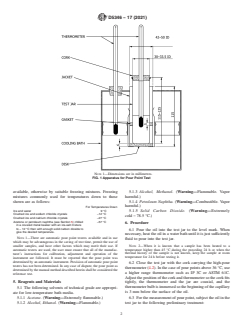
4. Apparatus (see Fig. 1)
standard. No other units of measurement are included in this
4.1 Test Jar, clear cylindrical glass, flat bottom, 30 to
standard.
33.5-mm inside diameter, and 115 to 125-mm height. To
indicate sample height the jar should be marked with a line
1.3 This standard does not purport to address all of the
54mm 63mm above the inside bottom.
safety concerns, if any, associated with its use. It is the
responsibility of the user of this standard to establish appro-
4.2 Thermometers, having ranges shown below and con-
priate safety, health, and environmental practices and deter-
forming to the requirements prescribed in Specifications E1 or
mine the applicability of regulatory limitations prior to use.
E2251 for thermometers:
1.4 This international standard was developed in accor-
Temperature Thermometer Number
Thermometer Range ASTM IP
dance with internationally recognized principles on standard-
High cloud and pour −38 to +50 °C 5C or S5C 1C
ization established in the Decision on Principles for the
Low cloud and pour −80 to +2 °C 6C 2C
Development of International Standards, Guides and Recom-
Melting point +32 to +127 °C 61C 63C
mendations issued by the World Trade Organization Technical
4.2.1 Since separation of liquid column thermometers occa-
Barriers to Trade (TBT) Committee.
sionally occurs and may escape detection, thermometers
should be checked immediately prior to the test and used only
2. Referenced Documents
if they prove accurate within 6 1 °C (for example ice point).
2.1 ASTM Standards:
4.3 Cork, to fit the test jar, bored centrally for the test
D97Test Method for Pour Point of Petroleum Products
thermometer.
E1Specification for ASTM Liquid-in-Glass Thermometers
4.4 Jacket, metal or glass, watertight, cylindrical, flat
E2251Specification for Liquid-in-Glass ASTM Thermom-
bottom, 115 mm in depth, 42 mm to 50 mm inside diameter. It
eters with Low-Hazard Precision Liquids
must be supported firmly in a vertical position in the cooling
2.2 Other Document:
bath of 4.7 so that not more than 25 mm projects out of the
ALCA Method H-18Cloud and Pour Point
cooling medium.
4.5 Disk, cork or felt, 6 mm thick to fit loosely inside the
jacket.
ThistestmethodisunderthejurisdictionofASTMCommitteeD31onLeather
4.6 Gasket, to fit snugly around the outside of the test jar
and is the direct responsibility of Subcommittee D31.08 on Fats and Oils.
and loosely inside the jacket. The gasket may be made of
Current edition approved Dec. 1, 2021. Published January 2022. Originally
approved in 1993. Last previous edition approved in 2017 as D5346–17. DOI:
rubber, leather, or other material that is elastic enough to cling
10.1520/D5346-17R21.
to the test jar and hard enough to hold its shape. Its purpose is
For referenced ASTM standards, visit the ASTM website, www.astm.org, or
to prevent the test jar from touching the jacket.
contact ASTM Customer Service at service@astm.org. For Annual Book of ASTM
Standards volume information, refer to the standard’s Document Summary page on
4.7 Bath or Baths, maintained at prescribed temperatures
the ASTM website.
with a firm support to hold the jacket vertical. The required
Available fromAmerican Leather ChemistsAssn., Texas Tech University, P.O.
Box 45300, Lubbock, TX 79409. bath temperatures may be obtained by refrigeration if
Copyright © ASTM International, 100 Barr Harbor Drive, PO Box C700, West Conshohocken, PA 19428-2959. United States
D5346 − 17 (2021)
NOTE 1—Dimensions are in millimetres.
FIG. 1 Apparatus for Pour Point Test
available, otherwise by suitable freezing mixtures. Freezing 5.1.3 Alcohol, Methanol. (Warning—Flammable. Vapor
mixtures commonly used for temperatures down to those harmful.)
shown are as follows: 5.1.4 Petroleum Naphtha. (Warning—Combustible. Vapor
harmful.)
For Temperatures Down
Ice and water 9 °C
5.1.5 Solid Carbon Dioxide. (Warning—Extremely
Crushed ice and sodium chloride crystals −12 °C
cold−78.5 °C.)
Crushed ice and calcium chloride crystals −27 °C
Acetone or petroleum naphtha (see Section 5) chilled −57 °C
6. Procedure
in a covered metal beaker with an ice-salt mixture
to − 12 °C then with enough solid carbon dioxide to
6.1 Pour the oil into the test jar to the level mark. When
give the desired temperature.
necessary,heattheoilinawaterbathuntilitisjustsufficiently
NOTE 1—There are automatic pour point testers available and in use
fluid to pour into the test jar.
which may be advantageous in the saving of test time, permit the use of
NOTE 2—When it is known that a sample has been heated to a
smaller samples, and have other factors which may merit their use. If
temperature higher than 45 °C during the preceding 24 h or when the
automatic testers are used, the user must ensure that all of the manufac-
thermal history of the sample is not known, keep the sample at room
turer’s instructions for calibration, adjustment and operation of the
temperature for 24 h before testing it.
instrument are followed. It must be reported that the pour point was
determined by an automatic instrument. Precision of automatic pour point
6.2 Close the test jar with the cork carrying the high-pour
testers has not been determined. In any case of dispute, the pour point as
thermometer (4.2). In the case of pour points above 36 °C, use
determinedbythemanualmethoddescribedhereinshallbeconsideredthe
a higher range thermometer such as IP 3C or ASTM 61C.
reference test.
Adjustthepositionofthecorkandthermometersothecorkfits
5. Reagents and Materials
tightly, the thermometer and the jar are coaxial, and the
thermometerbulbisimmersedsothebeginningofthecapillary
5.1 The following solvents of technical grade are appropri-
is
...