

ASTM D5551-95(2019)
(Test Method)Standard Test Method for Determination of the Cloud Point of Oil
General Information
- Abstract
SIGNIFICANCE AND USE
4.1 This test method is intended to determine the cloud point of oils used in the softening and stuffing of leather, as well as those used in the manufacture of products for such purpose. The cloud point of oils is measured for the purpose of quality assurance.
SCOPE
1.1 This test method covers the determination of the cloud point of oils used in the softening and stuffing of leather and in the manufacture of fat liquors and other softening and stuffing compounds. This test method was derived from Test Methods D97 and D2500.
1.2 The values stated in SI units are to be regarded as the standard. The values given in parentheses are for information only.
1.3 This standard does not purport to address all of the safety concerns, if any, associated with its use. It is the responsibility of the user of this standard to establish appropriate safety, health, and environmental practices and determine the applicability of regulatory limitations prior to use.
1.4 This international standard was developed in accordance with internationally recognized principles on standardization established in the Decision on Principles for the Development of International Standards, Guides and Recommendations issued by the World Trade Organization Technical Barriers to Trade (TBT) Committee.
- Status
- Published
- Publication Date
- 31-Mar-2019
- Technical Committee
- D31 - Leather
- Drafting Committee
- D31.08 - Fats and Oils


Overview
ASTM D5551-95(2019): Standard Test Method for Determination of the Cloud Point of Oil details an internationally recognized procedure for measuring the cloud point of oils used in the softening and stuffing of leather and in the production of compounds like fat liquors. The cloud point is defined as the temperature at which a cloud or haze of wax crystals first appears in an oil sample when cooled under specified conditions. Determining the cloud point is essential for quality assurance and product performance in the leather industry and related sectors.
This standard supports both manufacturers and end users by providing a consistent methodology for the evaluation of oils, helping to ensure that oils meet the performance requirements necessary for effective leather processing.
Key Topics
Scope of the Test Method: Applicable to oils for softening and stuffing leather, fat liquors, and other related compounds. It stems from established test methods such as ASTM D97 and D2500.
Significance and Use: Cloud point measurement is used as a quality check, ensuring oils will perform reliably in leather processing applications.
Definition: The cloud point is the temperature, as a multiple of 1°C (2°F), when a waxy cloud or haze appears at the bottom of a cooling oil sample.
Apparatus and Procedure Summary:
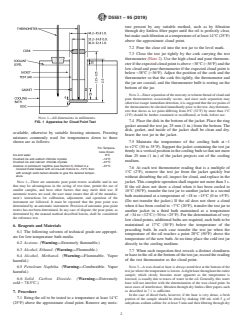
- Use of a clear glass test jar, accurate thermometers, cork fittings, cylindrical jacket, disk and gaskets, and temperature-controlled baths.
- Oils are filtered to remove moisture, poured into the test jar, cooled at prescribed rates, and inspected for cloudiness at regulated intervals.
- Test results are reported as the observed temperature at which cloudiness appears.
Precision: Explicit criteria for repeatability and reproducibility are given to ensure reliability across laboratories.
Safety Considerations: Users must establish proper safety, health, and environmental practices before applying this test method.
Applications
Leather Processing: Ensures that oils used for softening and stuffing deliver the right lubrication and pliability without premature crystallization or separation, which can impact leather quality.
Manufacture of Fat Liquors and Compounds: Critical for producers of fat liquors and softening compounds to assure product stability and performance in various temperatures.
Quality Assurance: Routine testing of supply batches confirms that products meet specifications, reducing the risks of product failure during manufacturing or end use.
Industrial Research and Development: Used in the formulation and evaluation of new oil-based softening and stuffing agents, supporting innovations in the leather industry.
Related Standards
ASTM D97 - Test Method for Pour Point of Petroleum Products: Provides procedures for determining the lowest temperature at which an oil will pour.
ASTM D2500 - Test Method for Cloud Point of Petroleum Products and Liquid Fuels: Outlines a related but distinct procedure for cloud point determination, primarily for fuels.
ASTM E1 - Specification for ASTM Liquid-in-Glass Thermometers: Specifies requirements for thermometers used in oil testing.
Practical Value
Adhering to ASTM D5551-95(2019) ensures that oils chosen for leather softening and stuffing have known and reliable low-temperature properties. This enhances product performance, bolsters consumer confidence, and facilitates compliance with international quality standards. Used globally, this test method helps maintain process consistency, supports supplier evaluation, and underpins advanced research in industrial oils and leather processing technologies.
Keywords: ASTM D5551, cloud point, oil testing, leather softening, stuffing compounds, fat liquors, quality assurance, standard test method, petroleum products, industrial oils.
Relations
- Effective Date
- 01-Apr-2019
- Effective Date
- 01-Jan-2016
- Effective Date
- 01-May-2013
- Effective Date
- 01-Dec-2012
- Effective Date
- 01-Jun-2011
- Effective Date
- 15-Apr-2009
- Effective Date
- 15-Apr-2009
- Effective Date
- 01-Sep-2008
- Effective Date
- 01-Dec-2007
- Effective Date
- 01-Nov-2007
- Effective Date
- 01-Nov-2006
- Effective Date
- 01-Nov-2005
- Effective Date
- 01-Jul-2005
- Effective Date
- 01-Jul-2005
- Effective Date
- 01-Jun-2005
Get Certified
Connect with accredited certification bodies for this standard

Element Materials Technology
Materials testing and product certification.

ABS Group Brazil
ABS Group certification services in Brazil.

ABS Quality Evaluations Inc.
American Bureau of Shipping quality certification.
Sponsored listings
Frequently Asked Questions
ASTM D5551-95(2019) is a standard published by ASTM International. Its full title is "Standard Test Method for Determination of the Cloud Point of Oil". This standard covers: SIGNIFICANCE AND USE 4.1 This test method is intended to determine the cloud point of oils used in the softening and stuffing of leather, as well as those used in the manufacture of products for such purpose. The cloud point of oils is measured for the purpose of quality assurance. SCOPE 1.1 This test method covers the determination of the cloud point of oils used in the softening and stuffing of leather and in the manufacture of fat liquors and other softening and stuffing compounds. This test method was derived from Test Methods D97 and D2500. 1.2 The values stated in SI units are to be regarded as the standard. The values given in parentheses are for information only. 1.3 This standard does not purport to address all of the safety concerns, if any, associated with its use. It is the responsibility of the user of this standard to establish appropriate safety, health, and environmental practices and determine the applicability of regulatory limitations prior to use. 1.4 This international standard was developed in accordance with internationally recognized principles on standardization established in the Decision on Principles for the Development of International Standards, Guides and Recommendations issued by the World Trade Organization Technical Barriers to Trade (TBT) Committee.
SIGNIFICANCE AND USE 4.1 This test method is intended to determine the cloud point of oils used in the softening and stuffing of leather, as well as those used in the manufacture of products for such purpose. The cloud point of oils is measured for the purpose of quality assurance. SCOPE 1.1 This test method covers the determination of the cloud point of oils used in the softening and stuffing of leather and in the manufacture of fat liquors and other softening and stuffing compounds. This test method was derived from Test Methods D97 and D2500. 1.2 The values stated in SI units are to be regarded as the standard. The values given in parentheses are for information only. 1.3 This standard does not purport to address all of the safety concerns, if any, associated with its use. It is the responsibility of the user of this standard to establish appropriate safety, health, and environmental practices and determine the applicability of regulatory limitations prior to use. 1.4 This international standard was developed in accordance with internationally recognized principles on standardization established in the Decision on Principles for the Development of International Standards, Guides and Recommendations issued by the World Trade Organization Technical Barriers to Trade (TBT) Committee.
ASTM D5551-95(2019) is classified under the following ICS (International Classification for Standards) categories: 75.080 - Petroleum products in general. The ICS classification helps identify the subject area and facilitates finding related standards.
ASTM D5551-95(2019) has the following relationships with other standards: It is inter standard links to ASTM D5551-95(2012), ASTM D2500-16, ASTM E1-13, ASTM D97-12, ASTM D97-11, ASTM D2500-09, ASTM D97-09, ASTM D97-08, ASTM D97-07, ASTM E1-07, ASTM D97-06, ASTM E1-05, ASTM D2500-05, ASTM D97-05a, ASTM D97-05. Understanding these relationships helps ensure you are using the most current and applicable version of the standard.
ASTM D5551-95(2019) is available in PDF format for immediate download after purchase. The document can be added to your cart and obtained through the secure checkout process. Digital delivery ensures instant access to the complete standard document.
Standards Content (Sample)
This international standard was developed in accordance with internationally recognized principles on standardization established in the Decision on Principles for the
Development of International Standards, Guides and Recommendations issued by the World Trade Organization Technical Barriers to Trade (TBT) Committee.
Designation: D5551 − 95 (Reapproved 2019)
Standard Test Method for
Determination of the Cloud Point of Oil
This standard is issued under the fixed designation D5551; the number immediately following the designation indicates the year of
original adoption or, in the case of revision, the year of last revision.Anumber in parentheses indicates the year of last reapproval.A
superscript epsilon (´) indicates an editorial change since the last revision or reapproval.
1. Scope 4. Significance and Use
1.1 This test method covers the determination of the cloud 4.1 This test method is intended to determine the cloud
pointofoilsusedinthesofteningandstuffingofleatherandin point of oils used in the softening and stuffing of leather, as
the manufacture of fat liquors and other softening and stuffing
well as those used in the manufacture of products for such
compounds. This test method was derived from Test Methods purpose.Thecloudpointofoilsismeasuredforthepurposeof
D97 and D2500.
quality assurance.
1.2 The values stated in SI units are to be regarded as the
5. Apparatus
standard. The values given in parentheses are for information
only.
5.1 Test Jar, clear cylindrical glass, flat bottom, 30- to
33.5-mm inside diameter, and 115- to 125-mm height. To
1.3 This standard does not purport to address all of the
indicate sample height the jar should be marked with a line 54
safety concerns, if any, associated with its use. It is the
6 3 mm above the inside bottom.
responsibility of the user of this standard to establish appro-
priate safety, health, and environmental practices and deter-
5.2 Thermometers, having ranges shown below and con-
mine the applicability of regulatory limitations prior to use.
forming to the requirements prescribed in Specification E1 for
1.4 This international standard was developed in accor-
thermometers:
dance with internationally recognized principles on standard-
Thermometer
ization established in the Decision on Principles for the
Temperature Number
Thermometer Range ASTM IP
Development of International Standards, Guides and Recom-
High cloud and pour −38 to +50°C 5C 1C
mendations issued by the World Trade Organization Technical
Low cloud and pour −80 to +20°C 6C 2C
Barriers to Trade (TBT) Committee.
Melting point +32 to +127°C 61C 63C
5.2.1 Since separation of liquid column thermometers occa-
2. Referenced Documents
sionally occurs and may escape detection, thermometers
2.1 ASTM Standards:
should be checked immediately prior to the test and used only
D97Test Method for Pour Point of Petroleum Products
if they prove accurate within 6 1°C (for example, ice point).
D2500Test Method for Cloud Point of Petroleum Products
5.3 Cork, to fit the test jar, bored centrally for the test
and Liquid Fuels
thermometer.
E1Specification for ASTM Liquid-in-Glass Thermometers
5.4 Jacket, metal or glass, watertight, cylindrical, flat
3. Terminology
bottom, 115 mm in depth, 42- to 50-mm inside diameter. It
3.1 cloud point—that temperature, expressed as a multiple
must be supported firmly in a vertical position in the cooling
of 1°C (2°F), at which a cloud or haze of wax crystals appears bath of 5.7 so that not more than 25 mm projects out of the
at the bottom of the test jar when the oil is cooled under
cooling medium.
prescribed conditions.
5.5 Disk, cork or felt, 6 mm thick, to fit loosely inside the
jacket.
ThistestmethodisunderthejurisdictionofASTMCommitteeD31onLeather
5.6 Gasket, to fit snugly around the outside of the test jar
and is the direct responsibility of Subcommittee D31.08 on Fats and Oils. This test
and loosely inside the jacket. The gasket may be made of
method was developed in cooperation with the American Leather Chemists Assn.
(Method H18-1957).
rubber, leather, or other material that is elastic enough to cling
Current edition approved April 1, 2019. Published April 2019. Originally
to the test jar and hard enough to hold its shape. Its purpose is
approved in 1994. Last previous edition approved in 2012 as D5551–95(2012).
to prevent the test jar from touching the jacket.
DOI: 10.1520/D5551-95R19.
For referenced ASTM standards, visit the ASTM website, www.astm.org, or
5.7 Bath or Baths, maintained at prescribed temperatures
contact ASTM Customer Service at service@astm.org. For Annual Book of ASTM
with a firm support to hold the jacket vertical. The required
Standards volume information, refer to the standard’s Document Summary page on
the ASTM website. bath temperatures may be obtained by refrigeration if
Copyright © ASTM International, 100 Barr Harbor Drive, PO Box C700, West Conshohocken, PA 19428-2959. United States
D5551 − 95 (2019)
ture present by any suitable method, such as by filtration
through dry lintless filter paper until the oil is perfectly clear,
butmakesuchfiltrationatatemperatureofatleast14°C(25°F)
above the approximate cloud point.
7.2 Pour the clear oil into the test jar to the level mark.
7.3 Close the test jar tightly by the cork carrying the test
thermometer (Note 2). Use the high cloud and pour thermom-
eteriftheexpectedcloudpointisabove−38°C(−36°F)andthe
low cloud and pour thermometer if the expected cloud point is
below−38°C (−36°F). Adjust the position of the cork and the
thermometer so that the cork fits tightly, the thermometer and
the jar are coaxial, and the thermometer bulb is resting on the
bottom of the jar.
NOTE2—Sinceseparationofthemercuryortoluenethreadofcloudand
pour thermometers occasionally occurs, and since such separation may
otherwiseescapeimmediatedetection,itissuggestedthattheicepointsof
thethermometersbecheckedimmediatelypriortothetest.Anythermom-
eter that shows as ice point differing from 0°C (32°F) by more than 1°C
(2°F) should be further examined or recalibrated, or both, before use.
NOTE 1—All dimensions in millimetres.
7.4 Place the disk in the bottom of the jacket. Place the ring
FIG. 1 Apparatus for Cloud Point Test
gasket around the test jar, 25 mm (1 in.) from the bottom. The
disk, gasket, and inside of the jacket shall be clean and dry.
available, otherwise by suitable freezing mixtures. Freezing
Insert the test jar in the jacket.
...