

ASTM D8225-19
(Test Method)Standard Test Method for Determination of Cracking Tolerance Index of Asphalt Mixture Using the Indirect Tensile Cracking Test at Intermediate Temperature
General Information
- Abstract
SIGNIFICANCE AND USE
5.1 The indirect tensile cracking test is used to determine asphalt mixture cracking resistance at an intermediate temperature which could range from 5 °C to 35 °C, depending on local climate. The specimens are readily obtained from Superpave gyratory compactor compacted cylinders with a diameter of 150 ± 2 mm, with no cutting, gluing, notching, drilling, or instrumentation required. Similarly, field cores can be tested to measure remaining cracking resistance of in-place asphalt mixtures.
5.2 The CTIndex of an asphalt mixture is calculated from the failure energy, the post-peak slope of the load-displacement curve, and deformation tolerance at 75 % of the peak load. The CTIndex is a performance indicator of the cracking resistance of asphalt mixtures containing various asphalt binders, asphalt binder modifiers, aggregate blends, fibers, and recycled materials. Generally, the higher the CTIndex value, the better the cracking resistance and, consequently, the less the cracking amount in the field. The range for an acceptable CTIndex will vary with mix types and associated specific applications.4 Users can employ the CTIndex and associated criteria to identify crack-prone mixtures during mix design and production quality control/assurance.
Note 1: The quality of the results produced by this standard are dependent on the competence of the personnel performing the procedure and the capability, calibration, and maintenance of the equipment used. Agencies that meet the criteria of Specification D3666 are generally considered capable of competent and objective testing, sampling, inspection, etc. Users of this standard are cautioned that compliance with Specification D3666 alone does not completely ensure reliable results. Reliable results depend on many factors; following the suggestions of Specification D3666 or some similar acceptable guideline provides a means of evaluating and controlling some of those factors.
SCOPE
1.1 This test method covers the procedures for preparing, testing, and measuring asphalt mixture cracking resistance using cylindrical laboratory-prepared asphalt mix samples or pavement cores. Testing temperatures are selected from the long-term pavement performance (LTPP) database intermediate temperatures. The test method describes the determination of the cracking tolerance index, CTIndex, and other parameters determined from the load-displacement curve. These parameters can be used to evaluate the resistance of asphalt mixtures to cracking.
1.2 The values stated in SI units are to be regarded as standard. No other units of measurement are included in this standard.
1.3 The text of this standard references notes and footnotes which provide explanatory material. These notes and footnotes (excluding those in tables and figures) shall not be considered as requirements of the standard.
1.4 This standard does not purport to address all of the safety concerns, if any, associated with its use. It is the responsibility of the user of this standard to establish appropriate safety, health, and environmental practices and determine the applicability of regulatory limitations prior to use.
1.5 This international standard was developed in accordance with internationally recognized principles on standardization established in the Decision on Principles for the Development of International Standards, Guides and Recommendations issued by the World Trade Organization Technical Barriers to Trade (TBT) Committee.
- Status
- Published
- Publication Date
- 31-Mar-2019
- Technical Committee
- D04 - Road and Paving Materials
- Drafting Committee
- D04.26 - Fundamental/Mechanistic Tests
Overview
ASTM D8225-19 is the standard test method for determining the Cracking Tolerance Index (CTIndex) of asphalt mixtures using the Indirect Tensile Cracking Test at intermediate temperatures. This standard is vital in assessing the cracking resistance of both laboratory-prepared and field-extracted cylindrical specimens, helping to predict pavement performance under various environmental conditions. By following ASTM D8225-19, engineers and laboratories can evaluate the durability and long-term resistance to cracking of asphalt mixtures, supporting quality mix designs and effective pavement maintenance strategies.
Key Topics
Scope and Temperature Range:
The standard covers procedures for preparing, testing, and measuring the cracking resistance of asphalt mixtures at intermediate temperatures, typically between 5 °C and 35 °C, suitable for local climates.Test Specimens:
Specimens can be laboratory-compacted using the Superpave gyratory compactor or cored from in-place pavement, with a standard diameter of 150 ± 2 mm. No sample cutting, gluing, notching, drilling, or instrumentation is required, simplifying specimen preparation.Cracking Tolerance Index (CTIndex):
CTIndex is calculated from the failure energy, the post-peak slope of the load-displacement curve, and deformation tolerance at 75% of the peak load. It is used as a performance indicator for the cracking resistance of asphalt mixtures.Load-Displacement Curve Analysis:
Parameters derived from the load versus displacement curve-such as failure energy and post-peak slope- inform the calculation of CTIndex and provide insight into crack initiation and propagation behavior.Practical Use:
The CTIndex enables identification of crack-prone mixtures during mix design and supports quality control/assurance during production. Higher CTIndex values generally correspond to better cracking resistance and lower in-service pavement cracking.
Applications
Asphalt Mix Design:
During the design phase, CTIndex provides a reliable means to compare and select asphalt binders, modifiers, aggregate blends, fibers, and recycled materials to optimize crack resistance for specific climatic conditions.Quality Control and Assurance:
Asphalt producers and agencies use CTIndex results for ongoing monitoring of mix performance, ensuring that production batches maintain desired resistance to intermediate-temperature cracking.Field Assessment:
Core samples taken from existing pavements can be tested to assess the remaining cracking resistance, guiding pavement management decisions and rehabilitation strategies.Research and Development:
The method is applicable in studies aiming to improve asphalt mixture formulations or evaluate the effects of new materials and additives on cracking resistance.
Related Standards
- ASTM D8: Terminology Relating to Materials for Roads and Pavements
- ASTM D3203/D3203M: Test Method for Percent Air Voids in Compacted Asphalt Mixtures
- ASTM D3666: Specification for Minimum Requirements for Agencies Testing and Inspecting Road and Paving Materials
- ASTM D6373: Specification for Performance Graded Asphalt Binder
- ASTM D6925: Test Method for Preparation and Determination of the Relative Density of Asphalt Mix Specimens by Means of the Superpave Gyratory Compactor
- AASHTO R30: Practice for Mixture Conditioning of Hot Mix Asphalt (HMA)
- AASHTO M 320/M 332: Specifications for Performance-Graded Asphalt Binders
Practical Value
Utilizing ASTM D8225-19 supports the production of robust, long-lasting pavements by providing a reproducible, laboratory-standardized method to assess and optimize asphalt mixture cracking resistance. This standard is instrumental in improving pavement durability, reducing maintenance costs, and enhancing roadway performance, making it an essential reference for engineers, researchers, and quality assurance professionals in the road construction industry.
Keywords: ASTM D8225-19, cracking tolerance index, CTIndex, asphalt mixture, indirect tensile cracking test, pavement performance, asphalt mix design, quality control, cracking resistance, intermediate temperature asphalt testing.
Relations
- Effective Date
- 01-Dec-2023
- Effective Date
- 01-Aug-2019
- Effective Date
- 15-Dec-2018
- Effective Date
- 15-Aug-2018
- Effective Date
- 01-Jul-2018
- Effective Date
- 01-Feb-2018
- Effective Date
- 15-Jul-2017
- Effective Date
- 15-Jun-2017
- Effective Date
- 01-May-2017
- Effective Date
- 01-Mar-2017
- Effective Date
- 01-Dec-2016
- Effective Date
- 01-Oct-2016
- Effective Date
- 15-Sep-2016
- Effective Date
- 01-Sep-2016
- Effective Date
- 01-Sep-2015
Get Certified
Connect with accredited certification bodies for this standard

Zavod za gradbeništvo Slovenije (ZAG) - Inšpekcija
ZAG inspection body for construction products, structures, and materials.
Sponsored listings
Frequently Asked Questions
ASTM D8225-19 is a standard published by ASTM International. Its full title is "Standard Test Method for Determination of Cracking Tolerance Index of Asphalt Mixture Using the Indirect Tensile Cracking Test at Intermediate Temperature". This standard covers: SIGNIFICANCE AND USE 5.1 The indirect tensile cracking test is used to determine asphalt mixture cracking resistance at an intermediate temperature which could range from 5 °C to 35 °C, depending on local climate. The specimens are readily obtained from Superpave gyratory compactor compacted cylinders with a diameter of 150 ± 2 mm, with no cutting, gluing, notching, drilling, or instrumentation required. Similarly, field cores can be tested to measure remaining cracking resistance of in-place asphalt mixtures. 5.2 The CTIndex of an asphalt mixture is calculated from the failure energy, the post-peak slope of the load-displacement curve, and deformation tolerance at 75 % of the peak load. The CTIndex is a performance indicator of the cracking resistance of asphalt mixtures containing various asphalt binders, asphalt binder modifiers, aggregate blends, fibers, and recycled materials. Generally, the higher the CTIndex value, the better the cracking resistance and, consequently, the less the cracking amount in the field. The range for an acceptable CTIndex will vary with mix types and associated specific applications.4 Users can employ the CTIndex and associated criteria to identify crack-prone mixtures during mix design and production quality control/assurance. Note 1: The quality of the results produced by this standard are dependent on the competence of the personnel performing the procedure and the capability, calibration, and maintenance of the equipment used. Agencies that meet the criteria of Specification D3666 are generally considered capable of competent and objective testing, sampling, inspection, etc. Users of this standard are cautioned that compliance with Specification D3666 alone does not completely ensure reliable results. Reliable results depend on many factors; following the suggestions of Specification D3666 or some similar acceptable guideline provides a means of evaluating and controlling some of those factors. SCOPE 1.1 This test method covers the procedures for preparing, testing, and measuring asphalt mixture cracking resistance using cylindrical laboratory-prepared asphalt mix samples or pavement cores. Testing temperatures are selected from the long-term pavement performance (LTPP) database intermediate temperatures. The test method describes the determination of the cracking tolerance index, CTIndex, and other parameters determined from the load-displacement curve. These parameters can be used to evaluate the resistance of asphalt mixtures to cracking. 1.2 The values stated in SI units are to be regarded as standard. No other units of measurement are included in this standard. 1.3 The text of this standard references notes and footnotes which provide explanatory material. These notes and footnotes (excluding those in tables and figures) shall not be considered as requirements of the standard. 1.4 This standard does not purport to address all of the safety concerns, if any, associated with its use. It is the responsibility of the user of this standard to establish appropriate safety, health, and environmental practices and determine the applicability of regulatory limitations prior to use. 1.5 This international standard was developed in accordance with internationally recognized principles on standardization established in the Decision on Principles for the Development of International Standards, Guides and Recommendations issued by the World Trade Organization Technical Barriers to Trade (TBT) Committee.
SIGNIFICANCE AND USE 5.1 The indirect tensile cracking test is used to determine asphalt mixture cracking resistance at an intermediate temperature which could range from 5 °C to 35 °C, depending on local climate. The specimens are readily obtained from Superpave gyratory compactor compacted cylinders with a diameter of 150 ± 2 mm, with no cutting, gluing, notching, drilling, or instrumentation required. Similarly, field cores can be tested to measure remaining cracking resistance of in-place asphalt mixtures. 5.2 The CTIndex of an asphalt mixture is calculated from the failure energy, the post-peak slope of the load-displacement curve, and deformation tolerance at 75 % of the peak load. The CTIndex is a performance indicator of the cracking resistance of asphalt mixtures containing various asphalt binders, asphalt binder modifiers, aggregate blends, fibers, and recycled materials. Generally, the higher the CTIndex value, the better the cracking resistance and, consequently, the less the cracking amount in the field. The range for an acceptable CTIndex will vary with mix types and associated specific applications.4 Users can employ the CTIndex and associated criteria to identify crack-prone mixtures during mix design and production quality control/assurance. Note 1: The quality of the results produced by this standard are dependent on the competence of the personnel performing the procedure and the capability, calibration, and maintenance of the equipment used. Agencies that meet the criteria of Specification D3666 are generally considered capable of competent and objective testing, sampling, inspection, etc. Users of this standard are cautioned that compliance with Specification D3666 alone does not completely ensure reliable results. Reliable results depend on many factors; following the suggestions of Specification D3666 or some similar acceptable guideline provides a means of evaluating and controlling some of those factors. SCOPE 1.1 This test method covers the procedures for preparing, testing, and measuring asphalt mixture cracking resistance using cylindrical laboratory-prepared asphalt mix samples or pavement cores. Testing temperatures are selected from the long-term pavement performance (LTPP) database intermediate temperatures. The test method describes the determination of the cracking tolerance index, CTIndex, and other parameters determined from the load-displacement curve. These parameters can be used to evaluate the resistance of asphalt mixtures to cracking. 1.2 The values stated in SI units are to be regarded as standard. No other units of measurement are included in this standard. 1.3 The text of this standard references notes and footnotes which provide explanatory material. These notes and footnotes (excluding those in tables and figures) shall not be considered as requirements of the standard. 1.4 This standard does not purport to address all of the safety concerns, if any, associated with its use. It is the responsibility of the user of this standard to establish appropriate safety, health, and environmental practices and determine the applicability of regulatory limitations prior to use. 1.5 This international standard was developed in accordance with internationally recognized principles on standardization established in the Decision on Principles for the Development of International Standards, Guides and Recommendations issued by the World Trade Organization Technical Barriers to Trade (TBT) Committee.
ASTM D8225-19 is classified under the following ICS (International Classification for Standards) categories: 93.080.20 - Road construction materials. The ICS classification helps identify the subject area and facilitates finding related standards.
ASTM D8225-19 has the following relationships with other standards: It is inter standard links to ASTM D6925-23, ASTM D8-19, ASTM D8-18c, ASTM D8-18b, ASTM D8-18a, ASTM D8-18, ASTM D8-17c, ASTM D8-17b, ASTM D8-17a, ASTM D8-17, ASTM D8-16b, ASTM D3666-16, ASTM D8-16a, ASTM D8-16, ASTM D8-15. Understanding these relationships helps ensure you are using the most current and applicable version of the standard.
ASTM D8225-19 is available in PDF format for immediate download after purchase. The document can be added to your cart and obtained through the secure checkout process. Digital delivery ensures instant access to the complete standard document.
Standards Content (Sample)
This international standard was developed in accordance with internationally recognized principles on standardization established in the Decision on Principles for the
Development of International Standards, Guides and Recommendations issued by the World Trade Organization Technical Barriers to Trade (TBT) Committee.
Designation: D8225 − 19
Standard Test Method for
Determination of Cracking Tolerance Index of Asphalt
Mixture Using the Indirect Tensile Cracking Test at
Intermediate Temperature
This standard is issued under the fixed designation D8225; the number immediately following the designation indicates the year of
original adoption or, in the case of revision, the year of last revision. A number in parentheses indicates the year of last reapproval. A
superscript epsilon (´) indicates an editorial change since the last revision or reapproval.
1. Scope 2. Referenced Documents
2.1 ASTM Standards:
1.1 This test method covers the procedures for preparing,
D8 Terminology Relating to Materials for Roads and Pave-
testing, and measuring asphalt mixture cracking resistance
ments
using cylindrical laboratory-prepared asphalt mix samples or
D3203/D3203M Test Method for PercentAir Voids in Com-
pavement cores. Testing temperatures are selected from the
pacted Asphalt Mixtures
long-term pavement performance (LTPP) database intermedi-
D3666 Specification for Minimum Requirements for Agen-
ate temperatures. The test method describes the determination
cies Testing and Inspecting Road and Paving Materials
of the cracking tolerance index, CT , and other parameters
Index
D6373 Specification for Performance Graded Asphalt
determined from the load-displacement curve. These param-
Binder
eters can be used to evaluate the resistance of asphalt mixtures
D6925 Test Method for Preparation and Determination of
to cracking.
the Relative Density ofAsphalt Mix Specimens by Means
1.2 The values stated in SI units are to be regarded as
of the Superpave Gyratory Compactor
standard. No other units of measurement are included in this 2.2 AASHTO Standards:
standard.
R30 Practice for Mixture Conditioning of Hot Mix Asphalt
(HMA)
1.3 The text of this standard references notes and footnotes
M 320 Specification for Performance-Graded Asphalt
which provide explanatory material. These notes and footnotes
Binder
(excluding those in tables and figures) shall not be considered
M 332 Specification for Performance-Graded Asphalt
as requirements of the standard.
Binder Using Multiple Stress Creep Recovery (MSCR)
Test
1.4 This standard does not purport to address all of the
safety concerns, if any, associated with its use. It is the
3. Terminology
responsibility of the user of this standard to establish appro-
3.1 Definitions:
priate safety, health, and environmental practices and deter-
3.1.1 For definitions of terms used in this standard, refer to
mine the applicability of regulatory limitations prior to use.
Terminology D8.
1.5 This international standard was developed in accor-
3.2 Definitions of Terms Specific to This Standard:
dance with internationally recognized principles on standard-
3.2.1 CT ,n—cracking tolerance index, value used to
Index
ization established in the Decision on Principles for the
evaluate mixture resistance to cracking.
Development of International Standards, Guides and Recom-
3.2.2 G,n—failure energy (Joules/m ) required to induce a
mendations issued by the World Trade Organization Technical f
unit surface area of a crack and calculated as the work of
Barriers to Trade (TBT) Committee.
For referenced ASTM standards, visit the ASTM website, www.astm.org, or
contact ASTM Customer Service at service@astm.org. For Annual Book of ASTM
This test method is under the jurisdiction of ASTM Committee D04 on Road Standards volume information, refer to the standard’s Document Summary page on
and Paving Materials and is the direct responsibility of Subcommittee D04.26 on the ASTM website.
Fundamental/Mechanistic Tests. Available from American Association of State Highway and Transportation
Current edition approved April 1, 2019. Published April 2019. Originally Officials (AASHTO), 444 N. Capitol St., NW, Suite 249, Washington, DC 20001,
approved in 2019. DOI: 10.1520/D8225-19. http://www.transportation.org.
Copyright © ASTM International, 100 Barr Harbor Drive, PO Box C700, West Conshohocken, PA 19428-2959. United States
D8225 − 19
failure divided by specimen diameter (150 6 2 mm) and 4.2 This test procedure considers both crack initiation and
normalized thickness of 62 mm. propagation in asphalt mixtures, and is developed based on
fracture mechanics.
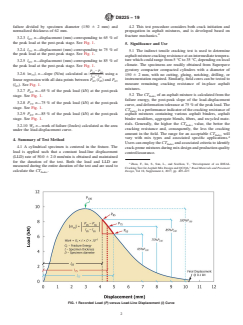
3.2.3 l ,n—displacement (mm) corresponding to 65 % of
the peak load at the post-peak stage. See Fig. 1.
5. Significance and Use
3.2.4 l ,n—displacement (mm) corresponding to 75 % of
75 5.1 The indirect tensile cracking test is used to determine
the peak load at the post-peak stage. See Fig. 1.
asphaltmixturecrackingresistanceatanintermediatetempera-
ture which could range from 5 °C to 35 °C, depending on local
3.2.5 l ,n—displacement (mm) corresponding to 85 % of
climate. The specimens are readily obtained from Superpave
the peak load at the post-peak stage. See Fig. 1.
gyratory compactor compacted cylinders with a diameter of
P 2P
85 65
3.2.6 |m |, n—slope (N/m) calculated as | | using a
75 150 6 2 mm, with no cutting, gluing, notching, drilling, or
l 2l
85 65
instrumentation required. Similarly, field cores can be tested to
linear regression with all data points between P (l ) and P
85 85 65
measure remaining cracking resistance of in-place asphalt
(l ). See Fig. 1.
mixtures.
3.2.7 P ,n—65 % of the peak load (kN) at the post-peak
5.2 The CT of an asphalt mixture is calculated from the
stage. See Fig. 1.
Index
failure energy, the post-peak slope of the load-displacement
3.2.8 P ,n—75 % of the peak load (kN) at the post-peak
curve, and deformation tolerance at 75 % of the peak load.The
stage. See Fig. 1.
CT is a performance indicator of the cracking resistance of
Index
3.2.9 P ,n—85 % of the peak load (kN) at the post-peak asphalt mixtures containing various asphalt binders, asphalt
stage. See Fig. 1.
binder modifiers, aggregate blends, fibers, and recycled mate-
rials. Generally, the higher the CT value, the better the
Index
3.2.10 W,n—work of failure (Joules) calculated as the area
f
cracking resistance and, consequently, the less the cracking
under the load-displacement curve.
amount in the field. The range for an acceptable CT will
Index
vary with mix types and associated specific applications.
4. Summary of Test Method
Users can employ the CT and associated criteria to identify
Index
4.1 A cylindrical specimen is centered in the fixture. The
crack-pronemixturesduringmixdesignandproductionquality
load is applied such that a constant load-line displacement
control/assurance.
(LLD) rate of 50.0 6 2.0 mm/min is obtained and maintained
for the duration of the test. Both the load and LLD are
Zhou, F., Im, S., Sun, L., and Scullion, T., “Development of an IDEAL
measured during the entire duration of the test and are used to
Cracking Test forAsphalt Mix Design and QC/QA,” Road Materials and Pavement
calculate the CT . Design, Vol 18, Supplement 4, 2017, pp. 405–427.
Index
FIG. 1 Recorded Load (P) versus Load-Line Displacement (l) Curve
D8225 − 19
NOTE 1—The quality of the results produced by this standard are
the specimen as in Fig. 2. The outer edges of the loading strips
dependent on the competence of the personnel performing the procedure
shall be beveled slightly to remove sharp edges.
and the capability, calibration, and maintenance of the equipment used.
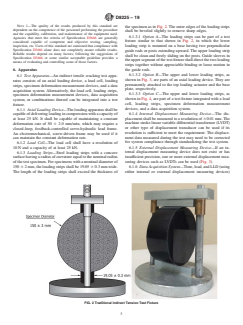
6.1.3.1 Option A—The loading strips can be part of a test
Agencies that meet the criteria of Specification D3666 are generally
fixture similar to that shown in Fig. 2, in which the lower
considered capable of competent and objective testing, sampling,
inspection, etc. Users of this standard are cautioned that compliance with loading strip is mounted on a base having two perpendicular
Specification D3666 alone does not completely ensure reliable results.
guide rods or posts extending upward. The upper loading strip
Reliable results depend on many factors; following the suggestions of
shall be clean and freely sliding on the posts. Guide sleeves in
Specification D3666 or some similar acceptable guideline provides a
theuppersegmentofthetestfixtureshalldirectthetwoloading
means of evaluating and controlling some of those factors.
strips together without appreciable binding or loose motion in
6. Apparatus the guide rods.
6.1.3.2 Option B—The upper and lower loading strips, as
6.1 Test Apparatus—An indirect tensile cracking test appa-
shown in Fig. 3, are parts of an axial loading device. They are
ratus consists of an axial loading device, a load cell, loading
permanently attached to the top loading actuator and the base
strips, specimen deformation measurement devices, and a data
plate, respectively.
acquisition system. Alternatively, the load cell, loading strips,
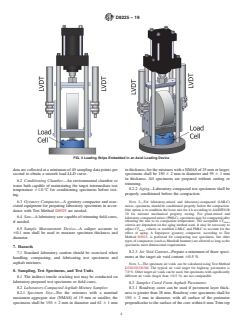
6.1.3.3 Option C—The upper and lower loading strips, as
specimen deformation measurement devices, data acquisition
shown in Fig. 4, are part of a test fixture integrated with a load
system, or combinations thereof can be integrated into a test
cell, loading strips, specimen deformation measurement
fixture.
devices, and a data acquisition system.
6.1.1 Axial Loading Device—Theloadingapparatusshallbe
6.1.4 Internal Displacement Measuring Device—The dis-
capableofdeliveringloadingincompressionwithacapacityof
placement shall be measured to a resolution of 60.01 mm.The
at least 25 kN. It shall be capable of maintaining a constant
machine stroke linear variable differential transformer (LVDT)
deformation rate of 50 6 2.0 mm/min, which may require a
or other type of displacement transducer can be used if its
closed-loop, feedback-controlled servo-hydraulic load frame.
resolution is sufficient to meet the requirement. The displace-
An electromechanical, screw-driven frame may be used if it
ment data measured during the test may need to be corrected
can maintain the constant deformation rate.
for system compliance through standardizing the test system.
6.1.2 Load Cell—The load cell shall have a resolution of
6.1.5 External Displacement Measuring Device—If an in-
10 N and a capacity of at least 25 kN.
ternal displacement measuring device does not exist or has
6.1.3 Loading Strips—Steel loading strips with a concave
insufficient precision, one or more external dis
...