

ASTM F1273-21
(Specification)Standard Specification for Tank Vent Flame Arresters
General Information
- Abstract
ABSTRACT
This specification provides the minimum requirements for design, construction, performance, and testing of two types of tank vent flame arrester (Type I and Type II). This specification is intended for flame arresters protecting systems containing vapors of flammable or combustible liquids with the specified vapor temperature. The defined test media can be used except where arresters protect systems handling vapors with the given value of maximum experimental safe gap (MESG). Flame arresters protecting such systems must be tested with appropriate media. The flame arrester housing, and other parts or bolting used for pressure retention, shall be constructed of the prescribed materials. Arrester, elements, gaskets, and seals shall be of materials resistant to attack by seawater and the liquids and vapors contained in the tank being protected. Nonmetallic materials, other than gaskets and seals, shall not be used in the construction of pressure-retaining components and nonmetallic gaskets and seals shall be noncombustible and suitable for the service intended. The possibility of galvanic corrosion shall be considered in the selection of materials. Requirements for flame arrester design and construction, housings, elements, threaded or flanged pipe connections, joints, and fastenings are detailed. Prototype testing such as corrosion test, performance test, endurance burn test, and flashback test shall be done.
SCOPE
1.1 This specification provides the minimum requirements for design, construction, performance, and testing of tank vent flame arresters.
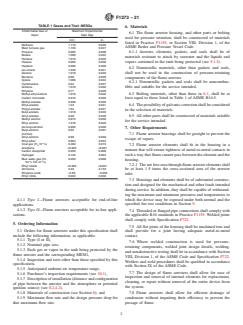
1.2 This specification is intended for flame arresters protecting systems containing vapors of flammable or combustible liquids where vapor temperatures do not exceed 60°C. The test media defined in 9.1.1 can be used except where arresters protect systems handling vapors with a maximum experimental safe gap (MESG) below 0.9 mm. Flame arresters protecting such systems must be tested with appropriate media (the same vapor or a media having a MESG no greater than the vapor). Various gases and their respective MESG are listed in Table 1.
1.3 The values stated in SI units are to be regarded as standard. The values given in parentheses after SI units are provided for information only and are not considered standard.
1.4 The following precautionary caveat pertains only to the test methods portions, Sections 8 and 9, of this specification: This standard does not purport to address all of the safety concerns, if any, associated with its use. It is the responsibility of the user of this standard to establish appropriate safety, health, and environmental practices and determine the applicability of regulatory limitations prior to use.
1.5 This standard should be used to measure and describe the properties of materials, products, or assemblies in response to heat and flame under controlled laboratory conditions and should not be used to describe or appraise the fire hazard or fire risk of materials, products, or assemblies under actual fire conditions. However, results of this test may be used as elements of a fire risk assessment which takes into account all of the factors which are pertinent to an assessment of the fire hazard of a particular end use
1.6 This international standard was developed in accordance with internationally recognized principles on standardization established in the Decision on Principles for the Development of International Standards, Guides and Recommendations issued by the World Trade Organization Technical Barriers to Trade (TBT) Committee.
- Status
- Published
- Publication Date
- 30-Apr-2021
- Technical Committee
- F25 - Ships and Marine Technology
- Drafting Committee
- F25.11 - Machinery and Piping Systems
Overview
ASTM F1273-21: Standard Specification for Tank Vent Flame Arresters provides detailed requirements for the design, construction, testing, and performance of flame arresters used in tank vent systems. Developed by ASTM International, this standard ensures that tank vent flame arresters are properly constructed to prevent the propagation of flames in systems containing vapors of flammable or combustible liquids. The standard addresses both end-of-line (Type I) and in-line (Type II) applications, focusing on safety, durability, and compatibility with marine and industrial systems.
Key Topics
- Design and Construction: Specifies the use of robust, corrosion-resistant materials for housings, fastenings, and elements to ensure long-term operation in challenging environments, including exposure to seawater and flammable vapors.
- Performance Requirements: Defines test methods such as corrosion, performance, endurance burn, and flashback testing, ensuring flame arrester effectiveness under controlled laboratory conditions.
- Material Selection: Recommends only metal (except for certain gaskets and seals) and mandates consideration of galvanic corrosion during material selection.
- Classification:
- Type I: For end-of-line tank vent applications
- Type II: For in-line installations within vent piping systems
- Testing Media: Outlines the use of specific gases or vapors for testing, defined by their maximum experimental safe gap (MESG), to reflect the hazards found in operational environments.
- Certification and Marking: Requires manufacturers to provide detailed installation, operation, and maintenance instructions, and to permanently mark devices for traceability and compliance.
Applications
Tank vent flame arresters specified by ASTM F1273-21 are used across a range of industries where storage tanks contain or process flammable or combustible liquids, including:
- Marine and Shipbuilding: Essential for shipboard piping, protecting cargo tanks in tankers from external ignition sources.
- Chemical and Petrochemical Facilities: Key for ensuring plant safety during the storage of volatile chemicals.
- Storage Tanks: Installed on atmospheric or low pressure tanks to prevent ignition of flammable vapors venting to the atmosphere.
- Industrial Process Systems: Utilized in facilities that process, store, or transfer flammable liquids, protecting process and personnel safety.
- Fuel Terminals and Distribution: Safeguard fuel terminals by preventing flame transmission through venting systems.
By complying with ASTM F1273-21, organizations can enhance fire safety, support regulatory compliance, and minimize risks of explosion or fire due to flashback or external ignition through vent piping.
Related Standards
Many international and industry-recognized standards are referenced or associated with ASTM F1273-21, including:
- ASTM F1155: Practice for selection and application of piping system materials.
- ASTM F722: Specification for welded joints in shipboard piping systems.
- ASME Boiler and Pressure Vessel Code (Section VIII & IX): Governs pressure vessel and welding requirements.
- ANSI/ASME B16.5: Pipe flanges and flanged fittings specifications.
- IEC 60079-1: Explosive atmospheres - Equipment protection by flameproof enclosures, which aligns with flame arrester applications.
- IMO MSC/Circ. 373/Rev. 1: International Maritime Organization guidelines for flame arrester performance on ships.
Utilizing ASTM F1273-21 in conjunction with these standards ensures a comprehensive approach to tank vent flame arrester implementation, servicing both marine and onshore industrial sectors.
Keywords: tank vent flame arrester, ASTM F1273-21, flammable liquid storage, combustible vapors, industrial safety, marine technology, fire hazard prevention, MESG, pressure vessel code, flame arrester testing.
Relations
- Refers
ASTM F1155-10(2019) - Standard Practice for Selection and Application of Piping System Materials - Effective Date
- 01-Dec-2019
- Refers
ASTM F1155-10(2015) - Standard Practice for Selection and Application of Piping System Materials - Effective Date
- 01-May-2015
- Effective Date
- 01-Nov-2014
- Effective Date
- 15-Dec-2010
- Effective Date
- 01-Nov-2008
- Refers
ASTM F1155-98(2004) - Standard Practice for Selection and Application of Piping System Materials - Effective Date
- 01-Nov-2004
- Effective Date
- 01-Nov-2004
- Effective Date
- 10-Apr-1998
- Effective Date
- 01-Jan-1993
Get Certified
Connect with accredited certification bodies for this standard

CIS Institut d.o.o.
Personal Protective Equipment (PPE) certification body. Notified Body NB-2890 for EU Regulation 2016/425 PPE.

Kiwa BDA Testing
Building and construction product certification.
Kmetijski inštitut Slovenije
Agricultural Institute of Slovenia. Soil testing, plant health, agricultural product analysis.
Sponsored listings
Frequently Asked Questions
ASTM F1273-21 is a technical specification published by ASTM International. Its full title is "Standard Specification for Tank Vent Flame Arresters". This standard covers: ABSTRACT This specification provides the minimum requirements for design, construction, performance, and testing of two types of tank vent flame arrester (Type I and Type II). This specification is intended for flame arresters protecting systems containing vapors of flammable or combustible liquids with the specified vapor temperature. The defined test media can be used except where arresters protect systems handling vapors with the given value of maximum experimental safe gap (MESG). Flame arresters protecting such systems must be tested with appropriate media. The flame arrester housing, and other parts or bolting used for pressure retention, shall be constructed of the prescribed materials. Arrester, elements, gaskets, and seals shall be of materials resistant to attack by seawater and the liquids and vapors contained in the tank being protected. Nonmetallic materials, other than gaskets and seals, shall not be used in the construction of pressure-retaining components and nonmetallic gaskets and seals shall be noncombustible and suitable for the service intended. The possibility of galvanic corrosion shall be considered in the selection of materials. Requirements for flame arrester design and construction, housings, elements, threaded or flanged pipe connections, joints, and fastenings are detailed. Prototype testing such as corrosion test, performance test, endurance burn test, and flashback test shall be done. SCOPE 1.1 This specification provides the minimum requirements for design, construction, performance, and testing of tank vent flame arresters. 1.2 This specification is intended for flame arresters protecting systems containing vapors of flammable or combustible liquids where vapor temperatures do not exceed 60°C. The test media defined in 9.1.1 can be used except where arresters protect systems handling vapors with a maximum experimental safe gap (MESG) below 0.9 mm. Flame arresters protecting such systems must be tested with appropriate media (the same vapor or a media having a MESG no greater than the vapor). Various gases and their respective MESG are listed in Table 1. 1.3 The values stated in SI units are to be regarded as standard. The values given in parentheses after SI units are provided for information only and are not considered standard. 1.4 The following precautionary caveat pertains only to the test methods portions, Sections 8 and 9, of this specification: This standard does not purport to address all of the safety concerns, if any, associated with its use. It is the responsibility of the user of this standard to establish appropriate safety, health, and environmental practices and determine the applicability of regulatory limitations prior to use. 1.5 This standard should be used to measure and describe the properties of materials, products, or assemblies in response to heat and flame under controlled laboratory conditions and should not be used to describe or appraise the fire hazard or fire risk of materials, products, or assemblies under actual fire conditions. However, results of this test may be used as elements of a fire risk assessment which takes into account all of the factors which are pertinent to an assessment of the fire hazard of a particular end use 1.6 This international standard was developed in accordance with internationally recognized principles on standardization established in the Decision on Principles for the Development of International Standards, Guides and Recommendations issued by the World Trade Organization Technical Barriers to Trade (TBT) Committee.
ABSTRACT This specification provides the minimum requirements for design, construction, performance, and testing of two types of tank vent flame arrester (Type I and Type II). This specification is intended for flame arresters protecting systems containing vapors of flammable or combustible liquids with the specified vapor temperature. The defined test media can be used except where arresters protect systems handling vapors with the given value of maximum experimental safe gap (MESG). Flame arresters protecting such systems must be tested with appropriate media. The flame arrester housing, and other parts or bolting used for pressure retention, shall be constructed of the prescribed materials. Arrester, elements, gaskets, and seals shall be of materials resistant to attack by seawater and the liquids and vapors contained in the tank being protected. Nonmetallic materials, other than gaskets and seals, shall not be used in the construction of pressure-retaining components and nonmetallic gaskets and seals shall be noncombustible and suitable for the service intended. The possibility of galvanic corrosion shall be considered in the selection of materials. Requirements for flame arrester design and construction, housings, elements, threaded or flanged pipe connections, joints, and fastenings are detailed. Prototype testing such as corrosion test, performance test, endurance burn test, and flashback test shall be done. SCOPE 1.1 This specification provides the minimum requirements for design, construction, performance, and testing of tank vent flame arresters. 1.2 This specification is intended for flame arresters protecting systems containing vapors of flammable or combustible liquids where vapor temperatures do not exceed 60°C. The test media defined in 9.1.1 can be used except where arresters protect systems handling vapors with a maximum experimental safe gap (MESG) below 0.9 mm. Flame arresters protecting such systems must be tested with appropriate media (the same vapor or a media having a MESG no greater than the vapor). Various gases and their respective MESG are listed in Table 1. 1.3 The values stated in SI units are to be regarded as standard. The values given in parentheses after SI units are provided for information only and are not considered standard. 1.4 The following precautionary caveat pertains only to the test methods portions, Sections 8 and 9, of this specification: This standard does not purport to address all of the safety concerns, if any, associated with its use. It is the responsibility of the user of this standard to establish appropriate safety, health, and environmental practices and determine the applicability of regulatory limitations prior to use. 1.5 This standard should be used to measure and describe the properties of materials, products, or assemblies in response to heat and flame under controlled laboratory conditions and should not be used to describe or appraise the fire hazard or fire risk of materials, products, or assemblies under actual fire conditions. However, results of this test may be used as elements of a fire risk assessment which takes into account all of the factors which are pertinent to an assessment of the fire hazard of a particular end use 1.6 This international standard was developed in accordance with internationally recognized principles on standardization established in the Decision on Principles for the Development of International Standards, Guides and Recommendations issued by the World Trade Organization Technical Barriers to Trade (TBT) Committee.
ASTM F1273-21 is classified under the following ICS (International Classification for Standards) categories: 13.220.01 - Protection against fire in general. The ICS classification helps identify the subject area and facilitates finding related standards.
ASTM F1273-21 has the following relationships with other standards: It is inter standard links to ASTM F1155-10(2019), ASTM F1155-10(2015), ASTM F722-82(2014), ASTM F1155-10, ASTM F722-82(2008), ASTM F1155-98(2004), ASTM F722-82(2004), ASTM F1155-98, ASTM F722-82(1998). Understanding these relationships helps ensure you are using the most current and applicable version of the standard.
ASTM F1273-21 is available in PDF format for immediate download after purchase. The document can be added to your cart and obtained through the secure checkout process. Digital delivery ensures instant access to the complete standard document.
Standards Content (Sample)
This international standard was developed in accordance with internationally recognized principles on standardization established in the Decision on Principles for the
Development of International Standards, Guides and Recommendations issued by the World Trade Organization Technical Barriers to Trade (TBT) Committee.
Designation:F1273 −21 An American National Standard
Standard Specification for
Tank Vent Flame Arresters
This standard is issued under the fixed designation F1273; the number immediately following the designation indicates the year of
original adoption or, in the case of revision, the year of last revision. A number in parentheses indicates the year of last reapproval. A
superscript epsilon (´) indicates an editorial change since the last revision or reapproval.
1. Scope mendations issued by the World Trade Organization Technical
Barriers to Trade (TBT) Committee.
1.1 This specification provides the minimum requirements
for design, construction, performance, and testing of tank vent
2. Referenced Documents
flame arresters.
2.1 ASTM Standards:
1.2 This specification is intended for flame arresters protect-
F722 Specification for Welded Joints for Shipboard Piping
ing systems containing vapors of flammable or combustible
Systems
liquids where vapor temperatures do not exceed 60°C. The test
F1155 Practice for Selection and Application of Piping
media defined in 9.1.1 can be used except where arresters
System Materials
protectsystemshandlingvaporswithamaximumexperimental
2.2 Other Documents:
safe gap (MESG) below 0.9 mm. Flame arresters protecting
ASME Boiler and Pressure Vessel Code Section VIII, Divi-
such systems must be tested with appropriate media (the same
sion 1
vapor or a media having a MESG no greater than the vapor). 3
ASME Boiler and Pressure Vessel Code Section IX
Various gases and their respective MESG are listed in Table 1.
ASME B16.5 Pipe Flanges and Flanged Fittings: NPS 1/2
1.3 The values stated in SI units are to be regarded as through NPS 24 Metric/Inch Standard
International Electrotechnical Commission: Publication
standard. The values given in parentheses after SI units are
provided for information only and are not considered standard. 60079-1 Explosive atmospheres — Part 1: Equipment
protection by flameproof enclosures ‘d’
1.4 The following precautionary caveat pertains only to the
test methods portions, Sections 8 and 9, of this specification:
3. Terminology
This standard does not purport to address all of the safety
3.1 Definitions:
concerns, if any, associated with its use. It is the responsibility
3.1.1 flame arrester, n—a device to prevent the passage of
of the user of this standard to establish appropriate safety,
flame in accordance with a specified performance standard. Its
health, and environmental practices and determine the appli-
flame arresting element is based on the principle of quenching.
cability of regulatory limitations prior to use.
1.5 This standard should be used to measure and describe 3.1.2 flame passage, n—the transmission of a flame through
the properties of materials, products, or assemblies in response
a flame arrester.
to heat and flame under controlled laboratory conditions and
3.1.3 flame speed, n—the speed at which a flame propagates
should not be used to describe or appraise the fire hazard or
along a pipe or other system.
fire risk of materials, products, or assemblies under actual fire
3.1.4 gasoline vapors, n—a nonleaded petroleum distillate
conditions. However, results of this test may be used as
consisting essentially of aliphatic hydrocarbon compounds
elements of a fire risk assessment which takes into account all
with a boiling range of approximately 65 to 75°C.
of the factors which are pertinent to an assessment of the fire
hazard of a particular end use
4. Classification
1.6 This international standard was developed in accor-
4.1 The two types of flame arresters covered in this speci-
dance with internationally recognized principles on standard-
fication are classified as follows:
ization established in the Decision on Principles for the
Development of International Standards, Guides and Recom-
For referenced ASTM standards, visit the ASTM website, www.astm.org, or
contact ASTM Customer Service at service@astm.org. For Annual Book of ASTM
Standards volume information, refer to the standard’s Document Summary page on
This specification is under the jurisdiction of ASTM Committee F25 on Ships the ASTM website.
and Marine Technology and is the direct responsibility of Subcommittee F25.11 on Available from American Society of Mechanical Engineers (ASME), ASME
Machinery and Piping Systems. International Headquarters, Two Park Ave., New York, NY 10016-5990, http://
Current edition approved May 1, 2021. Published June 2021. Originally www.asme.org.
approved in 1991. Last previous edition approved in 2013 as F1273 – 91 (2013). Available from International Electrotechnical Commission, 3 rue de Varembe,
DOI: 10.1520/F1273-21. Case Postale 131, CH-1211, Geneva 20, Switzerland.
Copyright © ASTM International, 100 Barr Harbor Drive, PO Box C700, West Conshohocken, PA 19428-2959. United States
F1273−21
TABLE 1 Gases and Their MESGs
6. Materials
Inflammable Gas or Maximum Experimental
6.1 The flame arrester housing, and other parts or bolting
Vapor Safe Gap
used for pressure retention, shall be constructed of materials
mm in.
listed in Practice F1155, or Section VIII, Division 1, of the
Methane 1.170 0.046
ASME Boiler and Pressure Vessel Code.
Blast furnace gas 1.193 0.047
Propane 0.965 0.038
6.1.1 Arrester, elements, gaskets, and seals shall be of
Butane 1.066 0.042
materials resistant to attack by seawater and the liquids and
Pentane 1.016 0.040
vapors contained in the tank being protected (see 5.1.3).
Hexane 0.965 0.038
Heptane 0.965 0.038
6.2 Nonmetallic materials, other than gaskets and seals,
Iso-octane 1.040 0.041
shall not be used in the construction of pressure-retaining
Decane 1.016 0.040
Benzene 0.99 0.039
components of the flame arrester.
Xylene 1.066 0.042
6.2.1 Nonmetallic gaskets and seals shall be noncombus-
Cyclohexane 0.94 0.037
Acetone 1.016 0.040 tible and suitable for the service intended.
Ethylene 0.71 0.028
6.3 Bolting materials, other than those in 6.1, shall be at
Methyl-ethyl-ketone 1.016 0.040
Carbon monoxide 0.915 0.036
least equal to those listed in Table 1 of ASME B16.5.
Methyl-acetate 0.990 0.039
6.4 Thepossibilityofgalvaniccorrosionshallbeconsidered
Ethyl-acetate 1.04 0.041
Propyl-acetate 1.04 0.041
in the selection of materials.
Butyl-acetate 1.016 0.040
Amyl-acetate 0.99 0.039 6.5 All other parts shall be constructed of materials suitable
Methyl alcohol 0.915 0.036
for the service intended.
Ethyl alcohol 1.016 0.040
Iso-butyl-alcohol 0.965 0.038
7. Other Requirements
Butyl-alcohol 0.94 0.037
(normal)
7.1 Flame arrester housings shall be gastight to prevent the
Amyl-alcohol 0.99 0.039
escape of vapors.
Ethyl-ether 0.864 0.034
Coal gas (H 57 %) 0.482 0.019
7.2 Flame arrester elements shall fit in the housing in a
Acetylene <0.025 <0.001
manner that will ensure tightness of metal-to-metal contacts in
Carbon disulphide 0.203 0.008
Hydrogen 0.102 0.004 such a way that flame cannot pass between the element and the
Blue water gas (H 0.203 0.008
housing.
53%CO47%)
7.2.1 The net free area through flame arrester elements shall
Ethyl nitrate <0.025 <0.001
Ammonia 3.33 0.133 be at least 1.5 times the cross-sectional area of the arrester
Ethylene oxide ;0.65 ;0.026
inlet.
Ethyl nitrite 0.922 0.038
7.3 Housings and elements shall be of substantial construc-
tion and designed for the mechanical and other loads intended
during service. In addition, they shall be capable of withstand-
ing the maximum and minimum pressures and temperatures to
which the device may be exposed under both normal and the
4.1.1 Type I—Flame arresters acceptable for end-of-line
specified fire test conditions in Section 9.
applications.
4.1.2 Type II—Flame arresters acceptable for in-line appli-
7.4 Threaded or flanged pipe connections shall comply with
cations.
the applicable B16 standards in Practice F1155. Welded joints
shall comply with Specification F722.
5. Ordering Information
7.5 All flat joints of the housing shall be machined true and
5.1 Orders for flame arresters under this specification shall
shall provide for a joint having adequate metal-to-metal
include the following information, as applicable:
contact.
5.1.1 Type (I or II),
7.6 Where welded construction is used for pressure-
5.1.2 Nominal pipe size,
retaining components, welded joint design details, welding,
5.1.3 Each gas or vapor in the tank being protected by the
and nondestructive testing shall be in accordance with Section
flame arrester and the corresponding MESG,
VIII, Division 1, of the ASME Code and Specification F722.
5.1.4 Inspection and tests other than those specified by this
Welders and weld procedures shall be qualified in accordance
specification,
with Section IX of the ASME Code.
5.1.5 Anticipated ambient air temperature range,
7.7 The design of flame arresters shall allow for ease of
5.1.6 Purchaser’s inspection requirements (see 10.1),
inspection and removal of internal elements for replacement,
5.1.7 Description of installation (distance and configuration
cleaning, or repair without removal of the entire device from
of pipe between the arrester and the atmosphere or potential
the system.
ignition source) (see 8.2.4.2),
5.1.8 Materials of construction (see Section 6), and 7.8 Flame arresters shall allow for efficient drainage of
5.1.9 Maximum flow rate and the design pressure drop for condensate without impairing their efficiency to prevent the
that maximum flow rate. passage of flame.
F1273−21
7.8.1 Where the design does not permit complete drainage movable parts shall operate properly and there shall be no
of condensate through its connection to the tank, the housing corrosion deposits that cannot be washed off.
shall be fitted with a plugged drain opening on the side of the 8.2.3 Performance characteristics as declared by the
atmospheric outlet of not less than ⁄2-in. nominal pipe size manufacturer, such as flow rates under both positive and
(NPS ⁄2). negative pressure, operating sensitivity, flow resistance, and
velocity, shall be demonstrated by appropriate tests.
7.9 All fastenings shall be protected against loosening.
8.2.4 Tank vent flame arresters shall be tested for endurance
7.10 Flame arresters shall be designed and constructed to
burn and flashback in accordance with the test procedures in
minimize the effect of fouling under normal operating condi-
Section 9. The following constraints apply:
tions.
8.2.4.1 Where a Type I flame arrester is provided with
cowls, weather hoods, deflectors, and so forth, it shall be tested
7.11 Flame arresters shall be capable of operating over
...
This document is not an ASTM standard and is intended only to provide the user of an ASTM standard an indication of what changes have been made to the previous version. Because
it may not be technically possible to adequately depict all changes accurately, ASTM recommends that users consult prior editions as appropriate. In all cases only the current version
of the standard as published by ASTM is to be considered the official document.
Designation: F1273 − 91 (Reapproved 2013) F1273 − 21 An American National Standard
Standard Specification for
Tank Vent Flame Arresters
This standard is issued under the fixed designation F1273; the number immediately following the designation indicates the year of
original adoption or, in the case of revision, the year of last revision. A number in parentheses indicates the year of last reapproval. A
superscript epsilon (´) indicates an editorial change since the last revision or reapproval.
1. Scope
1.1 This specification provides the minimum requirements for design, construction, performance, and testing of tank vent flame
arresters.
1.2 This specification is intended for flame arresters protecting systems containing vapors of flammable or combustible liquids
where vapor temperatures do not exceed 60°C. The test media defined in 9.1.1 can be used except where arresters protect systems
handling vapors with a maximum experimental safe gap (MESG) below 0.9 mm. Flame arresters protecting such systems must
be tested with appropriate media (the same vapor or a media having a MESG no greater than the vapor). Various gases and their
respective MESG are listed in Table 1.
NOTE 1—Flame arresters meeting this specification also comply with the minimum requirements of the International Maritime Organization, Maritime
Safety Committee Circular No. 373 (MSC/Circ. 373/Rev. 1).
1.3 The values stated in either inch-pound or SI units are to be regarded as the standard. The values given in parentheses are for
information only.after SI units are provided for information only and are not considered standard.
1.4 The following precautionary caveat pertains only to the test methods portions, Sections 8 and 9, of this specification: This
standard does not purport to address all of the safety concerns, if any, associated with its use. It is the responsibility of the user
of this standard to establish appropriate safety, health, and environmental practices and determine the applicability of regulatory
limitations prior to use.
1.5 This standard should be used to measure and describe the properties of materials, products, or assemblies in response to heat
and flame under controlled laboratory conditions and should not be used to describe or appraise the fire hazard or fire risk of
materials, products, or assemblies under actual fire conditions. However, results of this test may be used as elements of a fire risk
assessment which takes into account all of the factors which are pertinent to an assessment of the fire hazard of a particular end
use
1.6 This international standard was developed in accordance with internationally recognized principles on standardization
established in the Decision on Principles for the Development of International Standards, Guides and Recommendations issued
by the World Trade Organization Technical Barriers to Trade (TBT) Committee.
This specification is under the jurisdiction of ASTM Committee F25 on Ships and Marine Technology and is the direct responsibility of Subcommittee F25.11 on
Machinery and Piping Systems.
Current edition approved Oct. 1, 2013May 1, 2021. Published October 2013June 2021. Originally approved in 1991. Last previous edition approved in 20072013 as F1273
– 91 (2007).(2013). DOI: 10.1520/F1273-91R13.10.1520/F1273-21.
Copyright © ASTM International, 100 Barr Harbor Drive, PO Box C700, West Conshohocken, PA 19428-2959. United States
F1273 − 21
TABLE 1 Gases and Their MESGs
Inflammable Gas or Maximum Experimental
Vapor Safe Gap
mm in.
Methane 1.170 0.046
Blast furnace gas 1.193 0.047
Propane 0.965 0.038
Butane 1.066 0.042
Pentane 1.016 0.040
Hexane 0.965 0.038
Heptane 0.965 0.038
Iso-octane 1.040 0.041
Decane 1.016 0.040
Benzene 0.99 0.039
Xylene 1.066 0.042
Cyclohexane 0.94 0.037
Acetone 1.016 0.040
Ethylene 0.71 0.028
Methyl-ethyl-ketone 1.016 0.040
Carbon monoxide 0.915 0.036
Methyl-acetate 0.990 0.039
Ethyl-acetate 1.04 0.041
Propyl-acetate 1.04 0.041
Butyl-acetate 1.016 0.040
Amyl-acetate 0.99 0.039
Methyl alcohol 0.915 0.036
Ethyl alcohol 1.016 0.040
Iso-butyl-alcohol 0.965 0.038
Butyl-alcohol 0.94 0.037
(normal)
Amyl-alcohol 0.99 0.039
Ethyl-ether 0.864 0.034
Coal gas (H 57 %) 0.482 0.019
Acetylene <0.025 <0.001
Carbon disulphide 0.203 0.008
Hydrogen 0.102 0.004
Blue water gas (H 0.203 0.008
53 % CO 47 %)
Ethyl nitrate <0.025 <0.001
Ammonia 3.33 0.133
Ethylene oxide ;0.65 ;0.026
Ethyl nitrite 0.922 0.038
2. Referenced Documents
2.1 ASTM Standards:
F722 Specification for Welded Joints for Shipboard Piping Systems
F1155 Practice for Selection and Application of Piping System Materials
2.2 ANSI Standard:
B16.5 Pipe Flanges and Flanged Fittings
2.2 Other Documents:
ASME Boiler and Pressure Vessel Code:Code Section VIII, Division 1, Pressure Vessels1
ASME Boiler and Pressure Vessel Code:Code Section IX, Welding and Brazing QualificationsIX
International Maritime Organization, Maritime Safety Committee: MSC/Circ. 373/Rev. 1ASME B16.5 Revised Standards for
the Design, Testing and Locating of Devices to Prevent the Passage of Flame into Cargo Tanks in TankersPipe Flanges and
Flanged Fittings: NPS 1/2 through NPS 24 Metric/Inch Standard
International Electrotechnical Commission: Publication 60079-1 International Electrotechnical Commission: Publication 79-
1Electrical Apparatus for Explosive Gas AtmospheresExplosive atmospheres — Part 1: Equipment protection by flameproof
enclosures ‘d’
For referenced ASTM standards, visit the ASTM website, www.astm.org, or contact ASTM Customer Service at service@astm.org. For Annual Book of ASTM Standards
volume information, refer to the standard’sstandard’s Document Summary page on the ASTM website.
Available from American National Standards Institute (ANSI), 25 W. 43rd St., 4th Floor, New York, NY 10036, http://www.ansi.org.
Available from American Society of Mechanical Engineers (ASME), ASME International Headquarters, Two Park Ave., New York, NY 10016-5990, http://
www.asme.org.
Available from International Electrotechnical Commission, 3 rue de Varembe, Case Postale 131, CH-1211, Geneva 20, Switzerland.
F1273 − 21
3. Terminology
3.1 Definitions:
3.1.1 flame arrester—arrester, n—a device to prevent the passage of flame in accordance with a specified performance standard.
Its flame arresting element is based on the principle of quenching.
3.1.2 flame passage—passage, n—the transmission of a flame through a flame arrester.
3.1.3 flame speed—speed, n—the speed at which a flame propagates along a pipe or other system.
3.1.4 gasoline vapors—vapors, n—a nonleaded petroleum distillate consisting essentially of aliphatic hydrocarbon compounds
with a boiling range of approximately 65 to 75°C.
4. Classification
4.1 The two types of flame arresters covered in this specification are classified as follows:
4.1.1 Type I—Flame arresters acceptable for end-of-line applications.
4.1.2 Type II—Flame arresters acceptable for in-line applications.
5. Ordering Information
5.1 Orders for flame arresters under this specification shall include the following information, as applicable:
5.1.1 Type (I or II),
5.1.2 Nominal pipe size,
5.1.3 Each gas or vapor in the tank being protected by the flame arrester and the corresponding MESG,
5.1.4 Inspection and tests other than those specified by this specification,
5.1.5 Anticipated ambient air temperature range,
5.1.6 Purchaser’sPurchaser’s inspection requirements (see 10.1),
5.1.7 Description of installation (distance and configuration of pipe between the arrester and the atmosphere or potential ignition
source) (see 8.2.4.2),
5.1.8 Materials of construction (see Section 6), and
5.1.9 Maximum flow rate and the design pressure drop for that maximum flow rate.
6. Materials
6.1 The flame arrester housing, and other parts or bolting used for pressure retention, shall be constructed of materials listed in
Practice F1155, or Section VIII, Division 1, of the ASME Boiler and Pressure Vessel Code.
6.1.1 Arrester, elements, gaskets, and seals shall be of materials resistant to attack by seawater and the liquids and vapors
contained in the tank being protected (see 5.1.3).
6.2 Nonmetallic materials, other than gaskets and seals, shall not be used in the construction of pressure-retaining components of
the flame arrester.
6.2.1 Nonmetallic gaskets and seals shall be noncombustible and suitable for the service intended.
F1273 − 21
6.3 Bolting materials, other than those in 6.1, shall be at least equal to those listed in Table 1 of ANSIASME B16.5.
6.4 The possibility of galvanic corrosion shall be considered in the selection of materials.
6.5 All other parts shall be constructed of materials suitable for the service intended.
7. Other Requirements
7.1 Flame arrester housings shall be gastight to prevent the escape of vapors.
7.2 Flame arrester elements shall fit in the housing in a manner that will ensure tightness of metal-to-metal contacts in such a way
that flame cannot pass between the element and the housing.
7.2.1 The net free area through flame arrester elements shall be at least 1.5 times the cross-sectional area of the arrester inlet.
7.3 Housings and elements shall be of substantial construction and designed for the mechanical and other loads intended during
service. In addition, they shall be capable of withstanding the maximum and minimum pressures and temperatures to which the
device may be exposed under both normal and the specified fire test conditions in Section 9.
7.4 Threaded or flanged pipe connections shall comply with the applicable B16 standards in Practice F1155. Welded joints shall
comply with Specification F722.
7.5 All flat joints of the housing shall be machined true and shall provide for a joint having adequate metal-to-metal contact.
7.6 Where welded construction is used for pressure-retaining components, welded joint design details, welding, and nondestruc-
tive testing shall be in accordance with Section VIII, Division 1, of the ASME Code and Specification F722. Welders and weld
procedures shall be qualified in accordance with Section IX of the ASME Code.
7.7 The design of flame arresters shall allow for ease of inspection and removal of internal elements for replacement, cleaning,
or repair without removal of the entire device from the system.
7.8 Flame arresters shall allow for efficient drainage of condensate without impairing their efficiency to prevent the passage of
flame.
7.8.1 Where the design does not permit complete drainage of condensate through its connection to the tank, the housing shall be
1 1
fitted with a plugged drain opening on the side of the atmospheric outlet of not less than ⁄2-in. nominal pipe size (NPS ⁄2).
7.9 All fastenings shall be protected against loosening.
7.10 Flame arresters shall be designed and constructed to minimize the effect of fouling under normal operating conditions.
7.11 Flame arresters shall be capable of operating over the full range of ambient air temperatures anticipated.
7.12 End-of-line flame arresters shall be so constructed as to direct the efflux vertically upward.
7.13 Flame arresters shall be of first class workmanship and free from imperfections
...