

ASTM E2653-23
(Practice)Standard Practice for Conducting an Interlaboratory Study to Determine Precision Estimates for a Test Method with Fewer Than Six Participating Laboratories
General Information
- Abstract
SIGNIFICANCE AND USE
5.1 ASTM regulations require precision statements in all test methods in terms of repeatability and reproducibility. This practice is used when the number of participating laboratories or materials being tested, or both, in a precision study is less than the number specified by Practice E691. When possible, it is strongly recommended that a full Practice E691 standard protocol be followed to determine test method precision. Precision results produced by the procedures presented in this standard will not have the same degree of accuracy as results generated by a full Practice E691 protocol. This procedure will allow for the development of useful precision results when a full complement of laboratories is not available for interlaboratory testing.
5.2 This practice is based on recommendations for interlaboratory studies and data analysis presented in Practice E691. This practice does not concern itself with the development of test methods but with a standard means for gathering information and treating the data needed for developing a precision statement for a test method when a complete Practice E691 interlaboratory study and data analysis are not possible.
SCOPE
1.1 This practice describes the techniques for planning, conducting, analyzing, and treating results of an interlaboratory study (ILS) for estimating the precision of a test method when fewer than six laboratories are available to meet the recommended minimum requirements of Practice E691. Data obtained from an interlaboratory study are useful in identifying variables that require modifications for improving test method performance and precision.
1.2 Precision estimates developed using this practice will not be statistically equivalent to precision estimates produced by Practice E691 because a small number of laboratories are used. The smaller number of participating laboratories will seriously reduce the value of precision estimates reported by this practice. However, under circumstances where only a limited number of laboratories are available to participate in an ILS, precision estimates developed by this practice will provide the user with useful information concerning precision for a test method.
1.3 A minimum of three qualified laboratories is required for conducting an ILS using this practice. If six or more laboratories are available to participate in an ILS for a given test method, Practice E691 shall be used for conducting the ILS.
1.4 Since the primary purpose of this practice is the development of the information needed for a precision statement, the experimental design in this practice will not be optimum for evaluating all materials, test methods, or as a tool for individual laboratory analysis.
1.5 Because of the reduced number of participating laboratories, a Laboratory Monitor shall be used in the ILS. See Guide E2335.
1.6 Field of Application—This practice is concerned with test methods that yield numerical values or a series of numerical values for different properties associated with the test method. The numerical values mentioned above are typically the result of calculations from a set of measurements.
1.7 This practice includes design information suitable for use with the development of interlaboratory studies for test methods that have categorization (go-no-go) allocation test results. However, it does not provide a recommended statistical practice for evaluating the go-no-go data.
1.8 This practice cannot be used to provide quantitative measures.
1.9 This practice is issued under Committee E05, but it is generic in its statistical approach such that it is applicable to any other method.
1.10 This standard does not purport to address all of the safety concerns, if any, associated with its use. It is the responsibility of the user of this standard to establish appropriate safety, health, and environmental practices and determine the applicability of regulatory limitations prior to ...
- Status
- Published
- Publication Date
- 28-Feb-2023
- Technical Committee
- E05 - Fire Standards
- Drafting Committee
- E05.31 - Terminology and Services / Functions
Buy Documents
ASTM E2653-23 - Standard Practice for Conducting an Interlaboratory Study to Determine Precision Estimates for a Test Method with Fewer Than Six Participating Laboratories
REDLINE ASTM E2653-23 - Standard Practice for Conducting an Interlaboratory Study to Determine Precision Estimates for a Test Method with Fewer Than Six Participating Laboratories
Overview
ASTM E2653-23: Standard Practice for Conducting an Interlaboratory Study to Determine Precision Estimates for a Test Method with Fewer Than Six Participating Laboratories provides guidance for laboratories and organizations required to estimate the precision of a test method when there is insufficient participation for a full-scale interlaboratory study as specified in ASTM Practice E691. This standard enables users to generate repeatability and reproducibility data using three to five participating laboratories, allowing for the development of meaningful precision statements that comply with ASTM’s requirements.
Key Topics
- Applicability with Limited Laboratories: Designed for situations where fewer than six qualified laboratories are available, making a full E691 protocol unfeasible.
- Estimation of Precision: Focuses on gathering and analyzing data to produce repeatability and reproducibility estimates for test methods.
- Experimental Design: Offers a simplified interlaboratory study (ILS) approach, emphasizing careful experimental planning, execution, and analysis.
- Laboratory Monitor Requirement: Mandates the inclusion of a Laboratory Monitor to ensure quality and protocol adherence in the reduced-laboratory environment.
- Pilot and Full-Scale Runs: Recommends preliminary laboratory evaluation to ensure participating labs can properly execute the method before the main ILS.
- Data Analysis: Employs statistical procedures to estimate within-laboratory (repeatability) and between-laboratory (reproducibility) variability, with guidelines for identifying and addressing outliers.
- Limitations: Precision estimates derived from this practice are less robust compared to those from full-scale studies per E691 due to smaller sample sizes.
- Scope of Use: While issued by ASTM Committee E05 (Fire Standards), the statistical methodology is broadly applicable to any numerical test method.
Applications
ASTM E2653-23 holds practical value in several scenarios:
- Test Method Development: Provides a structured way to obtain required precision data for test methods, especially in specialized fields where limited laboratories are available.
- Fire Testing and Beyond: While originally developed under the purview of fire test methods, its generic statistical approach fits a variety of scientific and industrial domains that require repeatability and reproducibility estimates.
- Supporting Regulatory Compliance: Assists organizations in generating the precision statements demanded by standards bodies and regulatory agencies, even when limited to a smaller number of laboratories.
- Quality Assurance: Helps identify sources of variability and opportunities for improving test method accuracy and consistency.
- Interim Solution: Serves as a temporary approach for producing useful precision data pending the possibility of a full E691-compliant interlaboratory study.
Related Standards
For best practice and comprehensive precision analysis, ASTM E2653-23 should be used alongside related standards:
- ASTM E691: Standard Practice for Conducting an Interlaboratory Study to Determine the Precision of a Test Method (preferred when six or more labs are available)
- ASTM E177: Practice for Use of the Terms Precision and Bias in ASTM Test Methods
- ASTM E178: Practice for Dealing with Outlying Observations
- ASTM E1169: Practice for Conducting Ruggedness Tests
- ASTM E2335: Guide for Laboratory Monitors
- ASTM E176/E456: Terminology standards relevant to fire testing, quality, and statistics
Keywords: interlaboratory study, precision estimates, repeatability, reproducibility, ASTM E2653, test method, laboratory precision, practice E691 alternative, laboratory monitor, statistical analysis, quality assurance
By leveraging ASTM E2653-23, laboratories and testing organizations can ensure reliable estimation of test method precision and maintain compliance, even when resources are limited, thereby strengthening the integrity and credibility of their test results.
Relations
- Effective Date
- 01-Jan-2024
- Effective Date
- 01-Apr-2022
- Effective Date
- 15-Dec-2018
- Effective Date
- 01-Sep-2018
- Effective Date
- 01-Mar-2018
- Effective Date
- 01-Oct-2017
- Effective Date
- 01-Oct-2017
- Effective Date
- 01-Oct-2017
- Effective Date
- 01-Oct-2017
- Effective Date
- 01-Jun-2016
- Effective Date
- 01-Aug-2015
- Effective Date
- 01-Aug-2015
- Effective Date
- 01-Feb-2015
- Effective Date
- 01-Oct-2014
- Effective Date
- 15-Aug-2014
Buy Documents
ASTM E2653-23 - Standard Practice for Conducting an Interlaboratory Study to Determine Precision Estimates for a Test Method with Fewer Than Six Participating Laboratories
REDLINE ASTM E2653-23 - Standard Practice for Conducting an Interlaboratory Study to Determine Precision Estimates for a Test Method with Fewer Than Six Participating Laboratories
Get Certified
Connect with accredited certification bodies for this standard

CIS Institut d.o.o.
Personal Protective Equipment (PPE) certification body. Notified Body NB-2890 for EU Regulation 2016/425 PPE.

Kiwa BDA Testing
Building and construction product certification.
Kmetijski inštitut Slovenije
Agricultural Institute of Slovenia. Soil testing, plant health, agricultural product analysis.
Sponsored listings
Frequently Asked Questions
ASTM E2653-23 is a standard published by ASTM International. Its full title is "Standard Practice for Conducting an Interlaboratory Study to Determine Precision Estimates for a Test Method with Fewer Than Six Participating Laboratories". This standard covers: SIGNIFICANCE AND USE 5.1 ASTM regulations require precision statements in all test methods in terms of repeatability and reproducibility. This practice is used when the number of participating laboratories or materials being tested, or both, in a precision study is less than the number specified by Practice E691. When possible, it is strongly recommended that a full Practice E691 standard protocol be followed to determine test method precision. Precision results produced by the procedures presented in this standard will not have the same degree of accuracy as results generated by a full Practice E691 protocol. This procedure will allow for the development of useful precision results when a full complement of laboratories is not available for interlaboratory testing. 5.2 This practice is based on recommendations for interlaboratory studies and data analysis presented in Practice E691. This practice does not concern itself with the development of test methods but with a standard means for gathering information and treating the data needed for developing a precision statement for a test method when a complete Practice E691 interlaboratory study and data analysis are not possible. SCOPE 1.1 This practice describes the techniques for planning, conducting, analyzing, and treating results of an interlaboratory study (ILS) for estimating the precision of a test method when fewer than six laboratories are available to meet the recommended minimum requirements of Practice E691. Data obtained from an interlaboratory study are useful in identifying variables that require modifications for improving test method performance and precision. 1.2 Precision estimates developed using this practice will not be statistically equivalent to precision estimates produced by Practice E691 because a small number of laboratories are used. The smaller number of participating laboratories will seriously reduce the value of precision estimates reported by this practice. However, under circumstances where only a limited number of laboratories are available to participate in an ILS, precision estimates developed by this practice will provide the user with useful information concerning precision for a test method. 1.3 A minimum of three qualified laboratories is required for conducting an ILS using this practice. If six or more laboratories are available to participate in an ILS for a given test method, Practice E691 shall be used for conducting the ILS. 1.4 Since the primary purpose of this practice is the development of the information needed for a precision statement, the experimental design in this practice will not be optimum for evaluating all materials, test methods, or as a tool for individual laboratory analysis. 1.5 Because of the reduced number of participating laboratories, a Laboratory Monitor shall be used in the ILS. See Guide E2335. 1.6 Field of Application—This practice is concerned with test methods that yield numerical values or a series of numerical values for different properties associated with the test method. The numerical values mentioned above are typically the result of calculations from a set of measurements. 1.7 This practice includes design information suitable for use with the development of interlaboratory studies for test methods that have categorization (go-no-go) allocation test results. However, it does not provide a recommended statistical practice for evaluating the go-no-go data. 1.8 This practice cannot be used to provide quantitative measures. 1.9 This practice is issued under Committee E05, but it is generic in its statistical approach such that it is applicable to any other method. 1.10 This standard does not purport to address all of the safety concerns, if any, associated with its use. It is the responsibility of the user of this standard to establish appropriate safety, health, and environmental practices and determine the applicability of regulatory limitations prior to ...
SIGNIFICANCE AND USE 5.1 ASTM regulations require precision statements in all test methods in terms of repeatability and reproducibility. This practice is used when the number of participating laboratories or materials being tested, or both, in a precision study is less than the number specified by Practice E691. When possible, it is strongly recommended that a full Practice E691 standard protocol be followed to determine test method precision. Precision results produced by the procedures presented in this standard will not have the same degree of accuracy as results generated by a full Practice E691 protocol. This procedure will allow for the development of useful precision results when a full complement of laboratories is not available for interlaboratory testing. 5.2 This practice is based on recommendations for interlaboratory studies and data analysis presented in Practice E691. This practice does not concern itself with the development of test methods but with a standard means for gathering information and treating the data needed for developing a precision statement for a test method when a complete Practice E691 interlaboratory study and data analysis are not possible. SCOPE 1.1 This practice describes the techniques for planning, conducting, analyzing, and treating results of an interlaboratory study (ILS) for estimating the precision of a test method when fewer than six laboratories are available to meet the recommended minimum requirements of Practice E691. Data obtained from an interlaboratory study are useful in identifying variables that require modifications for improving test method performance and precision. 1.2 Precision estimates developed using this practice will not be statistically equivalent to precision estimates produced by Practice E691 because a small number of laboratories are used. The smaller number of participating laboratories will seriously reduce the value of precision estimates reported by this practice. However, under circumstances where only a limited number of laboratories are available to participate in an ILS, precision estimates developed by this practice will provide the user with useful information concerning precision for a test method. 1.3 A minimum of three qualified laboratories is required for conducting an ILS using this practice. If six or more laboratories are available to participate in an ILS for a given test method, Practice E691 shall be used for conducting the ILS. 1.4 Since the primary purpose of this practice is the development of the information needed for a precision statement, the experimental design in this practice will not be optimum for evaluating all materials, test methods, or as a tool for individual laboratory analysis. 1.5 Because of the reduced number of participating laboratories, a Laboratory Monitor shall be used in the ILS. See Guide E2335. 1.6 Field of Application—This practice is concerned with test methods that yield numerical values or a series of numerical values for different properties associated with the test method. The numerical values mentioned above are typically the result of calculations from a set of measurements. 1.7 This practice includes design information suitable for use with the development of interlaboratory studies for test methods that have categorization (go-no-go) allocation test results. However, it does not provide a recommended statistical practice for evaluating the go-no-go data. 1.8 This practice cannot be used to provide quantitative measures. 1.9 This practice is issued under Committee E05, but it is generic in its statistical approach such that it is applicable to any other method. 1.10 This standard does not purport to address all of the safety concerns, if any, associated with its use. It is the responsibility of the user of this standard to establish appropriate safety, health, and environmental practices and determine the applicability of regulatory limitations prior to ...
ASTM E2653-23 is classified under the following ICS (International Classification for Standards) categories: 13.220.01 - Protection against fire in general. The ICS classification helps identify the subject area and facilitates finding related standards.
ASTM E2653-23 has the following relationships with other standards: It is inter standard links to ASTM E176-24, ASTM E456-13a(2022)e1, ASTM E176-18a, ASTM E1169-18, ASTM E176-18, ASTM E456-13A(2017)e1, ASTM E456-13A(2017)e3, ASTM E1169-17e1, ASTM E1169-17, ASTM E178-16, ASTM E176-15a, ASTM E176-15ae1, ASTM E176-15, ASTM E176-14c, ASTM E176-14b. Understanding these relationships helps ensure you are using the most current and applicable version of the standard.
ASTM E2653-23 is available in PDF format for immediate download after purchase. The document can be added to your cart and obtained through the secure checkout process. Digital delivery ensures instant access to the complete standard document.
Standards Content (Sample)
This international standard was developed in accordance with internationally recognized principles on standardization established in the Decision on Principles for the
Development of International Standards, Guides and Recommendations issued by the World Trade Organization Technical Barriers to Trade (TBT) Committee.
Designation: E2653 − 23 An American National Standard
Standard Practice for
Conducting an Interlaboratory Study to Determine Precision
Estimates for a Test Method with Fewer Than Six
Participating Laboratories
This standard is issued under the fixed designation E2653; the number immediately following the designation indicates the year of
original adoption or, in the case of revision, the year of last revision. A number in parentheses indicates the year of last reapproval. A
superscript epsilon (´) indicates an editorial change since the last revision or reapproval.
1. Scope 1.6 Field of Application—This practice is concerned with
test methods that yield numerical values or a series of
1.1 This practice describes the techniques for planning,
numerical values for different properties associated with the
conducting, analyzing, and treating results of an interlaboratory
test method. The numerical values mentioned above are
study (ILS) for estimating the precision of a test method when
typically the result of calculations from a set of measurements.
fewer than six laboratories are available to meet the recom-
1.7 This practice includes design information suitable for
mended minimum requirements of Practice E691. Data ob-
use with the development of interlaboratory studies for test
tained from an interlaboratory study are useful in identifying
methods that have categorization (go-no-go) allocation test
variables that require modifications for improving test method
results. However, it does not provide a recommended statistical
performance and precision.
practice for evaluating the go-no-go data.
1.2 Precision estimates developed using this practice will
1.8 This practice cannot be used to provide quantitative
not be statistically equivalent to precision estimates produced
measures.
by Practice E691 because a small number of laboratories are
used. The smaller number of participating laboratories will
1.9 This practice is issued under Committee E05, but it is
seriously reduce the value of precision estimates reported by
generic in its statistical approach such that it is applicable to
this practice. However, under circumstances where only a
any other method.
limited number of laboratories are available to participate in an
1.10 This standard does not purport to address all of the
ILS, precision estimates developed by this practice will pro-
safety concerns, if any, associated with its use. It is the
vide the user with useful information concerning precision for
responsibility of the user of this standard to establish appro-
a test method.
priate safety, health, and environmental practices and deter-
mine the applicability of regulatory limitations prior to use.
1.3 A minimum of three qualified laboratories is required
1.11 This international standard was developed in accor-
for conducting an ILS using this practice. If six or more
dance with internationally recognized principles on standard-
laboratories are available to participate in an ILS for a given
ization established in the Decision on Principles for the
test method, Practice E691 shall be used for conducting the
Development of International Standards, Guides and Recom-
ILS.
mendations issued by the World Trade Organization Technical
1.4 Since the primary purpose of this practice is the devel-
Barriers to Trade (TBT) Committee.
opment of the information needed for a precision statement, the
experimental design in this practice will not be optimum for
2. Referenced Documents
evaluating all materials, test methods, or as a tool for individual
2.1 ASTM Standards:
laboratory analysis.
E176 Terminology of Fire Standards
1.5 Because of the reduced number of participating
E177 Practice for Use of the Terms Precision and Bias in
laboratories, a Laboratory Monitor shall be used in the ILS. See
ASTM Test Methods
Guide E2335.
E178 Practice for Dealing With Outlying Observations
E456 Terminology Relating to Quality and Statistics
E691 Practice for Conducting an Interlaboratory Study to
This practice is under the jurisdiction of ASTM Committee E05 on Fire
Standards and is the direct responsibility of Subcommittee E05.31 on Terminology
and Services / Functions. For referenced ASTM standards, visit the ASTM website, www.astm.org, or
Current edition approved March 1, 2023. Published March 2023. Originally contact ASTM Customer Service at service@astm.org. For Annual Book of ASTM
approved in 2008. Last previous edition approved in 2021 as E2653 – 21. DOI: Standards volume information, refer to the standard’s Document Summary page on
10.1520/E2653-23. the ASTM website.
Copyright © ASTM International, 100 Barr Harbor Drive, PO Box C700, West Conshohocken, PA 19428-2959. United States
E2653 − 23
Determine the Precision of a Test Method 4.4 Parties conducting an interlaboratory precision study of
E1169 Practice for Conducting Ruggedness Tests a test method will acquire participation agreements with as
E2335 Guide for Laboratory Monitors many laboratories as possible that are willing to take part in the
interlaboratory study and have the capability to run the test
method of interest. A minimum of three laboratories shall
3. Terminology
participate in the precision study. Precision results will increase
3.1 Definitions—For formal definitions of statistical terms,
in quality with a larger number of participating laboratories.
see Terminology E456. For formal definitions of fire terms, see
4.5 The types of materials and number of test specimens
Terminology E176.
shall be selected for the interlaboratory study. No less than
3.2 Definitions of Terms Specific to This Standard:
three test specimens shall be selected for the interlaboratory
3.2.1 protocol, n—in this practice, directions given to the
study, and they shall be selected to reflect the range of
laboratories for conducting the interlaboratory study (ILS).
performance of test specimens normally evaluated by the test
3.2.2 repeatability (of results and measurements),
method. A minimum of three replicates shall be tested for each
n—quantitative expression of the random variability associated
test material selected. If a standard reference material is
with successive measurements of the same measurand carried
available for the test method, the material shall be included as
out subject to all of the following conditions: the same
a specimen in the interlaboratory study. If a standard reference
measurement procedure, the same observer, the same measur-
material is not available, a test specimen that consistently
ing instrument, used under the same conditions, the same
produces low variability test results shall be selected as a
location, and repetition over a short period of time.
reference material for the interlaboratory study.
3.2.2.1 Discussion—Repeatability deals with results in a
5. Significance and Use
single laboratory while reproducibility deals with results ob-
tained in different laboratories.
5.1 ASTM regulations require precision statements in all
test methods in terms of repeatability and reproducibility. This
3.2.3 reproducibility (of results of measurements),
practice is used when the number of participating laboratories
n—quantitative expression of the random variability associated
or materials being tested, or both, in a precision study is less
with successive measurements of the same measurand carried
than the number specified by Practice E691. When possible, it
out by operators working in different laboratories, each obtain-
is strongly recommended that a full Practice E691 standard
ing single results on identical test material when applying the
protocol be followed to determine test method precision.
same method.
Precision results produced by the procedures presented in this
3.2.3.1 Discussion—Repeatability deals with results in a
standard will not have the same degree of accuracy as results
single laboratory while reproducibility deals with results ob-
generated by a full Practice E691 protocol. This procedure will
tained in different laboratories.
allow for the development of useful precision results when a
3.2.4 test method, n—in this practice, description of the
full complement of laboratories is not available for interlabo-
actual measurement process as well as written description of
ratory testing.
the process.
5.2 This practice is based on recommendations for interla-
3.3 For further discussion of the terms discussed above, see
boratory studies and data analysis presented in Practice E691.
Practice E177 and the formal definitions in Terminology E456.
This practice does not concern itself with the development of
test methods but with a standard means for gathering informa-
4. Summary of Practice
tion and treating the data needed for developing a precision
statement for a test method when a complete Practice E691
4.1 The procedure presented in this practice consists of
interlaboratory study and data analysis are not possible.
three basic steps: planning the interlaboratory study, guiding
the testing phase of the study, and analyzing the test result data.
PLANNING THE ILS
The analysis evaluates the consistency of the data through the
use of numerical estimates of precision of the test method
6. Planning
pertaining to both within-laboratory repeatability and between-
6.1 Task Group—Either the task group that developed the
laboratory reproducibility.
test method or a special task group appointed for the purpose
4.2 Planning of the interlaboratory study will include a
must have overall responsibility for the ILS, including funding
review of the test procedure to be used in the interlaboratory
where appropriate, staffing, the design of the ILS, and decision-
study. This review will identify portions of the test method that
making with regard to questionable data. The task group shall
appear to contribute to a loss in precision. Special interlabora-
decide on the number of laboratories, materials, and test results
tory instructions or modifications to the test method wording
for each material. In addition, it shall specify any special
are made as needed to clarify these sections and often result in
calibration procedures and the repeatability conditions to be
a modification to the test method following the interlaboratory
specified in the protocol.
study.
6.2 ILS Coordinator—The task group must appoint one
4.3 A manager for the interlaboratory study and an interla- individual to act as overall coordinator for conducting the ILS.
boratory test monitor shall be selected. The same person is The coordinator will supervise the distribution of materials and
allowed to conduct both functions. protocols to the laboratories and receive the test result reports
E2653 − 23
from the laboratories. Scanning the reports for gross errors and 8.2 The ruggedness test is a screening procedure for inves-
checking with the laboratories, when such errors are found, tigating the effects of variations in environmental and other
will also be the responsibility of the coordinator. The coordi- conditions in order to determine how control of such test
nator will consult as needed with a statistician in questionable conditions shall be specified in the written description of the
cases. method. Details for ruggedness testing are found in Guide
E1169.
6.3 Laboratory Monitor—The task group must appoint one
individual to act as a laboratory monitor for the ILS. The
8.3 A written version of the test method must be developed
laboratory monitor will develop an ILS checklist specific to the for the ILS (but not necessarily published as a standard
test method, inspect the test laboratories for equipment con-
method). This draft shall describe the test apparatus and
formity and operator training, verify compatibility of the data procedure in terms that are easily understood and followed in
acquisition system, and based on the Checklist and inspection any properly equipped laboratory by competent personnel with
results report to the sponsoring ASTM Subcommittee. Com- knowledge of the materials and the property to be tested. The
plete details for the function of a laboratory monitor are located method shall contain safety and calibration procedures, details
in Guide E2335. on control related limits that potentially cause test result
variability, and specify how test results are to be reported.
6.4 Statistician—The task group shall obtain the assistance
of a person skilled in the use of statistical procedures, the test
ILS TESTING
method being studied, and with the materials being tested in
order to ensure that the requirements in this practice are met in
9. Pilot Run
an efficient and effective manner. This person will conduct the
9.1 Prior to beginning testing for the formal ILS a prelimi-
data analysis using procedures given in this standard and will
nary laboratory evaluation study shall be carried out using a
assist the task group in interpreting results from the data
well characterized test material of known performance. This
analysis.
preliminary study is managed by the ILS Coordinator and
7. Basic Design
Laboratory Monitor and is used to determine if each of the
participating laboratories are capable of conducting tests as
7.1 Keep the ILS design simple in order to obtain estimates
specified by the written ILS test method. These preliminary
of within-and between-laboratory variability that are free of
tests conducted in the participating laboratories are typically
secondary effects. The basic design is represented by a two-
observed by the Laboratory Monitor as a part of the laboratory
way classification table in which the rows represent the
qualification process.
laboratories, the columns represent the materials, and the cell
(the intersection of a row and column) contains the test results
9.2 The pilot run results give the task group an indication of
made by a particular laboratory on a particular material (see
how well each laboratory will perform in terms of promptness
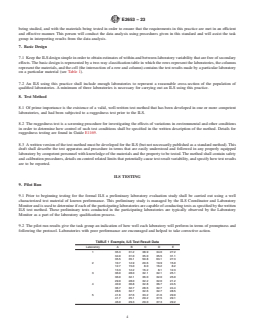
Table 1).
and following the protocol. Laboratories with poor perfor-
mance are encouraged and helped to take corrective action.
7.2 An ILS using this practice shall include enough labora-
tories to represent a reasonable cross-sectio
...
This document is not an ASTM standard and is intended only to provide the user of an ASTM standard an indication of what changes have been made to the previous version. Because
it may not be technically possible to adequately depict all changes accurately, ASTM recommends that users consult prior editions as appropriate. In all cases only the current version
of the standard as published by ASTM is to be considered the official document.
Designation: E2653 − 21 E2653 − 23 An American National Standard
Standard Practice for
Conducting an Interlaboratory Study to Determine Precision
Estimates for a Fire Test Method with Fewer Than Six
Participating Laboratories
This standard is issued under the fixed designation E2653; the number immediately following the designation indicates the year of
original adoption or, in the case of revision, the year of last revision. A number in parentheses indicates the year of last reapproval. A
superscript epsilon (´) indicates an editorial change since the last revision or reapproval.
1. Scope
1.1 This practice describes the techniques for planning, conducting, analyzing, and treating results of an interlaboratory study
(ILS) for estimating the precision of a fire test method when fewer than six laboratories are available to meet the recommended
minimum requirements of Practice E691. Data obtained from an interlaboratory study are useful in identifying variables that
require modifications for improving test method performance and precision.
1.2 Precision estimates developed using this practice will not be statistically equivalent to precision estimates produced by Practice
E691 because a small number of laboratories are used. The smaller number of participating laboratories will seriously reduce the
value of precision estimates reported by this practice. However, under circumstances where only a limited number of laboratories
are available to participate in an ILS, precision estimates developed by this practice will provide the user with useful information
concerning precision for a test method.
1.3 A minimum of three qualified laboratories is required for conducting an ILS using this practice. If six or more laboratories
are available to participate in an ILS for a given fire test method, Practice E691 shall be used for conducting the ILS.
1.4 Since the primary purpose of this practice is the development of the information needed for a precision statement, the
experimental design in this practice will not be optimum for evaluating all materials, test methods, or as a tool for individual
laboratory analysis.
1.5 Because of the reduced number of participating laboratories, a Laboratory Monitor shall be used in the ILS. See Standard
Guide E2335.
1.6 Field of Application—This practice is concerned with test methods that yield numerical values or a series of numerical values
for different fire-test response properties. properties associated with the test method. The numerical values mentioned above are
typically the result of calculations from a set of measurements.
1.7 This practice includes design information suitable for use with the development of interlaboratory studies for test methods that
have categorization (go-no-go) allocation test results. However, it does not provide a recommended statistical practice for
evaluating the go-no-go data.
This practice is under the jurisdiction of ASTM Committee E05 on Fire Standards and is the direct responsibility of Subcommittee E05.31 on Terminology and Services
/ Functions.
Current edition approved Dec. 1, 2021March 1, 2023. Published January 2022March 2023. Originally approved in 2008. Last previous edition approved in 20152021 as
E2653E2653 – 21.-15. DOI: 10.1520/E2653-21.10.1520/E2653-23.
Copyright © ASTM International, 100 Barr Harbor Drive, PO Box C700, West Conshohocken, PA 19428-2959. United States
E2653 − 23
1.8 This fire standard practice cannot be used to provide quantitative measures.
1.9 This practice is issued under Committee E05, but it is generic in its statistical approach such that it is applicable to any other
method.
1.10 This standard does not purport to address all of the safety concerns, if any, associated with its use. It is the responsibility
of the user of this standard to establish appropriate safety, health, and environmental practices and determine the applicability of
regulatory limitations prior to use.
1.11 This international standard was developed in accordance with internationally recognized principles on standardization
established in the Decision on Principles for the Development of International Standards, Guides and Recommendations issued
by the World Trade Organization Technical Barriers to Trade (TBT) Committee.
2. Referenced Documents
2.1 ASTM Standards:
E176 Terminology of Fire Standards
E177 Practice for Use of the Terms Precision and Bias in ASTM Test Methods
E178 Practice for Dealing With Outlying Observations
E456 Terminology Relating to Quality and Statistics
E691 Practice for Conducting an Interlaboratory Study to Determine the Precision of a Test Method
E1169 Practice for Conducting Ruggedness Tests
E2335 Guide for Laboratory Monitors
3. Terminology
3.1 Definitions—For formal definitions of statistical terms, see Terminology E456. For formal definitions of fire terms, see
Terminology E176.
3.2 Definitions of Terms Specific to This Standard:
3.2.1 protocol, n—in this practice, directions given to the laboratories for conducting the interlaboratory study (ILS).
3.2.2 repeatability (of results and measurements), n—quantitative expression of the random variability associated with successive
measurements of the same measurand carried out subject to all of the following conditions: the same measurement procedure, the
same observer, the same measuring instrument, used under the same conditions, the same location, and repetition over a short
period of time.
3.2.2.1 Discussion—
Repeatability deals with results in a single laboratory while reproducibility deals with results obtained in different laboratories.
3.2.3 reproducibility (of results of measurements), n—quantitative expression of the random variability associated with successive
measurements of the same measurand carried out by operators working in different laboratories, each obtaining single results on
identical test material when applying the same method.
3.2.3.1 Discussion—
Repeatability deals with results in a single laboratory while reproducibility deals with results obtained in different laboratories.
3.2.4 test method, n—in this practice, description of the actual measurement process as well as written description of the process.
3.3 For further discussion of the terms discussed above, see Practice E177 and the formal definitions in Terminology E456.
4. Summary of Practice
4.1 The procedure presented in this practice consists of three basic steps: planning the interlaboratory study, guiding the testing
phase of the study, and analyzing the test result data. The analysis evaluates the consistency of the data through the use of numerical
estimates of precision of the test method pertaining to both within-laboratory repeatability and between-laboratory reproducibility.
For referenced ASTM standards, visit the ASTM website, www.astm.org, or contact ASTM Customer Service at service@astm.org. For Annual Book of ASTM Standards
volume information, refer to the standard’s Document Summary page on the ASTM website.
E2653 − 23
4.2 Planning of the interlaboratory study will include a review of the test procedure to be used in the interlaboratory study. This
review will identify portions of the test method that appear to contribute to a loss in precision. Special interlaboratory instructions
or modifications to the test method wording are made as needed to clarify these sections and often result in a modification to the
test method following the interlaboratory study.
4.3 A manager for the interlaboratory study and an interlaboratory test monitor shall be selected. The same person is allowed to
conduct both functions.
4.4 Parties conducting an interlaboratory precision study of a test method will acquire participation agreements with as many
laboratories as possible that are willing to take part in the interlaboratory study and have the capability to run the test method of
interest. A minimum of three laboratories shall participate in the precision study. Precision results will increase in quality with a
larger number of participating laboratories.
4.5 The types of materials and number of test specimens shall be selected for the interlaboratory study. No less than three test
specimens shall be selected for the interlaboratory study, and they shall be selected to reflect the range of performance of test
specimens normally evaluated by the test method. A minimum of three replicates shall be tested for each test material selected.
If a standard reference material is available for the test method, the material shall be included as a specimen in the interlaboratory
study. If a standard reference material is not available, a test specimen that consistently produces low variability test results shall
be selected as a reference material for the interlaboratory study.
5. Significance and Use
5.1 ASTM regulations require precision statements in all test methods in terms of repeatability and reproducibility. This practice
is used when the number of participating laboratories or materials being tested, or both, in a precision study is less than the number
specified by Practice E691. When possible, it is strongly recommended that a full Practice E691 standard protocol be followed to
determine test method precision. Precision results produced by the procedures presented in this standard will not have the same
degree of accuracy as results generated by a full Practice E691 protocol. This procedure will allow for the development of useful
precision results when a full complement of laboratories is not available for interlaboratory testing.
5.2 This practice is based on recommendations for interlaboratory studies and data analysis presented in Practice E691. This
practice does not concern itself with the development of test methods but with a standard means for gathering information and
treating the data needed for developing a precision statement for a fire test method when a complete Practice E691 interlaboratory
study and data analysis are not possible.
PLANNING THE ILS
6. Planning
6.1 Task Group—Either the task group that developed the test method or a special task group appointed for the purpose must have
overall responsibility for the ILS, including funding where appropriate, staffing, the design of the ILS, and decision-making with
regard to questionable data. The task group shall decide on the number of laboratories, materials, and test results for each material.
In addition, it shall specify any special calibration procedures and the repeatability conditions to be specified in the protocol.
6.2 ILS Coordinator—The task group must appoint one individual to act as overall coordinator for conducting the ILS. The
coordinator will supervise the distribution of materials and protocols to the laboratories and receive the test result reports from the
laboratories. Scanning the reports for gross errors and checking with the laboratories, when such errors are found, will also be the
responsibility of the coordinator. The coordinator will consult as needed with a statistician in questionable cases.
6.3 Laboratory Monitor—The task group must appoint one individual to act as a laboratory monitor for the ILS. The laboratory
monitor will develop an ILS checklist specific to the test method, inspect the test laboratories for equipment conformity and
operator training, verify compatibility of the data acquisition system, and based on the Checklist and inspection results report to
the sponsoring ASTM Subcommittee. Complete details for the function of a laboratory monitor are located in Guide E2335.
6.4 Statistician—The task group shall obtain the assistance of a person skilled in the use of statistical procedures, the test method
E2653 − 23
being studied, and with the materials being tested in order to ensure that the requirements in this practice are met in an efficient
and effective manner. This person will conduct the data analysis using procedures given in this standard and will assist the task
group in interpreting results from the data analysis.
7. Basic Design
7.1 Keep the ILS design simple in order to obtain estimates of within-and between-laboratory variability that are free of secondary
effects. The basic design is represented by a two-way classification table in which the rows represent the laboratories, the columns
represent the materials, and the cell (the intersection of a row and column) contains the test results made by a particular laboratory
on a particular material (see Table 1).
7.2 An ILS using this practice shall include enough laboratories to represent a reasonable cross-section of the population of
qualified laboratories. A minimum of three laboratories is necessary for carrying out an ILS using this practice.
8. Test Method
8.1 Of prime importance is the existence of a valid, well-written test method that has been developed in one or more competent
laboratories, and had been subjected to a ruggedness test prior to the ILS.
8.2 The ruggedness test is a screening procedure for investigating the effects of variations in environmental and other conditions
in order to determine how control of such test conditions shall be specified in the written description of the method. Details for
ruggedness testing are found in Guide E1169.
8.3 A written version of the test method must be developed for the ILS (but not necessarily published as a standard method). This
draft shall describe the test apparatus and procedure in terms that are easily understood and followed in any properly equipped
laboratory by competent personnel with knowledge of the materials and the property to be tested. The method shall contain safety
and calibration procedures, details on control related limits that potentially cause test result variability, and specify how test results
are to be reported.
ILS TESTING
9. Pilot Run
9.1 Prior to beginning testing for the formal ILS a preliminary laboratory evaluation study shall be carried out using a well
characterized test material of known performance. This preliminary study is managed by the ILS Coordinator and Laboratory
Monitor and is used to determine if each of the participating laboratories are capable o
...