

ASTM F1429-99(2022)
(Test Method)Standard Test Method for Assembly Force of Plastic Underground Conduit Joints That Use Flexible Elastomeric Seals Located in the Bell
General Information
- Abstract
SIGNIFICANCE AND USE
5.1 The assembly force of a conduit joining system is one measure of the ease of which the conduit system can be assembled and installed in the field. This test method provides a means by which to quantify the assembly force of gasketed conduit joining systems. The results of the testing can be used to compare and categorize the assembly force of different designs of gasketed conduit joining systems.
5.2 This test method is not intended for use as a quality control test.
5.3 This test method can be used for comparison of gasketed conduit joining systems on the basis of assembly force. No information about joint sealing performance can be obtained from the use of this test method.
5.4 This test method covers all plastic conduit with push-on joints that use flexible elastomeric gaskets located in the bell to provide the joint seal.
5.5 This test method is also applicable to all fittings that are fabricated from conduit covered in 5.4 and that utilize the same type of push-on joints as the conduit covered in 5.4, and that are intended for use with the conduit types described in 5.4. For purposes of this test method, assembly force data obtained from the testing of the conduit that is the parent stock of a fitting shall apply to the fitting also.
SCOPE
1.1 This test method covers the determination of the relative force required to assemble plastic underground conduit joints that use flexible elastomeric seals located in the bell.
1.2 The values stated in inch-pound units are to be regarded as standard. The values given in parentheses are mathematical conversions to SI units that are provided for information only and are not considered standard.
1.3 This standard does not purport to address all of the safety concerns, if any, associated with its use. It is the responsibility of the user of this standard to establish appropriate safety, health, and environmental practices and determine the applicability of regulatory limitations prior to use.
1.4 This international standard was developed in accordance with internationally recognized principles on standardization established in the Decision on Principles for the Development of International Standards, Guides and Recommendations issued by the World Trade Organization Technical Barriers to Trade (TBT) Committee.
- Status
- Published
- Publication Date
- 31-Jan-2022
- Technical Committee
- F17 - Plastic Piping Systems
- Drafting Committee
- F17.40 - Test Methods
Overview
ASTM F1429-99(2022): Standard Test Method for Assembly Force of Plastic Underground Conduit Joints That Use Flexible Elastomeric Seals Located in the Bell defines a laboratory procedure to determine the relative force required to assemble plastic underground conduit joints equipped with flexible elastomeric seals located in the bell. Developed by ASTM International, this test method is intended to quantify and compare the assembly forces of different gasketed conduit joining systems, supporting better product selection and installation planning in underground plastic piping applications.
This standard applies to all plastic conduit and fittings that utilize push-on joints with bell-located elastomeric gaskets, facilitating evaluation and categorization by assembly force. Importantly, assembly force is a measure of the effort required during installation but does not evaluate joint sealing performance.
Key Topics
- Assembly Force Measurement: Determines the peak force required to assemble a gasketed conduit joint by measuring the maximum effort needed to insert the spigot into the bell end with a flexible elastomeric seal.
- Applicability: Covers all plastic conduits with push-on joints utilizing elastomeric gaskets in the bell and all fittings fabricated from such conduit. Assembly force test data from conduits can be applied to compatible fittings.
- Test Procedure:
- Utilizes a compression testing machine with a constant-rate-of-crosshead movement, equipped with a chart recorder.
- Involves conditioning test specimens, mandrels, and lubricant at a specified temperature.
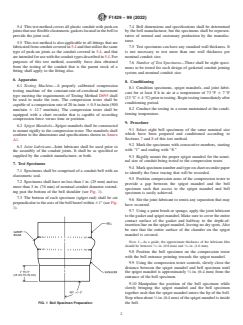
- Requires testing eight representative samples for each conduit size and joint type.
- Joint lubricant, gasket, and spigot chamfer are variables specified by the manufacturer and affect assembly force.
- Limitations:
- Not intended as a quality control method.
- Provides no data on joint sealing efficacy, only on assembly effort.
Applications
ASTM F1429 is highly relevant for manufacturers, specifiers, installers, and engineers involved in the selection and installation of underground plastic conduit systems. Key applications include:
- Product Comparison: Enables objective comparison of assembly forces between various designs of gasketed conduit joining systems, supporting optimal product selection for specific installation needs.
- Installation Planning: Helps estimate installation effort and required manpower or equipment, aiding in effective project planning and resource allocation.
- Design Evaluation: Supports manufacturers in evaluating the ease of assembly for new or modified gasketed conduit products.
- Specification Development: Provides stakeholders with reliable data to develop installation guidelines or project specifications involving plastic push-on conduit joints with elastomeric seals.
- Conduit Fitting Assessment: Since fitting assembly force can be referenced from the parent conduit, this standard streamlines assessment across related components.
Related Standards
The ASTM F1429 standard references several other key documents and standards related to plastic conduit systems and testing methods:
- ASTM D695 - Test Method for Compressive Properties of Rigid Plastics
- ASTM F412 - Terminology Relating to Plastic Piping Systems
For broader context or further technical guidance on plastic pipes and underground conduit performance, consult these and related ASTM International standards. Additionally, compliance with international standardization principles as outlined by the World Trade Organization Technical Barriers to Trade (TBT) Committee is confirmed.
Summary
In summary, ASTM F1429-99(2022) supports the reliable, comparative evaluation of assembly forces needed for plastic underground conduit joints with bell-located flexible elastomeric seals. By standardizing measurement and reporting, it advances ease-of-installation assessments for underground electrical and communications conduit installations, thereby enhancing productivity, safety, and system reliability in infrastructure projects.
Relations
- Effective Date
- 01-Apr-2020
- Effective Date
- 01-Jan-2019
- Effective Date
- 01-Aug-2017
- Effective Date
- 01-Feb-2017
- Effective Date
- 15-Nov-2016
- Effective Date
- 01-Aug-2016
- Effective Date
- 01-Jun-2015
- Effective Date
- 15-Feb-2013
- Effective Date
- 01-Apr-2012
- Effective Date
- 01-Apr-2010
- Effective Date
- 01-May-2009
- Effective Date
- 01-Aug-2008
- Effective Date
- 15-Dec-2007
- Effective Date
- 01-Mar-2006
- Effective Date
- 10-Aug-2002
Get Certified
Connect with accredited certification bodies for this standard

Institut za varilstvo d.o.o. (Welding Institute)
Slovenia's leading welding institute since 1952. ISO 3834, EN 1090, pressure equipment certification, NDT personnel, welder qualification. Only IIW Au
Sponsored listings
Frequently Asked Questions
ASTM F1429-99(2022) is a standard published by ASTM International. Its full title is "Standard Test Method for Assembly Force of Plastic Underground Conduit Joints That Use Flexible Elastomeric Seals Located in the Bell". This standard covers: SIGNIFICANCE AND USE 5.1 The assembly force of a conduit joining system is one measure of the ease of which the conduit system can be assembled and installed in the field. This test method provides a means by which to quantify the assembly force of gasketed conduit joining systems. The results of the testing can be used to compare and categorize the assembly force of different designs of gasketed conduit joining systems. 5.2 This test method is not intended for use as a quality control test. 5.3 This test method can be used for comparison of gasketed conduit joining systems on the basis of assembly force. No information about joint sealing performance can be obtained from the use of this test method. 5.4 This test method covers all plastic conduit with push-on joints that use flexible elastomeric gaskets located in the bell to provide the joint seal. 5.5 This test method is also applicable to all fittings that are fabricated from conduit covered in 5.4 and that utilize the same type of push-on joints as the conduit covered in 5.4, and that are intended for use with the conduit types described in 5.4. For purposes of this test method, assembly force data obtained from the testing of the conduit that is the parent stock of a fitting shall apply to the fitting also. SCOPE 1.1 This test method covers the determination of the relative force required to assemble plastic underground conduit joints that use flexible elastomeric seals located in the bell. 1.2 The values stated in inch-pound units are to be regarded as standard. The values given in parentheses are mathematical conversions to SI units that are provided for information only and are not considered standard. 1.3 This standard does not purport to address all of the safety concerns, if any, associated with its use. It is the responsibility of the user of this standard to establish appropriate safety, health, and environmental practices and determine the applicability of regulatory limitations prior to use. 1.4 This international standard was developed in accordance with internationally recognized principles on standardization established in the Decision on Principles for the Development of International Standards, Guides and Recommendations issued by the World Trade Organization Technical Barriers to Trade (TBT) Committee.
SIGNIFICANCE AND USE 5.1 The assembly force of a conduit joining system is one measure of the ease of which the conduit system can be assembled and installed in the field. This test method provides a means by which to quantify the assembly force of gasketed conduit joining systems. The results of the testing can be used to compare and categorize the assembly force of different designs of gasketed conduit joining systems. 5.2 This test method is not intended for use as a quality control test. 5.3 This test method can be used for comparison of gasketed conduit joining systems on the basis of assembly force. No information about joint sealing performance can be obtained from the use of this test method. 5.4 This test method covers all plastic conduit with push-on joints that use flexible elastomeric gaskets located in the bell to provide the joint seal. 5.5 This test method is also applicable to all fittings that are fabricated from conduit covered in 5.4 and that utilize the same type of push-on joints as the conduit covered in 5.4, and that are intended for use with the conduit types described in 5.4. For purposes of this test method, assembly force data obtained from the testing of the conduit that is the parent stock of a fitting shall apply to the fitting also. SCOPE 1.1 This test method covers the determination of the relative force required to assemble plastic underground conduit joints that use flexible elastomeric seals located in the bell. 1.2 The values stated in inch-pound units are to be regarded as standard. The values given in parentheses are mathematical conversions to SI units that are provided for information only and are not considered standard. 1.3 This standard does not purport to address all of the safety concerns, if any, associated with its use. It is the responsibility of the user of this standard to establish appropriate safety, health, and environmental practices and determine the applicability of regulatory limitations prior to use. 1.4 This international standard was developed in accordance with internationally recognized principles on standardization established in the Decision on Principles for the Development of International Standards, Guides and Recommendations issued by the World Trade Organization Technical Barriers to Trade (TBT) Committee.
ASTM F1429-99(2022) is classified under the following ICS (International Classification for Standards) categories: 23.040.60 - Flanges, couplings and joints. The ICS classification helps identify the subject area and facilitates finding related standards.
ASTM F1429-99(2022) has the following relationships with other standards: It is inter standard links to ASTM F412-20, ASTM F412-19, ASTM F412-17a, ASTM F412-17, ASTM F412-16a, ASTM F412-16, ASTM F412-15, ASTM F412-13, ASTM F412-12, ASTM D695-10, ASTM F412-09, ASTM D695-08, ASTM F412-07, ASTM F412-06, ASTM D695-02a. Understanding these relationships helps ensure you are using the most current and applicable version of the standard.
ASTM F1429-99(2022) is available in PDF format for immediate download after purchase. The document can be added to your cart and obtained through the secure checkout process. Digital delivery ensures instant access to the complete standard document.
Standards Content (Sample)
This international standard was developed in accordance with internationally recognized principles on standardization established in the Decision on Principles for the
Development of International Standards, Guides and Recommendations issued by the World Trade Organization Technical Barriers to Trade (TBT) Committee.
Designation: F1429 − 99 (Reapproved 2022)
Standard Test Method for
Assembly Force of Plastic Underground Conduit Joints That
Use Flexible Elastomeric Seals Located in the Bell
This standard is issued under the fixed designation F1429; the number immediately following the designation indicates the year of
original adoption or, in the case of revision, the year of last revision. A number in parentheses indicates the year of last reapproval. A
superscript epsilon (´) indicates an editorial change since the last revision or reapproval.
1. Scope 3.1.2 chart recorder—a device that records on paper (or
similarpermanentmedium)thereadingsobtainedbyaphysical
1.1 This test method covers the determination of the relative
testing machine, such as a compression tester. The chart
force required to assemble plastic underground conduit joints
recorder receives input from the testing machine in the form of
that use flexible elastomeric seals located in the bell.
electrical signals that are proportional to the test readings.
1.2 The values stated in inch-pound units are to be regarded
3.1.3 gasketed conduit joining system—a push-on conduit
as standard. The values given in parentheses are mathematical
joining system (see joint, push-on in Terminology F412) with
conversions to SI units that are provided for information only
the following three manufacturer-specified components that
and are not considered standard.
influence joint assembly force: (1) the elastomeric seal, (2) the
1.3 This standard does not purport to address all of the
chamfer on the spigot, and (3) the joint lubricant. This system
safety concerns, if any, associated with its use. It is the
is as supplied or recommended by the conduit manufacturer.
responsibility of the user of this standard to establish appro-
priate safety, health, and environmental practices and deter-
4. Summary of Test Method
mine the applicability of regulatory limitations prior to use.
4.1 A sample of eight gasketed conduit bells of the same
1.4 This international standard was developed in accor-
nominaldiameterarepreparedfromtypicalproductionstockof
dance with internationally recognized principles on standard-
the conduit manufacturer. An aluminum spigot mandrel made
ization established in the Decision on Principles for the
to the specifications of Annex A1 for the conduit size being
Development of International Standards, Guides and Recom-
tested is inserted into each of the eight gasketed conduit bell
mendations issued by the World Trade Organization Technical
specimens by means of a compression tester and the joint
Barriers to Trade (TBT) Committee.
system assembly force is recorded for each specimen. The
mean and standard deviation of the sample of eight recorded
2. Referenced Documents
assembly forces is then calculated and recorded.
2.1 ASTM Standards:
4.2 Any variation in the type of gasket, spigot chamfer, or
D695 Test Method for Compressive Properties of Rigid
joint lubricant specified by the manufacturer constitutes a
Plastics
change in the gasketed conduit joining system and requires that
F412 Terminology Relating to Plastic Piping Systems
a new sample of eight specimens be tested.
3. Terminology
5. Significance and Use
3.1 Definitions of Terms Specific to This Standard:
5.1 The assembly force of a conduit joining system is one
3.1.1 assembly force—the peak force or effort required to
measure of the ease of which the conduit system can be
insert the spigot into the belled end for gasketed conduit
assembled and installed in the field. This test method provides
joining systems.
a means by which to quantify the assembly force of gasketed
conduit joining systems. The results of the testing can be used
to compare and categorize the assembly force of different
This test method is under the jurisdiction of ASTM Committee F17 on Plastic
designs of gasketed conduit joining systems.
Piping Systems and is the direct responsibility of Subcommittee F17.40 on Test
Methods.
5.2 This test method is not intended for use as a quality
Current edition approved Feb. 1, 2022. Published March 2022. Originally
control test.
approved in 1992. Last previous edition approved in 2014 as F1429 – 99(2014).
DOI: 10.1520/F1429-99R22.
5.3 Thistestmethodcanbeusedforcomparisonofgasketed
For referenced ASTM standards, visit the ASTM website, www.astm.org, or
conduit joining systems on the basis of assembly force. No
contact ASTM Customer Service at service@astm.org. For Annual Book of ASTM
information about joint sealing performance can be obtained
Standards volume information, refer to the standard’s Document Summary page on
the ASTM website. from the use of this test method.
Copyright © ASTM International, 100 Barr Harbor Drive, PO Box C700, West Conshohocken, PA 19428-2959. United States
F1429 − 99 (2022)
5.4 This test method covers all plastic conduit with push-on 7.4 Bell dimensions and specifications shall be determined
joints that use flexible elastomeric gaskets located in the bell to by the bell manufacturer, but the specimens shall be represen-
provide the joint seal. tative of normal and customary production by the manufac-
turer.
5.5 This test method is also applicable to all fittings that are
fabricated from conduit covered in 5.4 and that utilize the same 7.5 Test specimens can have any standard wall thickness. It
type of push-on joints as the conduit covered in 5.4, and that is not necessary to test more than one wall thickness per
areintendedforusewiththeconduittypesdescribedin5.4.For nominal conduit size.
purposes of this test method, assembly force data obtained
7.6 Number of Test Specimens—There shall be eight speci-
from the testing of the conduit that is the parent stock of a
mens to be tested for each design of gasketed conduit joining
fitting shall apply to the fitting also.
system and nominal conduit size.
6. Apparatus
8. Conditioning
6.1 Testing Machine—A properly calibrated compression
8.1 Condition specimens, spigot mandrels, and joint lubri-
testing machine of the constant-rate-of-crosshead movement
cant for at least8hinairata temperature of 73 °F 6 7°F
type meeting the requirements of Testing Method D695 shall
(23 °C 64 °C)priortotesting.Begintestingimmediatelyafter
be used to make the tests. The compression tester shall be
conditioning period.
capable of a compression rate of 20 in./min 6 0.5 in./min (500
8.2 Conduct the testing in a room maintained at the condi-
mm/min 6 12.7 mm/min). The compression tester shall be
tioning temperature.
equipped with a chart recorder that is capable of recording
compression force versus time or position.
9. Procedure
6.2 Spigot Mandrels—Spigot mandrels shall be constructed
9.1 Select eight bell specimens of the same nominal size
to mount rigidly to the compression tester. The mandrels shall
which have been prepared and conditioned according to
conform to the dimensions and specifications shown in Annex
Sections 7 and 8 of this test method.
A1.
9.2 Mark the specimens with consecutive numbers, starting
6.3 Joint Lubricant—Joint lubricant shall be used prior to
with “1” and ending with “8.”
the assembly of the conduit joints. It shall be as specified or
supplied by the conduit manufacturer, or both.
9.3 Rigidly mount the proper spigot mandrel for the nomi-
nal size of conduit being tested to the compression tester.
7. Test Specimens
9.4 Markspecimennumberandtypeonchartrecorderpaper
7.1 Specimens shall be comprised of a conduit bell with an
to identify the force tracing that will be recorded.
elastomeric seal.
9.5 Position compression arms of the compression tester to
7.2 Specimens shall have no less than 1 in. (25 mm) and no
provide a gap between the spigot mandrel and the bell
more than 3 in. (76 mm) of nominal conduit diameter extend-
specimen such that access to the spigot m
...