


ASTM E1165-20
(Test Method)Standard Test Method for Measurement of Focal Spots of Industrial X-Ray Tubes by Pinhole Imaging
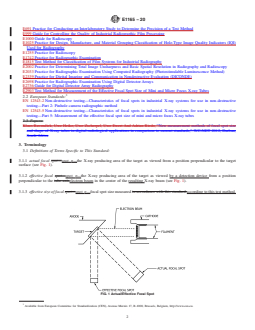
Standard Test Method for Measurement of Focal Spots of Industrial X-Ray Tubes by Pinhole Imaging
SIGNIFICANCE AND USE
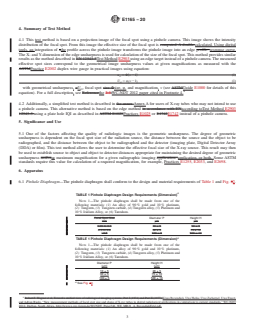
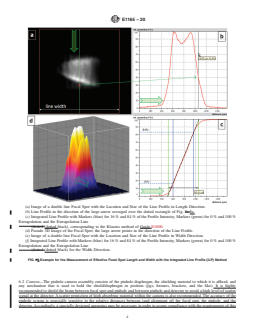
5.1 One of the factors affecting the quality of radiologic images is the geometric unsharpness. The degree of geometric unsharpness is dependent on the focal spot size of the radiation source, the distance between the source and the object to be radiographed, and the distance between the object to be radiographed and the detector (imaging plate, Digital Detector Array (DDA) or film). This test method allows the user to determine the effective focal size of the X-ray source. This result may then be used to establish source to object and object to detector distances appropriate for maintaining the desired degree of geometric unsharpness or maximum magnification for a given radiographic imaging application, or both. Some ASTM standards require this value for calculation of a required magnification, for example, Practices E1255, E2033, and E2698.
SCOPE
1.1 The image quality and the resolution of X-ray images are especially sensitive to the characteristics of the focal spot. The imaging qualities of the focal spot are based on its two dimensional intensity distribution as seen from the detector plane.
1.2 This test method provides instructions for determining the effective size (dimensions) of standard and mini focal spots of industrial X-ray tubes for focal spot dimensions from 100 μm up to several mm of X-ray sources up to 600 kV tube voltage. Smaller focal spots down to 50 µm could be evaluated with less precision. This determination is based on the measurement of an image of a focal spot that has been radiographically recorded with a “pinhole” technique. An alternative method with a plaque hole IQI may be found in the Annex A, which covers the same focal spot sizes.
1.3 Smaller focal spots should be measured using Test Method E2903 using the projection of an edge.
1.4 This test method may also be used to determine the change in focal spot size that may have occurred due to tube age, tube overloading, and the like. This would entail the production of a focal spot radiograph (with the pinhole method) and an evaluation of the resultant image for pitting, cracking, and the like.
1.5 Units—Values stated in SI units are to be regarded as the standard.
1.6 This standard does not purport to address all of the safety concerns, if any, associated with its use. It is the responsibility of the user of this standard to establish appropriate safety, health, and environmental practices and determine the applicability of regulatory limitations prior to use.
1.7 This international standard was developed in accordance with internationally recognized principles on standardization established in the Decision on Principles for the Development of International Standards, Guides and Recommendations issued by the World Trade Organization Technical Barriers to Trade (TBT) Committee.
General Information
- Status
- Published
- Publication Date
- 30-Nov-2020
- Technical Committee
- E07 - Nondestructive Testing
- Drafting Committee
- E07.01 - Radiography (X and Gamma) Method
Relations
- Effective Date
- 01-Dec-2023
- Effective Date
- 01-Feb-2018
- Effective Date
- 01-Feb-2018
- Effective Date
- 01-Feb-2018
- Effective Date
- 01-Dec-2016
- Refers
ASTM E999-15 - Standard Guide for Controlling the Quality of Industrial Radiographic Film Processing - Effective Date
- 01-Jun-2015
- Refers
ASTM E2033-99(2013) - Standard Practice for Computed Radiology (Photostimulable Luminescence Method) - Effective Date
- 01-Jun-2013
- Effective Date
- 01-Jun-2013
- Effective Date
- 01-Jun-2013
- Effective Date
- 01-May-2013
- Effective Date
- 01-Dec-2011
- Effective Date
- 01-Nov-2011
- Refers
ASTM E999-10 - Standard Guide for Controlling the Quality of Industrial Radiographic Film Processing - Effective Date
- 01-Jun-2010
- Effective Date
- 01-Jun-2010
- Effective Date
- 15-Apr-2010
Overview
ASTM E1165-20 is the internationally recognized standard test method for the measurement of focal spots of industrial X-ray tubes using the pinhole imaging technique. Developed by ASTM Committee E07 on Nondestructive Testing, this standard provides clear procedures for accurately determining the effective size (dimensions) of both standard and mini-focus X-ray tube focal spots, which are crucial for achieving optimal image quality and spatial resolution in industrial radiographic applications. The standard covers X-ray tubes with focal spot sizes from 100 μm up to several millimeters and tube voltages up to 600 kV, and can be applied, with reduced accuracy, to smaller focal spots down to 50 μm.
Understanding focal spot size is essential as it directly affects image quality through geometric unsharpness, influencing the sharpness, detail, and accuracy of radiographic inspections used in quality control, defect detection, and material characterization.
Key Topics
- Focal Spot Measurement: The standard prescribes the use of a pinhole camera setup to create a two-dimensional image of the X-ray tube's focal spot on a radiographic detector (film, digital imaging plate, or digital detector array).
- Geometric Unsharpness: The degree of sharpness in a radiographic image is determined by the focal spot size, the distance from the X-ray source to the object, and the distance from the object to the detector.
- Test Method Scope:
- Applicable for focal spots 100 μm to several mm at up to 600 kV (with less precision for smaller sizes and up to 1000 kV in some sections).
- Alternative method using a plaque hole IQI (Image Quality Indicator) is available in the annex.
- Guidance for evaluating focal spot deterioration due to tube usage, age, or overloading.
- Measurement Precision and Reporting: The standard outlines requirements for the alignment, distances, and calibration necessary for precise measurement, and provides procedures for reporting results, including focal spot classification.
- Safety and Compliance: Users are advised to adhere to safety, health, and environmental practices, and comply with applicable regulations.
Applications
ASTM E1165-20 is particularly relevant to industries and professionals involved in nondestructive testing (NDT) and industrial radiography, including:
- Radiographic Non-Destructive Evaluation (NDE): Ensuring accurate defect detection, weld integrity, and material evaluation by minimizing geometric unsharpness and enhancing image resolution.
- Quality Assurance in Manufacturing: Monitoring and maintaining the performance and condition of X-ray tubes by measuring focal spot size during regular maintenance and after suspected overload or aging.
- Equipment Qualification and Certification: Providing objective data on focal spot sizes for equipment approval, operator qualification, and compliance with radiographic standards.
- Calculation of Imaging Parameters: Helping establish optimal source-to-object and object-to-detector distances for maximum sensitivity or magnification, as required by other ASTM radiography standards (e.g., ASTM E1255, E2033, E2698).
Related Standards
ASTM E1165-20 is referenced alongside several key standards that support industrial radiographic testing and focal spot evaluation:
- ASTM E999: Guide for controlling the quality of industrial film processing.
- ASTM E1000: Guide for radioscopy.
- ASTM E1255: Practice for radioscopy.
- ASTM E1815: Test method for classification of film systems.
- ASTM E2002: Practice for determining total image unsharpness and spatial resolution.
- ASTM E2033: Practice for computed radiography.
- ASTM E2339: Practice for digital imaging and communication in NDT.
- ASTM E2698: Practice for examinations using digital detector arrays.
- ASTM E2903: Test method for measurement of mini and microfocus X-ray tube focal spot size.
- EN 12543-2 and EN 12543-5: European standards for characterization of focal spots in industrial X-ray systems.
By following ASTM E1165-20, users ensure standardized and reliable measurement of X-ray tube focal spot size, directly supporting the delivery of high-quality radiographic imaging for industrial applications. This contributes to improved NDT outcomes, better compliance with international requirements, and more effective quality control processes.
Buy Documents
ASTM E1165-20 - Standard Test Method for Measurement of Focal Spots of Industrial X-Ray Tubes by Pinhole Imaging

REDLINE ASTM E1165-20 - Standard Test Method for Measurement of Focal Spots of Industrial X-Ray Tubes by Pinhole Imaging
Get Certified
Connect with accredited certification bodies for this standard

IMP NDT d.o.o.
Non-destructive testing services. Radiography, ultrasonic, magnetic particle, penetrant, visual inspection.
Inštitut za kovinske materiale in tehnologije
Institute of Metals and Technology. Materials testing, metallurgical analysis, NDT.
Q Techna d.o.o.
NDT and quality assurance specialist. 30+ years experience. NDT personnel certification per ISO 9712, nuclear and thermal power plant inspections, QA/
Sponsored listings
Frequently Asked Questions
ASTM E1165-20 is a standard published by ASTM International. Its full title is "Standard Test Method for Measurement of Focal Spots of Industrial X-Ray Tubes by Pinhole Imaging". This standard covers: SIGNIFICANCE AND USE 5.1 One of the factors affecting the quality of radiologic images is the geometric unsharpness. The degree of geometric unsharpness is dependent on the focal spot size of the radiation source, the distance between the source and the object to be radiographed, and the distance between the object to be radiographed and the detector (imaging plate, Digital Detector Array (DDA) or film). This test method allows the user to determine the effective focal size of the X-ray source. This result may then be used to establish source to object and object to detector distances appropriate for maintaining the desired degree of geometric unsharpness or maximum magnification for a given radiographic imaging application, or both. Some ASTM standards require this value for calculation of a required magnification, for example, Practices E1255, E2033, and E2698. SCOPE 1.1 The image quality and the resolution of X-ray images are especially sensitive to the characteristics of the focal spot. The imaging qualities of the focal spot are based on its two dimensional intensity distribution as seen from the detector plane. 1.2 This test method provides instructions for determining the effective size (dimensions) of standard and mini focal spots of industrial X-ray tubes for focal spot dimensions from 100 μm up to several mm of X-ray sources up to 600 kV tube voltage. Smaller focal spots down to 50 µm could be evaluated with less precision. This determination is based on the measurement of an image of a focal spot that has been radiographically recorded with a “pinhole” technique. An alternative method with a plaque hole IQI may be found in the Annex A, which covers the same focal spot sizes. 1.3 Smaller focal spots should be measured using Test Method E2903 using the projection of an edge. 1.4 This test method may also be used to determine the change in focal spot size that may have occurred due to tube age, tube overloading, and the like. This would entail the production of a focal spot radiograph (with the pinhole method) and an evaluation of the resultant image for pitting, cracking, and the like. 1.5 Units—Values stated in SI units are to be regarded as the standard. 1.6 This standard does not purport to address all of the safety concerns, if any, associated with its use. It is the responsibility of the user of this standard to establish appropriate safety, health, and environmental practices and determine the applicability of regulatory limitations prior to use. 1.7 This international standard was developed in accordance with internationally recognized principles on standardization established in the Decision on Principles for the Development of International Standards, Guides and Recommendations issued by the World Trade Organization Technical Barriers to Trade (TBT) Committee.
SIGNIFICANCE AND USE 5.1 One of the factors affecting the quality of radiologic images is the geometric unsharpness. The degree of geometric unsharpness is dependent on the focal spot size of the radiation source, the distance between the source and the object to be radiographed, and the distance between the object to be radiographed and the detector (imaging plate, Digital Detector Array (DDA) or film). This test method allows the user to determine the effective focal size of the X-ray source. This result may then be used to establish source to object and object to detector distances appropriate for maintaining the desired degree of geometric unsharpness or maximum magnification for a given radiographic imaging application, or both. Some ASTM standards require this value for calculation of a required magnification, for example, Practices E1255, E2033, and E2698. SCOPE 1.1 The image quality and the resolution of X-ray images are especially sensitive to the characteristics of the focal spot. The imaging qualities of the focal spot are based on its two dimensional intensity distribution as seen from the detector plane. 1.2 This test method provides instructions for determining the effective size (dimensions) of standard and mini focal spots of industrial X-ray tubes for focal spot dimensions from 100 μm up to several mm of X-ray sources up to 600 kV tube voltage. Smaller focal spots down to 50 µm could be evaluated with less precision. This determination is based on the measurement of an image of a focal spot that has been radiographically recorded with a “pinhole” technique. An alternative method with a plaque hole IQI may be found in the Annex A, which covers the same focal spot sizes. 1.3 Smaller focal spots should be measured using Test Method E2903 using the projection of an edge. 1.4 This test method may also be used to determine the change in focal spot size that may have occurred due to tube age, tube overloading, and the like. This would entail the production of a focal spot radiograph (with the pinhole method) and an evaluation of the resultant image for pitting, cracking, and the like. 1.5 Units—Values stated in SI units are to be regarded as the standard. 1.6 This standard does not purport to address all of the safety concerns, if any, associated with its use. It is the responsibility of the user of this standard to establish appropriate safety, health, and environmental practices and determine the applicability of regulatory limitations prior to use. 1.7 This international standard was developed in accordance with internationally recognized principles on standardization established in the Decision on Principles for the Development of International Standards, Guides and Recommendations issued by the World Trade Organization Technical Barriers to Trade (TBT) Committee.
ASTM E1165-20 is classified under the following ICS (International Classification for Standards) categories: 19.100 - Non-destructive testing. The ICS classification helps identify the subject area and facilitates finding related standards.
ASTM E1165-20 has the following relationships with other standards: It is inter standard links to ASTM E1255-23, ASTM E2903-18, ASTM E1025-18, ASTM E2698-18, ASTM E1000-16, ASTM E999-15, ASTM E2033-99(2013), ASTM E1815-08(2013)e1, ASTM E2903-13, ASTM E691-13, ASTM E2339-11, ASTM E691-11, ASTM E999-10, ASTM E2339-10, ASTM E2736-10. Understanding these relationships helps ensure you are using the most current and applicable version of the standard.
ASTM E1165-20 is available in PDF format for immediate download after purchase. The document can be added to your cart and obtained through the secure checkout process. Digital delivery ensures instant access to the complete standard document.
Standards Content (Sample)
This international standard was developed in accordance with internationally recognized principles on standardization established in the Decision on Principles for the
Development of International Standards, Guides and Recommendations issued by the World Trade Organization Technical Barriers to Trade (TBT) Committee.
Designation: E1165 − 20
Standard Test Method for
Measurement of Focal Spots of Industrial X-Ray Tubes by
Pinhole Imaging
This standard is issued under the fixed designation E1165; the number immediately following the designation indicates the year of
original adoption or, in the case of revision, the year of last revision.Anumber in parentheses indicates the year of last reapproval.A
superscript epsilon (´) indicates an editorial change since the last revision or reapproval.
1. Scope Development of International Standards, Guides and Recom-
mendations issued by the World Trade Organization Technical
1.1 The image quality and the resolution of X-ray images
Barriers to Trade (TBT) Committee.
are especially sensitive to the characteristics of the focal spot.
The imaging qualities of the focal spot are based on its two
2. Referenced Documents
dimensional intensity distribution as seen from the detector
2.1 ASTM Standards:
plane.
E691Practice for Conducting an Interlaboratory Study to
1.2 This test method provides instructions for determining
Determine the Precision of a Test Method
theeffectivesize(dimensions)ofstandardandminifocalspots
E999Guide for Controlling the Quality of Industrial Radio-
of industrial X-ray tubes for focal spot dimensions from
graphic Film Processing
100µm up to several mm of X-ray sources up to 600kV tube
E1000Guide for Radioscopy
voltage.Smallerfocalspotsdownto50µmcouldbeevaluated
E1025 Practice for Design, Manufacture, and Material
with less precision. This determination is based on the mea-
Grouping Classification of Hole-Type Image Quality In-
surementofanimageofafocalspotthathasbeenradiographi-
dicators (IQI) Used for Radiography
cally recorded with a “pinhole” technique. An alternative
E1255Practice for Radioscopy
method with a plaque hole IQI may be found in theAnnexA,
E1742Practice for Radiographic Examination
which covers the same focal spot sizes.
E1815Test Method for Classification of Film Systems for
1.3 Smaller focal spots should be measured using Test
Industrial Radiography
Method E2903 using the projection of an edge.
E2002Practice for Determining Total Image Unsharpness
and Basic Spatial Resolution in Radiography and Radios-
1.4 This test method may also be used to determine the
copy
change in focal spot size that may have occurred due to tube
E2033Practice for Radiographic Examination Using Com-
age, tube overloading, and the like. This would entail the
puted Radiography (Photostimulable Luminescence
production of a focal spot radiograph (with the pinhole
Method)
method) and an evaluation of the resultant image for pitting,
E2339Practice for Digital Imaging and Communication in
cracking, and the like.
Nondestructive Evaluation (DICONDE)
1.5 Units—ValuesstatedinSIunitsaretoberegardedasthe
E2698Practice for Radiographic Examination Using Digital
standard.
Detector Arrays
1.6 This standard does not purport to address all of the
E2736Guide for Digital Detector Array Radiography
safety concerns, if any, associated with its use. It is the
E2903Test Method for Measurement of the Effective Focal
responsibility of the user of this standard to establish appro-
Spot Size of Mini and Micro Focus X-ray Tubes
priate safety, health, and environmental practices and deter-
2.2 European Standards:
mine the applicability of regulatory limitations prior to use.
EN 12543-2Non-destructive testing—Characteristics of fo-
1.7 This international standard was developed in accor-
cal spots in industrial X-ray systems for use in non-
dance with internationally recognized principles on standard-
destructive testing—Part 2: Pinhole camera radiographic
ization established in the Decision on Principles for the
method
1 2
This test method is under the jurisdiction of ASTM Committee E07 on For referenced ASTM standards, visit the ASTM website, www.astm.org, or
Nondestructive Testing and is the direct responsibility of Subcommittee E07.01 on contact ASTM Customer Service at service@astm.org. For Annual Book of ASTM
Radiology (X and Gamma) Method. Standards volume information, refer to the standard’s Document Summary page on
Current edition approved Dec. 1, 2020. Published February 2021. Originally the ASTM website.
approved in 1987. Last previous edition approved in 2017 as E1165–12(2017). Available from European Committee for Standardization (CEN), Avenue
DOI: 10.1520/E1165-20. Marnix 17, B-1000, Brussels, Belgium, http://www.cen.eu.
Copyright © ASTM International, 100 Barr Harbor Drive, PO Box C700, West Conshohocken, PA 19428-2959. United States
E1165 − 20
EN 12543-5Non-destructive testing—Characteristics of fo- with geometrical unsharpness, U , focal spot size, φ, and
G
cal spots in industrial X-ray systems for use in non- magnification, v(seeGuideE1000fordetailsofthisequation).
destructive testing—Part 5: Measurement of the effective For a full description, see the WC-NDT 2012 paper cited in
focal spot size of mini and micro focus X-ray tubes Footnote 4.
4.2 Additionally, a simplified test method is described in
3. Terminology
AnnexAfor users of X-ray tubes who may not intend to use a
3.1 Definitions of Terms Specific to This Standard:
pinhole camera. This alternative method is based on the edge
3.1.1 actual focal spot, n—the X-ray producing area of the
method according toTest Method E2903 using a plate hole IQI
target as viewed from a position perpendicular to the target
as described in Practices E1025 or E1742 instead of a pinhole
surface (see Fig. 1).
camera.
3.1.2 effective focal spot, n—theX-rayproducingareaofthe
5. Significance and Use
target as viewed by a detection device from a position
perpendiculartotheelectronbeaminthecenteroftheresulting
5.1 One of the factors affecting the quality of radiologic
X-ray beam (see Fig. 1).
images is the geometric unsharpness. The degree of geometric
unsharpnessisdependentonthefocalspotsizeoftheradiation
3.1.3 effective size of focal spot, n—focalspotsizemeasured
source, the distance between the source and the object to be
according to this test method.
radiographed, and the distance between the object to be
4. Summary of Test Method
radiographed and the detector (imaging plate, Digital Detector
Array (DDA) or film). This test method allows the user to
4.1 This test method is based on a projection image of the
determine the effective focal size of the X-ray source. This
focal spot using a pinhole camera. This image shows the
resultmaythenbeusedtoestablishsourcetoobjectandobject
intensity distribution of the focal spot. From this image the
to detector distances appropriate for maintaining the desired
effectivesizeofthefocalspotiscalculated.Usingdigitaltools,
degree of geometric unsharpness or maximum magnification
an integration of the profile across the pinhole image trans-
for a given radiographic imaging application, or both. Some
forms the pinhole image into an edge response curve. The X-
ASTMstandardsrequirethisvalueforcalculationofarequired
and Y-dimension of the edge unsharpness is used for calcula-
magnification, for example, Practices E1255, E2033, and
tion of the size of the focal spot. This method provides similar
E2698.
resultsasthemethoddescribedinTestMethodE2903usingan
edgetargetinsteadofapinholecamera.Themeasuredeffective
spot sizes correspond to the geometrical image unsharpness
Klaus Bavendiek, Uwe Heike, Uwe Zscherpel, Uwe Ewert, andAdrian Riedo.
values at given magnifications as measured with the Practice “New measurement methods of focal spot size and shape of X-ray tubes in digital
radiological applications in comparison to current standards,” WC-NDT 2012,
E2002 duplex wire gauge in practical images using equation:
Durban, South Africa, http://www.x-ray-forum.de/WCNDT_Paper346_WE_MR21
U 5φ~v 21! (1) _A_BavendiekEtAl.pdf.
G
FIG. 1 Actual/Effective Focal Spot
E1165 − 20
detector
6. Apparatus 6.5.1 The detector basic spatial resolution, SR , shall
b
be taken from the vendor’s data sheet or determined with the
6.1 Pinhole Diaphragm—The pinhole diaphragm shall con-
duplex wire IQI according to Practice E2002. The minimum
form to the design and material requirements of Table 1 and
projected length and width of the focal spot image should be
Fig. 2.
covered always by at least 20 detector pixels in digital images.
detector
6.2 Camera—The pinhole camera assembly consists of the
The maximum value for SR in Fig. 7, column 7 is the
b
pinholediaphragm,theshieldingmaterialtowhichitisaffixed,
smaller value of both requirements in formula (2) and 20
andanymechanismthatisusedtoholdtheshield/diaphragmin
detector pixels covering the focal spot.
position (jigs, fixtures, brackets, and the like). It is highly
6.5.2 The signal-to-noise ratio of the focal spot image (ratio
recommended to shield the beam between focal spot and
of the maximum intensity value inside the focal spot and the
pinhole and between pinhole and detector to avoid a high level
standard deviation of the background signal outside) should be
of scatter signal at the detector. A scatter protection of high
atleast50.Themaximumintensityinsidethefocalspotshould
absorbing material within the camera is also recommended.
be above 30%, but lower than 90% of the maximum linear
The accuracy of the pinhole system is especially sensitive to
detector output value.The gray scale resolution of the detector
the relative distances between (and alignment of) the focal
shall be in minimum 12 bit. The maximum background signal
spot, the pinhole, and the detector. Accordingly, a specially
shouldbelessthan15%ofthemaximumintensityvalueofthe
designed apparatus may be necessary in order to assure
image; if this could not be achieved, a scatter protection
compliance with the requirements of this standard. Fig. 3
between pinhole and detector shall be applied (see Fig. 4).
providesanexampleofaspecialcollimatorthatcanbeusedto
6.5.3 Imaging plate systems (Computed Radiography, CR)
ensure conformance with 61° alignment tolerance. Fig. 4
or digital detector arrays (DDA) may be used as digital image
shows the collimator in the system and additionally the
detectors following Practices E2033 or E2698. The pixel
shielding and scatter protection.
values shall be linear to the dose.
6.3 Alignment and Position of the Pinhole Camera—The 6.5.4 If radiographic film is used as image detector, it shall
meettherequirementsofTestMethodE1815filmsystemclass
anglebetweenthebeamdirectionandthepinholeaxis(seeFig.
5)shallbesmallerthan 61.5°.WhendeviatingfromFig.5,the I or Special and shall be packed in low absorption cassettes
using no screens. The film shall be exposed to a maximum
direction of the beam shall be indicated. The incident face of
thepinholediaphragmshallbeplacedatadistance, m,fromthe opticaldensitybetween1.5and2.5.Thefilmshallbedigitized
withamaximumpixelof50µmorasmallersize,whichfulfills
focal spot so that the variation of m over the extension of the
actual focal spot does not exceed 65% in the beam direction. therequirementsofFig.7.Iftheuserhasnodigitalequipment,
the film may be evaluated visually; the procedure is shown in
In no case shall this distance be less than 100 mm.
7.9. The film shall be processed in accordance with Guide
6.4 Position of the Radiographic Image Detector—The
E999.
radiographicimagedetector(film,imagingplateorDDA)shall
be placed normal to the beam direction at a distance, n, from 6.6 Image Processing Equipment—Thisapparatusisusedto
theincidentfaceofthepinholediaphragmdeterminedfromthe capture the images and to measure the intensity profile of the
focalspotintheprojectedimage.Theimageshallbeapositive
applicable geometry according to Fig. 6(a), Fig. 6(b), and Fig.
7. image (more dose shows higher grey values) and linear
proportional to the dose. The equipment shall be able:
6.5 Radiographic Image Detector—Analogue or digital ra-
(1)To calibrate the pixel size with a precision of 2 µm or
diographic image detectors may be used, provided sensitivity,
1% of the pixel size,
dynamicrangeanddetectorunsharpnessallowcapturingofthe
(2)To draw line profiles and average the line profiles over
full spatial size of the focal spot image without detector
a preset area,
saturation. The maximum allowed basic spatial resolution
detector (3)To integrate line profiles by the length of the line
(SR ) of the detector is determined from the pinhole
b
profile,
diameter, P, and the factor n/m (see Fig. 6(a)).
(4)To subtract the background using a linear interpolation
P n
(straight line) of both ends of the line profile using at least the
detector
SR # · 1 1 (2)
S D
b
2 m
averageof10%ofthelineprofileassupportonbothends,and
(5)TocalculatetheX-andY-dimensionofthefocalspotin
the image with two threshold values of 16% and 84% of the
integrated line profile and extrapolate the width to 100% (see
A
TABLE 1 Pinhole Diaphragm Design Requirements (Dimension)
Fig. 8).
NOTE 1—The pinhole diaphragm shall be made from one of the
following materials: (1) An alloy of 90% gold and 10% platinum, NOTE 1—A software that fulfills the requirements of 6.6 can be
(2) Tungsten, (3) Tungsten carbide, (4) Tungsten alloy, (5) Platinum and
downloaded from http://www.zscherpel.info/ic/.
10% Iridium Alloy, or (6) Tantalum.
6.6.1 When using CR technology or digitized film where
Diameter P [µm] Height H [µm]
outlier pixel may occur, a median 3×3 filter shall be available.
10±5 20±5
30±5 75±10
7. Procedure
100±5 500±10
A 7.1 If possible, the geometry shown in Fig. 7 shall be used
See Fig. 2.
for all exposures. If the machine geometry or accessibility
E1165 − 20
FIG. 2 Essential Dimensions of the Pinhole Diaphragm
limitationswillnotpermittheuseofthegeometryinFig.7,use 7.5 Before evaluation, the image shall be inspected for
the maximum attainable FDD (in these instances adjust the spikes or outliers. These artifacts shall be removed using a
relative distances between focal spot, pinhole, and detector median or despeckle 3×3 filter. When a median filter is used,
accordingly to suit the image enlargement factors specified in the size of the focal spot in the image shall be more than 40
Fig. 7). The distance between the focal spot and the pinhole is pixels in both directions. For this case, column #8 of Fig. 7
detector
based on the anticipated size of the focal spot being measured shows the requirements to SR .
b
and the desired degree of image enlargement (see Fig. 4). The
7.6 Theimagesshallbestoredwiththenomenclatureof7.2
specified focal spot to pinhole distance (m) for the different
in 16 Bit lossless Image Format, for example, TIFF or Digital
focalspotsizerangesisprovidedinFig.7.Positionthepinhole
Imaging and Communication in Nondestructive Evaluation
such that it is within 61.5° of the central axis of the X-ray
(DICONDE); see Practice E2339.
beam (see 6.2).
7.7 The pixel size in the image shall be calibrated by a
7.2 PositionthedetectorasillustratedinFig.4.Whenusing
known object size in the image like a “ruler” or by measured
film as detector, the exposure identification appearing on the
geometry of the camera with the precision of 1% of the
film (by radiographic imaging) should be X-ray machine
anticipated focal spot size.
identity (make and serial number), organization making the
radiograph, energy (kV), tube current (mA) and date of
7.8 Focal Spot Measurement using Integrated Line Profiles
exposure. When the film is digitized or a digital detector is (ILP):
used, this information shall be stored within the image or file
7.8.1 A line profile shall be drawn in length or width
name.
directionthroughthemaximumintensityofthefocalspot.The
line profile shall be accumulated perpendicular to the profile
7.3 Adjust the kilovoltage settings on the X-ray machine to
directionoverabout3timestheanticipatedfocalspotsize(see
75%ofthenominaltubevoltage,butnotmorethan200kVfor
Fig.8).Thelineprofileshouldhavealengthofatleast3times
evaluation with film. For evaluation with a DDA or CR, the
the anticipated focal spot size. The background shall be
maximum voltage is limited by the condition that the back-
subtracted using a linear interpolation (straight line) of both
ground intensity is lower than 15% of the maximum intensity
endsofthelineprofile,usingatleasttheaverageof10%ofthe
inside the focal spot. The X-ray tube current shall be the
line profile as support on both ends. When using the 10µm
maximum applicable tube current at the selected voltage. For
pinhole a penetration of the pinhole itself could occur creating
measurements with more than 200 kV when using CR or film,
a trapezoid-plateau in the image with gradients on both sides
an optional copper prefilter may be used to prevent saturation
(see Fig. 9); this plateau should be removed using an iterative
of the imaging device.
background subtraction or the measurement shall be limited to
7.4 Expose the detector as given in 6.5. When using CR or
the flat plateau range as indicated in Fig. 9.
film,themaximumpixelvalueordensityshallbecontrolledby
7.8.1.1 Now the line profile shall be integrated (accumu-
exposure time only. With a DDAthe internal detector settings
lated).Thenthepointsontheresultingcurveatwhichthecurve
(frame time or sensitivity, or both) shall be selected that the
has 16% and 84% of its max value shall be determined (see
conditions of 6.5 are met.
KlasensmethodofGuideE1000,andFig.16inGuideE1000).
NOTE 2—The required SNR can be achieved with a DDA system by
The distance between these points is extrapolated to the
integrationofframeswithidenticalexposuresinthecomputer.Fordetails,
refer to Guide E2736. theoretical 0% and 100% values of the total focal spot
E1165 − 20
FIG. 3 Pinhole and Alignment Collimator Schematic
intensity by a multiplication with 1.47.The result is the size of 7.8.2 Thismeasurementshallbedoneintwodirections(see
the focal spot in the direction of the integrated line profile. Fig. 8 and Fig. 4):
7.8.2.1 Direction X—Vertical to the electron beam direction
NOTE 3—By using the values of 16% and 84%, instead of 0% and
100%, the determined size is 32% too small. The factor 1.47 = (width).
100/(100–32) extrapolates this to 100%.
E1165 − 20
FIG. 4 Exposure Set-Up Schematic and Focal Spot WIDTH (X) and LENGTH (Y) Specification
FIG. 5 Alignment of the Pinhole Diaphragm
7.8.2.2 Direction Y—Parallel to the electron beam direction 7.9 Focal Spot Evaluation for Users Without Digital Equip-
(length). ment:
7.8.2.3 If available, an automatic software system which 7.9.1 Ifradiographicfilmisusedasanimagedetectorandit
could perform the functionality of 7.8.1 and 7.8.2 within one cannot be digitized, it shall be evaluated visually using an
step may be used. illuminator with a uniform luminance of 2000 to 3000 cd/m .
E1165 − 20
FIG. 6 Geometrical Conditions for Focal Spot Calculation With Example
NOTE 1—For a focal spot of Class FS7 (1000µm) a pinhole with 30µm diameter and a geometry with n/m=3is required due to Fig. 7.The projected
unsharpness, U , of the pinhole is
gp
U 5 P·~n ⁄ m 1 1!
gp
detector
and in this case 120µm. The required SR is 60µm. The total projected unsharpness, U of both is calculated with
b T,proj
2 detector 2
U 5 =U 1 2· S
...
This document is not an ASTM standard and is intended only to provide the user of an ASTM standard an indication of what changes have been made to the previous version. Because
it may not be technically possible to adequately depict all changes accurately, ASTM recommends that users consult prior editions as appropriate. In all cases only the current version
of the standard as published by ASTM is to be considered the official document.
Designation: E1165 − 12 (Reapproved 2017) E1165 − 20
Standard Test Method for
Measurement of Focal Spots of Industrial X-Ray Tubes by
Pinhole Imaging
This standard is issued under the fixed designation E1165; the number immediately following the designation indicates the year of
original adoption or, in the case of revision, the year of last revision. A number in parentheses indicates the year of last reapproval. A
superscript epsilon (´) indicates an editorial change since the last revision or reapproval.
1. Scope
1.1 The image quality and the resolution of X-ray images highly depend on are especially sensitive to the characteristics of the
focal spot. The imaging qualities of the focal spot are based on its two dimensional intensity distribution as seen from the detector
plane.
1.2 This test method provides instructions for determining the effective size (dimensions) of standard and mini focal spots of
industrial x-ray tubes. X-ray tubes for focal spot dimensions from 100 μm up to several mm of X-ray sources up to 600 kV tube
voltage. Smaller focal spots down to 50 μm could be evaluated with less precision. This determination is based on the measurement
of an image of a focal spot that has been radiographically recorded with a “pinhole” technique. An alternative method with a plaque
hole IQI may be found in the Annex A, which covers the same focal spot sizes.
1.3 This standard specifies a method for the measurement of focal spot dimensions from 50 μm up to several mm of X-ray sources
up to 1000 kV tube voltage. Smaller focal spots should be measured using EN 12543-5Test Method E2903 using the projection
of an edge.
1.4 This test method may also be used to determine the presence or extent of change in focal spot damage or deterioration size
that may have occurred due to tube age, tube overloading, and the like. This would entail the production of a focal spot radiograph
(with the pinhole method) and an evaluation of the resultant image for pitting, cracking, and the like.
1.5 Units—Values stated in SI units are to be regarded as the standard.
1.6 This standard does not purport to address all of the safety concerns, if any, associated with its use. It is the responsibility
of the user of this standard to establish appropriate safety, health, and environmental practices and determine the applicability of
regulatory limitations prior to use.
1.7 This international standard was developed in accordance with internationally recognized principles on standardization
established in the Decision on Principles for the Development of International Standards, Guides and Recommendations issued
by the World Trade Organization Technical Barriers to Trade (TBT) Committee.
2. Referenced Documents
2.1 ASTM Standards:
This test method is under the jurisdiction of ASTM Committee E07 on Nondestructive Testing and is the direct responsibility of Subcommittee E07.01 on Radiology
(X and Gamma) Method.
Current edition approved Nov. 1, 2017Dec. 1, 2020. Published December 2017February 2021. Originally approved in 1987. Last previous edition approved in 20122017
as E1165 – 12.E1165 – 12(2017). DOI: 10.1520/E1165-12R17.10.1520/E1165-20.
For referenced ASTM standards, visit the ASTM website, www.astm.org, or contact ASTM Customer Service at service@astm.org. For Annual Book of ASTM Standards
volume information, refer to the standard’s Document Summary page on the ASTM website.
Copyright © ASTM International, 100 Barr Harbor Drive, PO Box C700, West Conshohocken, PA 19428-2959. United States
E1165 − 20
E691 Practice for Conducting an Interlaboratory Study to Determine the Precision of a Test Method
E999 Guide for Controlling the Quality of Industrial Radiographic Film Processing
E1000 Guide for Radioscopy
E1025 Practice for Design, Manufacture, and Material Grouping Classification of Hole-Type Image Quality Indicators (IQI)
Used for Radiography
E1255 Practice for Radioscopy
E1742 Practice for Radiographic Examination
E1815 Test Method for Classification of Film Systems for Industrial Radiography
E2002 Practice for Determining Total Image Unsharpness and Basic Spatial Resolution in Radiography and Radioscopy
E2033 Practice for Radiographic Examination Using Computed Radiography (Photostimulable Luminescence Method)
E2339 Practice for Digital Imaging and Communication in Nondestructive Evaluation (DICONDE)
E2698 Practice for Radiographic Examination Using Digital Detector Arrays
E2736 Guide for Digital Detector Array Radiography
E2903 Test Method for Measurement of the Effective Focal Spot Size of Mini and Micro Focus X-ray Tubes
2.2 European Standards:
EN 12543-2 Non-destructive testing—Characteristics of focal spots in industrial X-ray systems for use in non-destructive
testing—Part 2: Pinhole camera radiographic method
EN 12543-5 Non-destructive testing—Characteristics of focal spots in industrial X-ray systems for use in non-destructive
testing—Part 5: Measurement of the effective focal spot size of mini and micro focus X-ray tubes
2.3 Papers:
Klaus Bavendiek, Uwe Heike, Uwe Zscherpel, Uwe Ewert And Adrian Riedo, “New measurement methods of focal spot size
and shape of X-ray tubes in digital radiological applications in comparison to current standards,” WC-NDT 2012, Durban,
South Africa
3. Terminology
3.1 Definitions of Terms Specific to This Standard:
3.1.1 actual focal spot—spot, n—the X-ray producing area of the target as viewed from a position perpendicular to the target
surface (see Fig. 1).
3.1.2 effective focal spot—spot, n—the X-ray producing area of the target as viewed by a detection device from a position
perpendicular to the tube axiselectron beam in the center of the resulting X-ray beam (see Fig. 1).
3.1.3 effective size of focal spot—spot, n—focal spot size measured in accordance with this standard.according to this test method.
FIG. 1 Actual/Effective Focal Spot
Available from European Committee for Standardization (CEN), Avenue Marnix 17, B-1000, Brussels, Belgium, http://www.cen.eu.
E1165 − 20
4. Summary of Test Method
4.1 This test method is based on a projection image of the focal spot using a pinhole camera. This image shows the intensity
distribution of the focal spot. From this image the effective size of the focal spot is computed. A double calculated. Using digital
tools, an integration of athe profile across the pinhole image transforms the pinhole image into an edge profile. response curve.
The X- and Y-dimension of the edge unsharpness is used for calculation of the size of the focal spot. This method provides similar
results as the method described in EN 12543-5Test Method E2903 using an edge target instead of a pinhole camera. The measured
effective spot sizes correspond to the geometrical image unsharpness values at given magnifications as measured with the
ASTMPractice E2002 duplex wire gauge in practical images using equation:
u 5 Φ v 21 (1)
~ !
G
U 5 φ v 21 (1)
~ !
G
with geometrical unsharpness, uU , focal spot size Φsize, φ, and magnification, v (see ASTMGuide E1000 for details of this
G
equation). For a full description, see Referencethe 2.3.WC-NDT 2012 paper cited in Footnote 4.
4.2 Additionally, a simplified test method is described in the annex Annex A for users of X-ray tubes who may not intend to use
a pinhole camera. This alternative method is based on the edge method in accordance with ENaccording toTest Method E2903
12543-5 using a plate hole IQI as described in ASTM E1025Practices E1025 or E1742E1742 instead of a pinhole camera.
5. Significance and Use
5.1 One of the factors affecting the quality of radiologic images is the geometric unsharpness. The degree of geometric
unsharpness is dependent on the focal spot size of the radiation source, the distance between the source and the object to be
radiographed, and the distance between the object to be radiographed and the detector (imaging plate, Digital Detector Array
(DDA) or film). This test method allows the user to determine the effective focal size of the X-ray source. This result may then
be used to establish source to object and object to detector distances appropriate for maintaining the desired degree of geometric
unsharpness and/oror maximum magnification for a given radiographic imaging application. application, or both. Some ASTM
standards require this value for calculation of a required magnification, for example, Practices E1255, E2033, and E2698.
6. Apparatus
6.1 Pinhole Diaphragm—The pinhole diaphragm shall conform to the design and material requirements of Table 1 and Fig. 32.
A
TABLE 1 Pinhole Diaphragm Design Requirements (Dimension)
NOTE 1—The pinhole diaphragm shall be made from one of the
following materials: (1) An alloy of 90 % gold and 10 % platinum,
(2) Tungsten, (3) Tungsten carbide, (4) Tungsten alloy, (5) Platinum and
10 % Iridium Alloy, or (6) Tantalum.
Focal Spot Size Diameter P Height H
mm μm μm
0.05 to 0.3 10 ± 5 50 ± 5
0.3 to 0.8 30 ± 5 75 ± 10
>0.8 100 ± 5 500 ± 10
A
TABLE 1 Pinhole Diaphragm Design Requirements (Dimension)
NOTE 1—The pinhole diaphragm shall be made from one of the
following materials: (1) An alloy of 90 % gold and 10 % platinum,
(2) Tungsten, (3) Tungsten carbide, (4) Tungsten alloy, (5) Platinum and
10 % Iridium Alloy, or (6) Tantalum.
Diameter P Height H
[μm] [μm]
10 ± 5 20 ± 5
30 ± 5 75 ± 10
100 ± 5 500 ± 10
A
See Fig. 32.
Robert F. Wagner et al, Toward a unified view of radiological imaging systems; Part I (1974) and Part II (1977).Klaus Bavendiek, Uwe Heike, Uwe Zscherpel, Uwe Ewert,
and Adrian Riedo. “New measurement methods of focal spot size and shape of X-ray tubes in digital radiological applications in comparison to current standards,” WC-NDT
2012, Durban, South Africa, http://www.x-ray-forum.de/WCNDT_Paper346_WE_MR21_A_BavendiekEtAl.pdf.
E1165 − 20
(a) Image of a double line Focal Spot with the Location and Size of the Line Profile in Length Direction.
(b) Line Profile in the direction of the large arrow averaged over the dotted rectangle of Fig. 2a.8a.
(c) Integrated Line Profile with Markers (blue) for 16 % and 84 % of the Profile Intensity, Markers (green) for 0 % and 100 %
Extrapolation and the Extrapolation Line
(dotted (dotted black), corresponding to the Klasens method of Guide E1000.
(d) Pseudo 3D Image of the Focal Spot; the large arrow points in the direction of the Line Profile.
(e) Image of a double line Focal Spot with the Location and Size of the Line Profile in Width Direction.
(f) Integrated Line Profile with Markers (blue) for 16 % and 84 % of the Profile Intensity, Markers (green) for 0 % and 100 %
Extrapolation and the Extrapolation Line
(dotted (dotted black) for the Width Direction.
FIG. 28 Example for the Measurement of Effective Focal Spot Length and Width with the Integrated Line Profile (ILP) Method
6.2 Camera—The pinhole camera assembly consists of the pinhole diaphragm, the shielding material to which it is affixed, and
any mechanism that is used to hold the shield/diaphragm in position (jigs, fixtures, brackets, and the like). It is highly
recommended to shield the beam between focal spot and pinhole and between pinhole and detector to avoid a high level of scatter
signal at the detector. A scatter protection of high absorbing material within the camera is also recommended. The accuracy of the
pinhole system is especially sensitive to the relative distances between (and alignment of) the focal spot, the pinhole, and the
detector. Accordingly, a specially designed apparatus may be necessary in order to assure compliance with the requirements of this
E1165 − 20
FIG. 32 Essential Dimensions of the Pinhole Diaphragm
standard. Fig. 3 provides an example of a special collimator that can be used to ensure conformance with 61° alignment tolerance.
Fig. 4 shows the collimator in the system and additionally the shielding and scatter protection.
6.3 Alignment and Position of the Pinhole Camera—The angle between the beam direction and the pinhole axis (see Fig. 45) shall
be smaller than 61.5°. When deviating from Fig. 45, the direction of the beam shall be indicated. The incident face of the pinhole
diaphragm shall be placed at a distance, m, from the focal spot so that the variation of them magnification over the extension of
the actual focal spot does not exceed 65 % in the beam direction. In no case shall this distance be less than 100 mm.
6.4 Position of the Radiographic Image Detector—The radiographic image detector (film, imaging plate or DDA) shall be placed
normal to the beam direction at a distance, n, from the incident face of the pinhole diaphragm determined from the applicable
magnificationgeometry according to Fig. 56(a), Fig. 6(b), and Table 2Fig. 7.
6.5 Radiographic Image Detector—Analogue or digital radiographic image detectors may be used, provided sensitivity, dynamic
range and detector unsharpness allow capturing of the full spatial size of the focal spot image without detector saturation. The
detector
maximum allowed detector unsharpness is given by the geometrical unsharpness basic spatial resolution (SRu ) of the
Gb
pinhole and the pinhole diameter detector is determined from the pinhole diameter, P, and the factor P.n/m It is calculated according
to (see Fig. 56).(a)).
u 5 P~11n/m! (2)
G
P n
detector
SR # · 1 1 (2)
S D
b
2 m
detector
6.5.1 The detector basic spatial resolution, SR , shall be taken from the vendor’s data sheet or determined with the duplex
b
wire IQI according to Practice E2002. The minimum projected length and width of the focal spot image should be covered always
detector
by at least 20 detector pixels in digital images. The maximum value for SR in Fig. 7, column 7 is the smaller value of both
b
requirements in formula (2) and 20 detector pixels covering the focal spot.
6.5.2 The detector unsharpness shall be determined with the duplex wire IQI in accordance with ASTM E2002. The minimum
projected length and width of the focal spot image should be covered always by at least 20 detector pixels in digital images. The
signal-to-noise ratio of the focal spot image (ratio of the maximum intensity value inside the focal spot and the standard deviation
of the background signal outside) should be at least 50. The maximum intensity inside the focal spot should be above 30 %, but
lower than 90 % of the maximum linear detector output value. The grey valuegray scale resolution of the detector shall be in
minimum 12 Bit.bit. The maximum background signal should be less than 15 % of the maximum intensity value of the image; if
this could not be achieved, a scatter protection between pinhole and detector shall be applied (see Fig. 4).
6.5.3 Imaging plate systems (Computed Radiography, CR) or digital detector arrays (DDA) may be used as digital image detectors
following practicesPractices E2033 or E2698. The pixel values shall be linear to the dose.
E1165 − 20
FIG. 53 Beam Direction Dimensions and PlanesPinhole and Alignment Collimator Schematic
FIG. 6 Exposure Set-Up Schematic
6.5.4 If radiographic film is used as image detector, it shall meet the requirements of E1815 Test Method E1815 film system class
I or Special and shall be packed in low absorption cassettes using no screens. The film shall be exposed to a maximum optical
density between 1.5 and 2.5. The film shall be digitized with a maximum pixel of 50 μm or a smaller size, which fulfills the
E1165 − 20
FIG. 74 Exposure Set-Up Schematic and Focal Spot WIDTH (X) and LENGTH (Y) Specification
FIG. 45 Alignment of the Pinhole Diaphragm
requirements of theFig. 7 above unsharpness conditions and be evaluated according to Eq 2. If the user has no digital equipment,
the film may be evaluated visually; the procedure is shown in 7.9. The film shall be processed in accordance with Guide
E999E999.
6.6 Image Processing Equipment—This apparatus is used to capture the images and to measure the intensity profile of the focal
spot in the projected image. The image shall be a positive image (more dose shows higher grey values) and linear proportional
to the dose. The equipment shall be able:
E1165 − 20
FIG. 6 Geometrical Conditions for Focal Spot Calculation With Example
NOTE 1—For a focal spot of Class FS7 (1000 μm) a pinhole with 30 μm diameter and a geometry with n/m = 3 is required due to Fig. 7. The projected
unsharpness, U , of the pinhole is
gp
U 5 P·~n ⁄ m 1 1!
gp
detector
and in this case 120 μm. The required SR is 60 μm. The total projected unsharpness, U of both is calculated with
b T,proj
2 detector 2
U 5=U 1 2 · SR
~ !
T,proj gp b
which is 170 μm and has to be divided by the factor n/m to get the total unsharpness on the focal spot plane
U 5 U ⁄ n ⁄ m
~ !
Im,φ T, proj
The influence of unsharpness, U , φ to the result of the focal spot measurement is 57 μm or 5.7 %.
Im
(1) toTo calibrate the pixel size with a precision of 2 μm or 1 % of the pixel size,
E1165 − 20
NOTE 1—Yellow marks in the figure indicate changes from the former version of E1165.
NOTE 2—The figure uses mechanical elements with 15 cm each and with a modular set the different required factors n/m can be achieved. Other sizes
may be used but the image enlargement factors should be the same (see 7.1).
detector
NOTE 3—The column for maximum SR in blue color shall be used in cases when a 3x3 Median filter is applied to remove outliers (see 7.5 for
b
details).
NOTE 4—The precision of this method decreases with smaller focal spots than class FS15 to a deviation of more than 10 %. For focal spots of class
FS16 and smaller, the edge method in the annexes or Test Method E2903 should be used.
NOTE 5—The 30 μm pinhole for the class FS10 creates a deviation of more than 10 %. If possible the 10 μm pinhole should be used for this class or
a detector with higher resolution.
NOTE 6—The right column with green characters shows as example the deviation due to the system unsharpness U in the case a detector with a
Im,φ
detector
SR of 25 μm is used for all classes (which is not unusual, because the detector is mainly fixed with the camera).
b
detector
FIG. 7 Geometry, Pinhole Diameters, and Maximum SR for Focal Spot Pinhole Images
b
(2) toTo draw line profiles and average the line profiles over a preset area,
(3) toTo integrate line profiles by the length of the line profile,
(4) toTo subtract the background using a linear interpolation (straight line) of both ends of the line profile using at least the
average of 10 % of the line profile as support on both ends, and
(5) toTo calculate the X- and Y-dimension of the focal spot in the image with two threshold values of 16 % and 84 % of the
integrated line profile and extrapolate the width to 100 % (see Fig. 28).
NOTE 1—The software for this calculation A software that fulfills the requirements of 6.6 can be downloaded from http://dir.bam.de/ic (or
http://www.kb.bam.de/~alex/ic/index.html).http://www.zscherpel.info/ic/.
6.6.1 When using CR technology or digitized film where outlineroutlier pixel may occur, a median 3×3 filter shall be available.
7. Procedure
7.1 If possible, use a standard 1 mthe geometry shown in Fig. 7 (40 in.) focal spot to detector distance (FDD = shall be used m+n)
for all exposures. If the machine geometry or accessibility limitations will not permit the use of a 1 mthe geometry in Fig. 7FDD,,
use the maximum attainable FDD (in these instances adjust the relative distances between focal spot, pinhole, and detector
E1165 − 20
FIG. 28 Example for the Measurement of Effective Focal Spot Length and Width with the Integrated Line Profile (ILP) Method (continued)
accordingly to suit the image enlargement factors specified in Table 2Fig. 7). For small focal spots FDD may be larger than 1 m
(40 in.) to meet the requirements in 6.5 and 7.5. The distance between the focal spot and the pinhole is based on the anticipated
size of the focal spot being measured and the desired degree of image enlargement (see Fig. 54). The specified focal spot to pinhole
distance (m) for the different focal spot size ranges is provided in Table 2Fig. 7. Position the pinhole such that it is within 61.5°
of the central axis of the X-ray beam.beam (see 6.2).
NOTE 2—The accuracy of the pinhole system is highly dependent upon the relative distances between (and alignment of) the focal spot, the pinhole, and
the detector. Accordingly, a specially designed apparatus may be necessary in order to assure compliance with the above requirements. Fig. 6 provides
an example of a special collimator that can be used to ensure conformance even with 61° alignment tolerance.
7.2 Position the detector as illustrated in Fig. 74. When using film as detector, the exposure identification appearing on the film
E1165 − 20
(by radiographic imaging) should be X-ray machine identity (make and serial number), organization making the radiograph, energy
(kV), tube current (mA) and date of exposure. When the film is digitized or a digital detector is used, this information shall be
stored within the image or file name.
7.3 Adjust the kilovoltage settings on the X-ray machine to 75 % of the nominal tube voltage, but not more than 200 kV for
evaluation with film. For evaluation with a DDA or CR, the maximum voltage is limited by the condition that the background
intensity is lower than the half 15 % of the maximum intensity inside the focal spot. The X-ray tube current shall be the maximum
applicable tube current at the selected voltage. For measurements with more than 200 kV when using CR or film, an optional
copper prefilter may be used to prevent saturation of the imaging device.
7.4 Expose the detector as given in 6.5. When using CR or film, the maximum pixel value or density shall be controlled by
exposure time only. With a DDA the internal detector settings (frame time and/or sensitivity) or sensitivity, or both) shall be
selected that the conditions of 6.5 are met.
NOTE 2—The required SNR can be achieved with a DDA system by integration of frames with identical exposures in the computer. For detaildetails, refer
to ASTMGuide E2736E2736.
7.5 Before evaluation, the image shall be inspected for spikes or outliners (CR and digitized film only). outliers. These artifacts
shall be removed using a median 3×3 filter. In this case or despeckle 3×3 filter. When a median filter is used, the size of the focal
spot in the image shall be >40 more than 40 pixels in both directions. For this case, column #8 of Fig. 7 shows the requirements
detector
to SR .
b
7.6 The images shall be stored with the nomenclature of 7.2 in 16 Bit lossless Image Format, for example, TIFF or
DICONDE.Digital Imaging and Communication in Nondestructive Evaluation (DICONDE); see Practice E2339.
7.7 The pixel size in the image shall be calibrated by a known object size in the image like a “ruler” or by measured geometry
of the camera with the precision of 1 % of the pixel anticipated focal spot size.
7.8 Focal Spot Measurement using Integrated Line Profiles (ILP):
7.8.1 A line profile shall be drawn in length or width direction through the maximum intensity of the focal spot. The line profile
shall be accumulated perpendicular to the profile direction over about 3 times the anticipated focal spot size (see Fig. 28). The line
profile should have a length of at least 3 times the anticipated focal spot size. The background shall be subtracted using a linear
interpolation (straight line) of both ends of the line profile, using at least the average of 10 % of the line profile as support on both
ends. Now the line profile shall be integrated (accumulated). Then the points on the resulting curveWhen using the 10 μm pinhole
a penetration of the pinhole itself could occur creating a trapezoid-plateau in the image with gradients on both sides (see Fig. 9at
which the curve has 16 % and 84 % of its max value shall be determined (see Klasens method of ); this plateau should be removed
using an iterative background subtraction or the measurement shall be limited E1000, and Fig. 16 in E1000). The distance between
these points is extrapolated to the theoretical 0 % and 100 % values of the total focal spot intensity by a multiplication with 1.47.
The result is the size of the focal spot to the flat plateau range as indicated in Fig. 9the direction of the integrated line profile.
7.8.1.1 Now the line profile shall be integrated (accumulated). Then the points on the resulting curve at which the curve has 16 %
and 84 % of its max value shall be determined (see Klasens method of Guide E10
...
Questions, Comments and Discussion
Ask us and Technical Secretary will try to provide an answer. You can facilitate discussion about the standard in here.
Loading comments...