

ASTM F1901-22
(Specification)Standard Specification for Polyethylene (PE) Pipe and Fittings for Roof Drain Systems
General Information
- Abstract
ABSTRACT
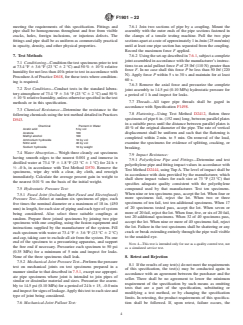
This specification covers requirements for polyethylene (PE) pipe and fittings for normal residential and commercial roof drain systems. Material for pipe or fitting shall be made from PE virgin plastic as defined by hydrostatic design stresses and shall contain suitable stabilizers and antioxidants. Pipe and fitting requirements include pipe dimensions, fitting dimensions, chemical resistance, water absorption, system integrity, sealing rings, flattening, impact resistance, workmanship, finish, and appearance. Test methods include test conditions, chemical resistance, water absorption, hydrostatic pressure test, mechanical-joint pullout test, threads, flattening, and impact resistance. Quality and product marking shall also conform to the requirements of this specification.
SCOPE
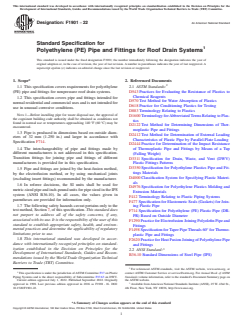
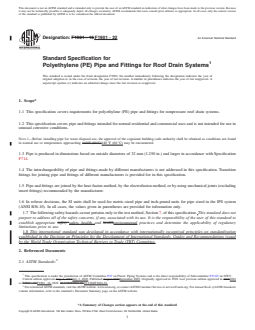
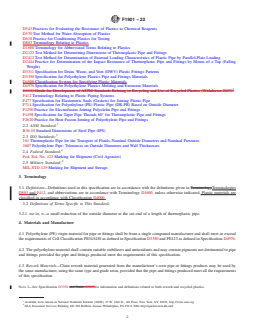
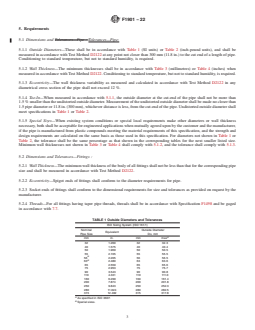
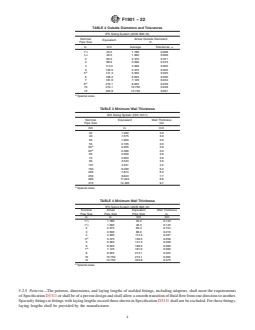
1.1 This specification covers requirements for polyethylene (PE) pipe and fittings for nonpressure roof drain systems.
1.2 This specification covers pipe and fittings intended for normal residential and commercial uses and is not intended for use in unusual corrosive conditions.
Note 1: Before installing pipe for waste disposal use, the approval of the cognizant building code authority shall be obtained as conditions not found in normal use or temperatures approaching 140 °F (60 °C) may be encountered.
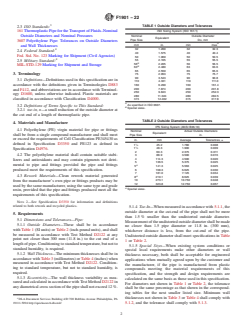
1.3 Pipe is produced in dimensions based on outside diameters of 32 mm (1.250 in.) and larger in accordance with Specification F714.
1.4 The interchangeability of pipe and fittings made by different manufacturers is not addressed in this specification. Transition fittings for joining pipe and fittings of different manufacturers is provided for in this specification.
1.5 Pipe and fittings are joined by the heat-fusion method, by the electrofusion method, or by using mechanical joints (excluding insert fittings) recommended by the manufacturer.
1.6 In referee decisions, the SI units shall be used for metric-sized pipe and inch-pound units for pipe sized in the IPS system (ANSI B36.10). In all cases, the values given in parentheses are provided for information only.
1.7 The following safety hazards caveat pertains only to the test method, Section 7, of this specification. This standard does not purport to address all of the safety concerns, if any, associated with its use. It is the responsibility of the user of this standard to establish appropriate safety, health, and environmental practices and determine the applicability of regulatory limitations prior to use.
1.8 This international standard was developed in accordance with internationally recognized principles on standardization established in the Decision on Principles for the Development of International Standards, Guides and Recommendations issued by the World Trade Organization Technical Barriers to Trade (TBT) Committee.
- Status
- Published
- Publication Date
- 30-Jun-2022
- Technical Committee
- F17 - Plastic Piping Systems
- Drafting Committee
- F17.63 - DWV
Buy Documents
ASTM F1901-22 - Standard Specification for Polyethylene (PE) Pipe and Fittings for Roof Drain Systems
REDLINE ASTM F1901-22 - Standard Specification for Polyethylene (PE) Pipe and Fittings for Roof Drain Systems
Overview
ASTM F1901-22: Standard Specification for Polyethylene (PE) Pipe and Fittings for Roof Drain Systems establishes requirements for the materials, dimensions, performance, and quality of PE pipes and fittings designed specifically for nonpressure roof drain systems in residential and commercial buildings. This standard, developed by ASTM International’s Committee F17 on Plastic Piping Systems, ensures consistent, high-quality PE piping products that meet the needs of building drainage applications.
The scope covers requirements for virgin PE materials, stabilizers, and antioxidants, as well as criteria for chemical resistance, water absorption, system integrity, mechanical properties, appearance, and markings. The standard also details approved joining methods for pipe and fittings, including heat fusion, electrofusion, and mechanical joints. This specification aims to provide clear guidance for manufacturers, installers, design professionals, and regulators engaged in roof drainage systems.
Key Topics
- Material Specifications: Only virgin PE plastic is permitted, ensuring high purity and consistent properties. Materials must meet specific cell classifications and contain suitable additives for longevity and performance.
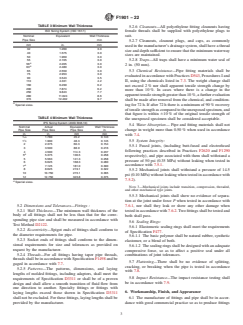
- Dimensional Requirements: Pipes are manufactured based on ISO and IPS outside diameter sizing systems for compatibility and standardization. Tables define tolerances for outside diameters and minimum wall thicknesses.
- Fittings Standards: Fittings must mirror the pipe’s wall thickness and be compatible in size. Requirements for cleanouts, traps, and fitting patterns are included for system completeness.
- Performance Criteria:
- Chemical Resistance: Pipes and fittings must resist specified chemicals without significant physical or strength changes.
- Water Absorption: Material must exhibit minimal water uptake, ensuring long-term reliability.
- System Integrity: Joints, whether fused or mechanical, are tested for leak tightness under standard pressures.
- Impact and Flattening Resistance: Pipes and fittings must withstand handling and installation stresses without cracking or breaking.
- Joining Methods: Accepted methods include heat-fusion, electrofusion, and manufacturer-specified mechanical joints (excluding insert fittings), supporting flexibility in installation practices.
- Marking Requirements: Clear, durable marking on pipe and fittings provides product traceability, compliance identification, and facilitates inspection.
- Quality Assurance: Manufacturers are responsible for comprehensive testing, inspection, and quality control to ensure all product batches meet the requirements of ASTM F1901.
Applications
ASTM F1901-22 is focused on roof drainage systems in standard residential and commercial buildings where nonpressure drainage conditions apply. The robust material and performance requirements make PE pipe and fittings an ideal solution for:
- Roof drain piping networks in new construction and renovations
- Projects where corrosion-resistant, lightweight, and durable piping is desirable
- Systems where flexibility in installation method (fusion or mechanical joining) is advantageous
- Installations that may require custom sizes or engineered solutions within the defined material and performance requirements
It is important to note that this standard is not intended for use in excessively corrosive environments or where waste disposal temperatures may approach 60°C (140°F); installers should consult building code authorities for approval in such cases. Transition fittings covered by this standard allow for integration with piping from different manufacturers or with other materials.
Related Standards
ASTM F1901-22 references and aligns with several related standards to ensure comprehensive performance and compatibility, including:
- ASTM F714: Polyethylene (PE) Plastic Pipe Based on Outside Diameter
- ASTM D3350: Specification for Polyethylene Plastics Pipe and Fittings Materials
- ASTM D543: Practice for Evaluating the Resistance of Plastics to Chemical Reagents
- ASTM D570: Test Method for Water Absorption of Plastics
- ASTM F477: Specification for Elastomeric Seals (Gaskets) for Joining Plastic Pipe
- ASTM F2620: Practice for Heat Fusion Joining of PE Pipe and Fittings
- ASTM F1290: Practice for Electrofusion Joining of Polyolefin Pipe and Fittings
- ISO 161 / ISO 3607: International standards for thermoplastic pipe dimensions and tolerances
These interconnected standards support quality assurance and safe, reliable use of PE piping in roof drain applications. For compliance, manufacturers, designers, and installers should reference the most current editions.
Practical Value
Adhering to ASTM F1901-22 ensures that PE pipes and fittings for roof drain systems will deliver reliable, long-term performance in line with recognized international construction standards, benefiting manufacturers, installers, and building owners alike.
Keywords: ASTM F1901-22, polyethylene pipe, roof drain systems, PE pipe fittings, building drainage, plastic piping standards, chemical resistance, system integrity, installation methods, quality assurance.
Relations
- Effective Date
- 01-Feb-2024
- Effective Date
- 01-Feb-2024
- Effective Date
- 01-Nov-2023
- Effective Date
- 01-Apr-2020
- Effective Date
- 01-Jan-2020
- Effective Date
- 01-Aug-2019
- Effective Date
- 15-Apr-2019
- Effective Date
- 01-Feb-2019
- Effective Date
- 01-Jan-2019
- Effective Date
- 01-Jan-2019
- Effective Date
- 01-Dec-2018
- Effective Date
- 01-Nov-2018
- Refers
ASTM D1600-18 - Standard Terminology for Abbreviated Terms Relating to Plastics (Withdrawn 2024) - Effective Date
- 01-Jan-2018
- Effective Date
- 15-Nov-2017
- Effective Date
- 15-Aug-2017
Buy Documents
ASTM F1901-22 - Standard Specification for Polyethylene (PE) Pipe and Fittings for Roof Drain Systems
REDLINE ASTM F1901-22 - Standard Specification for Polyethylene (PE) Pipe and Fittings for Roof Drain Systems
Get Certified
Connect with accredited certification bodies for this standard

Institut za varilstvo d.o.o. (Welding Institute)
Slovenia's leading welding institute since 1952. ISO 3834, EN 1090, pressure equipment certification, NDT personnel, welder qualification. Only IIW Au
Sponsored listings
Frequently Asked Questions
ASTM F1901-22 is a technical specification published by ASTM International. Its full title is "Standard Specification for Polyethylene (PE) Pipe and Fittings for Roof Drain Systems". This standard covers: ABSTRACT This specification covers requirements for polyethylene (PE) pipe and fittings for normal residential and commercial roof drain systems. Material for pipe or fitting shall be made from PE virgin plastic as defined by hydrostatic design stresses and shall contain suitable stabilizers and antioxidants. Pipe and fitting requirements include pipe dimensions, fitting dimensions, chemical resistance, water absorption, system integrity, sealing rings, flattening, impact resistance, workmanship, finish, and appearance. Test methods include test conditions, chemical resistance, water absorption, hydrostatic pressure test, mechanical-joint pullout test, threads, flattening, and impact resistance. Quality and product marking shall also conform to the requirements of this specification. SCOPE 1.1 This specification covers requirements for polyethylene (PE) pipe and fittings for nonpressure roof drain systems. 1.2 This specification covers pipe and fittings intended for normal residential and commercial uses and is not intended for use in unusual corrosive conditions. Note 1: Before installing pipe for waste disposal use, the approval of the cognizant building code authority shall be obtained as conditions not found in normal use or temperatures approaching 140 °F (60 °C) may be encountered. 1.3 Pipe is produced in dimensions based on outside diameters of 32 mm (1.250 in.) and larger in accordance with Specification F714. 1.4 The interchangeability of pipe and fittings made by different manufacturers is not addressed in this specification. Transition fittings for joining pipe and fittings of different manufacturers is provided for in this specification. 1.5 Pipe and fittings are joined by the heat-fusion method, by the electrofusion method, or by using mechanical joints (excluding insert fittings) recommended by the manufacturer. 1.6 In referee decisions, the SI units shall be used for metric-sized pipe and inch-pound units for pipe sized in the IPS system (ANSI B36.10). In all cases, the values given in parentheses are provided for information only. 1.7 The following safety hazards caveat pertains only to the test method, Section 7, of this specification. This standard does not purport to address all of the safety concerns, if any, associated with its use. It is the responsibility of the user of this standard to establish appropriate safety, health, and environmental practices and determine the applicability of regulatory limitations prior to use. 1.8 This international standard was developed in accordance with internationally recognized principles on standardization established in the Decision on Principles for the Development of International Standards, Guides and Recommendations issued by the World Trade Organization Technical Barriers to Trade (TBT) Committee.
ABSTRACT This specification covers requirements for polyethylene (PE) pipe and fittings for normal residential and commercial roof drain systems. Material for pipe or fitting shall be made from PE virgin plastic as defined by hydrostatic design stresses and shall contain suitable stabilizers and antioxidants. Pipe and fitting requirements include pipe dimensions, fitting dimensions, chemical resistance, water absorption, system integrity, sealing rings, flattening, impact resistance, workmanship, finish, and appearance. Test methods include test conditions, chemical resistance, water absorption, hydrostatic pressure test, mechanical-joint pullout test, threads, flattening, and impact resistance. Quality and product marking shall also conform to the requirements of this specification. SCOPE 1.1 This specification covers requirements for polyethylene (PE) pipe and fittings for nonpressure roof drain systems. 1.2 This specification covers pipe and fittings intended for normal residential and commercial uses and is not intended for use in unusual corrosive conditions. Note 1: Before installing pipe for waste disposal use, the approval of the cognizant building code authority shall be obtained as conditions not found in normal use or temperatures approaching 140 °F (60 °C) may be encountered. 1.3 Pipe is produced in dimensions based on outside diameters of 32 mm (1.250 in.) and larger in accordance with Specification F714. 1.4 The interchangeability of pipe and fittings made by different manufacturers is not addressed in this specification. Transition fittings for joining pipe and fittings of different manufacturers is provided for in this specification. 1.5 Pipe and fittings are joined by the heat-fusion method, by the electrofusion method, or by using mechanical joints (excluding insert fittings) recommended by the manufacturer. 1.6 In referee decisions, the SI units shall be used for metric-sized pipe and inch-pound units for pipe sized in the IPS system (ANSI B36.10). In all cases, the values given in parentheses are provided for information only. 1.7 The following safety hazards caveat pertains only to the test method, Section 7, of this specification. This standard does not purport to address all of the safety concerns, if any, associated with its use. It is the responsibility of the user of this standard to establish appropriate safety, health, and environmental practices and determine the applicability of regulatory limitations prior to use. 1.8 This international standard was developed in accordance with internationally recognized principles on standardization established in the Decision on Principles for the Development of International Standards, Guides and Recommendations issued by the World Trade Organization Technical Barriers to Trade (TBT) Committee.
ASTM F1901-22 is classified under the following ICS (International Classification for Standards) categories: 23.040.01 - Pipeline components and pipelines in general. The ICS classification helps identify the subject area and facilitates finding related standards.
ASTM F1901-22 has the following relationships with other standards: It is inter standard links to ASTM D883-24, ASTM F714-24, ASTM D883-23, ASTM F412-20, ASTM D883-20, ASTM D883-19c, ASTM D883-19a, ASTM D883-19, ASTM F412-19, ASTM F1290-19, ASTM D883-18a, ASTM D883-18, ASTM D1600-18, ASTM D2444-17, ASTM D883-17. Understanding these relationships helps ensure you are using the most current and applicable version of the standard.
ASTM F1901-22 is available in PDF format for immediate download after purchase. The document can be added to your cart and obtained through the secure checkout process. Digital delivery ensures instant access to the complete standard document.
Standards Content (Sample)
This international standard was developed in accordance with internationally recognized principles on standardization established in the Decision on Principles for the
Development of International Standards, Guides and Recommendations issued by the World Trade Organization Technical Barriers to Trade (TBT) Committee.
Designation:F1901 −22 An American National Standard
Standard Specification for
Polyethylene (PE) Pipe and Fittings for Roof Drain Systems
This standard is issued under the fixed designation F1901; the number immediately following the designation indicates the year of
original adoption or, in the case of revision, the year of last revision. A number in parentheses indicates the year of last reapproval. A
superscript epsilon (´) indicates an editorial change since the last revision or reapproval.
1. Scope* 2. Referenced Documents
1.1 This specification covers requirements for polyethylene 2.1 ASTM Standards:
(PE) pipe and fittings for nonpressure roof drain systems. D543 Practices for Evaluating the Resistance of Plastics to
Chemical Reagents
1.2 This specification covers pipe and fittings intended for
D570 Test Method for Water Absorption of Plastics
normal residential and commercial uses and is not intended for
D618 Practice for Conditioning Plastics for Testing
use in unusual corrosive conditions.
D883 Terminology Relating to Plastics
NOTE 1—Before installing pipe for waste disposal use, the approval of
D1600 Terminology forAbbreviatedTerms Relating to Plas-
the cognizant building code authority shall be obtained as conditions not
tics
found in normal use or temperatures approaching 140 °F (60 °C) may be
D2122 Test Method for Determining Dimensions of Ther-
encountered.
moplastic Pipe and Fittings
1.3 Pipe is produced in dimensions based on outside diam-
D2412 Test Method for Determination of External Loading
eters of 32 mm (1.250 in.) and larger in accordance with
Characteristics of Plastic Pipe by Parallel-Plate Loading
Specification F714.
D2444 Practice for Determination of the Impact Resistance
1.4 The interchangeability of pipe and fittings made by
of Thermoplastic Pipe and Fittings by Means of a Tup
different manufacturers is not addressed in this specification.
(Falling Weight)
Transition fittings for joining pipe and fittings of different
D3311 Specification for Drain, Waste, and Vent (DWV)
manufacturers is provided for in this specification.
Plastic Fittings Patterns
D3350 Specification for Polyethylene Plastics Pipe and Fit-
1.5 Pipe and fittings are joined by the heat-fusion method,
tings Materials
by the electrofusion method, or by using mechanical joints
D4000 Classification System for Specifying Plastic Materi-
(excluding insert fittings) recommended by the manufacturer.
als
1.6 In referee decisions, the SI units shall be used for
D4976 Specification for Polyethylene Plastics Molding and
metric-sizedpipeandinch-poundunitsforpipesizedintheIPS
Extrusion Materials
system (ANSI B36.10). In all cases, the values given in
F412 Terminology Relating to Plastic Piping Systems
parentheses are provided for information only.
F477 Specification for Elastomeric Seals (Gaskets) for Join-
1.7 The following safety hazards caveat pertains only to the
ing Plastic Pipe
test method, Section 7, of this specification. This standard does
F714 Specification for Polyethylene (PE) Plastic Pipe (DR-
not purport to address all of the safety concerns, if any,
PR) Based on Outside Diameter
associated with its use. It is the responsibility of the user of this
F1290 PracticeforElectrofusionJoiningPolyolefinPipeand
standard to establish appropriate safety, health, and environ-
Fittings
mental practices and determine the applicability of regulatory
F1498 Specification forTaper PipeThreads 60° forThermo-
limitations prior to use.
plastic Pipe and Fittings
1.8 This international standard was developed in accor-
F2620 Practice for Heat Fusion Joining of Polyethylene Pipe
dance with internationally recognized principles on standard-
and Fittings
ization established in the Decision on Principles for the 3
2.2 ANSI Standard:
Development of International Standards, Guides and Recom-
B36.10 Standard Dimensions of Steel Pipe (IPS)
mendations issued by the World Trade Organization Technical
Barriers to Trade (TBT) Committee.
For referenced ASTM standards, visit the ASTM website, www.astm.org, or
This specification is under the jurisdiction ofASTM Committee F17 on Plastic contact ASTM Customer Service at service@astm.org. For Annual Book of ASTM
Piping Systems and is the direct responsibility of Subcommittee F17.63 on DWV. Standards volume information, refer to the standard’s Document Summary page on
Current edition approved July 1, 2022. Published September 2022. Originally the ASTM website.
approved in 1998. Last previous edition approved in 2016 as F1901 - 16. DOI: Available from American National Standards Institute (ANSI), 25 W. 43rd St.,
10.1520/F1901-22. 4th Floor, New York, NY 10036, http://www.ansi.org.
*A Summary of Changes section appears at the end of this standard
Copyright © ASTM International, 100 Barr Harbor Drive, PO Box C700, West Conshohocken, PA 19428-2959. United States
F1901−22
TABLE 1 Outside Diameters and Tolerances
2.3 ISO Standards:
161 ThermoplasticPipefortheTransportofFluids–Nominal ISO Sizing System (ISO 161/1)
Outside Diameters and Nominal Pressures Nominal Outside Diameter
Equivalent
Pipe Size Do, mm
3607 Polyethylene Pipe: Tolerances on Outside Diameters
A
mm in. min max
and Wall Thicknesses
32 1.260 32 32.3
2.4 Federal Standard:
40 1.575 40 40.4
Fed. Std. No. 123 Marking for Shipment (Civil Agencies)
50 1.969 50 50.5
55 2.165 55 55.5
2.5 Military Standard:
B
56 2.205 56 56.5
MIL-STD-129 Marking for Shipment and Storage
B
63 2.480 63 63.6
65 2.559 65 65.6
3. Terminology
75 2.953 75 75.7
90 3.543 90 90.8
3.1 Definitions—Definitions used in this specification are in
110 4.331 110 111.0
accordance with the definitions given in Terminologies D883
160 6.299 160 161.4
200 7.874 200 201.8
and F412, and abbreviations are in accordance with Terminol-
250 9.843 250 252.3
ogy D1600, unless otherwise indicated. Plastic materials are
280 11.024 280 282.5
classified in accordance with Classification D4000.
315 12.402 315 317.8
A
As specified in ISO 3607.
3.2 Definitions of Terms Specific to This Standard:
B
Special sizes.
3.2.1 toe-in, n—a small reduction of the outside diameter at
the cut end of a length of thermoplastic pipe.
TABLE 2 Outside Diameters and Tolerances
4. Materials and Manufacture
IPS Sizing System (ANSI B36.10)
4.1 Polyethylene (PE) virgin material for pipe or fittings
Nominal Actual Outside Diameters
Equivalent
shall be from a single compound manufacturer and shall meet
Pipe Size in.
or exceed the requirements of Cell Classification PE345430 as
in. mm Average Tolerances, ±
defined in Specification D3350 and PE123 as defined in
1 ⁄4 45.2 1.780 0.008
1 ⁄2 48.3 1.900 0.009
Specification D4976.
2 60.3 2.375 0.011
3 88.9 3.500 0.016
4.2 The polyethylene material shall contain suitable stabi-
4 114.3 4.500 0.020
lizers and antioxidants and may contain pigments not detri-
5 136.5 5.375 0.025
A
mental to pipe and fittings provided the pipe and fittings
5 141.3 5.563 0.025
produced meet the requirements of this specification. 6 168.3 6.625 0.030
7 181.0 7.125 0.034
A
4.3 Rework Materials—Clean rework material generated
8 219.1 8.625 0.039
10 273.1 10.750 0.048
from the manufacturer’s own pipe or fittings products may be
12 323.8 12.750 0.057
used by the same manufacturer, using the same type and grade
A
Special sizes.
resin, provided that the pipe and fittings produced meet all the
requirements of this specification.
NOTE 2—See Specification D3350 for information and definitions
related to both rework and recycled plastics.
5.1.4 Toe-In—When measured in accordance with 5.1.1, the
outside diameter at the cut-end of the pipe shall not be more
5. Requirements
than 1.5 % smaller than the undistorted outside diameter.
5.1 Dimensions and Tolerances—Pipe:
Measurementoftheundistortedoutsidediametershallbemade
5.1.1 Outside Diameters—These shall be in accordance
no closer than 1.5 pipe diameter or 11.8 in. (300 mm),
with Table 1 (SI units) or Table 2 (inch-pound units), and shall
whichever distance is less, from the cut-end of the pipe.
be measured in accordance with Test Method D2122 at any
Undistorted outside diameter shall meet specifications in Table
point not closer than 300 mm (11.8 in.) to the cut end of a
1 or Table 2.
lengthofpipe.Conditioningtostandardtemperature,butnotto
5.1.5 Special Sizes—When existing system conditions or
standard humidity, is required.
special local requirements make other diameters or wall
5.1.2 Wall Thickness—The minimum thicknesses shall be in
thickness necessary, both shall be acceptable for engineered
accordancewithTable3(millimetres)orTable4(inches)when
applications when mutually agreed upon by the customer and
measured in accordance with Test Method D2122. Condition-
the manufacturer, if the pipe is manufactured from plastic
ing to standard temperature, but not to standard humidity, is
compounds meeting the material requirements of this
required.
specification, and the strength and design requirements are
5.1.3 Eccentricity—The wall thickness variability as mea-
calculated on the same basis as those used in this specification.
sured and calculated in accordance withTest Method D2122 in
For diameters not shown in Table 1 or Table 2, the tolerance
anydiametricalcrosssectionofthepipeshallnotexceed12 %.
shall be the same percentage as that shown in the correspond-
ing tables for the next smaller listed size. Minimum wall
thicknesses not shown in Table 3 or Table 4 shall comply with
DLA Document Services Building 4/D 700 Robbins Avenue Philadelphia, PA
19111-5094 http://quicksearch.dla.mil/ 5.1.2, and the tolerance shall comply with 5.1.3.
F1901−22
TABLE 3 Minimum Wall Thickness
5.2.6 Cleanouts—All polyethylene fitting cleanouts having
ISO Sizing System (ISO 161/1) female threads shall be supplied with polyethylene plugs to
Nominal Equivalent Wall Thickness suit.
Pipe Size min
5.2.7 Cleanouts, cleanout plugs, and caps, as commonly
mm in. mm
usedinthemanufacturer’sdrainagesystem,shallhaveathread
32 1.260 3.0
size and depth sufficient to ensure that the minimum waterway
40 1.575 3.0
sizes are maintained.
50 1.969 3.0
55 2.165 3.0 5.2.8 Traps—All traps shall have a minimum water seal of
A
56 2.205 3.0
2 in. (50 mm).
A
63 2.480 3.0
65 2.559 3.0
5.3 Chemical Resistance—Pipe fitting materials shall be
75 2.953 3.0
evaluated in accordance with Practices D543, Procedures I and
90 3.543 3.5
II, using the chemicals listed in 7.3. The weight change shall
110 4.331 4.2
160 6.299 6.2
not exceed 2 % nor shall apparent tensile strength change by
200 7.874 6.2
more than 10 %. In cases where there is a change in the
250 9.843 7.7
apparenttensilestrengthgreaterthan10 %,afurtherevaluation
280 11.024 8.6
315 12.402 9.7
shall be made after removal from the chemical, and condition-
A
Special sizes. ing for 72 h. If after 72 h there is a minimum of 90 % recovery
oftensilestrengthascomparedtotheunexposedspecimen,and
that figure is within 610 % of the original tensile strength of
TABLE 4 Minimum Wall Thickness
the unexposed specimen shall be considered acceptable.
IPS Sizing System (ANSI B36.10)
5.4 Water Absorption— Pipe and fitting materials shall not
Nominal Actual Equivalent Wall Thickness
Pipe Size Pipe Size Pipe Size in. change in weight more than 0.50 % when used in accordance
in. in. mm min
with 7.4.
1 ⁄4 1.780 45.2 0.143
1 ⁄2 1.900 48.3 0.145
5.5 System Integrity:
2 2.375 60.3 0.154
5.5.1 Fused joints, (including butt-fused and electrofused
3 3.500 88.9 0.216
following practices described in Practices F2620 and F1290
4 4.500 114.3 0.237
A
5 5.375 136.5 0.258
respectively), and pipe associated with them shall withstand a
5 5.563 141.3 0.258
pressure of 50 psi (0.35 MPa) without leaking when tested in
6 6.625 168.3 0.280
A
accordance with 7.5.1.
7 7.125 181.0 0.300
8 8.625 219.1 0.322
5.5.2 Mechanical joints shall withstand a pressure of 14.5
10 10.750 273.1 0.365
psi (0.10 MPa) without leaking when tested in accordance with
12 12.750 323.8 0.375
7.5.2).
A
Special sizes.
NOTE 3—Mechanical joints include transition, compression, threaded,
and other mechanical type joints.
5.5.3 Mechanical joints shall show no evidence of separa-
tion at the joint under force P when tested in accordance with
5.2 Dimensions and Tolerances—Fittings :
7.6.1, nor shall they leak or show any other damage when
5.2.1 Wall Thickness—The minimum wall thickness of the tested in accordance with 7.6.2.Two fittings shall be tested and
body of all fittings shall not be less than that for the corre- both shall pass.
sponding pipe size and shall be measured in accordance with
5.6 Sealing Rings:
Test Method D2122.
5.6.1 Elastomeric sealing rings shall meet the requirements
5.2.2 Eccentricity—Spigot ends of fittings shall conform to
of Specification F477.
the diameter requirements for pipe.
5.6.1.1 The basic polymer shall be natural rubber, synthetic
5.2.3 Socket ends of fittings shall conform to the dimen-
elastomer, or a blend of both.
sional requirements for size and tolerances as provided on
5.6.1.2 The sealing rings shall be designed with an adequate
request by the manufacturer.
compressive force, so as to affect a positive seal under all
5.2.4 Threads—For all fittings having taper pipe threads,
combinations of joint tolerances.
threads shall be in accordance with Specification F1498 and be
5.7 Flattening—There shall be no evidence of splitting,
gaged in accordance with 7.7.
cracking, or breaking when the pipe is tested in accordance
5.2.5 Patterns—The patterns, dimensions, and laying
with 7.8.
lengths of molded fittings, including adaptors, shall meet the
5.8 Impact Resistance—The impact resistance testing shall
requirements of Specification D3311 or shall be of a proven
be in accordance with 7.9.
design and shall allow a smooth transition of fluid flow from
one direction to another. Specialty fittings or fittings with
6. Workmanship, Finish, and Appearance
laying lengths exceed those shown in Specification D3311
shall not be excluded. For these fittings, laying lengths shall be 6.1 The manufacture of fittings and pipe shall be in accor-
provided by the manufacturer. dance with good commercial practice so as to produce fittings
F1901−22
meeting the requirements of this specification. Fittings and 7.6.1 Join two sections of pipe by a coupling. Mount the
pipe shall be homogeneous through
...
This document is not an ASTM standard and is intended only to provide the user of an ASTM standard an indication of what changes have been made to the previous version. Because
it may not be technically possible to adequately depict all changes accurately, ASTM recommends that users consult prior editions as appropriate. In all cases only the current version
of the standard as published by ASTM is to be considered the official document.
Designation: F1901 − 16 F1901 − 22 An American National Standard
Standard Specification for
Polyethylene (PE) Pipe and Fittings for Roof Drain Systems
This standard is issued under the fixed designation F1901; the number immediately following the designation indicates the year of
original adoption or, in the case of revision, the year of last revision. A number in parentheses indicates the year of last reapproval. A
superscript epsilon (´) indicates an editorial change since the last revision or reapproval.
1. Scope*
1.1 This specification covers requirements for polyethylene (PE) pipe and fittings for nonpressure roof drain systems.
1.2 This specification covers pipe and fittings intended for normal residential and commercial uses and is not intended for use in
unusual corrosive conditions.
NOTE 1—Before installing pipe for waste disposal use, the approval of the cognizant building code authority shall be obtained as conditions not found
in normal use or temperatures approaching 140°F (60°C)140 °F (60 °C) may be encountered.
1.3 Pipe is produced in dimensions based on outside diameters of 32 mm (1.250 in.) and larger in accordance with Specification
F714.
1.4 The interchangeability of pipe and fittings made by different manufacturers is not addressed in this specification. Transition
fittings for joining pipe and fittings of different manufacturers is provided for in this specification.
1.5 Pipe and fittings are joined by the heat-fusion method, by the electrofusion method, or by using mechanical joints (excluding
insert fittings) recommended by the manufacturer.
1.6 In referee decisions, the SI units shall be used for metric-sized pipe and inch-pound units for pipe sized in the IPS system
(ANSI B36.10). In all cases, the values given in parentheses are provided for information only.
1.7 The following safety hazards caveat pertains only to the test method, Section 7, of this specification. This standard does not
purport to address all of the safety concerns, if any, associated with its use. It is the responsibility of the user of this standard to
establish appropriate safety safety, health, and healthenvironmental practices and determine the applicability of regulatory
limitations prior to use.
1.8 This international standard was developed in accordance with internationally recognized principles on standardization
established in the Decision on Principles for the Development of International Standards, Guides and Recommendations issued
by the World Trade Organization Technical Barriers to Trade (TBT) Committee.
2. Referenced Documents
2.1 ASTM Standards:
This specification is under the jurisdiction of ASTM Committee F17 on Plastic Piping Systems and is the direct responsibility of Subcommittee F17.63 on DWV.
Current edition approved Aug. 1, 2016July 1, 2022. Published August 2016September 2022. Originally approved in 1998. Last previous edition approved in 20102016
as F1901 - 10.F1901 - 16. DOI: 10.1520/F1901-16.10.1520/F1901-22.
For referenced ASTM standards, visit the ASTM website, www.astm.org, or contact ASTM Customer Service at service@astm.org. For Annual Book of ASTM Standards
volume information, refer to the standard’s Document Summary page on the ASTM website.
*A Summary of Changes section appears at the end of this standard
Copyright © ASTM International, 100 Barr Harbor Drive, PO Box C700, West Conshohocken, PA 19428-2959. United States
F1901 − 22
D543 Practices for Evaluating the Resistance of Plastics to Chemical Reagents
D570 Test Method for Water Absorption of Plastics
D618 Practice for Conditioning Plastics for Testing
D883 Terminology Relating to Plastics
D1600 Terminology for Abbreviated Terms Relating to Plastics
D2122 Test Method for Determining Dimensions of Thermoplastic Pipe and Fittings
D2412 Test Method for Determination of External Loading Characteristics of Plastic Pipe by Parallel-Plate Loading
D2444 Practice for Determination of the Impact Resistance of Thermoplastic Pipe and Fittings by Means of a Tup (Falling
Weight)
D3311 Specification for Drain, Waste, and Vent (DWV) Plastic Fittings Patterns
D3350 Specification for Polyethylene Plastics Pipe and Fittings Materials
D4000 Classification System for Specifying Plastic Materials
D4976 Specification for Polyethylene Plastics Molding and Extrusion Materials
D5033 Guide for Development of ASTM Standards Relating to Recycling and Use of Recycled Plastics (Withdrawn 2007)
F412 Terminology Relating to Plastic Piping Systems
F477 Specification for Elastomeric Seals (Gaskets) for Joining Plastic Pipe
F714 Specification for Polyethylene (PE) Plastic Pipe (DR-PR) Based on Outside Diameter
F1290 Practice for Electrofusion Joining Polyolefin Pipe and Fittings
F1498 Specification for Taper Pipe Threads 60° for Thermoplastic Pipe and Fittings
F2620 Practice for Heat Fusion Joining of Polyethylene Pipe and Fittings
2.2 ANSI Standard:
B36.10 Standard Dimensions of Steel Pipe (IPS)
2.3 ISO Standards:
161 Thermoplastic Pipe for the Transport of Fluids–Nominal Outside Diameters and Nominal Pressures
3607 Polyethylene Pipe: Tolerances on Outside Diameters and Wall Thicknesses
2.4 Federal Standard:
Fed. Std. No. 123 Marking for Shipment (Civil Agencies)
2.5 Military Standard:
MIL-STD-129 Marking for Shipment and Storage
3. Terminology
3.1 Definitions—Definitions used in this specification are in accordance with the definitions given in TerminologyTerminologies
D883 and F412, and abbreviations are in accordance with Terminology D1600, unless otherwise indicated. Plastic materials are
classified in accordance with Classification D4000.
3.2 Definitions of Terms Specific to This Standard:
3.2.1 toe-in, n—a small reduction of the outside diameter at the cut end of a length of thermoplastic pipe.
4. Materials and Manufacture
4.1 Polyethylene (PE) virgin material for pipe or fittings shall be from a single compound manufacturer and shall meet or exceed
the requirements of Cell Classification PE345430 as defined in Specification D3350 and PE123 as defined in Specification D4976.
4.2 The polyethylene material shall contain suitable stabilizers and antioxidants and may contain pigments not detrimental to pipe
and fittings provided the pipe and fittings produced meet the requirements of this specification.
4.3 Rework Materials—Clean rework material generated from the manufacturer’s own pipe or fittings products may be used by
the same manufacturer, using the same type and grade resin, provided that the pipe and fittings produced meet all the requirements
of this specification.
NOTE 2—See Specification D3350 and Guide D5033for information and definitions related to both rework and recycled plastics.
Available from American National Standards Institute (ANSI), 25 W. 43rd St., 4th Floor, New York, NY 10036, http://www.ansi.org.
DLA Document Services Building 4/D 700 Robbins Avenue Philadelphia, PA 19111-5094 http://quicksearch.dla.mil/
F1901 − 22
5. Requirements
5.1 Dimensions and Tolerances—Pipe : Tolerances—Pipe:
5.1.1 Outside Diameters—These shall be in accordance with Table 1 (SI units) or Table 2 (inch-pound units), and shall be
measured in accordance with Test Method D2122 at any point not closer than 300 mm (11.8 in.) to the cut end of a length of pipe.
Conditioning to standard temperature, but not to standard humidity, is required.
5.1.2 Wall Thickness—The minimum thicknesses shall be in accordance with Table 3 (millimetres) or Table 4 (inches) when
measured in accordance with Test Method D2122. Conditioning to standard temperature, but not to standard humidity, is required.
5.1.3 Eccentricity—The wall thickness variability as measured and calculated in accordance with Test Method D2122 in any
diametrical cross section of the pipe shall not exceed 12 %.
5.1.4 Toe-In—When measured in accordance with 5.1.1, the outside diameter at the cut-end of the pipe shall not be more than
1.5 % smaller than the undistorted outside diameter. Measurement of the undistorted outside diameter shall be made no closer than
1.5 pipe diameter or 11.8 in. (300 mm), whichever distance is less, from the cut-end of the pipe. Undistorted outside diameter shall
meet specifications in Table 1 or Table 2.
5.1.5 Special Sizes—When existing system conditions or special local requirements make other diameters or wall thickness
necessary, both shall be acceptable for engineered applications when mutually agreed upon by the customer and the manufacturer,
if the pipe is manufactured from plastic compounds meeting the material requirements of this specification, and the strength and
design requirements are calculated on the same basis as those used in this specification. For diameters not shown in Table 1 or
Table 2, the tolerance shall be the same percentage as that shown in the corresponding tables for the next smaller listed size.
Minimum wall thicknesses not shown in Table 3 or Table 4 shall comply with 5.1.2, and the tolerance shall comply with 5.1.3.
5.2 Dimensions and Tolerances—Fittings :
5.2.1 Wall Thickness—The minimum wall thickness of the body of all fittings shall not be less than that for the corresponding pipe
size and shall be measured in accordance with Test Method D2122.
5.2.2 Eccentricity—Spigot ends of fittings shall conform to the diameter requirements for pipe.
5.2.3 Socket ends of fittings shall conform to the dimensional requirements for size and tolerances as provided on request by the
manufacturer.
5.2.4 Threads—For all fittings having taper pipe threads, threads shall be in accordance with Specification F1498 and be gaged
in accordance with 7.7.
TABLE 1 Outside Diameters and Tolerances
ISO Sizing System (ISO 161/1)
Nominal Outside Diameter
Equivalent
Pipe Size Do, mm
A
mm in. min max
32 1.260 32 32.3
40 1.575 40 40.4
50 1.969 50 50.5
55 2.165 55 55.5
B
56 2.205 56 56.5
B
63 2.480 63 63.6
65 2.559 65 65.6
75 2.953 75 75.7
90 3.543 90 90.8
110 4.331 110 111.0
160 6.299 160 161.4
200 7.874 200 201.8
250 9.843 250 252.3
280 11.024 280 282.5
315 12.402 315 317.8
A
As specified in ISO 3607.
B
Special sizes.
F1901 − 22
TABLE 2 Outside Diameters and Tolerances
IPS Sizing System (ANSI B36.10)
Nominal Actual Outside Diameters
Equivalent
Pipe Size in.
in. mm Average Tolerances, ±
1 ⁄4 45.2 1.780 0.008
1 ⁄2 48.3 1.900 0.009
2 60.3 2.375 0.011
3 88.9 3.500 0.016
4 114.3 4.500 0.020
5 136.5 5.375 0.025
A
5 141.3 5.563 0.025
6 168.3 6.625 0.030
7 181.0 7.125 0.034
A
8 219.1 8.625 0.039
10 273.1 10.750 0.048
12 323.8 12.750 0.057
A
Special sizes.
TABLE 3 Minimum Wall Thickness
ISO Sizing System (ISO 161/1)
Nominal Equivalent Wall Thickness
Pipe Size min
mm in. mm
32 1.260 3.0
40 1.575 3.0
50 1.969 3.0
55 2.165 3.0
A
56 2.205 3.0
A
63 2.480 3.0
65 2.559 3.0
75 2.953 3.0
90 3.543 3.5
110 4.331 4.2
160 6.299 6.2
200 7.874 6.2
250 9.843 7.7
280 11.024 8.6
315 12.402 9.7
A
Special sizes.
TABLE 4 Minimum Wall Thickness
IPS Sizing System (ANSI B36.10)
Nominal Actual Equivalent Wall Thickness
Pipe Size Pipe Size Pipe Size in.
in. in. mm min
1 ⁄4 1.780 45.2 0.143
1 ⁄2 1.900 48.3 0.145
2 2.375 60.3 0.154
3 3.500 88.9 0.216
4 4.500 114.3 0.237
A
5 5.375 136.5 0.258
5 5.563 141.3 0.258
6 6.625 168.3 0.280
A
7 7.125 181.0 0.300
8 8.625 219.1 0.322
10 10.750 273.1 0.365
12 12.750 323.8 0.375
A
Special sizes.
5.2.5 Patterns—The patterns, dimensions, and laying lengths of molded fittings, including adaptors, shall meet the requirements
of Specification D3311 or shall be of a proven design and shall allow a smooth transition of fluid flow from one direction to another.
Specialty fittings or fittings with laying lengths exceed those shown in Specification D3311 shall not be excluded. For these fittings,
laying lengths shall be provided by the manufacturer.
F1901 − 22
5.2.6 Cleanouts—All polyethylene fitting cleanouts having female threads shall be supplied with polyethylene plugs to suit.
5.2.7 Cleanouts, cleanout plugs, and caps, as commonly used in the manufacturer’s drainage system, shall have a thread size and
depth sufficient to ensure that the minimum waterway sizes are maintained.
5.2.8 Traps—All traps shall have a minimum water seal of 2 in. (50 mm).
5.3 Chemical Resistance—Pipe fitting materials shall be evaluated in accordance with Practices D543, Procedures I and II, using
the chemicals listed in 7.3. The weight change shall not exceed 2 % nor shall apparent tensile strength change by more than 10 %.
In cases where there is a change in the apparent tensile strength greater than 10 %, a further evaluation shall be made after removal
from the chemical, and conditioning for 72 h. If after 72 h there is a minimum of 90 % recovery of tensile strength as compared
to the unexposed specimen, and that figure is within 610 % of the original tensile strength of the unexposed specimen shall be
considered acceptable.
5.4 Water Absorption— Pipe and fitting materials shall not change in weight more than 0.50 % when used in accordance with 7.4.
5.5 System Integrity:
5.5.1 Fused joints, (including butt-fused and electrofused following practices described in Practices F2620 and F1290
respectively), and pipe associated with them shall withstand a pressure of 50 psi (0.35 MPa) without leaking when tested in
accordance with 7.5.1.
5.5.2 Mechanical joints shall withstand a pressure of 14.5 psi (0.10 MPa) without leaking when tested in accordance with 7.5.2).
NOTE 3—Mechanical joints include transition, compression, threaded, and other mechanical type joints.
5.5.3 Mechanical joints shall show no evidence of separation at the joint under force P when tested in accordance with 7.6.1, nor
shall they leak or show any other damage when tested in accordance with 7.6.2. Two fittings shall be tested and both shall pass.
5.6 Sealing Rings:
5.6.1 Elastomeric sealing rings shall meet the requirements of Specification F477.
5.6.1.1 The basic polymer shall be natural rubber, synthetic elastomer, or a blend of both.
5.6.1.2 The sealing rings shall be designed with an adequate compressive force, so as to affect a positive seal under all
combinations of joint tolerances.
5.7 Flattening—There shall be no evidence of splitting, cracking, or breaking when the pipe is tested in accordance with 7.8.
5.8 Impact Resistance—The impact resistance testing shall be in accordance with 7.9.
6. Workmanship, Finish, and Appearance
6.1 The manufacture of fittings and pipe shall be in accordance with good commercial practice so as to produce fittings meeting
the requirements of this specification. Fittings and pipe shall be homogeneous throughout and free from visible cracks, holes,
foreign inclusions, or injurious defects. The fittings and pipe shall be as uniform as commercially practical in opacity, density, and
other physical properties.
7. Test Methods
7.1 Conditioning—Condition the test specimens prior to test at 73.473.4 °F 6 3.6°F (233.6 °F (23 °C 6 2°C)2 °C) and 5050 %
6 10 % relative humidity for no
...