

ASTM F2984-13(2019)
(Specification)Standard Specification for Segmental Panel System for the Grout-in-Place-Liner (GIPL) Rehabilitation Method of Existing Man-Entry Size Sewers, Culverts, and Conduits
General Information
- Abstract
ABSTRACT
This specification establishes the requirements and test methods for the materials, dimensions, workmanship, and finished quality of injection molded polyvinyl chloride (PVC) profile sections used for the field fabrication of a PVC liner inside existing man-entry size circular and non-circular sewers; circular, non-circular, and box culverts, conduits, and vertical shafts or manholes having dimensions of 39.4 in. and larger (1000 mm and larger). It covers segmental panel system for non-pressure applications where the PVC liner is installed in the existing structure and the annular space between the liner and the existing structure is grouted with a low viscosity, high strength cementitious grout.
SCOPE
1.1 This specification covers the requirements and test methods for the materials, dimensions, workmanship, and finished quality of injection molded poly vinyl chloride (PVC) profile sections used for the field fabrication of a PVC liner inside existing man-entry size circular and non-circular sewers; circular, non-circular, and box culverts, conduits, and vertical shafts or manholes having dimensions of 39.4 in. and larger (1000 mm and larger).
1.2 The segmental panel system produced under this specification is for non-pressure applications where the PVC liner is installed in the existing structure and the annular space between the liner and the existing structure is grouted with a low viscosity, high strength cementitious grout.
1.3 Units—The values stated in either SI units or inch-pound units are to be regarded separately as standard. The values stated in each system may not be exact equivalents; therefore, each system shall be used independently of the other. Combining values from the two systems may result in non-conformance with the standard.
1.4 This standard does not purport to address all of the safety concerns, if any, associated with its use. It is the responsibility of the user of this standard to establish appropriate safety, health, and environmental practices and determine the applicability of regulatory limitations prior to use.
1.5 This international standard was developed in accordance with internationally recognized principles on standardization established in the Decision on Principles for the Development of International Standards, Guides and Recommendations issued by the World Trade Organization Technical Barriers to Trade (TBT) Committee.
- Status
- Published
- Publication Date
- 31-Mar-2019
- Technical Committee
- F17 - Plastic Piping Systems
- Drafting Committee
- F17.67 - Trenchless Plastic Pipeline Technology
Overview
ASTM F2984-13(2019) is an internationally recognized standard specification for segmental panel systems used in the Grout-in-Place-Liner (GIPL) rehabilitation method for existing man-entry size sewers, culverts, and conduits. Developed by ASTM International, this standard defines requirements for injection molded polyvinyl chloride (PVC) profile sections intended for field fabrication of liners inside large-diameter, man-entry pipelines and vertical structures with dimensions of 1000 mm (39.4 inches) and larger.
This specification addresses non-pressure applications, where a PVC liner is installed within an existing structure and the annular space between the liner and the original structure is filled with a low-viscosity, high-strength cementitious grout. The standard covers material properties, dimensions, joint performance, workmanship, marking, and quality assurance, ensuring a reliable solution for infrastructure rehabilitation.
Key Topics
Material Requirements
- Specifies PVC compounds that meet ASTM D1784 requirements.
- Allows use of clean rework PVC from the manufacturer’s own production, provided final products meet the standard.
Product Dimensions and Tolerances
- Defines minimum wall thickness and panel heights for both circular and box culvert liners.
- Sets tolerances for segment widths and accepts variations as per stated percentage limits.
Performance and Testing
- Abrasion resistance tested per ASTM G195 to ensure durability in sanitary and storm sewer environments.
- Joint watertightness required, verified by pressure testing joints with applied sealant at 0.3 MPa (43.5 psi).
- Flexibility of assembled segment rings must accommodate grout installation in multiple lifts.
Workmanship and Appearance
- Panels must be homogeneous, free from cracks and defects, and consistent in color and density.
- Visual translucency aids inspection of grout installation during field application.
Inspection and Certification
- Sampling procedures for quality control during production runs.
- Certification of compliance provided by the manufacturer upon request.
Applications
The ASTM F2984 standard is critical for engineers, contractors, and municipal authorities involved in the rehabilitation of aging or damaged large-diameter pipelines and vertical sewer structures, especially those requiring trenchless solutions. Typical applications include:
- Rehabilitation of man-entry size sanitary and storm sewers, improving structural integrity without full pipe replacement.
- Renewal of culverts and conduits, minimizing traffic and environmental disruption during installation.
- Refurbishment of manholes and vertical shafts with internal liners, extending service life and preventing infiltration or exfiltration.
- Non-pressure environments where watertight lining is required to restore existing infrastructure economically and efficiently.
Related Standards
For comprehensive pipeline and rehabilitation project planning, the following ASTM standards are commonly referenced alongside ASTM F2984:
- ASTM D1784: Specification for Rigid Poly(Vinyl Chloride) (PVC) Compounds and Chlorinated Poly(Vinyl Chloride) (CPVC) Compounds
- ASTM D2122: Test Method for Determining Dimensions of Thermoplastic Pipe and Fittings
- ASTM D2152: Test Method for Adequacy of Fusion of Extruded Poly(Vinyl Chloride) (PVC) Pipe and Molded Fittings by Acetone Immersion
- ASTM G195: Guide for Conducting Wear Tests Using a Rotary Platform Abraser
- ASTM F412: Terminology Relating to Plastic Piping Systems
Practical Value
Implementing the ASTM F2984 standard ensures that the segmental panel system for GIPL rehabilitation delivers reliable, long-term performance in critical infrastructure assets. The document’s guidelines help guarantee that materials and workmanship consistently meet essential safety, durability, and installation criteria, supporting cost-effective upgrades of sewer and culvert systems via modern trenchless technologies.
Keywords: ASTM F2984, segmental panel system, grout-in-place liner, PVC liner, sewer rehabilitation, culvert renewal, non-pressure pipe lining, trenchless technology, pipeline standards, infrastructure rehabilitation.
Relations
- Effective Date
- 01-Apr-2019
- Effective Date
- 01-Feb-2024
- Effective Date
- 01-Nov-2023
- Effective Date
- 01-Nov-2023
- Effective Date
- 01-Apr-2020
- Effective Date
- 15-Jan-2020
- Effective Date
- 01-Jan-2020
- Effective Date
- 01-Aug-2019
- Effective Date
- 15-Apr-2019
- Effective Date
- 01-Feb-2019
- Effective Date
- 01-Jan-2019
- Effective Date
- 01-Dec-2018
- Effective Date
- 01-Nov-2018
- Refers
ASTM D1600-18 - Standard Terminology for Abbreviated Terms Relating to Plastics (Withdrawn 2024) - Effective Date
- 01-Jan-2018
- Effective Date
- 01-Nov-2017
Get Certified
Connect with accredited certification bodies for this standard

Institut za varilstvo d.o.o. (Welding Institute)
Slovenia's leading welding institute since 1952. ISO 3834, EN 1090, pressure equipment certification, NDT personnel, welder qualification. Only IIW Au
Sponsored listings
Frequently Asked Questions
ASTM F2984-13(2019) is a technical specification published by ASTM International. Its full title is "Standard Specification for Segmental Panel System for the Grout-in-Place-Liner (GIPL) Rehabilitation Method of Existing Man-Entry Size Sewers, Culverts, and Conduits". This standard covers: ABSTRACT This specification establishes the requirements and test methods for the materials, dimensions, workmanship, and finished quality of injection molded polyvinyl chloride (PVC) profile sections used for the field fabrication of a PVC liner inside existing man-entry size circular and non-circular sewers; circular, non-circular, and box culverts, conduits, and vertical shafts or manholes having dimensions of 39.4 in. and larger (1000 mm and larger). It covers segmental panel system for non-pressure applications where the PVC liner is installed in the existing structure and the annular space between the liner and the existing structure is grouted with a low viscosity, high strength cementitious grout. SCOPE 1.1 This specification covers the requirements and test methods for the materials, dimensions, workmanship, and finished quality of injection molded poly vinyl chloride (PVC) profile sections used for the field fabrication of a PVC liner inside existing man-entry size circular and non-circular sewers; circular, non-circular, and box culverts, conduits, and vertical shafts or manholes having dimensions of 39.4 in. and larger (1000 mm and larger). 1.2 The segmental panel system produced under this specification is for non-pressure applications where the PVC liner is installed in the existing structure and the annular space between the liner and the existing structure is grouted with a low viscosity, high strength cementitious grout. 1.3 Units—The values stated in either SI units or inch-pound units are to be regarded separately as standard. The values stated in each system may not be exact equivalents; therefore, each system shall be used independently of the other. Combining values from the two systems may result in non-conformance with the standard. 1.4 This standard does not purport to address all of the safety concerns, if any, associated with its use. It is the responsibility of the user of this standard to establish appropriate safety, health, and environmental practices and determine the applicability of regulatory limitations prior to use. 1.5 This international standard was developed in accordance with internationally recognized principles on standardization established in the Decision on Principles for the Development of International Standards, Guides and Recommendations issued by the World Trade Organization Technical Barriers to Trade (TBT) Committee.
ABSTRACT This specification establishes the requirements and test methods for the materials, dimensions, workmanship, and finished quality of injection molded polyvinyl chloride (PVC) profile sections used for the field fabrication of a PVC liner inside existing man-entry size circular and non-circular sewers; circular, non-circular, and box culverts, conduits, and vertical shafts or manholes having dimensions of 39.4 in. and larger (1000 mm and larger). It covers segmental panel system for non-pressure applications where the PVC liner is installed in the existing structure and the annular space between the liner and the existing structure is grouted with a low viscosity, high strength cementitious grout. SCOPE 1.1 This specification covers the requirements and test methods for the materials, dimensions, workmanship, and finished quality of injection molded poly vinyl chloride (PVC) profile sections used for the field fabrication of a PVC liner inside existing man-entry size circular and non-circular sewers; circular, non-circular, and box culverts, conduits, and vertical shafts or manholes having dimensions of 39.4 in. and larger (1000 mm and larger). 1.2 The segmental panel system produced under this specification is for non-pressure applications where the PVC liner is installed in the existing structure and the annular space between the liner and the existing structure is grouted with a low viscosity, high strength cementitious grout. 1.3 Units—The values stated in either SI units or inch-pound units are to be regarded separately as standard. The values stated in each system may not be exact equivalents; therefore, each system shall be used independently of the other. Combining values from the two systems may result in non-conformance with the standard. 1.4 This standard does not purport to address all of the safety concerns, if any, associated with its use. It is the responsibility of the user of this standard to establish appropriate safety, health, and environmental practices and determine the applicability of regulatory limitations prior to use. 1.5 This international standard was developed in accordance with internationally recognized principles on standardization established in the Decision on Principles for the Development of International Standards, Guides and Recommendations issued by the World Trade Organization Technical Barriers to Trade (TBT) Committee.
ASTM F2984-13(2019) is classified under the following ICS (International Classification for Standards) categories: 23.040.01 - Pipeline components and pipelines in general. The ICS classification helps identify the subject area and facilitates finding related standards.
ASTM F2984-13(2019) has the following relationships with other standards: It is inter standard links to ASTM F2984-13, ASTM D883-24, ASTM D883-23, ASTM D2152-23, ASTM F412-20, ASTM D1784-20, ASTM D883-20, ASTM D883-19c, ASTM D883-19a, ASTM D883-19, ASTM F412-19, ASTM D883-18a, ASTM D883-18, ASTM D1600-18, ASTM D2152-17. Understanding these relationships helps ensure you are using the most current and applicable version of the standard.
ASTM F2984-13(2019) is available in PDF format for immediate download after purchase. The document can be added to your cart and obtained through the secure checkout process. Digital delivery ensures instant access to the complete standard document.
Standards Content (Sample)
This international standard was developed in accordance with internationally recognized principles on standardization established in the Decision on Principles for the
Development of International Standards, Guides and Recommendations issued by the World Trade Organization Technical Barriers to Trade (TBT) Committee.
Designation:F2984 −13 (Reapproved 2019)
Standard Specification for
Segmental Panel System for the Grout-in-Place-Liner (GIPL)
Rehabilitation Method of Existing Man-Entry Size Sewers,
Culverts, and Conduits
This standard is issued under the fixed designation F2984; the number immediately following the designation indicates the year of
original adoption or, in the case of revision, the year of last revision. A number in parentheses indicates the year of last reapproval. A
superscript epsilon (´) indicates an editorial change since the last revision or reapproval.
1. Scope 2. Referenced Documents
2.1 ASTM Standards:
1.1 This specification covers the requirements and test
D618 Practice for Conditioning Plastics for Testing
methods for the materials, dimensions, workmanship, and
D883 Terminology Relating to Plastics
finished quality of injection molded poly vinyl chloride (PVC)
D1600 Terminology forAbbreviatedTerms Relating to Plas-
profile sections used for the field fabrication of a PVC liner
tics
insideexistingman-entrysizecircularandnon-circularsewers;
D1784 Specification for Rigid Poly(Vinyl Chloride) (PVC)
circular, non-circular, and box culverts, conduits, and vertical
Compounds and Chlorinated Poly(Vinyl Chloride)
shafts or manholes having dimensions of 39.4 in. and larger
(CPVC) Compounds
(1000 mm and larger).
D2122 Test Method for Determining Dimensions of Ther-
1.2 The segmental panel system produced under this speci-
moplastic Pipe and Fittings
fication is for non-pressure applications where the PVC liner is D2152 Test Method for Adequacy of Fusion of Extruded
installed in the existing structure and the annular space Poly(Vinyl Chloride) (PVC) Pipe and Molded Fittings by
Acetone Immersion
between the liner and the existing structure is grouted with a
F412 Terminology Relating to Plastic Piping Systems
low viscosity, high strength cementitious grout.
G195 Guide for Conducting Wear Tests Using a Rotary
1.3 Units—The values stated in either SI units or inch-
Platform Abraser
pound units are to be regarded separately as standard. The
values stated in each system may not be exact equivalents;
3. Terminology
therefore, each system shall be used independently of the other.
3.1 General—Definitions are in accordance with Terminol-
Combining values from the two systems may result in non-
ogy D883 and Terminology F412. Abbreviations are in accor-
conformance with the standard.
dance with Terminology D1600, unless otherwise indicated.
1.4 This standard does not purport to address all of the
3.2 Definitions of Terms Specific to This Standard:
safety concerns, if any, associated with its use. It is the
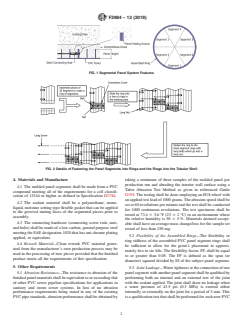
3.2.1 See Fig. 1 to clarify terminology.
responsibility of the user of this standard to establish appro-
3.2.2 PVC liner, n—a tubular assembly field fabricated from
priate safety, health, and environmental practices and deter-
injection molded PVC profile wall segments which are as-
mine the applicability of regulatory limitations prior to use.
sembled into rings which are subsequently joined together
1.5 This international standard was developed in accor-
which substantially conforms to the shape of the inner surface
dance with internationally recognized principles on standard-
of the existing pipe structure or conduit over some portion of
ization established in the Decision on Principles for the
or its entire inner circumference.
Development of International Standards, Guides and Recom-
3.2.3 PVC segmental panels, n—an element available in
mendations issued by the World Trade Organization Technical
various geometries, consisting of a smooth inner surface and a
Barriers to Trade (TBT) Committee.
ribbed outer surface (profile) with edge configurations to allow
mechanical locking and sealing with adjacent panels.
This test method is under the jurisdiction of ASTM Committee F17 on Plastic
Piping Systems and is the direct responsibility of Subcommittee F17.67 on
Trenchless Plastic Pipeline Technology. For referenced ASTM standards, visit the ASTM website, www.astm.org, or
Current edition approved April 1, 2019. Published September 2019. Originallly contact ASTM Customer Service at service@astm.org. For Annual Book of ASTM
approved in 2013. Last previous edition approved in 2013 as F2984–13. DOI: Standards volume information, refer to the standard’s Document Summary page on
10.1520/F2984-13R19. the ASTM website.
Copyright © ASTM International, 100 Barr Harbor Drive, PO Box C700, West Conshohocken, PA 19428-2959. United States
F2984−13 (2019)
FIG. 1Segmental Panel System Features
FIG. 2Details of Fastening the Panel Segments into Rings and the Rings into the Tubular Shell
4. Materials and Manufacture taking a minimum of three samples of the molded panel per
production run and abrading the interior wall surface using a
4.1 The molded panel segments shall be made from a PVC
Taber Abrasion Test Method as given in referenced Guide
compound meeting all of the requirements for a cell classifi-
G195. The testing shall be done employing an H18 wheel with
cation of 12344 or higher as defined in Specification D1784.
an applied test load of 1000 grams.The abrasion speed shall be
4.2 The sealant material shall be a polyurethane, mono-
set at 60 revolutions per minute and the test shall be conducted
liquid, moisture setting type flexible gasket that can be applied
for 1000 continuous revolutions. The test specimens shall be
to the grooved mating faces of the segmental pieces prior to
tested at 73.4 6 3.6 °F (23 6 2 °C) in an environment where
assembly.
the relative humidity is 50 6 5 %. Materials deemed accept-
4.3 The connecting hardware (connecting screw rods, nuts,
able shall have an average mass change/loss for the sample set
and bolts) shall be made of a low carbon, general purpose steel
tested of less than 250 mg.
meeting the SAE designation 1020 that has uni-chrome plating
5.2 Flexibility of the Assembled Rings—The flexibility or
applied, or equivalent.
ring stiffness of the assembled PVC panel segment rings shall
4.4 Rework Material—Clean rework PVC material gener-
be sufficient to allow for the grout’s placement in approxi-
ated from the manufacturer’s own production process may be
mately five to six lifts. The flexibility factor, FF, shall be equal
used in the processing of new pieces provided that the finished
to or greater than 0.05. The FF is defined as the span (or
product meets all the requirements of this specification.
diameter) squared divided by EI of the subject panel segment.
5. Other Requirements
5.3 Joint Leakage—Water tightness at the connection of one
panel segment with another panel segment shall be qualified by
5.1 Abrasion Resistance—The resistance to abrasion of the
performing both an internal and an external test of the joint
finishedpanelmaterialsshallbeequivalenttoorexceedingthat
of other PVC sewer pipeline specifications for applications in with the sealant applied. The joint shall show no leakage when
a water pressure of 43.5 psi (0.3 MPa) is exerted either
sanitary and storm sewer systems. In lieu of no abrasion
performance requirements being stated in any of the existing internally or externally on the joint for a period of 3 min. This
PVCpipestandards,abrasionperformanceshallbeobtainedby is a qualification test that shall be performed for each new PVC
F2984−13 (2019)
resin compound or new injection mold that is put into dance with Procedure A of Practice D618, unless otherwise
production to verify the tightness capabilities of the manufac- specified in the test methods or in this specification.
tured pieces therefrom.
9.2 Panel Profile Dimensions:
9.2.1 Height of the Panel’s Profile—Measure the height of
6. Dimensions, Mass, and Permissible Variations
the panel in accordance with Section 6 of Test Method D2122.
6.1 Height of the Panel Segments’ Profile—The minimum
Measurements shall be made from the smooth surface (finished
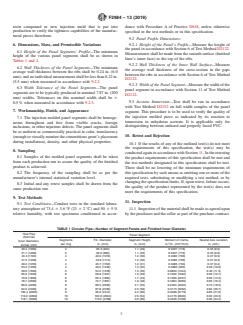
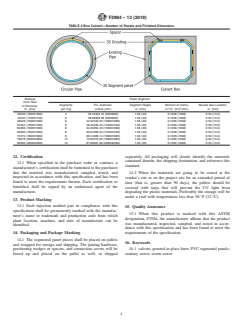
height of the various panel segments shall be as shown in
liner’s inner face) to the top of the ribs.
Tables 1 and 2.
9.2.2 Wall Thickness of the Inner Wall Surfac
...