

ASTM C828-23
(Test Method)Standard Test Method for Low-Pressure Air Test of Vitrified Clay Pipe Lines
General Information
- Abstract
ABSTRACT
This test method contains procedures using low-pressure air for testing the integrity of installed vitrified clay pipe lines such as gravity-flow sewer pipes. The procedures detailed here should be performed on lines after adequately and properly plugging and bracing connection laterals, if any, and after the trenches are backfilled for a sufficient time. This test method can also be used as a preliminary test to demonstrate the condition of the line prior to backfill and further construction activities.
SCOPE
1.1 This test method defines procedures for testing vitrified clay pipe lines, using low-pressure air, to demonstrate the integrity of the installed line. Refer to Practice C12.
1.2 This test method shall be performed on lines after connection laterals, if any, have been plugged and braced adequately to withstand the test pressure, and after the trenches have been backfilled for a sufficient time to generate a significant portion of the ultimate trench load on the pipe line. The time between completion of the backfill operation and low-pressure air testing shall be determined by the approving authority.
1.3 This test method may also be used as a preliminary test, which enables the installer to demonstrate the condition of the line prior to backfill and further construction activities.
1.4 This test method is suitable for testing gravity-flow sewer pipe constructed of vitrified clay or combinations of clay and other pipe materials.
1.5 Terminology C896 is to be used for clarification of terminology in this test method.
1.6 The values stated in inch-pound units are to be regarded as standard. The values given in parentheses are mathematical conversions to SI units that are provided for information only and are not considered standard.
1.7 This standard does not purport to address all of the safety concerns, if any, associated with its use. It is the responsibility of the user of this standard to establish appropriate safety, health, and environmental practices and determine the applicability of regulatory limitations prior to use.
1.8 This international standard was developed in accordance with internationally recognized principles on standardization established in the Decision on Principles for the Development of International Standards, Guides and Recommendations issued by the World Trade Organization Technical Barriers to Trade (TBT) Committee.
- Status
- Published
- Publication Date
- 31-Jan-2023
- Technical Committee
- C04 - Vitrified Clay Pipe
- Drafting Committee
- C04.20 - Methods of Test and Specifications


Overview
ASTM C828-23 provides a standard test method for assessing the integrity of vitrified clay pipe lines, typically used in gravity-flow sewer systems, by employing a low-pressure air test. This procedure verifies the tightness and soundness of installed pipelines by measuring air loss under controlled conditions. It is recognized and approved for use by major authorities, including agencies of the U.S. Department of Defense, to ensure reliable sewer infrastructure installation.
Low-pressure air testing is favored due to its efficiency and non-destructive approach, making it suitable for both newly installed and existing pipes before and after trench backfilling. This method helps identify leaks or weaknesses that could compromise the long-term function of clay sewer lines.
Key Topics
- Test Procedures: The method involves securely plugging the pipe section, introducing air at low pressure, and monitoring the rate of pressure drop over time. The line is deemed satisfactory if the pressure does not drop by more than 1 psi within the specified test duration, which varies by pipe size.
- Preparation and Safety: All connection laterals must be properly plugged and braced. The interior should be wet for consistent results, and personnel safety measures are stressed due to the hazards of over-pressurization or improper plug installation.
- Test Timing: Minimum holding times for various pipe diameters are provided to standardize results and reliably detect significant leaks.
- Allowable Air Loss: Maximum permissible air loss rates are defined for different pipe sizes, ensuring that even minor leaks can be identified.
Applications
Low-pressure air testing according to ASTM C828-23 is widely used by:
- Municipalities and Utilities: To confirm the integrity of newly installed or rehabilitated vitrified clay gravity sewer pipes before acceptance.
- Contractors: For quality assurance during pipeline installation and for performing preliminary tests prior to backfilling, minimizing risk of costly rework.
- Consulting Engineers: As a verification tool within construction oversight programs for sewer projects.
- Regulatory Authorities: To ensure compliance with project specifications and environmental regulations concerning sewer system performance.
These procedures apply to gravity-flow sewer pipe systems constructed with vitrified clay and may also be used where pipes of different materials are combined. The test ensures pipelines meet performance criteria prior to putting them into service or covering them with backfill.
Related Standards
ASTM C828-23 references several other important standards:
- ASTM C12: Practice for Installing Vitrified Clay Pipe Lines, providing guidance for proper installation techniques.
- ASTM C1091: Test Method for Hydrostatic Infiltration Testing of Vitrified Clay Pipe Lines, used when infiltration is suspected.
- ASTM C896: Terminology Relating to Clay Products, which clarifies terms specific to clay pipe standards.
Keywords: low-pressure air testing, vitrified clay pipe, gravity-flow sewer, pipeline integrity, sewer pipe standards, ASTM C828-23, air loss, pressure test, pipeline testing, municipal sewer testing
By adhering to ASTM C828-23, stakeholders ensure that vitrified clay sewer lines are robust, leak-free, and compliant with recognized industry best practices, supporting reliable and safe wastewater infrastructure.
Relations
- Effective Date
- 01-Apr-2024
- Effective Date
- 01-Dec-2017
- Effective Date
- 01-Jun-2017
- Effective Date
- 01-Nov-2016
- Effective Date
- 15-May-2016
- Effective Date
- 01-Dec-2015
- Effective Date
- 01-Sep-2014
- Effective Date
- 01-Sep-2014
- Effective Date
- 01-Dec-2013
- Effective Date
- 01-Dec-2013
- Effective Date
- 01-Dec-2013
- Effective Date
- 01-Mar-2013
- Effective Date
- 01-Nov-2011
- Effective Date
- 01-Oct-2009
- Effective Date
- 01-Oct-2009
Get Certified
Connect with accredited certification bodies for this standard

Institut za varilstvo d.o.o. (Welding Institute)
Slovenia's leading welding institute since 1952. ISO 3834, EN 1090, pressure equipment certification, NDT personnel, welder qualification. Only IIW Au
Sponsored listings
Frequently Asked Questions
ASTM C828-23 is a standard published by ASTM International. Its full title is "Standard Test Method for Low-Pressure Air Test of Vitrified Clay Pipe Lines". This standard covers: ABSTRACT This test method contains procedures using low-pressure air for testing the integrity of installed vitrified clay pipe lines such as gravity-flow sewer pipes. The procedures detailed here should be performed on lines after adequately and properly plugging and bracing connection laterals, if any, and after the trenches are backfilled for a sufficient time. This test method can also be used as a preliminary test to demonstrate the condition of the line prior to backfill and further construction activities. SCOPE 1.1 This test method defines procedures for testing vitrified clay pipe lines, using low-pressure air, to demonstrate the integrity of the installed line. Refer to Practice C12. 1.2 This test method shall be performed on lines after connection laterals, if any, have been plugged and braced adequately to withstand the test pressure, and after the trenches have been backfilled for a sufficient time to generate a significant portion of the ultimate trench load on the pipe line. The time between completion of the backfill operation and low-pressure air testing shall be determined by the approving authority. 1.3 This test method may also be used as a preliminary test, which enables the installer to demonstrate the condition of the line prior to backfill and further construction activities. 1.4 This test method is suitable for testing gravity-flow sewer pipe constructed of vitrified clay or combinations of clay and other pipe materials. 1.5 Terminology C896 is to be used for clarification of terminology in this test method. 1.6 The values stated in inch-pound units are to be regarded as standard. The values given in parentheses are mathematical conversions to SI units that are provided for information only and are not considered standard. 1.7 This standard does not purport to address all of the safety concerns, if any, associated with its use. It is the responsibility of the user of this standard to establish appropriate safety, health, and environmental practices and determine the applicability of regulatory limitations prior to use. 1.8 This international standard was developed in accordance with internationally recognized principles on standardization established in the Decision on Principles for the Development of International Standards, Guides and Recommendations issued by the World Trade Organization Technical Barriers to Trade (TBT) Committee.
ABSTRACT This test method contains procedures using low-pressure air for testing the integrity of installed vitrified clay pipe lines such as gravity-flow sewer pipes. The procedures detailed here should be performed on lines after adequately and properly plugging and bracing connection laterals, if any, and after the trenches are backfilled for a sufficient time. This test method can also be used as a preliminary test to demonstrate the condition of the line prior to backfill and further construction activities. SCOPE 1.1 This test method defines procedures for testing vitrified clay pipe lines, using low-pressure air, to demonstrate the integrity of the installed line. Refer to Practice C12. 1.2 This test method shall be performed on lines after connection laterals, if any, have been plugged and braced adequately to withstand the test pressure, and after the trenches have been backfilled for a sufficient time to generate a significant portion of the ultimate trench load on the pipe line. The time between completion of the backfill operation and low-pressure air testing shall be determined by the approving authority. 1.3 This test method may also be used as a preliminary test, which enables the installer to demonstrate the condition of the line prior to backfill and further construction activities. 1.4 This test method is suitable for testing gravity-flow sewer pipe constructed of vitrified clay or combinations of clay and other pipe materials. 1.5 Terminology C896 is to be used for clarification of terminology in this test method. 1.6 The values stated in inch-pound units are to be regarded as standard. The values given in parentheses are mathematical conversions to SI units that are provided for information only and are not considered standard. 1.7 This standard does not purport to address all of the safety concerns, if any, associated with its use. It is the responsibility of the user of this standard to establish appropriate safety, health, and environmental practices and determine the applicability of regulatory limitations prior to use. 1.8 This international standard was developed in accordance with internationally recognized principles on standardization established in the Decision on Principles for the Development of International Standards, Guides and Recommendations issued by the World Trade Organization Technical Barriers to Trade (TBT) Committee.
ASTM C828-23 is classified under the following ICS (International Classification for Standards) categories: 23.040.01 - Pipeline components and pipelines in general. The ICS classification helps identify the subject area and facilitates finding related standards.
ASTM C828-23 has the following relationships with other standards: It is inter standard links to ASTM C896-24, ASTM C896-17a, ASTM C896-17, ASTM C12-16a, ASTM C12-16, ASTM C896-15, ASTM C896-14, ASTM C12-14, ASTM C12-13a, ASTM C896-13, ASTM C1091-03a(2013), ASTM C12-13, ASTM C896-11, ASTM C896-04(2009), ASTM C12-09. Understanding these relationships helps ensure you are using the most current and applicable version of the standard.
ASTM C828-23 is available in PDF format for immediate download after purchase. The document can be added to your cart and obtained through the secure checkout process. Digital delivery ensures instant access to the complete standard document.
Standards Content (Sample)
This international standard was developed in accordance with internationally recognized principles on standardization established in the Decision on Principles for the
Development of International Standards, Guides and Recommendations issued by the World Trade Organization Technical Barriers to Trade (TBT) Committee.
Designation: C828 − 23
Standard Test Method for
Low-Pressure Air Test of Vitrified Clay Pipe Lines
This standard is issued under the fixed designation C828; the number immediately following the designation indicates the year of
original adoption or, in the case of revision, the year of last revision. A number in parentheses indicates the year of last reapproval. A
superscript epsilon (´) indicates an editorial change since the last revision or reapproval.
This standard has been approved for use by agencies of the U.S. Department of Defense.
1. Scope mendations issued by the World Trade Organization Technical
Barriers to Trade (TBT) Committee.
1.1 This test method defines procedures for testing vitrified
clay pipe lines, using low-pressure air, to demonstrate the
2. Referenced Documents
integrity of the installed line. Refer to Practice C12.
2.1 ASTM Standards:
1.2 This test method shall be performed on lines after
C12 Practice for Installing Vitrified Clay Pipe Lines
connection laterals, if any, have been plugged and braced
C1091 Test Method for Hydrostatic Infiltration Testing of
adequately to withstand the test pressure, and after the trenches
Vitrified Clay Pipe Lines
have been backfilled for a sufficient time to generate a
C896 Terminology Relating to Clay Products
significant portion of the ultimate trench load on the pipe line.
3. Summary of Test Method
The time between completion of the backfill operation and
low-pressure air testing shall be determined by the approving 3.1 The section of the line to be tested is plugged. Air, at low
authority.
pressure, is introduced into the plugged line. The line passes
the test if the rate of air loss, as measured by pressure drop,
1.3 This test method may also be used as a preliminary test,
does not exceed a specified amount in a specified time. This
which enables the installer to demonstrate the condition of the
may be determined by the use of Table 1, or calculated by use
line prior to backfill and further construction activities.
of the formulas in Appendix X1.
1.4 This test method is suitable for testing gravity-flow
4. Hazards
sewer pipe constructed of vitrified clay or combinations of clay
and other pipe materials.
4.1 The low-pressure air test may be dangerous to personnel
if, through lack of understanding or carelessness, a line is
1.5 Terminology C896 is to be used for clarification of
over-pressurized or plugs are installed improperly. It is ex-
terminology in this test method.
tremely important that the various plugs be installed so as to
1.6 The values stated in inch-pound units are to be regarded
prevent the sudden expulsion of a poorly installed or partially
as standard. The values given in parentheses are mathematical
inflated plug. As an example of the hazard, a force of 250 lbf
conversions to SI units that are provided for information only
(1110 N) is exerted on an 8-in. (205-mm) plug by an internal
and are not considered standard.
pressure of 5 psi (35 kPa). Observe the following safety
1.7 This standard does not purport to address all of the
precautions:
safety concerns, if any, associated with its use. It is the
4.1.1 No one shall be allowed in the manholes during testing
responsibility of the user of this standard to establish appro-
because of the hazards.
priate safety, health, and environmental practices and deter-
4.1.2 Install all plugs securely.
mine the applicability of regulatory limitations prior to use. 4.1.3 When lines are to be tested, it may be necessary that
1.8 This international standard was developed in accor- the plugs be braced as an added safety factor.
dance with internationally recognized principles on standard- 4.1.4 Do not over-pressurize the lines. Do not exceed 5 psi
ization established in the Decision on Principles for the (35 kPa).
Development of International Standards, Guides and Recom-
5. Preparation of the Line
5.1 Air may pass through the walls of dry pipe. A wetted
interior pipe surface is desirable and will produce more
This test method is under the jurisdiction of ASTM Committee C04 on Vitrified
Clay Pipe and is the direct responsibility of Subcommittee C04.20 on Methods of
Test and Specifications. For referenced ASTM standards, visit the ASTM website, www.astm.org, or
Current edition approved Feb. 1, 2023. Published February 2023. Originally contact ASTM Customer Service at service@astm.org. For Annual Book of ASTM
approved in 1975. Last previous edition approved in 2021 as C828 - 11(2021). DOI: Standards volume information, refer to the standard’s Document Summary page on
10.1520/C0828-23. the ASTM website.
Copyright © ASTM International, 100 Barr Harbor Drive, PO Box C700, West Conshohocken, PA 19428-2959. United States
C828 − 23
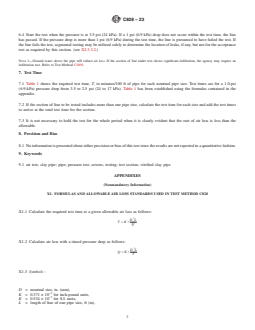
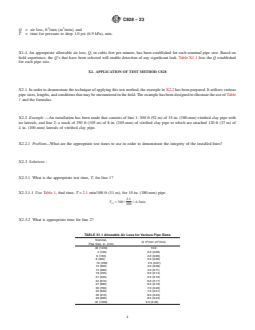
TABLE 1 Minimum Test Time for Various Pipe Sizes
6.4 Start the test when the pressure is at 3.5 psi (24 kPa). If
Nominal T (time), a 1 psi (6.9 kPa) drop does not occur within the test time, the
Pipe Size, in. (mm) min/100 ft
line has passed. If the pressure drop is more than 1 psi (6.9 kPa)
(min/100 m)
during the test time, the line is presumed to have failed the test.
48 (1220) 8.5
4 (100) 0.3 (0.98) If the line fails the test, segmental testing may be utilized solely
6 (150) 0.7 (2.3)
to determine the location of leaks, if any, but not for the
8 (205) 1.2 (3.9)
acceptance test as required by this section. (see X2.3.3.2.)
10 (255) 1.5 (4.9)
12 (305) 1.8 (5.9)
NOTE 1—Ground water above the pipe will reduce air loss. If the
15 (380) 2.1 (6.9)
section of line under test shows significant infiltration, the agency may
18 (455) 2.4 (7.9)
require an infiltration test. Refer to Test Method C1091.
21 (535) 3.0 (9.8)
24 (610) 3.6 (11.8)
27 (685) 4.2 (13.8)
7. Test Time
30 (760) 4.8 (15.7)
33 (840) 5.4 (17.7)
7.1 Table 1 shows the required test time, T, in minutes/100
36 (915) 6.0 (19.7)
ft of pipe for each nominal pipe size. Test times are for a
39 (990) 6.6 (21.6)
42 (1065) 7.3 (23.9) 1.0-psi (6.9-kPa) pre
...
This document is not an ASTM standard and is intended only to provide the user of an ASTM standard an indication of what changes have been made to the previous version. Because
it may not be technically possible to adequately depict all changes accurately, ASTM recommends that users consult prior editions as appropriate. In all cases only the current version
of the standard as published by ASTM is to be considered the official document.
Designation: C828 − 11 (Reapproved 2021) C828 − 23
Standard Test Method for
Low-Pressure Air Test of Vitrified Clay Pipe Lines
This standard is issued under the fixed designation C828; the number immediately following the designation indicates the year of
original adoption or, in the case of revision, the year of last revision. A number in parentheses indicates the year of last reapproval. A
superscript epsilon (´) indicates an editorial change since the last revision or reapproval.
This standard has been approved for use by agencies of the U.S. Department of Defense.
1. Scope
1.1 This test method defines procedures for testing vitrified clay pipe lines, using low-pressure air, to demonstrate the integrity of
the installed line. Refer to Practice C12.
1.2 This test method shall be performed on lines after connection laterals, if any, have been plugged and braced adequately to
withstand the test pressure, and after the trenches have been backfilled for a sufficient time to generate a significant portion of the
ultimate trench load on the pipe line. The time between completion of the backfill operation and low-pressure air testing shall be
determined by the approving authority.
1.3 This test method may also be used as a preliminary test, which enables the installer to demonstrate the condition of the line
prior to backfill and further construction activities.
1.4 This test method is suitable for testing gravity-flow sewer pipe constructed of vitrified clay or combinations of clay and other
pipe materials.
1.5 Terminology C896 is to be used for clarification of terminology in this test method.
1.6 The values stated in inch-pound units are to be regarded as standard. The values given in parentheses are mathematical
conversions to SI units that are provided for information only and are not considered standard.
1.7 This standard does not purport to address all of the safety concerns, if any, associated with its use. It is the responsibility
of the user of this standard to establish appropriate safety, health, and environmental practices and determine the applicability of
regulatory limitations prior to use.
1.8 This international standard was developed in accordance with internationally recognized principles on standardization
established in the Decision on Principles for the Development of International Standards, Guides and Recommendations issued
by the World Trade Organization Technical Barriers to Trade (TBT) Committee.
2. Referenced Documents
2.1 ASTM Standards:
This test method is under the jurisdiction of ASTM Committee C04 on Vitrified Clay Pipe and is the direct responsibility of Subcommittee C04.20 on Methods of Test
and Specifications.
Current edition approved April 1, 2021Feb. 1, 2023. Published April 2021February 2023. Originally approved in 1975. Last previous edition approved in 20162021 as
C828 - 11(2016). DOI: 10.1520/C0828-11R21.(2021). DOI: 10.1520/C0828-23.
For referenced ASTM standards, visit the ASTM website, www.astm.org, or contact ASTM Customer Service at service@astm.org. For Annual Book of ASTM Standards
volume information, refer to the standard’s Document Summary page on the ASTM website.
Copyright © ASTM International, 100 Barr Harbor Drive, PO Box C700, West Conshohocken, PA 19428-2959. United States
C828 − 23
C12 Practice for Installing Vitrified Clay Pipe Lines
C1091 Test Method for Hydrostatic Infiltration Testing of Vitrified Clay Pipe Lines
C896 Terminology Relating to Clay Products
3. Summary of Test Method
3.1 The section of the line to be tested is plugged. Air, at low pressure, is introduced into the plugged line. The line passes the
test if the rate of air loss, as measured by pressure drop, does not exceed a specified amount in a specified time. This may be
determined by the use of Table 1, or calculated by use of the formulas in Appendix X1.
4. Hazards
4.1 The low-pressure air test may be dangerous to personnel if, through lack of understanding or carelessness, a line is
over-pressurized or plugs are installed improperly. It is extremely important that the various plugs be installed so as to prevent the
sudden expulsion of a poorly installed or partially inflated plug. As an example of the hazard, a force of 250 lbf (1110 N) is exerted
on an 8-in. (205-mm) plug by an internal pressure of 5 psi (35 kPa). Observe the following safety precautions:
4.1.1 No one shall be allowed in the manholes during testing because of the hazards.
4.1.2 Install all plugs securely.
4.1.3 When lines are to be tested, it may be necessary that the plugs be braced as an added safety factor.
4.1.4 Do not over-pressurize the lines. Do not exceed 5 psi (35 kPa).
5. Preparation of the Line
5.1 Air may pass through the walls of dry pipe. A wetted interior pipe surface is desirable and will produce more consistent test
results. Usually moisture absorbed from the backfill is sufficient to cope with this situation. Where practical, clean the line prior
to testing to wet the pipe surface and eliminate debris.
6. Procedure
6.1 Determine the test time for the section of line to be tested using Table 1 or Table X1.1 or the formulas in Appendix X1.
6.2 Plug all openings in the test section.
6.3 Add air until the internal pressure of the line is raised to approximately 4.0 psi (28 kPa). After this pressure is reached, allow
the pressure to stabilize. The pressure will normally drop as the air temperature stabilizes. This usually takes 2 to 5 min, depending
on the pipe size. The pressure should be reduced to 3.5 psi (24 kPa) before starting the test.
TABLE 1 Minimum Test Time for Various Pipe Sizes
Nominal T (time),
Pipe Size, in. (mm) min/100 ft
(min/100 m)
48 (1220) 8.5
4 (100) 0.3 (0.98)
6 (150) 0.7 (2.3)
8 (205) 1.2 (3.9)
10 (255) 1.5 (4.9)
12 (305) 1.8 (5.9)
15 (380) 2.1 (6.9)
18 (455) 2.4 (7.9)
21 (535) 3.0 (9.8)
24 (610) 3.6 (11.8)
27 (685) 4.2 (13.8)
30 (760) 4.8 (15.7)
33 (840) 5.4 (17.7)
36 (915) 6.0 (19.7)
39 (990) 6.6 (21.6)
42 (1065) 7.3 (23.9)
-----------
...