

ASTM F2232-14(2020)
(Test Method)Standard Test Method for Determining the Longitudinal Load Required to Detach High Heels from Footwear
General Information
- Abstract
SIGNIFICANCE AND USE
4.1 Since the heel is an integral support element of the shoe, the heel-attaching strength is a significant factor in ensuring the wearer's safety, as well as the longevity and serviceability of the shoe.
4.2 This test should be performed on each new style shoe and when any changes are made in the design, material or method of shank or heel area of the shoe, or both, or in the attachment of the heel in an existing shoe.
SCOPE
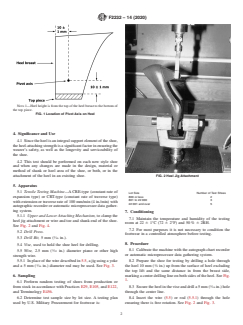
1.1 This test method covers the determination of the force required to detach the heel from footwear through the application of longitudinal tensile force at a constant displacement rate. The longitudinal test force simulates the most common heel failure mode. Heel height of 20 mm (13/16 in.) or larger is needed to perform this test method properly. Most women's medium and high heeled footwear meets this requirement.
1.2 The values stated in SI units are to be regarded as the standard. The values given in parentheses are for information only.
1.3 This standard does not purport to address all of the safety concerns, if any, associated with its use. It is the responsibility of the user of this standard to establish appropriate safety, health, and environmental practices and determine the applicability of regulatory limitations prior to use.
1.4 This international standard was developed in accordance with internationally recognized principles on standardization established in the Decision on Principles for the Development of International Standards, Guides and Recommendations issued by the World Trade Organization Technical Barriers to Trade (TBT) Committee.
- Status
- Published
- Publication Date
- 31-Jan-2020
- Technical Committee
- F13 - Pedestrian/Walkway Safety and Footwear
- Drafting Committee
- F13.30 - Footwear

Overview
ASTM F2232-14(2020): Standard Test Method for Determining the Longitudinal Load Required to Detach High Heels from Footwear establishes a systematic method for assessing the force needed to separate the heel from footwear by applying a longitudinal tensile load. This standard is essential for ensuring the structural integrity, safety, and serviceability of medium and high-heeled footwear, particularly relevant in the women's shoe segment where heels exceed 20 mm (13/16 in.) in height. Developed by ASTM Committee F13 on Pedestrian/Walkway Safety and Footwear, this test method is recognized internationally and aligns with the principles of the World Trade Organization Technical Barriers to Trade (TBT) Committee.
The standard provides a framework for manufacturers, quality assurance teams, and product designers to evaluate and maintain consistent heel attachment strength, directly impacting footwear quality, durability, and user safety.
Key Topics
Main aspects covered by ASTM F2232-14(2020) include:
Purpose and Significance
- Verifies heel attachment strength as a critical safety and performance factor.
- Assesses the impact of design, material, and construction changes on the durability of heel attachments.
Applicability
- Applies to most women's medium and high-heeled shoes with a heel height of 20 mm or greater.
- Intended for implementation whenever alterations are made to heel, shank, or attachment methods.
Testing Methodology
- Specifies use of a tensile testing machine to apply a longitudinal load at a constant rate until the heel detaches.
- Outlines preparation steps: drilling, insertion of a wire or rod, securing and aligning the footwear, and observing heel detachment.
- Requires documentation of force required to separate the heel and detailed reporting of failure modes.
Sampling and Reporting
- Recommends statistically valid sampling in accordance with referenced ASTM practices.
- Details necessary reporting elements, including shoe specifications, material details, testing apparatus, and observations from the test.
Safety and Compliance
- Highlights the need for users to establish safety, health, and environmental measures as per regulatory requirements.
Applications
Practical uses of ASTM F2232-14(2020) span across:
Footwear Manufacturing and Quality Control
- Ensures robust attachment of heels during product development and before launch of new styles.
- Guides routine and change-driven testing to uphold high standards of footwear construction and safety.
Design and Product Development
- Assists designers in evaluating the impact of new materials and attachment techniques on heel durability.
- Supports iterative improvements to footwear structure to enhance user satisfaction and reduce return rates due to heel failures.
Regulatory and Compliance Testing
- Provides documented evidence of compliance with industry norms for footwear performance and consumer safety.
Research and Comparative Assessment
- Offers a standardized benchmark for comparing the performance of different footwear models and construction methods.
Related Standards
To ensure comprehensive testing and standardization in footwear performance and safety, refer to these related standards:
- BS EN 12785: Footwear - Test Method for Whole Shoes - Heel Attachment
- ASTM E29: Practice for Using Significant Digits in Test Data to Determine Conformance with Specifications
- ASTM E105: Practice for Probability Sampling of Materials
- ASTM E122: Practice for Calculating Sample Size to Estimate, With Specified Precision, the Average for a Characteristic of a Lot or Process
- ASTM E456: Terminology Relating to Quality and Statistics
Keywords: footwear testing, high heel attachment strength, footwear safety, heel detachment test, quality control, footwear construction, ASTM F2232, footwear durability, manufacturing standards, product design, compliance testing, longitudinal load test, women's footwear performance.
ASTM F2232-14(2020) is vital for anyone involved in the design, manufacturing, and quality assurance of heeled footwear, helping ensure safer, longer-lasting products that meet international expectations.
Relations
- Effective Date
- 01-Feb-2020
- Effective Date
- 01-Apr-2022
- Effective Date
- 01-Oct-2017
- Effective Date
- 01-Oct-2017
- Effective Date
- 15-Nov-2013
- Effective Date
- 15-Nov-2013
- Effective Date
- 15-Nov-2013
- Effective Date
- 15-Nov-2013
- Effective Date
- 15-Aug-2013
- Effective Date
- 01-May-2012
- Effective Date
- 01-May-2012
- Effective Date
- 01-Aug-2011
- Effective Date
- 01-Oct-2010
- Effective Date
- 01-Aug-2009
- Effective Date
- 01-Oct-2008
Frequently Asked Questions
ASTM F2232-14(2020) is a standard published by ASTM International. Its full title is "Standard Test Method for Determining the Longitudinal Load Required to Detach High Heels from Footwear". This standard covers: SIGNIFICANCE AND USE 4.1 Since the heel is an integral support element of the shoe, the heel-attaching strength is a significant factor in ensuring the wearer's safety, as well as the longevity and serviceability of the shoe. 4.2 This test should be performed on each new style shoe and when any changes are made in the design, material or method of shank or heel area of the shoe, or both, or in the attachment of the heel in an existing shoe. SCOPE 1.1 This test method covers the determination of the force required to detach the heel from footwear through the application of longitudinal tensile force at a constant displacement rate. The longitudinal test force simulates the most common heel failure mode. Heel height of 20 mm (13/16 in.) or larger is needed to perform this test method properly. Most women's medium and high heeled footwear meets this requirement. 1.2 The values stated in SI units are to be regarded as the standard. The values given in parentheses are for information only. 1.3 This standard does not purport to address all of the safety concerns, if any, associated with its use. It is the responsibility of the user of this standard to establish appropriate safety, health, and environmental practices and determine the applicability of regulatory limitations prior to use. 1.4 This international standard was developed in accordance with internationally recognized principles on standardization established in the Decision on Principles for the Development of International Standards, Guides and Recommendations issued by the World Trade Organization Technical Barriers to Trade (TBT) Committee.
SIGNIFICANCE AND USE 4.1 Since the heel is an integral support element of the shoe, the heel-attaching strength is a significant factor in ensuring the wearer's safety, as well as the longevity and serviceability of the shoe. 4.2 This test should be performed on each new style shoe and when any changes are made in the design, material or method of shank or heel area of the shoe, or both, or in the attachment of the heel in an existing shoe. SCOPE 1.1 This test method covers the determination of the force required to detach the heel from footwear through the application of longitudinal tensile force at a constant displacement rate. The longitudinal test force simulates the most common heel failure mode. Heel height of 20 mm (13/16 in.) or larger is needed to perform this test method properly. Most women's medium and high heeled footwear meets this requirement. 1.2 The values stated in SI units are to be regarded as the standard. The values given in parentheses are for information only. 1.3 This standard does not purport to address all of the safety concerns, if any, associated with its use. It is the responsibility of the user of this standard to establish appropriate safety, health, and environmental practices and determine the applicability of regulatory limitations prior to use. 1.4 This international standard was developed in accordance with internationally recognized principles on standardization established in the Decision on Principles for the Development of International Standards, Guides and Recommendations issued by the World Trade Organization Technical Barriers to Trade (TBT) Committee.
ASTM F2232-14(2020) is classified under the following ICS (International Classification for Standards) categories: 61.060 - Footwear. The ICS classification helps identify the subject area and facilitates finding related standards.
ASTM F2232-14(2020) has the following relationships with other standards: It is inter standard links to ASTM F2232-14, ASTM E456-13a(2022)e1, ASTM E456-13A(2017)e3, ASTM E456-13A(2017)e1, ASTM E456-13ae2, ASTM E456-13ae1, ASTM E456-13ae3, ASTM E456-13a, ASTM E456-13, ASTM E456-12e1, ASTM E456-12, ASTM E122-09e1, ASTM E105-10, ASTM E122-09, ASTM E29-08. Understanding these relationships helps ensure you are using the most current and applicable version of the standard.
ASTM F2232-14(2020) is available in PDF format for immediate download after purchase. The document can be added to your cart and obtained through the secure checkout process. Digital delivery ensures instant access to the complete standard document.
Standards Content (Sample)
This international standard was developed in accordance with internationally recognized principles on standardization established in the Decision on Principles for the
Development of International Standards, Guides and Recommendations issued by the World Trade Organization Technical Barriers to Trade (TBT) Committee.
Designation: F2232 − 14 (Reapproved 2020)
Standard Test Method for
Determining the Longitudinal Load Required to Detach High
Heels from Footwear
This standard is issued under the fixed designation F2232; the number immediately following the designation indicates the year of
original adoption or, in the case of revision, the year of last revision. A number in parentheses indicates the year of last reapproval. A
superscript epsilon (´) indicates an editorial change since the last revision or reapproval.
1. Scope 2.2 European Standard:
BSEN 12785 Footwear, Test Method for Whole Shoes—
1.1 This test method covers the determination of the force
Heel Attachment
required to detach the heel from footwear through the appli-
cation of longitudinal tensile force at a constant displacement
3. Terminology
rate. The longitudinal test force simulates the most common
heel failure mode. Heel height of 20 mm ( ⁄16 in.) or larger is
3.1 Definitions:
needed to perform this test method properly. Most women’s 3.1.1 forefoot—the portion of the shoe extending forward
medium and high heeled footwear meets this requirement.
from the break of the joint to the toe, also called forepart.
3.1.2 heel attachment strength—the force in pounds mea-
1.2 The values stated in SI units are to be regarded as the
standard. The values given in parentheses are for information sured under the testing conditions of Test Method F2232
required to detach the heel from the sole/insole assembly.
only.
1.3 This standard does not purport to address all of the 3.1.3 heel breast—the front face of the shoe heel.
safety concerns, if any, associated with its use. It is the
3.1.4 heel height—the vertical distance from the top back
responsibility of the user of this standard to establish appro-
edge of the heel to the plane of the tread (wear) surface of the
priate safety, health, and environmental practices and deter-
heel.
mine the applicability of regulatory limitations prior to use.
3.1.5 insole—the part of the shoe that is a structural anchor
1.4 This international standard was developed in accor-
to which the upper and heel are fastened during manufacture.
dance with internationally recognized principles on standard-
It may or may not be covered on the foot side by material
ization established in the Decision on Principles for the
referred to as a socklining.
Development of International Standards, Guides and Recom-
3.1.6 outsole—the bottom (sole) of the shoe: including the
mendations issued by the World Trade Organization Technical
surface which is exposed to wear.
Barriers to Trade (TBT) Committee.
3.1.7 seatboard—a reinforcement (if used) of the insole
2. Referenced Documents
where the heel is attached.
2.1 ASTM Standards:
3.1.8 shank—areinforcementinthearch(instep)oftheshoe
E29 Practice for Using Significant Digits in Test Data to
between the insole and outsole made from steel, wood,
Determine Conformance with Specifications
fiberboard or plastic (individually or in combination).
E105 Practice for Probability Sampling of Materials
3.1.9 shankboard—the back part of the insole which is
E122 Practice for Calculating Sample Size to Estimate,With
fabricated from a firm fiberboard. It is contoured to the arch of
Specified Precision, the Average for a Characteristic of a
the foot for support.
Lot or Process
3.1.10 top piece (toplift)—the bottom layer of a heel (wear
E456 Terminology Relating to Quality and Statistics
surface) usually made of leather, rubber, plastic, steel, or
elastomers.
This test method is under the jurisdiction of ASTM Committee F13 on
3.2 For definitions of other terms relating to footwear, refer
Pedestrian/Walkway Safety and Footwear and is the direct responsibility of
to the Footwear Products Glossary.
Subcommittee F13.30 on Footwear.
Current edition approved Feb. 1, 2020. Published February 2020. Originally
approved in 2003. Last previous edition approved in 2014 as F2232 – 14. DOI:
10.1520/F2232-14R20.
2 3
For referenced ASTM standards, visit the ASTM website, www.astm.org, or Orders for all BSI, International and foreign standards publications should be
contact ASTM Customer Service at service@astm.org. For Annual Book of ASTM addressed to Customer Service.
Standards volume information, refer to the standard’s Document Summary page on Available from American Apparel & Footwear Assoc. (AAFA), 1601 N. Kent
the ASTM website. St., Suite 1200, Arlington, VA 22209.
Copyright © ASTM International, 100 Barr Harbor Drive, PO Box C700, West Conshohocken, PA 19428-2959. United States
F2232 − 14 (2020)
NOTE 1—Heel height is from the top of the heel breast to the bottom of
the top piece.
FIG. 1 Location of Pivot Axis on Heel
4. Significance and Use
4.1 Since the heel is an integral support element of the shoe,
theheel-attachingstrengthisasignificantfactorinensuringthe
wearer’s safety, as well as the longevity and serviceability of
the shoe.
4.2 This test should be performed on each new style shoe
and when any changes are made in the design, material or
method of shank or heel area of the shoe, or both, or in the
attachment of the heel in an existing shoe. FIG. 2 Heel Jig Attachment
5. Apparatus
5.1 Tensile Testing Machine—A CRE-type (constant rate of
Lot Size Number of Test Shoes
expansion type) or CRT-type (constant rate of traverse type) 800 or less 2
801 to 22 000 3
with extension or traverse rate of 100 mm/min (4 in./min) with
22 001 and over 5
autographic recorder or automatic microprocessor data gather-
ing system.
7. Conditioning
5.
...