

ASTM F1900-98(2017)
(Test Method)Standard Test Method for Water Resistance of Footwear Using a Walking Step Simulator
General Information
- Abstract
SIGNIFICANCE AND USE
3.1 Water resistance is a desirable characteristic for many different types of footwear. This test method provides a guide for measuring water resistance under dynamic conditions that closely duplicate normal human walking. The degree of correlation between this test and footwear performance in the field or footwear performance in the SATRA Trough-Water Penetration Test has not been fully determined.
SCOPE
1.1 This test method covers a method of measuring the water resistance of footwear.
1.2 This standard does not purport to address all of the safety concerns, if any, associated with its use. It is the responsibility of the user of this standard to establish appropriate safety, health, and environmental practices and determine the applicability of regulatory limitations prior to use.
1.3 This international standard was developed in accordance with internationally recognized principles on standardization established in the Decision on Principles for the Development of International Standards, Guides and Recommendations issued by the World Trade Organization Technical Barriers to Trade (TBT) Committee.
- Status
- Published
- Publication Date
- 31-Aug-2017
- Technical Committee
- F08 - Sports Equipment, Playing Surfaces, and Facilities
- Drafting Committee
- F08.54 - Athletic Footwear
Overview
ASTM F1900-98(2017), titled Standard Test Method for Water Resistance of Footwear Using a Walking Step Simulator, is an internationally recognized standard developed by ASTM. This method focuses on evaluating the water resistance of footwear, including shoes, boots, and sport shoes, by replicating the dynamic conditions of human walking. The standard addresses a critical requirement in the footwear industry, where water resistance significantly impacts product performance and user satisfaction. The method uses a specialized walking step simulator to closely mimic real-world use, providing valuable data for manufacturers, designers, and quality control professionals.
Key Topics
- Dynamic Testing: The test method involves a walking step simulator that applies realistic movements and forces to footwear, simulating the heel-to-toe motion and weight borne during normal walking.
- Moisture Detection: Multiple moisture sensors are placed at standard locations on a prosthetic foot fitted inside the footwear to detect water penetration during the test.
- Test Parameters: The test is conducted with tap water at controlled temperatures and depths, ensuring consistent and repeatable conditions.
- Reporting Requirements: Detailed results, including step count to penetration, location and size of leaks, and test conditions, must be documented for each model tested.
- Safety and Compliance: The standard emphasizes the responsibility of users to follow appropriate safety, health, and regulatory practices when performing the test.
Applications
The ASTM F1900-98(2017) standard provides essential guidance for:
- Footwear Manufacturers: Ensuring product lines meet specified water resistance requirements, thereby enhancing quality assurance and brand reputation.
- Product Development: Guiding material selection, design improvement, and prototyping processes focused on water-resistant features.
- Quality Control: Comparing batch-to-batch consistency in finished products and identifying performance issues before reaching the market.
- Benchmarking: Evaluating new designs against existing footwear or competing brands by providing standardized, repeatable test results.
- Research and Development: Supporting innovation in waterproof technologies with quantifiable data on water penetration performance.
- Compliance Testing: Assisting in meeting both internal and external quality specifications or contractual obligations regarding water resistance.
The method is applicable to various types of footwear, whether designed for casual, sport, or industrial use, and is particularly relevant where environmental exposure to moisture is a concern.
Related Standards
ASTM F1900-98(2017) refers to several important test methods and guidelines, including:
- ASTM D2098 - Test Method for Dynamic Water Resistance of Shoe Upper Leather by the Dow Corning Leather Tester
- ASTM D2099 - Test Method for Dynamic Water Resistance of Shoe Upper Leather by the Maeser Water Penetration Tester
- SATRA PM81 - Trough-Water Penetration Test for whole shoes
- FIA No. 1209, Appendix B - Whole Shoe Flex in Water Test Method
These related standards provide specific testing protocols for materials and finished products, contributing to comprehensive assessment strategies for water-resistant footwear.
Summary
The ASTM F1900-98(2017) standard plays a pivotal role in advancing water resistance evaluation in the global footwear industry. By outlining a rigorous, practical, and repeatable test method using a walking step simulator, it enables stakeholders to quantify and improve the performance of shoes, boots, and other footwear against environmental moisture. Adherence to this standard helps manufacturers and brands deliver more durable, reliable, and market-ready products to consumers and end-users.
Keywords: water resistance, footwear, ASTM F1900-98(2017), walking step simulator, waterproof shoes, dynamic testing, quality control, leak detection, footwear testing standards.
Relations
- Effective Date
- 01-Sep-2017
- Effective Date
- 01-Sep-2012
- Effective Date
- 01-Apr-2010
- Effective Date
- 01-Sep-2008
- Effective Date
- 01-Apr-2005
- Effective Date
- 01-Sep-2004
- Effective Date
- 10-Sep-2000
- Effective Date
- 10-Sep-2000
Frequently Asked Questions
ASTM F1900-98(2017) is a standard published by ASTM International. Its full title is "Standard Test Method for Water Resistance of Footwear Using a Walking Step Simulator". This standard covers: SIGNIFICANCE AND USE 3.1 Water resistance is a desirable characteristic for many different types of footwear. This test method provides a guide for measuring water resistance under dynamic conditions that closely duplicate normal human walking. The degree of correlation between this test and footwear performance in the field or footwear performance in the SATRA Trough-Water Penetration Test has not been fully determined. SCOPE 1.1 This test method covers a method of measuring the water resistance of footwear. 1.2 This standard does not purport to address all of the safety concerns, if any, associated with its use. It is the responsibility of the user of this standard to establish appropriate safety, health, and environmental practices and determine the applicability of regulatory limitations prior to use. 1.3 This international standard was developed in accordance with internationally recognized principles on standardization established in the Decision on Principles for the Development of International Standards, Guides and Recommendations issued by the World Trade Organization Technical Barriers to Trade (TBT) Committee.
SIGNIFICANCE AND USE 3.1 Water resistance is a desirable characteristic for many different types of footwear. This test method provides a guide for measuring water resistance under dynamic conditions that closely duplicate normal human walking. The degree of correlation between this test and footwear performance in the field or footwear performance in the SATRA Trough-Water Penetration Test has not been fully determined. SCOPE 1.1 This test method covers a method of measuring the water resistance of footwear. 1.2 This standard does not purport to address all of the safety concerns, if any, associated with its use. It is the responsibility of the user of this standard to establish appropriate safety, health, and environmental practices and determine the applicability of regulatory limitations prior to use. 1.3 This international standard was developed in accordance with internationally recognized principles on standardization established in the Decision on Principles for the Development of International Standards, Guides and Recommendations issued by the World Trade Organization Technical Barriers to Trade (TBT) Committee.
ASTM F1900-98(2017) is classified under the following ICS (International Classification for Standards) categories: 61.060 - Footwear. The ICS classification helps identify the subject area and facilitates finding related standards.
ASTM F1900-98(2017) has the following relationships with other standards: It is inter standard links to ASTM F1900-98(2012), ASTM D2098-04(2012), ASTM D2099-05(2010)e1, ASTM D2098-04(2008), ASTM D2099-05, ASTM D2098-04, ASTM D2098-00, ASTM D2099-00. Understanding these relationships helps ensure you are using the most current and applicable version of the standard.
ASTM F1900-98(2017) is available in PDF format for immediate download after purchase. The document can be added to your cart and obtained through the secure checkout process. Digital delivery ensures instant access to the complete standard document.
Standards Content (Sample)
This international standard was developed in accordance with internationally recognized principles on standardization established in the Decision on Principles for the
Development of International Standards, Guides and Recommendations issued by the World Trade Organization Technical Barriers to Trade (TBT) Committee.
Designation: F1900 − 98 (Reapproved 2017) An American National Standard
Standard Test Method for
Water Resistance of Footwear Using a Walking Step
Simulator
This standard is issued under the fixed designation F1900; the number immediately following the designation indicates the year of
original adoption or, in the case of revision, the year of last revision. A number in parentheses indicates the year of last reapproval. A
superscript epsilon (´) indicates an editorial change since the last revision or reapproval.
1. Scope for measuring water resistance under dynamic conditions that
closely duplicate normal human walking. The degree of
1.1 This test method covers a method of measuring the
correlation between this test and footwear performance in the
water resistance of footwear.
field or footwear performance in the SATRA Trough-Water
1.2 This standard does not purport to address all of the
Penetration Test has not been fully determined.
safety concerns, if any, associated with its use. It is the
responsibility of the user of this standard to establish appro-
4. Apparatus
priate safety, health, and environmental practices and deter-
mine the applicability of regulatory limitations prior to use.
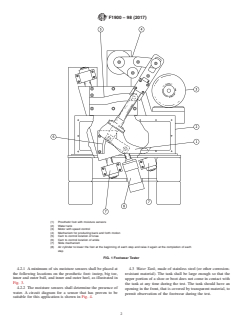
4.1 Mechanism, such as the one shown in Fig. 1, that
1.3 This international standard was developed in accor-
approximates the movements and forces involved in human
dance with internationally recognized principles on standard-
walking motion. The important features of the walking motion
ization established in the Decision on Principles for the
produced by the mechanism are defined as follows:
Development of International Standards, Guides and Recom-
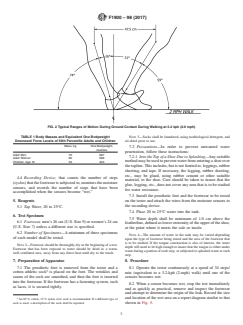
4.1.1 At the beginning of a step (the point where the heel of
mendations issued by the World Trade Organization Technical
the footwear touches the walking surface) the leg pylon
Barriers to Trade (TBT) Committee.
attached to the prosthetic foot shall form an angle of 16 6 5°
2. Referenced Documents (relative to a line perpendicular to the walking surface) as
shown in Fig. 2.
2.1 ASTM Standards:
4.1.2 At the end of a step (the point where the toe of the
D2098 Test Method for Dynamic Water Resistance of Shoe
Upper Leather by the Dow Corning Leather Tester footwear departs from the walking surface) the leg pylon shall
D2099 Test Method for Dynamic Water Resistance of Shoe form an angle 31 6 5° (see Fig. 2).
Upper Leather by the Maeser Water Penetration Tester
4.1.3 Each step shall begin with no force being exerted on
2.2 SATRA Test Method:
the footwear and with the footwear not in contact with the
Physical Test Method PM81 Trough-Water Penetration Test
walking surface. When the footwear contacts the walking
2.3 FIA Test Methods:
surface, it shall remain in contact during the entire support
No. 1209, Appendix B—Whole Shoe Flex in Water
phase of the step and then depart from the walking surface at
the end of the step.
3. Significance and Use
4.1.4 During the support phase of each step, a downward
3.1 Water resistance is a desirable characteristic for many
force shall be applied to the footwear to simulate the weight of
different types of footwear. This test method provides a guide
the user. The force shall equal one bodyweight of the typical
prospective user, with a tolerance of 610 %, unless a different
force is specified. Table 1 lists the body masses of 50th
This test method is under the jurisdiction of ASTM Committee F08 on Sports
Equipment, Playing Surfaces, and Facilities and is the direct responsibility of
percentile adults and children, and the equivalent one body-
Subcommittee F08.54 on Athletic Footwear.
weight downward force levels. If no other downward force is
Current edition approved Sept. 1, 2017. Published December 2017. Originally
specified, the values in Table 1 shall be used.
approved in 1998. Last previous edition approved in 2012 as F1900 – 98 (2012).
DOI: 10.1520/F1900-98R17.
For referenced ASTM standards, visit the ASTM website, www.astm.org, or NOTE 1—The force under the prosthetic foot can be measured with a
contact ASTM Customer Service at service@astm.org. For Annual Book of ASTM
load cell or force plate.
Standards volume information, refer to the standard’s Document Summary page on
the ASTM website. 4.2 Men’s 26-cm (U.S. Size 9) or Women’s 24-cm (U.S. Size
Available from SATRA Footwear Technology Centre, Rockingham Road,
7)RightorLeftProstheticFoot,shallbeusedunlessadifferent
Kettering, Northamptonshire, NN16 9JH, United Kingdom.
4 size is specified. The foot shall closely approximate the shape,
Available from Footwear Industries of America, 1420 K St. NW, Suite 600,
Washington, DC. texture, and flexibility of a human foot.
Copyright © ASTM International, 100 Barr Harbor Drive, PO Box C700, West Conshohocken, PA 19428-2959. United States
F1900 − 98 (2017)
(1) Prosthetic foot with moisture sensors
(2) Water tank
(3) Motor with speed control
(4) Mechanism for producing back and forth motion
(5) Cam to control location of knee
(6) Cam to control location of ankle
(7) Slide mechanism
(8) Air cylinder to lower the foot at the beginning of each step and raise it again at the completion of each
step
FIG. 1 Footwear Tester
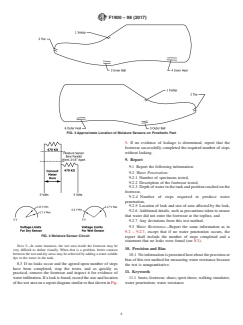
4.2.1 Aminimum of six moisture sensors shall be placed at 4.3 Water Tank, made of stainless steel (or other corrosion-
the following locations on the prosthetic foot: instep, big toe, resistant material). The tank shall be large enough so that the
inner and outer ball, and inner and outer heel, as illustrated in
upper portion of a shoe or boot does not come in contact with
Fig. 3.
the tank at any time during the test. The tank should have an
4.2.2 The moisture sensors shall determine the presence of
opening in the front, that is covered by transparent material, to
water. A circuit diagram for a sensor that has proven to be
permit observation of the footwear during the test.
suitable for this application is shown in Fig. 4.
F1900 − 98 (2017)
FIG. 2 Typical Ranges of Motion During Ground Contact During Walking at 3.2 kph (2.0 mph)
TABLE 1 Body Masses and Equivalent One Bodyweight
NOTE 3—Socks
...