

ASTM E1332-22
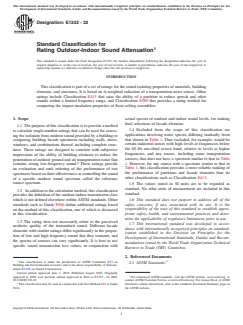
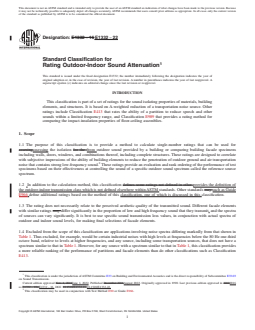
(Classification)Standard Classification for Rating Outdoor-Indoor Sound Attenuation
General Information
- Abstract
SIGNIFICANCE AND USE
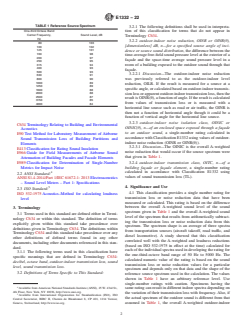
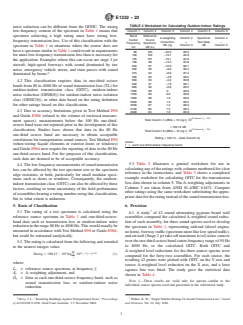
4.1 This classification provides a single number rating for transmission loss or noise reduction data that have been measured or calculated. This rating is based on the difference between the overall A-weighted sound level of the sound spectrum given in Table 1 and the overall A-weighted sound level of the spectrum that results from arithmetically subtracting the transmission loss or noise reduction data from this spectrum. The spectrum shape is an average of three spectra from transportation sources (aircraft takeoff, road traffic, and diesel locomotive). A study showed that this classification correlated well with the A-weighted and loudness reductions (based on ISO 532:1975 in effect at the time) calculated for each of the individual spectra used in developing the rating for the one-third-octave band range of 50 Hz to 5000 Hz. The calculated numeric value of the rating is based on the sound transmission loss or noise reduction values for a particular specimen and depends only on that data and the shape of the reference source spectrum used in the calculation. The values shown in Table 1 have an arbitrary reference level. Use single-number ratings with caution. Specimens having the same rating can result in different indoor spectra depending on the variation of their transmission loss with frequency. Also, if the actual spectrum of the outdoor sound is different from that assumed in Table 1, the overall A-weighted outdoor-indoor noise reduction can be different from the OINIC. The strong low-frequency content of the spectrum in Table 1 means that specimen achieving a high rating must have strong low-frequency transmission loss. Use of this classification with the spectrum in Table 1 in situations where the source does not have a spectrum similar to Table 1 could result in requirements for more low-frequency transmission loss than is necessary for the application. Examples where this can occur are stage 3 jet aircraft, high-speed freeways with sound dominated by ti...
SCOPE
1.1 The purpose of this classification is to provide a method to calculate single-number ratings that can be used for assessing the isolation from outdoor sound provided by a building or comparing building facade specimens including walls, doors, windows, and combinations thereof, including complete structures. These ratings are designed to correlate with subjective impressions of the ability of building elements to reduce the penetration of outdoor ground and air transportation noise that contains strong low-frequency sound.2 These ratings provide an evaluation and rank ordering of the performance of test specimens based on their effectiveness at controlling the sound of a specific outdoor sound spectrum called the reference source spectrum.
1.2 In addition to the calculation method, this classification provides the definition of the outdoor-indoor transmission class which is not defined elsewhere within ASTM standards. Other standards such as Guide E966 define additional ratings based on the method of this classification, one of which is discussed in this classification.
1.3 The rating does not necessarily relate to the perceived aesthetic quality of the transmitted sound. Different facade elements with similar ratings differ significantly in the proportion of low and high frequency sound that they transmit, and the spectra of sources can vary significantly. It is best to use specific sound transmission loss values, in conjunction with actual spectra of outdoor and indoor sound levels, for making final selections of facade elements.
1.4 Excluded from the scope of this classification are applications involving noise spectra differing markedly from that shown in Table 1. Thus excluded, for example, would be certain industrial noises with high levels at frequencies below the 80 Hz one-third octave band, relative to levels at higher frequencies, and any source, including some transportation sources, that does not ...
- Status
- Published
- Publication Date
- 31-May-2022
- Technical Committee
- E33 - Building and Environmental Acoustics
- Drafting Committee
- E33.03 - Sound Transmission

Overview
ASTM E1332-22: Standard Classification for Rating Outdoor-Indoor Sound Attenuation provides a uniform methodology for calculating single-number ratings that measure the effectiveness of building facades and components-such as walls, doors, and windows-in isolating outdoor sound. Developed by ASTM, this standard is essential in evaluating and comparing how well different building elements reduce the transmission of outdoor noise, particularly from transportation sources including aircraft, road traffic, and railways. The ratings generated by this classification are especially significant where noise contains strong low-frequency components.
Key Topics
- Single-number Ratings: The standard defines single-number metrics, such as the Outdoor-Indoor Transmission Class (OITC) and the Outdoor-Indoor Noise Isolation Class (OINIC), to summarize the noise attenuation performance of building materials.
- Reference Source Spectrum: Calculation is based on an averaged spectrum derived from outdoor transportation noise sources, ensuring relevancy for environments exposed to ground and air transportation noise.
- A-weighted Measurement: Ratings correlate with A-weighted sound level reductions, aligning measurement with human perceptual responses to noise.
- Applicability Criteria:
- Designed for typical transportation noise environments (aircraft takeoff, traffic, locomotive).
- Best applied when outdoor noise spectra are similar to the reference spectrum provided in the standard.
- Not intended for sources with significantly different spectra, such as specific industrial noises or unusual transportation sources.
- Calculation Methodology: The standard provides a clear process for using laboratory or field-measured transmission loss or noise reduction data, typically across one-third octave bands from 80 Hz to 4000 Hz.
Applications
- Building Facade Design: Architects and engineers can use ASTM E1332-22 ratings to compare the acoustic performance of facade assemblies, aiding in the selection of materials and configurations that best mitigate outdoor noise intrusion.
- Product Testing and Certification: Manufacturers of windows, doors, and wall systems utilize this standard to test and communicate the sound attenuation capability of their products, supporting informed choices for building professionals.
- Regulatory Compliance: Municipalities and urban planners may refer to OITC and related ratings to ensure buildings meet minimum noise insulation standards, particularly in densely populated or high-traffic areas.
- Retrofitting and Renovations: When upgrading existing structures for better acoustic comfort, ASTM E1332-22 helps assess the performance of proposed or installed facade upgrades against recognized benchmarks.
- Field and Laboratory Measurements: The standard can be used in conjunction with test methods such as ASTM E90 (laboratory measurement of airborne sound transmission loss) and ASTM E966 (field measurement of facade attenuation).
Related Standards
- ASTM E413: Standard Classification for Rating Sound Insulation - focuses on speech and typical indoor sounds, using a different frequency range.
- ASTM E90: Test Method for Laboratory Measurement of Airborne Sound Transmission Loss of Building Partitions and Elements - referenced for generating data used in E1332-22.
- ASTM E966: Guide for Field Measurements of Airborne Sound Attenuation of Building Facades and Elements - applicable for in-situ performance assessment.
- ASTM E989: Classification for Determination of Single-Number Metrics for Impact Noise - pertains to impact rather than airborne noise.
- ISO 532: Acoustics – Method for Calculating Loudness Level - relevant for subjective correlation of A-weighted sound reductions.
- ANSI S1.4/IEC 61672: Sound Level Meters - Specifications for instrumentation involved in measurements.
Practical Value
ASTM E1332-22 provides a robust, repeatable framework for rating and comparing building envelope elements for noise control, ensuring that buildings in noise-impacted environments deliver suitable acoustic comfort. By offering a harmonized, single-number classification system tailored for transportation-related noise, the standard aids decision-makers in optimizing designs and upgrades for effective outdoor-indoor sound attenuation, supporting better living and working environments in urban and near-transport settings.
Keywords: ASTM E1332-22, outdoor-indoor sound attenuation, transmission loss, noise reduction, OITC, OINIC, building facade acoustics, sound insulation standard, transportation noise, A-weighted sound level, architectural acoustics, building envelope noise control.
Relations
- Effective Date
- 01-Dec-2023
- Effective Date
- 01-Nov-2018
- Effective Date
- 15-Jan-2018
- Effective Date
- 01-Dec-2016
- Effective Date
- 01-Sep-2013
- Refers
ASTM E989-06(2012) - Standard Classification for Determination of Impact Insulation Class (IIC) - Effective Date
- 01-Sep-2012
- Effective Date
- 01-Dec-2011
- Effective Date
- 01-Sep-2010
- Effective Date
- 01-Sep-2010
- Effective Date
- 01-Sep-2010
- Effective Date
- 01-Sep-2010
- Effective Date
- 01-Jun-2010
- Effective Date
- 01-Jul-2009
- Effective Date
- 01-Apr-2009
- Effective Date
- 01-Sep-2008
Get Certified
Connect with accredited certification bodies for this standard

CIS Institut d.o.o.
Personal Protective Equipment (PPE) certification body. Notified Body NB-2890 for EU Regulation 2016/425 PPE.

Kiwa BDA Testing
Building and construction product certification.
Kmetijski inštitut Slovenije
Agricultural Institute of Slovenia. Soil testing, plant health, agricultural product analysis.
Sponsored listings
Frequently Asked Questions
ASTM E1332-22 is a standard published by ASTM International. Its full title is "Standard Classification for Rating Outdoor-Indoor Sound Attenuation". This standard covers: SIGNIFICANCE AND USE 4.1 This classification provides a single number rating for transmission loss or noise reduction data that have been measured or calculated. This rating is based on the difference between the overall A-weighted sound level of the sound spectrum given in Table 1 and the overall A-weighted sound level of the spectrum that results from arithmetically subtracting the transmission loss or noise reduction data from this spectrum. The spectrum shape is an average of three spectra from transportation sources (aircraft takeoff, road traffic, and diesel locomotive). A study showed that this classification correlated well with the A-weighted and loudness reductions (based on ISO 532:1975 in effect at the time) calculated for each of the individual spectra used in developing the rating for the one-third-octave band range of 50 Hz to 5000 Hz. The calculated numeric value of the rating is based on the sound transmission loss or noise reduction values for a particular specimen and depends only on that data and the shape of the reference source spectrum used in the calculation. The values shown in Table 1 have an arbitrary reference level. Use single-number ratings with caution. Specimens having the same rating can result in different indoor spectra depending on the variation of their transmission loss with frequency. Also, if the actual spectrum of the outdoor sound is different from that assumed in Table 1, the overall A-weighted outdoor-indoor noise reduction can be different from the OINIC. The strong low-frequency content of the spectrum in Table 1 means that specimen achieving a high rating must have strong low-frequency transmission loss. Use of this classification with the spectrum in Table 1 in situations where the source does not have a spectrum similar to Table 1 could result in requirements for more low-frequency transmission loss than is necessary for the application. Examples where this can occur are stage 3 jet aircraft, high-speed freeways with sound dominated by ti... SCOPE 1.1 The purpose of this classification is to provide a method to calculate single-number ratings that can be used for assessing the isolation from outdoor sound provided by a building or comparing building facade specimens including walls, doors, windows, and combinations thereof, including complete structures. These ratings are designed to correlate with subjective impressions of the ability of building elements to reduce the penetration of outdoor ground and air transportation noise that contains strong low-frequency sound.2 These ratings provide an evaluation and rank ordering of the performance of test specimens based on their effectiveness at controlling the sound of a specific outdoor sound spectrum called the reference source spectrum. 1.2 In addition to the calculation method, this classification provides the definition of the outdoor-indoor transmission class which is not defined elsewhere within ASTM standards. Other standards such as Guide E966 define additional ratings based on the method of this classification, one of which is discussed in this classification. 1.3 The rating does not necessarily relate to the perceived aesthetic quality of the transmitted sound. Different facade elements with similar ratings differ significantly in the proportion of low and high frequency sound that they transmit, and the spectra of sources can vary significantly. It is best to use specific sound transmission loss values, in conjunction with actual spectra of outdoor and indoor sound levels, for making final selections of facade elements. 1.4 Excluded from the scope of this classification are applications involving noise spectra differing markedly from that shown in Table 1. Thus excluded, for example, would be certain industrial noises with high levels at frequencies below the 80 Hz one-third octave band, relative to levels at higher frequencies, and any source, including some transportation sources, that does not ...
SIGNIFICANCE AND USE 4.1 This classification provides a single number rating for transmission loss or noise reduction data that have been measured or calculated. This rating is based on the difference between the overall A-weighted sound level of the sound spectrum given in Table 1 and the overall A-weighted sound level of the spectrum that results from arithmetically subtracting the transmission loss or noise reduction data from this spectrum. The spectrum shape is an average of three spectra from transportation sources (aircraft takeoff, road traffic, and diesel locomotive). A study showed that this classification correlated well with the A-weighted and loudness reductions (based on ISO 532:1975 in effect at the time) calculated for each of the individual spectra used in developing the rating for the one-third-octave band range of 50 Hz to 5000 Hz. The calculated numeric value of the rating is based on the sound transmission loss or noise reduction values for a particular specimen and depends only on that data and the shape of the reference source spectrum used in the calculation. The values shown in Table 1 have an arbitrary reference level. Use single-number ratings with caution. Specimens having the same rating can result in different indoor spectra depending on the variation of their transmission loss with frequency. Also, if the actual spectrum of the outdoor sound is different from that assumed in Table 1, the overall A-weighted outdoor-indoor noise reduction can be different from the OINIC. The strong low-frequency content of the spectrum in Table 1 means that specimen achieving a high rating must have strong low-frequency transmission loss. Use of this classification with the spectrum in Table 1 in situations where the source does not have a spectrum similar to Table 1 could result in requirements for more low-frequency transmission loss than is necessary for the application. Examples where this can occur are stage 3 jet aircraft, high-speed freeways with sound dominated by ti... SCOPE 1.1 The purpose of this classification is to provide a method to calculate single-number ratings that can be used for assessing the isolation from outdoor sound provided by a building or comparing building facade specimens including walls, doors, windows, and combinations thereof, including complete structures. These ratings are designed to correlate with subjective impressions of the ability of building elements to reduce the penetration of outdoor ground and air transportation noise that contains strong low-frequency sound.2 These ratings provide an evaluation and rank ordering of the performance of test specimens based on their effectiveness at controlling the sound of a specific outdoor sound spectrum called the reference source spectrum. 1.2 In addition to the calculation method, this classification provides the definition of the outdoor-indoor transmission class which is not defined elsewhere within ASTM standards. Other standards such as Guide E966 define additional ratings based on the method of this classification, one of which is discussed in this classification. 1.3 The rating does not necessarily relate to the perceived aesthetic quality of the transmitted sound. Different facade elements with similar ratings differ significantly in the proportion of low and high frequency sound that they transmit, and the spectra of sources can vary significantly. It is best to use specific sound transmission loss values, in conjunction with actual spectra of outdoor and indoor sound levels, for making final selections of facade elements. 1.4 Excluded from the scope of this classification are applications involving noise spectra differing markedly from that shown in Table 1. Thus excluded, for example, would be certain industrial noises with high levels at frequencies below the 80 Hz one-third octave band, relative to levels at higher frequencies, and any source, including some transportation sources, that does not ...
ASTM E1332-22 is classified under the following ICS (International Classification for Standards) categories: 13.040.01 - Air quality in general. The ICS classification helps identify the subject area and facilitates finding related standards.
ASTM E1332-22 has the following relationships with other standards: It is inter standard links to ASTM E90-23, ASTM E966-18a, ASTM E966-18, ASTM E90-09(2016), ASTM C634-13, ASTM E989-06(2012), ASTM C634-11, ASTM E966-10e1, ASTM E966-10, ASTM E413-10, ASTM C634-10a, ASTM C634-10, ASTM E90-09, ASTM C634-09, ASTM C634-08a. Understanding these relationships helps ensure you are using the most current and applicable version of the standard.
ASTM E1332-22 is available in PDF format for immediate download after purchase. The document can be added to your cart and obtained through the secure checkout process. Digital delivery ensures instant access to the complete standard document.
Standards Content (Sample)
This international standard was developed in accordance with internationally recognized principles on standardization established in the Decision on Principles for the
Development of International Standards, Guides and Recommendations issued by the World Trade Organization Technical Barriers to Trade (TBT) Committee.
Designation:E1332 −22
Standard Classification for
Rating Outdoor-Indoor Sound Attenuation
This standard is issued under the fixed designation E1332; the number immediately following the designation indicates the year of
original adoption or, in the case of revision, the year of last revision. A number in parentheses indicates the year of last reapproval. A
superscript epsilon (´) indicates an editorial change since the last revision or reapproval.
INTRODUCTION
This classification is part of a set of ratings for the sound isolating properties of materials, building
elements, and structures. It is based on A-weighted reduction of a transportation noise source. Other
ratings include Classification E413 that rates the ability of a partition to reduce speech and other
sounds within a limited frequency range, and Classification E989 that provides a rating method for
comparing the impact-insulation properties of floor-ceiling assemblies.
1. Scope actual spectra of outdoor and indoor sound levels, for making
final selections of facade elements.
1.1 The purpose of this classification is to provide a method
1.4 Excluded from the scope of this classification are
to calculate single-number ratings that can be used for assess-
applications involving noise spectra differing markedly from
ing the isolation from outdoor sound provided by a building or
that shown in Table 1. Thus excluded, for example, would be
comparing building facade specimens including walls, doors,
certain industrial noises with high levels at frequencies below
windows, and combinations thereof, including complete struc-
the 80 Hz one-third octave band, relative to levels at higher
tures. These ratings are designed to correlate with subjective
frequencies, and any source, including some transportation
impressions of the ability of building elements to reduce the
sources, that does not have a spectrum similar to that in Table
penetration of outdoor ground and air transportation noise that
1. However, for any source with a spectrum similar to that in
contains strong low-frequency sound. These ratings provide
Table 1, this classification provides a more reliable ranking of
an evaluation and rank ordering of the performance of test
the performance of partitions and facade elements than do
specimens based on their effectiveness at controlling the sound
other classifications such as Classification E413.
of a specific outdoor sound spectrum called the reference
source spectrum.
1.5 The values stated in SI units are to be regarded as
standard. No other units of measurement are included in this
1.2 In addition to the calculation method, this classification
standard.
providesthedefinitionoftheoutdoor-indoortransmissionclass
which is not defined elsewhere withinASTM standards. Other 1.6 This standard does not purport to address all of the
safety concerns, if any, associated with its use. It is the
standards such as Guide E966 define additional ratings based
on the method of this classification, one of which is discussed responsibility of the user of this standard to establish appro-
priate safety, health, and environmental practices and deter-
in this classification.
mine the applicability of regulatory limitations prior to use.
1.3 The rating does not necessarily relate to the perceived
1.7 This international standard was developed in accor-
aesthetic quality of the transmitted sound. Different facade
dance with internationally recognized principles on standard-
elements with similar ratings differ significantly in the propor-
ization established in the Decision on Principles for the
tion of low and high frequency sound that they transmit, and
Development of International Standards, Guides and Recom-
the spectra of sources can vary significantly. It is best to use
mendations issued by the World Trade Organization Technical
specific sound transmission loss values, in conjunction with
Barriers to Trade (TBT) Committee.
2. Referenced Documents
This classification is under the jurisdiction of ASTM Committee E33 on
2.1 ASTM Standards:
Building and Environmental Acoustics and is the direct responsibility of Subcom-
mittee E33.03 on Sound Transmission.
Current edition approved June 1, 2022. Published August 2022. Originally
approved in 1990. Last previous edition approved in 2016 as E1332 – 16. DOI: For referenced ASTM standards, visit the ASTM website, www.astm.org, or
10.1520/E1332-22. contact ASTM Customer Service at service@astm.org. For Annual Book of ASTM
This classification may be used in conjunction with Test Method E90 or Guide Standards volume information, refer to the standard’s Document Summary page on
E966. the ASTM website.
Copyright © ASTM International, 100 Barr Harbor Drive, PO Box C700, West Conshohocken, PA 19428-2959. United States
E1332−22
TABLE 1 Reference Source Spectrum
3.2.1 The following definitions shall be used in interpreta-
One-third Octave Band tion of this classification for terms that do not appear in
Center Frequency, Sound Level, dB
Terminology C634.
Hz
3.2.2 outdoor-indoor noise reduction, OINR or OINR(θ),
80 103
[dimensionless] dB, n—for a specified source angle of inci-
100 102
125 101
dence or source sound distribution, the difference between the
160 98
time-average free-field sound pressure level at the exterior of a
200 97
façade and the space-time average sound pressure level in a
250 95
315 94 room of a building exposed to the outdoor sound through that
400 93
façade.
500 93
3.2.2.1 Discussion—The outdoor-indoor noise reduction
630 91
800 90
was previously referred to as the outdoor-indoor level
1000 89
reduction, OILR. If the result is measured for a source at a
1250 89
specific angle, or calculated based on outdoor-indoor transmis-
1600 88
2000 88
sionlossorapparentoutdoor-indoortransmissionloss,thenthe
2500 87
result isOINR(θ), afunctionof angle. Iftheresultiscalculated
3150 85
from values of transmission loss or is measured with a
4000 84
horizontal line source such as road or air traffic, the OINR is
then not a function of horizontal angle though it could be a
function of vertical angle for the horizontal line source.
3.2.3 outdoor-indoor noise isolation class, OINIC or
C634 Terminology Relating to Building and Environmental
OINIC(θ), n—of an enclosed space exposed through a façade
Acoustics
to an outdoor sound, a single-number rating calculated in
E90 Test Method for Laboratory Measurement of Airborne
accordance with Classification E1332 using values of outdoor-
Sound Transmission Loss of Building Partitions and
indoor noise reduction (OINR or OINR(θ)).
Elements
3.2.3.1 Discussion—The OINIC is the overall A-weighted
E413 Classification for Rating Sound Insulation
noise reduction that would occur if the source spectrum were
E966 Guide for Field Measurements of Airborne Sound
that given in Table 1.
Attenuation of Building Facades and Facade Elements
E989 Classification for Determination of Single-Number 3.2.4 outdoor-indoor transmission class, OITC, n—of a
Metrics for Impact Noise building façade or façade element, a single-number rating
calculated in accordance with Classification E1332 using
2.2 ANSI Standard:
values of sound transmission loss (TL).
ANSI S1.4-2014/Part 1/IEC 61672-1: 2013 Electroacoustics
– Sound Level Meters – Part 1: Specifications
4. Significance and Use
2.3 ISO Standard:
4.1 This classification provides a single number rating for
ISO 532:1975 Acoustics–Method for calculating loudness
transmission loss or noise reduction data that have been
level
measured or calculated. This rating is based on the difference
between the overall A-weighted sound level of the sound
3. Terminology
spectrum given in Table 1 and the overall A-weighted sound
3.1 Terms used in this standard are defined either in Termi-
level of the spectrum that results from arithmetically subtract-
nology C634 or within this standard. The definition of terms
ing the transmission loss or noise reduction data from this
explicitly given within this standard take precedence over
spectrum. The spectrum shape is an average of three spectra
definitions given in Terminology C634. The definitions within
from transportation sources (aircraft takeoff, road traffic, and
Terminology C634 and this standard take precedence over any
diesel locomotive). A study showed that this classification
other definitions of defined terms found in any other
correlated well with the A-weighted and loudness reductions
documents, including other documents referenced in this stan-
(based on ISO 532:1975 in effect at the time) calculated for
dard.
each of the individual spectra used in developing the rating for
3.1.1 The following terms used in this classification have
the one-third-octave band range of 50 Hz to 5000 Hz. The
specific meanings that are defined in Terminology C634:
calculated numeric value of the rating is based on the sound
decibel, octave band, outdoor-indoor transmission loss, sound
transmission loss or noise reduction values for a particular
l
...
This document is not an ASTM standard and is intended only to provide the user of an ASTM standard an indication of what changes have been made to the previous version. Because
it may not be technically possible to adequately depict all changes accurately, ASTM recommends that users consult prior editions as appropriate. In all cases only the current version
of the standard as published by ASTM is to be considered the official document.
Designation: E1332 − 16 E1332 − 22
Standard Classification for
Rating Outdoor-Indoor Sound Attenuation
This standard is issued under the fixed designation E1332; the number immediately following the designation indicates the year of
original adoption or, in the case of revision, the year of last revision. A number in parentheses indicates the year of last reapproval. A
superscript epsilon (´) indicates an editorial change since the last revision or reapproval.
INTRODUCTION
This classification is part of a set of ratings for the sound isolating properties of materials, building
elements, and structures. It is based on A-weighted reduction of a transportation noise source. Other
ratings include Classification E413 that rates the ability of a partition to reduce speech and other
sounds within a limited frequency range, and Classification E989 that provides a rating method for
comparing the impact-insulation properties of floor-ceiling assemblies.
1. Scope
1.1 The purpose of this classification is to provide a method to calculate single-number ratings that can be used for
assesingassessing the isolation for the from outdoor sound provided by a building or comparing building facade specimens
including walls, doors, windows, and combinations thereof, including complete structures. These ratings are designed to correlate
with subjective impressions of the ability of building elements to reduce the penetration of outdoor ground and air transportation
noise that contains strong low-frequency sound. These ratings provide an evaluation and rank ordering of the performance of test
specimens based on their effectiveness at controlling the sound of a specific outdoor sound spectrum called the reference source
spectrum.
1.2 In addition to the calculation method, this classification defines some ratings not defined in other provides the definition of
the outdoor-indoor transmission class which is not defined elsewhere within ASTM standards. Other standards may such as Guide
E966 define additional ratings based on the method of this classification, one of which is discussed in this classification.
1.3 The rating does not necessarily relate to the perceived aesthetic quality of the transmitted sound. Different facade elements
with similar ratings may differ significantly in the proportion of low and high frequency sound that they transmit, and the spectra
of sources can vary significantly. It is best to use specific sound transmission loss values, in conjunction with actual spectra of
outdoor and indoor sound levels, for making final selections of facade elements.
1.4 Excluded from the scope of this classification are applications involving noise spectra differing markedly from that shown in
Table 1. Thus excluded, for example, would be certain industrial noises with high levels at frequencies below the 80 Hz one-third
octave band, relative to levels at higher frequencies, and any source, including some transportation sources, that does not have a
spectrum similar to that in Table 1. However, for any source with a spectrum similar to that in Table 1, this classification provides
a more reliable ranking of the performance of partitions and facade elements than do other classifications such as Classification
E413.
This classification is under the jurisdiction of ASTM Committee E33 on Building and Environmental Acoustics and is the direct responsibility of Subcommittee E33.03
on Sound Transmission.
Current edition approved Nov. 1, 2016June 1, 2022. Published December 2016August 2022. Originally approved in 1990. Last previous edition approved in 20102016
as E1332 – 10a.E1332 – 16. DOI: 10.1520/E1332-16.10.1520/E1332-22.
This classification may be used in conjunction with Test Method E90 or Guide E966.
Copyright © ASTM International, 100 Barr Harbor Drive, PO Box C700, West Conshohocken, PA 19428-2959. United States
E1332 − 22
TABLE 1 Reference Source Spectrum
One-third Octave Band
Center Frequency, Sound Level, dB
Hz
80 103
100 102
125 101
160 98
200 97
250 95
315 94
400 93
500 93
630 91
800 90
1000 89
1250 89
1600 88
2000 88
2500 87
3150 85
4000 84
1.5 The values stated in SI units are to be regarded as standard. No other units of measurement are included in this standard.
1.6 This standard does not purport to address all of the safety concerns, if any, associated with its use. It is the responsibility
of the user of this standard to establish appropriate safety safety, health, and healthenvironmental practices and determine the
applicability of regulatory limitations prior to use.
1.7 This international standard was developed in accordance with internationally recognized principles on standardization
established in the Decision on Principles for the Development of International Standards, Guides and Recommendations issued
by the World Trade Organization Technical Barriers to Trade (TBT) Committee.
2. Referenced Documents
2.1 ASTM Standards:
C634 Terminology Relating to Building and Environmental Acoustics
E90 Test Method for Laboratory Measurement of Airborne Sound Transmission Loss of Building Partitions and Elements
E413 Classification for Rating Sound Insulation
E966 Guide for Field Measurements of Airborne Sound Attenuation of Building Facades and Facade Elements
E989 Classification for Determination of Single-Number Metrics for Impact Noise
2.2 ANSI Standard:
ANSI S1.4S1.4-2014/Part 1/IEC 61672-1: 2013 Part 1 – American National Standard Electroacoustics Electroacoustics – Sound
Level Meters – Part 11: Specifications
2.3 ISO Standard:
ISO 532532:1975 Acoustics–Method for Calculating Loudness Levelcalculating loudness level
3. Terminology
3.1 The following terms Terms used in this classification have specific meanings that standard are defined either in Terminology
C634: airborne sound, decibel, impact insulation class, octave band, outdoor-indoor transmission loss, sound insulation, sound
isolation, sound level, sound transmission loss.or within this standard. The definition of terms explicitly given within this standard
take precedence over definitions given in Terminology C634. The definitions within Terminology C634 and this standard take
precedence over any other definitions of defined terms found in any other documents, including other documents referenced in this
standard.
For referenced ASTM standards, visit the ASTM website, www.astm.org, or contact ASTM Customer Service at service@astm.org. For Annual Book of ASTM Standards
volume information, refer to the standard’s Document Summary page on the ASTM website.
Available from American National Standards Institute (ANSI), 25 W. 43rd St., 4th Floor, New York, NY 10036, http://www.ansi.org.
Available from International Organization for Standardization (ISO), ISO Central Secretariat, BIBC II, Chemin de Blandonnet 8, CP 401, 1214 Vernier, Geneva,
Switzerland, http://www.iso.org.
E1332 − 22
3.1.1 The following terms used in this classification have specific meanings that are defined in Terminology C634: decibel, octave
band, outdoor-indoor transmission loss, sound level, sound transmission loss.
3.2 Definitions:Definitions of Terms Specific to This Standard:
3.2.1 apparent outdoor-indoor transmission class, AOITC(θ), n—of a building façade or façade element, a single-number rating
calculated in accordance with Classification E1332 using measured values of apparent outdoor-indoor transmission loss at a
specified angle θ or range of angles.
3.2.1 The following definitions shall be used in interpretation of this classification for terms that do not appear in Terminology
C634.
3.2.2 apparent outdoor-indoor transmission loss, AOITL(θ), dB, n—of a building façade or façade element, the value of
outdoor-indoor transmission loss obtained on a test façade element as installed, in a specified frequency band, for a source at a
specified angle θ or range of angles as measured from the normal to the center of the specimen surface, without flanking tests to
identify or eliminate extraneous transmission paths.
3.2.2.1 Discussion—
All the sound power transmitted into the receiving room through both direct and flanking paths is attributed solely to the physical
area of the test specimen. If flanking transmission is significant, the AOITL will be less than the actual OITL for the specimen.
3.2.2 outdoor-indoor noise reduction, OINR or OINR(θ), [dimensionless] dB, n—for a specified source angle of incidence or
source sound distribution, the difference between the time-average free-field sound pressure level at the exterior of a façade and
the space-time average sound pressure level in a room of a building exposed to the outdoor sound through that façade.
3.2.2.1 Discussion—
The outdoor-indoor noise reduction was previously referred to as the outdoor-indoor level reduction, OILR. If the result is
measured for a source at a specific angle, or calculated based on outdoor-indoor transmission loss or apparent outdoor-indoor
transmission loss, then the result is OINR(θ), a function of angle. If the result is calculated from values of transmission loss or is
measured with a horizontal line source such as road or air traffic, the OINR is then not a function of horizontal angle though it
maycould be a function of vertical angle for the horizontal line source.
3.2.3 outdoor-indoor noise isolation class, OINIC or OINIC(θ), n—of an enclosed space exposed through a façade to an outdoor
sound, a single-number rating calculated in accordance with Classification E1332 using values of outdoor-indoor noise
reduction.reduction (OINR or OINR(θ)).
3.2.3.1 Discussion—
The OINIC is the overall A-weighted noise reduction that would occur if the source spectrum were that given in Table 1.
3.2.4 outdoor-indoor transmission class, OITC, n—of a building façade or façade element, a single-number rating calculated in
accordance with Classification E1332 using values of sound transmission loss.loss (TL).
4. Significance and Use
4.1 This classification provides a single number rating for transmission loss or noise reduction data that have been measured or
calculated. This rating is based on the difference between the overall A-weighted sound level of the sound spectrum given in Table
1 and the overall A-weighted sound level of the spectrum that results from arithmetically subtracting the transmission loss or noise
reduction data from this spectrum. The spectrum shape is an average of three spectra from transportation sources (aircraft takeoff,
road, road traffic, and diesel locomotive passby). locomotive). A study showed that this classification c
...