

ASTM D4551-22
(Specification)Standard Specification for Poly(Vinyl Chloride) (PVC) Plastic Flexible Concealed Water-Containment Membrane
General Information
- Abstract
ABSTRACT
This specification covers poly(vinyl chloride) flexible sheeting which is used without mastic, bedding, or coating for construction of concealed water containment membranes that include fountains, pools, planters, shower and safe pans, tile tubs, or similar wet installations where the membrane is inaccessible once the construction is complete. The plastic materials shall meet the inherent viscosity and compound density requirements and shall be subjected to tests that have been selected to be conducted primarily with liquids that simulate the environment to which the membrane will be subjected during actual use. Qualification tests shall be performed wherein the sheeting shall conform to the following physical property requirements: thickness; stress-strain properties such as tensile strength, tensile stress at elongation, and elongation at break; tear resistance; pinholes; microorganism resistance; puncture resistance; indentation resistance; folding resistance; chemical resistance to distilled water, soapy water, or alkali; hydrostatic pressure resistance; shrinkage; and volatile loss.
SCOPE
1.1 This specification covers poly(vinyl chloride) (PVC) flexible sheeting which is used without mastic, bedding, or coating for construction of concealed water-containment-membranes in applications where there is potential for costly secondary damage from water leakage and very long-term reliable performance is essential. Examples are fountains, pools, planters, shower and safe pans, tile tubs, or similar wet installations where the membrane is inaccessible once the construction is complete. Included are requirements for materials and sheeting, test methods, workmanship criteria, and methods of marking.
1.2 Recycled materials may be used in this product in accordance with the requirements in Section 5.
1.3 The tests are intended to ensure quality and performance and are not intended for design purposes. Tests have been selected to be conducted primarily with liquids that simulate the environment to which the membrane will be subjected during actual use.
1.4 This specification does not cover water-containment membranes exposed to ultraviolet light.
1.5 The values stated in inch-pound units are to be regarded as the standard. The values given in parentheses are for information only.
1.6 There is no known ISO equivalent to this standard.
1.7 The following precautionary caveat pertains only to the test method portion, Section 11, of this specification: This standard does not purport to address all of the safety concerns, if any, associated with its use. It is the responsibility of the user of this standard to establish appropriate safety, health, and environmental practices and determine the applicability of regulatory limitations prior to use.
1.8 This international standard was developed in accordance with internationally recognized principles on standardization established in the Decision on Principles for the Development of International Standards, Guides and Recommendations issued by the World Trade Organization Technical Barriers to Trade (TBT) Committee.
- Status
- Published
- Publication Date
- 31-Aug-2022
- Technical Committee
- D20 - Plastics
- Drafting Committee
- D20.24 - Plastic Building Products
Buy Documents
ASTM D4551-22 - Standard Specification for Poly(Vinyl Chloride) (PVC) Plastic Flexible Concealed Water-Containment Membrane
REDLINE ASTM D4551-22 - Standard Specification for Poly(Vinyl Chloride) (PVC) Plastic Flexible Concealed Water-Containment Membrane
Overview
ASTM D4551-22: Standard Specification for Poly(Vinyl Chloride) (PVC) Plastic Flexible Concealed Water-Containment Membrane establishes the requirements for flexible PVC sheeting used as a concealed membrane for water containment in construction applications. This specification is crucial for ensuring the reliable, long-term performance of waterproofing systems in areas where membrane access will not be possible after installation. The standard targets installations where secondary water damage could be costly, such as fountains, pools, planters, showers, and tile tubs.
PVC membranes specified by ASTM D4551-22 are evaluated for their material properties, resistance to water leakage, and long-term durability under conditions that closely simulate those encountered in actual in-use environments. The standard also includes testing and quality assurance requirements, making it a critical resource for manufacturers, builders, and specifiers within the construction industry.
Key Topics
- Material Requirements: The standard covers homogeneous, monolithic flexible PVC sheeting, free of pinholes, foreign inclusions, and detrimental defects. Both virgin and recycled materials may be used, provided they meet all criteria in the standard.
- Physical Performance: The membrane must meet various performance metrics for:
- Thickness (minimums for Grade 30 and Grade 40)
- Tensile strength and elongation
- Tear, puncture, indentation, and folding resistance
- Resistance to microorganisms, chemicals (distilled/soapy water and alkali), and hydrostatic pressure
- Low shrinkage and volatile loss
- Testing Methods: Quality assurance is achieved via:
- Random sampling across production lots
- Detailed physical and chemical tests simulating actual use environments
- Regular requalification, especially if compounding or processing changes occur
- Workmanship and Packaging: Strict inspection standards are in place for appearance, dimensions, and packaging. Material must be continuously marked with manufacturer details, grade, and ASTM D4551 designation.
Applications
Flexible PVC concealed water-containment membranes per ASTM D4551-22 are widely used in:
- Shower pans and tile tubs: Delivering a watertight barrier beneath ceramic or stone tile to prevent leaks into building structures.
- Pools and fountains: Ensuring reliable containment of water in complex or inaccessible assemblies.
- Planters: Providing a protective liner to prevent water damage to building envelopes and adjacent structures.
- Safety pans: Used in areas prone to overflow or leaks for added protection in high-risk installations.
Because these membranes are installed in locations where access is impossible after construction, stringent testing and marking provide confidence in their lifespan and serviceability. The standard excludes membranes intended for exposure to ultraviolet (UV) light.
Related Standards
ASTM D4551-22 references several key testing and terminology standards, including:
- ASTM D374/D374M - Thickness of Solid Electrical Insulation
- ASTM D412 - Tension Testing of Thermoplastic Elastomers
- ASTM D543 - Resistance of Plastics to Chemical Reagents
- ASTM D1004 - Tear Resistance of Plastic Film and Sheeting
- ASTM D1203/D1204 - Volatile Loss and Dimensional Changes
- ASTM E96/E96M - Water Vapor Transmission Rate (for information only)
- MIL-STD-105 - Sampling Procedures for Inspection
These referenced documents support consistent testing and reliable product performance. Note that there is currently no ISO equivalent for this specification.
Practical Value
By complying with ASTM D4551-22, manufacturers and specifiers can ensure delivery of dependable, high-performance PVC water-containment membranes. This protects structures from costly leak-related damage, simplifies installation processes, and supports sustainable manufacturing through the responsible use of recycled materials. The standard’s rigorous testing framework and clear marking requirements help end users confidently identify and select suitable membrane products for critical waterproofing applications.
Relations
- Effective Date
- 01-Mar-2024
- Effective Date
- 01-Feb-2024
- Effective Date
- 15-Nov-2023
- Refers
ASTM D1203-23 - Standard Test Methods for Volatile Loss from Plastics Using Activated Carbon Methods - Effective Date
- 01-Nov-2023
- Effective Date
- 01-Nov-2023
- Effective Date
- 01-Oct-2023
- Refers
ASTM D1243-22e1 - Standard Test Method for Dilute Solution Viscosity of Vinyl Chloride Polymers - Effective Date
- 01-May-2022
- Effective Date
- 01-Apr-2020
- Effective Date
- 01-Jan-2020
- Effective Date
- 01-Aug-2019
- Effective Date
- 15-Apr-2019
- Effective Date
- 01-Feb-2019
- Effective Date
- 01-Dec-2018
- Effective Date
- 01-Nov-2018
- Refers
ASTM D1600-18 - Standard Terminology for Abbreviated Terms Relating to Plastics (Withdrawn 2024) - Effective Date
- 01-Jan-2018
Buy Documents
ASTM D4551-22 - Standard Specification for Poly(Vinyl Chloride) (PVC) Plastic Flexible Concealed Water-Containment Membrane
REDLINE ASTM D4551-22 - Standard Specification for Poly(Vinyl Chloride) (PVC) Plastic Flexible Concealed Water-Containment Membrane
Get Certified
Connect with accredited certification bodies for this standard

DIN CERTCO
DIN Group product certification.

Smithers Quality Assessments
US management systems and product certification.
Sponsored listings
Frequently Asked Questions
ASTM D4551-22 is a technical specification published by ASTM International. Its full title is "Standard Specification for Poly(Vinyl Chloride) (PVC) Plastic Flexible Concealed Water-Containment Membrane". This standard covers: ABSTRACT This specification covers poly(vinyl chloride) flexible sheeting which is used without mastic, bedding, or coating for construction of concealed water containment membranes that include fountains, pools, planters, shower and safe pans, tile tubs, or similar wet installations where the membrane is inaccessible once the construction is complete. The plastic materials shall meet the inherent viscosity and compound density requirements and shall be subjected to tests that have been selected to be conducted primarily with liquids that simulate the environment to which the membrane will be subjected during actual use. Qualification tests shall be performed wherein the sheeting shall conform to the following physical property requirements: thickness; stress-strain properties such as tensile strength, tensile stress at elongation, and elongation at break; tear resistance; pinholes; microorganism resistance; puncture resistance; indentation resistance; folding resistance; chemical resistance to distilled water, soapy water, or alkali; hydrostatic pressure resistance; shrinkage; and volatile loss. SCOPE 1.1 This specification covers poly(vinyl chloride) (PVC) flexible sheeting which is used without mastic, bedding, or coating for construction of concealed water-containment-membranes in applications where there is potential for costly secondary damage from water leakage and very long-term reliable performance is essential. Examples are fountains, pools, planters, shower and safe pans, tile tubs, or similar wet installations where the membrane is inaccessible once the construction is complete. Included are requirements for materials and sheeting, test methods, workmanship criteria, and methods of marking. 1.2 Recycled materials may be used in this product in accordance with the requirements in Section 5. 1.3 The tests are intended to ensure quality and performance and are not intended for design purposes. Tests have been selected to be conducted primarily with liquids that simulate the environment to which the membrane will be subjected during actual use. 1.4 This specification does not cover water-containment membranes exposed to ultraviolet light. 1.5 The values stated in inch-pound units are to be regarded as the standard. The values given in parentheses are for information only. 1.6 There is no known ISO equivalent to this standard. 1.7 The following precautionary caveat pertains only to the test method portion, Section 11, of this specification: This standard does not purport to address all of the safety concerns, if any, associated with its use. It is the responsibility of the user of this standard to establish appropriate safety, health, and environmental practices and determine the applicability of regulatory limitations prior to use. 1.8 This international standard was developed in accordance with internationally recognized principles on standardization established in the Decision on Principles for the Development of International Standards, Guides and Recommendations issued by the World Trade Organization Technical Barriers to Trade (TBT) Committee.
ABSTRACT This specification covers poly(vinyl chloride) flexible sheeting which is used without mastic, bedding, or coating for construction of concealed water containment membranes that include fountains, pools, planters, shower and safe pans, tile tubs, or similar wet installations where the membrane is inaccessible once the construction is complete. The plastic materials shall meet the inherent viscosity and compound density requirements and shall be subjected to tests that have been selected to be conducted primarily with liquids that simulate the environment to which the membrane will be subjected during actual use. Qualification tests shall be performed wherein the sheeting shall conform to the following physical property requirements: thickness; stress-strain properties such as tensile strength, tensile stress at elongation, and elongation at break; tear resistance; pinholes; microorganism resistance; puncture resistance; indentation resistance; folding resistance; chemical resistance to distilled water, soapy water, or alkali; hydrostatic pressure resistance; shrinkage; and volatile loss. SCOPE 1.1 This specification covers poly(vinyl chloride) (PVC) flexible sheeting which is used without mastic, bedding, or coating for construction of concealed water-containment-membranes in applications where there is potential for costly secondary damage from water leakage and very long-term reliable performance is essential. Examples are fountains, pools, planters, shower and safe pans, tile tubs, or similar wet installations where the membrane is inaccessible once the construction is complete. Included are requirements for materials and sheeting, test methods, workmanship criteria, and methods of marking. 1.2 Recycled materials may be used in this product in accordance with the requirements in Section 5. 1.3 The tests are intended to ensure quality and performance and are not intended for design purposes. Tests have been selected to be conducted primarily with liquids that simulate the environment to which the membrane will be subjected during actual use. 1.4 This specification does not cover water-containment membranes exposed to ultraviolet light. 1.5 The values stated in inch-pound units are to be regarded as the standard. The values given in parentheses are for information only. 1.6 There is no known ISO equivalent to this standard. 1.7 The following precautionary caveat pertains only to the test method portion, Section 11, of this specification: This standard does not purport to address all of the safety concerns, if any, associated with its use. It is the responsibility of the user of this standard to establish appropriate safety, health, and environmental practices and determine the applicability of regulatory limitations prior to use. 1.8 This international standard was developed in accordance with internationally recognized principles on standardization established in the Decision on Principles for the Development of International Standards, Guides and Recommendations issued by the World Trade Organization Technical Barriers to Trade (TBT) Committee.
ASTM D4551-22 is classified under the following ICS (International Classification for Standards) categories: 83.140.10 - Films and sheets. The ICS classification helps identify the subject area and facilitates finding related standards.
ASTM D4551-22 has the following relationships with other standards: It is inter standard links to ASTM E96/E96M-24, ASTM D883-24, ASTM E96/E96M-23, ASTM D1203-23, ASTM D883-23, ASTM D374/D374M-23, ASTM D1243-22e1, ASTM D1204-14(2020), ASTM D883-20, ASTM D883-19c, ASTM D883-19a, ASTM D883-19, ASTM D883-18a, ASTM D883-18, ASTM D1600-18. Understanding these relationships helps ensure you are using the most current and applicable version of the standard.
ASTM D4551-22 is available in PDF format for immediate download after purchase. The document can be added to your cart and obtained through the secure checkout process. Digital delivery ensures instant access to the complete standard document.
Standards Content (Sample)
This international standard was developed in accordance with internationally recognized principles on standardization established in the Decision on Principles for the
Development of International Standards, Guides and Recommendations issued by the World Trade Organization Technical Barriers to Trade (TBT) Committee.
Designation:D4551 −22 An American National Standard
Standard Specification for
Poly(Vinyl Chloride) (PVC) Plastic Flexible Concealed Water-
Containment Membrane
This standard is issued under the fixed designation D4551; the number immediately following the designation indicates the year of
original adoption or, in the case of revision, the year of last revision.Anumber in parentheses indicates the year of last reapproval.A
superscript epsilon (´) indicates an editorial change since the last revision or reapproval.
1. Scope* ization established in the Decision on Principles for the
Development of International Standards, Guides and Recom-
1.1 This specification covers poly(vinyl chloride) (PVC)
mendations issued by the World Trade Organization Technical
flexible sheeting which is used without mastic, bedding, or
Barriers to Trade (TBT) Committee.
coating for construction of concealed water-containment-
membranes in applications where there is potential for costly
2. Referenced Documents
secondary damage from water leakage and very long-term
2.1 ASTM Standards:
reliable performance is essential. Examples are fountains,
D374/D374MTest Methods for Thickness of Solid Electri-
pools, planters, shower and safe pans, tile tubs, or similar wet
cal Insulation
installations where the membrane is inaccessible once the
D412TestMethodsforVulcanizedRubberandThermoplas-
construction is complete. Included are requirements for mate-
tic Elastomers—Tension
rials and sheeting, test methods, workmanship criteria, and
D543Practices for Evaluating the Resistance of Plastics to
methods of marking.
Chemical Reagents
1.2 Recycled materials may be used in this product in
D618Practice for Conditioning Plastics for Testing
accordance with the requirements in Section 5.
D883Terminology Relating to Plastics
1.3 Thetestsareintendedtoensurequalityandperformance D1004Test Method for Tear Resistance (Graves Tear) of
and are not intended for design purposes. Tests have been Plastic Film and Sheeting
selected to be conducted primarily with liquids that simulate D1203Test Methods for Volatile Loss from Plastics Using
the environment to which the membrane will be subjected Activated Carbon Methods
during actual use. D1204Test Method for Linear Dimensional Changes of
Nonrigid Thermoplastic Sheeting or Film at Elevated
1.4 This specification does not cover water-containment
Temperature
membranes exposed to ultraviolet light.
D1243Test Method for Dilute Solution Viscosity of Vinyl
1.5 Thevaluesstatedininch-poundunitsaretoberegarded
Chloride Polymers
as the standard. The values given in parentheses are for
D1600TerminologyforAbbreviatedTermsRelatingtoPlas-
information only.
tics
1.6 There is no known ISO equivalent to this standard. D3892Practice for Packaging/Packing of Plastics
E96/E96MTest Methods for Gravimetric Determination of
1.7 The following precautionary caveat pertains only to the
Water Vapor Transmission Rate of Materials
test method portion, Section 11, of this specification: This
2.2 ANSI Standard:
standard does not purport to address all of the safety concerns,
Z26.1SafetyCodeforSafetyGlazingMaterialsforGlazing
if any, associated with its use. It is the responsibility of the user
Motor Vehicles Operating on Land Highways
of this standard to establish appropriate safety, health, and
2.3 Military Standard:
environmental practices and determine the applicability of
MIL-STD-105Sampling Procedures and Tables for Inspec-
regulatory limitations prior to use.
tion by Attributes
1.8 This international standard was developed in accor-
dance with internationally recognized principles on standard-
For referenced ASTM standards, visit the ASTM website, www.astm.org, or
contact ASTM Customer Service at service@astm.org. For Annual Book of ASTM
This specification is under the jurisdiction of ASTM Committee D20 on Standards volume information, refer to the standard’s Document Summary page on
PlasticsandisthedirectresponsibilityofSubcommitteeD20.24onPlasticBuilding the ASTM website.
Products. Available fromAmerican National Standards Institute (ANSI), 25 W. 43rd St.,
Current edition approved Sept. 1, 2022. Published September 2022. Originally 4th Floor, New York, NY 10036, http://www.ansi.org.
approved in 1986. Last previous edition approved in 2017 as D4551–17. DOI: AvailablefromStandardizationDocumentsOrderDesk,Bldg.4SectionD,700
10.1520/D4551-22. Robbins Ave., Philadelphia, PA 19111-5094, Attn: NPODS.
*A Summary of Changes section appears at the end of this standard
Copyright ©ASTM International, 100 Barr Harbor Drive, PO Box C700, West Conshohocken, PA19428-2959. United States
D4551−22
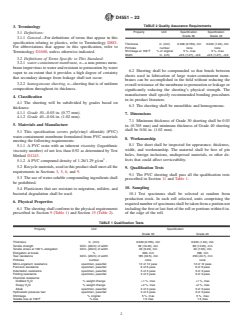
TABLE 2 Quality Assurance Requirements
3. Terminology
Property Unit Specification Specification
3.1 Definitions:
Grade 30 Grade 40
3.1.1 General—For definitions of terms that appear in this
specification relating to plastics, refer to Terminology D883.
Thickness in. (mm) 0.030 (0.765), min 0.040 (1.02), min
For abbreviations that appear in this specification, refer to
Pinholes number none none
Shrinkage at 158°F % of original 5 %, max 5 %, max
Terminology D1600, unless otherwise indicated.
Width in. (cm) +0.5 (1.27), −0.0 +0.5 (1.27), −0.0
3.2 Definitions of Terms Specific to This Standard:
3.2.1 water-containment membrane, n—anon-porousmem-
braneimpervioustowaterandresistanttopermeationbywater
6.2 Sheeting shall be compounded so that bonds between
vapor to an extent that it provides a high degree of certainty
sheets used in fabrication of large water-containment mem-
that secondary damage from leakage shall not occur.
branes can be accomplished in the field without reducing the
3.2.2 homogeneous sheeting, n—sheeting that is of uniform
overallresistanceofthemembranetopermeationorleakageor
composition throughout its thickness.
significantly reducing the sheeting’s physical strength. The
manufacturer shall specify recommended bonding procedures
4. Classification
in its product literature.
4.1 The sheeting will be subdivided by grades based on
6.3 The sheeting shall be monolithic and homogeneous.
thickness:
4.1.1 Grade 30—0.03 in. (0.77 mm).
7. Dimensions
4.1.2 Grade 40—0.04 in. (1.02 mm).
7.1 Minimum thickness of Grade 30 sheeting shall be 0.03
5. Materials and Manufacture in. (0.765 mm) and minimum thickness of Grade 40 sheeting
shall be 0.04 in. (1.02 mm).
5.1 This specification covers poly(vinyl chloride) (PVC)
water-containment membrane formulated from PVC materials
8. Workmanship
meeting the following requirements:
8.1 The sheet shall be inspected for appearance, thickness,
5.1.1 A PVC resin with an inherent viscosity (logarithmic
width, and workmanship. The material shall be free of pin
viscosity number) of not less than 0.92 as determined by Test
holes, foreign inclusions, undispersed materials, or other de-
Method D1243.
fects that could affect serviceability.
5.1.2 A PVC compound density of 1.26/1.29 g/cm .
5.2 Recyclematerials,usedinthisproductshallmeetallthe
9. Qualification Tests
requirements in Sections 3, 5, 6, and 9.
9.1 The PVC sheeting shall pass all the qualification tests
5.3 Theuseofwater-solublecompoundingingredientsshall
prescribed in Section 11 and Table 1.
be prohibited.
10. Sampling
5.4 Plasticizers that are resistant to migration, mildew, and
bacterial degradation shall be used. 10.1 Test specimens shall be selected at random from
production stock. In each roll selected, units comprising the
6. Physical Properties
requirednumberofspecimensshallbetakenfromaportionnot
6.1 Thesheetingshallconformtothephysicalrequirements includingthefirstorlastfootoftherollorportionswithin6in.
prescribed in Section 9 (Table 1) and Section 15 (Table 2). of the edge of the roll.
TABLE 1 Qualification Tests
Property Unit Specification
Grade 30 Grade 40
Thickness in. (mm) 0.030 (0.765), min 0.040 (1.02), min
Tensile strength lbf/in. (kN/m) of width 60 (10.45), min 80 (14.05), min
Tensile stress at 100 % elongation lbf/in. (kN/m) of width 30 (5.23), min 40 (7.03), min
Elongation at break % 300, min 300, min
Tear resistance lbf/in. (kN/m) of width 185 (32.5), min 250 (43.7), min
Pinholes number none none
Micro-organism resistance specimen, pass/fail 12 of 12 pass 12 of 12 pass
Puncture resistance specimen, pass/fail 6 of 6 pass 6 of 6 pass
Indentation resistance specimen, pass/fail 3 of 3 pass 3 of 3 pass
Folding resistance specimen, pass/fail 3 of 3 pass 3 of 3 pass
Chemical resistance
Distilled H O % weight change +1 %, max +1 %, max
Soapy H O % weight change +2 %, max +2 %, max
Alkali specimen, pass/fail 3 of 3 pass 3 of 3 pass
Hydrostatic pressure test specimen, pass/fail 3 of 3 pass 3 of 3 pass
Shrinkage % original 5 %, max 5 %, max
Volatile loss at 158°F % loss 1.5 max 1.5 max
D4551−22
11. Test Methods 11.7 Shrinkage—Testfor1hat158°F(70°C)inaccordance
with Test Method D1204.
11.1 Thickness—Test five specimens obtained from loca-
tions equidistant across the width of the sheet in accordance
11.8 Hydrostatic Pressure Test—Determine the ability of
with Method C of Test Methods D374/D374M. Report thick-
plasticmembranematerialtowithstandwaterpressurewithout
ness of each specimen and location in sheet.
leaking in accordance with the test procedure in Annex A5.
11.2 Stress-Strain Properties—Determine tensile stress at
11.9 Tear Resistance—Determine the average value for six
100% elongation (modulus), tensile strength, and ultimate
specimens in accordance with Test Method D1004.
elongation in accordance with Method A of Test Methods
11.10 Volatile Loss—Determine volatile loss in accordance
D412, using a dumbbell specimen (Die C). Report physical
with Test Methods D1203, MethodA. Test specimens shall be
properties as the average value from testing of 6 specimens.
nominal thickness sheeting.
11.3 Pinholes—Examine sheeting for pinholes by viewing
the surface of the sheeting while held under slight-hand
12. Conditioning
tension. Position a bright light source behind the film so as to
12.1 Condition all qualification test specimens at 73 6 4°F
clearly illuminate the surface without producing glare in the
(23 6 2°C) and 50 6 10% relative humidity for not less than
observer’s eyes.Apinhole is defined as any opening observed
40 h prior to testing, in accordance with MethodAof Methods
in the sheet under the conditions specified. Examine a 12-in.
D618.
(305-mm)stripfromtheentirewidthofthesheetandreportthe
presence or absence of pinholes.
12.2 In-plantqualitycontrolspecimensshallbeconditioned
at 73 6 4°F (23 6 2°C) for2hinair.
11.4 Resistance to Chemical Reagents—Conduct this test in
accordance with Test Method D543, Procedure 1.
13. Product Marking
11.4.1 Weigh loss after immersion in distilled water at
120°F (49°C) for 24 h.
13.1 Material complying with this specification shall be
11.4.2 Weigh loss after immersion in a 1% soapy water
continuously marked and shall include the following spaced
solution at 120°F (49°C) for 24 h.
out at intervals of not more than 2 ft (610 mm).
11.4.3 Alkali Resistance Test—This test indicates the effect
13.1.1 Manufacturer’s name (or brand name or trademark).
of hot alkali solutions on the plastic membrane materials.
13.1.2 Material designation.
11.4.3.1 Specimens—Each test unit shall consist of three
13.1.3 Designation, Grade 30 or Grade 40, with which the
specimensofflatmaterial3by3in.(76by76mm)selectedin
sheet complies.
accordance with 12.1.
13.1.4 Designation, “ASTM D4551”, with which the sheet
11.4.3.2 Procedure—Make a solution by dissolving 5.0 g of
complies.
reagent-grade sodium hydroxide and 5.0 g of reagent-grade
13.1.5 Theproductioncodeshallbeincludedinsidethecore
potassium hydroxide in 1 L of distilled water in a beaker. The
of all shipping units.
solution shall be maintained at a temperature of 150°F (66°C).
11.4.3.3 Immerse each specimen in its own individual
14. Packaging and Package Marking
beaker of solution in accordance with 11.4.3.2. Immerse the
14.1 The material shall be rolled on a substantial core and
specimen for 72 h, and completely change the solution every
packaged in standard commercial containers, so constructed as
24 h. Before immersion of a specimen in the new solution, the
to ensure acceptance by common or other carriers for safe
solution shall be at a temperature of 150°F (66°C).
11.4.3.4 Test each specimen for waterproofness in accor- transportation to the point of delivery.
dance with 11.8 for hydrostatic pressure test.
14.2 All packing, packaging, and marking provisions of
11.5 Microorganism Resistance Test—Determine the resis- Practice D3892 shall apply to this specification.
tance of PVC membrane to mold growth in accordance with
Annex A1.
15. Quality Assurance
11.6 Strength and Toughness Tests:
15.1 Sheeting manufactured from compound qualified by
11.6.1 Puncture Resistance Test—Determine the resistance
Section 9 shall pass the quality assurance and control require-
of the material to mechanical damage which might occur
ments prescribed in Table 2.
during the installation of the water-containment membrane in
15.2 If the results of any tests do not conform to the
accordance with the procedure described in Annex A2.
requirements of this specification, retesting to determine con-
11.6.2 Indentational Resistance Test—Determine the ability
formity shall be performed.
of the material to withstand nail-head indentation without
impairing waterproofness. Conduct the test in accordance with
16. Keywords
the procedure detailed in Annex A3.
16.1 flexible sheeting; fountains; planters; pools; poly(vinyl
11.6.3 FoldingResistanceTest—Determinetheabilityofthe
material to withstand corner folding without impairing water- chloride); PVC; recycle usage; shower and safe pans; tile tubs;
proofness in accordance with the procedure outlined in Annex water containment membrane; water leakage resistance; water
A4. permeation
D4551−22
SUPPLEMENTARY REQUIREMENTS
QUALITY ASSURANCE PROVISIONS FOR GOVERNMENT/MILITARY
PROCUREMENT
These requirements apply only Federal/Military procurement, not domestic sales or transfers.
S1. Selection of Acceptable Quality Level (AQL) and of
IL AQL
Defects in material and workmanship II 2.5
Inspection Level (IL) shall be made with consideration of the
Defects of preparation for delivery S-2 2.5
specific use requirements. This is discussed in Sections 7 and
Testing (products) S-1 1.5
8 of the above docume
...
This document is not an ASTM standard and is intended only to provide the user of an ASTM standard an indication of what changes have been made to the previous version. Because
it may not be technically possible to adequately depict all changes accurately, ASTM recommends that users consult prior editions as appropriate. In all cases only the current version
of the standard as published by ASTM is to be considered the official document.
Designation: D4551 − 17 D4551 − 22 An American National Standard
Standard Specification for
Poly(Vinyl Chloride) (PVC) Plastic Flexible Concealed Water-
Containment Membrane
This standard is issued under the fixed designation D4551; the number immediately following the designation indicates the year of
original adoption or, in the case of revision, the year of last revision. A number in parentheses indicates the year of last reapproval. A
superscript epsilon (´) indicates an editorial change since the last revision or reapproval.
1. Scope*
1.1 This specification covers poly(vinyl chloride) (PVC) flexible sheeting which is used without mastic, bedding, or coating for
construction of concealed water-containment-membranes in applications where there is potential for costly secondary damage from
water leakage and very long-term reliable performance is essential. Examples are fountains, pools, planters, shower and safe pans,
tile tubs, or similar wet installations where the membrane is inaccessible once the construction is complete. Included are
requirements for materials and sheeting, test methods, workmanship criteria, and methods of marking.
1.2 Recycled materials may be used in this product in accordance with the requirements in Section 5.
1.3 The tests are intended to ensure quality and performance and are not intended for design purposes. Tests have been selected
to be conducted primarily with liquids that simulate the environment to which the membrane will be subjected during actual use.
1.4 This specification does not cover water-containment membranes exposed to ultraviolet light.
1.5 The values stated in inch-pound units are to be regarded as the standard. The values given in parentheses are for information
only.
1.6 There is no known ISO equivalent to this standard.
1.7 The following precautionary caveat pertains only to the test method portion, Section 11, of this specification: This standard
does not purport to address all of the safety concerns, if any, associated with its use. It is the responsibility of the user of this
standard to establish appropriate safety, health, and environmental practices and determine the applicability of regulatory
limitations prior to use.
1.8 This international standard was developed in accordance with internationally recognized principles on standardization
established in the Decision on Principles for the Development of International Standards, Guides and Recommendations issued
by the World Trade Organization Technical Barriers to Trade (TBT) Committee.
2. Referenced Documents
2.1 ASTM Standards:
D374/D374M Test Methods for Thickness of Solid Electrical Insulation
This specification is under the jurisdiction of ASTM Committee D20 on Plastics and is the direct responsibility of Subcommittee D20.24 on Plastic Building Products.
Current edition approved Dec. 1, 2017Sept. 1, 2022. Published January 2018September 2022. Originally approved in 1986. Last previous edition approved in 20122017
as D4551 – 12.D4551 – 17. DOI: 10.1520/D4551-17.10.1520/D4551-22.
For referenced ASTM standards, visit the ASTM website, www.astm.org, or contact ASTM Customer Service at service@astm.org. For Annual Book of ASTM Standards
volume information, refer to the standard’s Document Summary page on the ASTM website.
*A Summary of Changes section appears at the end of this standard
Copyright © ASTM International, 100 Barr Harbor Drive, PO Box C700, West Conshohocken, PA 19428-2959. United States
D4551 − 22
D412 Test Methods for Vulcanized Rubber and Thermoplastic Elastomers—Tension
D543 Practices for Evaluating the Resistance of Plastics to Chemical Reagents
D618 Practice for Conditioning Plastics for Testing
D883 Terminology Relating to Plastics
D1004 Test Method for Tear Resistance (Graves Tear) of Plastic Film and Sheeting
D1203 Test Methods for Volatile Loss from Plastics Using Activated Carbon Methods
D1204 Test Method for Linear Dimensional Changes of Nonrigid Thermoplastic Sheeting or Film at Elevated Temperature
D1243 Test Method for Dilute Solution Viscosity of Vinyl Chloride Polymers
D1600 Terminology for Abbreviated Terms Relating to Plastics
D3892 Practice for Packaging/Packing of Plastics
E96/E96M Test Methods for Gravimetric Determination of Water Vapor Transmission Rate of Materials
2.2 ANSI Standard:
Z 26.1 Safety Code for Safety Glazing Materials for Glazing Motor Vehicles Operating on Land Highways
2.3 Military Standard:
MIL-STD-105 Sampling Procedures and Tables for Inspection by Attributes
3. Terminology
3.1 Definitions:
3.1.1 General—Definitions are in accordance with For definitions of terms that appear in this specification relating to plastics, refer
to Terminology D883. For abbreviations that appear in this specification, refer to Terminology D1600, unless otherwise indicated.
3.2 Definitions of Terms Specific to This Standard:
3.2.1 water-containment membrane—membrane, n—a non-porous membrane impervious to water and resistant to permeation by
water vapor to an extent that it provides a high degree of certainty that secondary damage from leakage shall not occur.
3.2.2 homogeneous sheeting—sheeting, n—sheeting that is of uniform composition throughout its thickness.
4. Classification
4.1 The sheeting will be subdivided by grades based on thickness:
4.1.1 Grade 30—0.03 in. (0.765(0.77 mm).
4.1.2 Grade 40—0.04 in. (1.02 mm).
5. Materials and Manufacture
5.1 This specification covers poly(vinyl chloride) (PVC) water-containment membrane formulated from PVC materials meeting
the following requirements:
5.1.1 A PVC resin with an inherent viscosity (logarithmic viscosity number) of not less than 0.92 as determined by Test Method
D1243.
5.1.2 A PVC compound density of 1.26/1.29 g/cm .
5.2 Recycle materials, used in this product shall meet all the requirements in Sections 3, 5, 6, and 9.
5.3 The use of water-soluble compounding ingredients shall be prohibited.
5.4 Plasticizers that are resistant to migration, mildew, and bacterial degradation shall be used.
Available from American National Standards Institute (ANSI), 25 W. 43rd St., 4th Floor, New York, NY 10036, http://www.ansi.org.
Available from Standardization Documents Order Desk, Bldg. 4 Section D, 700 Robbins Ave., Philadelphia, PA 19111-5094, Attn: NPODS.
D4551 − 22
6. Physical Properties
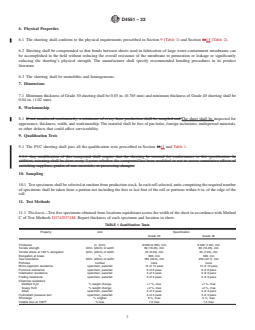
6.1 The sheeting shall conform to the physical requirements prescribed in Section 9 (Table 1) and Section 1615 (Table 2).
6.2 Sheeting shall be compounded so that bonds between sheets used in fabrication of large water-containment membranes can
be accomplished in the field without reducing the overall resistance of the membrane to permeation or leakage or significantly
reducing the sheeting’s physical strength. The manufacturer shall specify recommended bonding procedures in its product
literature.
6.3 The sheeting shall be monolithic and homogeneous.
7. Dimensions
7.1 Minimum thickness of Grade 30 sheeting shall be 0.03 in. (0.765 mm) and minimum thickness of Grade 40 sheeting shall be
0.04 in. (1.02 mm).
8. Workmanship
8.1 If not monitored continuously, a minimum of every hour production shall be sampled and The sheet shall be inspected for
appearance, thickness, width, and workmanship. The material shall be free of pin holes, foreign inclusions, undispersed materials,
or other defects that could affect serviceability.
9. Qualification Tests
9.1 The PVC sheeting shall pass all the qualification tests prescribed in Section 1111 and Table 1.
9.1.1 Any modification of this compound shall require that the sheeting be retested for conformance to this specification. In
addition, retesting shall be done every 3 years whether the compound has been modified or not to assess cumulative effects of
switching suppliers, grades of raw materials, or processing changes.
10. Sampling
10.1 Test specimens shall be selected at random from production stock. In each roll selected, units comprising the required number
of specimens shall be taken from a portion not including the first or last foot of the roll or portions within 6 in. of the edge of the
roll.
11. Test Methods
11.1 Thickness—Test five specimens obtained from locations equidistant across the width of the sheet in accordance with Method
C of Test Methods D374/D374M. Report thickness of each specimen and location in sheet.
TABLE 1 Qualification Tests
Property Unit Specification
Grade 30 Grade 40
Thickness in. (mm) 0.030 (0.765), min 0.040 (1.02), min
Tensile strength lbf/in. (kN/m) of width 60 (10.45), min 80 (14.05), min
Tensile stress at 100 % elongation lbf/in. (kN/m) of width 30 (5.23), min 40 (7.03), min
Elongation at break % 300, min 300, min
Tear resistance lbf/in. (kN/m) of width 185 (32.5), min 250 (43.7), min
Pinholes number none none
Micro-organism resistance specimen, pass/fail 12 of 12 pass 12 of 12 pass
Puncture resistance specimen, pass/fail 6 of 6 pass 6 of 6 pass
Indentation resistance specimen, pass/fail 3 of 3 pass 3 of 3 pass
Folding resistance specimen, pass/fail 3 of 3 pass 3 of 3 pass
Chemical resistance
Distilled H O % weight change +1 %, max +1 %, max
Soapy H O % weight change +2 %, max +2 %, max
Alkali specimen, pass/fail 3 of 3 pass 3 of 3 pass
Hydrostatic pressure test specimen, pass/fail 3 of 3 pass 3 of 3 pass
Shrinkage % original 5 %, max 5 %, max
Volatile loss at 158°F % loss 1.5 max 1.5 max
D4551 − 22
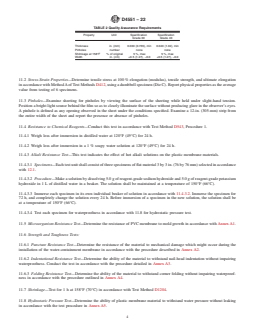
TABLE 2 Quality Assurance Requirements
Property Unit Specification Specification
Grade 30 Grade 40
Thickness in. (mm) 0.030 (0.765), min 0.040 (1.02), min
Pinholes number none none
Shrinkage at 158°F % of original 5 %, max 5 %, max
Width in. (cm) +0.5 (1.27), −0.0 +0.5 (1.27), −0.0
11.2 Stress-Strain Properties—Determine tensile stress at 100 % elongation (modulus), tensile strength, and ultimate elongation
in accordance with Method A of Test Methods D412, using a dumbbell specimen (Die C). Report physical properties as the average
value from testing of 6 specimens.
11.3 Pinholes—Examine sheeting for pinholes by viewing the surface of the sheeting while held under slight-hand tension.
Position a bright light source behind the film so as to clearly illuminate the surface without producing glare in the observer’s eyes.
A pinhole is defined as any opening observed in the sheet under the conditions specified. Examine a 12-in. (305-mm) strip from
the entire width of the sheet and report the presence or absence of pinholes.
11.4 Resistance to Chemical Reagents—Conduct this test in accordance with Test Method D543, Procedure 1.
11.4.1 Weigh loss after immersion in distilled water at 120°F (49°C) for 24 h.
11.4.2 Weigh loss after immersion in a 1 % soapy water solution at 120°F (49°C) for 24 h.
11.4.3 Alkali Resistance Test—This test indicates the effect of hot alkali solutions on the plastic membrane materials.
11.4.3.1 Specimens—Each test unit shall consist of three specimens of flat material 3 by 3 in. (76 by 76 mm) selected in accordance
with 12.1.
11.4.3.2 Procedure—Make a solution by dissolving 5.0 g of reagent-grade sodium hydroxide and 5.0 g of reagent-grade potassium
hydroxide in 1 L of distilled water in a beaker. The solution shall be maintained at a temperature of 150°F (66°C).
11.4.3.3 Immerse each specimen in its own individual beaker of solution in accordance with 11.4.3.2. Immerse the specimen for
72 h, and completely change the solution every 24 h. Before immersion of a specimen in the new solution, the solution shall be
at a temperature of 150°F (66°C).
11.4.3.4 Test each specimen for waterproofness in accordance with 11.8 for hydrostatic pressure test.
11.5 Microorganism Resistance Test—Determine the resistance of PVC membrane to mold growth in accordance with Annex A1.
11.6 Strength and Toughness Tests:
11.6.1 Puncture Resistance Test—Determine the resistance of the material to mechanical damage which might occur during the
installation of the water-containment membrane in accordance with the procedure described in Annex A2.
11.6.2 Indentational Resistance Test—Determine the ability of the material to withstand nail-head indentation without impairing
waterproofness. Conduct the test in accordance with the procedure detailed in Annex A3.
11.6.3 Folding Resistance Test—Determine the ability of the material to withstand corner folding without impairing waterproof-
ness in accordance with the procedure outlined in Annex A4.
11.7 Shrinkage—Test for 1 h at 158°F (70°C) in accordance with Test Method D1204.
11.8 Hydrostatic Pressure Test—Determine the ability of plastic membrane material to withstand water pressure without leaking
in accordance with the test procedure in Annex A5.
D4551 − 22
11.9 Tear Resistance—Determine the average value for six specimens in accordance with Test Method D1004.
11.10 Volatile Loss—Determine volatile loss in accordance with Test Methods D1203, Method A, at 158°F (70°C) with grade AC
(A. ⁄14 mesh) activated carbon. Test specimens shall be nominal thickness sheeting.
NOTE 1—Requirement for Water—Vapor Transmission of Materials in Sheet Form (Procedure E of Test Methods E96/E96M) has been deleted until the
test method is improved to the extent that it can be reproducibly run by commercial laboratories.
12. Conditioning
12.1 Condition all qualification test specimens at 73 6 4°F (23 6 2°C) and 50 6 10 % relative humidity for not less than 40 h
prior to testing, in accordance with Method A of Methods D618.
12.2 In-plant quality control specimens shall be conditioned at 73 6 4°F (23 6 2°C) for 2 h in air.
13. Certification
13.1 When specified in the purchase order or contract, the manufacturer’s or the supplier’s certification shall be furnished to the
purchaser stating that samples representing each lot have been manufactured, tested, and inspected in accordance with this
specification and the requirements have been met. When specified in the purchase order or contract, a report of the test results shall
be furnished.
13. Product Marking
13.1 Material complying with this specification shall be continuously marked and shall include the following spaced out at
intervals of not more than 2 ft (610 mm).
13.1.1 Manufacturer’s name (or brand name or trademark).
13.1.2 Material designation.
13.1.3 Designation, Grade 30 or Grade 40, with which the sheet complies.
13.1.4 Designation, “ASTM D4551”, with which the sheet complies.
13.1.5 The production code shall be included inside the core of all shipping units.
14. Packaging and Package Marking
14.1 The material shall be rolled on a substantial core and packaged in standard commercial containers, so constructed as to ensure
acceptance by common or other carriers for safe transportation to the point of delivery, unless otherwise specified in the contract
or order. delivery.
15.2 Shipping containers shall be marked as agreed upon between the purchaser and the seller.
15.3 Packaging provisions for government/military procurement.
14.2 All packing, packaging, and marking provisions of Practice D3892 shall apply to this specification.
15. Quality Assurance
15.1 Sheeting manufactured from compound qualified by Section 9 shall pass the quality assurance and control requirements
prescribed in Table 2.
16.1.1 In addition to the in-plant quality control inspections specified in Section 8, at least annually samples shall be tested and
certified as complying with the requirements of Table 2.
D4551 − 22
15.2 If the results of any tests do not conform to the requirements of this specification, retesting to determine conformity may be
performed as agreed upon between the purchaser and the seller. shall be performed.
16. Keywords
16.1 flexible sheeting; fountains; planters; pools; poly(vinyl chloride); PVC; recycle usage; shower and
...