

ASTM D2291/D2291M-22
(Practice)Standard Practice for Fabrication of Ring Test Specimens for Glass-Resin Composites
General Information
- Abstract
SIGNIFICANCE AND USE
4.1 This practice provides a uniform procedure for fabricating glass fiber/thermoset resin ring samples for use as test specimens. Specimens so prepared can be used in Test Methods D2290 and D2344/D2344M.
SCOPE
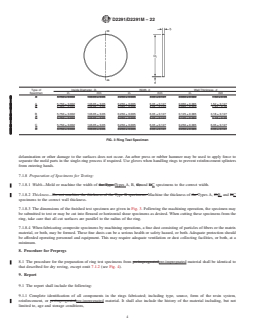
1.1 This practice is intended for use in the fabrication of ring-type test specimens to be used in the evaluation of the mechanical properties of reinforcement and resins in a composite structure. The practice outlines the steps in the preparation of the test specimens, including the final specimen machining where applicable. Three final ring configurations are included.
1.2 The values stated in either SI units or inch-pound units are to be regarded separately as standard. The values stated in each system may not be exact equivalents; therefore, each system shall be used independently of the other. Combining values from the two systems may result in nonconformance with the standard.
1.3 This standard does not purport to address all of the safety concerns, if any, associated with its use. It is the responsibility of the user of this standard to establish appropriate safety, health, and environmental practices and determine the applicability of regulatory limitations prior to use.
Note 1: There is no known ISO equivalent to this practice.
1.4 This international standard was developed in accordance with internationally recognized principles on standardization established in the Decision on Principles for the Development of International Standards, Guides and Recommendations issued by the World Trade Organization Technical Barriers to Trade (TBT) Committee.
- Status
- Published
- Publication Date
- 31-Oct-2022
- Technical Committee
- D20 - Plastics
- Drafting Committee
- D20.18 - Reinforced Thermosetting Plastics
Buy Documents

ASTM D2291/D2291M-22 - Standard Practice for Fabrication of Ring Test Specimens for Glass-Resin Composites
REDLINE ASTM D2291/D2291M-22 - Standard Practice for Fabrication of Ring Test Specimens for Glass-Resin Composites
Overview
ASTM D2291/D2291M-22: Standard Practice for Fabrication of Ring Test Specimens for Glass-Resin Composites provides a standardized procedure for preparing glass fiber/thermoset resin ring specimens for material testing. This ASTM standard is widely recognized for ensuring that glass-resin composite samples used for mechanical property evaluation are produced in a consistent, reliable manner. Consistent specimen fabrication is critical for accurate testing and comparability of results across laboratories and industries. The standard is under the jurisdiction of ASTM Committee D20 on Plastics and is internationally aligned with the World Trade Organization’s principles for standardization.
Key Topics
- Uniform Fabrication Procedures: The standard details methods for fabricating ring-type specimens from glass fiber and thermoset resin composites, including both the use of dry reinforcements and pre-impregnated (prepreg) materials.
- Specimen Configuration: Three final ring specimen configurations are described, ensuring compatibility with a variety of test methods and equipment.
- Equipment Guidelines: Recommendations for winding machines, tension measuring systems, molds or mandrels, and curing ovens ensure proper manufacturing of specimens.
- Conditioning and Storage: Proper storage and conditioning protocols are outlined for both glass fibers and resins to maintain material integrity before fabrication.
- Machining and Safety: Provides guidance on machining ring specimens to correct dimensions, and emphasizes the importance of health and safety measures when handling composite materials and fine dust.
- Reporting Requirements: Establishes comprehensive documentation practices for specimen identification, fabrication conditions, and relevant test details to support transparency and reproducibility.
Applications
ASTM D2291/D2291M-22 is essential for professionals in the composite materials industry, research institutions, and quality control laboratories that require standardized test specimens for evaluating:
- Mechanical Properties: This practice is used to fabricate samples for use in recognized mechanical testing methods, including hoop tensile strength (ASTM D2290) and shear strength (ASTM D2344/D2344M).
- Material Development: Researchers and manufacturers use these standardized specimens to compare different formulations of glass-resin composites efficiently.
- Quality Assurance: Ensures the reliability of test results for product certification, regulatory compliance, and quality control.
- Structural Evaluation: Useful in the aerospace, automotive, and construction industries where accurate assessment of composite reinforcement is critical.
Following the steps and requirements outlined in this standard helps ensure test specimens are reproducible, representative, and suitable for valid comparative testing.
Related Standards
Professionals utilizing ASTM D2291/D2291M-22 may also reference the following related ASTM standards:
- ASTM D2290: Test Method for Apparent Hoop Tensile Strength of Plastic or Reinforced Plastic Pipe
- ASTM D2344/D2344M: Test Method for Short-Beam Strength of Polymer Matrix Composite Materials and Their Laminates
- ASTM D618: Practice for Conditioning Plastics for Testing
- ASTM D883: Terminology Relating to Plastics
Currently, there is no ISO equivalent to ASTM D2291/D2291M-22.
Keywords: ASTM D2291, glass-resin composites, ring test specimens, specimen fabrication, mechanical testing, composite materials, hoop tensile testing, shear strength, prepreg composites, specimen preparation standard.
Relations
- Effective Date
- 01-Feb-2024
- Effective Date
- 01-Nov-2023
- Effective Date
- 01-Jan-2020
- Effective Date
- 01-Aug-2019
- Effective Date
- 01-Aug-2019
- Effective Date
- 15-Apr-2019
- Effective Date
- 01-Feb-2019
- Effective Date
- 01-Jan-2019
- Effective Date
- 01-Dec-2018
- Effective Date
- 01-Nov-2018
- Effective Date
- 15-Aug-2017
- Effective Date
- 01-Aug-2016
- Effective Date
- 01-Oct-2013
- Effective Date
- 15-Nov-2012
- Effective Date
- 15-May-2011
Buy Documents
ASTM D2291/D2291M-22 - Standard Practice for Fabrication of Ring Test Specimens for Glass-Resin Composites
REDLINE ASTM D2291/D2291M-22 - Standard Practice for Fabrication of Ring Test Specimens for Glass-Resin Composites
Get Certified
Connect with accredited certification bodies for this standard

DIN CERTCO
DIN Group product certification.

Smithers Quality Assessments
US management systems and product certification.
Sponsored listings
Frequently Asked Questions
ASTM D2291/D2291M-22 is a standard published by ASTM International. Its full title is "Standard Practice for Fabrication of Ring Test Specimens for Glass-Resin Composites". This standard covers: SIGNIFICANCE AND USE 4.1 This practice provides a uniform procedure for fabricating glass fiber/thermoset resin ring samples for use as test specimens. Specimens so prepared can be used in Test Methods D2290 and D2344/D2344M. SCOPE 1.1 This practice is intended for use in the fabrication of ring-type test specimens to be used in the evaluation of the mechanical properties of reinforcement and resins in a composite structure. The practice outlines the steps in the preparation of the test specimens, including the final specimen machining where applicable. Three final ring configurations are included. 1.2 The values stated in either SI units or inch-pound units are to be regarded separately as standard. The values stated in each system may not be exact equivalents; therefore, each system shall be used independently of the other. Combining values from the two systems may result in nonconformance with the standard. 1.3 This standard does not purport to address all of the safety concerns, if any, associated with its use. It is the responsibility of the user of this standard to establish appropriate safety, health, and environmental practices and determine the applicability of regulatory limitations prior to use. Note 1: There is no known ISO equivalent to this practice. 1.4 This international standard was developed in accordance with internationally recognized principles on standardization established in the Decision on Principles for the Development of International Standards, Guides and Recommendations issued by the World Trade Organization Technical Barriers to Trade (TBT) Committee.
SIGNIFICANCE AND USE 4.1 This practice provides a uniform procedure for fabricating glass fiber/thermoset resin ring samples for use as test specimens. Specimens so prepared can be used in Test Methods D2290 and D2344/D2344M. SCOPE 1.1 This practice is intended for use in the fabrication of ring-type test specimens to be used in the evaluation of the mechanical properties of reinforcement and resins in a composite structure. The practice outlines the steps in the preparation of the test specimens, including the final specimen machining where applicable. Three final ring configurations are included. 1.2 The values stated in either SI units or inch-pound units are to be regarded separately as standard. The values stated in each system may not be exact equivalents; therefore, each system shall be used independently of the other. Combining values from the two systems may result in nonconformance with the standard. 1.3 This standard does not purport to address all of the safety concerns, if any, associated with its use. It is the responsibility of the user of this standard to establish appropriate safety, health, and environmental practices and determine the applicability of regulatory limitations prior to use. Note 1: There is no known ISO equivalent to this practice. 1.4 This international standard was developed in accordance with internationally recognized principles on standardization established in the Decision on Principles for the Development of International Standards, Guides and Recommendations issued by the World Trade Organization Technical Barriers to Trade (TBT) Committee.
ASTM D2291/D2291M-22 is classified under the following ICS (International Classification for Standards) categories: 83.140.10 - Films and sheets. The ICS classification helps identify the subject area and facilitates finding related standards.
ASTM D2291/D2291M-22 has the following relationships with other standards: It is inter standard links to ASTM D883-24, ASTM D883-23, ASTM D883-20, ASTM D2290-19a, ASTM D883-19c, ASTM D883-19a, ASTM D883-19, ASTM D2290-19, ASTM D883-18a, ASTM D883-18, ASTM D883-17, ASTM D2290-16, ASTM D2344/D2344M-13, ASTM D883-12e1, ASTM D883-11. Understanding these relationships helps ensure you are using the most current and applicable version of the standard.
ASTM D2291/D2291M-22 is available in PDF format for immediate download after purchase. The document can be added to your cart and obtained through the secure checkout process. Digital delivery ensures instant access to the complete standard document.
Standards Content (Sample)
This international standard was developed in accordance with internationally recognized principles on standardization established in the Decision on Principles for the
Development of International Standards, Guides and Recommendations issued by the World Trade Organization Technical Barriers to Trade (TBT) Committee.
Designation: D2291/D2291M − 22
Standard Practice for
Fabrication of Ring Test Specimens for Glass-Resin
Composites
This standard is issued under the fixed designation D2291/D2291M; the number immediately following the designation indicates the
year of original adoption or, in the case of revision, the year of last revision. A number in parentheses indicates the year of last
reapproval. A superscript epsilon (´) indicates an editorial change since the last revision or reapproval.
This standard has been approved for use by agencies of the U.S. Department of Defense.
1. Scope* D883 Terminology Relating to Plastics
D2290 Test Method for Apparent Hoop Tensile Strength of
1.1 This practice is intended for use in the fabrication of
Plastic or Reinforced Plastic Pipe
ring-type test specimens to be used in the evaluation of the
D2344/D2344M Test Method for Short-Beam Strength of
mechanical properties of reinforcement and resins in a com-
PolymerMatrixCompositeMaterialsandTheirLaminates
posite structure. The practice outlines the steps in the prepara-
tion of the test specimens, including the final specimen
3. Terminology
machining where applicable. Three final ring configurations
3.1 For definitions of terms which apply to this practice, see
are included.
Terminology D883.
1.2 The values stated in either SI units or inch-pound units
are to be regarded separately as standard. The values stated in
4. Significance and Use
each system may not be exact equivalents; therefore, each
4.1 This practice provides a uniform procedure for fabricat-
system shall be used independently of the other. Combining
ing glass fiber/thermoset resin ring samples for use as test
values from the two systems may result in nonconformance
specimens.SpecimenssopreparedcanbeusedinTestMethods
with the standard.
D2290 and D2344/D2344M.
1.3 This standard does not purport to address all of the
safety concerns, if any, associated with its use. It is the
5. Apparatus
responsibility of the user of this standard to establish appro-
5.1 Winding Machine—The winding machine shall consist
priate safety, health, and environmental practices and deter-
of any adequate superstructure for mounting impregnated
mine the applicability of regulatory limitations prior to use.
reinforcement or components for application of resin to the
NOTE 1—There is no known ISO equivalent to this practice.
reinforcement, tensioning the reinforcement, and collecting the
1.4 This international standard was developed in accor-
wetted, tensioned material on a mold or mandrel of the desired
dance with internationally recognized principles on standard- size.
ization established in the Decision on Principles for the
5.2 Tension Measuring System—Any device suitable for
Development of International Standards, Guides and Recom-
measurement of the tension applied to the wetted reinforce-
mendations issued by the World Trade Organization Technical
ment. The use of a tension measuring system is optional for
Barriers to Trade (TBT) Committee.
measurement of the tension applied to the wetted reinforce-
ment.
2. Referenced Documents
5.3 The single-ring fabrication mold on which the wetted
2.1 ASTM Standards:
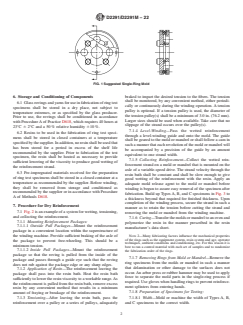
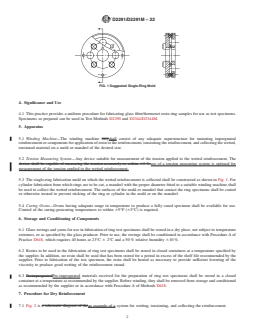
reinforcementiscollectedshallbeconstructedasshowninFig.
D618 Practice for Conditioning Plastics for Testing
1. For cylinder fabrication from which rings are to be cut, a
mandrel with the proper diameter fitted to a suitable winding
machine shall be used to collect the wetted reinforcement. The
This practice is under the jurisdiction ofASTM Committee D20 on Plastics and
surfacesofthemoldormandrelthatcontacttheringspecimens
is the direct responsibility of Subcommittee D20.18 on Reinforced Thermosetting
Plastics.
shall be coated or otherwise treated to prevent sticking of the
Current edition approved Nov. 1, 2022. Published November 2022. Originally
ring or cylinder in the mold or on the mandrel.
approved in 1964. Last previous edition approved in 2016 as D2291 - 16. DOI:
10.1520/D2291_D2291M-22.
5.4 Curing Ovens—Ovens having adequate range in tem-
For referenced ASTM standards, visit the ASTM website, www.astm.org, or
perature to produce a fully cured specimen shall be available
contact ASTM Customer Service at service@astm.org. For Annual Book of ASTM
for use. Control of the curing-postcuring temperatures to
Standards volume information, refer to the standard’s Document Summary page on
the ASTM website. within 69°F (65°C) is required.
*A Summary of Changes section appears at the end of this standard
Copyright © ASTM International, 100 Barr Harbor Drive, PO Box C700, West Conshohocken, PA 19428-2959. United States
D2291/D2291M − 22
FIG. 1 Suggested Single-Ring Mold
6. Storage and Conditioning of Components braked to impart the desired tension to the fibers. The tension
shall be monitored, by any convenient method, either periodi-
6.1 Glassrovingsandyarnsforuseinfabricationofringtest
cally or continuously during the winding operation. A tension
specimens shall be stored in a dry place, not subject to
pulley is optional. If a tension pulley is used, the diameter of
temperature extremes, or as specified by the glass producer.
the tension pulley(s) shall be a minimum of 3.0 in. (76.2 mm).
Prior to use, the rovings shall be conditioned in accordance
Larger sizes should be used when available. Take care that no
with ProcedureAof Practice D618, which requires 40 hours at
slippage of the strand occurs over the pulley(s).
23°C 6 2°C and a 50 % relative humidity 610 %.
7.1.4 Level-Winding—Pass the wetted reinforcement
6.2 Resins to be used in the fabrication of ring test speci-
through a level-winding guide and onto the mold. The guide
mens shall be stored in closed containers at a temperature
shall be geared to the mold or mandrel or shall follow a cam in
specifiedbythesupplier.Inaddition,noresinshallbeusedthat
such a manner that each revolution of the mold or mandrel will
has been stored for a period in excess of the shelf life
be accompanied by a precision of the guide by an amount
recommended by the supplier. Prior to fabrication of the test
equivalent to one strand width.
specimen, the resin shall be heated as necessary to provide
7.1.5 Collecting Reinforcement—Collect the wetted rein-
sufficient lowering of the viscosity to produce good wetting of
forcement strand on a mold or mandrel that is mounted on the
the reinforcement strand.
axle of a variable-speed drive. The strand velocity through the
6.3 Pre-impregnated materials received for the preparation
resin bath shall be constant and shall be slow enough to give
of ring test specimens shall be stored in a closed container at a
good wetting of the reinforcement with the resin. Apply an
temperature as recommended by the supplier. Before winding,
a
...
This document is not an ASTM standard and is intended only to provide the user of an ASTM standard an indication of what changes have been made to the previous version. Because
it may not be technically possible to adequately depict all changes accurately, ASTM recommends that users consult prior editions as appropriate. In all cases only the current version
of the standard as published by ASTM is to be considered the official document.
Designation: D2291/D2291M − 16 D2291/D2291M − 22
Standard Practice for
Fabrication of Ring Test Specimens for Glass-Resin
Composites
This standard is issued under the fixed designation D2291/D2291M; the number immediately following the designation indicates the
year of original adoption or, in the case of revision, the year of last revision. A number in parentheses indicates the year of last
reapproval. A superscript epsilon (´) indicates an editorial change since the last revision or reapproval.
This standard has been approved for use by agencies of the U.S. Department of Defense.
1. Scope*
1.1 This practice is intended for use in the fabrication of ring-type test specimens to be used in the evaluation of the mechanical
properties of reinforcement and resins in a composite structure. The practice outlines the steps in the preparation of the test
specimens, including the final specimen machining where applicable. FourThree final ring configurations are included.
1.2 The values stated in either SI units or inch-pound units are to be regarded separately as standard. The values stated in each
system may not be exact equivalents; therefore, each system shall be used independently of the other. Combining values from the
two systems may result in nonconformance with the standard.
1.3 This standard does not purport to address all of the safety concerns, if any, associated with its use. It is the responsibility
of the user of this standard to establish appropriate safety safety, health, and healthenvironmental practices and determine the
applicability of regulatory limitations prior to use.
NOTE 1—There is no known ISO equivalent to this practice.
1.4 This international standard was developed in accordance with internationally recognized principles on standardization
established in the Decision on Principles for the Development of International Standards, Guides and Recommendations issued
by the World Trade Organization Technical Barriers to Trade (TBT) Committee.
2. Referenced Documents
2.1 ASTM Standards:
D618 Practice for Conditioning Plastics for Testing
D883 Terminology Relating to Plastics
D2290 Test Method for Apparent Hoop Tensile Strength of Plastic or Reinforced Plastic Pipe
D2344/D2344M Test Method for Short-Beam Strength of Polymer Matrix Composite Materials and Their Laminates
3. Terminology
3.1 For definitions of terms which apply to this practice, see Terminology D883.
This practice is under the jurisdiction of ASTM Committee D20 on Plastics and is the direct responsibility of Subcommittee D20.18 on Reinforced Thermosetting Plastics.
Current edition approved Sept. 1, 2016Nov. 1, 2022. Published September 2016November 2022. Originally approved in 1964. Last previous edition approved in 20092016
as D2291 - 09.D2291 - 16. DOI: 10.1520/D2291_D2291M-16.10.1520/D2291_D2291M-22.
For referenced ASTM standards, visit the ASTM website, www.astm.org, or contact ASTM Customer Service at service@astm.org. For Annual Book of ASTM Standards
volume information, refer to the standard’s Document Summary page on the ASTM website.
*A Summary of Changes section appears at the end of this standard
Copyright © ASTM International, 100 Barr Harbor Drive, PO Box C700, West Conshohocken, PA 19428-2959. United States
D2291/D2291M − 22
FIG. 1 Suggested Single-Ring Mold
4. Significance and Use
4.1 This practice provides a uniform procedure for fabricating glass fiber/thermoset resin ring samples for use as test specimens.
Specimens so prepared can be used in Test Methods D2290 and D2344/D2344M.
5. Apparatus
5.1 Winding Machine—The winding machine mayshall consist of any adequate superstructure for mounting impregnated
reinforcement or components for application of resin to the reinforcement, tensioning the reinforcement, and collecting the wetted,
tensioned material on a mold or mandrel of the desired size.
5.2 Tension Measuring System—Any device suitable for measurement of the tension applied to the wetted reinforcement. The
device shall be capable of measuring the tension accurately to within 65 %.use of a tension measuring system is optional for
measurement of the tension applied to the wetted reinforcement.
5.3 The single-ring fabrication mold on which the wetted reinforcement is collected shall be constructed as shown in Fig. 1. For
cylinder fabrication from which rings are to be cut, a mandrel with the proper diameter fitted to a suitable winding machine shall
be used to collect the wetted reinforcement. The surfaces of the mold or mandrel that contact the ring specimens shall be coated
or otherwise treated to prevent sticking of the ring or cylinder in the mold or on the mandrel.
5.4 Curing Ovens—Ovens having adequate range in temperature to produce a fully cured specimen shall be available for use.
Control of the curing-postcuring temperatures to within 69°F (65°C) is required.
6. Storage and Conditioning of Components
6.1 Glass rovings and yarns for use in fabrication of ring test specimens shall be stored in a dry place, not subject to temperature
extremes, or as specified by the glass producer. Prior to use, the rovings shall be conditioned in accordance with Procedure A of
Practice D618, which requires 40 hours at 23°C 6 2°C and a 50 % relative humidity 610 %.
6.2 Resins to be used in the fabrication of ring test specimens shall be stored in closed containers at a temperature specified by
the supplier. In addition, no resin shall be used that has been stored for a period in excess of the shelf life recommended by the
supplier. Prior to fabrication of the test specimen, the resin shall be heated as necessary to provide sufficient lowering of the
viscosity to produce good wetting of the reinforcement strand.
6.3 PreimpregnatedPre-impregnated materials received for the preparation of ring test specimens shall be stored in a closed
container at a temperature as recommended by the supplier. Before winding, they shall be removed from storage and conditioned
as recommended by the supplier or in accordance with Procedure A of Methods D618.
7. Procedure for Dry Reinforcement
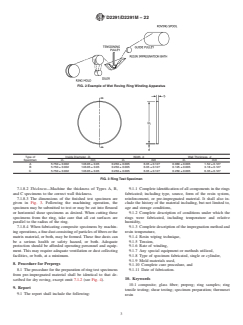
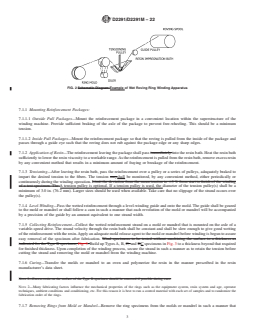
7.1 Fig. 2 is a schematic diagram of thean example of a system for wetting, tensioning, and collecting the reinforcement.
D2291/D2291M − 22
FIG. 2 Schematic Diagram Example of Wet Roving Ring Winding Apparatus
7.1.1 Mounting Reinforcement Packages:
7.1.1.1 Outside Pull Packages—Mount the reinforcement package in a convenient location within the superstructure of the
winding machine. Provide sufficient braking of the axle of the package to prevent free-wheeling. This should be a minimum
tension.
7.1.1.2 Inside Pull Packages—Mount the reinforcement package so that the roving is pulled from the inside of the package and
passes through a guide eye such that the roving does not rub against the package edge or any sharp edges.
7.1.2 Application of Resin—The reinforcement leaving the package shall pass immediately into the resin bath. Heat the resin bath
sufficiently to lower the resin viscosity to a workable range. As the reinforcement is pulled from the resin bath, remove excess resin
by any convenient method that results in a minimum amount of fraying or breakage of the reinforcement.
7.1.3 Tensioning—After leaving the resin bath, pass the rein
...