

ASTM D1922-23
(Test Method)Standard Test Method for Propagation Tear Resistance of Plastic Film and Thin Sheeting by Pendulum Method
General Information
- Abstract
SIGNIFICANCE AND USE
4.1 This test method is of value in ranking relative tearing resistance of various plastic films and thin sheeting of comparable thickness. Experience has shown the test to have its best reliability on relatively less extensible films and sheeting. Variable elongation and oblique tearing effects on the more extensible films preclude its use as a precise production-control tool for these types of plastics. This test method should be used for specification acceptance testing only after it has been demonstrated that the data for the particular material are acceptably reproducible. This test method should be used for service evaluation only after its usefulness for the particular application has been demonstrated with a number of different films.
4.2 This test method has been widely used as one index of the tearing resistance of plastic film and thin sheeting used in packaging applications. While it is not always be possible to correlate film tearing data with its other mechanical or toughness properties, the apparatus of this test method provides a controlled means for tearing specimens at straining rates approximating some of those found in actual packaging service.
4.3 Due to orientation during their manufacture, plastic films and sheeting frequently show marked anisotropy in their resistance to tearing. This is further complicated by the fact that some films elongate greatly during tearing, even at the relatively rapid rates of loading encountered in this test method. The degree of this elongation is dependent in turn on film orientation and the inherent mechanical properties of the polymer from which it is made. These factors make tear resistance of some films reproducible between sets of specimens to ±5 % of the mean value, while others potentially show no better reproducibility than ±50 %.
4.4 Data obtained by this test method may supplement that from Test Method D1004, wherein the specimen is strained at a rate of 50 mm (2 in.) per minute. However, spec...
SCOPE
1.1 This test method2 covers the determination of the average force to propagate tearing through a specified length of plastic film or nonrigid sheeting after the tear has been started, using an Elmendorf-type tearing tester. Two specimens are cited, a rectangular type, and one with a constant radius testing length. The latter shall be the preferred or referee specimen.
1.2 Because of (1) difficulties in selecting uniformly identical specimens, (2) the varying degree of orientation in some plastic films, and (3) the difficulty found in testing highly extensible or highly oriented materials, or both, the reproducibility of the test results may be variable and, in some cases, not good or misleading. Provisions are made in the test method to address oblique directional tearing which may be found with some materials.
1.3 The values stated in SI units are to be regarded as standard. The values given in parentheses are for information only.
1.4 This standard does not purport to address all of the safety concerns, if any, associated with its use. It is the responsibility of the user of this standard to establish appropriate safety, health, and environmental practices and determine the applicability of regulatory limitations prior to use. Specific precautionary statements are given in 13.1.
Note 1: Film has been arbitrarily defined as sheeting having nominal thickness not greater than 0.25 mm (0.010 in.).
Note 2: This standard is equivalent to ISO 6383-2.
1.5 This international standard was developed in accordance with internationally recognized principles on standardization established in the Decision on Principles for the Development of International Standards, Guides and Recommendations issued by the World Trade Organization Technical Barriers to Trade (TBT) Committee.
- Status
- Published
- Publication Date
- 30-Apr-2023
- Technical Committee
- D20 - Plastics
- Drafting Committee
- D20.19 - Film, Sheeting, and Molded Products
Buy Documents
ASTM D1922-23 - Standard Test Method for Propagation Tear Resistance of Plastic Film and Thin Sheeting by Pendulum Method
REDLINE ASTM D1922-23 - Standard Test Method for Propagation Tear Resistance of Plastic Film and Thin Sheeting by Pendulum Method
Overview
ASTM D1922-23 is the Standard Test Method for Propagation Tear Resistance of Plastic Film and Thin Sheeting by Pendulum Method, developed by ASTM International. This test method describes a widely accepted approach for determining the average force required to propagate a tear through a specified length of plastic film or nonrigid sheeting using an Elmendorf-type tearing tester. It is valuable for ranking the relative tearing resistance of various plastic films and thin sheeting materials of similar thickness.
This standard is particularly relevant to packaging applications, where understanding and controlling tear resistance is vital for product performance and safety. It should be noted that this method is most reliable for less extensible films, and its reproducibility can vary, especially with highly extensible or highly oriented materials.
Key Topics
Purpose and Value
- Establishes a quantitative method to compare the tear resistance of plastic films and thin sheeting.
- Supports quality control, material selection, and product development processes in industries utilizing plastic films.
Testing Procedure Highlights
- Specimens are prepared as either rectangular or, preferably, with a constant-radius testing length to address oblique tear issues.
- The film or sheeting is placed in a pendulum tester, where it is torn from a pre-cut slit. The loss of pendulum energy, measured by a scale or digital reading, correlates to the force needed to propagate the tear.
- Testing is conducted under controlled environmental conditions for consistency.
Specimen Orientation and Anisotropy
- Tests are conducted in both the machine direction and transverse direction due to typical anisotropy in plastic films.
- Oblique tears or variable elongation during tearing can affect data quality and reproducibility.
Limitations and Precautions
- Not suited for highly extensible plastics as a production control measure.
- Reproducibility can vary significantly, so demonstration of acceptable repeatability is recommended before specification or acceptance testing.
- Data are comparable only among specimens of similar thickness.
Applications
- Packaging Industry: The standard is widely used to evaluate tear resistance for films used in packaging, where tear propagation properties impact product integrity, shelf life, and consumer safety.
- Material Development: Supports research and development by providing a standardized method to assess new film materials and formulations.
- Quality Assurance: Enables manufacturers and buyers to specify and verify material performance according to recognized industry benchmarks.
- Comparative Assessment: Facilitates the selection of appropriate plastic films by providing comparative tear resistance data across different products and suppliers.
Companies producing, converting, or using plastic films in products such as bags, wraps, liners, and labels benefit from this standard. It also assists regulatory authorities and testing laboratories in ensuring compliance and supporting claims regarding material durability.
Related Standards
- ASTM D1004: Test Method for Tear Resistance (Graves Tear) of Plastic Film and Sheeting - useful for comparison and supplementary data.
- ASTM D618: Practice for Conditioning Plastics for Testing - specifies environmental conditioning of samples.
- ISO 6383-2: Plastics - Film and Sheeting - Determination of Tear Resistance - Part 2: Elmendorf Method - equivalent international method.
- ASTM D5947 & D6988: Test methods for physical dimensions and thickness measurement of plastic film specimens.
- ASTM D4000: Classification System for Specifying Plastic Materials.
Understanding and utilizing ASTM D1922-23 ensures consistency and reliability in assessing the tear properties of plastic films, supporting material selection, product safety, compliance, and innovation in industries worldwide. By following this standard, stakeholders can confidently determine and report material tear resistance, contributing to better product performance and user satisfaction.
Relations
- Effective Date
- 01-Mar-2024
- Effective Date
- 01-May-2013
- Effective Date
- 01-May-2012
- Effective Date
- 01-Nov-2011
- Effective Date
- 01-Apr-2011
- Effective Date
- 01-Jul-2010
- Effective Date
- 01-May-2010
- Effective Date
- 15-Sep-2009
- Refers
ASTM D1004-09 - Standard Test Method for Tear Resistance (Graves Tear) of Plastic Film and Sheeting - Effective Date
- 01-May-2009
- Effective Date
- 01-Jan-2009
- Effective Date
- 01-Jan-2009
- Effective Date
- 01-Nov-2008
- Effective Date
- 01-Nov-2008
- Refers
ASTM D1004-08 - Standard Test Method for Tear Resistance (Graves Tear) of Plastic Film and Sheeting - Effective Date
- 01-Nov-2008
- Effective Date
- 01-Oct-2008
Buy Documents
ASTM D1922-23 - Standard Test Method for Propagation Tear Resistance of Plastic Film and Thin Sheeting by Pendulum Method
REDLINE ASTM D1922-23 - Standard Test Method for Propagation Tear Resistance of Plastic Film and Thin Sheeting by Pendulum Method
Get Certified
Connect with accredited certification bodies for this standard

DIN CERTCO
DIN Group product certification.

Smithers Quality Assessments
US management systems and product certification.
Sponsored listings
Frequently Asked Questions
ASTM D1922-23 is a standard published by ASTM International. Its full title is "Standard Test Method for Propagation Tear Resistance of Plastic Film and Thin Sheeting by Pendulum Method". This standard covers: SIGNIFICANCE AND USE 4.1 This test method is of value in ranking relative tearing resistance of various plastic films and thin sheeting of comparable thickness. Experience has shown the test to have its best reliability on relatively less extensible films and sheeting. Variable elongation and oblique tearing effects on the more extensible films preclude its use as a precise production-control tool for these types of plastics. This test method should be used for specification acceptance testing only after it has been demonstrated that the data for the particular material are acceptably reproducible. This test method should be used for service evaluation only after its usefulness for the particular application has been demonstrated with a number of different films. 4.2 This test method has been widely used as one index of the tearing resistance of plastic film and thin sheeting used in packaging applications. While it is not always be possible to correlate film tearing data with its other mechanical or toughness properties, the apparatus of this test method provides a controlled means for tearing specimens at straining rates approximating some of those found in actual packaging service. 4.3 Due to orientation during their manufacture, plastic films and sheeting frequently show marked anisotropy in their resistance to tearing. This is further complicated by the fact that some films elongate greatly during tearing, even at the relatively rapid rates of loading encountered in this test method. The degree of this elongation is dependent in turn on film orientation and the inherent mechanical properties of the polymer from which it is made. These factors make tear resistance of some films reproducible between sets of specimens to ±5 % of the mean value, while others potentially show no better reproducibility than ±50 %. 4.4 Data obtained by this test method may supplement that from Test Method D1004, wherein the specimen is strained at a rate of 50 mm (2 in.) per minute. However, spec... SCOPE 1.1 This test method2 covers the determination of the average force to propagate tearing through a specified length of plastic film or nonrigid sheeting after the tear has been started, using an Elmendorf-type tearing tester. Two specimens are cited, a rectangular type, and one with a constant radius testing length. The latter shall be the preferred or referee specimen. 1.2 Because of (1) difficulties in selecting uniformly identical specimens, (2) the varying degree of orientation in some plastic films, and (3) the difficulty found in testing highly extensible or highly oriented materials, or both, the reproducibility of the test results may be variable and, in some cases, not good or misleading. Provisions are made in the test method to address oblique directional tearing which may be found with some materials. 1.3 The values stated in SI units are to be regarded as standard. The values given in parentheses are for information only. 1.4 This standard does not purport to address all of the safety concerns, if any, associated with its use. It is the responsibility of the user of this standard to establish appropriate safety, health, and environmental practices and determine the applicability of regulatory limitations prior to use. Specific precautionary statements are given in 13.1. Note 1: Film has been arbitrarily defined as sheeting having nominal thickness not greater than 0.25 mm (0.010 in.). Note 2: This standard is equivalent to ISO 6383-2. 1.5 This international standard was developed in accordance with internationally recognized principles on standardization established in the Decision on Principles for the Development of International Standards, Guides and Recommendations issued by the World Trade Organization Technical Barriers to Trade (TBT) Committee.
SIGNIFICANCE AND USE 4.1 This test method is of value in ranking relative tearing resistance of various plastic films and thin sheeting of comparable thickness. Experience has shown the test to have its best reliability on relatively less extensible films and sheeting. Variable elongation and oblique tearing effects on the more extensible films preclude its use as a precise production-control tool for these types of plastics. This test method should be used for specification acceptance testing only after it has been demonstrated that the data for the particular material are acceptably reproducible. This test method should be used for service evaluation only after its usefulness for the particular application has been demonstrated with a number of different films. 4.2 This test method has been widely used as one index of the tearing resistance of plastic film and thin sheeting used in packaging applications. While it is not always be possible to correlate film tearing data with its other mechanical or toughness properties, the apparatus of this test method provides a controlled means for tearing specimens at straining rates approximating some of those found in actual packaging service. 4.3 Due to orientation during their manufacture, plastic films and sheeting frequently show marked anisotropy in their resistance to tearing. This is further complicated by the fact that some films elongate greatly during tearing, even at the relatively rapid rates of loading encountered in this test method. The degree of this elongation is dependent in turn on film orientation and the inherent mechanical properties of the polymer from which it is made. These factors make tear resistance of some films reproducible between sets of specimens to ±5 % of the mean value, while others potentially show no better reproducibility than ±50 %. 4.4 Data obtained by this test method may supplement that from Test Method D1004, wherein the specimen is strained at a rate of 50 mm (2 in.) per minute. However, spec... SCOPE 1.1 This test method2 covers the determination of the average force to propagate tearing through a specified length of plastic film or nonrigid sheeting after the tear has been started, using an Elmendorf-type tearing tester. Two specimens are cited, a rectangular type, and one with a constant radius testing length. The latter shall be the preferred or referee specimen. 1.2 Because of (1) difficulties in selecting uniformly identical specimens, (2) the varying degree of orientation in some plastic films, and (3) the difficulty found in testing highly extensible or highly oriented materials, or both, the reproducibility of the test results may be variable and, in some cases, not good or misleading. Provisions are made in the test method to address oblique directional tearing which may be found with some materials. 1.3 The values stated in SI units are to be regarded as standard. The values given in parentheses are for information only. 1.4 This standard does not purport to address all of the safety concerns, if any, associated with its use. It is the responsibility of the user of this standard to establish appropriate safety, health, and environmental practices and determine the applicability of regulatory limitations prior to use. Specific precautionary statements are given in 13.1. Note 1: Film has been arbitrarily defined as sheeting having nominal thickness not greater than 0.25 mm (0.010 in.). Note 2: This standard is equivalent to ISO 6383-2. 1.5 This international standard was developed in accordance with internationally recognized principles on standardization established in the Decision on Principles for the Development of International Standards, Guides and Recommendations issued by the World Trade Organization Technical Barriers to Trade (TBT) Committee.
ASTM D1922-23 is classified under the following ICS (International Classification for Standards) categories: 83.140.10 - Films and sheets. The ICS classification helps identify the subject area and facilitates finding related standards.
ASTM D1922-23 has the following relationships with other standards: It is inter standard links to ASTM D689-17(2024), ASTM E691-13, ASTM D4000-12, ASTM E691-11, ASTM D4000-11, ASTM D4000-10a, ASTM D4000-10, ASTM D4000-09b, ASTM D1004-09, ASTM D4000-09, ASTM D4000-09a, ASTM D6988-08, ASTM D618-08, ASTM D1004-08, ASTM E691-08. Understanding these relationships helps ensure you are using the most current and applicable version of the standard.
ASTM D1922-23 is available in PDF format for immediate download after purchase. The document can be added to your cart and obtained through the secure checkout process. Digital delivery ensures instant access to the complete standard document.
Standards Content (Sample)
This international standard was developed in accordance with internationally recognized principles on standardization established in the Decision on Principles for the
Development of International Standards, Guides and Recommendations issued by the World Trade Organization Technical Barriers to Trade (TBT) Committee.
Designation: D1922 − 23
Standard Test Method for
Propagation Tear Resistance of Plastic Film and Thin
Sheeting by Pendulum Method
This standard is issued under the fixed designation D1922; the number immediately following the designation indicates the year of
original adoption or, in the case of revision, the year of last revision. A number in parentheses indicates the year of last reapproval. A
superscript epsilon (´) indicates an editorial change since the last revision or reapproval.
This standard has been approved for use by agencies of the U.S. Department of Defense.
NOTE 1—Film has been arbitrarily defined as sheeting having nominal
1. Scope*
thickness not greater than 0.25 mm (0.010 in.).
1.1 This test method covers the determination of the
NOTE 2—This standard is equivalent to ISO 6383-2.
average force to propagate tearing through a specified length of
1.5 This international standard was developed in accor-
plastic film or nonrigid sheeting after the tear has been started,
dance with internationally recognized principles on standard-
using an Elmendorf-type tearing tester. Two specimens are
ization established in the Decision on Principles for the
cited, a rectangular type, and one with a constant radius testing
Development of International Standards, Guides and Recom-
length. The latter shall be the preferred or referee specimen.
mendations issued by the World Trade Organization Technical
1.2 Because of (1) difficulties in selecting uniformly iden-
Barriers to Trade (TBT) Committee.
tical specimens, (2) the varying degree of orientation in some
2. Referenced Documents
plastic films, and (3) the difficulty found in testing highly
extensible or highly oriented materials, or both, the reproduc-
2.1 ASTM Standards:
ibility of the test results may be variable and, in some cases, not
D618 Practice for Conditioning Plastics for Testing
good or misleading. Provisions are made in the test method to
D689 Test Method for Internal Tearing Resistance of Paper
address oblique directional tearing which may be found with
D1004 Test Method for Tear Resistance (Graves Tear) of
some materials.
Plastic Film and Sheeting
D4000 Classification System for Specifying Plastic Materi-
1.3 The values stated in SI units are to be regarded as
als
standard. The values given in parentheses are for information
D5947 Test Methods for Physical Dimensions of Solid
only.
Plastics Specimens
1.4 This standard does not purport to address all of the
D6988 Guide for Determination of Thickness of Plastic Film
safety concerns, if any, associated with its use. It is the
Test Specimens
responsibility of the user of this standard to establish appro-
E691 Practice for Conducting an Interlaboratory Study to
priate safety, health, and environmental practices and deter-
Determine the Precision of a Test Method
mine the applicability of regulatory limitations prior to use.
2.2 ISO Standard:
Specific precautionary statements are given in 13.1.
ISO 6383-2 Plastics—Film and Sheeting—Determination of
Tear Resistance—Part 2 Elmendorf Method
This test method is under the jurisdiction of ASTM Committee D20 on Plastics
3. Summary of Test Method
and is the direct responsibility of Subcommittee D20.19 on Film, Sheeting, and
Molded Products.
3.1 The force in grams required to propagate tearing across
Current edition approved May 1, 2023. Published May 2023. Originally
a film or sheeting specimen is measured using a precisely
approved in 1961. Last previous edition approved in 2020 as D1922 - 15(2020).
calibrated pendulum device. Acting by gravity, the pendulum
DOI: 10.1520/D1922-23.
This test method has been adapted from TAPPI Standard Method T 414M-49,
swings through an arc, tearing the specimen from a precut slit.
Internal Tearing Resistance of Paper. In testing certain plastic films, problems of
The specimen is held on one side by the pendulum and on the
reproducibility and interpretation of results are encountered which require special
other side by a stationary member. The loss in energy by the
treatment to make the test method of most value. This test method is revised here
specifically for use with plastic film and thin sheeting. For more complete
explanation of certain aspects of the equipment, its calibration and adjustment, refer
to TAPPI Standard Method T 414M-49. For referenced ASTM standards, visit the ASTM website, www.astm.org, or
The following additional references may be of interest in connection with this contact ASTM Customer Service at service@astm.org. For Annual Book of ASTM
test method: Standards volume information, refer to the standard’s Document Summary page on
Painter, E. V., Chu, C. C., and Morgan, H. M., “Testing Textiles on the Elmendorf the ASTM website.
Tear Tester,” Textile Research Journal, Vol XX, No. 6, June 1950, pp. 410–417. Available from American National Standards Institute (ANSI), 25 W. 43rd St.,
Elmendorf, A., “Strength Test for Paper,” Paper, Vol 26, April 21, 1920, p. 302. 4th Floor, New York, NY 10036, http://www.ansi.org.
*A Summary of Changes section appears at the end of this standard
Copyright © ASTM International, 100 Barr Harbor Drive, PO Box C700, West Conshohocken, PA 19428-2959. United States
D1922 − 23
pendulum is indicated by a pointer. The scale indication is a 5. Apparatus
function of the force required to tear the specimen. 5
5.1 Pendulum Impulse-Type Testing Apparatus, consisting
of the following:
4. Significance and Use
5.1.1 Stationary Clamp.
4.1 This test method is of value in ranking relative tearing
5.1.2 Movable Clamp, carried on a pendulum, preferably
resistance of various plastic films and thin sheeting of compa-
formed by a sector of a wheel or circle, free to swing on a ball
rable thickness. Experience has shown the test to have its best
bearing or other substantially frictionless bearing.
reliability on relatively less extensible films and sheeting.
5.1.3 Stop Catch, for holding the pendulum in a raised
Variable elongation and oblique tearing effects on the more
position and for releasing it instantaneously.
extensible films preclude its use as a precise production-control
5.1.4 Indicating Device, for registering the maximum arc
tool for these types of plastics. This test method should be used
through which the pendulum swings when released. The
for specification acceptance testing only after it has been
pendulum shall carry a circumferential scale, graduated from 0
demonstrated that the data for the particular material are
to 100 % of the machine capacity so as to read against the
acceptably reproducible. This test method should be used for
pointer the average force required to tear a specimen 43 mm
service evaluation only after its usefulness for the particular
(1.7 in.). The option to replace the pointer and scale by an
application has been demonstrated with a number of different
electronic digital readout is available. Digital readouts are
films.
available which will give test results directly in millinewtons,
directly in grams-force, or in percent of pendulum capacity.
4.2 This test method has been widely used as one index of
With the pendulum in its initial position ready for test, separate
the tearing resistance of plastic film and thin sheeting used in
the two clamps by an interval of 2.54 mm (0.10 in.). So align
packaging applications. While it is not always be possible to
them that the specimen clamped in them lies in a plane
correlate film tearing data with its other mechanical or tough-
perpendicular to the plane of oscillation of the pendulum with
ness properties, the apparatus of this test method provides a
the edges of the jaws gripping the specimen in a horizontal
controlled means for tearing specimens at straining rates
line, a perpendicular to which through the axis of suspension of
approximating some of those found in actual packaging ser-
the pendulum is 102.7 6 0.05 mm (4.044 6 0.002 in.) in
vice.
length and makes an angle of 27.5° with the plane of the film
4.3 Due to orientation during their manufacture, plastic
specimen. The clamping surface in each jaw shall be at least
films and sheeting frequently show marked anisotropy in their
25.4 mm (1 in.) in width and at least 12.7 mm (0.5 in.) in depth.
resistance to tearing. This is further complicated by the fact that
5.1.5 Capacity—Instruments of several capacities, 1960,
some films elongate greatly during tearing, even at the rela-
3920, 7840, 15 600, 31 360, 62 720 mN (200, 400, 800, 1600,
tively rapid rates of loading encountered in this test method.
3200, 6400 gf), and perhaps others are available. These
The degree of this elongation is dependent in turn on film
capacities are achieved by individual instruments, interchange-
orientation and the inherent mechanical properties of the
able pendulum sectors, or augmenting weights.
polymer from which it is made. These factors make tear
5,6
5.2 Template, Die, or Shear-Type Cutter , for cutting
resistance of some films reproducible between sets of speci-
specimens.
mens to 65 % of the mean value, while others potentially show
no better reproducibility than 650 %.
5.3 Razor Blades, single-edged, for cutting specimens
where a template is used.
4.4 Data obtained by this test method may supplement that
from Test Method D1004, wherein the specimen is strained at
5.4 Thickness-Measuring Device—Micrometer, or other
a rate of 50 mm (2 in.) per minute. However, specimen
suitable thickness gauge for measuring the thickness of test
geometry and testing speed of the two test methods are
specimens in accordance with Test Methods D5947 or Guide
dissimilar. The rate of tearing in this test method, while varying
D6988 as appropriate.
as a function of resistance to tear, is in the range from 7.6 to 46
m (300 to 1800 in.)/min.
6. Test Specimens
4.5 There is not a direct, linear relationship between tearing
6.1 Test specimens shall be cut using a die or template, as
force and specimen thickness. Data from this test method are
shown in Fig. 1, to form a constant-radius testing length. This
expressed as tearing force in millinewtons (or grams-force, if
shall be the preferred or referee specimen type since its
desired), with specimen thickness also reported. But sets of
geometry is intended to compensate to some degree for the
data from specimens of dissimilar thickness are usually not
problem of oblique tearing (Note 3 and Note 4). Alternatively,
comparable. Therefore, only data at the same thickness is
specimens shall be cut to form a rectangle 76 mm (3 in.) or
compared.
4.6 For many materials, there may be a specification that
The sole source of supply of the apparatus known to the committee at this time
requires the use of this test method, but with some procedural
is Thwing-Albert Instrument Co., Philadelphia, PA 19144. If you are aware of
modifications that take precedence when adhering to the
alternative suppliers, please provide this information to ASTM International
Headquarters. Your comments will receive careful consideration at a meeting of the
specification. Therefore, it is advisable to refer to that material
responsible technical committee, which you may attend.
specification before using this test method. Table 1 of Classi-
The TA63 Sample Cutter, Catalog No. 98, available from the Thwing-Albert
fication System D4000 lists the ASTM materials standards that
Instrument Co., Philadelphia, PA 19144, has been found satisfactory for cutting
currently exist. specimens.
D1922 − 23
noted in 6.1 for rectangular specimens and shall not vary more
than 0.5 % from these dimensions.
7. Adjustment of Apparatus
7.1 Pendulum Friction:
7.1.1 Older Instruments—To check the pendulum swing for
freedom from excess friction, level the apparatus and draw a
pencil line on the base or stop mechanism 25.4 mm (1 in.) to
the right of the edge of the sector stop. With the sector raised
to its initial position and the pointer set against its stop, on
releasing the sector and holding the stop down, the sector shall
make at least 20 complete oscillations before the edge of the
sector that engages with the stop no longer passes to the left of
the pencil line. Otherwise, oil and adjust the bearing.
7.1.2 Newer Instruments—In recent years, a new type of
frictionless bearing made of synthetic material has been used.
This bearing will not necessarily allow the pendulum sector to
make 20 complete oscillations as the older one did. This does
not mean that there is excess friction in the pendulum swing.
Die or Template Tolerances = 60.050 mm (0.002 in.)
Consult the instructions supplied with the instrument for
guidance before lubricating the bearings.
FIG. 1 Die or Template for Constant-Radius Test Specimen
7.2 Pointer Friction—Check the pointer friction as follows:
Set the pointer at zero reading on the scale before releasing the
more in width by 63 mm (2.5 in.) in length and plainly marked
sector, and after release see that the pointer is not pushed more
to denote intended direction of tear. The 63-mm specimen
than three scale divisions beyond zero. A reading of more than
dimension shall be the direction of tear. Two sets of specimens
three divisions indicates excessive pointer friction and the
shall be cut from each sample so that their sides are parallel to
pointer needs to be removed, the bearing wiped clean, and a
(1) the machine direction and (2) the transverse direction,
trace of oil or petroleum jelly applied. When the pointer
respectively, of the material being tested. Enough specimens
friction has been reduced, finally adjust the pointer stop.
shall be cut in each direction to provide a minimum of ten tear
7.3 Pointer Zero Reading—To check the pointer for its zero
strength determinations.
point, level the apparatus so that, with the sector free, the line
NOTE 3—Specimens having constant-radius testing lengths are de-
on the sector indicating the vertical point of suspension
signed to correct for oblique directional tearing encountered in certain
coincides with a corresponding point on the base of the
anisotropic, elastomeric films, and nonrigid sheeting. For purposes of
specimen selection, oblique tearing is defined as tearing in a curved or apparatus, usually placed on the stop mechanism. After
straight line that deviates more than 9.5 mm ( ⁄8 in.) from the vertical line
leveling, operate the apparatus several times with nothing in
of intended tear.
the jaws, the movable jaw being closed, to ascertain whether
NOTE 4—Certain film and sheeting specimens showing oblique tearing
the pointer registers zero with no load. If zero is not registered,
may yield data of poor reproducibility because the axis of maximum
adjust the position of the pointer stop by means of the pointer
orientation varies as much as 30° from the nominal machine direction.
When this is suspected, the sample may be examined by crossed Polaroid stop thumb screw until a zero reading is obtained.
plates to determine this direction of maximum orientation and the
8. Verification of Scale
specimens cut along the axis of anisotropy for testing parallel and normal
to it.
8.1 The scale is verified either by the procedure described in
6.2 Where a metal template is used, the film or sheeting
Test Method D689 and repeated here, or by the method which
shall be placed on a hard surface. The template shall be held
uses the Elmendorf check weights obtainable from the manu-
over it and the specimens cut out using a single-edged razor
facturer. The method in Test Method D689 is relatively
blade.
time-consuming and complicated. The check weight method is
relatively simple.
6.3 When the specimen is cut out, a slit 20 mm (0.8 in.) deep
is to be made at the center of the edge perpendicular to the
8.2 Test Method D689 Procedure:
direction to be tested. This leaves exactly 43 mm (1.7 in.) of
8.2.1 To verify the scale, first mark the center of gravity of
tearing length between the end of the slit and the opposite edge
the weight (including means of attaching) by a punched dot on
of the specimen. Alternatively, cut this slit into the specimen
the face of the weight. Then clamp a known weight in grams,
after it has been placed in the testing apparatus.
W, to the radial edge of the sector beneath the jaws.
8.2.2 Raise and set the sector as for tearing a specimen and,
NOTE 5—The pendulum apparatus may be fitted with a sharp-loaded
by means of a suitable scale, measure the height in centimetres,
knife to make this slit in the specimen after it has been clamped in the
apparatus. The action of the knife must be such as to make a clean slit
h, of the center of gravity of the weight above the surface upon
exactly 20 mm (0.8 in.) into the specimen from the edge.
which the apparatus rests. Then release the sector, allow it to
6.4 The test specimens shall conform to the dimensions in swing, and note the pointe
...
This document is not an ASTM standard and is intended only to provide the user of an ASTM standard an indication of what changes have been made to the previous version. Because
it may not be technically possible to adequately depict all changes accurately, ASTM recommends that users consult prior editions as appropriate. In all cases only the current version
of the standard as published by ASTM is to be considered the official document.
Designation: D1922 − 15 (Reapproved 2020) D1922 − 23
Standard Test Method for
Propagation Tear Resistance of Plastic Film and Thin
Sheeting by Pendulum Method
This standard is issued under the fixed designation D1922; the number immediately following the designation indicates the year of
original adoption or, in the case of revision, the year of last revision. A number in parentheses indicates the year of last reapproval. A
superscript epsilon (´) indicates an editorial change since the last revision or reapproval.
This standard has been approved for use by agencies of the U.S. Department of Defense.
1. Scope Scope*
1.1 This test method covers the determination of the average force to propagate tearing through a specified length of plastic film
or nonrigid sheeting after the tear has been started, using an Elmendorf-type tearing tester. Two specimens are cited, a rectangular
type, and one with a constant radius testing length. The latter shall be the preferred or referee specimen.
1.2 Because of (1) difficulties in selecting uniformly identical specimens, (2) the varying degree of orientation in some plastic
films, and (3) the difficulty found in testing highly extensible or highly oriented materials, or both, the reproducibility of the test
results may be variable and, in some cases, not good or misleading. Provisions are made in the test method to address oblique
directional tearing which may be found with some materials.
1.3 The values stated in SI units are to be regarded as standard. The values given in parentheses are for information only.
1.4 This standard does not purport to address all of the safety concerns, if any, associated with its use. It is the responsibility
of the user of this standard to establish appropriate safety, health, and environmental practices and determine the applicability of
regulatory limitations prior to use. Specific precautionary statements are given in 13.1.
NOTE 1—Film has been arbitrarily defined as sheeting having nominal thickness not greater than 0.25 mm (0.010 in.).
NOTE 2—This standard is equivalent to ISO 6383-2.
1.5 This international standard was developed in accordance with internationally recognized principles on standardization
established in the Decision on Principles for the Development of International Standards, Guides and Recommendations issued
by the World Trade Organization Technical Barriers to Trade (TBT) Committee.
This test method is under the jurisdiction of ASTM Committee D20 on Plastics and is the direct responsibility of Subcommittee D20.19 on Film, Sheeting, and Molded
Products.
Current edition approved April 1, 2020May 1, 2023. Published April 2020May 2023. Originally approved in 1961. Last previous edition approved in 20152020 as
D1922 - 15.D1922 - 15(2020). DOI: 10.1520/D1922-15R20.10.1520/D1922-23.
This test method has been adapted from TAPPI Standard Method T 414M-49, Internal Tearing Resistance of Paper. In testing certain plastic films, problems of
reproducibility and interpretation of results are encountered which require special treatment to make the test method of most value. This test method is revised here specifically
for use with plastic film and thin sheeting. For more complete explanation of certain aspects of the equipment, its calibration and adjustment, refer to TAPPI Standard Method
T 414M-49.
The following additional references may be of interest in connection with this test method:
Painter, E. V., Chu, C. C., and Morgan, H. M., “Testing Textiles on the Elmendorf Tear Tester,” Textile Research Journal, Vol XX, No. 6, June 1950, pp. 410–417.
Elmendorf, A., “Strength Test for Paper,” Paper, Vol 26, April 21, 1920, p. 302.
*A Summary of Changes section appears at the end of this standard
Copyright © ASTM International, 100 Barr Harbor Drive, PO Box C700, West Conshohocken, PA 19428-2959. United States
D1922 − 23
2. Referenced Documents
2.1 ASTM Standards:
D618 Practice for Conditioning Plastics for Testing
D689 Test Method for Internal Tearing Resistance of Paper
D1004 Test Method for Tear Resistance (Graves Tear) of Plastic Film and Sheeting
D4000 Classification System for Specifying Plastic Materials
D5947 Test Methods for Physical Dimensions of Solid Plastics Specimens
D6988 Guide for Determination of Thickness of Plastic Film Test Specimens
E691 Practice for Conducting an Interlaboratory Study to Determine the Precision of a Test Method
2.2 ISO Standard:
ISO 6383-2 Plastics—Film and Sheeting—Determination of Tear Resistance—Part 2 Elmendorf Method
3. Summary of Test Method
3.1 The force in grams required to propagate tearing across a film or sheeting specimen is measured using a precisely calibrated
pendulum device. Acting by gravity, the pendulum swings through an arc, tearing the specimen from a precut slit. The specimen
is held on one side by the pendulum and on the other side by a stationary member. The loss in energy by the pendulum is indicated
by a pointer. The scale indication is a function of the force required to tear the specimen.
4. Significance and Use
4.1 This test method is of value in ranking relative tearing resistance of various plastic films and thin sheeting of comparable
thickness. Experience has shown the test to have its best reliability on relatively less extensible films and sheeting. Variable
elongation and oblique tearing effects on the more extensible films preclude its use as a precise production-control tool for these
types of plastics. This test method should be used for specification acceptance testing only after it has been demonstrated that the
data for the particular material are acceptably reproducible. This test method should be used for service evaluation only after its
usefulness for the particular application has been demonstrated with a number of different films.
4.2 This test method has been widely used as one index of the tearing resistance of plastic film and thin sheeting used in packaging
applications. While it is not always be possible to correlate film tearing data with its other mechanical or toughness properties, the
apparatus of this test method provides a controlled means for tearing specimens at straining rates approximating some of those
found in actual packaging service.
4.3 Due to orientation during their manufacture, plastic films and sheeting frequently show marked anisotropy in their resistance
to tearing. This is further complicated by the fact that some films elongate greatly during tearing, even at the relatively rapid rates
of loading encountered in this test method. The degree of this elongation is dependent in turn on film orientation and the inherent
mechanical properties of the polymer from which it is made. These factors make tear resistance of some films reproducible between
sets of specimens to 65 % of the mean value, while others potentially show no better reproducibility than 650 %.
4.4 Data obtained by this test method may supplement that from Test Method D1004, wherein the specimen is strained at a rate
of 50 mm (2 in.) per minute. However, specimen geometry and testing speed of the two test methods are dissimilar. The rate of
tearing in this test method, while varying as a function of resistance to tear, is in the range from 7.6 to 46 m (300 to 1800 in.)/min.
4.5 There is not a direct, linear relationship between tearing force and specimen thickness. Data from this test method are
expressed as tearing force in millinewtons (or grams-force, if desired), with specimen thickness also reported. But sets of data from
specimens of dissimilar thickness are usually not comparable. Therefore, only data at the same thickness is compared.
4.6 For many materials, there may be a specification that requires the use of this test method, but with some procedural
modifications that take precedence when adhering to the specification. Therefore, it is advisable to refer to that material
specification before using this test method. Table 1 of Classification System D4000 lists the ASTM materials standards that
currently exist.
For referenced ASTM standards, visit the ASTM website, www.astm.org, or contact ASTM Customer Service at service@astm.org. For Annual Book of ASTM Standards
volume information, refer to the standard’s Document Summary page on the ASTM website.
Available from American National Standards Institute (ANSI), 25 W. 43rd St., 4th Floor, New York, NY 10036, http://www.ansi.org.
D1922 − 23
5. Apparatus
5.1 Pendulum Impulse-Type Testing Apparatus, consisting of the following:
5.1.1 Stationary Clamp.
5.1.2 Movable Clamp, carried on a pendulum, preferably formed by a sector of a wheel or circle, free to swing on a ball bearing
or other substantially frictionless bearing.
5.1.3 Stop Catch, for holding the pendulum in a raised position and for releasing it instantaneously.
5.1.4 Indicating Device, for registering the maximum arc through which the pendulum swings when released. The pendulum shall
carry a circumferential scale, graduated from 0 to 100 % of the machine capacity so as to read against the pointer the average force
required to tear a specimen 43 mm (1.7 in.). The option to replace the pointer and scale by an electronic digital readout is available.
Digital readouts are available which will give test results directly in millinewtons, directly in grams-force, or in percent of
pendulum capacity. With the pendulum in its initial position ready for test, separate the two clamps by an interval of 2.54 mm (0.10
in.). So align them that the specimen clamped in them lies in a plane perpendicular to the plane of oscillation of the pendulum with
the edges of the jaws gripping the specimen in a horizontal line, a perpendicular to which through the axis of suspension of the
pendulum is 102.7 6 0.05 mm (4.044 6 0.002 in.) in length and makes an angle of 27.5° with the plane of the film specimen.
The clamping surface in each jaw shall be at least 25.4 mm (1 in.) in width and at least 12.7 mm (0.5 in.) in depth.
5.1.5 Capacity—Instruments of several capacities, 1960, 3920, 7840, 15 600, 31 360, 62 720 mN (200, 400, 800, 1600, 3200, 6400
gf), and perhaps others are available. These capacities are achieved by individual instruments, interchangeable pendulum sectors,
or augmenting weights.
5,6
5.2 Template, Die, or Shear-Type Cutter , for cutting specimens.
5.3 Razor Blades, single-edged, for cutting specimens where a template is used.
5.4 Thickness-Measuring Device—Micrometer, or other suitable thickness gauge for measuring the thickness of test specimens in
accordance with Test Methods D5947 or Guide D6988 as appropriate.
6. Test Specimens
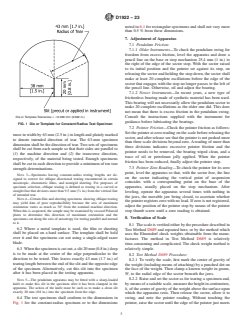
6.1 Test specimens shall be cut using a die or template, as shown in Fig. 1, to form a constant-radius testing length. This shall be
the preferred or referee specimen type since its geometry is intended to compensate to some degree for the problem of oblique
tearing (Note 3 and Note 4). Alternatively, specimens shall be cut to form a rectangle 76 mm (3 in.) or more in width by 63 mm
(2.5 in.) in length and plainly marked to denote intended direction of tear. The 63-mm specimen dimension shall be the direction
of tear. Two sets of specimens shall be cut from each sample so that their sides are parallel to (1) the machine direction and (2)
the transverse direction, respectively, of the material being tested. Enough specimens shall be cut in each direction to provide a
minimum of ten tear strength determinations.
NOTE 3—Specimens having constant-radius testing lengths are designed to correct for oblique directional tearing encountered in certain anisotropic,
elastomeric films, and nonrigid sheeting. For purposes of specimen selection, oblique tearing is defined as tearing in a curved or straight line that deviates
more than 9.5 mm ( ⁄8 in.) from the vertical line of intended tear.
NOTE 4—Certain film and sheeting specimens showing oblique tearing may yield data of poor reproducibility because the axis of maximum orientation
varies as much as 30° from the nominal machine direction. When this is suspected, the sample may be examined by crossed Polaroid plates to determine
this direction of maximum orientation and the specimens cut along the axis of anisotropy for testing parallel and normal to it.
6.2 Where a metal template is used, the film or sheeting shall be placed on a hard surface. The template shall be held over it and
the specimens cut out using a single-edged razor blade.
The sole source of supply of the apparatus known to the committee at this time is Thwing-Albert Instrument Co., Philadelphia, PA 19144. If you are aware of alternative
suppliers, please provide this information to ASTM International Headquarters. Your comments will receive careful consideration at a meeting of the responsible technical
committee, which you may attend.
The TA63 Sample Cutter, Catalog No. 98, available from the Thwing-Albert Instrument Co., Philadelphia, PA 19144, has been found satisfactory for cutting specimens.
D1922 − 23
Tolerance Die or Template Tolerances = 60.050 mm (0.002 in.)
FIG. 1 Die or Template for Constant-Radius Test Specimen
6.3 When the specimen is cut out, a slit 20 mm (0.8 in.) deep is to be made at the center of the edge perpendicular to the direction
to be tested. This leaves exactly 43 mm (1.7 in.) of tearing length between the end of the slit and the opposite edge of the specimen.
Alternatively, cut this slit into the specimen after it has been placed in the testing apparatus.
NOTE 5—The pendulum apparatus may be fitted with a sharp-loaded knife to make this slit in the specimen after it has been clamped in the apparatus.
The action of the knife must be such as to make a clean slit exactly 20 mm (0.8 in.) into the specimen from the edge.
6.4 The test specimens shall conform to the dimensions in Fig. 1 for the constant-radius specimen or to the dimensions noted in
6.1 for rectangular specimens and shall not vary more than 0.5 % from these dimensions.
7. Adjustment of Apparatus
7.1 Pendulum Friction:
7.1.1 Older Instruments—To check the pendulum swing for freedom from excess friction, level the apparatus and draw a pencil
line on the base or stop mechanism 25.4 mm (1 in.) to the right of the edge of the sector stop. With the sector raised to its initial
position and the pointer set against its stop, on releasing the sector and holding the stop down, the sector shall make at least 20
complete oscillations before the edge of the sector that engages with the stop no longer passes to the left of the pencil line.
Otherwise, oil and adjust the bearing.
7.1.2 Newer Instruments—In recent years, a new type of frictionless bearing made of synthetic material has been used. This
bearing will not necessarily allow the pendulum sector to make 20 complete oscillations as the older one did. This does not mean
that there is excess friction in the pendulum swing. Consult the instructions supplied with the instrument for guidance before
lubricating the bearings.
7.2 Pointer Friction—Check the pointer friction as follows: Set the pointer at zero reading on the scale before releasing the sector,
and after release see that the pointer is not pushed more than three scale divisions beyond zero. A reading of more than three
divisions indicates excessive pointer friction and the pointer needs to be removed, the bearing wiped clean, and a trace of oil or
petroleum jelly applied. When the pointer friction has been reduced, finally adjust the pointer stop.
7.3 Pointer Zero Reading—To check the pointer for its zero point, level the apparatus so that, with the sector free, the line on the
sector indicating the vertical point of suspension coincides with a corresponding point on the base of the apparatus, usually placed
on the stop mechanism. After leveling, operate the apparatus several times with nothing in the jaws, the movable jaw being closed,
D1922 − 23
to ascertain whether the pointer registers zero with no load. If zero is not registered, adjust the position of the pointer stop by means
of the pointer stop thumb screw until a zero reading is obtained.
8. Verification of Scale
8.1 The scale is verified either by the procedure described in Test Method D689 and repeated here, or by the method which uses
the Elmendorf check weights obtainable from the manufacturer. The method in Test Method D689 is relatively time-consuming
and complicated. The check weight method is relatively simple.
8.2 Test Method D689 Procedure:
8.2.1 To verify the scale, first mark the center of gravity of the weight (including means of attaching) by a punched dot on the
face of the weight. Then clamp a known weight in grams, W, to the radial edge of the sector beneath the jaws.
8.2.2 Raise and set the sector as for tearing a specimen and,
...